What is multilingual AEO? Customers now ask ChatGPT, Gemini, Perplexity, and Google's AI Overviews questions in their own language, and the answer tends to be built from sources in that language. Multilingual AEO (answer engine optimization) is the work of making every language version of your site separate, complete, and consistent, so AI assistants can read it and name you no matter which language the question comes in. Translating the navigation is not enough; there has to be a real page to read. This guide covers the steps, how Welda measures the work, and where it stops.
Why multilingual AEO is its own job
Plenty of US businesses serve customers in more than one language. A heating and cooling company in Phoenix takes calls in English and Spanish. A family dental practice in Houston has front-desk staff who switch languages all day. A boutique hotel in San Francisco hosts guests from Asia and Europe. A manufacturer in the Midwest sells to buyers in Mexico and Canada. Most of these businesses have a language switcher somewhere on their site, usually a small "ES" link in the header.
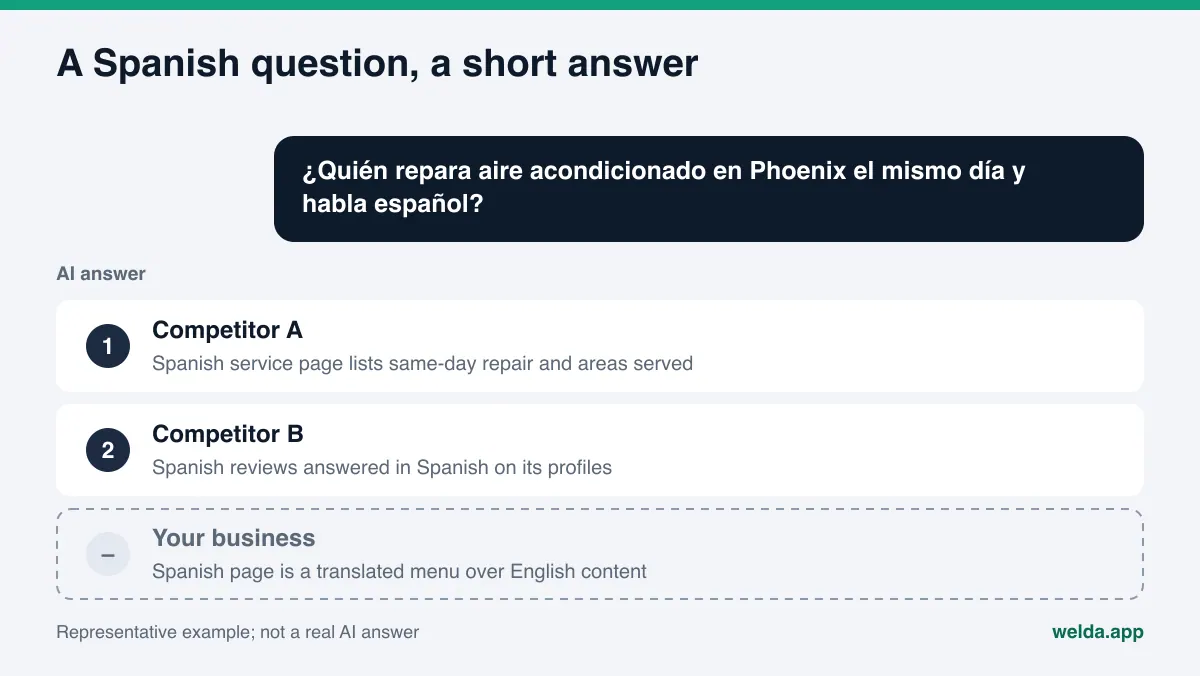
Here is the problem. When someone asks an AI assistant a question in Spanish, the answer is more likely to lean on content that exists in Spanish. If your Spanish version is a translated menu sitting on top of English copy, the assistant has very little it can quote or use as a reason to recommend you. Your English pages may be excellent and still not help much when the question is "¿quién repara aire acondicionado el mismo día?"
The second problem is consistency. The English page shows your new phone number; the Spanish page still has the old one. The English page says you offer weekend service; the Spanish page never mentions it. AI systems read these versions separately. When the facts disagree, they may skip both or repeat the wrong one. A multilingual site simply has more places to get things wrong.
The third problem is technical. Many sites switch languages with a cookie, a browser setting, or the visitor's location. That is convenient for people, but if the same URL shows different languages to different visitors, there is no telling which version a crawler sees. Google's own guidance recommends separate URLs for each language version, warns against relying on cookies or browser settings to change the content language, and says not to adapt content based on IP analysis. Since AI search tools largely depend on pages they can fetch from the web, the same principle is a sensible starting point for AEO.
If you want to see where your site stands today, run the free AI visibility analysis. It reads your home page and a few inner pages the way Google and AI systems do, lists gaps in titles, descriptions, business information, and FAQs, and explains how to fix each one. The analysis works in English, so you can run it on your English site and read the report in English.
Which businesses need multilingual AEO?
Not every business needs a second language. A neighborhood barber whose clients all speak English gains nothing from a Spanish page nobody maintains. Multilingual AEO is real work for these groups:
- Local services in bilingual markets: Home services, auto repair, legal and tax help, and clinics in cities where a large share of customers prefer Spanish or another language. These customers often ask an assistant on their phone, in their language, when something breaks.
- Hospitality and travel: Hotels, tour operators, and restaurants in destinations with international visitors. Travelers plan trips in their own language long before they land.
- Healthcare practices: Dental, medical, and therapy practices that serve patients in more than one language. Health content needs extra care in every language, and claims should be reviewed by the practice.
- Exporters and B2B suppliers: Companies whose buyers research vendors abroad. How those buyers search is covered in how B2B buyers use AI to find vendors.
- Multi-location brands: Brands with locations in different metro areas where language mix varies by location. Consistency gets harder with every location, which is why AEO for franchises deals with it separately.
If you fit one of these groups, your second language is not decoration. It is one of the main ways a customer who prefers that language finds you. If you do not, strengthening your visibility in one language comes first.
What AI systems look at on a multilingual site
Nobody outside the AI companies knows exactly how each engine chooses sources, and the engines do not publish the details. What you can know is which information is readable and which is not. On a multilingual site, these are the points that make an AI system's job easier or harder.
A readable URL. When your Spanish version lives at a stable address like /es/, that page can be linked, fetched by a crawler, and cited in an answer. When the language changes only through a button and the URL stays the same, a crawler will most likely see only the default language. If the switch happens in JavaScript, extra care is needed; JavaScript rendering and AI crawlers walks through why.
The language of the visible text. Google states plainly that it determines a page's language from the visible content and does not use the lang attribute for that purpose. So a Spanish page with lang="es" in the code but English body copy is still, in practice, an English page. Google also notes that translating only the boilerplate (menus, footer, buttons) while leaving the main content in one language creates a poor experience.
Links between versions. hreflang annotations tell search engines which pages are language alternates of each other. According to Google's documentation on localized versions, each version must list itself and every other version, and if two pages do not point to each other, the annotations are ignored. An x-default value can name a fallback page for visitors whose language does not match. There is no public statement on how AI engines use hreflang. But several engines draw on search indexes, so getting the mapping right in search is an indirect benefit.
The same business facts in every language. Your name, address, phone number, and hours should be identical in every version. Business schema markup should appear on each language version and carry the same core facts. Service descriptions change by language; your phone number does not.
Sources in that language. AI systems do not stop at your site. In Spanish, the sources an assistant leans on may be different review sites, local media, and community forums than in English. Your Google Business Profile, Yelp, Angi, BBB, Tripadvisor, or Healthgrades listings all carry reviews, and reviews written in Spanish are content in Spanish. Which directories matter and why is covered in business directories for AI visibility.
Multilingual AEO step by step
The steps below work in the same order for a home services company, a clinic, or an exporter. Rather than finishing each step for every language at once, start with the second language that brings you the most customers.
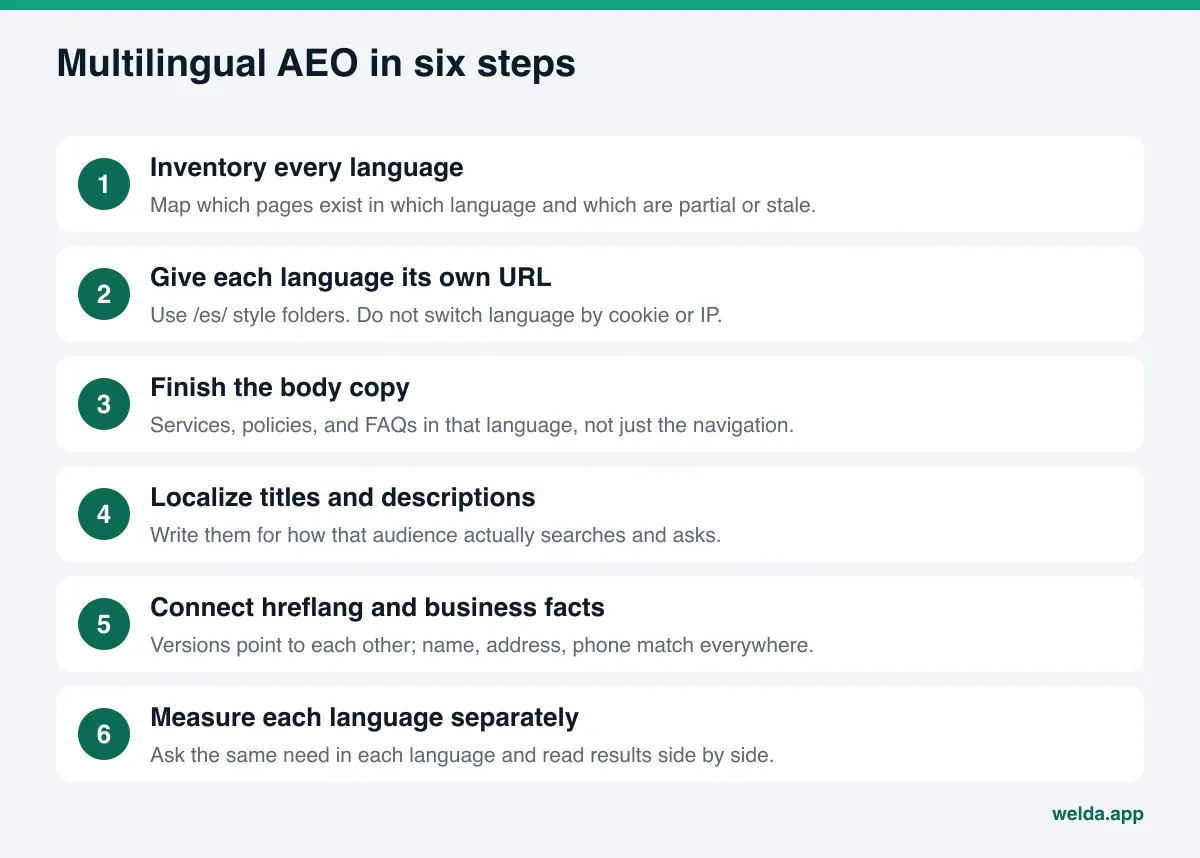
- Inventory every language. Build a simple spreadsheet with your pages as rows and your languages as columns. Mark each cell "complete," "partial," "missing," or "stale." Most businesses discover that the second language is far thinner than they assumed: a translated home page, half the service pages missing, no FAQ at all.
- Give each language its own stable URL. Subfolders such as
/es/are the most common and the easiest to maintain. Do not auto-redirect visitors based on location; Google notes this can keep both users and search engines from seeing all your versions. Keep a visible language switcher instead. - Check robots.txt with your language folders in mind. Some sites carry a leftover rule from development that blocks
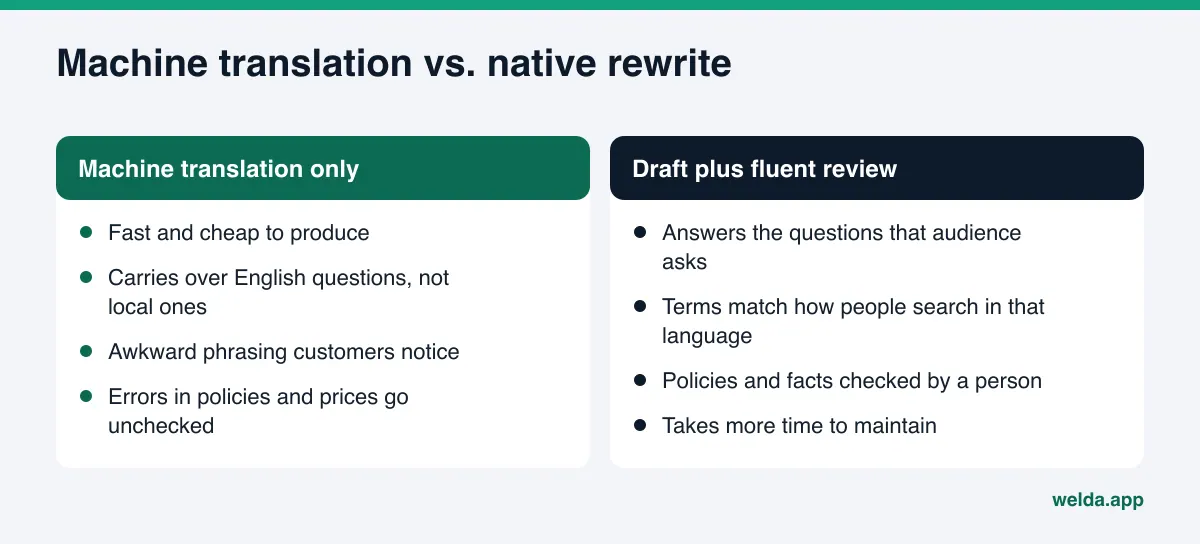
/es/or blocks AI crawlers entirely. Confirm that every language folder is open. - Finish the body copy. Services, service areas, how you work, cancellation and refund policies, directions: each one complete in that language. Starting from a machine translation is fine, but someone fluent should read and correct it, especially anything involving prices, policies, or health information.
- Write questions for the audience, do not just translate them. The questions a Spanish-speaking homeowner asks are not always the English questions in Spanish. They may want to know whether the technician speaks Spanish, whether you offer financing, or whether you serve their part of town. Build each language's FAQ from real calls, emails, and reviews in that language.
- Write title tags and meta descriptions per language. An English title left on a Spanish page is one of the most common mistakes. Each language deserves its own title and description, written the way that audience searches.
- Connect hreflang and business facts. Every page should point to itself and to each language alternate. Add business schema on every language version with identical name, address, and phone.
- Bring your profiles in line. Reply to reviews in the language they were written in, calmly and specifically. Make sure profile descriptions match what the site says.
- Measure each language separately. Ask the same need in English and in Spanish and read the results apart. Showing up in one language and not the other is the most common pattern on multilingual sites.
The most common mistakes in language versions
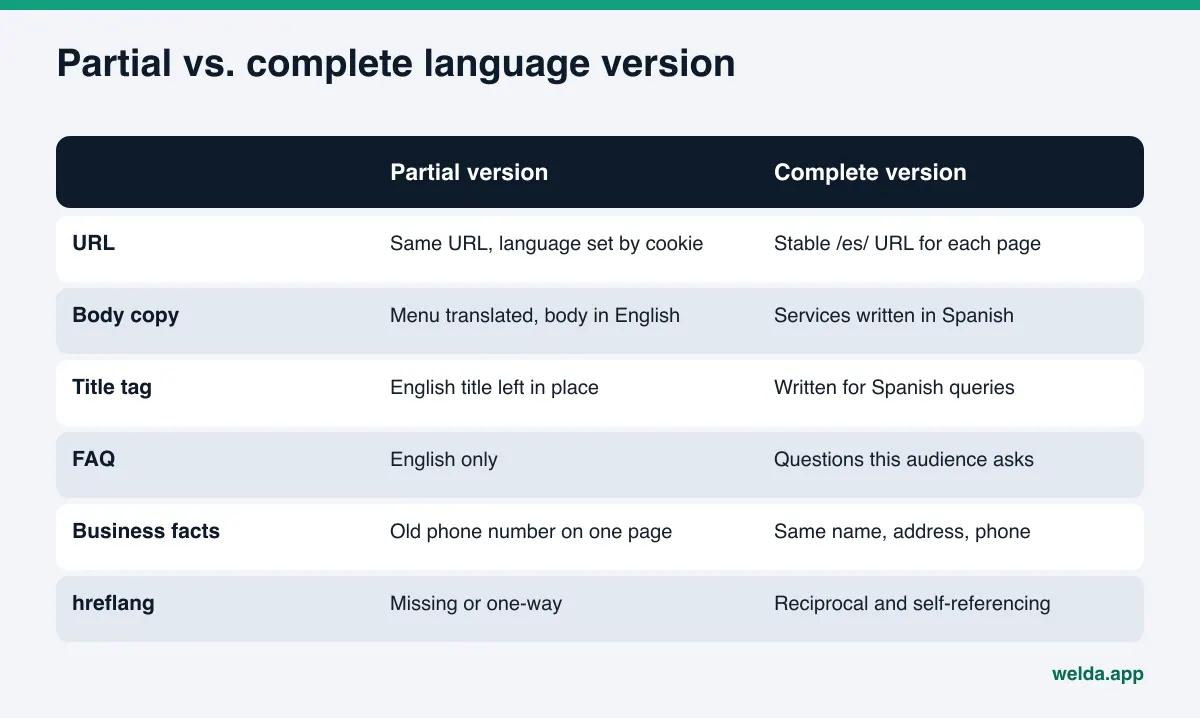
The same mistakes come up again and again. This table sums up what each one means for an AI system and how to fix it.
| Mistake | What it means for AI search | Fix |
|---|---|---|
| Language set by cookie or browser setting | Crawlers likely see only the default language | Give each language a stable URL |
| Only navigation and buttons translated | Page looks Spanish, reads English | Write the body copy in that language |
| English title tag on the Spanish page | Wrong language in results and summaries | Separate title and description per language |
| Phone or address differs by language | No way to tell which fact is current | One source of truth, copied exactly |
| FAQ in English only | Spanish questions have no answer on your site | A separate FAQ from that audience's questions |
| One-way or missing hreflang | Search engines cannot pair the versions | Reciprocal, self-referencing hreflang |
| An old, forgotten language version | Outdated prices and policies get repeated | Finish it or take it down |
The last row is easy to miss. A French or Chinese version built years ago and never touched again can lead an AI system to repeat outdated information. If you cannot maintain a language version, removing it is safer than leaving it half done.
How Welda handles multilingual AEO
Welda is software that measures where a business shows up in AI answers and helps close the gaps on its behalf. Three parts of it matter for a multilingual site: the free analysis, measurement with a selectable question language, and the to-do list with approvals.
The free analysis as a baseline. The analysis reads the home page at the address you enter, plus a few inner pages such as services, pricing, about, and contact. It checks whether AI crawlers can access the site, the title tag and meta description, the main heading, business schema, address and phone details, the FAQ section, and how clearly your services are described. You get a score out of 100, a fix for each gap, and ready-to-use copy suggestions for the home page. The free analysis works in English and German. To be straightforward about it: the analysis does not separately score hreflang or the consistency between your language versions. You will need the table above and the checklist below for that. It is free once per site, and the results link arrives by email and stays open for 14 days.
Measuring questions by language. In the Welda dashboard, the question language can be set to English or Turkish. Each question is asked three times in ChatGPT, Gemini, Perplexity, and Google AI, and you see whether your business is named and in what position. For a business that serves customers in two languages, the value lies in reading those results apart, question by question: named in one language, absent in the other, and which sources the answer relied on. Looking at the sources behind an answer you are missing from tells you far more about what your site lacks than a single overall score.
The to-do list and approvals. Welda prepares copy for missing content, profile descriptions, and review replies. It does not invent information it cannot find on your site; it asks you for it on the to-do list. On WordPress sites, Welda connects through a separate Editor user and an application password, with no code to install. Prepared content opens on your site as a draft and goes live when you approve it. On other platforms, Welda gives you a ready package and the changes are made by hand. Publishing approval always stays with the business, and the content always lives on your own site.
On a multilingual site, the work left to the business is clear. Someone fluent in each language should review the final copy. A practice knows how it talks to its Spanish-speaking patients better than any tool does. Welda speeds the work up and shows what is missing; it does not take responsibility for the language itself.
Alongside these, the dashboard includes views of where competitors are ahead, which sources AI systems draw on, before-and-after comparisons, and a one-page monthly report. Those are part of the general measurement, not specific to multilingual sites.
A note on availability. The Welda dashboard is in early access and opening in stages, starting with businesses in Turkey. Regular measurement across all four engines is being added during early access, and sample screens in the dashboard use representative data. What anyone can use today is the free site analysis, which works in English and German. Pricing is discussed in the early access conversation.
Limits, and what Welda does not do
Multilingual AEO attracts big promises. The real picture is calmer.
- No guarantees. Welda does not guarantee rankings or placement in ChatGPT in any language. AI answers vary; the same question can get a different answer on a different day.
- Welda does not translate your site. It is not a translation service. It prepares copy for missing content, but the final review of each language version belongs to the business.
- It does not write what it does not know. If your site does not state your service area, financing terms, or cancellation policy, Welda will not guess. It asks.
- It does not publish sensitive content without approval. In healthcare there is no automatic publishing; every piece comes to you for approval, and patient data is not sent to AI. The compliance check flags patterns such as pricing claims, guarantees, superiority claims, and diagnosis-like statements before publishing, but it is not legal advice and has not been reviewed by legal counsel.
- It does not create fake reviews. Earning reviews in any language, handling negative ones, managing directory accounts, and press work remain with the business.
- Results take time. New or completed content usually takes weeks to show up in AI answers.
There is one more measurement limit worth stating clearly. The dashboard's question language is English or Turkish today. If your second language is Spanish, you will need to check Spanish questions by hand and log the results yourself.
Decision checklist for a multilingual site
Answer these questions separately for each language version. Every "no" is information an AI system cannot use when deciding whether to name you in that language.
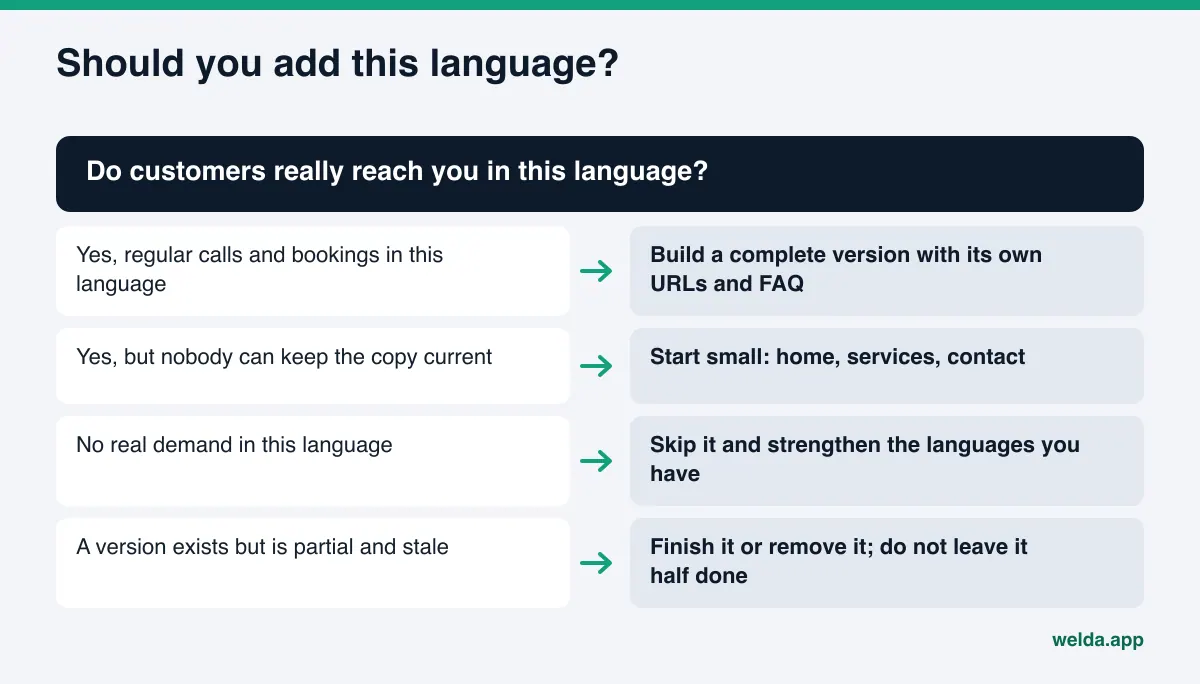
- Do customers really reach you in this language, and does someone own keeping this version current?
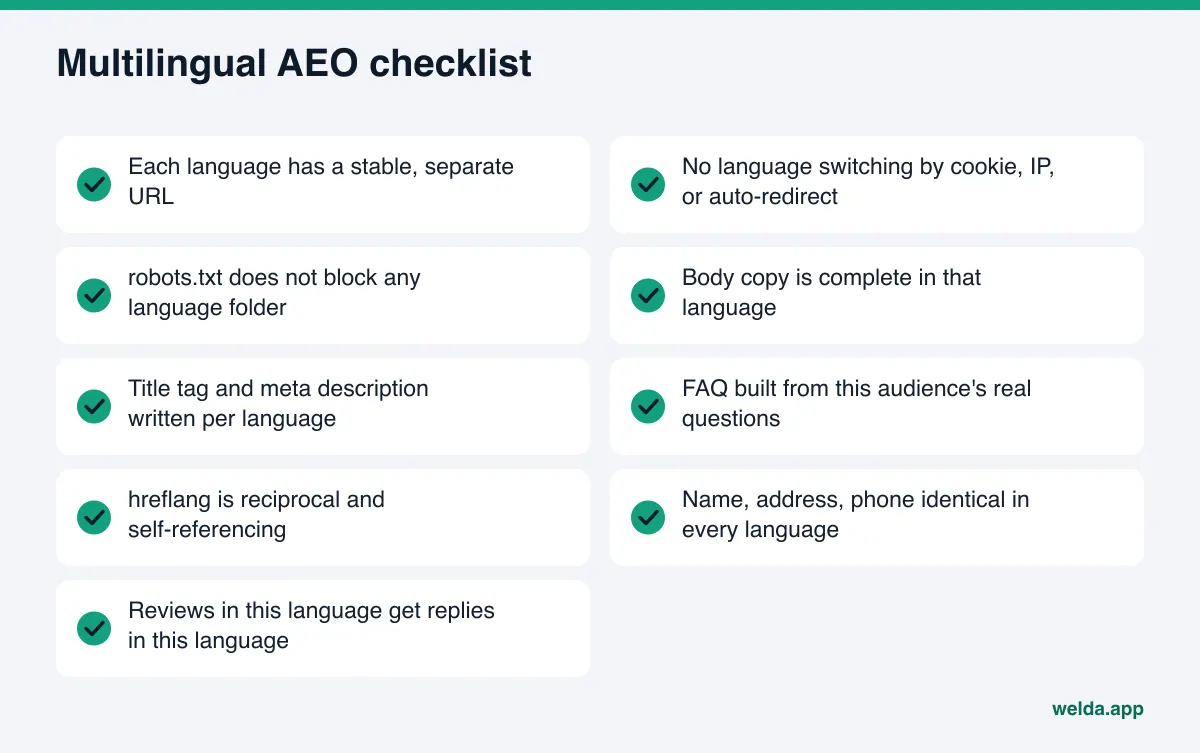
- Does this language have a stable, shareable URL of its own?
- Is language chosen with a visible switcher rather than auto-redirects, cookies, or IP detection?
- Are the home page, services, contact, and FAQ complete in this language?
- Are the title tag and meta description written in this language, for how this audience searches?
- Is the FAQ built from questions this audience actually asks?
- Is hreflang reciprocal, and does each page reference itself?
- Are name, address, phone, and hours identical across every language?
- Do reviews in this language get replies in this language?
- Are you tracking results for this language separately?
If you already have a report from the free analysis, reading it alongside this list makes the next steps clearer. How to read your AI visibility report explains each section of the report.
Example: a bilingual home services company's first month
This scenario is an example, not a real business. Picture a heating and cooling company in Phoenix where a large share of calls come from Spanish-speaking homeowners. The site has an English version and a Spanish version, but the Spanish version was built years ago and then forgotten.
Week one: inventory. The owner builds the page and language spreadsheet. The Spanish home page exists, but service pages only have translated headings. Pages on maintenance plans, service areas, and emergency calls are missing in Spanish. The FAQ is English only. Spanish pages still carry English title tags.
Week two: analysis and baseline. The owner runs the free analysis on the English site. The report shows missing business schema and a thin FAQ. The same week, the owner asks a handful of Spanish questions in AI assistants by hand and writes down the answers. In English, the company is named now and then; in Spanish, not at all.
Weeks three and four: filling the gaps. Spanish pages for repair, maintenance, and service areas are written by a bilingual staff member. A Spanish FAQ comes out of real calls: does the technician speak Spanish, is there a charge to come out, which neighborhoods are covered, are weekend visits available. Title tags are rewritten in Spanish, hreflang is made reciprocal, and business schema is added to both versions. Spanish reviews on Google Business Profile and Yelp get replies in Spanish.
No outcome is claimed here, because AI answers take weeks to reflect changes and nobody can guarantee them. But by the end of the month, the Spanish version is a page an AI system can read and use as a reason to recommend the company. Measurement starts to mean something from that point on.
Frequently asked questions
How is multilingual AEO different from multilingual SEO?
The foundation is the same: separate URLs, complete copy, correct hreflang. Multilingual AEO adds a focus on concrete facts an AI system can quote as a reason, FAQs written from each audience's own questions, and measuring each language on its own. You may also see this called GEO (generative engine optimization); in the US, AEO is the more common term.
Is a machine-translated Spanish version good enough?
It is a reasonable first draft, not a finished version. Translation moves English questions into Spanish; it does not add the different questions Spanish-speaking customers ask. A fluent person should review the copy and fill in what is missing.
Does hreflang matter for AI search engines?
There is no public statement on how AI engines use hreflang. Some engines draw on search indexes, so correct mapping in search helps indirectly. What matters most is that a complete page exists in each language.
Is it bad to auto-redirect visitors by location?
Google says automatic redirection can keep users and search engines from seeing all your versions and advises avoiding it. A visible language switcher, and if needed a suggestion banner, is the safer approach.
Can Welda measure Spanish questions?
The dashboard's question language can be set to English or Turkish today. The free site analysis works in English and German. Spanish questions need to be checked by hand for now.
How many language versions do I need?
As many as your customers actually speak and you can maintain. For most businesses, one well-written second language is worth more than four half-finished ones.
How long until a finished language version shows up in AI answers?
New or completed content usually takes weeks to be reflected, and no one can give an exact timeline. That is why it pays to ask the same questions at regular intervals, in each language separately.
Check your language versions today
A multilingual site is a door for customers who prefer another language. If there is no real page behind that door, AI systems will not see it. The first step is to find out what your site tells AI systems today. Run the free AI visibility analysis and get the gaps and ready-to-use copy suggestions in a few minutes. Then go through each language version with the table and checklist in this guide.