Do B2B buyers use AI to find vendors, and what does that mean for you? They do. Procurement managers, engineers and owners now ask ChatGPT, Gemini, Perplexity and Google's AI Overviews to name suppliers that meet a specific spec. If your company is not in that answer, you can be cut from the shortlist before anyone fills out your contact form, and you will never see it happen.
When B2B buyers use AI to find vendors, a new stage appears in the sales cycle: the one that happens before the RFQ. A buyer used to search Google, browse an industry directory, or collect cards at a trade show, and your website showed up somewhere along the way. Now the same buyer describes the need to an AI assistant and gets back three or four company names with a short reason for each. This guide covers what gets a supplier into that answer, what a manufacturer, distributor or professional services firm can do about it, and how Welda handles the work. This discipline is called AEO (answer engine optimization), and some people use GEO (generative engine optimization) for the same idea; here we stick with AEO. To see where you stand today, start with a free AI visibility analysis of your website. It shows what your site is telling AI engines in a few minutes.
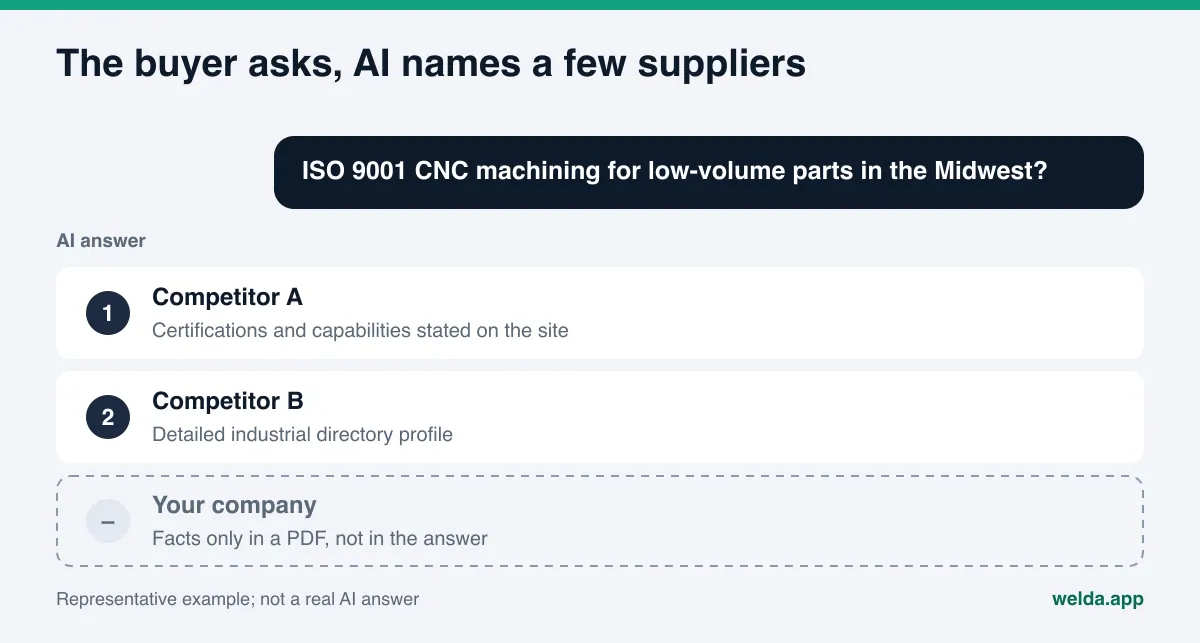
What do B2B buyers ask when they use AI to find vendors?
A business purchase is rarely framed as "who is the best company." It reads more like a short spec: material, volume, certification, lead time, region. The AI engine builds its answer around those conditions, and it favors suppliers whose websites state them plainly.
Typical prompts fall into five groups:
- Discovery: "Which US companies make custom stainless steel tanks?" or "industrial packaging suppliers near Columbus, Ohio."
- Requirements: "ISO 9001 certified CNC machine shop that takes low-volume orders" or "SOC 2 compliant payroll provider for a 50-person company."
- Comparison: "How do these three vendors differ?" or "domestic manufacturer vs. importer for this part."
- Risk: "Are there complaints about this supplier?" or "do they hit their lead times?"
- Preparation: "What should I ask a contract manufacturer before requesting a quote?" Your name may not appear here, but your content can be the source the answer is built from.
All five share one trait: the answer names only a handful of companies. On a search results page, page two still got some clicks. In an AI answer, you are either on the list or you are not. For B2B companies, AI search visibility works like a screening round that happens before your sales team gets involved.
Why AI vendor discovery matters more in B2B
Research on software purchasing shows how far this has gone. In a survey of more than 1,000 B2B software buyers published in July 2026, G2 found that 82 percent had sourced software recommendations from an AI chatbot in the last 24 months, and that review sites (38 percent) and AI chatbots (37 percent) were the top two sources shaping which vendors make a shortlist (G2 Buyer Behavior 2026). Those numbers describe software buyers; industrial and services buyers may behave differently. The direction, though, is clear: part of the shortlist now forms inside an AI answer.
B2B companies tend to be more exposed than consumer brands, for four reasons:
- Websites read like brochures. Lines such as "quality you can trust" give an AI engine nothing to match against a spec.
- Capabilities live in PDFs. Certifications, tolerances and capacity often sit in a downloadable line card rather than on the page.
- Third-party signals are thin. A restaurant has hundreds of reviews; a fastener supplier may have a handful. Every listing and every mention carries more weight.
- Sales cycles are long. One missed shortlist can mean a year without that account, and nothing in your CRM records the loss.
AI answers also shift from one run to the next. Asking a prompt once and seeing your name, or not seeing it, tells you very little. The article on why AI answers change every time explains the mechanics. In B2B, where the number of relevant prompts is small and each one matters, repeated measurement is even more important.
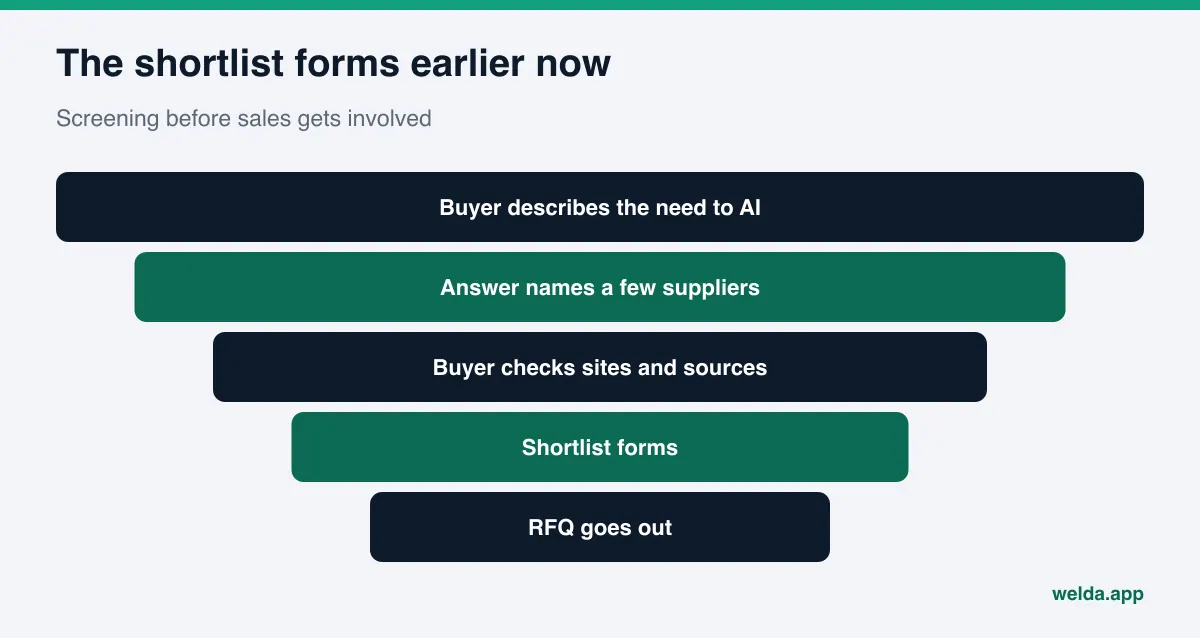
How does an AI engine decide which suppliers to recommend?
An AI answer is assembled from sources the engine finds through web search and considers reliable. To be named, two things have to be true: the engine can find you, and what it finds matches the conditions in the prompt. In practice, that means the following facts need to exist as plain text somewhere.
| Buyer requirement | What the AI looks for | Where it should live |
|---|---|---|
| What you make or do | Product and service names, applications | Dedicated product or service pages in plain text |
| Industries served | Named industries and use cases | An "Industries we serve" section |
| Certifications | Certification names and scope | Quality or About page, on the page itself, not only in a PDF |
| Capacity and volume | Minimum order, capacity, lead time ranges | FAQ section and request-for-quote page |
| Location and coverage | Facility address, shipping regions | Contact page and business schema markup |
| Trust | Reviews, listings, client types | Third-party sources plus a trust section on your site |
The last row points off your site. For B2B prompts, AI engines can draw on industrial directories such as Thomasnet, software review sites such as G2 and Capterra, agency directories such as Clutch, Google Business Profile, trade association member lists, trade press and forums. Which of these carry weight depends on the prompt and the industry. Rather than guess, measure which sources the answers actually cite.
A step-by-step plan for when B2B buyers use AI to find vendors
These steps are things a manufacturer, distributor or B2B services firm can start with its own team. Order matters: measure first, then fix.
- Write down real buyer prompts. Ask sales for the first sentence of recent RFQs and inbound emails. "We need X in Y volume with Z certification" is the closest thing to what buyers type into an AI assistant. Ten to twenty prompts is a solid start.
- Run each prompt in several engines, several times. Record whether you are named, in what position, and who is named instead.
- Write your site like a spec sheet. Give every product line or service its own plain-text page. State materials, standards, volume ranges, lead time ranges and industries served. If a number varies, do not invent one; "quoted per project" beats a made-up figure.
- Move key facts out of the PDF. Keep the line card, but put its core facts on the page.
- Add an FAQ section. Answer what buyers ask on the first call: minimum order, samples, export, certifications, payment terms, shipping.
- Mark up your business information. Use schema markup for company name, address, phone, service area and social profiles.
- Fix titles and descriptions. Your home page title should say what you make and where, not "Welcome." The guide to title tags and meta descriptions for AI search goes into detail.
- Clean up third-party listings. Make sure directory profiles, Google Business Profile and association listings match your site.
- Check that AI crawlers can reach you. A robots.txt file can block AI bots without anyone noticing.
- Measure again. New content usually takes weeks to show up in AI answers. Re-run the same prompts the same way.
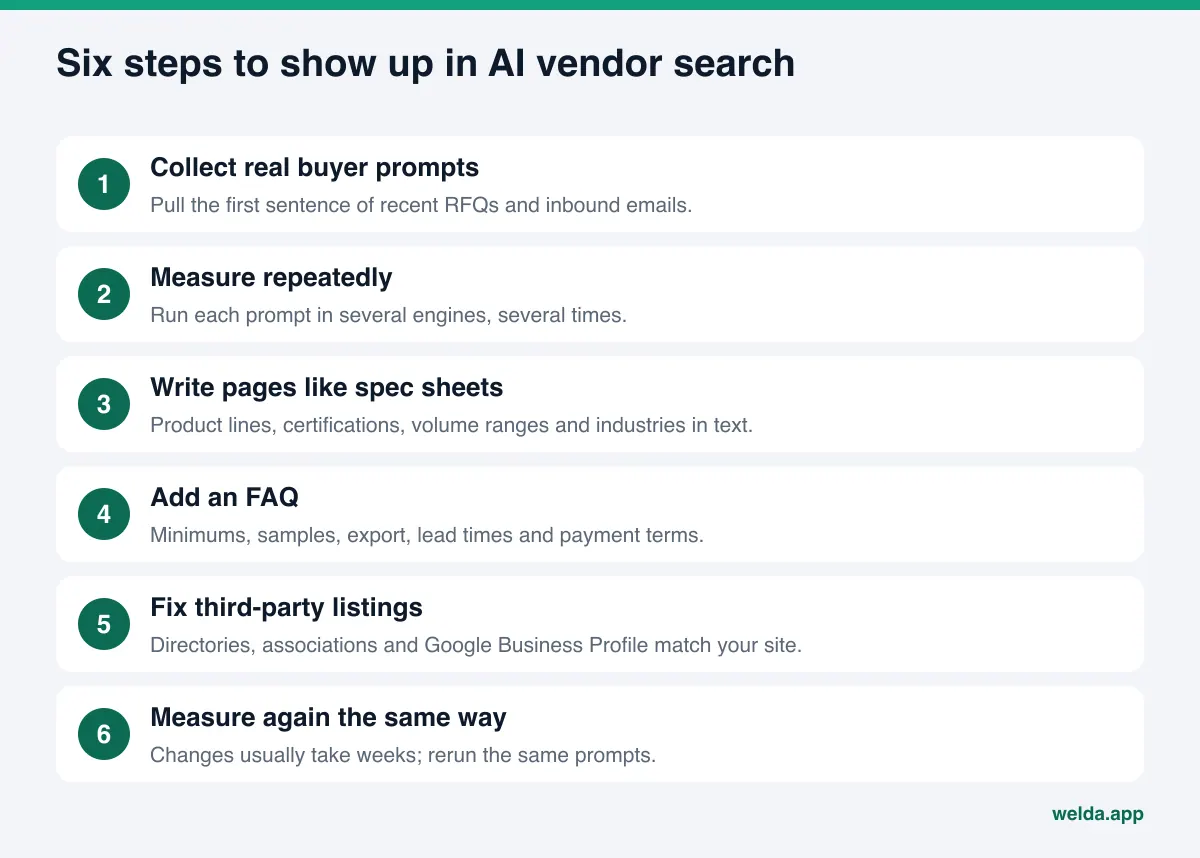
Most of these steps are not technical. They are about putting the right facts in the right place. The hard part is seeing which prompt you lost because of which gap, and keeping the work going month after month.
How to build a buyer prompt set with your sales team
Measurement is only as useful as the prompts behind it. Marketing teams tend to guess broad prompts ("best packaging company"). Sales teams hear narrower and more valuable ones. Pull from these sources:
- Recent RFQs: The first paragraph of an inbound request describes the need in the buyer's own words.
- Lost deals: What the buyer asked about before choosing someone else, and which requirement decided it.
- Trade show and discovery call notes: The questions buyers ask in the first five minutes are the questions your website should answer.
- Questions to your engineers: Material, tolerance and compliance questions are the raw material for requirement prompts.
The weighting also depends on what kind of company you are. Use this table as a starting frame and rewrite the prompts in your industry's language.
| Company type | Prompt types to emphasize | Conditions buyers mention |
|---|---|---|
| Manufacturer | Discovery and requirements | Material, certification, capacity, minimum order, contract manufacturing |
| Distributor | Discovery and region | Authorized brands, stock, shipping region, account terms |
| Professional services | Comparison and risk | Industry experience, team, process, contract model |
| B2B software | Comparison and requirements | Integrations, security standards, company size, support |
Tag each prompt as discovery, requirement, comparison or risk. When the results come in, the tag group where you lose tells you which part of your site is missing. Keep the set tight: 15 prompts your sales lead recognizes as "that is exactly how buyers ask" tell you more than 100 prompts nobody types.
Example scenario: a contract machining shop
This scenario is an example, not a real company. Picture a mid-sized precision machining shop in the Midwest. Sales says new inbound inquiries have slowed. The team asks several engines: "ISO 9001 certified CNC machining for low-volume aerospace parts in the Midwest."
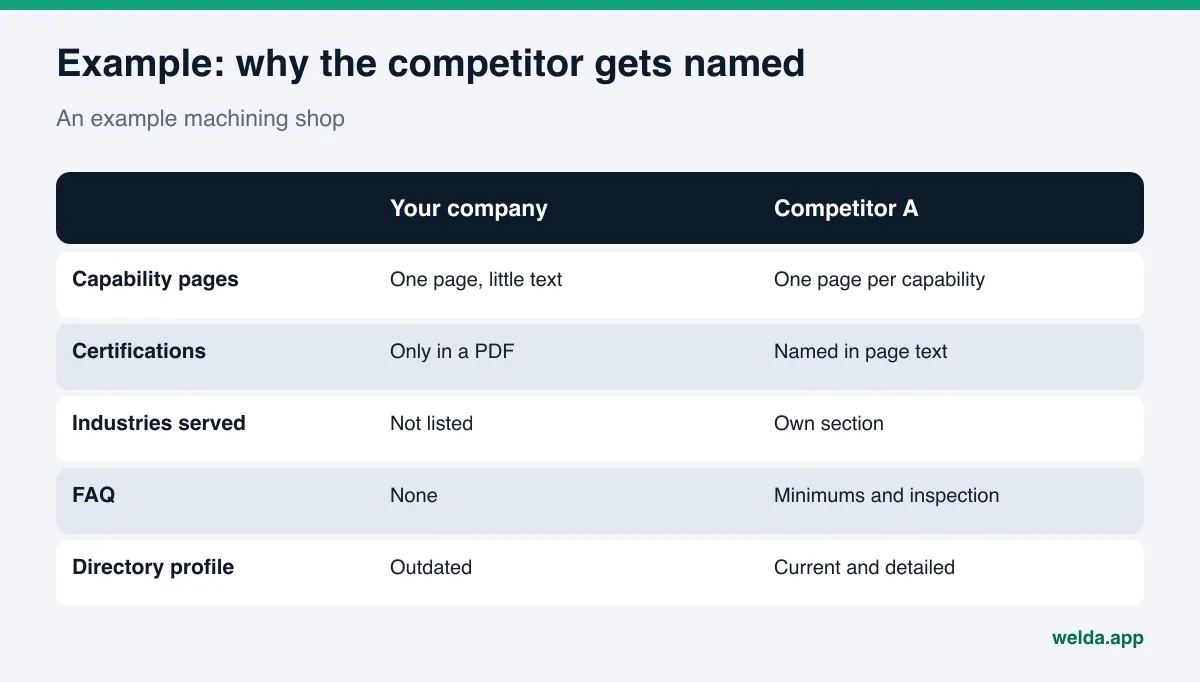
Two competitors are named; the shop is not. A look at the website shows why. All capabilities sit on one image-heavy page with little text. Certifications appear only in a PDF. The home page title is just the company name. Industries served are not listed anywhere. One competitor has a detailed industrial directory profile; the other has a dedicated aerospace page with an FAQ covering minimum order quantities and first-article inspection.
The to-do list writes itself: a dedicated aerospace page, certifications in page text, an FAQ covering minimums and samples, an updated directory profile. When and how much the answers will change cannot be predicted. But once you can see which prompt you lost because of which gap, the work stops being guesswork.
How Welda handles AI vendor discovery
Welda is software that measures where a business appears in AI answers and prepares the fixes on its behalf. Three parts of it do most of the work for a B2B company trying to show up when buyers ask for suppliers.
Prompt tracking. The prompts your buyers would ask are run in ChatGPT, Gemini, Perplexity and Google AI, three times each. For every prompt you see which engine names you and in what position. For a B2B firm, the useful reading is by prompt type: if you show up on discovery prompts but drop out on requirement prompts, your site is missing spec-level facts. The answer detail also lists the sources each answer relied on. Prompts can run in English or Turkish.
Sources and competitors. The sources view shows which sites the AI engines cite and whether you are present on them. The competitors view shows where a rival gets ahead and which source gives them the edge. Read the two together: if a competitor wins "certified supplier" prompts and the answers cite an industrial directory, the fix is your listing there, not another page on your website.
One to-do list with drafted copy. Welda collects the gaps in a single list and drafts the text for each item: a product line page, FAQ answers, a title and description, a directory profile description. It does not make up facts. If it does not know your minimum order or which certifications you hold, it asks you. On WordPress sites it connects through a separate Editor user and an application password, with no code to install; drafts open on your site and go live only after you approve them. On other platforms you get a ready-made package to apply yourself.
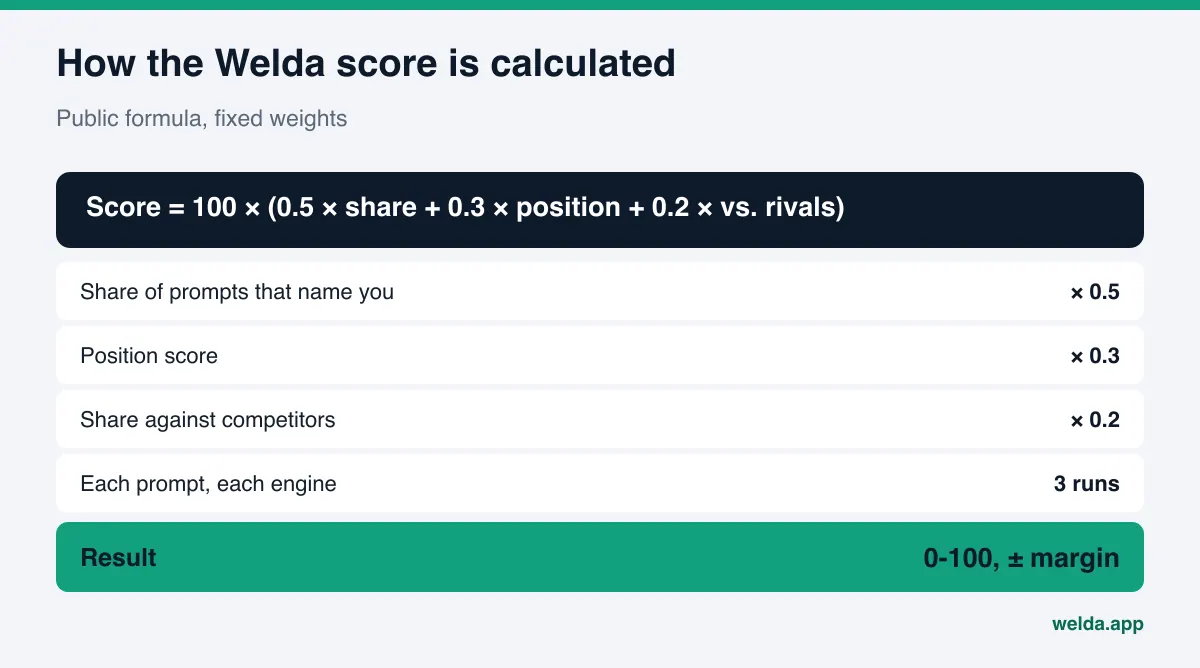
The score formula is public: 100 × (0.5 × share of prompts that name you + 0.3 × position score + 0.2 × share against competitors), with a ± margin of error from the spread across the three runs. That lets you answer "were we doing better on requirement prompts last month" with the same method instead of a hunch. A monthly one-page report and a before-and-after view round it out.
What stays with you: publishing approval, accuracy of technical claims, certification and capacity data, and the customer relationship. Content always lives on your own site; Welda does not host it.
Early access note: The Welda dashboard is in early access and is opening first in Turkey. Regular four-engine tracking is being added during early access, and the sample dashboard screens use representative data. The part anyone can use today is the free website analysis, which works in English. Pricing is discussed in the early access conversation.
What the free analysis shows a B2B company
You can check your site before the dashboard opens to you. The free analysis reads your home page and a few inner pages (services, pricing, about, contact) the way Google and AI engines do. For a B2B firm, the most useful findings are whether your services are clearly described, whether business schema is present, whether your address and phone details are consistent, whether you have an FAQ section, whether AI crawlers are allowed in, and what trust signals the page shows.
You get a score out of 100 (technical and content scored separately), and for each gap, what was found, why it matters and how to fix it. It also drafts a home page title, description, main heading, intro paragraph and FAQs, simulates how much each fix would move the score, compares you with competitors, and gives you a ready-to-install fix package. It also asks a web-search-enabled AI assistant five questions a customer might ask and checks whether your name comes up; that is a one-time check, not ongoing tracking. It is free once per site, the result link arrives by email, and it stays open for 14 days.
Limits: what Welda does not do
B2B purchase decisions depend on many factors, and an AI answer is only one of them. So the limits deserve plain language.
- Welda does not guarantee rankings or a spot in ChatGPT. The article on guaranteed ChatGPT rankings explains why nobody can honestly promise that.
- It does not invent facts. Capacity, certifications, client types and lead times come from you.
- It does not create fake reviews or testimonials. In the US, the FTC finalized a rule in 2024 that bans fake reviews and testimonials (FTC announcement).
- It does not publish sensitive content without approval.
- Handling negative reviews, managing directory accounts and press outreach stay with you. Welda can draft the text, but you own and run those accounts.
- New content usually takes weeks to show up in AI answers. In B2B that is short next to a sales cycle, but do not expect overnight change.
The compliance check flags patterns such as pricing claims, guarantees and superiority claims before anything goes live. It is not legal advice; for contract terms, product compliance statements and export rules, talk to your own counsel. For how negative sources shape answers, see the guide to AI reputation management.
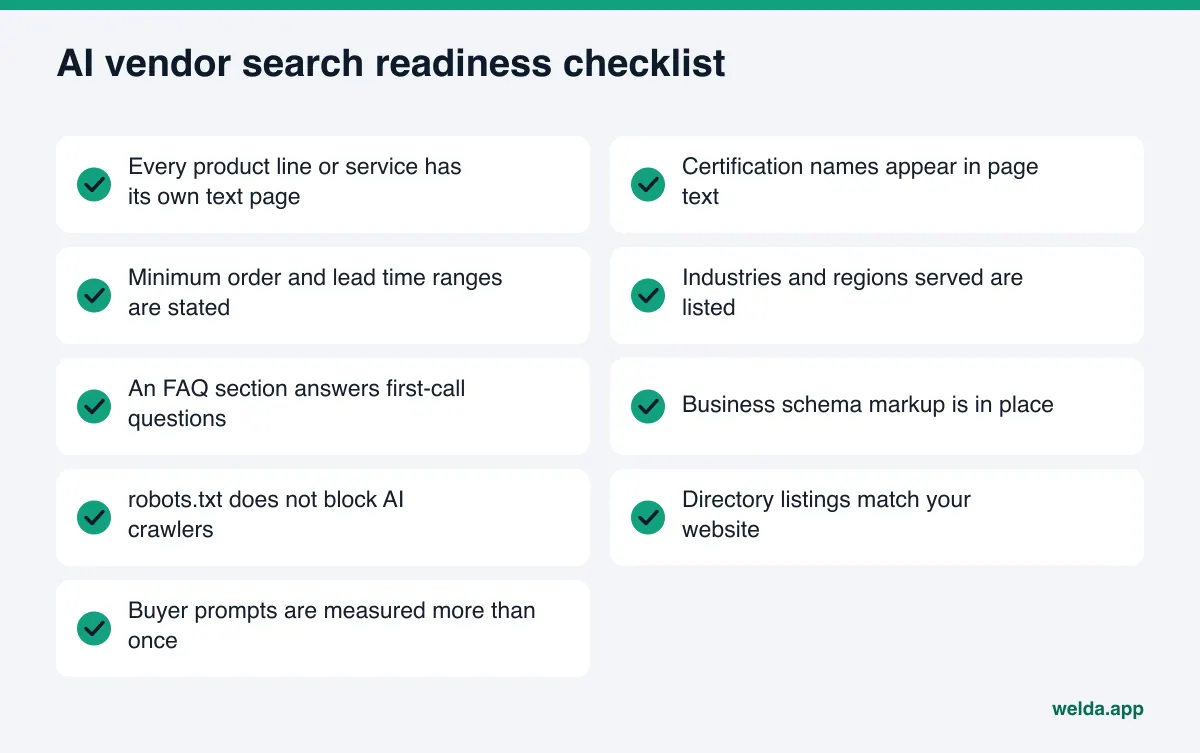
Checklist: is your company ready for AI vendor search?
Answer each item yes or no. Every no goes to the top of your to-do list.
| What you see | What it means | First step |
|---|---|---|
| Missing from discovery prompts | AI does not link you to this product or service | Product line pages and clear titles |
| Named in discovery, missing on requirements | Certification, volume or region facts are missing | FAQ and spec facts in page text |
| Same competitor always ahead | They are on more or stronger sources | Compare cited sources and fix listings |
| Negative source on risk prompts | The answer leans on a complaint or stale info | A clear, signed reply and current facts |
| No data at all | You do not know where you stand | Start with the free analysis |
A brand-new company or a new product line faces a different problem: with no third-party footprint yet, the foundations come first. The guide to AEO for startups is a better starting point in that case.
Frequently asked questions
Do B2B buyers really use AI to find vendors?
Surveys of software buyers show it has become common. In industrial and services purchasing the share varies by industry, but most buying processes now include a moment where someone asks an AI assistant.
Is our PDF line card enough?
Keep it, but put the core facts on the page as well. Certifications, product lines and volume ranges in plain text are much easier for an AI engine to find and match.
Do we have to publish prices?
No. In B2B, pricing is often quoted per project. What matters is explaining how pricing works, your minimum order and how the quote process runs.
Will Welda create our directory profiles for us?
No. Directory and listing accounts stay with you. Welda shows where you are missing and drafts the text to use there.
Can we track prompts for international buyers?
Prompts can run in English or Turkish. The free analysis works in English today; the full dashboard is in early access and opening first in Turkey.
How soon will we see results?
There is no fixed timeline. New content usually takes weeks to appear in answers, and results cannot be guaranteed, which is why the same prompts should be measured again the same way.
Next step: see where you stand before the shortlist forms
B2B buyers use AI to find vendors, and the shortlist is forming earlier, often before any RFQ arrives. Getting on it takes clear, accurate, findable facts more than budget: what you make, which requirements you meet, who you serve. The first step is seeing what your website tells AI engines today. Run the free AI visibility analysis to get your gaps, drafted copy and an estimate of which fix moves the needle most, in one report.