What is AEO for startups, and why does it matter before you have brand awareness? AEO for startups (answer engine optimization) is the work of making sure ChatGPT, Gemini, Perplexity and Google's AI features describe your company correctly and mention it when buyers ask "what tool should I use for this?" A young company has a thin footprint on the web, so AI answers tend to default to incumbents or repeat an outdated pitch. The fix is to state clearly what you do, keep that statement consistent everywhere you control, and check on a regular schedule which questions you show up in.
This guide is written for founders and the first person who owns marketing at an early-stage company. You are short on budget and shorter on time, so each section tries to answer one question: do this now, or can it wait? AEO will not replace your sales motion. But the first summary an investor, a prospect or a candidate reads about you is more and more often an AI-generated answer, and you want a say in what it says.
Why AEO for startups is a different job than AEO for established brands
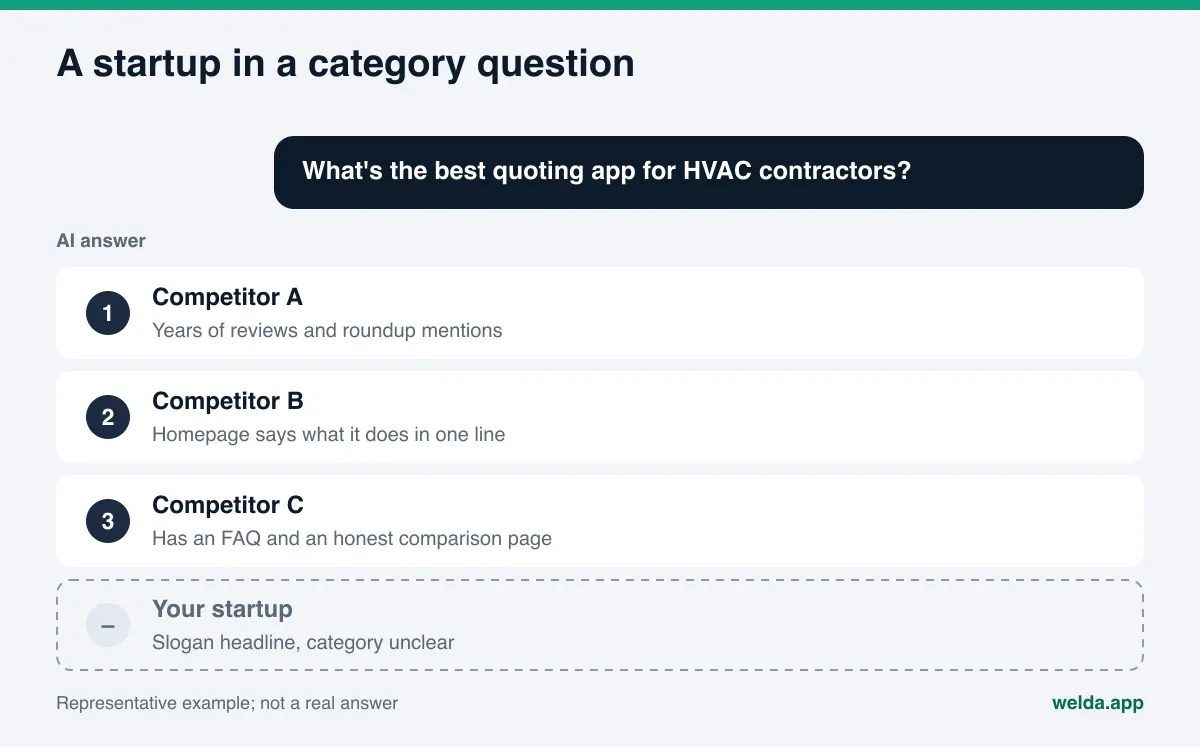
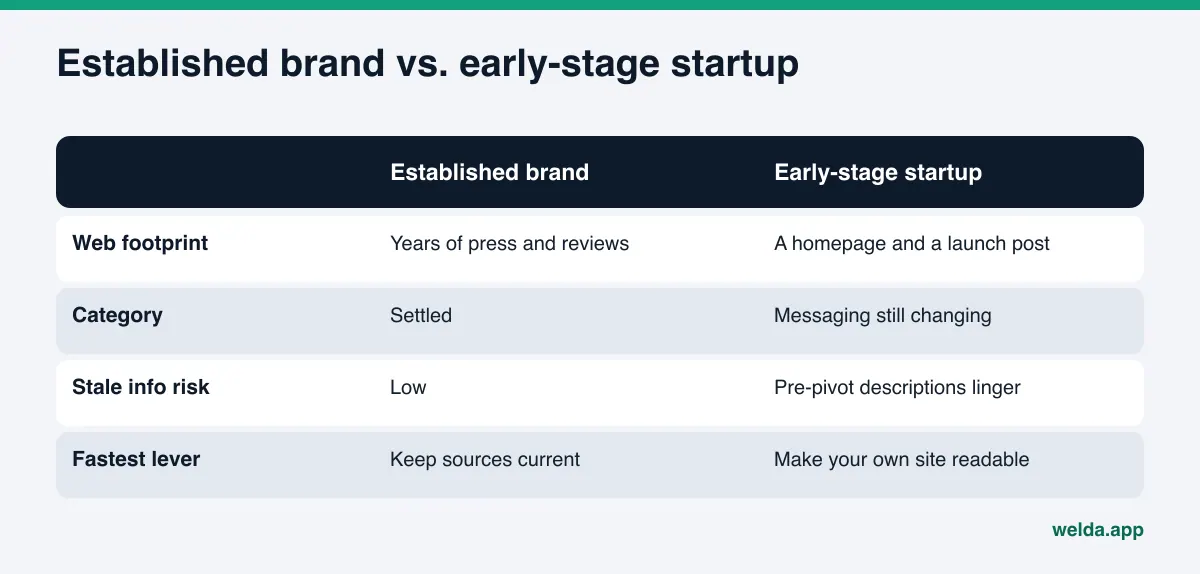
An established company has years of press coverage, analyst mentions, review profiles and community threads. AI answers lean on that history. A startup usually has a homepage, a launch post and maybe a funding announcement. That gap shows up in three concrete ways.
- You are invisible in category questions. Ask "what are good tools for X" and the answer lists the brands with the most written about them. Yours is not on the list. That is a data gap, not a penalty.
- You are described from an old snapshot. Startups pivot. Your ideal customer, pricing model and core use case may have changed twice since the seed round. AI answers can pick up a pre-pivot description, a sunset feature or an old team page.
- Your category is fuzzy. Founders building a new category often describe it in ambitious, abstract language. "Reimagining how work gets done" does not tell a human what you sell, and it gives an answer engine nothing to match against a buyer's question.
Then there is timing. It usually takes weeks for new content to show up in AI answers. Wondering why ChatGPT does not know you in launch week is normal. Still wondering three months later means something on your side needs fixing. AI answers that run a live web search can read your current pages, which is why a clear, crawlable site is the fastest lever a startup has.
A quick note on vocabulary: some people call this GEO (generative engine optimization). In the US, AEO and "AI search visibility" are the more common terms, and they describe the same work.
Where do answer engines learn about a new company?
No answer comes from a single source. What matters for a startup is knowing which sources you control and which you do not. Here is a typical map for a US software startup.
| Source | What gets read | Who controls it | Startup priority |
|---|---|---|---|
| Your website | What you do, who it is for, how it works, FAQs | You | Week one |
| Software review sites (G2, Capterra) | Category, user reviews, feature notes | Profile is yours; reviews are customers' | Once you have real customers to ask |
| Product Hunt, Crunchbase | Launch description, company basics | Mostly you | At launch; keep it current after pivots |
| Reddit and niche forums | How users talk about you and your category | Users | Monitor; never seed fake posts |
| Google Business Profile | Category, contact details, description | You | If you have a physical office or serve a local area |
| App Store and Google Play | App description and ratings | Description is yours; ratings are users' | Week one if you ship a mobile app |
The takeaway: start with the sources you own and make them complete and consistent with each other. Press and community mentions come later and cannot be manufactured; you earn them with real news.
There is a technical check too. If your site blocks AI crawlers, answers cannot read your current pages. OpenAI, for example, documents separate crawlers: OAI-SearchBot surfaces sites in ChatGPT search features, and GPTBot collects content that may be used for model training, so you can allow or block them separately in robots.txt (OpenAI crawler documentation). Google states there are no additional requirements or special optimizations needed to appear in AI Overviews or AI Mode beyond its normal search guidance (Google Search Central). In other words, a startup's technical debt is also AEO debt.
If you want to see how your site reads today before going through each check by hand, the free site analysis looks at crawler access, title and description, structured data and your FAQ section in a few minutes.
AEO for startups: a 30-day plan, step by step
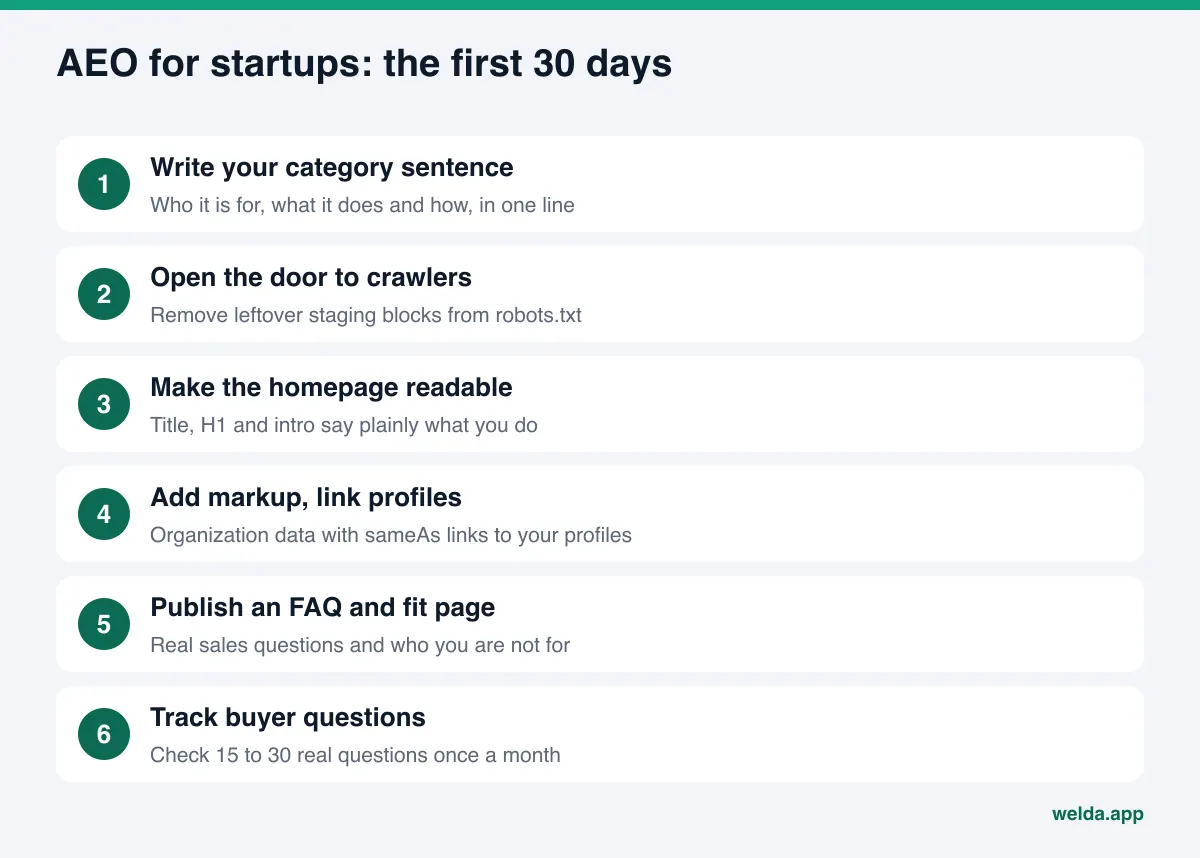
This sequence is built so a two- or three-person team can finish it in a month. Each step builds on the one before, so keep the order.
- Write your category sentence. One line: "[Product] is a [type of software] that helps [who] [do what] by [how]." Put that exact sentence in your homepage intro, meta description, Product Hunt and Crunchbase profiles, app store listing and social bios.
- Check crawler access. Open robots.txt on your live domain. A "disallow everything" rule left over from staging is a more common startup mistake than you would think.
- Make the homepage readable. The title tag and H1 should say what you do. Copy that only lives inside an animation or an image is often invisible to an answer engine. Our piece on homepage copy for AI search goes deeper.
- Add structured data. Organization or SoftwareApplication markup with your name, URL, logo, founding details and sameAs links to your profiles. Linking profiles helps an AI conclude that the site and the accounts are the same company.
- Describe each use case separately. If your product solves three jobs, give each a clear section or page, written in the words a buyer would type: "send quotes from the job site," "follow up on unsigned estimates," "track which quotes turned into jobs."
- Publish an FAQ. Take the 6 to 10 questions you hear most on sales calls and in support, and answer each in two or three sentences: setup time, integrations, data security, who it is not for.
- Prepare for "alternative to" questions. Buyers will ask "what can I use instead of Competitor A?" An honest page on your own site about who you are a good fit for, and who you are not, gives answer engines something accurate to read.
- Pick the questions you will track. Write 15 to 30 real buyer questions and check once a month which answers mention you. How to build that list is below.
None of these steps needs ad spend. If you are wondering whether there is a paid shortcut, we covered whether you can pay to appear in ChatGPT answers separately. The short version: your spot in organic answers is not an ad slot.
How to write a category sentence and an honest comparison page
This is where most founders get stuck, because pitch language and definition language are different things. When an answer engine builds a response, it looks for a plain answer to "what does this company do, and for whom?" If you do not write it, someone else's sentence gets used.
The example below is made up. Picture an early-stage SaaS company that helps HVAC and plumbing contractors send and track quotes.
| What the site says | The problem | A better version |
|---|---|---|
| "The future of the trades starts here." | No product, no audience | "Quoting software that lets HVAC and plumbing contractors send estimates from the job site and see which ones get signed." |
| "AI-powered all-in-one platform." | True of almost any product | "Builds a quote from your price book, texts it to the homeowner, and reminds them if it is not signed in three days." |
| "Built for everyone." | Cannot be matched to any question | "For residential service companies with 2 to 25 technicians." |
| "Way better than the big guys." | Unverifiable claim | "Not a full field service suite; it works alongside the dispatch tool you already use." |
The last row matters most. Saying who you are not for keeps answer engines from placing you in the wrong question. For a startup, the wrong lead costs nearly as much as no lead.
The same rule applies to comparison pages. Do not publish weaknesses of competitors that you cannot verify; it is a legal risk and it erodes trust. Describe your own scope, when you are a good fit and when another type of tool might fit better. Answer engines tend to cite sources that are balanced and specific. If you are unsure about a comparative claim, ask counsel; nothing here is legal advice.
Which buyer questions should a startup track?
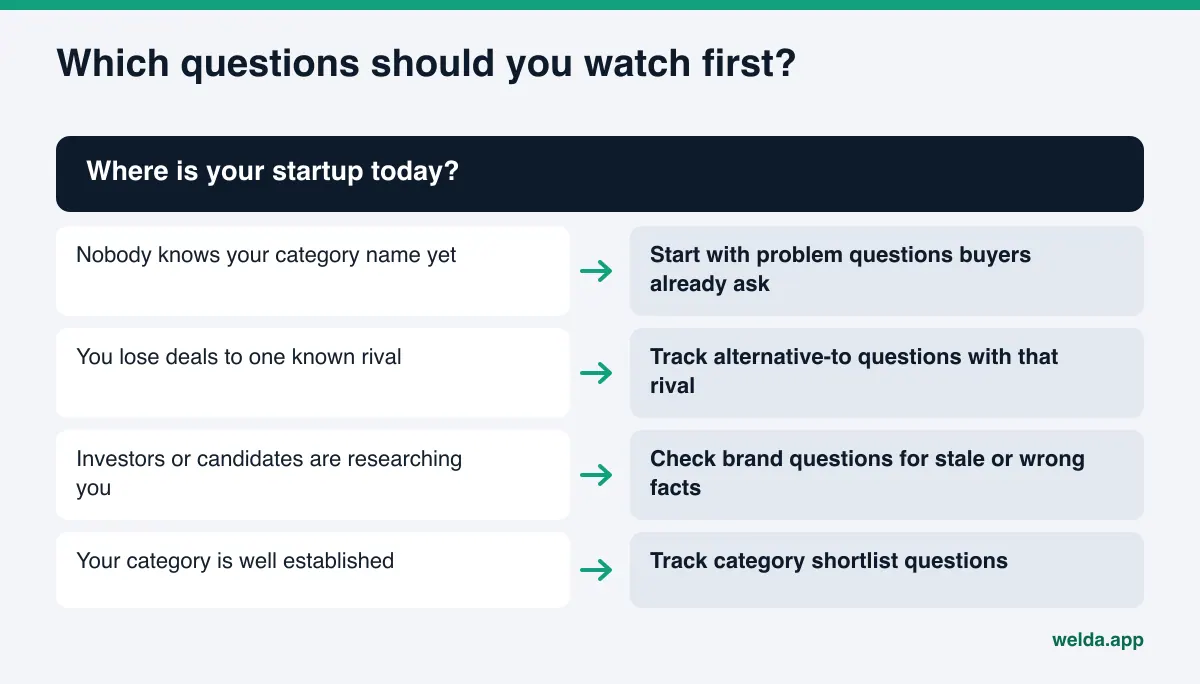
You cannot fix what you do not measure. For a startup, the questions worth tracking fall into four groups. Pick a few from each; 15 to 30 questions in total is manageable for a small team.
| Question type | Example (fictional) | What it tells you |
|---|---|---|
| Category | "What's the best quoting app for HVAC contractors?" | Whether you make the category shortlist |
| Problem | "Homeowners never sign my estimates. What should I do?" | Whether you get suggested to someone describing the pain |
| Alternative | "What's a cheaper alternative to Competitor A?" | Whether you reach your competitor's customers |
| Brand | "Is [Product] legit? What does it do?" | Whether you are described accurately |
Brand questions deserve extra attention. Investors, candidates and buyers ask about you by name. If the answer describes your old pivot, gets a founder's name wrong or lists a feature you killed, you want to know early. Our guide on what to do when ChatGPT has wrong information about your business walks through the fix.
Do not invent the question list at your desk. Build it from what your startup already has:
- Sales call notes: how did prospects describe their problem on the first call? Those sentences look a lot like what people type into an AI assistant.
- Support tickets: recurring questions such as "does it work with my accounting software" belong in your FAQ and on your tracking list.
- Closed-lost deals: which product did the buyer choose instead? The "alternative to" question with that name belongs on the list.
- Signup form: add "AI assistant (ChatGPT, Perplexity, etc.)" as an option under "How did you hear about us?" It is the simplest way to see whether visibility turns into pipeline.
Review the list each quarter. As you add a segment, a market or a use case, your questions should change with it. Archive old questions instead of deleting them so you can compare before and after.
How Welda handles AEO for startups
Welda is software that measures where a business shows up in AI answers and fills the gaps on the business's behalf. Three parts are most useful for a startup. We will use the fictional quoting startup from above as the example.
The free analysis: a pre-launch readability check
Running the free site analysis right before launch, or right before a new homepage goes live, is the cheapest check a startup can make. It reads your homepage and a few inner pages (features or services, pricing, about, contact) the way Google and an AI system would. For the quoting startup, likely findings would be: the H1 is a slogan, so the product is unclear; there is no Organization markup; profiles are not linked from the site; there is no FAQ.
For every gap, the report says what it found, why it matters and how to fix it. The most useful part for a founder is the set of ready-to-use homepage suggestions: title, meta description, H1, intro paragraph and FAQs. If you have been struggling to write your category sentence, this gives you a starting draft to edit. A simulation shows how much each fix would move your score, so a small team can do the highest-impact work first. The competitor comparison shows where rival sites are ahead on the same checks, and a fix package includes ready-made structured data code.
The analysis also asks 5 buyer questions to an AI assistant that can search the web and checks whether your company is named in the answers. Treat it as a one-time baseline, not ongoing tracking. It is free once per site, your results link arrives by email and stays open for 14 days, and it does not measure rankings. It runs in English for US sites.
Competitors and sources: who wins which question, and from where
In the Welda panel, buyer questions are asked to ChatGPT, Gemini, Perplexity and Google AI three times each. For a startup, the competitors view is usually the most instructive screen. It shows your share against competitors, which question groups a rival leads in, and which sources the answers draw on when they name that rival.
For the quoting startup, the screen might show that Competitor A leads on category questions and is cited from a software review site and an industry roundup. That lets a founder make two decisions. First, is the gap content on your site, or a missing source? Second, do you have real news, a product update or a customer use case worth bringing to that publication? Press work stays with you; Welda does not pitch on your behalf, but it shows you where to look.
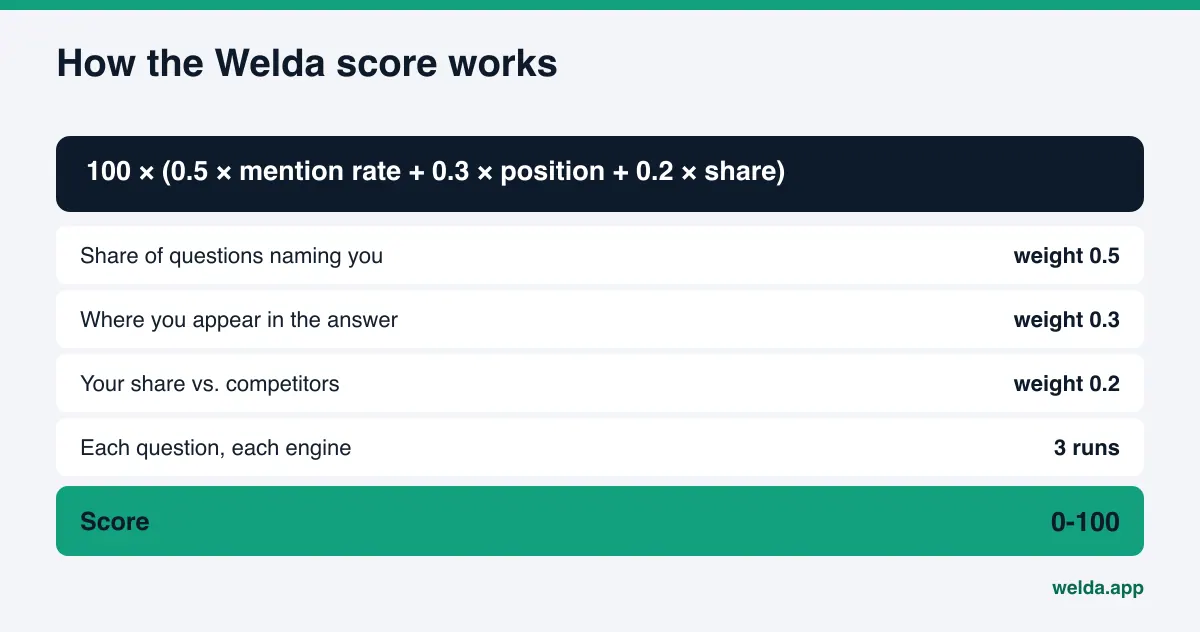
The score formula is published, so you can explain it to your team or your board. It weighs how often you are named, where you appear in the answer and your share against competitors, and the spread across three runs gives a margin of error. A number with a known method is easier to defend in an investor update than "AI knows about us." For more on ongoing measurement versus a single check, see one-time AEO audit vs ongoing tracking.
The to-do list: it asks instead of guessing
Startup facts go stale fast. When Welda drafts content and needs a fact your site does not state, such as your founding year, which tools you integrate with or your support hours, it does not invent it. It lists the item as missing information and asks you. Once you answer, the fact is reused in later drafts. Items waiting for approval sit next to their ready-to-publish text; you approve what goes live.
On WordPress sites, Welda connects through a separate Editor user and an application password, with no code to install. Content lands as a draft on your site and goes live after you approve it. Many startup sites run on other platforms; there, Welda hands over a ready package and your team applies it. Content always lives on your own site. A compliance check flags patterns such as price claims, guarantees and superiority claims before anything is published. It is not legal advice.
Early access, plainly: the Welda panel is in early access and opening in stages, starting with businesses in Turkey. Regular four-engine tracking is being added during early access, and the sample panel screens use representative data. The part anyone can use today, including US startups, is the free site analysis, which works in English. Pricing is discussed in the early access conversation.
Limits: what Welda does not do, and what stays with your team
Founders should be skeptical of anyone selling certainty here, so here are the limits in plain terms.
- No guarantees. Welda does not guarantee rankings or a spot in ChatGPT answers. AI answers vary; the same question can get different answers at different times. That is why each question is run three times.
- It takes time. New content usually takes weeks to show up in AI answers. Do not expect movement in launch week.
- No made-up facts. Welda does not write what it does not know. It will not invent customer counts, growth rates or logos for you.
- No fake reviews. Welda does not generate reviews. The FTC's rule on consumer reviews and testimonials prohibits fake reviews and undisclosed insider reviews (FTC announcement). Asking real customers for reviews and replying to them is your job; Welda can draft replies.
- Press, directory accounts and negative reviews stay with you. Pitching journalists, claiming profiles on review sites and handling a critical review are the company's own work.
- Nothing sensitive goes out without approval.
One startup-specific limit: if you are creating a brand-new category that nobody searches for yet, there are few questions to track. Focus on problem questions first. Buyers may not know your category name, but they can describe their pain.
Is your startup ready? A checklist and a timing guide
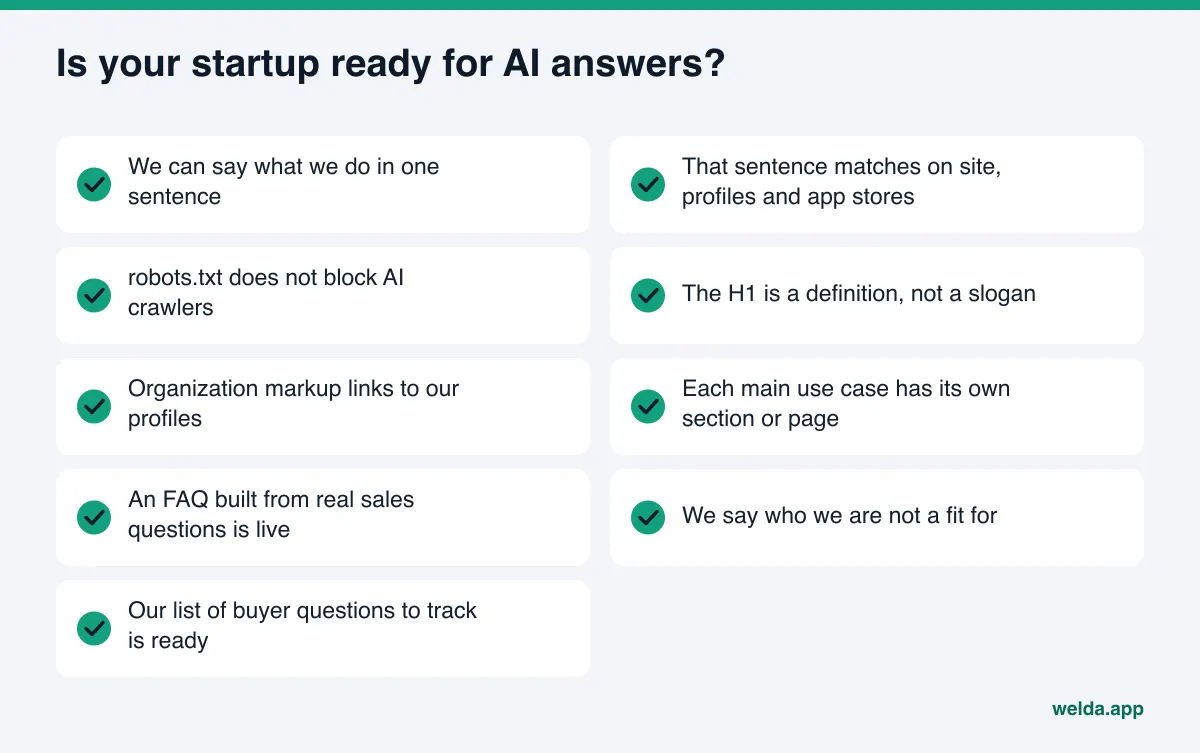
You can fill this out in five minutes at a founders' meeting. Every "no" is work for the next two weeks.
And when should AEO get real time from the team? A rough guide:
| Stage | What to do |
|---|---|
| Pre-product, waitlist only | Category sentence and crawler access; too early to measure |
| Launched, first customers arriving | Free analysis, homepage, structured data, FAQ |
| Searching for product-market fit, messaging changes often | Update the category sentence on every channel at once, every time |
| Sales team hired, being compared to rivals | Regular measurement, competitor and source tracking |
Once a dedicated marketer takes over, AEO for marketing managers offers a fuller framework for turning this into a team routine.
Frequently asked questions
Is AEO for startups different from SEO?
It sits on the same foundation: a crawlable site, clear headings, structured data and well-written pages. The difference is what you measure. SEO looks at where a page ranks; AEO looks at whether you are named inside an answer and how you are described.
Should we bother before we have customers?
It is early for measurement but not for the basics. A category sentence, crawler access and a readable homepage take half a day and prevent mistakes that could cost you weeks after launch.
ChatGPT does not know our startup. How long until it does?
There is no fixed timeline. New content usually takes weeks to appear in answers. Answers that run a live web search can pick up your current pages sooner, so make sure your site is readable first.
Is it risky to publish an "alternatives" or comparison page?
It is if you make claims you cannot verify. A page that honestly describes your scope and who you are and are not a fit for is useful to buyers and answer engines alike. If you are unsure, ask counsel.
Can a US startup use Welda today?
Yes, the free site analysis works in English for any site. The full panel is in early access and opening first in Turkey; it can track questions in English. Pricing is discussed in the early access conversation.
We pivoted. What happens to our old descriptions?
Update the category sentence on every channel you control on the same day: site, meta description, structured data, Crunchbase, Product Hunt, review profiles and app stores. Update or redirect pages about the old product, then watch your brand questions for a few weeks.
Where to start
AEO for startups needs attention more than budget: say what you do in one sentence, keep that sentence identical everywhere and check regularly which questions you appear in. Start by seeing how your site reads to an AI system today. Run the free site analysis to get your score, the gaps, homepage copy suggestions and a competitor comparison in one report, then work through the 30-day plan above.