How do fake reviews rules affect your AI visibility? Fake reviews rules and AI visibility are tied together because ChatGPT, Gemini, Perplexity and Google AI build their recommendations partly from reviews and review sites. Bought, invented or AI-written reviews break federal rules and platform policies, and when a platform removes them, the visibility they seemed to create disappears too. The safe path is more real reviews, a thoughtful reply to every one of them, and clear trust information on your own site.
This guide is for owners and marketing leads at local and service businesses who want to show up more often in AI answers and are tempted to push their review count up fast. Maybe an agency pitched a "review package." Maybe a manager suggested the team leave five stars. Maybe someone asked whether it is fine to have an AI tool draft customer reviews. The goal here is not to scare anyone. It is to separate what crosses the line from what is allowed, and to show what actually supports answer engine optimization (AEO), which some call generative engine optimization (GEO), over time. This is not legal advice; talk to your own counsel about your situation.
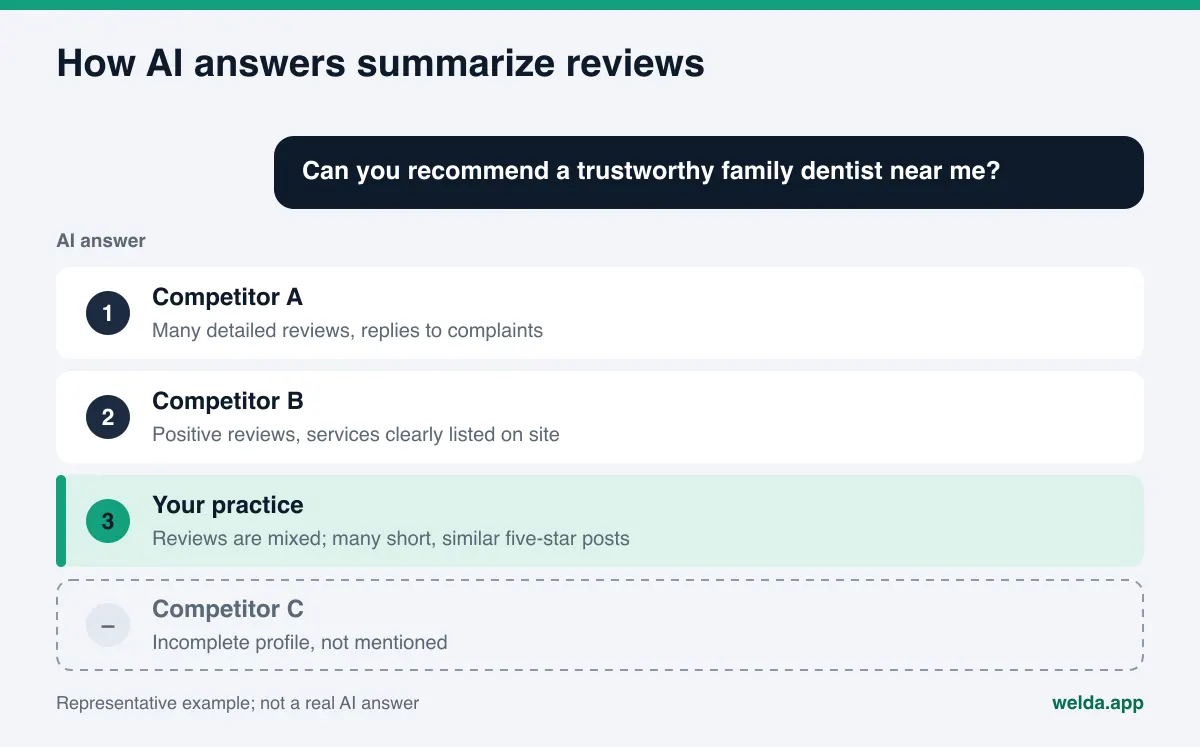
What do the federal fake reviews rules say?
In the United States, the main federal rule is the FTC's Trade Regulation Rule on the Use of Consumer Reviews and Testimonials (16 CFR Part 465). It was published in the Federal Register in August 2024 and took effect on October 21, 2024. According to the FTC's announcement, the rule covers six areas:
- Fake or false reviews and testimonials: creating, buying, selling or spreading reviews that misrepresent who wrote them or whether that person had real experience with the business. The FTC states this includes AI-generated fake reviews.
- Buying positive or negative reviews: offering compensation or incentives conditioned on a particular sentiment, whether that condition is stated or implied.
- Insider reviews: reviews from officers, managers or employees without a clear disclosure of the connection, plus limits on managers soliciting reviews from relatives or staff.
- Company-controlled review sites: presenting a site you control as an independent source of reviews for your category.
- Review suppression: using unfounded legal threats, intimidation or false accusations to remove negative reviews, or implying that the reviews you show are all or most of them when some were suppressed.
- Fake social media indicators: buying or selling fake followers or views to misrepresent influence for commercial purposes.
The rule lets the FTC seek civil penalties from violators. State consumer protection laws can apply as well, and some industries have their own advertising rules. If you are unsure whether a practice fits within the rule, your counsel should make the call, not a vendor.
On top of the law sit platform policies. Google's contribution policy treats paid or incentivized reviews as fake engagement and removes them. It also tells merchants not to discourage negative reviews and not to selectively ask only happy customers. Yelp runs consumer alerts that it places on business pages when it finds compensated or suspicious review activity. So even a practice that looks legal can still get your reviews removed, and that is the part that matters most for AI visibility.
Fake reviews rules and AI visibility: where is the connection?
AI answers are built from sources. When someone asks "best family dentist near me," "quiet boutique hotel in Savannah" or "reliable HVAC company in Phoenix," answer engines read what they can find on the web. Much of that is review content: Google Business Profile ratings and reviews, Yelp, Tripadvisor for hospitality, Healthgrades for medical practices, Angi for home services, BBB complaint histories, and the testimonials on your own website. Community threads matter too; we cover that in our piece on how Reddit shapes AI answers.
That is why fake reviews hurt AI search visibility in three ways.
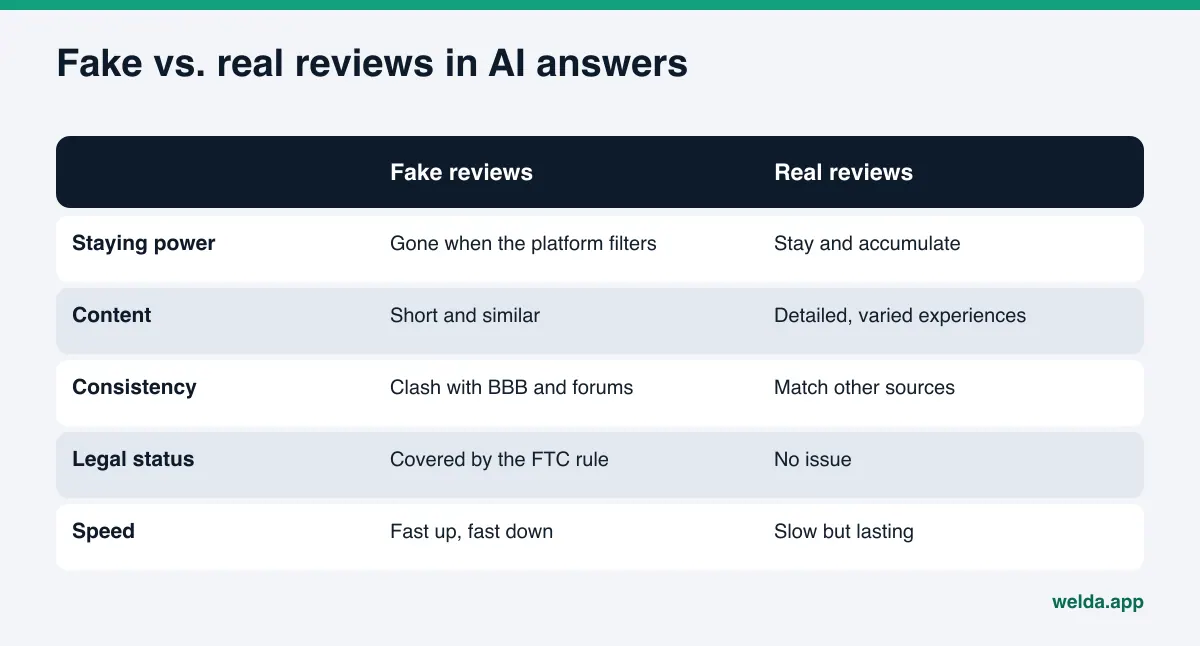
- Removed reviews, removed source material: When a platform filters or deletes fake or incentivized reviews, the information they carried leaves the source. Your rating drops, your count shrinks, and the picture an answer engine reads changes overnight.
- Inconsistency: A burst of short, similar five-star reviews next to detailed complaints on BBB or a forum thread looks contradictory. AI answers often summarize that kind of conflict cautiously, with phrases like "reviews are mixed."
- Legal and reputation fallout: An enforcement action, a platform alert on your listing, or a local news story adds a new, negative page to the sources about your business. Answer engines may read that page for months.
Visibility built on fake reviews has no stable base. Real reviews build slowly, but they stay. They are detailed, they describe different experiences, and they give answer engines a true answer to "what is this business known for."
Which review practices are risky and which are fine?
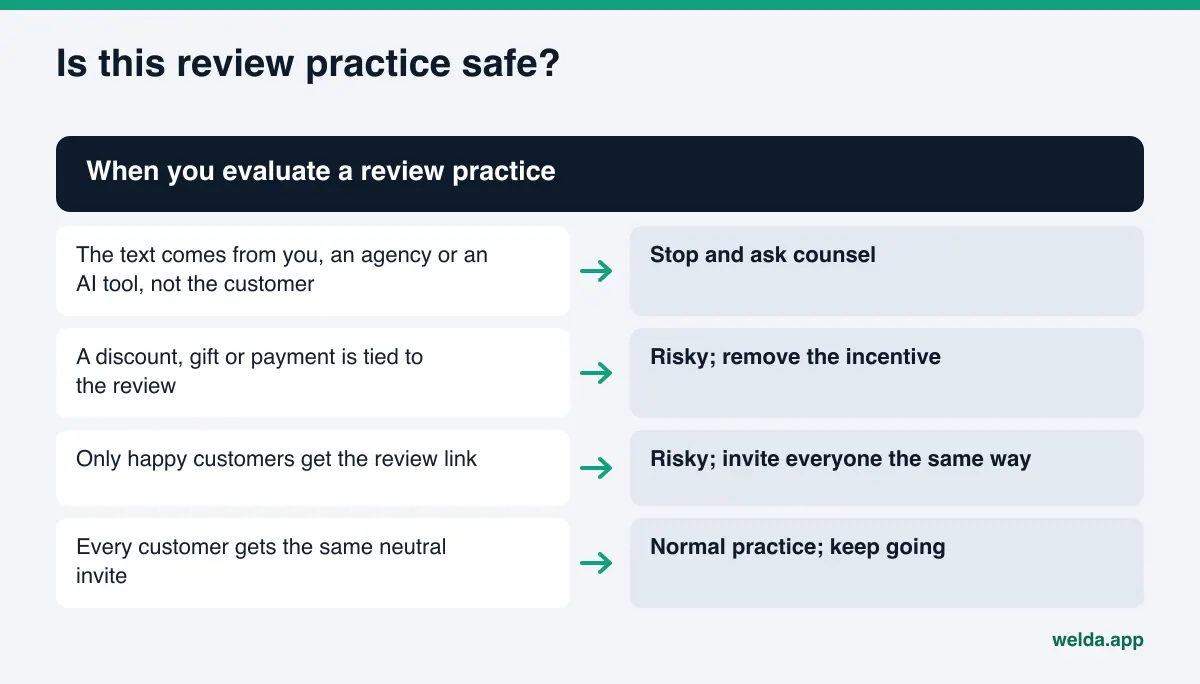
Most owners already know that writing fake reviews is wrong. The real questions sit in the gray zone. The table below summarizes common practices against the FTC rule and Google's policy. For a final decision, check with counsel and the current rules of each platform.
| Practice | Status | Why |
|---|---|---|
| Writing or ordering reviews for customers who never visited | Do not do it | No real experience; covered by the FTC rule and removed by platforms |
| Having an AI tool write "customer reviews" you then post | Do not do it | The experience is invented, whoever types it |
| Offering a discount or gift for a five-star review | Do not do it | Incentive tied to sentiment; also against Google policy |
| Offering any incentive for posting a review | Risky | Google removes incentivized reviews regardless of sentiment |
| Sending the review link only to happy customers | Risky | Google policy prohibits selective solicitation |
| Staff or family posting as regular customers | Risky | Insider connection hidden from readers |
| Hiding negative reviews from a "reviews" page on your site | Risky | Can misrepresent what customers actually say |
| Inviting every customer with the same neutral message | Fine | No incentive, no filtering, no scripted content |
| Replying to every review, including negative ones | Fine and recommended | Adds information and shows how you handle problems |
The row people overlook is the AI one. "The customer was happy, they just had no time to write" does not change anything: if the words did not come from the customer, it is not a customer review. AI has a legitimate job here, but it is a different one: drafting the business's reply. We come back to that in the Welda section below.
How to grow AI visibility with real reviews, step by step
What replaces fake reviews is a process. None of these steps needs a big budget. Most are set up once and then become a habit.
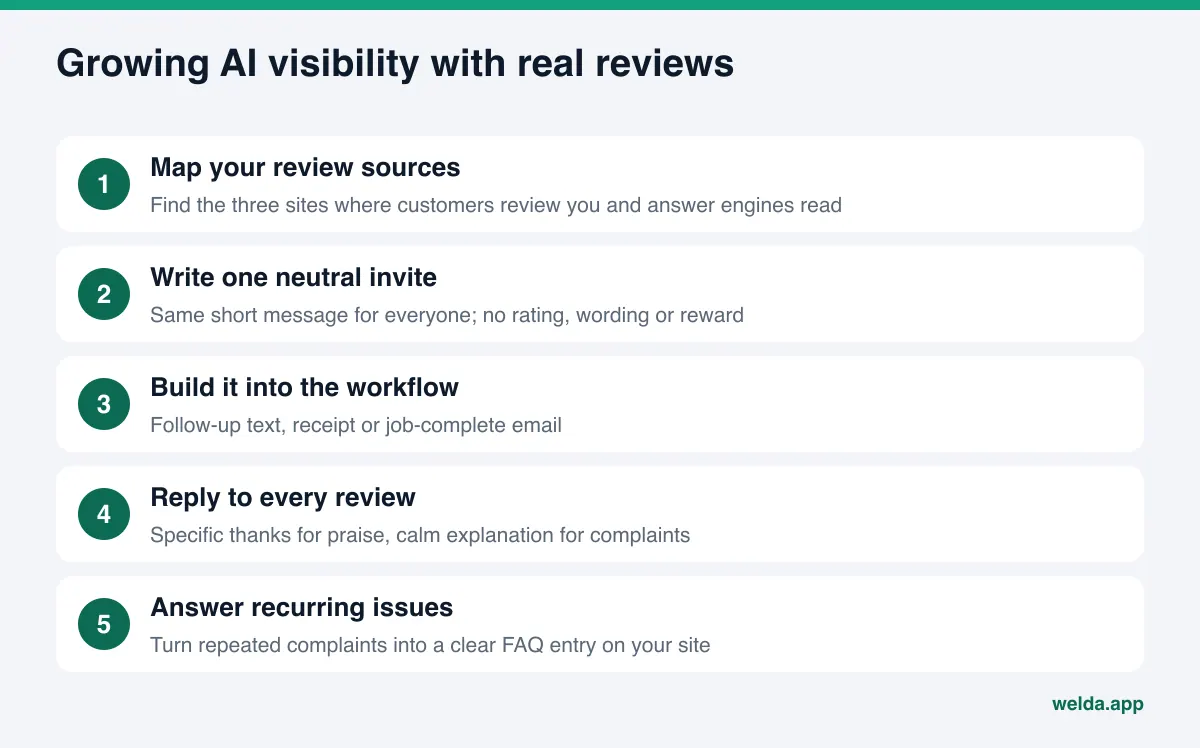
- Map where your reviews live. Where do customers actually review you: Google Business Profile, Yelp, Tripadvisor, Healthgrades, Angi, BBB? The places answer engines draw from usually overlap with this list. Know which sources matter before you spend effort.
- Write one neutral invitation. After every job or visit, the same short message goes out: "We'd appreciate hearing about your experience." No star request, no suggested wording, no reward. Unhappy customers get the same message.
- Build the invitation into your workflow. Put the review link in the follow-up text, on the receipt or in the job-complete email. Do not set review quotas for staff; Google's policy flags that too.
- Reply to every review. A specific thank-you for positive ones, a calm explanation and a path to resolution for negative ones. Your replies are source material too; answer engines read them to learn how you handle complaints.
- Watch BBB and complaint channels. Assign one person to complaint notifications and answer them quickly and factually.
- Show testimonials honestly on your site. If you display customer quotes, name the source and date. Do not present a handful of picked compliments as the whole picture.
- Answer recurring complaints on your site. If reviews keep mentioning the same issue ("no parking," "price not given on the phone"), add an FAQ entry that explains it. Answer engines can then use your own words for that question.
None of these steps promises fast results. New reviews and new content usually take weeks to show up in AI answers. But every step builds something a platform will not delete.
Reviews and schema markup on your own site
Many businesses add star widgets and review schema to their site, hoping to tell answer engines "our rating is high." Two points are worth knowing.
First, Google's review snippet guidelines say that pages where the reviewed business controls the reviews about itself are not eligible for star review features. That applies to pages using LocalBusiness or Organization markup. So the rating markup on your own homepage may never show as stars. Second, the same guidelines require that the marked-up review content be visible to users on the page. Putting a rating in code that visitors cannot see breaks the rule and creates a gap between what an answer engine reads and what a customer sees.
The practical takeaway: use business schema for verifiable facts like address, phone, hours, services and links to your profiles. Show real testimonials as visible text with their source. We cover the setup in our guide to schema markup for AI search.
How Welda handles reviews in AEO
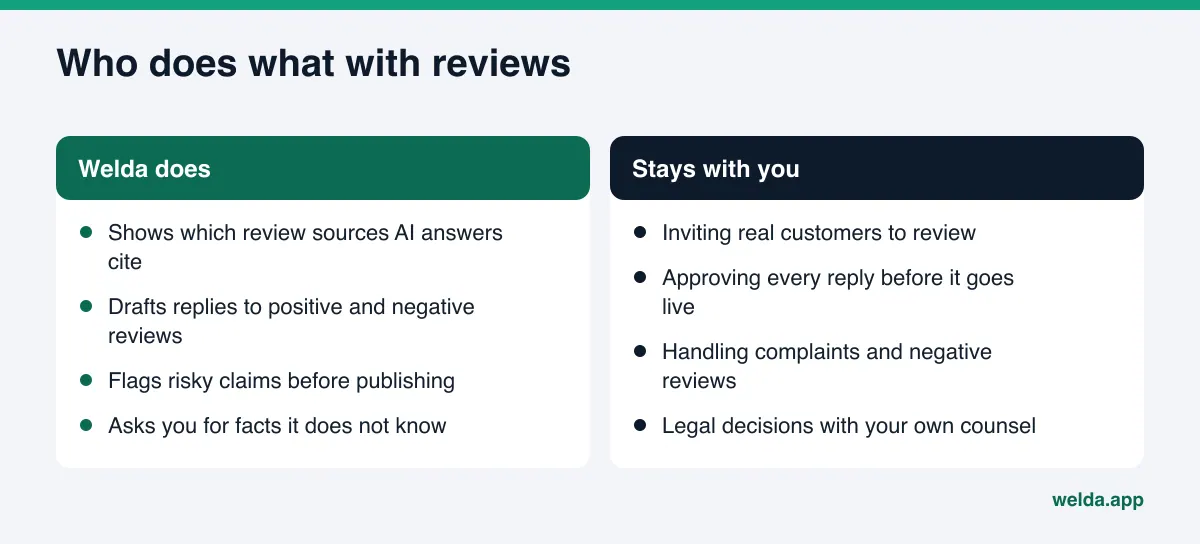
Welda is software that measures where a business appears in AI answers and fills the gaps on the business's behalf. When it comes to reviews, Welda's job is not to produce them. It shows where your reviews are being read, drafts your replies, and flags risky wording before anything goes live. Three parts of the product matter most for this topic.
The sources view: where are your reviews being read? The sources screen in the Welda panel lists the sites AI answers lean on and your status on each one. For a hotel that list might be booking sites, Tripadvisor and directories; for a dental practice, the map profile and health directories. Each row shows a status such as "incomplete profile" or "missing" and the next step. With that list in hand, you choose where to put your review effort based on the sources answer engines actually cite, not on guesswork. The question shifts from "how do we get more stars" to "which profile where real customers already write is incomplete."
Review replies: Welda drafts, you approve. Welda writes reply drafts: a specific thank-you for a positive review, and for a negative one, a reply that acknowledges the problem without blaming the customer and offers a next step. The draft sits in the to-do list; you read it, edit it and approve it. If your Google Business Profile is connected, the approved reply can be published from there. If not, the task is listed as manual, and copying the text over is up to you. Welda never writes reviews on behalf of customers, never rates your business and never tries to get reviews taken down.
Compliance check: flags before publishing. Every text Welda prepares goes through a compliance check that flags patterns such as price claims, guarantees, superiority claims and diagnostic suggestions. If a reply says "the best clinic in town" or "results guaranteed," it shows up flagged before it can be published. This is a warning, not legal advice, and it has not been reviewed by legal counsel. For more on that kind of wording, see "best" claims and advertising rules in AI content and our content approval workflow for AEO.
If you do not have panel access, start with the free site analysis, which works in English today. It reads your homepage and several inner pages the way Google and AI systems do, and one of the things it checks is reviews and trust signals: is there a testimonials section, are your map and social profiles linked from the site, is your business schema correct. For each gap it explains what it found, why it matters and how to fix it. It also asks a web-search-enabled AI assistant 5 questions your customers might ask and checks whether your business name appears in the answers. That is a one-time snapshot, not ongoing tracking.
Example: replying to a negative review
The most common reason businesses consider fake reviews is to bury a bad one. But a good reply to a negative review often tells readers and answer engines more than a few new compliments would. The example below is fictional and does not belong to any real business or customer.
Example review (a boutique hotel, two stars): "Room was nice, but we waited half an hour at check-in and there was no parking. Nobody mentioned that beforehand."
Example reply: "Thank you for taking the time to write this. We're sorry about the wait at check-in; we were short-staffed that day, which explains it but doesn't excuse it. We don't have on-site parking, and the nearest public garage is a short walk away. We've now added that to our booking confirmation and to the FAQ on our website. We'd like the chance to host you better next time. Front desk manager."
This reply does three things. It does not argue with the guest. It adds a concrete fact, no on-site parking with a garage nearby, which now lives under the review and on the website, so an answer engine can answer "does this hotel have parking" correctly. And it states the change without overpromising: no "this will never happen again," no "best service in the city." Welda's reply drafts follow the same structure. If a fact is missing, such as the distance to the garage, Welda asks the business instead of guessing, and the text only goes out once it is approved.
What Welda does not do
Reviews are one of the easiest places to cross a line, so it is worth being plain about the limits.
- Welda does not create fake reviews, does not write reviews for customers and does not rate your business.
- Welda does not try to get negative reviews or complaints removed. Handling them stays with the business; Welda drafts the reply.
- Welda does not write what it does not know. If a reply needs a policy, an hour or a detail that is not on your site, Welda asks you instead of inventing it.
- Welda does not publish sensitive content without approval. In healthcare there is no automatic publishing; every item comes to you for approval, and patient data is not sent to AI.
- Welda does not guarantee rankings or "getting into ChatGPT." Real reviews and good replies usually take weeks to show up in AI answers.
- The compliance check is a warning, not a legal opinion.
One more point about where the product stands. The Welda panel is in early access and opening in stages, starting with businesses in Turkey. Regular measurement across all four engines is being added during early access, and the sample screens in the panel use representative data. The part anyone can use today is the free site analysis, which runs in English and German. Pricing is discussed in the early access conversation. On the question of who answers for mistakes in generated text, see liability for errors in AI-written content.
A compliance checklist for reviews and AI visibility
Walk through this list once with your team. Every "no" is next month's work.
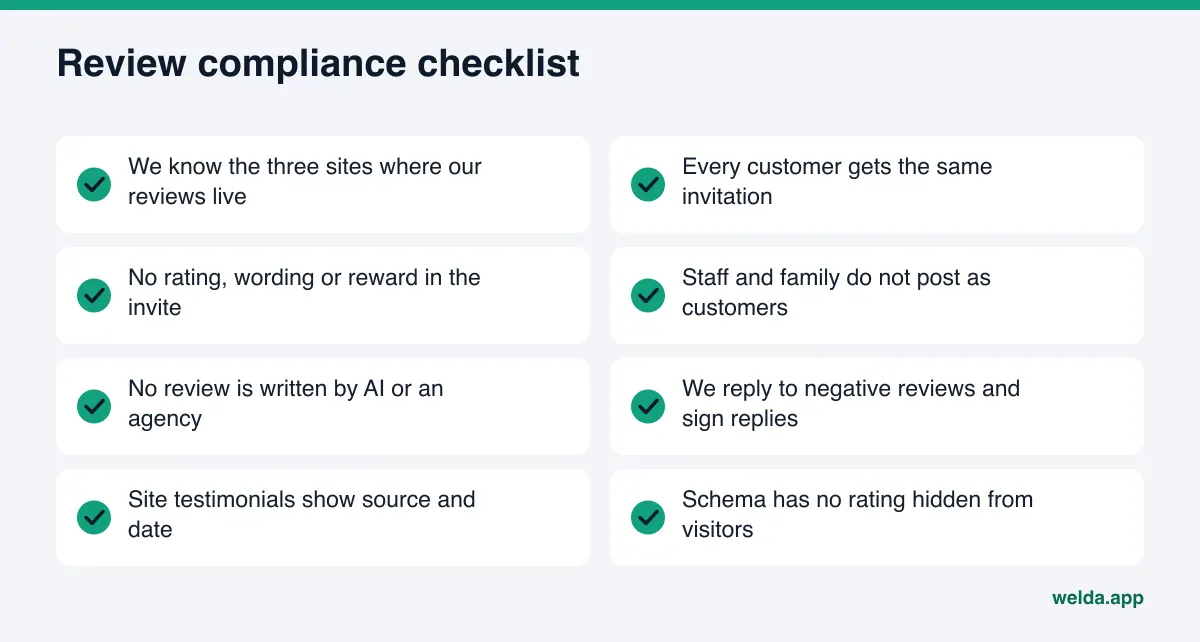
- We know the three places where most of our reviews live.
- Every customer gets the same review invitation.
- The invitation asks for no rating, no wording and offers no reward.
- Staff and family do not post reviews as regular customers.
- No review is written by AI, an agency or anyone but the customer.
- We reply to negative reviews calmly and sign our replies.
- Someone watches BBB and complaint notifications.
- Testimonials on our site show their source and date.
- Our schema contains no rating that is not visible on the page.
- Recurring complaints are answered in an FAQ on our site.
Keep in mind that AI visibility is not only about reviews. A readable website, accurate business details and clear service pages carry just as much weight. If your site also makes price or promotion claims, the same care applies; see pricing claims in AI-ready content.
Frequently asked questions
Is it illegal to have AI write reviews?
If a review did not come from someone with real experience and is presented as a customer review, the FTC states its rule covers it, including AI-generated fake reviews. Using AI to draft your replies to reviews is a different matter. This is not legal advice.
Can I ask customers for reviews?
Yes. The problems start when the request is selective, tied to an incentive or scripted. Sending every customer the same neutral invitation, with no rating or wording requested, is normal business practice.
Do fake reviews actually affect AI answers?
Answer engines can read review sites and map profiles as sources. But when platforms remove fake reviews, that effect disappears and can leave an inconsistent picture behind. Real reviews work slowly but stay.
Can I offer an incentive if I accept any rating?
The FTC rule focuses on incentives tied to sentiment, but Google's policy removes incentivized reviews in general. For Google Business Profile, the safe choice is no incentive at all. Ask counsel about other platforms and state law.
Does Welda collect or remove reviews?
No. Welda does not write, collect or remove reviews. It shows which sources your reviews sit on, drafts replies and flags risky wording before publishing. The decision to publish always stays with the business.
Does the free analysis look at my reviews?
The free analysis checks review and trust signals on your site: a testimonials section, links to map and social profiles, and business schema. It does not audit individual reviews on Google or Yelp. It is free once per site.
Next step
Fake reviews rules are not an obstacle to AI visibility. They point the way: reviews from real customers, good replies and clearly written trust information. To see where to start, run your site through the free AI visibility analysis. The report lists every gap, including review and trust signals, with how to fix each one. The link arrives by email and stays open for 14 days.