Can my website and AI-written content say we are "the best," and what do US advertising rules require? Under federal law, objective claims in advertising need a reasonable basis before they run, and comparisons with competitors have to be truthful. "Best," "#1," "only," and "leading" can cross from opinion into a claim you have to prove. For AEO (answer engine optimization), an unsupported superlative adds nothing an AI assistant can check, while concrete facts do. This guide covers best claims and advertising rules in AI content, how to clean up your pages step by step, and how Welda flags these phrases before anything is published. It is not legal advice.
Best claims and advertising rules in AI content: the US framework
Your homepage, service pages, Google Business Profile description, Instagram bio, and even your replies to reviews are all commercial speech. When those words promote what you sell, US advertising law applies to them just as it applies to a print ad or a TV spot. The core rule comes from Section 5 of the FTC Act, which prohibits unfair or deceptive acts or practices. Three FTC documents explain how that rule treats superlatives and comparisons:
- Substantiation. The FTC's Policy Statement Regarding Advertising Substantiation says advertisers need a reasonable basis for objective claims before those claims are disseminated. If an ad says "tests prove" or "studies show," the advertiser is expected to have at least that level of support.
- Objective versus subjective. The FTC's advertising guide for small businesses explains that proof is required before the ad runs, and that subjective claims consumers can judge for themselves (its example is a cola that "tastes great") receive less attention. The same guide notes that competitors can challenge deceptive comparisons under the Lanham Act or through the National Advertising Division.
- Comparisons. The FTC's Statement of Policy Regarding Comparative Advertising encourages truthful comparisons that name competitors, and judges them by the same standard as any other ad: whether they have a tendency or capacity to deceive.
On top of federal rules, states have their own consumer protection laws, and many professions (attorneys, healthcare providers, financial advisors) have additional advertising rules from their licensing bodies. Before you publish a specific claim, check the rules that apply to your state and your profession. This article is a working map, not a legal opinion; whether a particular sentence is acceptable is a question for your attorney.
Why superlatives matter for AEO and AI search visibility
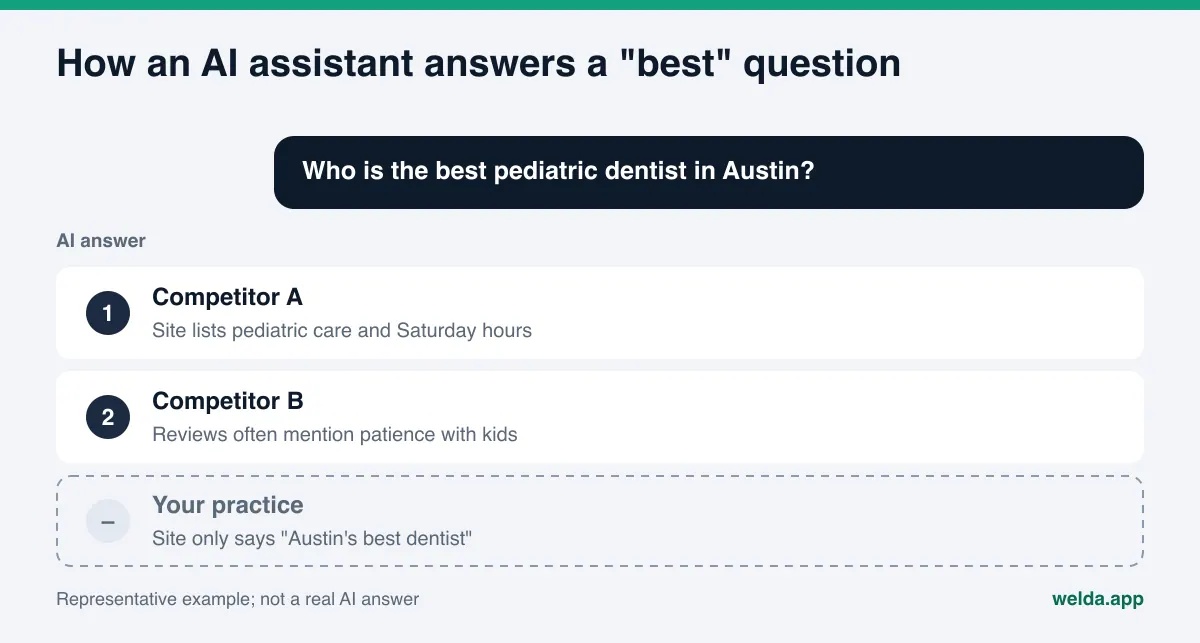
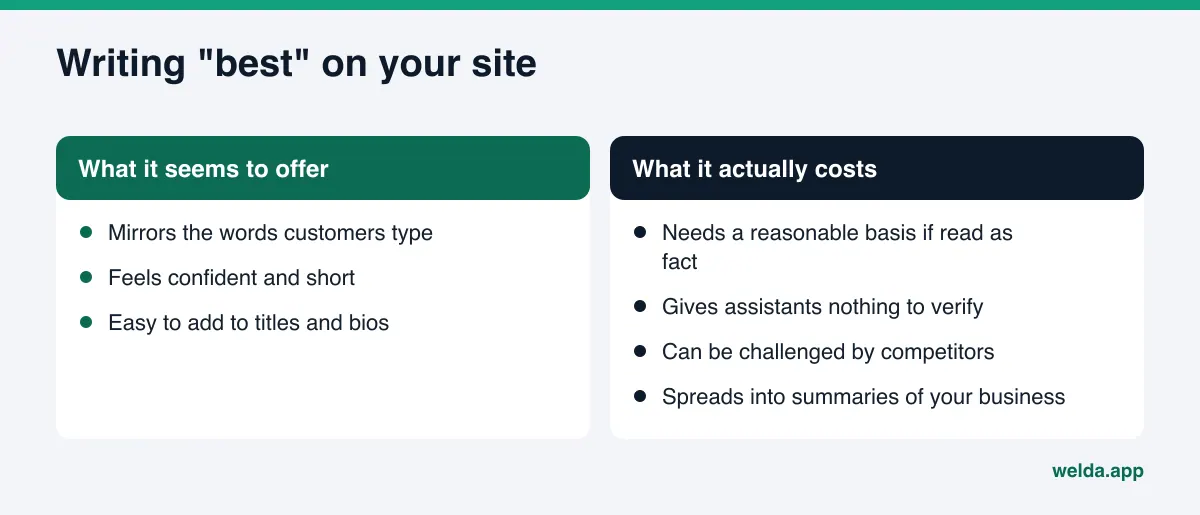
AEO, sometimes also called GEO (generative engine optimization), is the work of making sure AI assistants such as ChatGPT, Gemini, Perplexity, and Google's AI Overviews can find and describe your business correctly. Many of the questions people ask those assistants are "best" questions: "Who is the best pediatric dentist in Austin?", "best HVAC company near me that does weekend service", "best family-friendly hotel in San Diego". When a business owner sees those questions, the first instinct is to put "Austin's best pediatric dentist" on the homepage. The logic seems straightforward: if the question says "best," the page should too.
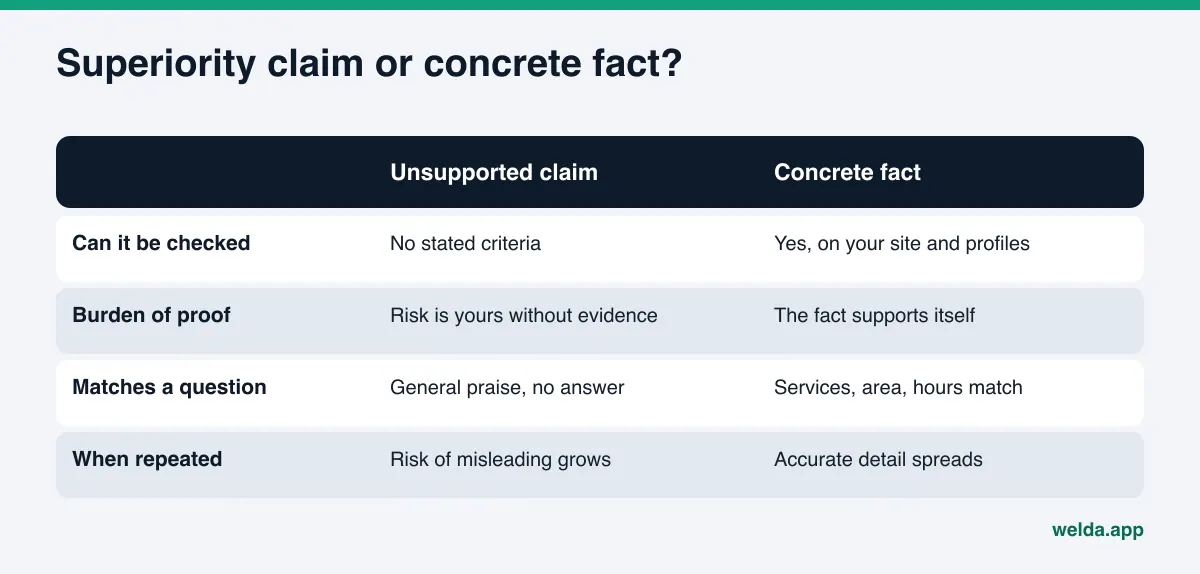
Those are two different jobs. When an assistant recommends a business, it needs reasons it can state: what services are offered, in which neighborhood, for whom, during which hours, what reviewers say, what other sources confirm. "We are the best" supplies none of those reasons. A business's own unsupported claim about itself is not something an assistant can verify. Sentences like "open Saturdays 9 a.m. to 2 p.m.," "we see children from age one," or "a 21-room hotel two blocks from the beach" are both checkable and likely to match the question a customer actually typed.
The second risk is quieter. When you use an AI tool to draft content, the model can add promotional language on its own. Phrases like "industry-leading," "the most trusted name in town," and "unmatched quality" slip into drafts without anyone asking for them. Publish the draft without reading it, and those phrases become your advertising. We cover where responsibility lands in liability for errors in AI-written content.
The third risk is amplification. A sentence on your site can come back to you as part of an AI summary of your business. Accurate, documented facts help you when they spread. An unsupported claim that spreads widens the chance of misleading people and is harder to correct later.
To see which facts your site states clearly today and which are missing, you can run the free site analysis. It reads your homepage and a few inner pages and checks how clearly your services are described, your review and trust signals, your business information, and whether you have an FAQ section.
Which "best" claims are risky, and what to write instead
Not every positive statement carries the same weight. "Our friendly team" is a subjective description. "The most-chosen clinic in Denver" sounds like a measurable fact, and if you cannot back it up, it reads as deceptive. The table below lists common patterns and alternatives that also work better for AI search visibility.
| Common phrase | Why it is risky | Concrete alternative |
|---|---|---|
| "Best hotel in the city" | No criteria, no source; reads like a fact | Room count, location, who it suits, what amenities exist |
| "#1 roofer in Phoenix" | Implies a ranking someone measured | Years in business, services offered, service area |
| "The only clinic offering..." | Uniqueness is hard to prove and changes over time | What the service is and how you deliver it |
| "98% of customers recommend us" | A statistic; misleading without a real survey | Link to your reviews, or a figure you actually measured, with its source |
| "Cheaper than the competition" | Comparative claim; needs a fair, current comparison | Your own pricing structure, what is included, last updated date |
| "Award-winning restaurant" | Which award, from whom, when? | Award name, issuing organization, year, link to the source |
| "Guaranteed results" | Guarantee claims have their own rules; restricted in healthcare | How the process works and what happens in which case |
The right-hand column does two jobs at once. It moves the claim onto ground you can support, and it gives AI assistants information they can match to a question. Price claims have their own rules; see pricing claims in AI-ready content.
Is it ever OK to say "best"?
The rule does not ban the word. It targets claims you cannot support. A business can have real backing for a superiority claim: an independent survey, a named award with a year, a public ranking with a stated method. In that case the job is to state the claim together with its source, and only as broadly as the source allows.
For example, if a restaurant appeared on a city magazine's annual list, "the best restaurant in town" overstates it. "Named to [magazine]'s 2026 list of top neighborhood restaurants" is accurate and documented. It is also more useful for AEO, because the magazine itself is a source an assistant can read, and the two pieces of information confirm each other. Keep the claim within the scope of the source: a category award should not become a business-wide "best." Watch the dates too: last year's award is not this year's claim.
Pure opinion sits in a different place. "We love serving breakfast on the patio" or "we aim to give guests a quiet stay" are not factual claims. The line is not always sharp, though; the same sentence can imply superiority depending on context. When you are unsure, ask your attorney before publishing.
How to audit for best claims and advertising rules in AI content, step by step
Use this sequence to clean up existing content and to get new content right from the start. The first pass usually takes a few hours. After that, the same check becomes a habit of a few minutes per new page.
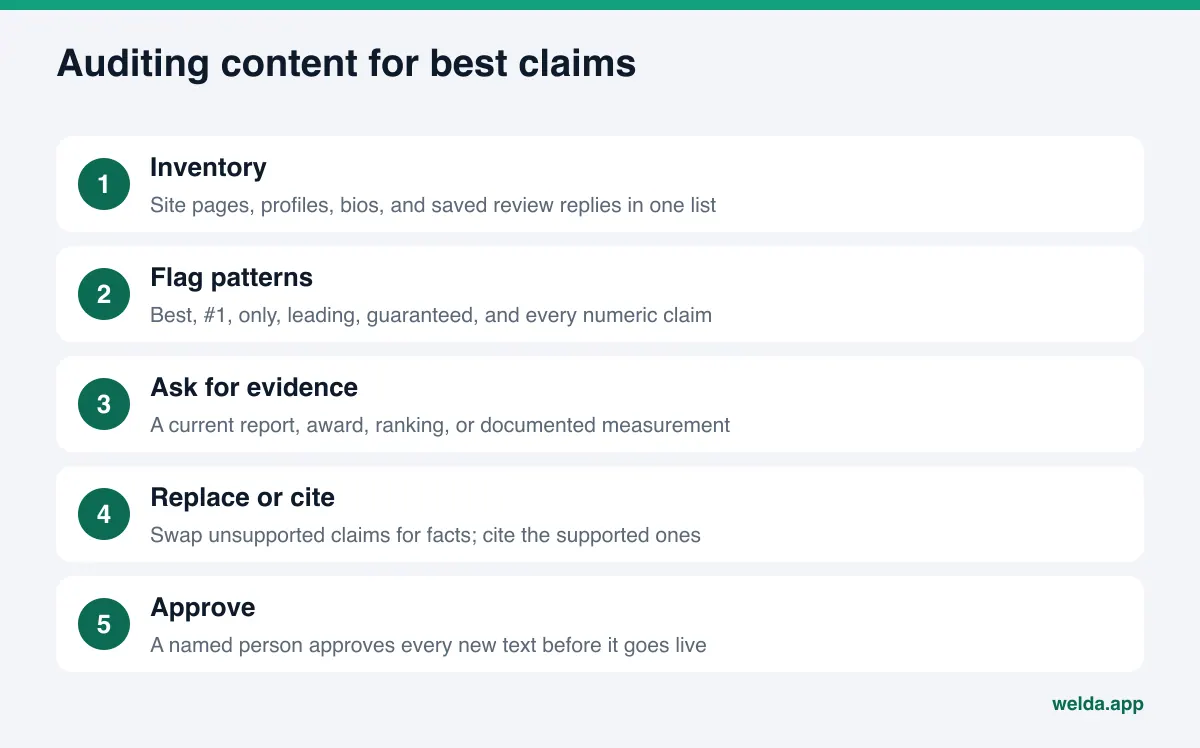
- Inventory everything. List your homepage, service pages, About page, FAQ, blog posts, Google Business Profile description, Yelp business description, social bios, and any saved review replies. AI assistants can read all of them.
- Flag the patterns. Search for "best," "#1," "number one," "only," "first," "leading," "top-rated," "unmatched," "better than," "lowest price," and "guaranteed." Flag every number-based claim (percentages, customer counts, years) separately.
- Ask for the evidence. For each claim: is there a report, award certificate, independent ranking, or your own documented measurement behind it? Was it current when the content went live? Does its scope match the sentence?
- Replace unsupported claims with facts. As in the table above, swap the claim for something checkable: what the service is, who it suits, where and when it is offered.
- Cite the supported ones. Name the award, the organization, the year; say who ran the survey and when. Keep the documents in one folder so you can produce them if asked.
- Check profession-specific rules. Healthcare, legal, and financial services carry extra restrictions. For medical and dental practices, see compliant AEO content for healthcare practices.
- Make approval permanent. Whoever writes new content (you, an agency, an AI tool), a named person approves it before it goes live. The setup is covered in content approval workflow for AEO.
Example: one service paragraph, before and after
Here is what the audit looks like on a real-world style paragraph. Imagine an example veterinary clinic whose services page opens with this AI-drafted introduction:
"As the best veterinary clinic in the city, our industry-leading team delivers unmatched care for your pets. 99% of our clients recommend us."
That short paragraph carries four separate claims: "best clinic" (superiority), "industry-leading team" (comparison), "unmatched care" (uniqueness), and "99%" (a statistic). None is supported on the page. For AEO it is also empty: it does not say which animals the clinic treats, whether it handles urgent cases, or when it is open. A rewrite built on facts might read:
"We provide vaccinations, spay and neuter surgery, and dental care for cats and dogs. We are open weekdays 8 a.m. to 6 p.m. and Saturdays 9 a.m. to 1 p.m.; book by phone or online. Our team includes two veterinarians and a licensed veterinary technician."
The new version contains no praise, but it tells readers and assistants everything they need. It can match questions like "vet open Saturday" or "cat spay near me." Every detail is something the business can confirm, and easy to correct if it changes. The hours and staff in this example are illustrative only; your own paragraph should state only your real details.
Where superlatives slip into AI-generated content
AI drafting lets businesses fill missing pages quickly. That speed also tempts people to skip the review step. Superlatives usually enter content through four doors:
- Intro paragraphs. Ask a model for "an introduction about our business" and it reaches for marketing patterns it has seen, which is why "trusted leader" shows up so often.
- Title and meta description suggestions. Short fields reward punchy words, and "best" and "#1" are the easiest to reach for.
- FAQ answers. The answer to "Why choose us?" is one sentence away from a comparative claim.
- Review replies. "We will keep being the best plumber in Tampa" in reply to a five-star review on Yelp or Google is still your commercial speech.
None of this requires bad intent. The problem is a draft going live unread. So the fix is a process, not a tool: every generated text gets scanned for specific patterns and approved by a person before publication. Reviews themselves come with a separate set of federal rules; see fake reviews rules and AI visibility.
How Welda handles superiority claims
Welda is software that measures where a business shows up in AI answers and prepares the missing content on the business's behalf. Three parts of it relate directly to this topic: the compliance check before publication, the approval queue, and the rule that it does not invent facts.
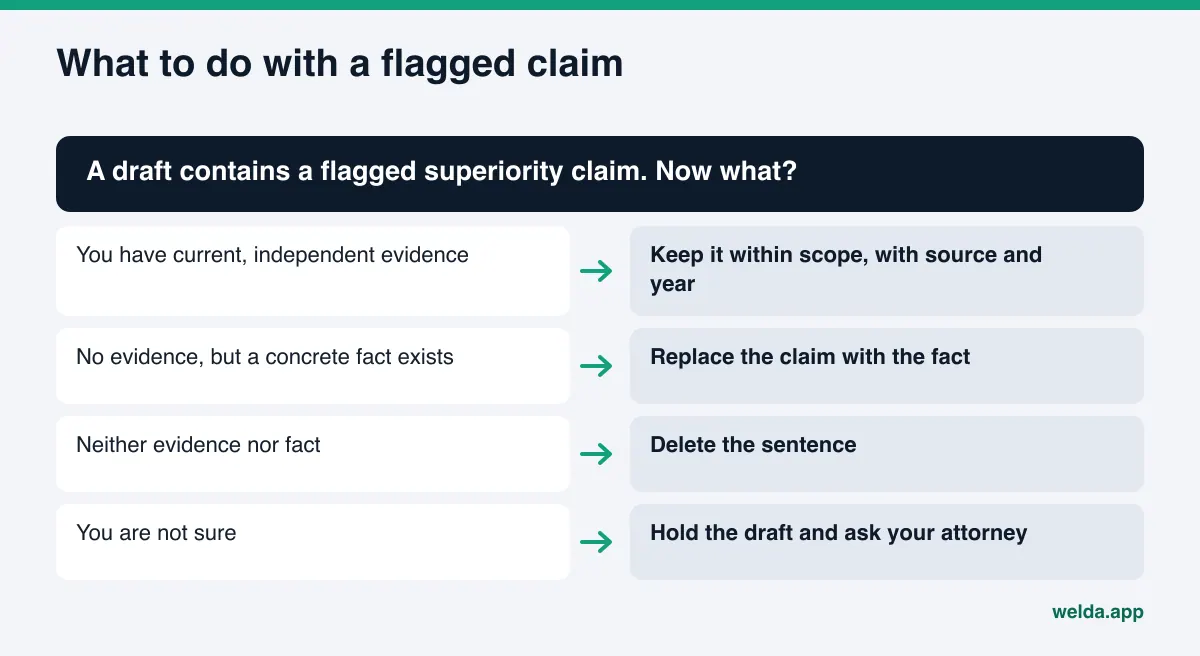
Compliance check. Every piece of content Welda prepares is scanned for patterns before it goes anywhere. Pricing language, guarantee language, superiority claims, and, in healthcare, anything that reads like a diagnosis are flagged. Say a draft service page includes "the most experienced team in the county." That sentence shows up as a separate flag in the panel's compliance check. You read it and choose one of three paths: keep it with its source if you have documentation, replace it with a concrete fact, or delete it. This check is not legal advice and has not been reviewed by legal counsel; its job is to put the phrases you might miss in front of you before they go live.
Approval queue. Welda drafts content, profile text, and review replies; the decision to publish stays with you. Drafts wait in the to-do list under items awaiting approval. On WordPress sites, Welda connects through a dedicated Editor user and an application password, so content opens as a draft and goes live only after you approve it. For systems without a connection, Welda hands you a ready package and the change is made by hand. In healthcare there is no automatic publishing at all; every item comes to you for approval.
No invented facts. Superlatives usually fill a gap: when a model does not know how long a business has operated or which credentials it holds, it pads with general praise. Welda does not fill that gap. Information it cannot read from your site, it asks you for, and once you answer, the detail is applied across every related draft. So where a generic tool would write "best," the draft carries the fact you supplied.
The rest of the panel puts this in context: the questions view shows whether your name appears for the "best" questions customers ask, and the competitor view shows which topic and which source a competitor wins on.
Limits: what Welda does not do
Being honest about limits matters as much as the topic itself.
- Welda does not give legal opinions. The compliance check is a pattern scan; whether a phrase is lawful is your attorney's call.
- It does not guarantee rankings or "showing up in ChatGPT." No tool can honestly promise that.
- It does not add facts it does not know, awards you have not won, or statistics nobody measured. It asks you.
- It does not publish sensitive content without your approval, and it does not write fake reviews.
- Handling negative reviews, directory accounts such as BBB or Angi, and press outreach stays with you.
Here is where the product stands today. The free site analysis works in English and is open to anyone now. The full Welda panel is in early access and is opening first in Turkey; regular measurement across four AI engines is being added during early access, and sample panel screens use representative data. Pricing is discussed in the early access conversation. New content also takes time to show up in AI answers, usually weeks; a corrected sentence will not appear in answers the next day.
Pre-publication checklist for best claims
Use this list for every new page, profile description, or batch of review replies. If any answer is "no," fix the text before it goes live.
- Does the text use "best," "#1," "only," "first," "leading," or "unmatched"? If so, is the evidence for each one on file?
- Does every numeric claim (percentages, customer counts, years) have a known, current source?
- If competitors are compared, is the comparison fair, measurable, and current?
- If an award is mentioned, are its name, the issuing organization, and the year stated?
- Is there any guarantee or promise of results, and does your profession allow it?
- Has generic praise been replaced with services, location, hours, and who you serve?
- Has a named person read and approved the text?
- Have state and profession-specific advertising rules been checked?
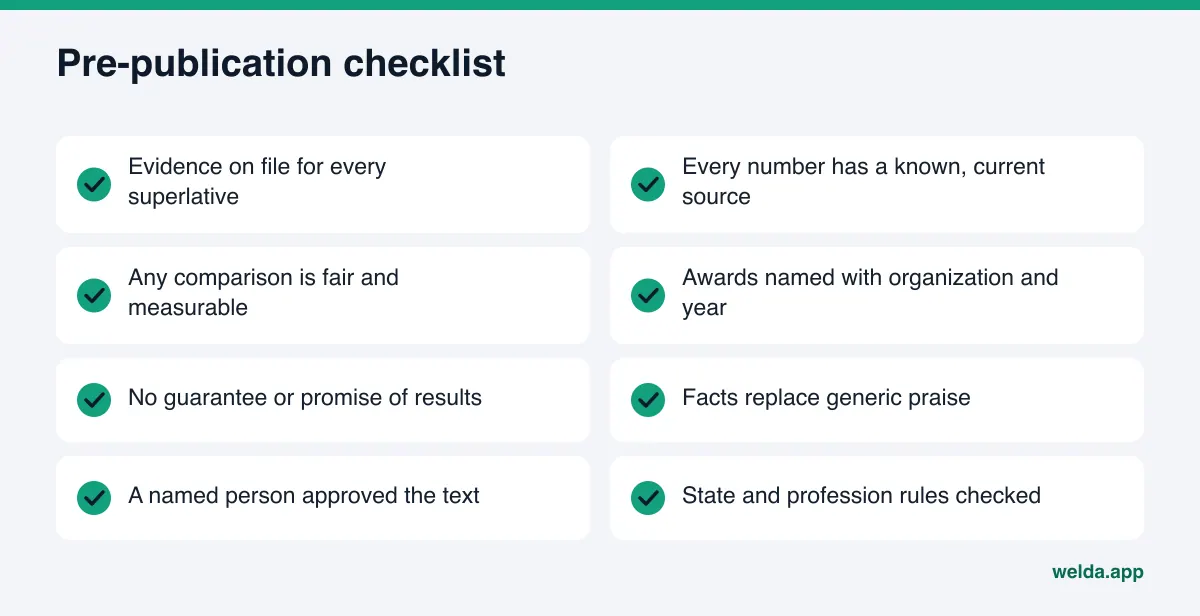
Text that passes this list is easier to defend under advertising rules and carries the facts AI assistants need to describe you accurately.
Frequently asked questions
Is the word "best" banned in US advertising?
No. Subjective opinion that consumers can judge for themselves draws less scrutiny. The problem is a claim that sounds objective and lacks a reasonable basis. If you have independent support, state the claim within its scope and cite the source. Ask your attorney about specific wording.
If my site says "best," will AI assistants recommend me more?
There is no measurement showing that, and Welda does not promise any such effect. An assistant needs checkable reasons to justify a recommendation, and a business's unsupported claim about itself does not provide one. Services, location, hours, and who you serve match questions more easily.
Who is responsible for a claim an AI tool wrote?
You are the one publishing it on your site or profile, so as the advertiser you carry the burden of supporting it. That is why every AI-drafted text should be read and approved before it goes live.
Do review replies count as advertising?
Review replies are part of your business's commercial communication. "We'll keep being the best in town" raises the same questions as the same sentence on your homepage. Thanks, concrete information, and a fix when needed are safer replies.
Does Welda's compliance check replace an attorney?
No. It flags pricing, guarantee, superiority, and diagnosis-style patterns before publication. It is not legal advice and has not been reviewed by legal counsel. The final decision and responsibility stay with the business.
Does the free analysis check for superiority claims?
The free analysis does not run a legal review. It shows how AI reads your site, how clearly your services are described, your trust signals, and what information is missing, and it suggests ready-to-use homepage text. Read those suggestions against the checklist above before you publish them.
Bottom line: facts first, claims second
Showing up for "best" questions in AI search does not start with writing "best" on your site. It starts with stating the concrete, checkable facts that answer the customer's question, and using superiority claims only with their source, or not at all. That is also what US advertising rules ask of you. To see how AI reads your site today, which information is missing, and which fixes would raise your score most, run the free site analysis. It is free once per site, and the results link arrives by email.