How do you create compliant AEO content for healthcare practices? You write content that gives AI assistants clear, verifiable facts about your practice (services, providers, location, hours, how to book) and you keep out the claims that health advertising rules restrict: unsupported outcome promises, misleading testimonials and patient details shared without authorization. Compliant AEO content for healthcare practices is less about clever copy and more about accurate information plus a review step before anything goes live.
Why compliant AEO content matters for a healthcare practice
Patients now ask ChatGPT, Gemini, Perplexity and Google's AI Overviews questions like "Which dentist near me takes walk-ins on Saturday?" or "Is there a pediatric dermatologist in Austin who sees new patients?" The assistant assembles an answer from practice websites, Google Business Profile listings, Yelp and Healthgrades pages, review sites and local directories. Answer engine optimization (AEO), the work of making your practice easy for these systems to understand and cite, is largely about publishing that information clearly and consistently. You will also see the same work called GEO, generative engine optimization; in the US, AEO and "AI search visibility" are the more common terms.
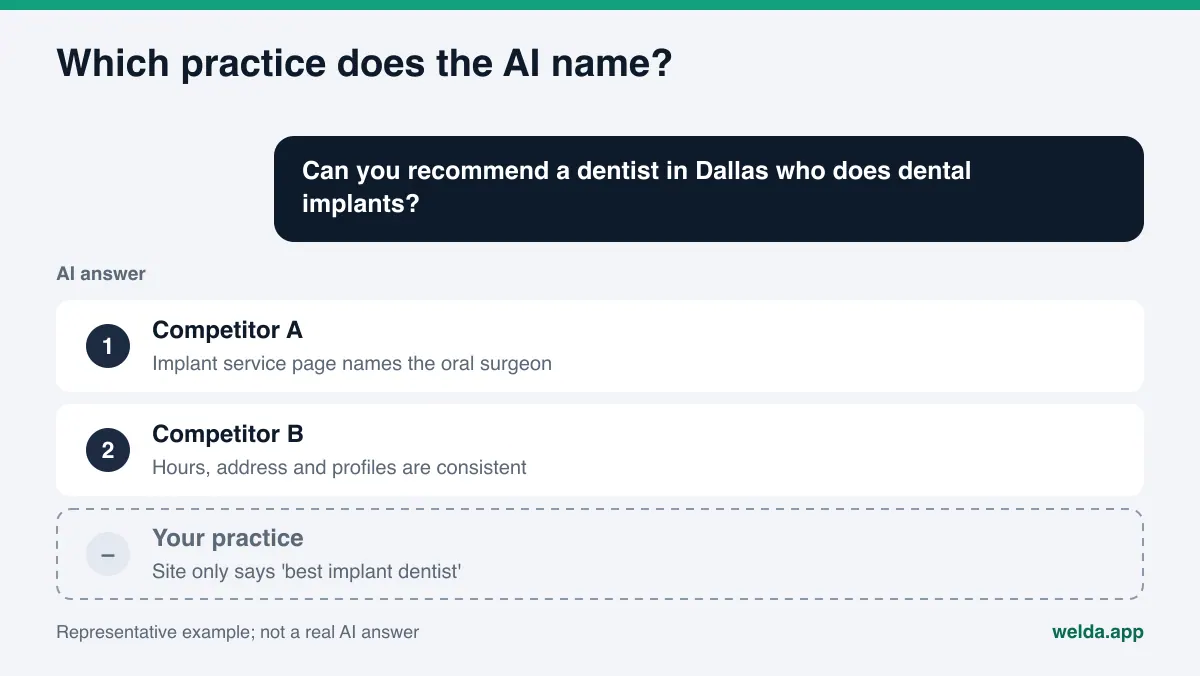
Here is the tension. The sentences that are easiest for an AI system to repeat are often the most promotional ones: "the best implant dentist in Dallas," "pain-free root canals, guaranteed," "our patients love us." In healthcare, many of those sentences create risk. Federal truth-in-advertising law applies to health claims no matter who or what wrote them, and patient information carries its own privacy rules. A practice that uses AI writing tools to scale content quickly can end up publishing the same risky claim on twenty service pages, three social profiles and its Google Business Profile in an afternoon.
There is a second risk. AI writing tools fill gaps with guesses. They can invent a board certification, a procedure your office does not offer or a success rate nobody measured. In healthcare, that is not just a factual error; it can mislead patients and turn an information page into a deceptive ad. We cover the responsibility side in more depth in our piece on liability for errors in AI-written content.
So the goal is to do two things at once: give answer engines enough accurate detail to describe your practice correctly, and do it in plain informational language that stays clear of restricted claims. If you want to see where your own site stands today, the free site analysis reads your homepage and a few inner pages the way Google and AI systems do and checks whether services are clearly described, whether you have an FAQ section and which trust signals are visible.
Which US rules shape compliant AEO content for healthcare practices?
There is no single federal "healthcare advertising code" for private practices. Several overlapping rules apply, and your state medical, dental or professional board may add its own advertising rules on top. The table below lists the federal rules that most often affect content written for AI search visibility. It is a summary for orientation, not legal advice; read the primary sources and talk to your counsel about your situation.
| Rule or guidance | What it says, in short | Where it shows up in AEO content |
|---|---|---|
| FTC truth-in-advertising principles and the FTC's Health Products Compliance Guidance | Health benefit and safety claims need "competent and reliable scientific evidence"; consumer anecdotes are never enough to substantiate a health claim | Outcome claims on service pages, FAQ answers, blog intros |
| FTC Endorsement Guides (FTC FAQ) | If a testimonial shows exceptional results, the ad must make clear what people can generally expect | "Patient stories" sections, before-and-after captions, quoted reviews |
| FTC rule on consumer reviews and testimonials (announced August 14, 2024) | Bans fake reviews and testimonials, including AI-generated ones, and undisclosed insider reviews | Review widgets, profile reviews, any content written "in a patient's voice" |
| HIPAA Privacy Rule, 45 CFR 164.508 | A covered entity must obtain an authorization for any use or disclosure of protected health information for marketing | Testimonials that identify patients, review replies that confirm someone was treated |
| State board advertising rules | Vary by state and profession; some address specialty claims, testimonials or "best" language | Provider bios, specialty descriptions, superlatives |
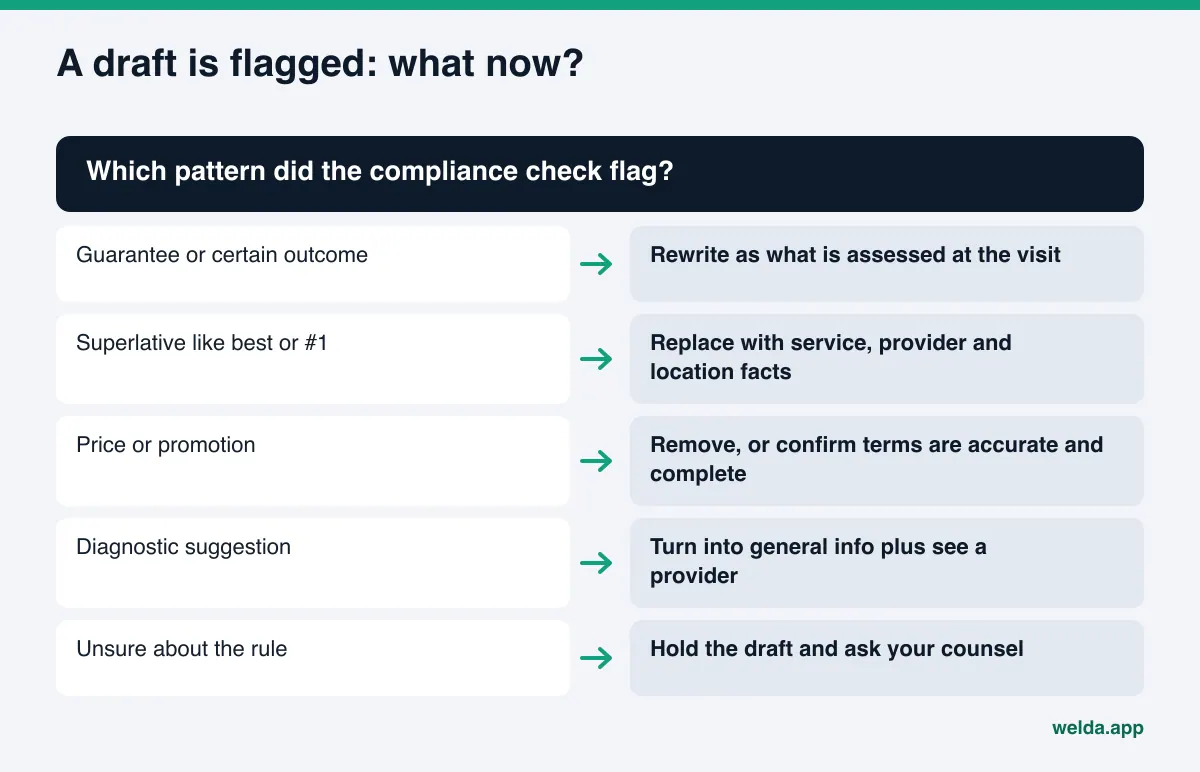
Two patterns cause the most trouble in practice. The first is superiority language: "top-rated," "leading," "#1" and "best" are hard to substantiate in healthcare and invite scrutiny. The broader rules are covered in our piece on best claims and advertising rules in AI content. The second is pricing and promotions, such as "$99 whitening this month only," where the terms have to be accurate and complete; see pricing claims in AI-ready content for the general framework.
Why answer engines can cite compliant content just as well
A common worry from practice owners is: "If we can't make bold claims, what will make an AI assistant recommend us?" The answer lies in what the assistant actually needs. When a patient asks "Is there a pediatric dentist in Plano open on weekends?", the system is not looking for a slogan. It is looking for facts it can match and cross-check:
- Does the practice actually offer this service, and is it stated clearly on a service page?
- Where is the practice, which neighborhood, and what are the hours?
- Which provider delivers the service, and what is their specialty?
- How does a patient book, and are the phone number and address consistent everywhere?
- Do the Google Business Profile, Healthgrades listing and website say the same thing?
- Are answers to common patient questions published on the site?
None of these require a restricted claim. In fact, accurate patient information and AI-friendly content overlap almost completely. "Our implant success rate is outstanding" is a weak source for an answer engine because nothing in it can be verified. "Dental implants at our Plano office are placed by our oral surgeon after an exam and imaging to confirm you are a candidate" is safer and gives the assistant a service, a location and a provider to connect to your practice.
Step by step: building compliant AEO content
The steps below fit a dental office, a dermatology clinic, a physical therapy practice, a med spa or a solo physician. Following them in order saves you from fixing the same risky sentence in ten places later.
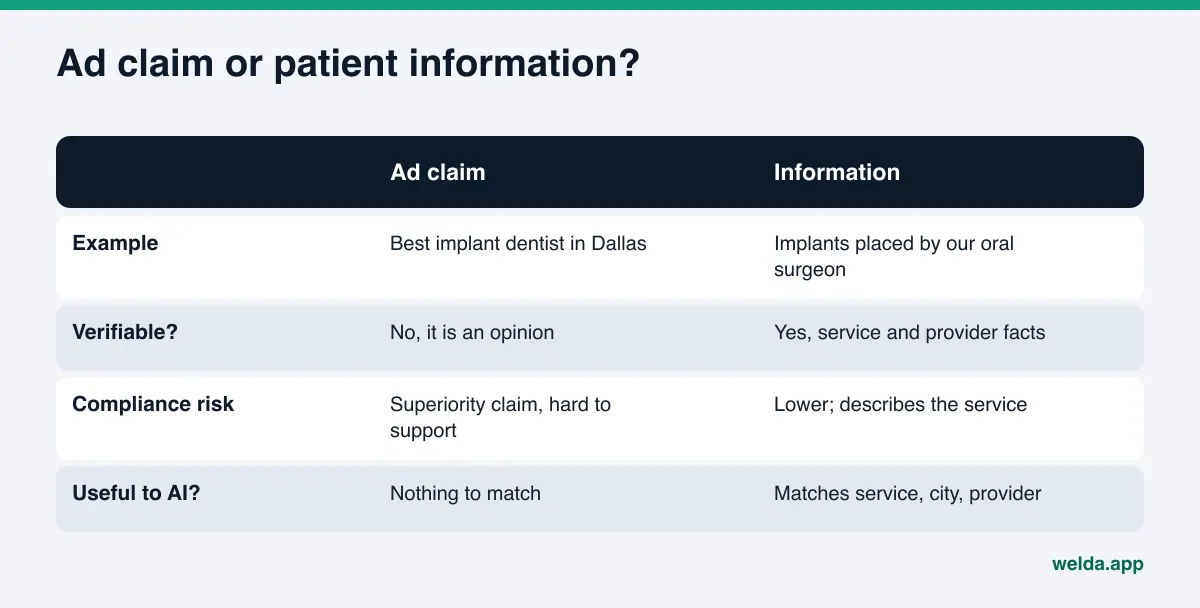
- Build a fact sheet first. List your services, which provider handles each, office locations, hours, holiday hours, insurance information you are comfortable publishing and how to book. Hand this to anyone, or any tool, that writes content for you. Without it, gaps get filled with guesses.
- Write a "never publish" list. Collect the phrases your practice will not use: "guaranteed," "pain-free," "permanent," "best," "#1," fear-based hooks, unqualified patient quotes and anything that identifies a patient. Share it with every writer and every tool.
- Create one information page per service. Explain what the treatment is, who it may be appropriate for, what the evaluation looks like and how to schedule. Leave out outcome promises, timelines presented as certain and any price claim you cannot keep accurate.
- Write FAQ answers in patient language. "How soon can I eat after a tooth extraction?" deserves a general answer plus a note that individual cases are assessed at the visit. Avoid answers that diagnose ("if your gums bleed, you have periodontitis").
- Add structured business information. Publish name, address, phone, hours and practice type as visible text and as schema markup. Make sure it matches your Google Business Profile, Yelp and Healthgrades listings.
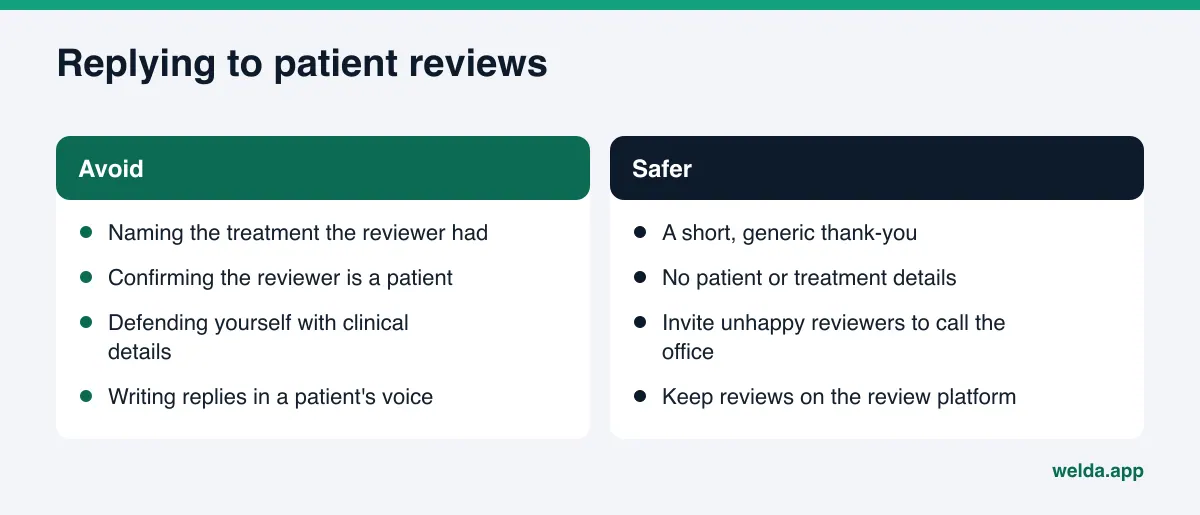
- Apply the same rules to profiles and review replies. Your Google Business Profile description, Instagram bio and Facebook "About" section are advertising too. In review replies, never confirm that the reviewer is a patient or mention their treatment.
- Review in two passes before publishing. First a pattern scan for restricted phrases (pricing, guarantees, superiority, diagnosis), then a full read by a person who knows the practice. Bring in counsel for anything unusual.
- Keep a record. Note which text went live, when and who approved it. If a question ever comes up, the record helps.
How to set up the approval step without slowing your AEO work to a crawl is covered in our guide to a content approval workflow for AEO.
Rewriting risky sentences into compliant ones: examples
Knowing the rules and fixing a page are different skills. The examples below show sentence types that appear often on practice websites and in first drafts from AI writing tools, with a safer direction for each. They are illustrative and do not come from any real practice. The "safer direction" column is not legal approval; it only shows which way to move.
| Risky sentence type | Why it is risky | Safer direction |
|---|---|---|
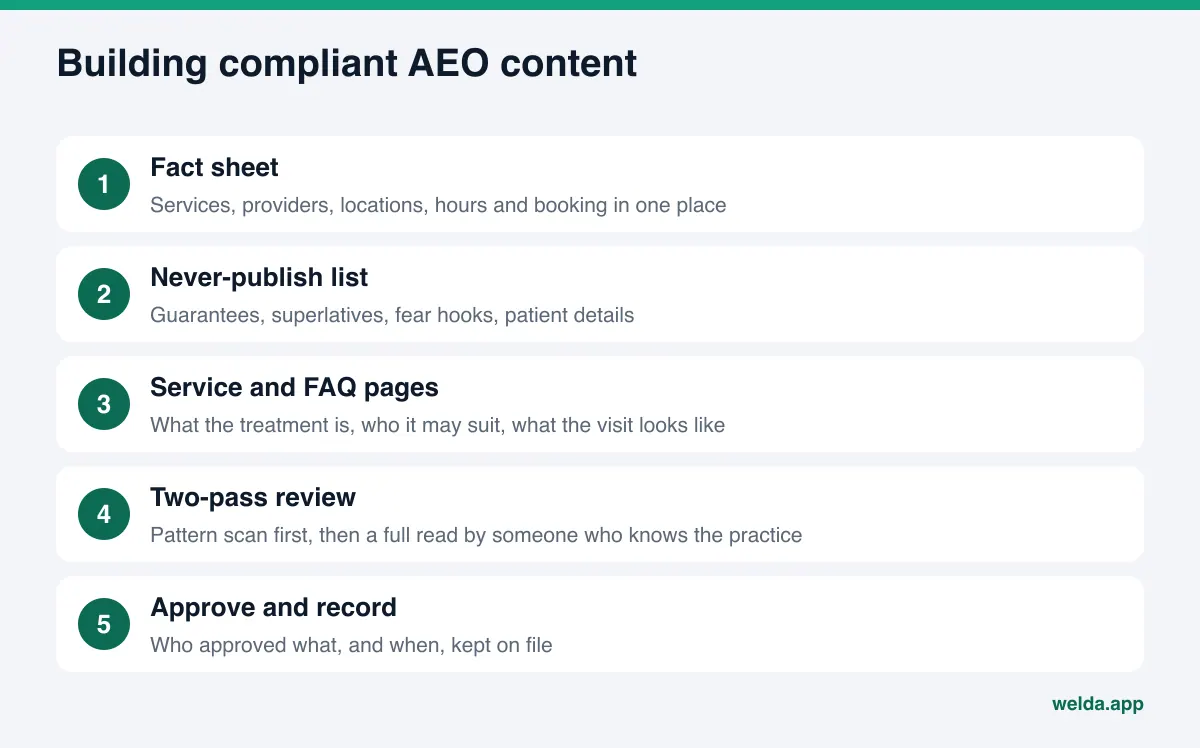
| "The best implant dentist in Dallas" | Superiority claim that is hard to substantiate | "Dental implants in Dallas, placed by our oral surgeon after an exam and imaging" |
| "Pain-free root canals, guaranteed" | Outcome guarantee for something that varies by patient | "We explain anesthesia options and aftercare for root canal treatment at your visit" |
| "Lose 20 pounds in 30 days with our program" | Specific health result that needs scientific support and typical-results context | "Our program starts with an evaluation; your provider explains what to expect based on your health history" |
| "Hear what our patients say" with named quotes and treatment details | May involve patient information used for marketing without authorization; testimonials may not reflect typical results | Keep reviews on review platforms and reply there without patient details |
| "If your gums bleed, you have gum disease" | Diagnostic statement that can mislead and alarm | "Bleeding gums can have several causes; your dentist can evaluate the cause at an exam" |
| "Unlike other clinics, we use only premium materials" | Comparative claim that needs support | Describe the materials and process you use without comparing |
Notice that the safer sentences are also more useful to an answer engine. They name a service, a city, a provider type and a next step. An assistant answering "implant dentist in Dallas" can use that to match your practice to the question. "The best" carries no checkable information at all.
Reviews, profiles and HIPAA: where healthcare AEO needs extra care
AI answers do not come from your website alone. Google Business Profile reviews, Yelp, Healthgrades, Zocdoc-style booking profiles, Reddit threads and local directories all feed the picture. Two points need special attention in healthcare.
The first is review replies. Answering a five-star review with "We're so glad your implant surgery went well, Maria" confirms that the reviewer is a patient and discloses their treatment. For a covered practice, that kind of reply can raise HIPAA questions, because the patient posting a review is not the same as the practice disclosing their information. Talk to your privacy officer or counsel before setting a reply policy. A safer reply is short, warm and generic, and for negative reviews it invites the person to contact the office directly instead of debating the details in public.
The second is fake or steered reviews. Buying reviews, having staff post them or asking an AI tool to write reviews "from a patient's perspective" runs straight into the FTC's rule on fake reviews and testimonials, which explicitly names AI-generated fake reviews. For the broader picture, see our piece on fake reviews rules and AI visibility. Inflating review counts is not an AEO shortcut; it is a liability.
How Welda handles compliant content: compliance check and approval queue
Welda is software that measures where a business appears in AI answers and fills the gaps on the business's behalf by drafting content, profile text and review replies. For a healthcare practice, two parts of that work matter most here: the compliance check before publishing and an approval flow with auto-publishing switched off.
Compliance check. Every draft Welda prepares passes a pattern scan before it reaches you for approval. Pricing language, guarantee wording, superiority claims and diagnostic suggestions are flagged. If a draft service page for dental implants contains "guaranteed results" or a discount line, that phrase shows up flagged on the approval screen so it is the first thing you review. This check is not legal advice and has not been reviewed by legal counsel. Its job is to make easy-to-miss patterns visible before anything goes live; the final decision stays with the practice.
Approval queue. In healthcare, Welda never publishes automatically. Website pages, Facebook and Instagram posts and profile text all land in one to-do list as items waiting for your approval. You read each one, then approve or edit it. On a WordPress site, Welda connects through a separate Editor user with an application password, no plugin or code required, and new content opens as a draft that only goes live once approved. Where no connection exists, Welda provides a ready-to-apply package and the change is made by hand.
Asking instead of guessing. In healthcare content, invented detail is the biggest danger. When Welda cannot read something from your site, such as your hours, a full address, whether you offer sedation or the name of the supervising provider, it does not guess. It lists the missing fact and asks you. Once you fill it in, it flows into every related draft, and anything still missing stays flagged in the preview so an incomplete page does not go live by accident.
Patient data. In healthcare, patient data is not sent to AI. Welda works from your practice's public information and the business details you enter.
Measurement follows the same logic. Welda asks the questions patients are likely to ask, repeated across four engines, and shows where your practice is named and which sources are helping competitors. In healthcare, the point of that measurement is to answer "which question are we missing, and which fact is missing for it," not to justify bolder copy.
A clear word on availability: the Welda panel is in early access. It is opening in stages, first with businesses in Turkey, and regular four-engine measurement is being added during early access; sample screens use representative data. What anyone can use today, in English, is the free site analysis. Pricing is discussed in an early access conversation.
Limits: what Welda does not do
In a regulated field like healthcare, what a tool does not do matters as much as what it does:
- It does not guarantee rankings or "showing up in ChatGPT." AI answers change, and new content usually takes weeks to show up in them.
- It does not write facts it does not know; it asks you.
- It does not publish anything in healthcare without your approval.
- It does not create fake reviews or write in a patient's voice.
- It does not give legal advice. The compliance check flags patterns; it does not certify that a page meets FTC, HIPAA or state board requirements.
- Handling negative reviews, directory accounts and press work stays with your practice.
- It does not host your content; content always lives on your own website.
Pre-publish checklist for compliant AEO content
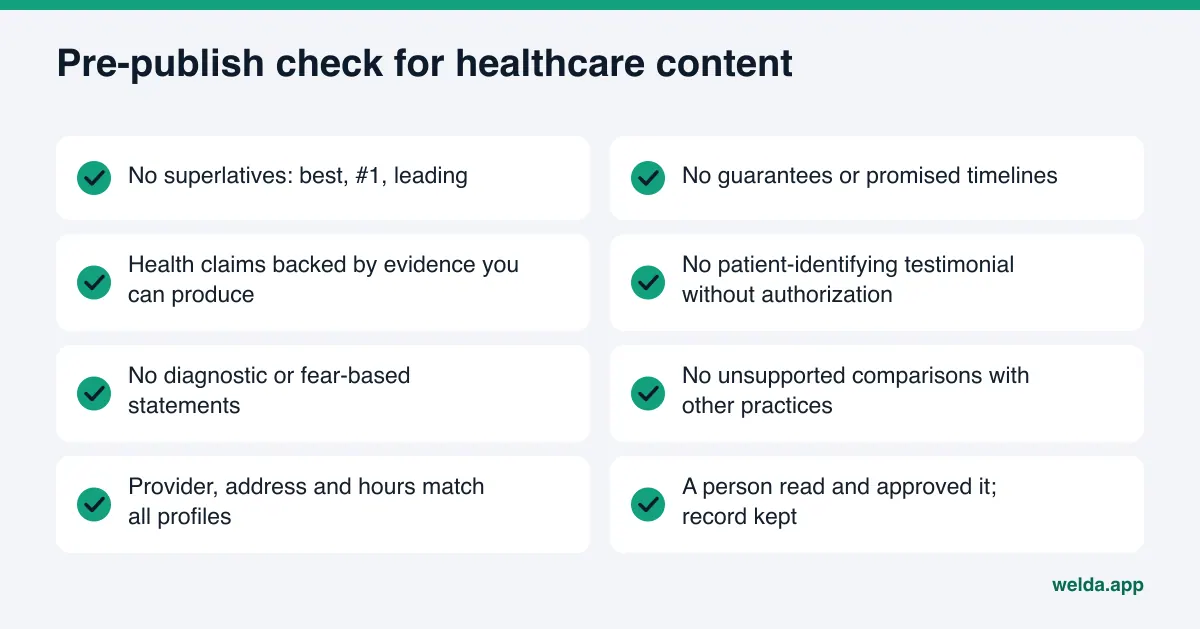
Before a page, post or profile update goes live, run through these questions in order. If the answer to any of them is "no" or "not sure," hold the text.
| Check | If yes | If no |
|---|---|---|
| No superlatives like "best," "#1" or "leading"? | Continue | Replace with service, provider and location facts |
| No guarantees, certain outcomes or promised timelines? | Continue | Rewrite as "assessed at your visit" |
| Every health benefit claim backed by evidence you could produce? | Continue | Remove the claim or describe the treatment instead |
| No patient-identifying testimonial without written authorization? | Continue | Remove it until authorization is on file |
| No diagnostic or fear-based statements? | Continue | Rewrite as general information plus "see a provider" |
| Provider, service, address and hours match all profiles? | Continue | Fix the facts first, then publish |
| A person read the full text and approved it? | Publish and keep the record | Do not publish yet |
This list covers patterns. If a page touches a specialized area, such as cosmetic procedures, weight-loss programs or telehealth across state lines, check the specific rules that apply and involve counsel.
Frequently asked questions
Is AI-written healthcare content against the rules?
The tool is not what the rules look at; the published claims are. If AI-assisted content is accurate, substantiated and free of restricted claims and patient information, the tool itself is not the issue. If it is not, the fact that an AI wrote it does not shift responsibility away from the practice.
If we can't make bold claims, how will AI assistants recommend us?
Answer engines look for facts, not slogans. Clear service pages, provider specialties, location, hours, schema markup, consistent profiles and answers to common patient questions are the raw material for being named in AI answers. None of that requires a restricted claim.
Can we put patient reviews on our website?
It depends on the details. Reviews that identify a patient or their treatment may involve HIPAA authorization requirements, and testimonials with exceptional results raise FTC typical-results questions. Many practices leave reviews on review platforms and reply there without patient details. Ask your counsel about your specific case.
Does Welda's compliance check guarantee a page is compliant?
No. It flags patterns such as pricing, guarantees, superiority claims and diagnostic suggestions before publishing. It is not legal advice and has not been reviewed by legal counsel. The final read and decision belong to the practice.
Does Welda auto-publish content for healthcare practices?
No. In healthcare there is no auto-publishing. Every item goes to your approval queue and nothing goes live until you approve it. On WordPress, content opens as a draft first.
Is patient data sent to AI?
No. In healthcare, patient data is not sent to AI. Welda works with your practice's public information and the business details you provide.
How long until compliant content shows up in AI answers?
There is no fixed timeline. New content usually takes weeks to be reflected in AI answers, and no result can be guaranteed. That is why content work should be paired with regular measurement.
Start by seeing what your site tells AI today
In healthcare, AI search visibility comes from clearer, more accurate information, not louder claims. The first step is to see what your website currently tells answer engines. The free site analysis reads your homepage and inner pages such as services, about and contact, and checks how clearly services are described, your business schema, address and phone details, FAQ content and trust signals. You get a score out of 100, a fix for each gap and ready-to-use homepage text suggestions. Run those suggestions through the checklist above before you publish them. The analysis is free once per site, works in English, does not measure rankings and does not promise them.