How do you rank in Perplexity? Perplexity runs a live web search for nearly every question and shows numbered sources next to its answer. To be named, your site has to be reachable by Perplexity's crawler, your pages have to answer the customer's question in plain sentences, and the outside sources Perplexity reads, like Google Business Profile, Yelp and industry directories, have to agree with your site.
This guide explains how to rank in Perplexity as a local or small business: how an answer gets built, which sources feed it, what to fix first, and how to tell whether anything changed. The broader discipline is usually called AEO, short for answer engine optimization, and Perplexity is one of the clearest answer engines to work with because it shows its sources. If you want to see how your own website reads to AI tools today before you change anything, run a free AI visibility analysis. One of the things it checks is whether AI crawlers are allowed into your site at all.
What "ranking" in Perplexity actually means
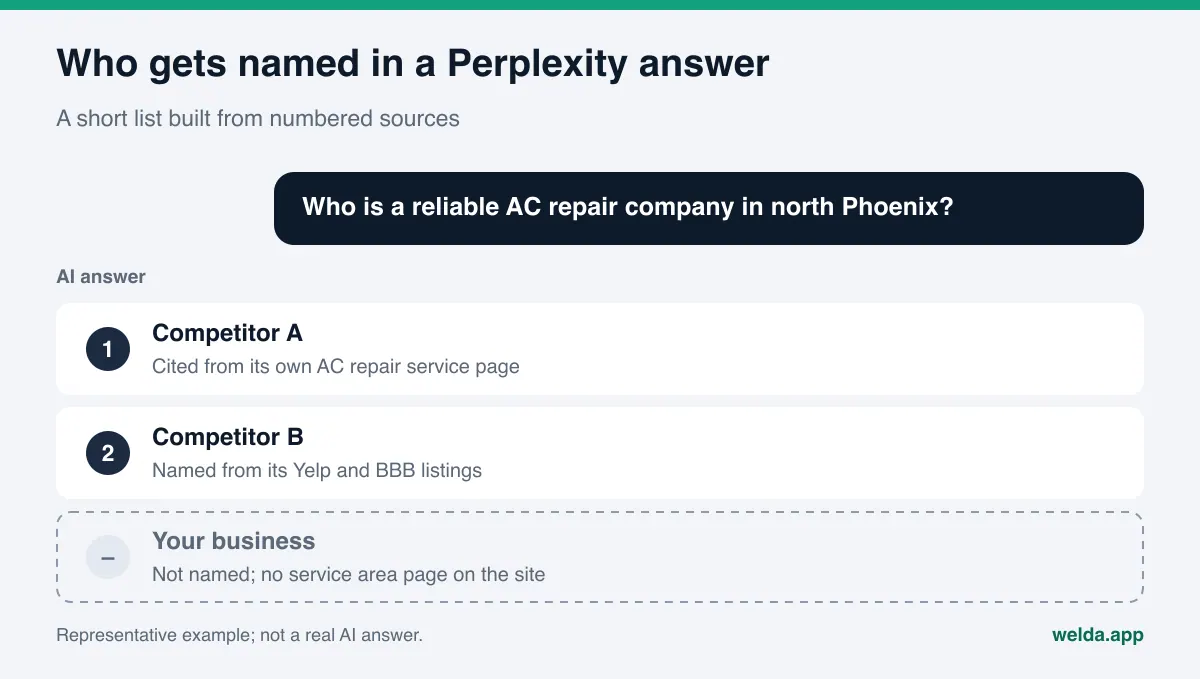
Perplexity does not show ten blue links. It writes a short answer, often a list of three to five businesses with a reason for each, and attaches numbered citations. Perplexity's own help center says that every answer includes numbered citations linking to the original sources and that the search happens in real time.
So "ranking" in Perplexity comes down to three separate outcomes, and it helps to track them separately:
- Being mentioned. Your business name appears in the answer at all.
- Position in the answer. You are named first, or third, or last, and with or without a concrete reason.
- Being the cited source. Your own website is one of the numbered sources, rather than a directory page about you.
The third outcome is easy to overlook. When a directory is cited for your business, the customer who clicks lands on the directory, next to your competitors. When your own page is cited, the click comes to you. A good AEO plan for Perplexity aims at all three.
Why Perplexity deserves its own attention
Perplexity's audience is smaller than ChatGPT's, but the people who use it tend to be researchers. They ask "best pediatric dentist in Plano that takes new patients" or "emergency plumber in north Phoenix open Sunday" and then read the sources. That is a buyer close to a decision.
Perplexity also behaves differently from tools that lean on training data. Because it searches the web at question time, what matters is what the web says about you today. Fixing a wrong phone number on your Google Business Profile or publishing a clear service page can show up in a Perplexity answer as soon as Perplexity reads the updated page, rather than waiting for a model to be retrained. That makes Perplexity a good place to see whether your AEO work is landing, and a good mirror for the problems that also hold you back in ChatGPT and Google's AI Overviews.
How Perplexity finds and reads your website
Perplexity documents two different visitors in its crawler documentation. PerplexityBot crawls sites so they can be surfaced and linked in Perplexity search results, and it follows robots.txt. Perplexity-User visits a page when a user's question calls for it; because the fetch is user initiated, Perplexity says it generally ignores robots.txt. The same page recommends allowing PerplexityBot in your robots.txt file.
In practice that means a blanket Disallow: /, an overly strict security plugin, or a CDN rule that blocks unfamiliar bots can quietly keep you out of Perplexity's search index. It is the first thing to check when a business with a decent website never shows up. Our guide on checking whether AI bots are crawling your website walks through the same check for every major AI crawler.
Once Perplexity can reach a page, it pulls a sentence or two from it. Pages that bury the answer in vague marketing copy rarely get quoted. Pages that say who you are, what you do, where, and for whom, in a sentence that still makes sense on its own, get quoted far more easily.
Which sources Perplexity leans on for local businesses
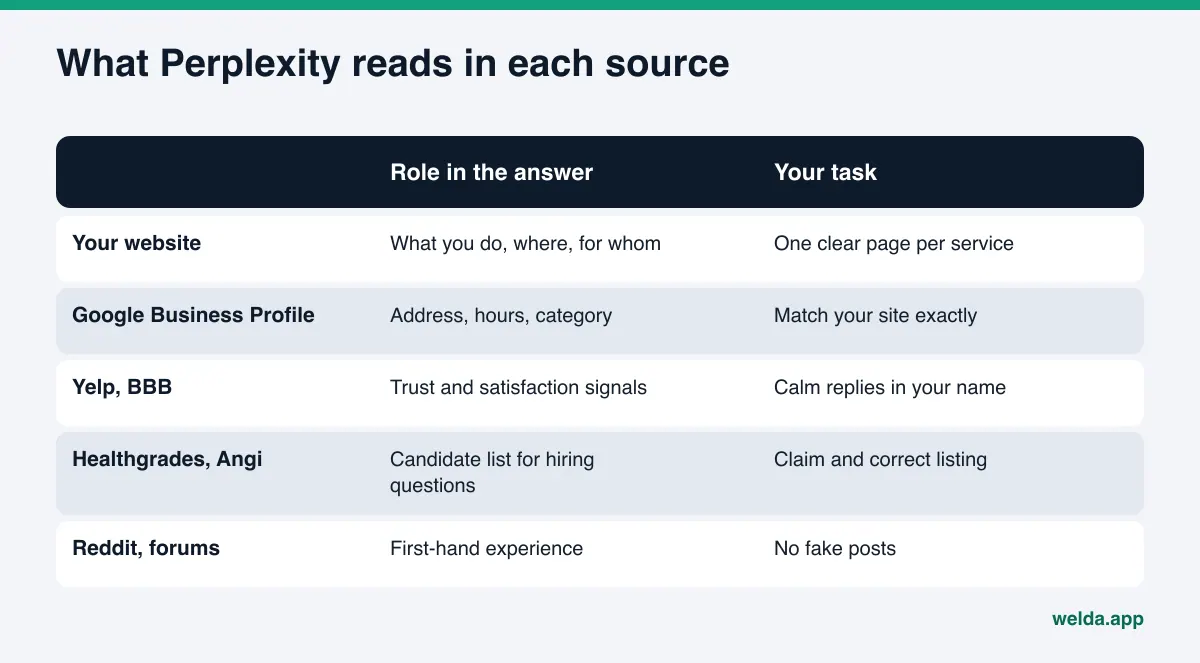
For a local or service business question, the citations usually fall into a handful of groups. The mix varies by industry and by question, so treat this table as a map of where to look, not as a ranking of importance.
| Source type | US examples | What it tells Perplexity | What to do |
|---|---|---|---|
| Your website | Service pages, about, contact, FAQ | What you do, where, and for whom, in your own words | One clear page per key service, with direct answers |
| Maps and listings | Google Business Profile, Apple Business Connect, Bing Places | Address, hours, category, review summary | Keep category, hours and description current and matching your site |
| Review platforms | Yelp, Tripadvisor, BBB | Trust and satisfaction signals | Respond to reviews calmly and in your own name |
| Industry directories | Healthgrades, Angi, Avvo, Houzz | A ready-made list of candidates for "who should I hire" questions | Claim the listing and correct the details |
| Communities | Reddit threads, local forums | First-hand experience in "which one is better" questions | No fake posts; answer openly when it is appropriate |
The pattern behind the table is consistency. If your site says you are open Saturday and your Yelp page says you are closed, Perplexity has to pick one, or it may leave you out. If you recently moved or renamed, our guide on updating AI answers after a rebrand or move covers the cleanup order. Finding the specific sites where competitors are cited and you are not is the subject of citation gap analysis.
How to rank in Perplexity: a step-by-step plan
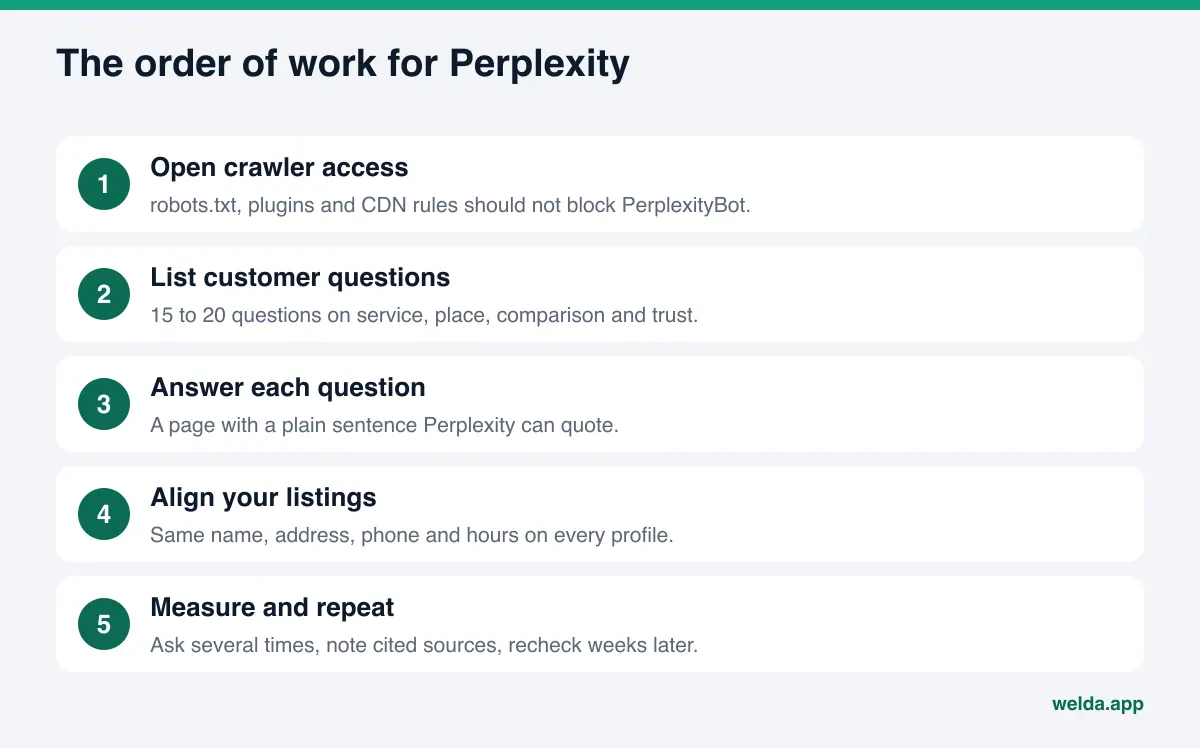
These steps are ordered so that each one makes the next worth doing. There is no point polishing service pages that PerplexityBot cannot reach.
- Confirm PerplexityBot can crawl your site. Open yourdomain.com/robots.txt and look for rules that block
PerplexityBotor all bots. Check your security plugin and CDN bot settings as well. - Write down the questions customers actually ask. Aim for 15 to 20: service plus place ("roof repair in Mesa"), comparisons ("which Austin daycare has the smallest classes"), trust ("is there a licensed electrician near me with good reviews"). This list becomes your scoreboard.
- Make sure each important question has a page that answers it. A single "Services" page that lists ten things in two words each will not be quoted. Each key service needs a page that says who it is for, where you offer it, how it works and what affects the price.
- Tighten the top of your homepage. The title tag, meta description and H1 should state your business name, what you do and your city together. "Excellence in every detail" carries no information Perplexity can use.
- Add structured business data. Name, address, phone, hours and service area should be written the same way on every page, and LocalBusiness schema should present them in a machine-readable form.
- Add a real FAQ. Answer the questions people ask your front desk: parking, walk-ins, insurance, kids, weekend hours. Short question and answer blocks are easy for Perplexity to lift.
- Align your listings. Google Business Profile, Yelp, BBB and your industry directory should match your site. Link your social and map profiles from your website.
- Make trust visible. Licenses, memberships, team bios and real customer reviews should be readable on your site. Never buy or invent reviews; the FTC's final rule banning fake reviews and testimonials makes that a legal risk as well as an ethical one. This is not legal advice.
- Measure, wait, measure again. Ask your question list in Perplexity on a schedule, note whether you are named and which sources are cited, then check again a few weeks after each change.
Writing a service page Perplexity can quote
The step that takes the most effort is usually the service page. Perplexity tends to quote a sentence or two and pin a citation number on it, so the page needs at least one sentence that still makes sense when lifted out of context. Here is the same service written two ways, for an example HVAC company.
| Page element | Weak version | Quotable version |
|---|---|---|
| H1 | Comfort you can count on | AC repair in north Phoenix and Scottsdale |
| Opening sentence | We are passionate about your comfort | We repair central air and heat pump systems for homes in north Phoenix and Scottsdale. |
| Who it is for | Everyone | Homeowners and small landlords with residential systems |
| How it works | Custom solutions | A technician diagnoses the system first; repair options and pricing are explained before work starts |
| Practical details | Contact us today | Weekday and Saturday appointments; book by phone or online form |
Nothing in the right-hand column is a promise or a superlative, yet every row answers a real question. When someone asks Perplexity for "AC repair in north Phoenix," that page can be found by the search and quoted in the answer.
Three rules help. Put your business name and city in the same paragraph at least once, because Perplexity does not always carry surrounding context into the quote. Do not publish anything you cannot stand behind, since a wrong detail that gets quoted is slow to correct. And end the page with two or three service-specific questions, such as "Do you service older systems?" or "Do you charge for a diagnostic visit?", with short, accurate answers.
How to read a Perplexity answer about your business
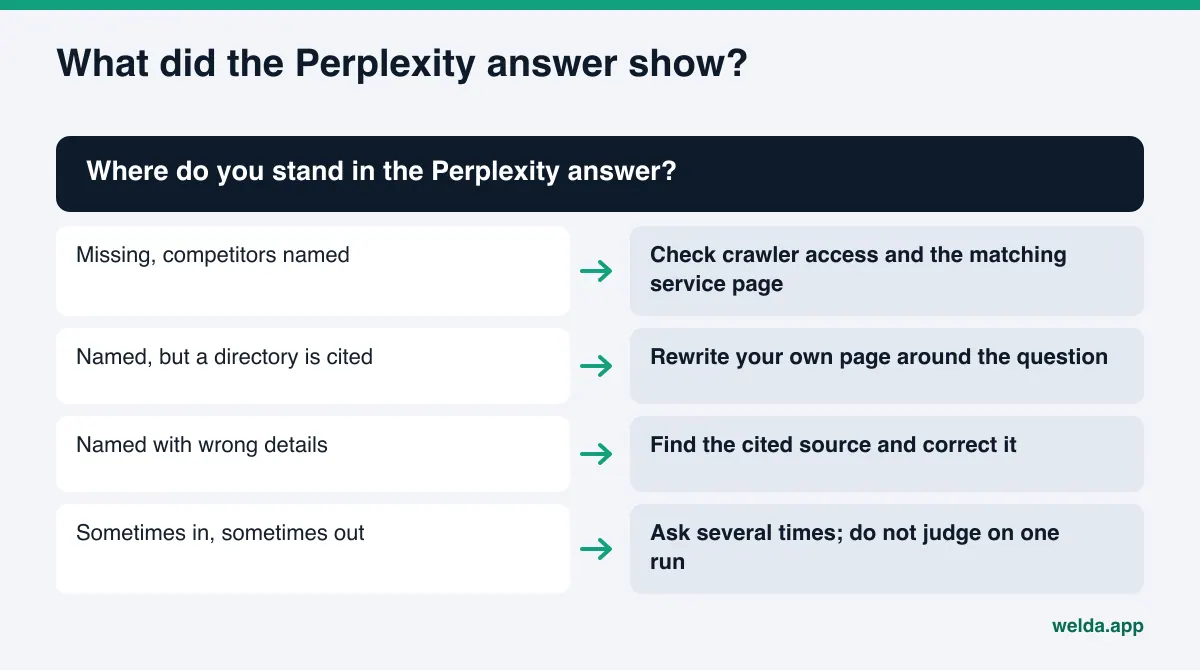
When you test your own questions, "am I in it?" is only the first question. The citation list next to the answer tells you what to fix.
| What you see | Likely meaning | First move |
|---|---|---|
| You are missing, competitors are named | Perplexity cannot find you, or no page of yours answers the question | Check crawler access and the matching service page |
| You are named, but a directory is cited | Your own site is not clear enough on this point | Rewrite the relevant page around the question |
| You are named with wrong details | An outdated source is still out there | Open the cited source and correct it |
| You are last, with no reason given | Nothing concrete sets you apart | Add specifics: specialties, credentials, reviews |
| Sometimes in, sometimes out | Answers vary from run to run | Ask several times and look at the pattern |
That last row matters more than people expect. The same question can return different businesses and different sources an hour apart, so a single check proves very little. We cover the tradeoffs in manual ChatGPT checks vs tracking tools, and the same logic applies to Perplexity.
How Welda does this work
Welda is software that measures where a business shows up in AI answers and prepares the fixes on the business's behalf. For Perplexity specifically, three parts matter.
The free site analysis: can Perplexity read you? The free analysis works in English and reads your homepage plus a few inner pages such as services, pricing, about and contact. It checks whether AI crawlers are blocked in robots.txt, your title and meta description, your H1, your LocalBusiness schema, whether address and phone are clearly stated, whether your social and map profiles are linked, whether you have an FAQ, trust signals, how clearly your services are described, and page speed. For every gap it shows what it found, why it matters and how to fix it, plus ready-to-use homepage copy. It also asks 5 customer-style questions to an AI assistant that can search the web and checks whether your name comes up. That is a one-time snapshot; it does not track Perplexity over time and it does not measure rankings.
The question view: where you stand in Perplexity, question by question. In the Welda dashboard, your customer questions are asked to ChatGPT, Gemini, Perplexity and Google AI three times each. Filter to Perplexity and you see, for each question, whether you were named and in what position. Open a question and you see a summary of the answer and the sources Perplexity cited. The decision this screen supports is simple: which questions are you missing, and which sites does Perplexity trust for them.
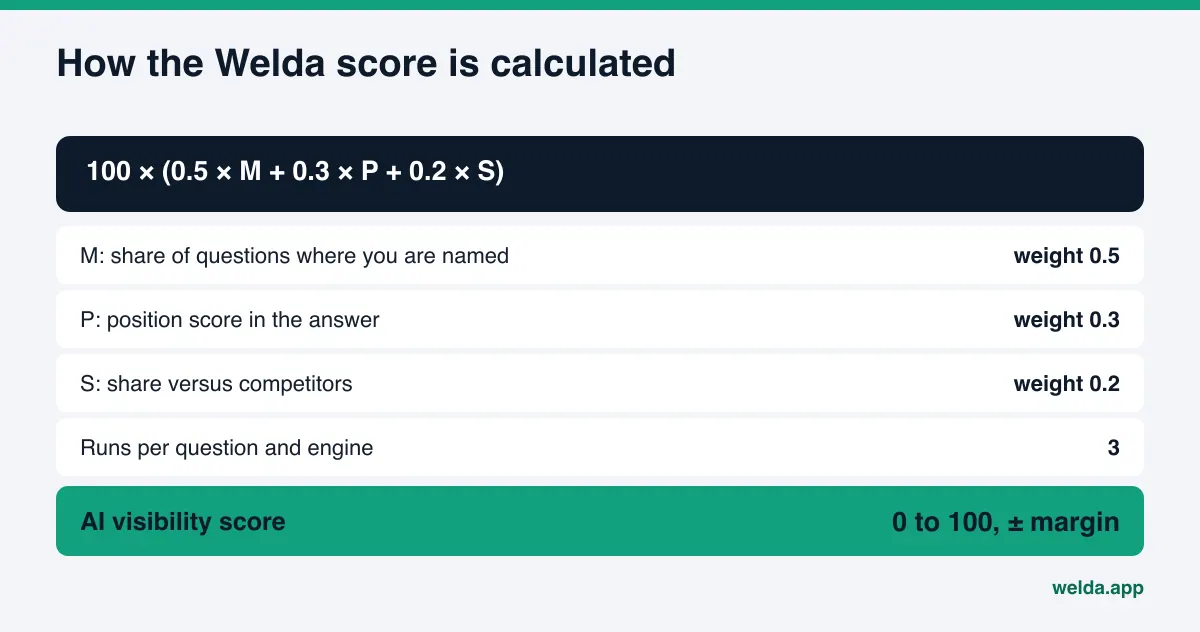
The score: one number with a visible formula. The dashboard rolls those runs into a score from 0 to 100 using a published formula, shown below. Because each question is asked three times, the spread between runs produces a margin of error, which is a more honest way to report a moving target like Perplexity than a single screenshot.
What stays with you. Welda drafts page copy, profile text and review replies; you approve anything before it goes live. On WordPress it connects through a separate Editor user and opens content as a draft. Without a connection it hands you a ready-made package to apply. It does not invent facts it does not know; it asks you. It also lists the gaps in sources you have to handle yourself, such as directory accounts.
To be clear about status: the Welda dashboard is in early access and is opening first in Turkey. Regular four-engine measurement is being added during early access, and the dashboard screens shown in our materials use representative data. The part anyone in the US can use today is the free site analysis. Pricing is discussed in the early access conversation.
Limits: what Welda does not do
- No ranking promises. Perplexity decides what it cites. Welda does not promise placement in Perplexity or any other AI tool; it builds the conditions for Perplexity to find and read you correctly.
- No overnight results. New content typically takes weeks to be found and to show up in AI answers.
- No fake reviews or sockpuppet posts. Nothing is posted under a hidden identity on Reddit, Yelp or anywhere else.
- Some work stays with you. Handling negative reviews, opening directory accounts and press outreach remain the business's job. Welda lists them and drafts the text.
- No unapproved sensitive content. In healthcare nothing is published automatically. The compliance check flags risky claims before publishing, but it is not legal advice.
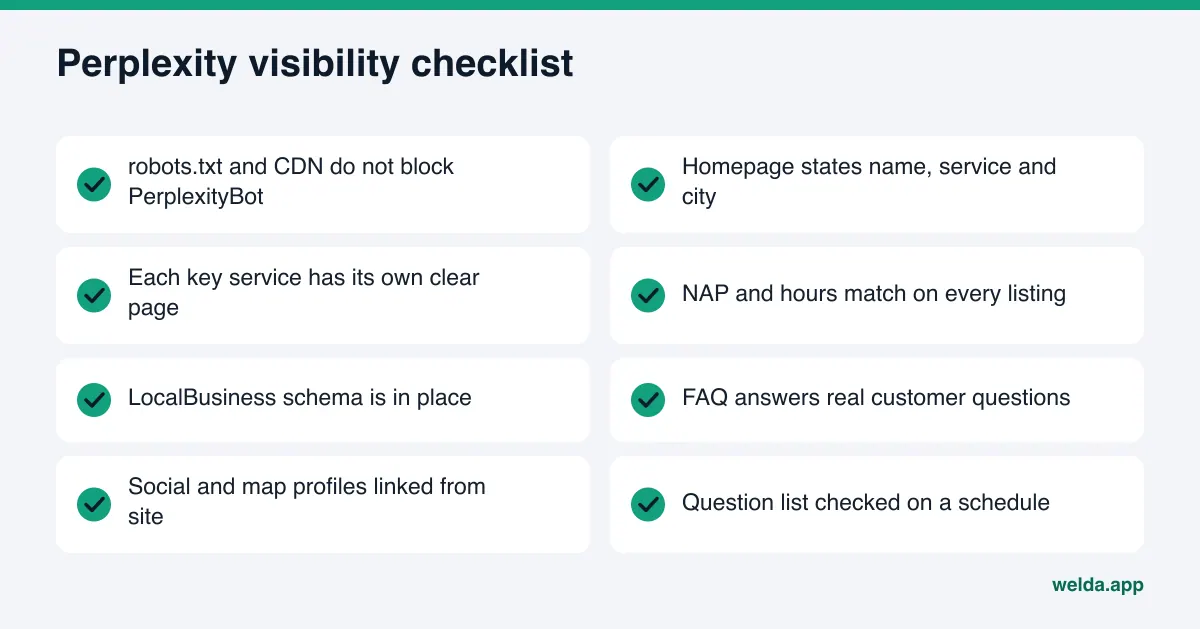
Perplexity visibility checklist
Run through this once. Every "no" is a plausible reason you are not showing up.
- robots.txt does not block
PerplexityBot, and no plugin or CDN rule does either. - Your homepage title and first paragraph state your name, your service and your city.
- Each key service has its own clear page.
- Name, address, phone and hours match across your site, Google Business Profile, Yelp and directories.
- LocalBusiness schema is in place.
- An FAQ answers the questions customers really ask.
- Social and map profiles are linked from your site.
- You have a list of 15 to 20 customer questions and you check them on a schedule.
Much of this overlaps with showing up for local intent in general; see near me searches in AI for the local side, and how to get cited by AI for making your pages the source rather than just a mention.
Frequently asked questions
Can I pay to rank in Perplexity?
This guide is about being named in Perplexity's answers themselves, which depend on what Perplexity finds and trusts at the time of the question. The work is to be present, clear and consistent in those sources.
What happens if I block PerplexityBot in robots.txt?
According to Perplexity's documentation, PerplexityBot respects robots.txt and is what surfaces sites in Perplexity search results. Blocking it makes it harder for your site to be found there. Perplexity-User, which fetches pages for a specific question, generally ignores robots.txt.
Do I need special content for Perplexity?
No. There is no Perplexity-only format. Pages that answer customer questions clearly and state your name, place and service together work for Perplexity and for other answer engines.
How long until changes show up in Perplexity?
There is no fixed timeline. Because Perplexity searches live, some fixes can appear quickly, but a new page usually takes weeks to be found and trusted. Recheck a few weeks apart.
Is AEO different from GEO?
Not in practice. GEO, generative engine optimization, is another name for the same goal. In the US, AEO is the more common term.
Does Welda guarantee I will show up in Perplexity?
No. Welda does not guarantee rankings or visibility. It measures where you stand, shows the gaps and drafts the fixes; approval and some tasks stay with you.
See how Perplexity can read your site today
The fastest way to start on how to rank in Perplexity is to see what your site looks like to AI tools right now. Run the free AI visibility analysis: you get a score out of 100, split into technical and content, with every gap explained and a fix for each, including robots.txt, schema, FAQ and service pages. It is free once per site, your email and phone are verified, and the results link stays open for 14 days.