How should you think about data privacy and AEO tools? An AEO tool reads your website, drafts review replies, connects to your accounts and sometimes shows inbound leads. Some of that is personal information, and you stay responsible for it. Before you pick a tool, pin down what data reaches it, where it is processed, and what the contract says the vendor may do with it.
This article is not legal advice. Our goal is practical: if you are starting work with a tool to get your business named in ChatGPT, Gemini, Perplexity and Google's AI Overviews, here are the questions worth asking and the places where privacy problems actually show up. Take the list to your attorney or privacy lead and use it as a starting point.
Data privacy and AEO tools: what is the actual problem?
AEO (answer engine optimization) is the work of getting your business named in AI answers. You will also see it called AI search visibility, AI visibility, or GEO (generative engine optimization); in the US, AEO is the more common term, so we use it here. At first glance it looks like a job done entirely with public information. AI engines read your website, your Google Business Profile, Yelp, Tripadvisor, the BBB, Healthgrades, Angi and similar sources. Most of that is already public. So why does privacy come up at all?
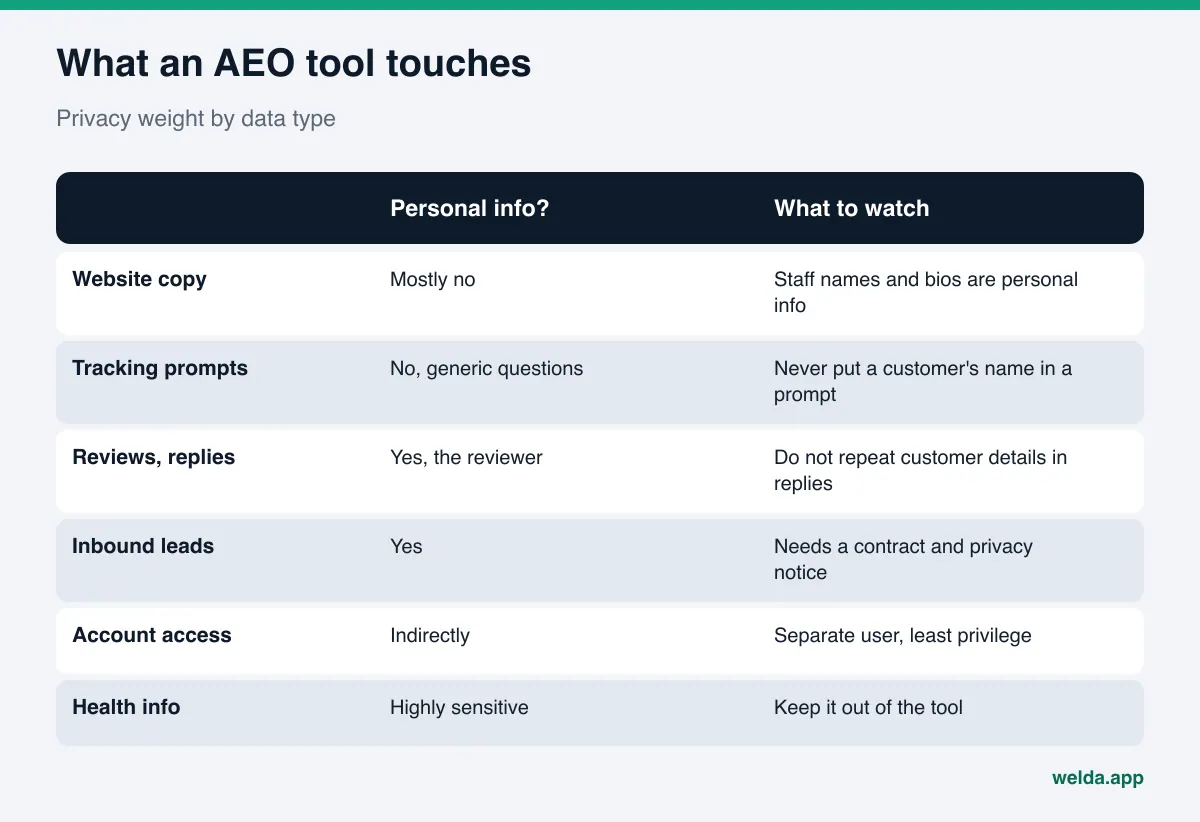
Because the work does not stop at measurement. Once an AEO tool starts fixing gaps, it can touch:
- Your website copy: service pages, pricing, team pages. Staff names, photos and bios on a team page are personal information.
- Customer reviews and your replies: the reviewer's name is personal information, and a reply that restates what the customer bought or received can disclose more.
- Inbound leads: the name, phone number, message and appointment time of someone who found you through an AI answer and contacted you.
- Account access: WordPress, Google Business Profile, Instagram, Facebook. These are not customer records themselves, but customer messages and reviews live inside them.
- Your own contact details: the name, email and phone number you use to sign up.
In most privacy frameworks, the business that decides why and how this data is used carries primary responsibility. A tool that processes it on your behalf is typically a service provider or processor, and the contract between you is what limits how it may use the data. A vendor's weak spot becomes your weak spot.
The easiest way to start is on the side that needs no customer data at all. Welda's free site analysis reads only the public pages of your website and lists what AI engines cannot find. It works in English and never touches your customer records.
What data does an AI visibility tool touch?
Asking a vendor "are you privacy compliant?" gets you a yes from almost everyone. A better approach is to split the data into types and ask a specific question for each one.
| Data type | Example | Where it may go | Question to ask |
|---|---|---|---|
| Public website copy | Service page, address, hours | Vendor servers, an AI model | Are staff names on the team page processed too? |
| Tracking prompts | "Pediatric dentist open Saturdays in Austin" | ChatGPT, Gemini, Perplexity, Google AI | Do prompts ever include personal information? |
| Reviews | A Yelp review and the reviewer's name | Vendor servers, a model for reply drafts | Where is review text stored, and for how long? |
| Inbound leads | Form message, phone, booking | Vendor dashboard, notification emails | Is this data ever sent to an AI model? |
| Account access | WordPress user, social account connection | Vendor servers | What permission level, and how do we revoke it? |
| Health information | Patient name, treatment, reason for visit | Nowhere | Does the tool block it? |
The second row matters. The prompts an AEO tool uses for measurement are generic questions, the kind a new customer would type: "best family dentist near downtown Austin" or "boutique hotel in Charleston with parking". They describe your service and location. They do not name a customer, and they should not. If a tool asks you to add customer details to tracking prompts, ask why.
The last row is not up for debate. Visibility work does not need patient names, treatment history or the reason someone booked. Everything that improves how AI engines describe a practice can be done with information about the practice itself.
Which US privacy rules matter for AEO tools?
The US has no single federal privacy law that covers every business. What applies depends on your state, your size, your industry and the data involved. Here are the pieces that come up most often with AI visibility work. Confirm your own situation with counsel.
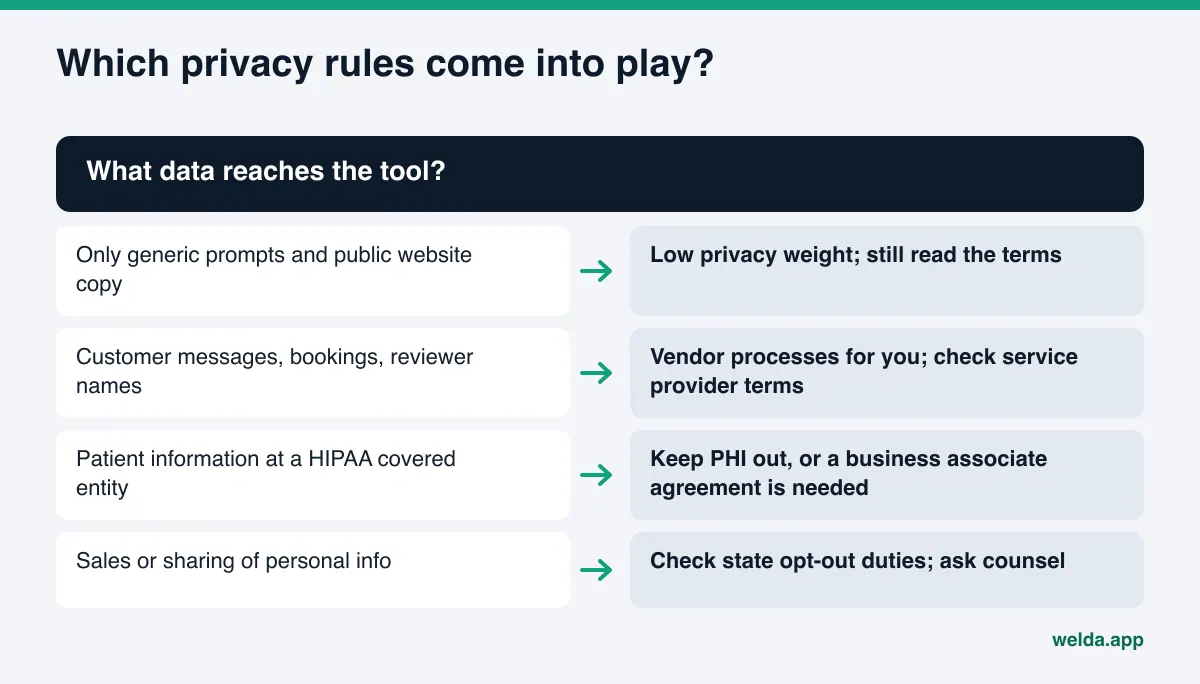
- State comprehensive privacy laws. California's CCPA is the best known. According to the California Privacy Protection Agency's FAQ, it applies to for-profit businesses doing business in California that meet at least one threshold, such as annual gross revenue of $26.625 million or more, or buying, selling or sharing the personal information of 100,000 or more California consumers or households. It places separate obligations on service providers and contractors that process personal information for businesses under contract. Other states have their own laws and thresholds, so check the ones where your customers live.
- Consumer rights. Where a state law applies, consumers can ask what you collected, ask you to delete or correct it, and opt out of its sale or sharing. If your AEO tool holds inbound leads, you need to be able to find and delete a person's data there too.
- HIPAA. If you are a covered entity, such as a dental or medical practice, and a vendor creates, receives, maintains or transmits protected health information for you, a business associate agreement is generally required. HHS publishes sample business associate agreement provisions. The simpler path for visibility work is to keep PHI out of the tool entirely.
- Your own privacy policy. Whatever your privacy notice promises, you need to keep. If you add a tool that processes customer messages, make sure your notice describes that use accurately.
Review replies deserve special attention in healthcare. HHS's Office for Civil Rights has settled with practices that disclosed patient information while responding to online reviews. In one December 2022 announcement, a dental practice agreed to pay $23,000 after replies to online reviews disclosed patients' names, treatment and insurance information. Any AEO tool that drafts review replies for a practice has to be set up so that this cannot happen without a human noticing.
How to vet an AEO tool for privacy, step by step
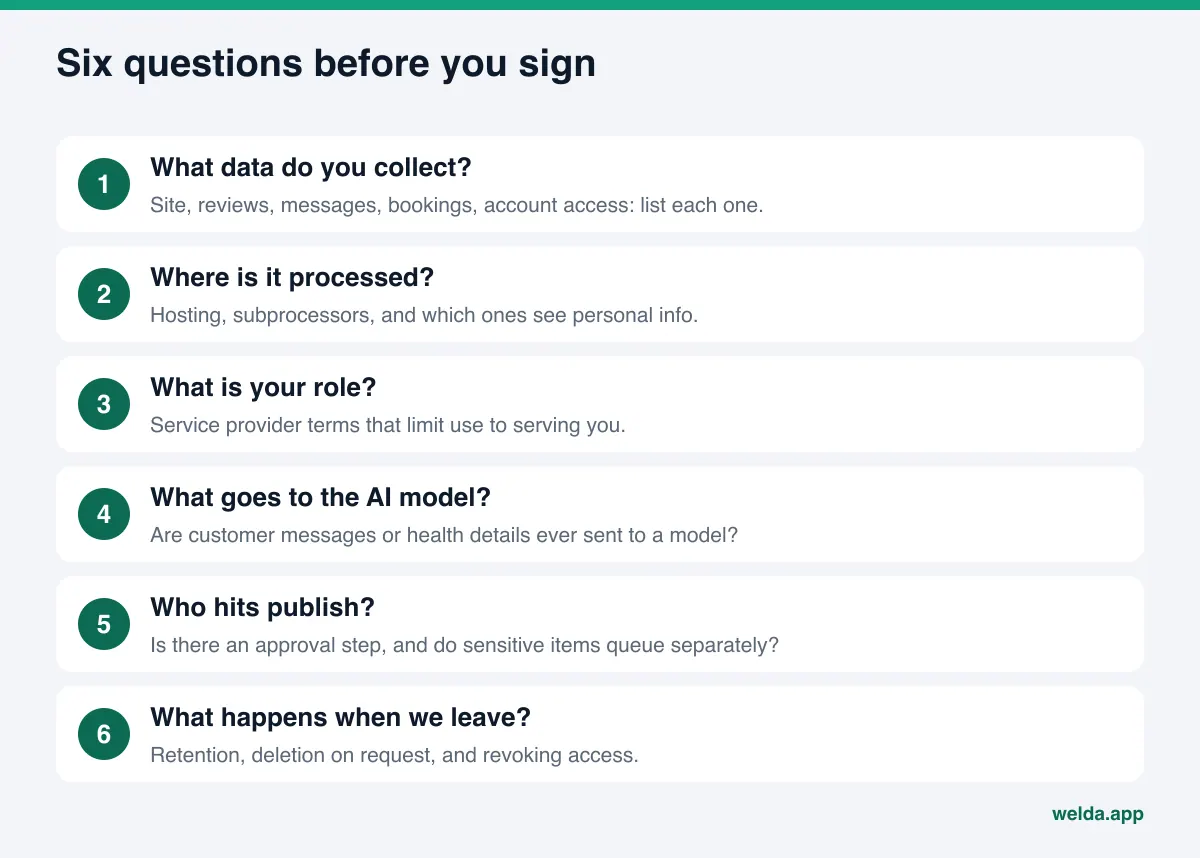
Here is a practical order for evaluating an AEO tool. Get each answer in writing.
- Map the data. Write down every kind of data the tool will touch: site copy, reviews, social accounts, form messages, bookings. Ask the vendor for the same list and compare.
- Settle the roles. Does the vendor process data only to serve you, or does it also use it for its own purposes, such as serving other customers or training models? The contract should state this plainly.
- Ask where processing happens. Which hosting providers and subprocessors see personal information? Which ones are AI model providers?
- Find out what reaches the model. When the tool drafts content, which data is sent to an AI model? Customer messages, patient details and reviewer names should not be part of that flow unless there is a clear reason and a contract that covers it.
- Limit access. Never hand over your main admin password. Create a separate login for the tool with only the permissions it needs, using a method you can revoke on your own.
- Keep the publish button. Does the tool publish without your approval? Do drafts that might contain personal or health information land in a separate approval queue?
- Plan the exit. When the contract ends, how fast is your data deleted, how are connections closed, and where does your content live?
- Update your notice. If the tool will process customer data, make sure your privacy policy reflects it.
Most of these belong in your buying process anyway. Our AEO RFP template gives you a structure for collecting vendor answers, and the overview of AI SEO tools helps you compare tool types. We suggest adding the privacy questions above as their own section in that RFP.
Privacy in the content an AEO tool writes
The thing AEO work produces most is text: FAQ answers, service pages, profile descriptions and review replies. Privacy risk often comes from what that text says, not from the tool itself.
Review replies
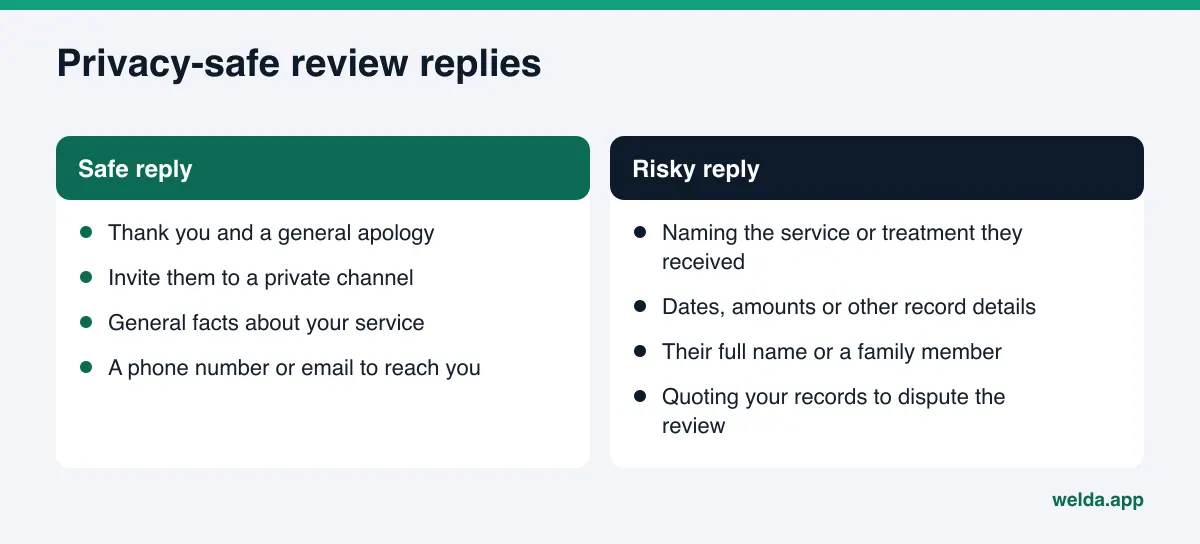
AI engines read reviews and your replies to them. Replying well helps visibility. But answering a one-star review with "Our records show you had a root canal on March 12" publishes something the customer never shared. In healthcare that is protected health information. Keep replies short and polite, leave customer details out, and move the conversation to a private channel.
Customer stories and names
Lines like "Our client Jennifer from Plano loved her results" carry privacy risk and advertising risk at the same time. If you use a real customer's name, photo or story, get their written permission first. Fabricated or incentivized reviews raise separate legal issues; we cover those in fake reviews rules and AI visibility.
Team pages
AI answers often mention expertise: the lead dentist, the attorney who handles estate cases, the master electrician. Names and credentials are strong trust signals. They are also personal information. Get your staff's agreement before publishing names, photos and bios, and update the page when someone leaves. A former employee's name can keep showing up in AI answers for months.
Wrong information
One of the most common problems with AI-assisted content is guessing. When a tool fills an unknown detail with a plausible guess, such as hours, service area or insurance accepted, customers get misled. We look at who is responsible in liability for errors in AI-written content.
How Welda handles data privacy
Welda is software that measures where a business appears in AI answers and fills the gaps on the business's behalf. Here are the three parts that matter most for this topic.
Measurement runs without customer data
Welda measures with the kind of questions customers actually ask AI assistants: "family dentist open Saturdays near me", "boutique hotel with free parking downtown". Each question is asked three times in ChatGPT, Gemini, Perplexity and Google AI, and Welda checks whether your business is named, in what position, and where competitors come out ahead. The questions describe your service and location. They contain no customer names or complaints. You do not have to share a customer list to see your visibility.
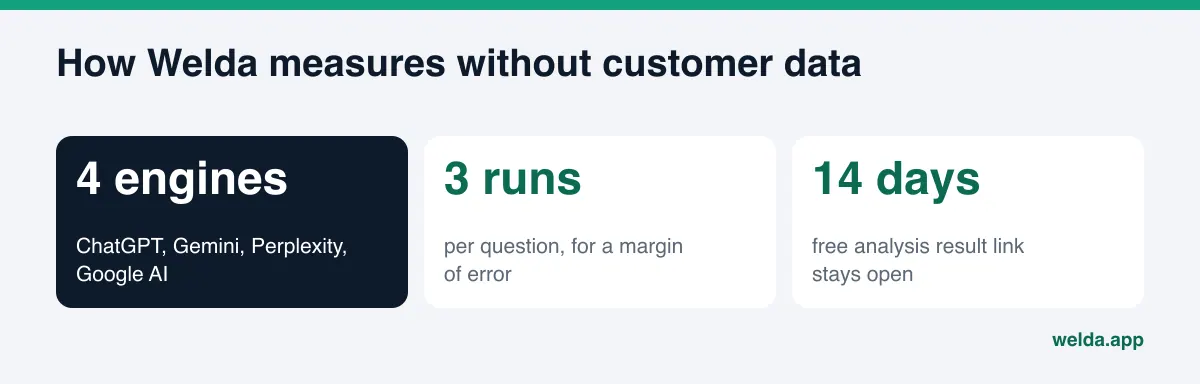
The free site analysis works the same way. It reads only your public pages. The only personal information it asks for is yours: your email and phone number are verified, the result link arrives by email and stays open for 14 days.
Every post needs your approval, and healthcare never auto-publishes
Welda drafts content, profile text and review replies, and the decision to publish stays with you. Each draft sits in an approval list on its own: a page for your website, a post for Facebook, a caption for Instagram. You read it, edit it if needed, then approve it.
Welda does not invent details it cannot find on your site. Missing facts, such as opening hours, a full address or the name of a team lead, show up as blank fields for you to fill in. That way no person's name or opinion enters the text without your say-so.
In healthcare the rule is stricter: nothing publishes automatically, every draft comes to you for approval, and patient data is not sent to AI. A compliance check flags patterns like price claims, guarantees, superiority claims and diagnostic suggestions before anything goes live. That check is not legal advice and has not been reviewed by legal counsel; the final call is yours. For the healthcare marketing side, see compliant AEO content for healthcare practices, and for setting up sign-off, our content approval workflow for AEO.
Connections use least privilege, and content stays on your site
On WordPress sites, Welda connects through a separate Editor user and an application password that you create for it, not your admin account, and with no code to install. Drafts open on your site as drafts and go live only when you approve them. To end the relationship, you delete that user or revoke the application password.
Your content always lives on your own site; Welda does not host content. On systems without a connection, Welda gives you a ready-made package and you or your web person apply it by hand. Google Business Profile, Instagram and Facebook can be connected; if you prefer not to connect them, the task is listed as a manual one with the text ready next to it.
The dashboard also has an inbound leads area: messages, sign-ups and a calendar. By its nature that area holds customer personal information. Ask Welda the same written questions you would ask any vendor about where that data is processed and how long it is kept.
Limits: what Welda does not do
The Welda dashboard is in early access and is opening in stages, starting in Turkey. Regular measurement across all four engines is being added during early access, and the sample dashboard screens use representative data. The free site analysis works in English today and is the part anyone can use right now. Pricing is discussed in an early access conversation.
Limits that matter for this topic:
- Welda does not give legal advice. The compliance check flags risky patterns, but it does not certify your privacy compliance. Your privacy notice, contracts and records remain your responsibility and your counsel's.
- Welda does not write what it does not know; it asks you. It does not add staff names or customer experiences on its own.
- Welda does not publish sensitive content without approval and does not create fake reviews.
- Handling negative reviews, managing directory listings and press work stay with your business. Welda can draft text, but you own the accounts.
- Welda does not guarantee rankings or a spot in ChatGPT. New content usually takes weeks to show up in AI answers.
A vendor that tells you its limits plainly is a good sign. Be wary of one that says "privacy is our problem, not yours". In most frameworks the business that controls the data cannot hand that responsibility to a tool.
Which data is most sensitive in your industry?
The same tool carries different risk in different industries. A coffee shop replying to a review is not the same as a dental practice replying to one. Use this table to set priorities; it is not a legal classification.
| Industry | Most sensitive data | What to watch in AEO work |
|---|---|---|
| Restaurants and cafes | Reservation names and phone numbers | Do not mention a guest's table or date in a reply |
| Hotels | Stay dates, ID details | Ask where form messages are stored in the tool |
| Dental and medical practices | PHI | Keep patient data out; every draft goes through approval |
| Med spas and aesthetics | Treatment details, before and after photos | Written consent for photos; do not name the procedure in replies |
| E-commerce | Orders, addresses, returns | No order details in public replies |
| Home services | Home addresses, job records | Do not use a customer's street or name in project examples |
The pattern is the same everywhere. What AI engines need to recommend you is information about your business: services, location, hours, pricing policy, expertise. Customer data is not the fuel for this work. If a tool asks for it, ask what it has to do with visibility.
Data privacy checklist for AEO tools
Fill this in before you sign. Every "not sure" is a question for the vendor or your counsel.
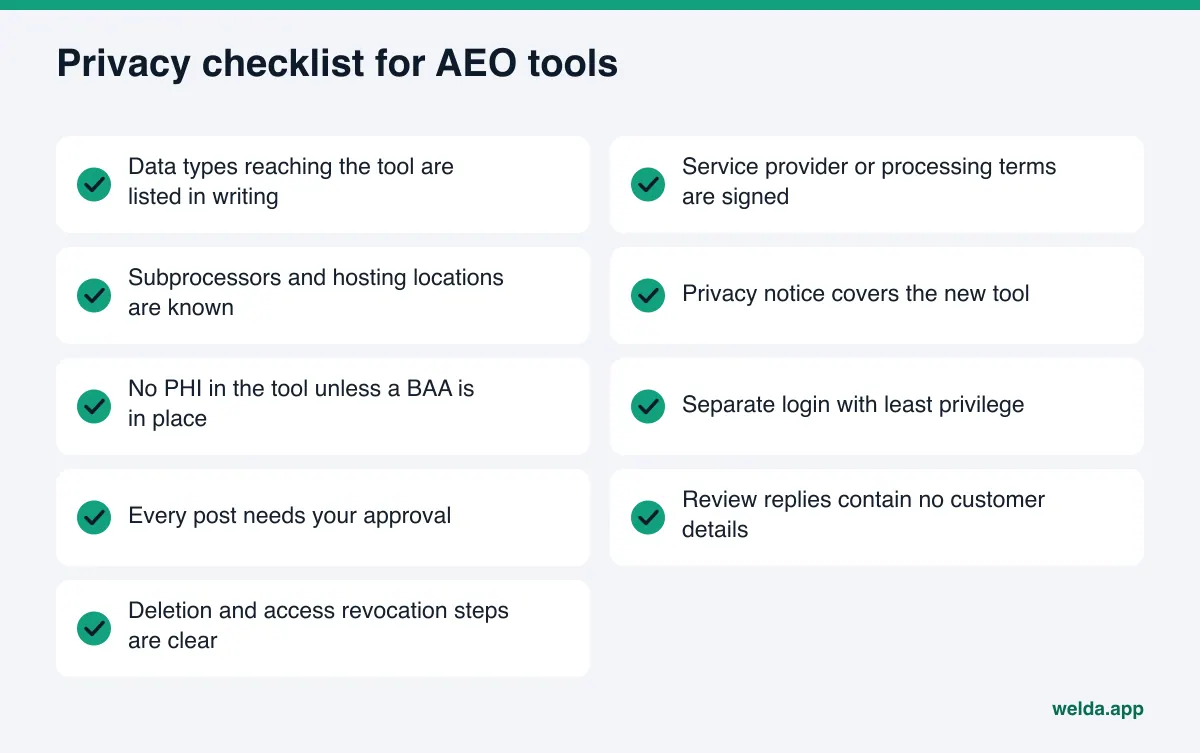
An example. A sample boutique hotel wants an AEO tool that also shows messages from its booking form. Website copy and tracking prompts carry little privacy weight. Booking messages contain guest names, phone numbers and dates. So the hotel asks where those messages are stored and for how long, adds the tool to its privacy notice, and creates a separate WordPress user for it. Measurement and content work can start before those answers come back, because no personal information is involved there.
Frequently asked questions
Is using an AEO tool a privacy problem in itself?
No. What matters is which personal information reaches the tool, where it is processed and under what contract. Measurement built on public website copy and generic questions carries little privacy weight. This is not legal advice.
Is asking ChatGPT about my business a disclosure of personal information?
Not if the question is generic. "Pediatric dentist in Austin" does not identify anyone. It changes if you type a customer's name, phone number or complaint into the prompt.
Do I need a contract with my AEO vendor about data?
If the tool processes customer messages, reviews or bookings on your behalf, you should have written terms that limit how the vendor may use that data. Ask counsel what your state's laws require.
Does an AEO tool need a business associate agreement?
If you are a HIPAA covered entity and the tool would create, receive, maintain or transmit PHI for you, generally yes. The cleaner setup is to keep PHI out of the tool entirely.
Does Welda send patient data to AI?
No. In healthcare, patient data is not sent to AI, nothing publishes automatically, and every draft comes to you for approval.
Do I have to share my WordPress admin password with Welda?
No. Welda uses a separate Editor user and an application password. Drafts arrive as drafts and go live when you approve. You can cut access at any time by deleting the user.
What do I share to run the free analysis?
Your website address and your own contact details. Your email and phone are verified, and the result link arrives by email and stays open for 14 days. The analysis reads only your public pages.
Start with the part that needs no customer data
The sensible order for data privacy and AEO tools is simple: fix your public information first, then take on anything that touches personal data with the right contract in place. You do not need to share customer data with anyone to see what your site is missing, whether AI crawlers can reach it, and which fixes would raise your score most. Run the free site analysis. It is free once per site and works in English.