What does AI visibility software for dietitians and nutritionists actually do? It checks whether your name comes up when prospective clients ask ChatGPT, Gemini, Perplexity or Google AI for a dietitian, shows which facts about your practice are missing or unclear, and drafts the fixes. Because nutrition marketing touches health claims, every draft should go through your own review before it goes live. No tool can guarantee that an AI assistant will recommend you.
This guide is for registered dietitian nutritionists in private practice, dietitians who work inside a clinic or group practice, and nutrition professionals who see most clients over telehealth. The question is simple: when someone asks an AI assistant "Can you recommend a dietitian in Austin who takes my insurance?" or "virtual dietitian for gestational diabetes," does your name show up in the answer? Below we cover what AI visibility software for dietitians and nutritionists should measure, the work in the right order, how FTC and licensure rules shape what you can publish, and how Welda handles this work. If you want to see where your site stands today, start with the free site analysis.
Why AEO matters for dietitians and nutritionists
AEO, or answer engine optimization, is the work of making your practice easy for AI assistants to understand, trust and mention. Some people call the same work GEO (generative engine optimization); in the US, AEO and "AI search visibility" are the more common terms, so we use those here.
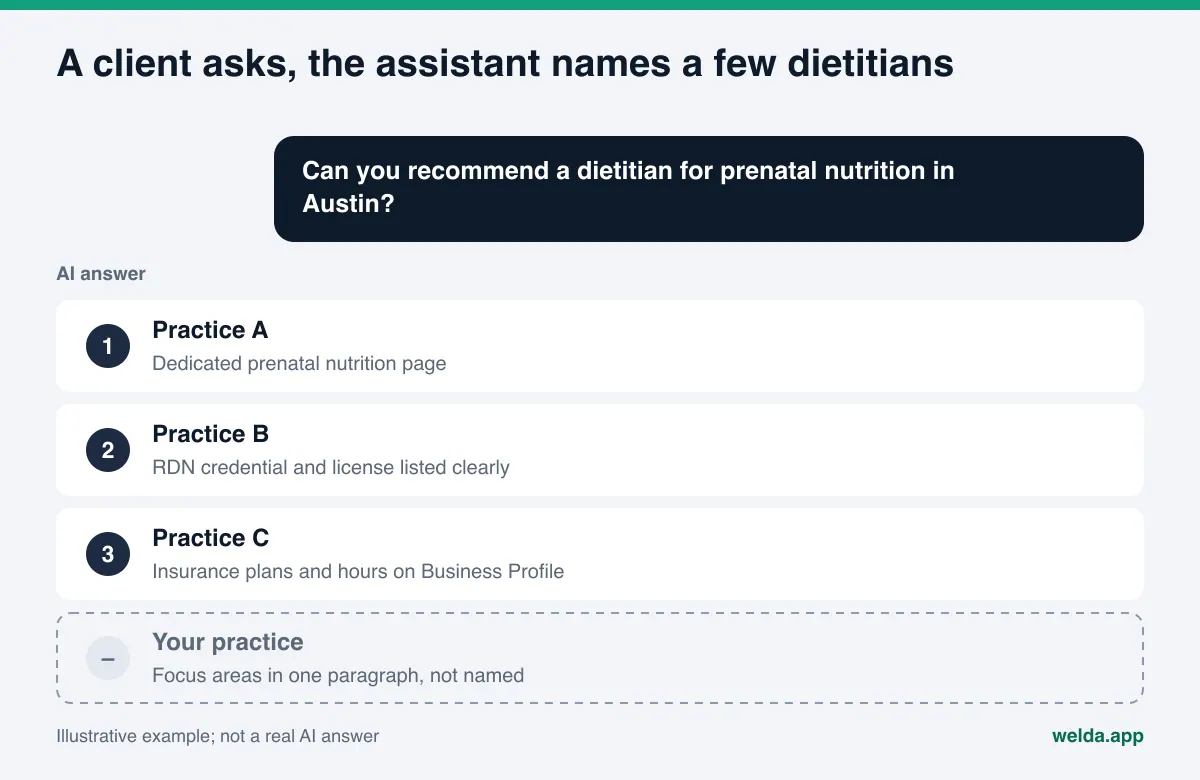
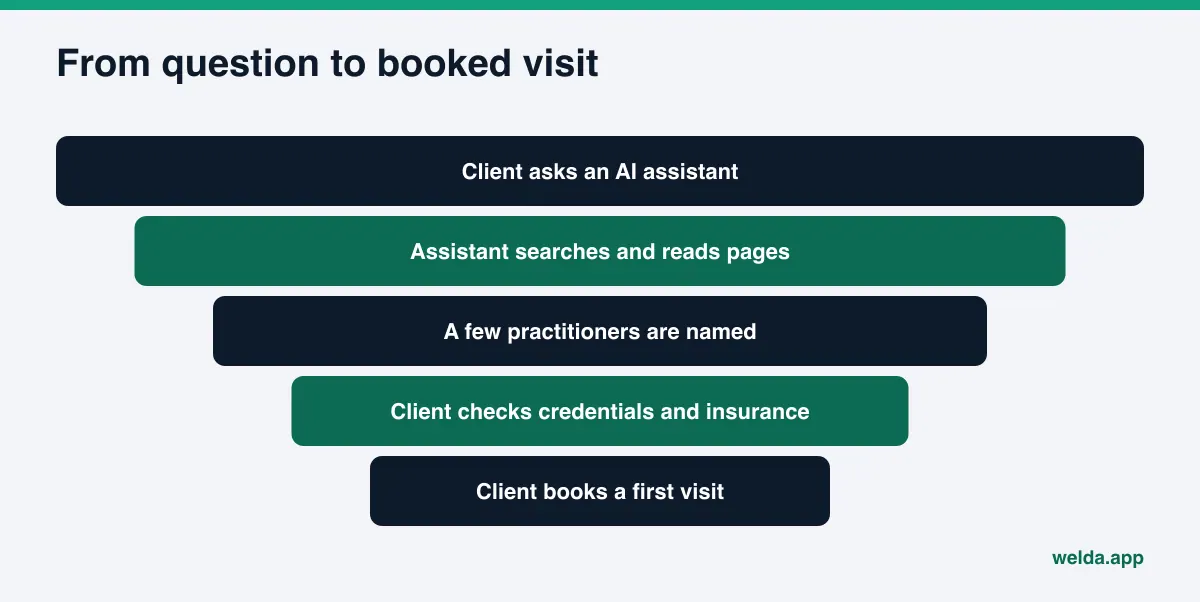
Choosing a dietitian is not like choosing a coffee shop. A client is committing to several months of appointments and sharing personal health details. People research carefully, and a growing share of that research now starts in a chat window. The assistant runs a web search, reads a handful of pages, and names a few practitioners with a one-line reason for each. If you are not one of those names, you never enter the comparison.
Dietitian searches have a few traits that set them apart from other health questions:
- The field is wide. Prenatal nutrition, pediatric feeding, sports nutrition, eating disorder recovery, diabetes and kidney nutrition, plant-based eating. Clients rarely look for "a dietitian"; they look for someone who works with their situation. An assistant only knows your focus areas if your site states them plainly.
- Telehealth is normal. Many clients never visit an office. For "virtual dietitian" questions, location matters less than a clear description of how sessions work and which states you serve.
- Titles are confusing. "Dietitian," "RDN," "nutritionist," "nutrition coach" and "health coach" all appear side by side online. Many clients specifically want a registered dietitian, and assistants read that distinction from your credentials page.
- Insurance comes up early. Clients often want to know whether a visit is covered before they book. If your site does not say which plans you accept or how superbills work, the assistant has nothing to quote.
- Outcome claims are tempting and risky. Weight and timeline promises run into FTC rules and work against the kind of trustworthy source an assistant looks for.
What clients ask AI assistants about dietitians
The table below shows typical question types with example wording we wrote for this guide. These are illustrations, not research data. Use them as a template when you build your own question list.
| Question type | Example (illustrative) | What your site needs to answer it |
|---|---|---|
| Local and personal | "Recommend a registered dietitian in South Austin" | Full address, city and neighborhood, your name and credentials |
| Specialty | "Dietitian who works with PCOS near me" | A separate section for each focus area, written plainly |
| Telehealth | "Virtual dietitian licensed in Florida" | Which states you serve, how sessions run, how to book |
| Insurance | "Dietitian that takes Blue Cross for nutrition counseling" | Plans you accept, or how self-pay and superbills work |
| Process | "What happens at a first dietitian appointment?" | A description of the intake visit and follow-up schedule |
| Hours | "Dietitian with evening appointments" | Current hours, the same on your site and your Business Profile |
The right-hand column is really a to-do list. Each question type needs a matching fact on your site. Without one, an assistant has nothing to base a mention on. If you serve several cities or states, the approach in our guide to local AI rank tracking explains how to measure each market separately.
How AI assistants decide which dietitian to recommend
AI assistants do not know you personally. They search the web, read what they find, combine the facts and name the practitioners that best fit the question. On the ChatGPT side, that search is done by OAI-SearchBot. OpenAI's crawler documentation says sites that block this bot in robots.txt will not be shown in ChatGPT search answers. So the first check is technical: is your door open? On the Google side, Google's guidance on AI features says no special markup is required for AI Overviews and AI Mode; normal search best practices apply.
Once the door is open, content decides. To be recommended, an assistant needs to find these facts consistently:
- Who: your name, your credential (RD or RDN, and any state license), your education and where you practice.
- What: your focus areas, each described in a few clear sentences.
- Where: your office address, or for telehealth-only practices, the states you serve.
- How: what happens at the first visit, how follow-ups work, how virtual sessions run.
- Insurance and payment: which plans you are in network with, or how self-pay works.
- Structured data: Schema markup with your name, address, phone and hours.
Many of these facts live outside your site too. Google Business Profile, Yelp, your insurance network listings and telehealth directories all feed into what assistants read. If your site says "open Saturdays" and your Business Profile says "closed Saturday," the assistant cannot tell which is right and may name a competitor with consistent information. Finding the sources where you are missing is covered in our piece on citation gap analysis.
Licensure, the FTC and what dietitians can publish
Two sets of rules shape dietitian content in the US. The first is credentials and licensure. The Commission on Dietetic Registration explains in its guide to CDR credentials and state licensure that the RDN is a national credential, while most states separately require a license or certification to practice or to use protected titles, and requirements vary by state. The same guide notes that for telehealth, the client's location determines which state's law applies. For AEO, this means two things: state your credentials exactly as they are, and say clearly which states you serve virtually.
The second set is advertising law. The FTC's Health Products Compliance Guidance says health benefit claims need competent and reliable scientific evidence, and it warns that testimonials reporting results better than what people can generally expect are likely deceptive; a "results not typical" line does not fix that. The FTC's final rule banning fake reviews and testimonials (announced August 2024) also prohibits buying or fabricating reviews.
For dietitian content, that translates into a few practical rules:
- Avoid specific weight-loss numbers and timelines ("lose 20 pounds in 8 weeks").
- Do not use client before-and-after stories as proof that your approach works for everyone.
- Do not imply that a diet cures or treats a disease. Describe the support you provide instead.
- Never buy, write or incentivize reviews in a way that hides the connection.
- State credentials accurately. Do not present a weekend certificate as a specialty credential.
There is good news here. The facts that are clearly allowed (credentials, focus areas, process, location, hours, insurance) are also the facts assistants need most. Compliant content and visible content overlap almost completely.
Note: This section is general information, not legal advice. It was checked against the sources linked above in November 2026. Confirm the current rules with your state licensing board or a health care attorney before publishing.
Step by step: AEO for a dietitian practice
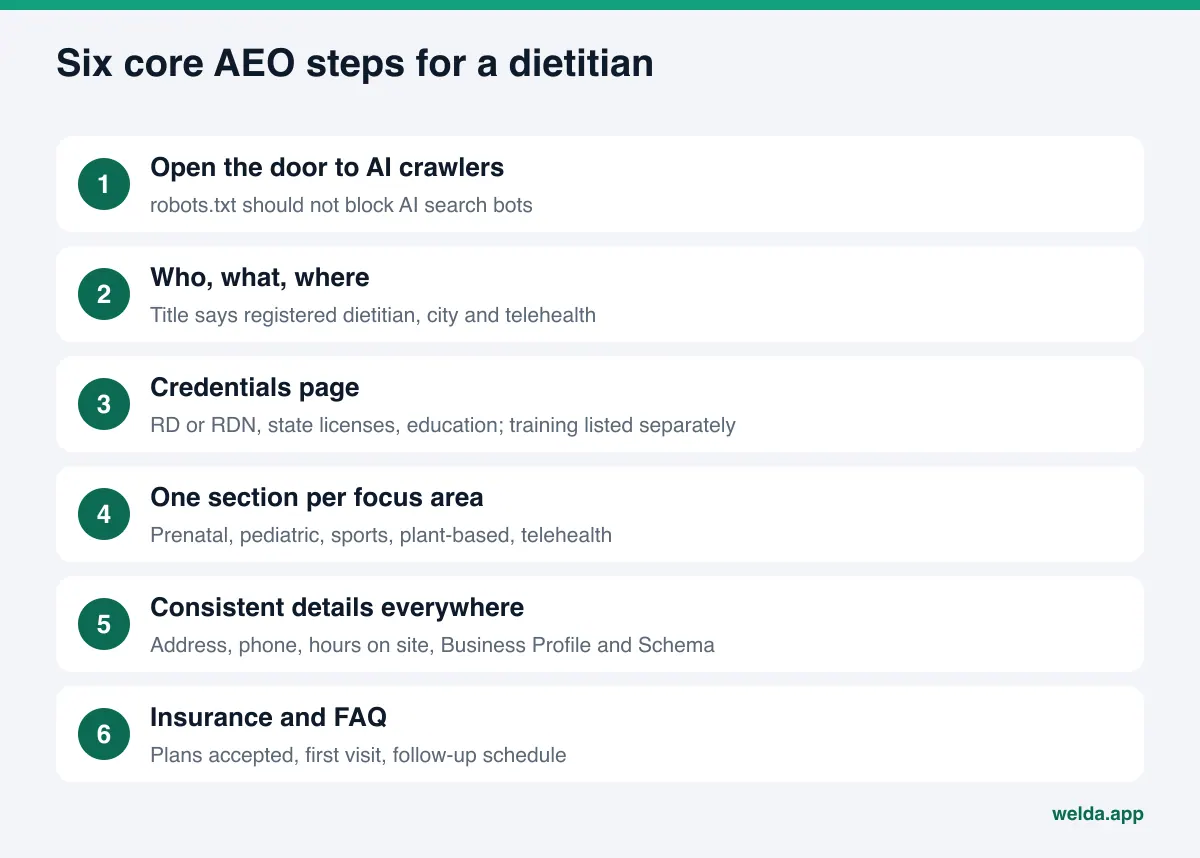
Order matters. If bots cannot reach your site, new content does nothing. If your basic facts are inconsistent, new pages spread the inconsistency further.
- Open the door. Check that robots.txt does not block AI search crawlers. Some website builders and security plugins block them without telling you.
- Say who, what and where in one line. Your page title, meta description and main heading should include "registered dietitian," your city and, if relevant, "telehealth." A heading like "Nourish your best life" tells an assistant nothing.
- Build a credentials page. Your name, RD or RDN, state licenses, education and professional background. List additional training under its own heading, separate from your credential.
- Give each focus area its own section. Who it is for, what the first visit covers and how follow-up works. No weight or cure promises.
- Explain telehealth plainly. Which states you serve, which platform you use in general terms, session length and how booking works.
- Spell out insurance. Plans you are in network with, or how self-pay and superbills work. Clients tend to check this before they book.
- Keep name, address, phone and hours identical everywhere. Site footer, contact page, Google Business Profile, Yelp and insurance directories. Add the same data as Schema markup.
- Add an FAQ section. What to bring to the first visit, how often follow-ups happen, whether you see children, how cancellations work.
If your practice also offers counseling-style sessions, our guide to AI search optimization for therapists and counseling practices covers a similar trust-driven decision. For how reviews feed into answers, see reviews and AI recommendations.
Telehealth practice vs. office practice: what changes for AI visibility
Many dietitians run a mix of in-person and virtual sessions. The two models need slightly different information on the site.
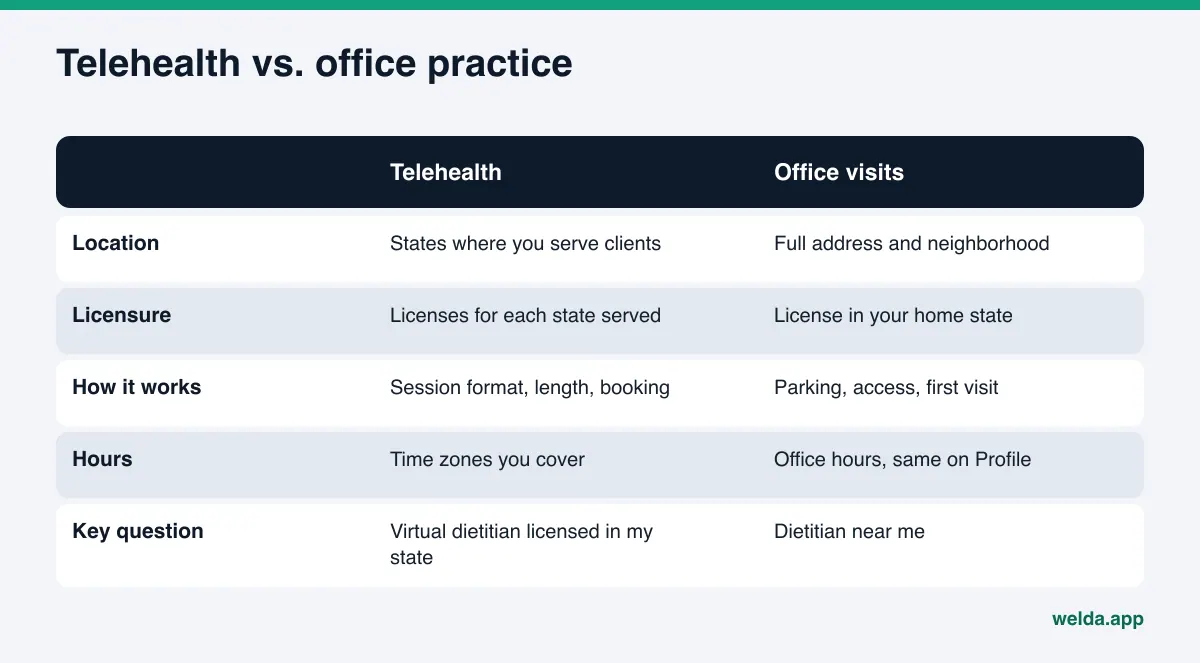
A practice that does both should cover both columns. A typical gap in this setup is a site that mentions telehealth once in passing, which gives assistants little reason to treat the practice as an option outside its city.
What to look for in AI visibility software for dietitians and nutritionists
When you compare tools, skip the promises and ask these questions. Because dietetics is a health profession, some criteria matter more than they would for a restaurant or retailer.
| Criterion | Why it matters | Question to ask |
|---|---|---|
| Engine coverage | Clients use different assistants | Which AI engines are measured? |
| Repeats and margin of error | The same question gets different answers over time | How many times is each question asked, and is variance shown? |
| Score formula | A black-box score is hard to act on | What goes into the score, and with what weights? |
| Question list | Prenatal, sports and telehealth questions differ | Are questions built around my focus areas and service area? |
| Approval flow | Publishing health content without review is risky | Does every draft wait for my approval? |
| Claim checks | Guarantees and cure language create risk | Are risky phrases flagged before publishing? |
| Client data | Health information is sensitive | Is any client data sent to an AI model? |
| Where content lives | Content should be your asset | Does content stay on my own site? |
For a dietitian, the last four rows are the deciding ones. A tool that produces content quickly but has no approval step is not a fit for a licensed health professional. Our piece on data privacy and AEO tools goes deeper on the data questions.
How Welda handles AI visibility for dietitians
For a dietitian, Welda's work comes down to two things: showing which client questions mention you, and filling the gaps in your information with drafts that you approve before anything goes live.
The questions view: where you show up and where you don't
In the panel, a question list is built around your focus areas and your service area. For an example dietitian, that list might include local questions, prenatal and pediatric questions, telehealth questions and evening-hours questions. Each question is asked three times in ChatGPT, Gemini, Perplexity and Google AI, because the same question can get a different answer later in the day. Next to every question you see which engine mentioned you and in what position.
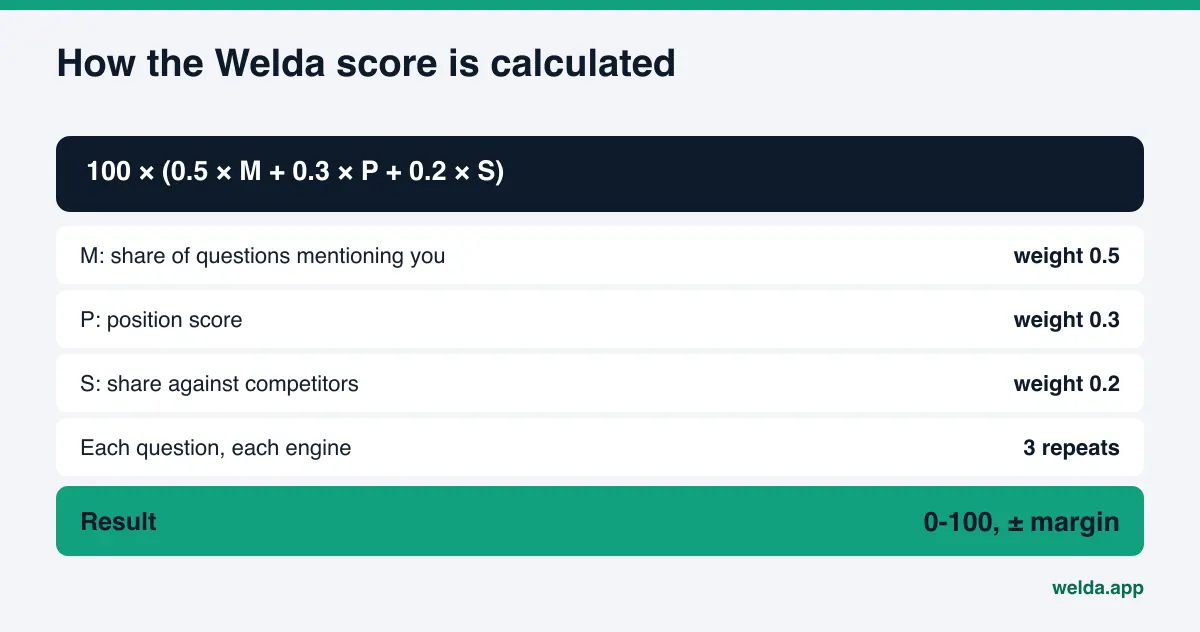
The decision this view supports is concrete. If you show up for local questions but never for "virtual dietitian" questions, the missing piece is probably a clear telehealth section. If another practice keeps winning prenatal questions, the competitors view shows which source is behind it: a detailed page on their own site, or a directory profile. The score formula is open: 100 × (0.5 × the share of questions where you are mentioned + 0.3 × position score + 0.2 × share against competitors), with a ± margin of error from the spread of the three repeats.
The to-do list and approval queue: no automatic publishing in health care
Welda does not invent facts it cannot read from your site. If your credentials, states served or hours are missing, they are left blank on the to-do list and you are asked to fill them in once. That answer is then used in every draft. For a dietitian this matters: only you can state your credential and licenses correctly.
Welda drafts page copy, Business Profile and social profile text, and review replies. In health care, nothing is published automatically; every draft waits in the approval queue for you to read, edit or approve. A built-in claim check flags patterns such as pricing, guarantees, superiority claims and diagnosis-like statements before anything goes live. That check is a helper, not legal advice, and it has not been reviewed by legal counsel. Client data is never sent to the AI.
Content always lives on your own site. On WordPress, Welda connects through a separate Editor user with an application password, with no code to install; drafts open on your site as drafts and go live only after you approve them. On other platforms, Welda gives you a ready-made package to apply by hand. Google Business Profile, Instagram and Facebook can be connected; if they aren't, the task appears as a manual item. The panel also includes a sources view, before-and-after comparison and a one-page monthly PDF report.
Early access, and what you can use today
The Welda panel is in early access. It is opening in stages, starting with businesses in Türkiye, and regular four-engine measurement is being added during early access; sample panel screens use representative data. Pricing is discussed in an early access call. What anyone can use today is the free site analysis, which runs in English. It reads your homepage and a few inner pages (services, about, contact), gives separate technical and content scores out of 100, and explains each gap: what it found, why it matters and how to fix it. It also asks a web-search-enabled AI assistant 5 questions a client might ask and checks whether your practice is named in the answers. That is a one-time snapshot, not ongoing tracking.
Example scenario: a dietitian in private practice gets started
This scenario is illustrative, not a real practice or result. An example solo dietitian sees clients in an office three days a week and over telehealth two days a week, and focuses on prenatal nutrition.
- Day one: She runs the free analysis. The report shows her homepage title contains only her name, with no "dietitian," city or telehealth wording, no structured data and no FAQ section. In the 5-question test, she is not named for the local question.
- First week: She edits the suggested title and description into her own voice, adds the structured data from the fix package, and matches her Business Profile hours to her site.
- Following weeks: She writes a prenatal nutrition section, a telehealth section listing the states she serves, an insurance section and a credentials page. She removes a "lose the baby weight in 12 weeks" banner and replaces it with a description of her first visit.
- After that: She requests panel early access to track which questions mention her, and expects changes to show up over weeks, not days.
Most of this work is not technical. It is writing facts clearly and consistently, in the right order, and then measuring.
Limits: what Welda does not do
- Welda does not guarantee rankings or that you will "show up in ChatGPT." AI answers vary by person, time and wording.
- It does not write facts it does not know. Credentials, licenses, hours and insurance details come from you.
- It does not publish without approval. In health care, every draft waits for you.
- It does not write fake reviews or invent client stories.
- It does not write meal plans or nutrition advice. Its job is to get accurate information about your practice to AI assistants.
- Handling negative reviews, managing directory and insurance listings, and press outreach stay with you.
- New content usually takes weeks to show up in AI answers.
- The claim check is not a substitute for legal advice.
The free analysis does not measure rankings and does not guarantee them; it shows how your site reads to search engines and AI, and what is missing.
Checklist: is your dietitian website ready for AI search?
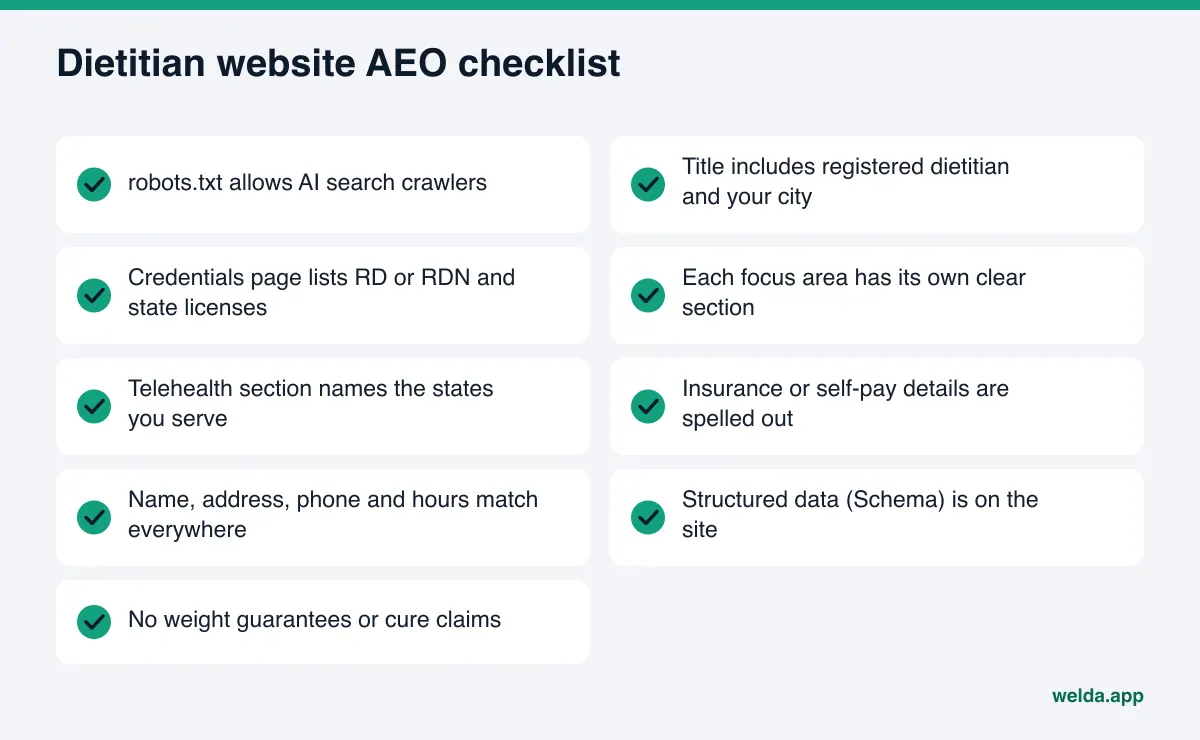
If you count more than three gaps, work in this order: crawler access first, then consistent name, address and hours, then credentials and focus areas, then insurance and FAQ. Reviews and reputation are a longer project. For how another health specialty approaches tool selection, see AI visibility software for dermatologists.
Frequently asked questions
Is AI visibility software for dietitians different from an SEO tool?
Yes. An SEO tool tracks where your pages rank in search results. AI visibility software checks whether AI assistants mention you, in what position, and where competitors are ahead. They share some technical basics, but the questions and the measurement are different.
I only see clients over telehealth. Do I still need an address?
Assistants describe you more easily when they can connect you to a place. State the states where you are licensed or serve clients, and explain how virtual sessions work. You do not need to publish a home address; a consistent business contact is enough.
Can I share client weight-loss results to build trust?
The FTC treats testimonials with results better than what people can generally expect as likely deceptive, and a disclaimer does not cure that. For AI visibility, clear credentials, focus areas and process descriptions do more than individual results. This is not legal advice.
Should I list prices on my site?
That is your decision; check any rules that apply in your state. Clear payment information, even without exact fees, helps assistants answer cost questions. Welda does not decide this for you; it drafts what you approve. If you list fees, keep them consistent everywhere.
Is client data sent to Welda or to an AI model?
No. In health care, client data is not sent to the AI. Welda works with your public practice information and the drafts it prepares.
How long until I see results?
Technical fixes can be done quickly, but new content usually takes weeks to be reflected in AI answers. That is why measurement needs to be repeated and compared before and after.
What does the free analysis include?
It is free once per site. Your email and phone are verified, the results link arrives by email and stays open for 14 days. It includes scores, gaps, suggested homepage copy, a score simulation, a competitor comparison, a fix package with structured data, a PDF and a shareable score card.
Next step: see how AI reads your practice website
Before choosing AI visibility software for dietitians and nutritionists, it helps to know where you stand. The free site analysis shows which facts are missing, whether AI crawlers can reach your site, and whether your name appears in 5 questions a client might ask. If you want to talk about panel early access, bringing your analysis results to the call is the most useful place to start.