What does AI search optimization for therapists and counseling practices actually involve? It is the work of making sure that when someone asks ChatGPT, Gemini, Perplexity, or Google's AI Overviews to recommend a therapist, your practice is one of the names in the answer. In the US this is usually called AEO (answer engine optimization); you may also see it called GEO, short for generative engine optimization. The work starts with seeing what AI assistants can read on your website, then filling the gaps within the limits of your professional ethics code and state licensing rules. No one can guarantee a specific position in an AI answer.
This guide is for licensed psychologists in private practice, group counseling practices, LMFT and LCSW practices, and the people who run their websites. AI search optimization for therapists and counseling practices looks a lot like the same work for a dental office or a physical therapy clinic, with three important differences: clients search for help with something deeply personal, the decision rests on trust more than convenience, and asking clients for reviews raises ethical questions that most other businesses never face. Below we cover the problem, the steps, how Welda handles the work, and what it does not do. If you want to see where your own site stands today, you can start with the free AI visibility analysis.
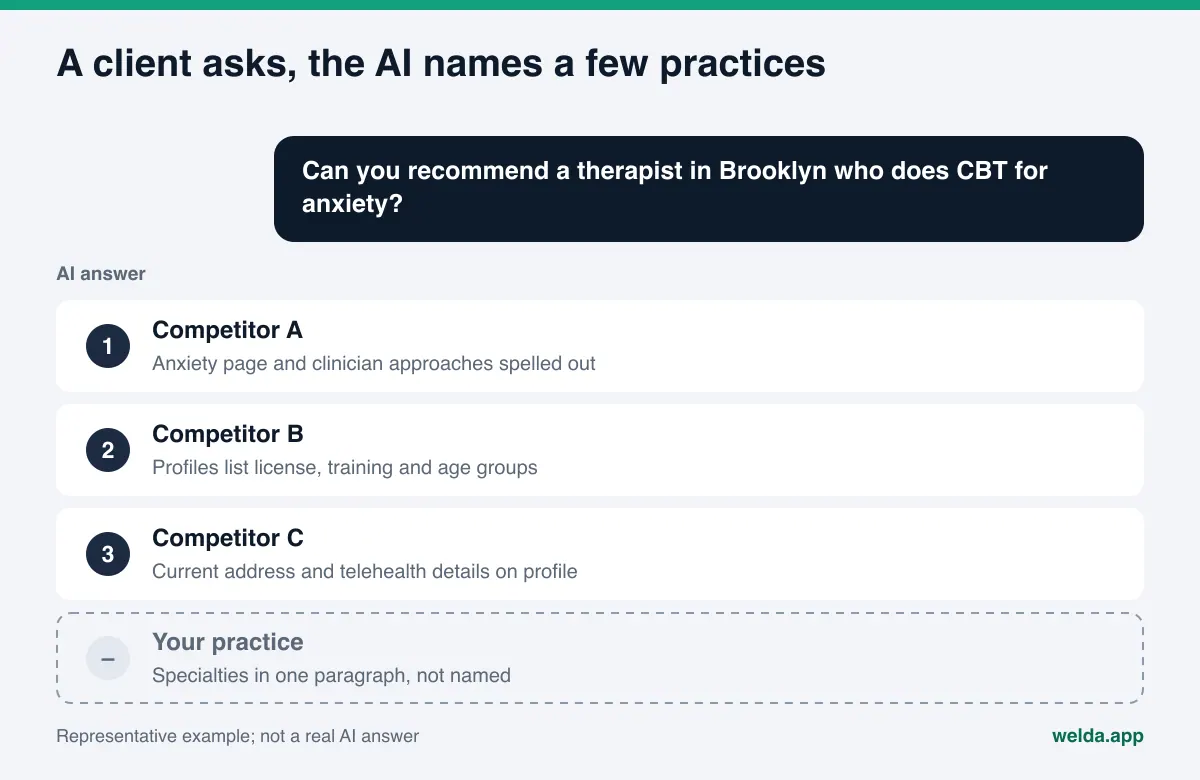
Why clients now ask AI assistants to find a therapist
Deciding to start therapy is rarely quick. People often spend weeks thinking about what they are going through before they look for someone to talk to. When they do look, many would rather not ask friends or family. Typing the question into an AI assistant feels private, and the assistant answers in plain language with a short list of names.
The questions tend to be specific: "therapist in Brooklyn who does CBT for anxiety," "couples counselor in Austin with evening appointments," "Spanish-speaking therapist who does telehealth in California," "psychologist in Denver who works with teenagers," "therapist near me who takes my insurance." To answer, the assistant runs a web search, reads the pages it finds, and picks a few names. A practice that is not named never makes it onto the list the client compares.
Three things make this harder for therapy practices than for most local businesses:
- Clients search by approach and specialty. They rarely search for "therapist" alone. They look for CBT, EMDR, DBT, trauma-focused work, couples counseling, or work with children and adolescents. If your site does not say this clearly, the AI cannot match you to the question.
- Reviews are scarce. Many clients do not want to say publicly that they are in therapy. Credentials, training, and a clear description of how you work become the main trust signals.
- The limits are firm. Content that diagnoses, promises outcomes, or tells client stories can conflict with professional ethics codes and advertising rules. Writing for AI search does not loosen those limits.
What AI assistants look for when recommending a therapist
AI assistants do not know your practice from experience. They read the pages they can reach, combine what they find, and choose the names that best fit the question. The first requirement is that the assistant can reach your site at all. ChatGPT's search feature uses a crawler called OAI-SearchBot; according to OpenAI's crawler documentation, sites that block it will not appear in ChatGPT search answers. For Google's AI Overviews and AI Mode there is no extra technical requirement; Google's AI features documentation says a page needs to be indexed and eligible to show a snippet. We cover crawler access in detail in our guide to robots.txt for AI crawlers.
Once the assistant can read your site, this is the information it needs to put your practice in an answer:
| Information | Where it should live | What happens if it is missing |
|---|---|---|
| Concerns you work with | A separate page for each main area: anxiety, depression, trauma, couples, teens | You are known as a "general therapist" and left out of specific questions |
| Therapy approaches | An approaches page and each clinician's profile | "Therapist who does EMDR" goes to someone else |
| Clinicians and licenses | A team page with license type, degree, training, populations served | Weak trust signal compared with practices that spell it out |
| Session format | In person, telehealth, the states you are licensed in, languages | You miss "online therapist in [state]" and language questions |
| Insurance and payment | A clear page or FAQ: in-network plans, out-of-network, superbills | Insurance questions name other practices |
| Address, phone, hours | Every page of the site and your Google Business Profile, written the same way | Old or inconsistent details end up in the answer |
None of this is new information. The difference is writing it clearly, in one place, in a way an AI system can read without guessing. A homepage that says only "individual, couples, and family therapy" gives an assistant nothing to work with when someone asks for "a female therapist in Chicago who specializes in postpartum anxiety."
What clients ask AI about therapy, by question type
Knowing the right questions tells you which page is missing. For therapy practices, questions usually fall into four groups. The examples below were written for this article; they are not measurement results.
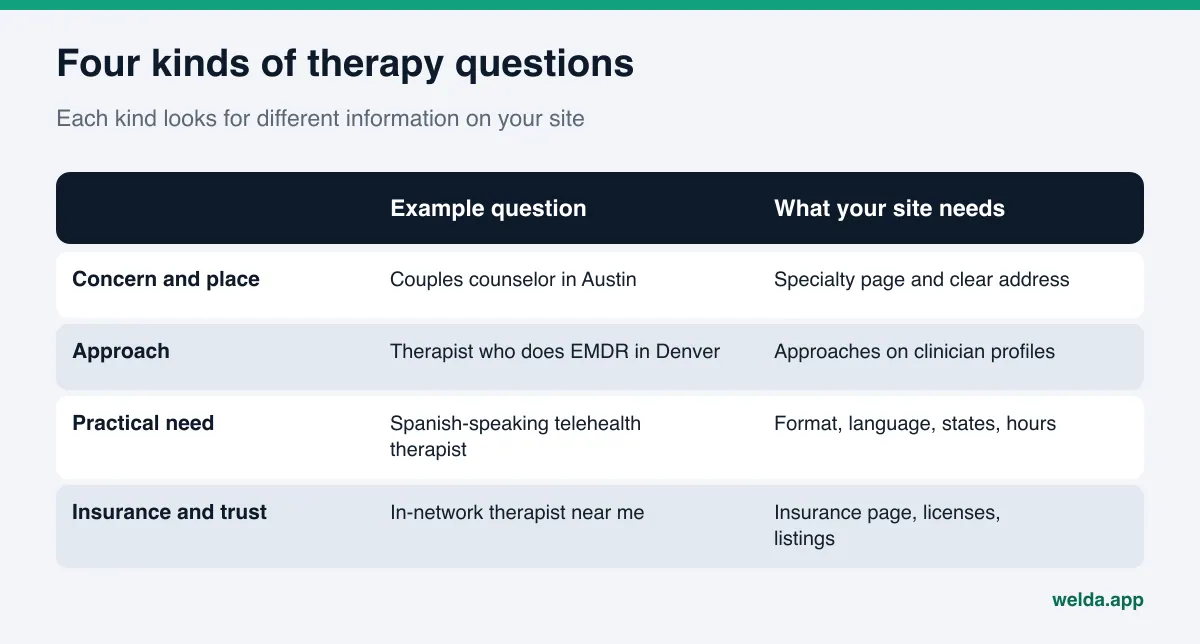
Each group needs a different kind of page. Concern and location questions are answered by specialty pages. Approach questions are answered by clinician profiles that name the methods each person uses. Practical questions (telehealth, insurance, language, evening hours) are answered by a well-written FAQ. Trust questions are answered by license and training details on your site, and by consistent listings on Google Business Profile and in therapist directories such as Psychology Today.
Insurance deserves a note of its own. In the US, "therapist who takes [insurance plan]" is one of the most practical questions a client can ask. If you are in network with certain plans, say so on a page the AI can read, and keep it current. If you are out of network, say that clearly too and explain how clients can request a superbill. An honest "we are out of network" still helps an assistant match you correctly, and it saves both you and the client a wasted call.
Some clients describe their situation rather than naming a type of therapy: "I can't stop worrying about work, who should I talk to?" In those cases the assistant usually gives general information first and then suggests seeing a professional. If your site has a calm, non-diagnostic page that explains how you work with people in that situation, your practice has a better chance of being named in that suggestion.
AI search optimization for therapists and counseling practices, step by step
The order below starts with the most basic barrier and moves toward trust signals. Skipping ahead rarely pays off: writing new pages for a site that crawlers cannot reach means writing text the AI will never read.
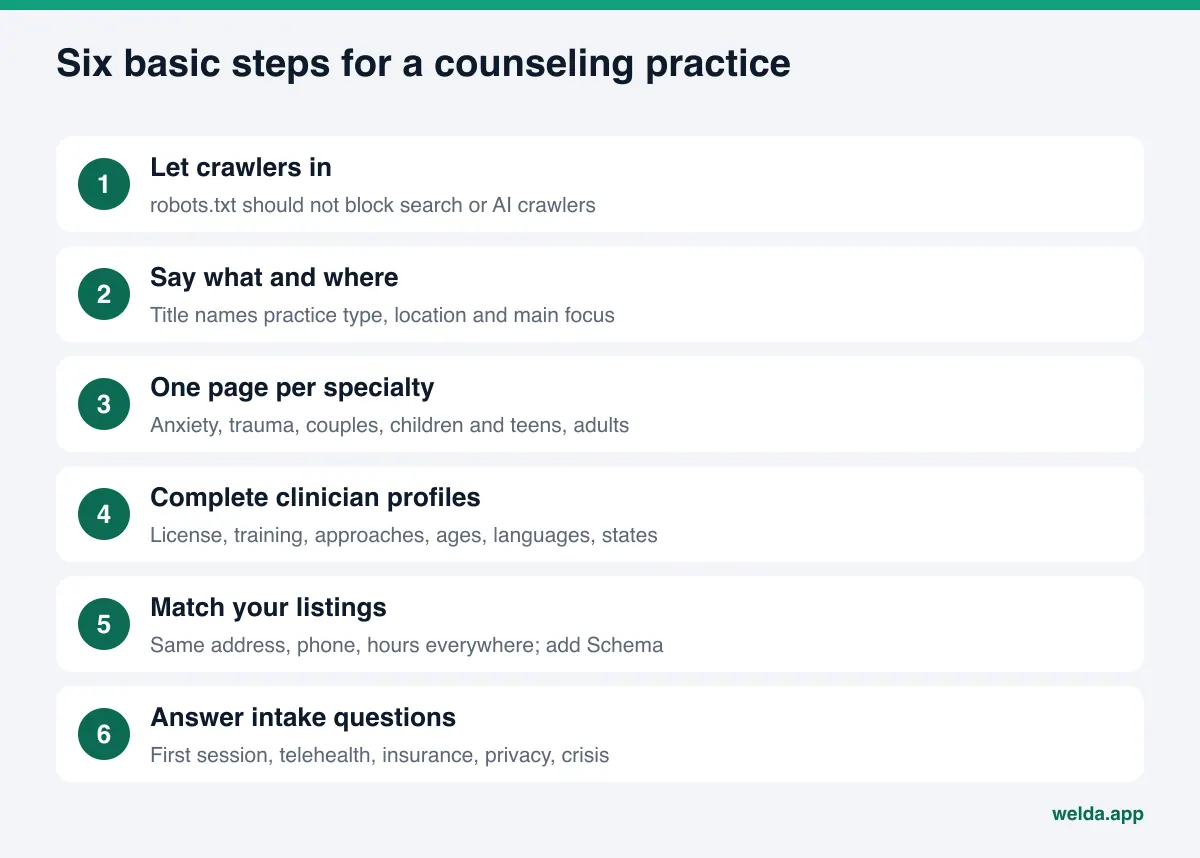
- Check crawler access. Your robots.txt file should not block search or AI crawlers. Some website templates and security plugins block them without telling you.
- Say what and where in your titles. Your homepage title should name the type of practice, the city or neighborhood, and your main focus, for example "Counseling Practice in Park Slope, Brooklyn: Individual, Couples and Teen Therapy." See our guide to title tags and meta descriptions for AI search.
- Give each main specialty its own page. Anxiety, trauma, couples, children and teens, adult individual therapy. Each page should say who it is for, how the first session works, which clinicians do this work, and which approaches they use. Describe how you work with people facing that concern instead of listing symptoms.
- Complete every clinician profile. License type, degree, relevant training, approaches, age groups, languages, and the states where the clinician can see clients by telehealth. Use credentials exactly as your license allows.
- Make your business information consistent. Address, phone, and hours should match on your site, Google Business Profile, and directories. Add business structured data (Schema) to your site.
- Answer the questions clients call about. How the first session works, session length, telehealth, insurance and superbills, confidentiality, and what to do in a crisis. The crisis answer should point clearly to 911 or the 988 Suicide and Crisis Lifeline.
None of these steps requires client information. Everything is about the practice itself: facts you already know but have not written down on your site. If you want to see the same structure in a related field, our guide on how physical therapy clinics get recommended by ChatGPT walks through it for clinics.
Example: building a specialty page
The outline below is for an example couples counseling page. It is not taken from a real practice; it is a skeleton to fill with your own details.
- Page title: "Couples Counseling in Austin: In Person and Telehealth." Type, city, and format in one line.
- Opening paragraph: Who the page is for, in two or three sentences, such as couples dealing with communication problems, a decision about separating, or a major life change. No diagnosis, no promises.
- How we work: What happens in the first session, how session length and frequency are decided, which approach the clinicians use.
- Clinicians who do this work: Name, license, relevant training, and a link to each profile.
- Practical details: Location, parking, telehealth, languages, insurance status, how to request a first appointment.
- Short FAQ: "What if my partner doesn't want to come?", "How long are sessions?", "How is confidentiality handled in couples work?"
You can repeat this outline for each specialty, but the text should not be copy-paste. When the same paragraph appears on several pages with small edits, an AI system may not treat any of them as a strong source for that topic. Each page should describe how you actually work in that area.
Ethics and advertising limits: what not to publish
Content written with AI search in mind follows the same rules as everything else on your site. For psychologists, the APA Ethics Code addresses public statements directly; Standard 5.05 says psychologists do not solicit testimonials from current therapy clients or from others who are vulnerable to undue influence. Counselors, social workers, and marriage and family therapists follow their own codes and state board rules, and general truth-in-advertising rules apply to everyone. The list below is not legal advice; it helps you spot risky patterns. Check anything borderline with your attorney, your licensing board's guidance, and your professional association.
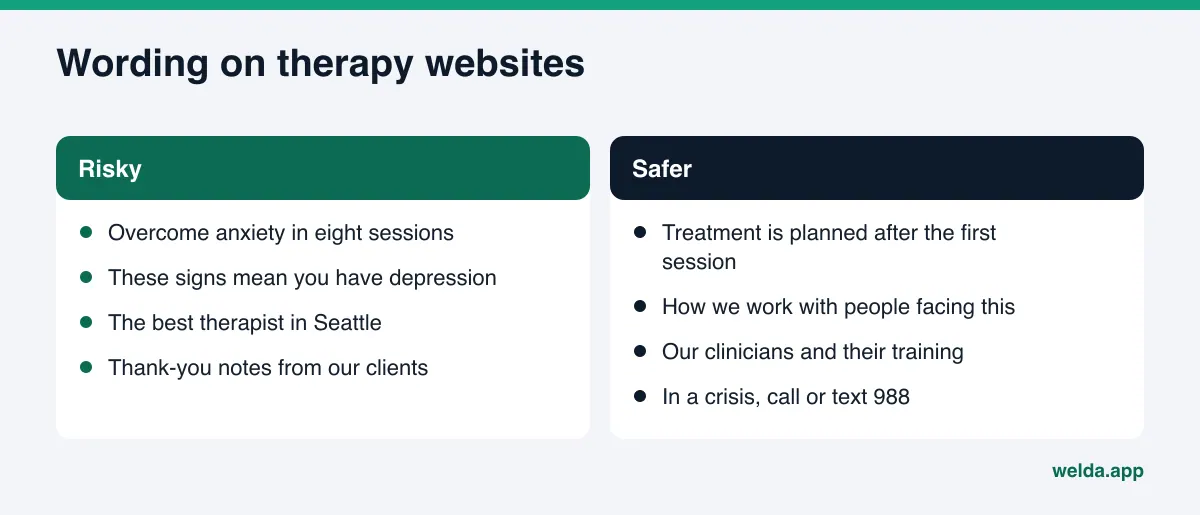
The most common risky patterns on therapy websites are outcome promises ("overcome anxiety in eight sessions"), diagnostic statements ("these signs mean you have depression"), superiority claims ("the best therapist in Seattle"), client stories and thank-you notes, and recommendations about medication. If the pages an AI reads contain these claims, the AI may repeat them in its answer, with your name attached. Pricing language needs the same care; our guide to pricing claims in AI-ready content covers how to state fees and insurance information without overpromising.
Reviews need extra care. Asking a current client for a review can put them in a difficult position. For therapy practices, the main trust signal is not review volume. It is clearly stated licenses, training, and a transparent description of how you work. When reviews do arrive on their own, replies should be short and general, and should never confirm that the reviewer is a client.
How Welda handles AI search optimization for therapy practices
Welda is software that measures where a business appears in AI answers and fills the gaps on the business's behalf. For a therapy practice, three parts matter most: the free analysis that reads your site, a task list that asks you for missing facts instead of guessing, and an approval flow that sends every health-related text to you before anything is published.
The free analysis reads your site the way AI does
The free analysis reads your homepage and a few inner pages such as services, about, and contact. For a counseling practice, the most useful findings are usually whether AI crawlers can get in, whether your title and description say what you are and where, whether business structured data is present, whether your address and phone are readable, whether you have an FAQ section, and whether your specialties are written out clearly. You get a score out of 100 (technical and content scored separately), and for each gap: what was found, why it matters, and how to fix it. It also suggests ready-to-use homepage text, shows which fixes would raise the score the most, compares you with competitors, and gives you a fix package to add to your site, including business structured data code.
The analysis also asks 5 questions a client might ask to an AI assistant that can search the web, and checks whether your practice is named in the answers. Think of it as a one-time snapshot. The free analysis works in English. It is free once per site; your email and phone are verified, and the results link arrives by email and stays open for 14 days.
The task list asks instead of guessing
Inside the Welda panel, the top of the task list holds the facts Welda could not find on your site. It leaves those fields blank and asks you. For a therapy practice these are usually questions like: which clinician works with which age group, which languages telehealth sessions are offered in, how long the first session lasts, whether there are weekend hours. You answer once, and the answer flows into every text that uses it, so the teen therapy page, the telehealth FAQ, and the Google Business Profile description all carry the same facts.
The second part of the list holds drafts waiting for your approval. Welda prepares specialty pages, profile text, and review replies, and each one comes with "read" and "approve." In health care there is no automatic publishing: every text for a therapy practice goes into this queue and nothing goes live until you approve it. Client data is never sent to AI. Welda works only with information about the practice itself.
Question tracking, the score, and the legal check
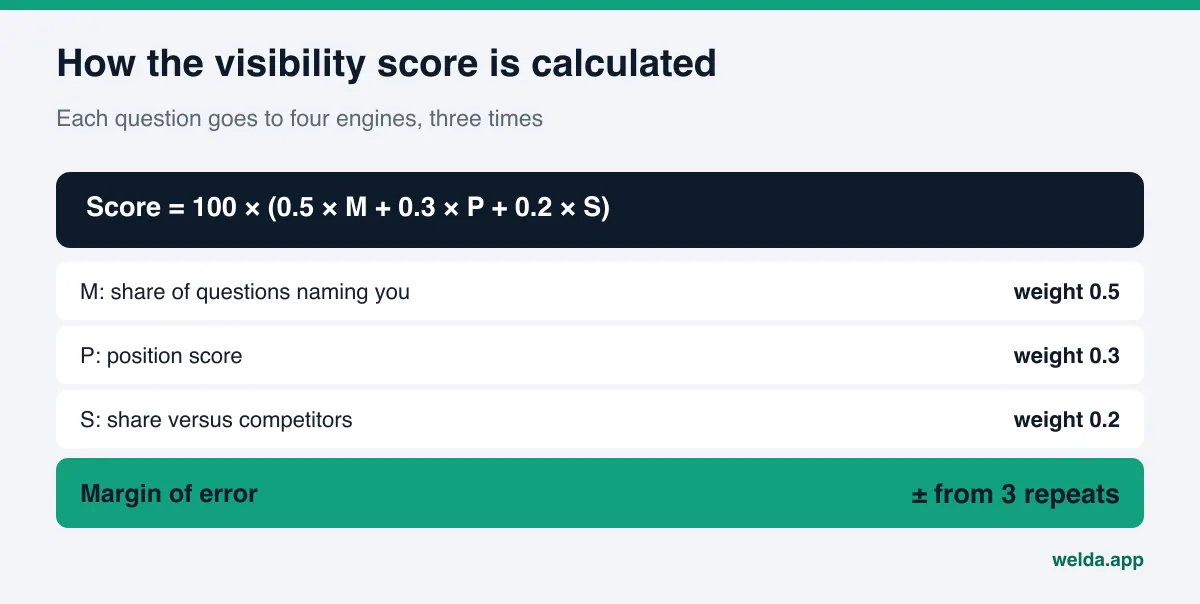
In the panel, the questions your clients would ask are put to ChatGPT, Gemini, Perplexity, and Google AI three times each. The questions screen shows, question by question, which engine names your practice and in what position. A practice might see that it shows up for couples questions but not for teen questions, and decide which page to write next. The score formula is open:
Before anything is published, the legal check flags patterns such as pricing, guarantees, superiority claims, and diagnostic suggestions. It is a warning layer, not legal advice, and it has not been reviewed by legal counsel. The final call stays with you.
For WordPress sites, Welda connects through a separate Editor user and an application password, with no code to install. Drafts open on your site as drafts and go live when you approve. For other systems, Welda gives you a ready package and the changes are made by hand. Content always lives on your own site. Progress shows up in a one-page monthly report; our guide to the monthly AEO report explains how to read it.
Early access note: The Welda panel is in early access and is opening first in Turkey. Regular four-engine tracking is being added during early access, and sample panel screens use representative data. What anyone can use today is the free site analysis, which works in English. Pricing is discussed in an early access conversation.
Limits: what Welda does not do
- Welda does not guarantee rankings or that you will "show up in ChatGPT." AI answers vary; the same question can get different answers at different times.
- It does not write facts it does not know. If a clinician's training or approach is not on your site, Welda asks you.
- It does not publish sensitive content without approval. In health care, every text goes through the approval queue.
- It does not create fake reviews and does not run review collection from clients.
- Handling negative reviews, managing directory accounts, and PR work stay with your practice.
- It does not replace clinical judgment on diagnosis, treatment, or the accuracy of clinical content. Whoever approves the text is responsible for it.
Timing matters too. New pages or corrected profile text usually take weeks to be reflected in AI answers, and the delay varies by engine and question.
Where to start: a decision checklist
You do not need to do everything at once. The decision guide below helps you choose a first step based on where your practice stands now.
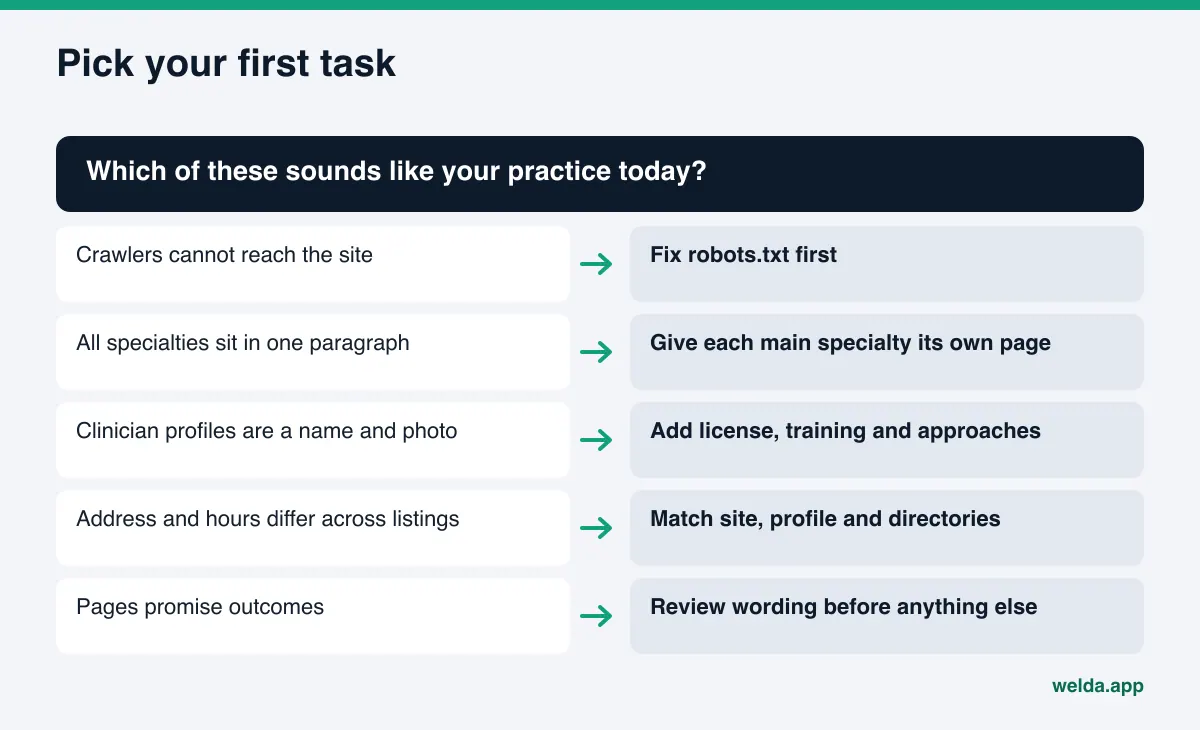
Use this table to check your own site. Any row where you cannot answer "yes" belongs on your first to-do list.
| Check | How to look | Priority |
|---|---|---|
| Can crawlers reach the site? | Open yoursite.com/robots.txt | Very high |
| Does the homepage title say type and location? | Read the title in the browser tab | High |
| Does each main specialty have its own page? | Look for anxiety, couples, teens pages in the menu | High |
| Is every clinician profile complete? | License, training, approaches, ages, languages, states | High |
| Is insurance status stated clearly? | In-network plans or out-of-network and superbills | Medium |
| Do address and phone match everywhere? | Site, Google Business Profile, directories | Medium |
| Any risky claims? | Outcome promises, diagnosis, client stories | High |
Group practices face one more decision: a separate page for each clinician, or one team page? Clients often search for a specific kind of person, so individual pages usually match questions better. Each page has to be filled in, though; a page with only a name and a photo tells an AI nothing.
Frequently asked questions
Is AEO for therapists different from regular SEO?
The foundation is the same: crawler access, clear titles, consistent business information. The difference is that an AI assistant picks a few names for a single answer, so clear, detailed information about specialties, approaches, and clinicians matters more.
Can we appear in AI answers without many reviews?
Yes, it is possible. Because reviews are scarce in therapy, AI systems also rely on other signals: licenses, training, specialties, and consistent listings. Writing those out clearly partly makes up for a low review count.
We only offer telehealth. Does location still matter?
Yes, but differently. Clients search by state because licensing is state-based. List the states each clinician can practice in, and if you also have an office, state its address clearly.
Does Welda see our client information?
No. Welda works only with information about the practice: website, profiles, services, clinicians. In health care, patient or client data is never sent to AI.
Are drafts published automatically?
No. There is no automatic publishing in health care. Every text goes to the approval queue and nothing goes live until you approve it. On WordPress, content opens as a draft first.
How long until we see results?
New content usually takes weeks to show up in AI answers. No one can promise a timeline or position; the way to track progress is to ask the same questions regularly.
Does the free analysis work for US therapy practices?
Yes. The free analysis works in English and reads any site regardless of industry. It is free once per site.
See where your practice stands today
AI search optimization for therapists and counseling practices starts with seeing what your website tells AI systems right now. Are crawlers blocked? Does your title leave out your location? Are all your specialties squeezed into one paragraph? You can find out in a few minutes. The free AI visibility analysis reads your site, lists each gap with the reason and the fix, and checks whether your practice is named in answers to 5 client questions. The results link arrives by email; after that, you decide what to fix yourself and whether to ask for an early access conversation.