How do physical therapy clinics get recommended by ChatGPT? ChatGPT recommends a PT clinic based on what it can read about it: which conditions you treat, who your therapists are, where you are, when you are open, which insurance you take and what patients say about you. When that information is clear, consistent and easy to crawl, your clinic is more likely to be named in the answer. No one can guarantee a specific position.
This guide is for owners and marketing leads of outpatient physical therapy clinics, sports rehab practices and multi-location PT groups in the US. The question is practical: when a patient asks ChatGPT, Gemini, Perplexity or Google's AI Overviews "Can you recommend a physical therapist near me for lower back pain who takes my insurance?", does your clinic show up? If not, why not, and what should you fix first? Below we cover how physical therapy clinics get recommended by ChatGPT, the work that answer engine optimization (AEO) involves for a PT practice, how Welda handles that work, and what it does not do. If you want to see where your own site stands today, start with the free AI visibility analysis.
Why AI search visibility matters for physical therapy practices
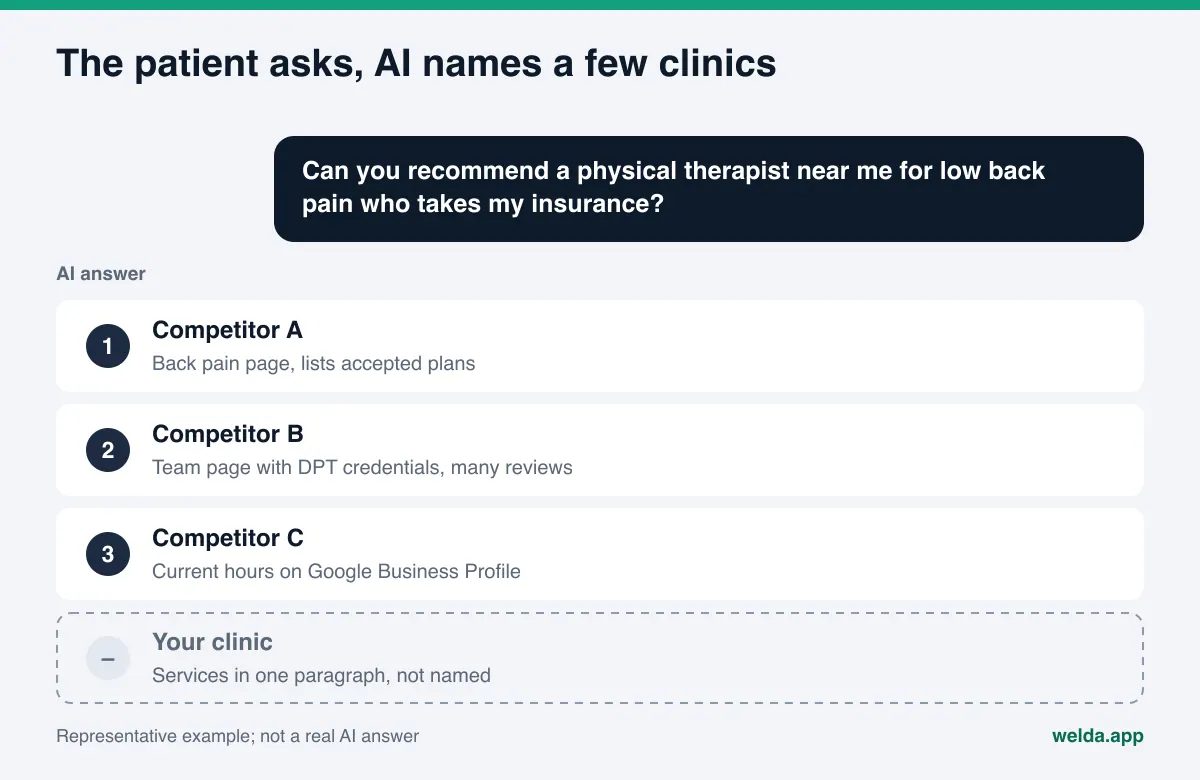
Most PT journeys start with pain, not with a clinic name. A patient describes the problem, then asks where to go. In classic search those were two separate steps: read about the condition, then search "physical therapy near me" and compare a few listings on the map. In an AI assistant both steps happen in one conversation. The patient types the condition, the neighborhood, the insurance plan and the hours they need, and the assistant replies with a short list of named clinics.
A clinic that is not in that list is not in the comparison at all. On a results page, ranking sixth still earned some clicks. In an AI answer there are usually only a handful of names, and the patient tends to pick from them. That is why AEO, also called GEO (generative engine optimization), has become a front-desk issue, not just a marketing experiment.
Physical therapy has a few traits that make this harder than it looks:
- Many conditions, many questions. Low back pain, neck pain, ACL rehab, rotator cuff, post-surgical rehab, vestibular therapy, pelvic floor therapy, pediatric PT. Each is its own question and its own answer.
- Logistics decide the visit. Patients come several times a week. Location, parking, early morning and evening slots, in-network plans, Medicare and home visits matter as much as clinical content.
- Direct access changes the question. According to the APTA's 2025 report on direct access, all 50 states, DC and the US Virgin Islands allow some form of direct access to physical therapist evaluation and treatment, though provisions vary by state. Patients now ask "Can I see a PT without a referral?" and AI answers that question with names.
How physical therapy clinics get recommended by ChatGPT: what the model reads
AI assistants do not know your clinic from experience. They run a web search, read the pages they find, combine what those pages say and name the clinics that best fit the question. For ChatGPT search, the crawler is OAI-SearchBot. OpenAI's crawler documentation says sites that opt out of OAI-SearchBot will not appear in ChatGPT search answers. On the Google side, Google's AI features documentation says there are no additional requirements to appear in AI Overviews or AI Mode beyond being indexed and eligible for a snippet.
In practice, here is what an answer engine needs before it can recommend a PT clinic:
| Information | Where it should live | What happens if it is missing |
|---|---|---|
| Conditions you treat | One clear service page per major condition | You are known as "a PT clinic" and skipped for "ACL rehab" questions |
| Therapists and credentials | Team page with names, DPT or other credentials, specialties | Trust signals are weak and a competitor is named instead |
| Address, phone, hours | Every page footer and Google Business Profile, written the same way | Old or conflicting details end up in the answer |
| Insurance and payment | An insurance page or FAQ that lists accepted plans | You are left out of "in-network" and "takes Medicare" answers |
| Direct access and referrals | A short FAQ on how patients can start care in your state | The assistant cannot say whether a patient can book you directly |
| Patient reviews | Google Business Profile, Yelp, Healthgrades, a reviews section on site | Comparison questions go to the clinic with visible reviews |
None of this is new information. The difference is that it must be written in a form a model can read, in one place, and the same everywhere. A clinic page that says "We treat back pain, neck pain, sports injuries and more" in one paragraph gives the model nothing to work with when someone asks for "vestibular therapy in Austin that is open on Saturdays."
What patients ask AI about physical therapy
Knowing the questions tells you which page is missing. PT questions usually fall into four groups: condition plus location ("physical therapy for knee pain in Plano"), logistics ("PT clinic open before 7 am", "in-home physical therapy near me"), insurance and access ("physical therapist that takes Medicare", "can I see a PT without a doctor's referral in Ohio"), and trust or comparison ("best reviewed sports physical therapy clinic near me"). We go deeper on building and maintaining that list in prompts to track for AI visibility.
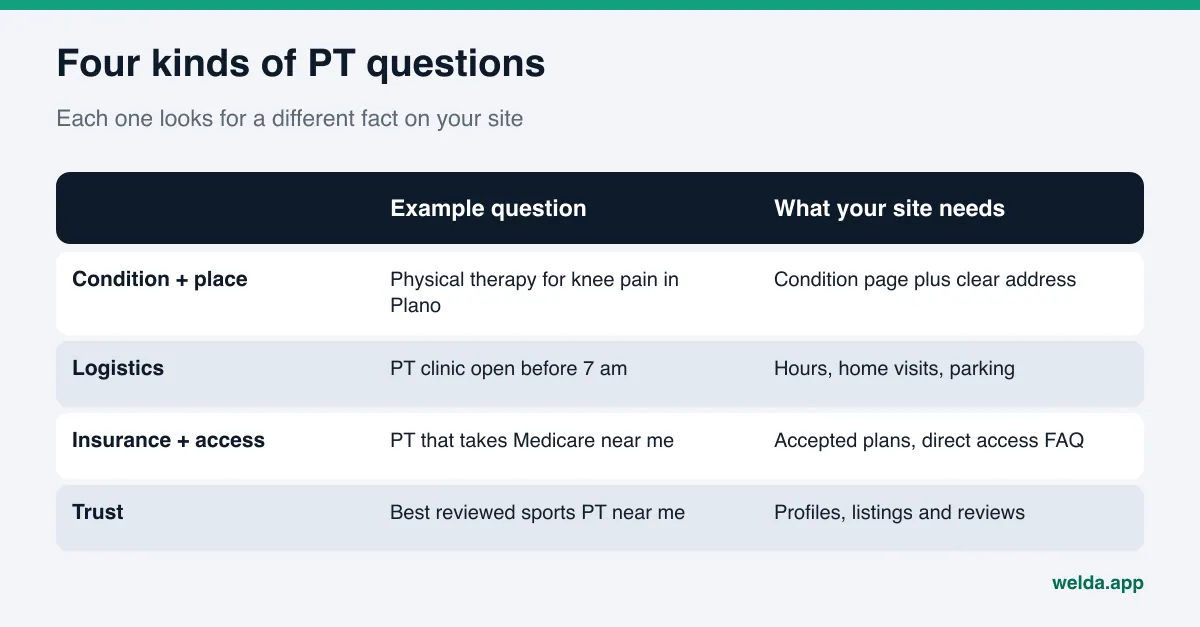
Notice that most of these questions are local. An assistant that answers "physical therapy for knee pain in Plano" needs to connect three facts: you treat knees, you are in Plano, and the details it found about you are current. If any one of the three is missing or contradictory, the safest move for the model is to name someone else.
AEO for PT clinics: a step-by-step plan
The order below starts with the fixes that take the least effort and unblock everything else. Your own team can do every step. In the next section we explain where Welda fits.
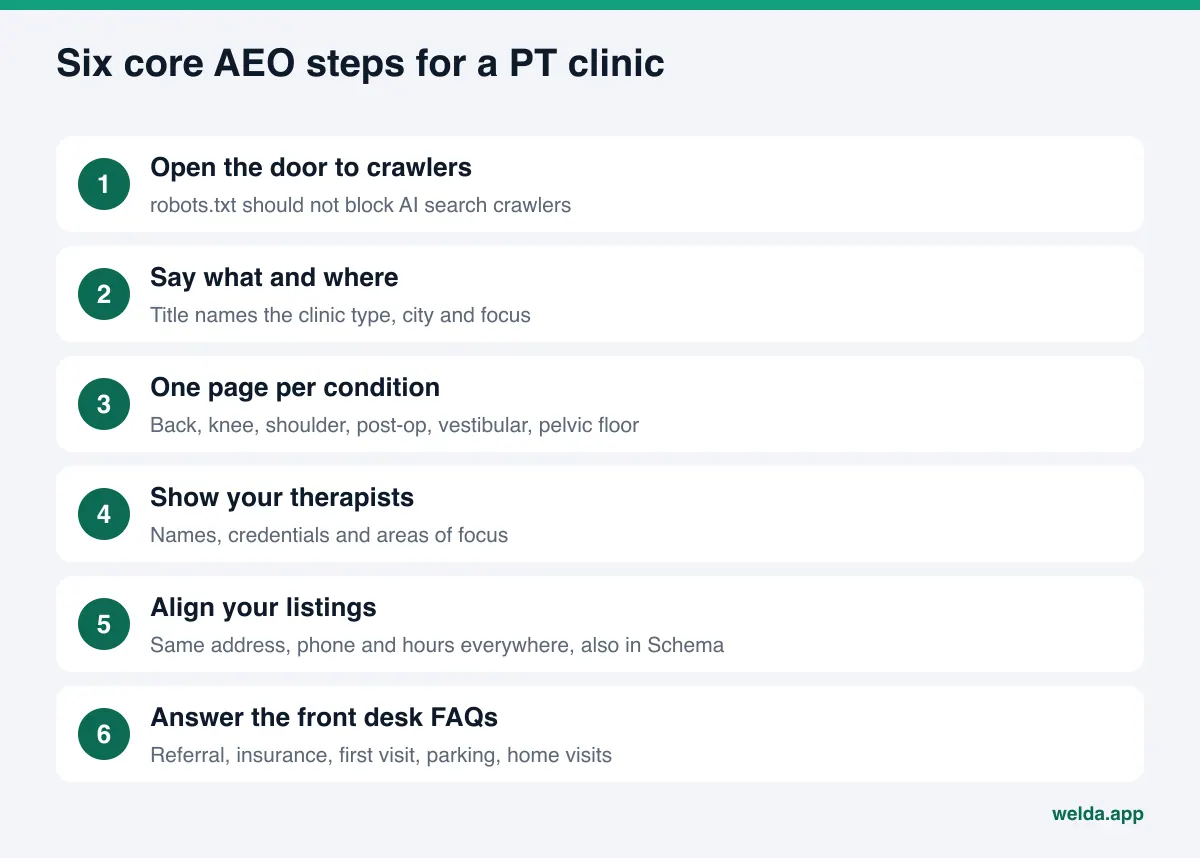
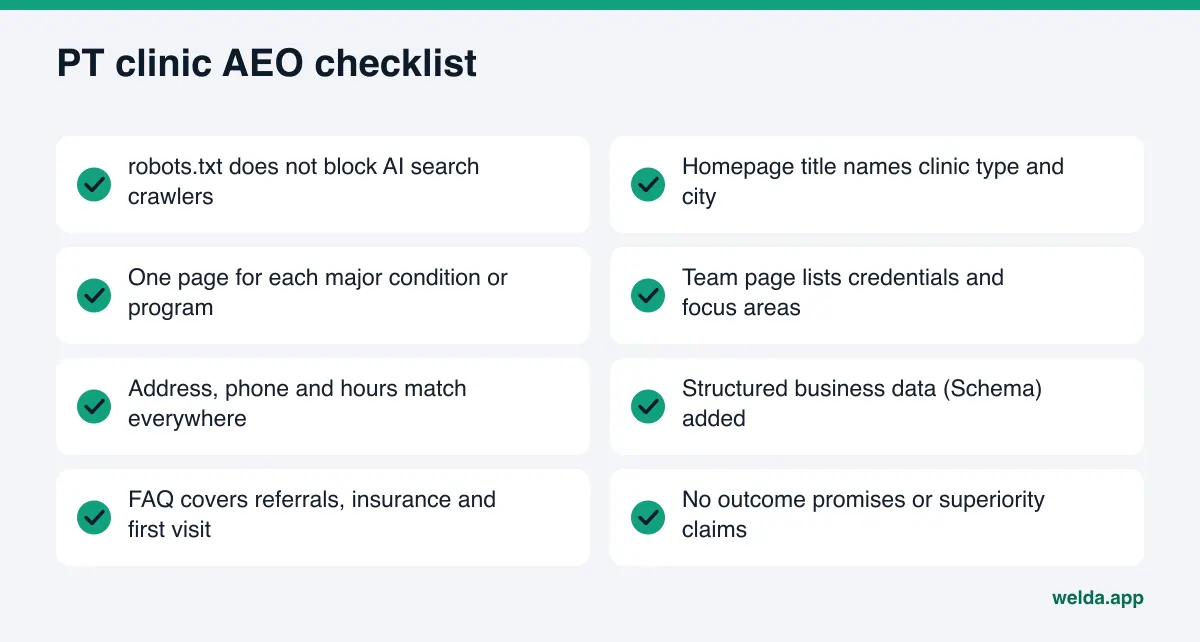
- Make sure AI crawlers can reach your site. Check robots.txt for blocks on OAI-SearchBot, Googlebot and other AI search crawlers. Security plugins and hosting firewalls sometimes block them without anyone noticing.
- Rewrite your homepage title and description. Say what you are and where: "Physical Therapy and Sports Rehab in South Austin." Generic lines like "Your health is our priority" tell the model nothing.
- Create one page per major condition or program. Low back pain, neck pain, knee and ACL, shoulder, post-surgical rehab, vestibular, pelvic floor, pediatric. Each page explains how the evaluation works, what the plan of care generally looks like and who provides it. Do not promise outcomes.
- Update the team page. Names, credentials, board certifications if any, and areas of focus. This helps both patients and models judge expertise.
- Keep name, address, phone and hours identical everywhere. Site footer, contact page, Google Business Profile, Yelp, Healthgrades and any directory listings should match. Conflicting details are a common source of wrong answers; see wrong address or phone number in AI answers.
- Add structured business data (Schema). Name, address, phone, hours, services and social profiles in machine-readable form help the model match facts to the right clinic.
- Write a real FAQ. Answer what the front desk hears every day: Do I need a referral? Which plans are you in-network with? How long is the first visit? Do you offer home visits? Is there parking?
- Clean up off-site profiles. Complete your Google Business Profile, keep Yelp and Healthgrades listings current, and read what patients say. Reply to reviews calmly and without confirming anyone's health details or patient status.
Example: a service page an answer engine can use
The most time-consuming step is the condition page. Here is a skeleton for an example clinic's "physical therapy for low back pain" page. It is not a real clinic; the parts you fill in with your own facts are spelled out.
- Page title: "Physical Therapy for Low Back Pain in South Austin | Clinic name." Condition, location and name together.
- Intro: Two or three sentences on how the clinic evaluates low back pain, who does it and where. No outcome promises.
- Your first visit: How the evaluation works, what to bring (for example imaging reports if you have them, insurance card), and roughly how long it takes at your clinic.
- How we treat it: A short description of approaches your clinic actually uses, with a line such as "your therapist decides what fits after the evaluation."
- Who you will see: Therapists who focus on spine care, linked to the team page.
- Logistics: Hours, early or evening slots, accepted plans, direct access in your state, parking.
- FAQ: Three or four questions. For "How many visits will I need?" say it depends on the evaluation instead of giving a number.
- Contact: Phone, address and booking link, identical to the rest of the site.
Repeat the structure for knee, shoulder, neck and post-op pages, but write each one for its own condition. Near-duplicate pages are hard for a model to tell apart.
Health claims and reviews: staying inside the rules
Producing more content for AI visibility creates a health-specific risk: every new page is another chance to publish a claim you cannot support. The FTC requires health-related advertising claims to be truthful and backed by appropriate evidence, and your state practice act or licensing board may add its own rules on advertising, so check them as well. Reviews have their own rule: the FTC's rule on consumer reviews and testimonials, published in August 2024, prohibits fake reviews, including AI-generated ones, and undisclosed insider reviews. This is not legal advice; have your compliance advisor review your pages.
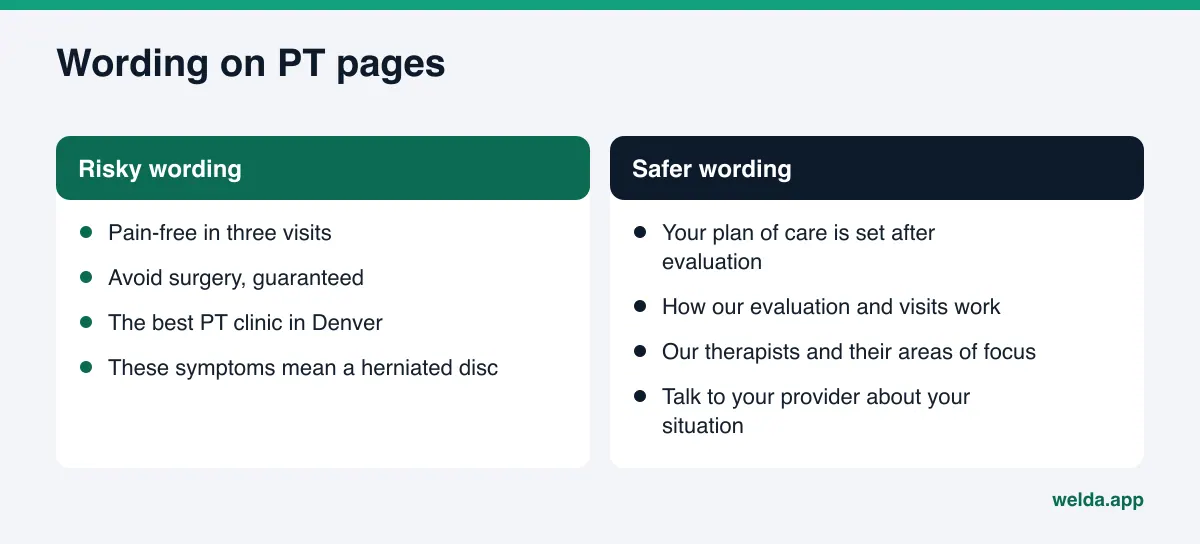
Phrases to watch on PT sites:
- Outcome promises: "pain-free in three visits", "avoid surgery guaranteed".
- Superiority claims: "the best physical therapy clinic in Denver", "number one".
- Individual diagnosis: "If you have these symptoms, you have a herniated disc and need this treatment."
- Patient stories with names, photos or health details without proper authorization.
- Price promotions that are not accurate for every plan.
How Welda does this work
Welda is software that measures where a business appears in AI answers and fills the gaps on the business's behalf. For a PT clinic the work has two parts: the free site analysis, which anyone can use today, and the Welda panel, which is in early access.
What the free analysis shows
The analysis reads your homepage and a few inner pages (services, pricing, about, contact) the way Google and AI systems do. It checks whether AI crawlers can access the site (robots.txt), your page title and description, the main heading, business structured data (Schema), address, phone and location details, whether your social and map profiles are linked from the site, an FAQ section, reviews and trust signals, whether services are clearly described, and page speed.
You get a score out of 100, with technical and content scores shown separately. For each gap you see what was found, why it matters and how to fix it. You also get ready-to-use homepage copy (title, description, main heading, intro paragraph and FAQs), a simulation showing how much each fix would raise the score, a competitor comparison, a ready-made fix package for your site including the structured data code, a PDF and a shareable score card.
The analysis also asks an AI assistant that can search the web 5 questions a patient might ask and checks whether your clinic's name appears in the answers. That is a one-time measurement. The analysis is free once per site and works in English. Your email and phone number are verified, the results link arrives by email and stays open for 14 days. It does not measure rankings and does not guarantee them.
What the Welda panel does
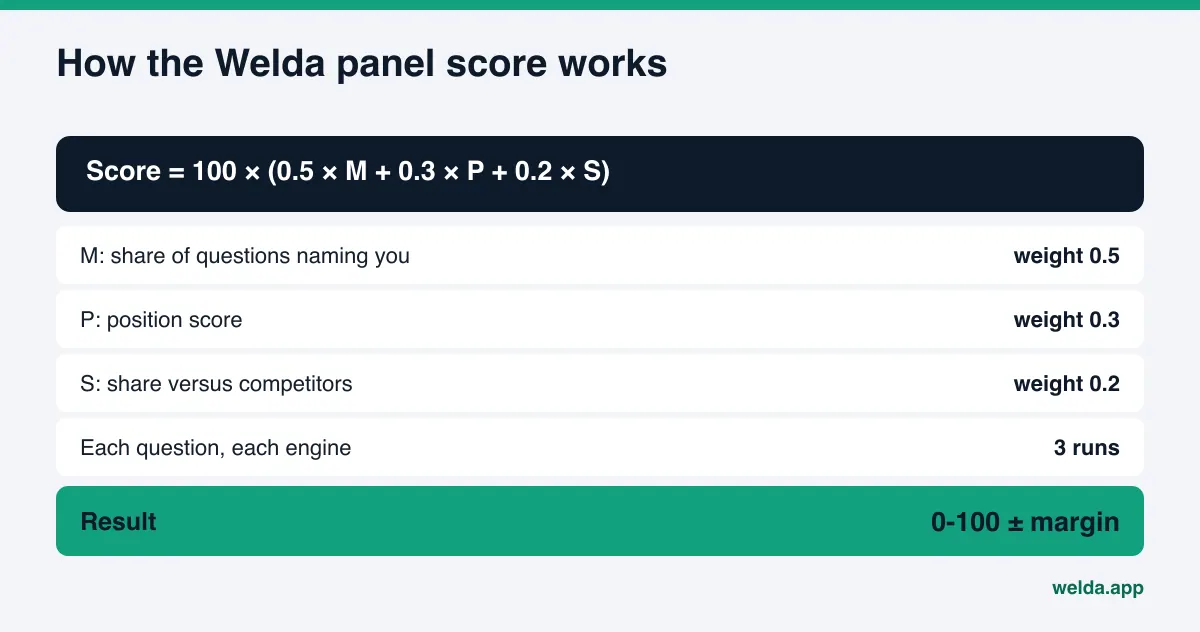
In the panel, the questions patients ask are run three times each on ChatGPT, Gemini, Perplexity and Google AI. You see which questions mention your clinic, in what position, and where competitors lead. The score formula is public: 100 × (0.5 × share of questions where you are named + 0.3 × position score + 0.2 × share versus competitors). The spread across the three runs gives a ± margin of error, so you can tell a lucky run from a real change. Questions can be tracked in English or Turkish.
The panel's screens include a home view (score, a one-line summary and next tasks), a to-do list (missing information, items waiting for approval and manual tasks, each with ready text), questions (whether you are named, question by question), competitors (which topic and which source each competitor wins on), sources (the sites AI draws from and where you are missing), prepared pages (applies recommendations and readies a page for preview), a compliance check, incoming requests (messages, sign-ups, calendar), a before and after comparison and a one-page monthly PDF report.
For fixes, Welda drafts content, profile copy and review replies. It does not invent facts: if it cannot find your hours or accepted plans, it asks you. Publishing approval always stays with the clinic, and content always lives on your own website; Welda does not host content. On WordPress, Welda connects through a separate Editor user and an application password, with no code to install; content opens as a draft and goes live when you approve it. For other systems Welda provides a ready package that you apply by hand. Google Business Profile, Instagram and Facebook can be connected; if they are not, the task is listed as manual.
Two rules apply to healthcare. Nothing is published automatically; every piece of content comes to you for approval. And patient data is never sent to AI. The compliance check flags patterns such as prices, guarantees, superiority claims and diagnostic advice before publishing. It is not legal advice and has not been reviewed by legal counsel.
Limits: what Welda does not do
- Welda does not guarantee rankings or "showing up in ChatGPT." AI answers vary by model, question and time.
- It does not write information it does not know; it asks the clinic.
- It does not publish sensitive content without approval.
- It does not create fake reviews.
- Negative reviews, directory accounts and press work stay with the clinic.
- New content usually takes weeks to show up in AI answers.
Be clear on where the product stands, too. The Welda panel is in early access and opens in stages, starting with businesses in Turkey. Regular four-engine tracking is being added during early access, and sample panel screens use representative data. The part anyone can use today, including US clinics, is the free analysis in English. Pricing is not published; it is discussed in the early access conversation. If you lead marketing for a larger health organization, AEO for healthcare marketing teams covers the team side, and practices working closely with surgeons may find AI visibility software for orthopedic practices useful.
Decision checklist: where should your clinic start?
| Your situation | First fix | Why |
|---|---|---|
| You are not named in any AI answer | Check robots.txt and structured data | The model may not be able to read or identify your clinic |
| Named for general questions, not for conditions | Build one page per major condition | The model does not know you treat that problem |
| Wrong address or phone in answers | Align every listing to one correct record | Old listings are feeding the answer |
| A competitor wins comparison questions | See which source the competitor wins on | The gap is often reviews and directory profiles |
| Insurance questions skip you | Publish accepted plans and direct access FAQ | Assistants answer logistics questions with facts they can find |
Frequently asked questions
How does ChatGPT choose which physical therapy clinics to recommend?
It searches the web, reads the pages it finds and names the clinics that best fit the question. Clear service pages, consistent contact details, therapist credentials and patient reviews all help. OpenAI has not published a formula.
Is AEO different from local SEO for a PT clinic?
They overlap. Crawlable pages, accurate listings and reviews help both. AEO adds a focus on whether AI answers actually name you for the questions patients ask, and on writing content that answers those questions directly.
How long until changes show up in AI answers?
Usually weeks. The page has to be crawled, indexed and then used in answers, and each engine moves at its own pace. Nobody can promise a date.
Does the free analysis work for US physical therapy clinics?
Yes. The free analysis works in English for any site. It reads your pages, lists the gaps with fixes, and asks an AI assistant 5 patient questions to see whether your clinic is named.
Does Welda send patient information to AI?
No. Patient data is not sent to AI, and in healthcare nothing is published automatically. Every piece of content Welda prepares waits for your approval.
Can Welda guarantee my clinic will appear in ChatGPT?
No. Welda measures where you appear, shows what is missing and prepares fixes for your approval. It does not guarantee placement.
Where to start today
How physical therapy clinics get recommended by ChatGPT comes down to facts a model can find and trust: crawlable pages, one page per condition, consistent contact details, clear insurance and access information, and real reviews. To see which of those your site is missing, run the free AI visibility analysis from Welda. You can apply the ready copy and fix package with your own team, and join the early access list if you want ongoing tracking and approval-based content preparation later.