Where does AEO for healthcare marketing teams actually start? It starts with a list of the questions patients ask ChatGPT, Gemini, Perplexity and Google's AI features, broken down by service line and location. Then you publish the facts those answers depend on (locations, hours, providers, accepted insurance) as clear, consistent text that passes your clinical and compliance review. This guide walks through that workflow for a hospital, health system or multi-location practice, and explains which parts Welda takes off your team's plate.
Why AEO for healthcare marketing teams is its own discipline
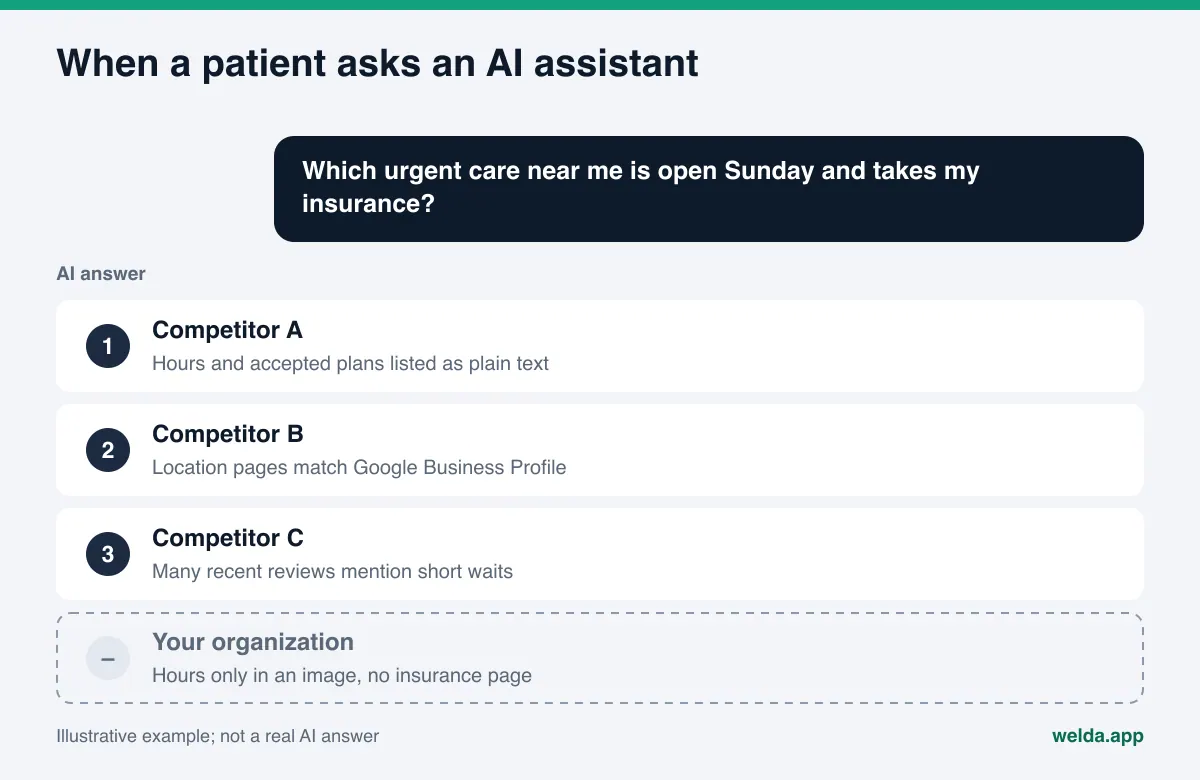
AEO, short for answer engine optimization, is the work of getting your organization named when an AI assistant answers a patient's question. You will also see it called AI search visibility, or GEO (generative engine optimization), which means the same thing. In classic search a patient scans ten links and picks one. In an AI answer they often see three or four names, or a single recommendation. If you are not in that short list, the patient decides without ever seeing you.
For a restaurant marketer, this shift mostly means "publish more information." For a healthcare marketing team it is harder, because three constraints apply at once:
- Regulatory constraints. Health claims are advertising claims, and the FTC, state laws and medical board rules all apply. Content that is routine in other industries, like outcome promises, superiority claims and glowing testimonials, carries real risk here.
- Review constraints. Marketing writes the copy, but physicians, compliance and often legal counsel read it before it goes live. Content meant to improve AI visibility goes through the same chain.
- Scale constraints. A health system can have dozens of service lines, hundreds of providers and many locations. Patients do not ask for "a cardiologist." They ask for "a cardiologist in Plano who takes Blue Cross and has Saturday appointments." Every service line and location is its own set of questions.
Put together, these constraints make AEO in healthcare less a content production job and more a job of organizing facts and running approvals. The good news: the facts an AI assistant needs most to recommend a provider are the least risky facts you can publish. Locations, hours, service lines, provider credentials, languages spoken and accepted plans. The usual problem is not that this information is missing. It is scattered, out of date, or locked inside images and PDFs.
To see where your own site stands, start with the free AI visibility analysis. It reads your homepage and several inner pages the way Google and AI assistants do and lists every gap it finds.
What do patients ask AI, and where do the answers come from?
A typical patient question combines three things: a service or symptom, a place and a condition. "Pediatric urgent care open late in Tempe," "dermatologist in Austin who speaks Spanish," "orthopedic surgeon near me who takes Medicare." The table below shows question types and the sources an assistant tends to read when building an answer. The questions are examples written for this guide, not measurement results.
| Question type | Example | Facts the answer depends on |
|---|---|---|
| Service and place | Which clinic in Fort Worth has a sleep medicine program? | Service line page, address, Business Profile category |
| Time | Is there an urgent care open Sunday evening near downtown? | Hours, holiday schedule |
| Insurance | Which OB-GYN practices near me take Aetna? | Accepted plans page, insurer directories |
| Provider | Does this hospital have a hand surgeon? | Provider page, specialty and subspecialty |
| Access | Pediatric dentist with wheelchair access and parking | Facility and access details, FAQ section |
| Language | Family doctor in Houston who speaks Vietnamese | Languages on provider pages |
| Comparison | Which ER around here has the shortest wait? | Reviews on Google, Yelp and Healthgrades |
The last row is the one marketing controls least. For "which is better" questions, assistants may draw on Google reviews, Yelp and Healthgrades. You do not write those reviews, but your replies and the consistency of your basic facts shape the answer. Every other row is directly in your hands.
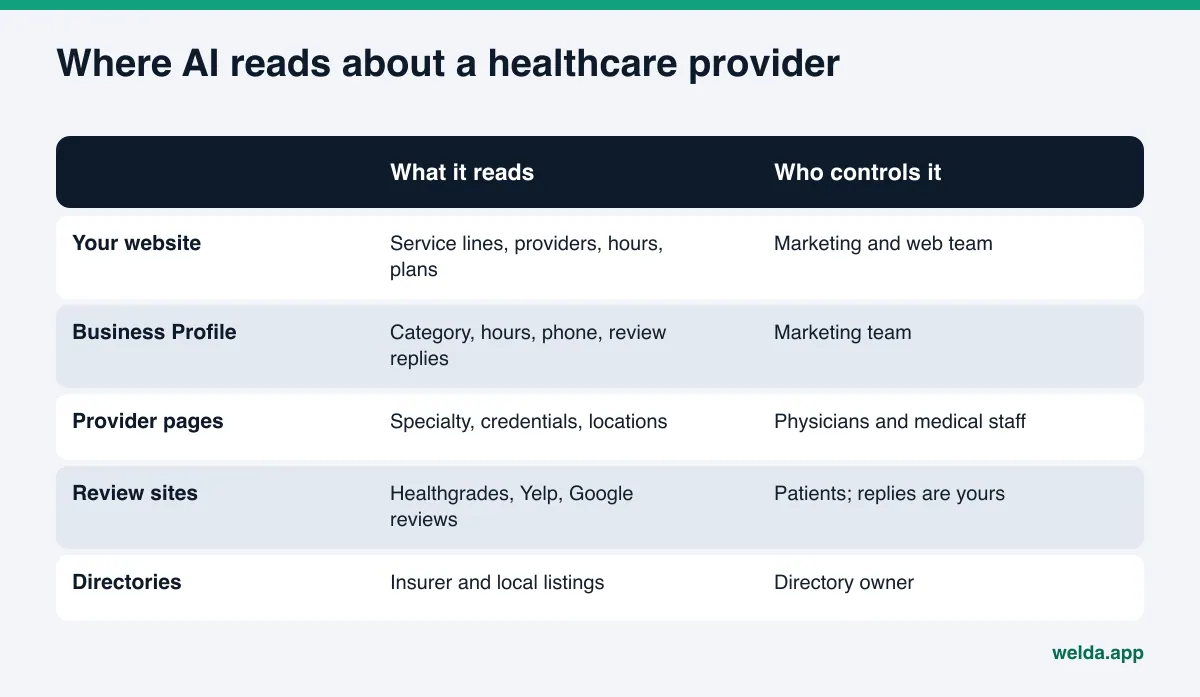
There is also a technical prerequisite: AI crawlers have to be able to reach your site. Enterprise security rules sometimes block them along with everything else. OpenAI documents its crawlers separately, including OAI-SearchBot, which it uses to surface sites in ChatGPT search, on its bots page. Google says there are no additional technical requirements for AI Overviews or AI Mode: a page needs to be indexed and eligible to show with a snippet. Review your robots.txt and firewall rules with IT once, and write down the decision.
Compliance: what the rules mean for AI-ready content
This section is not legal advice. It points to the rules and their sources; talk to your counsel about how they apply to your organization.
There is no separate rulebook for content that AI assistants read. Your website, your listings and your social profiles are already subject to the rules that govern healthcare advertising. A few points shape an AEO plan directly:
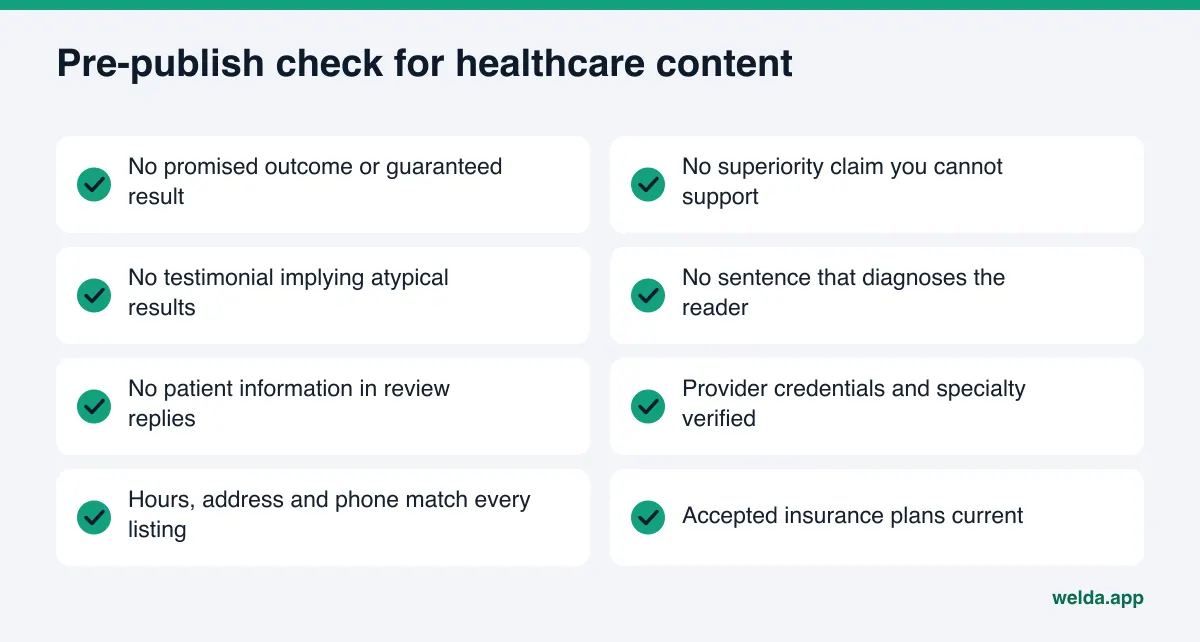
- Claims need support. At the federal level, the FTC Act prohibits deceptive advertising. The FTC's Health Products Compliance Guidance, written for health-related products, says health benefit claims generally need competent and reliable scientific evidence. The same thinking is a useful filter for service pages: if you cannot back a claim, do not publish it just because an AI might quote it.
- Testimonials are risky. The same guidance says testimonials describing results better than what people can generally expect are likely deceptive, and that a "results not typical" disclaimer does not fix that. A "patient stories" page built to feed AI answers needs the same care as an ad.
- Review replies carry privacy risk. A reply that confirms someone is a patient or mentions their care can expose protected health information. Keep replies general and route anything specific offline. Your privacy officer should set the rule.
- State and board rules vary. Physician advertising rules differ by state and specialty. Ask counsel which apply to you.
For more on review rules, see our guide to fake reviews rules and AI visibility.
AEO for healthcare marketing teams: a step-by-step plan
The plan below is written for an organization with several service lines and locations. A single-location practice follows the same steps at a smaller scale.
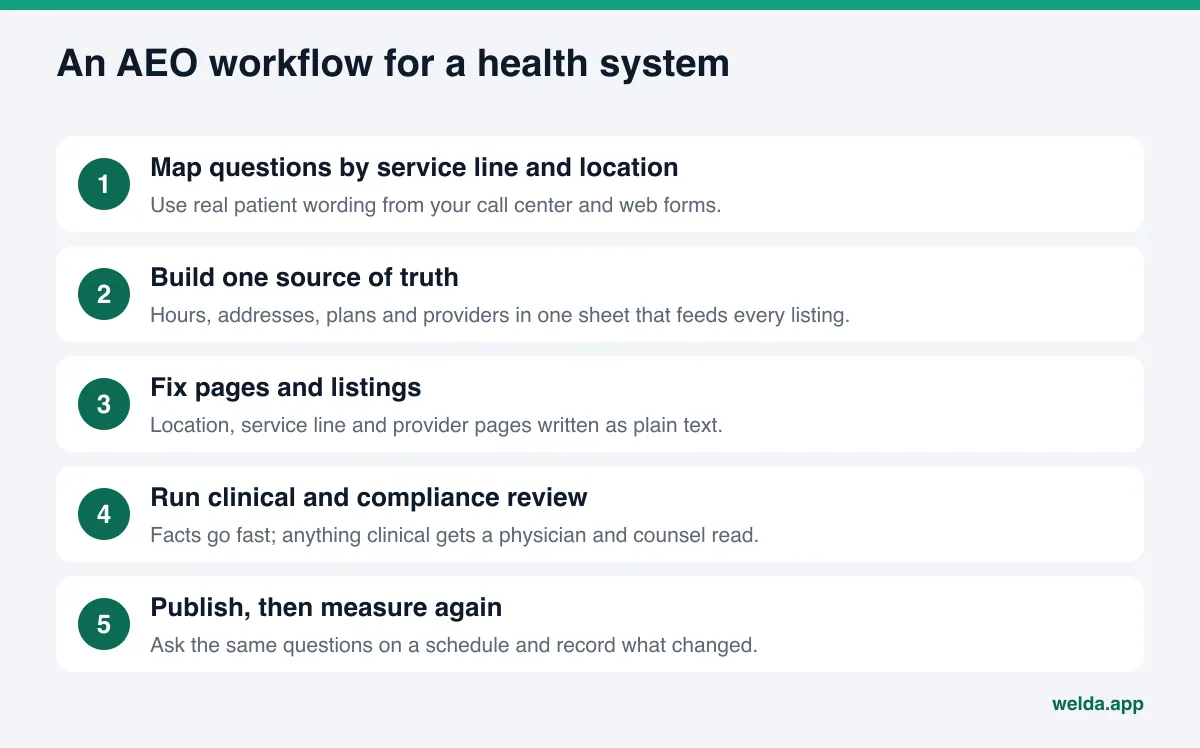
- Map patient questions. For each service line and each location, write 5 to 15 questions in patients' own words. Your call center logs and web form submissions are the best source. Cover "service plus place," "service plus time," "insurance," "provider plus specialty" and "access."
- Build one source of truth. Keep a single sheet with every location's address, phone, hours, holiday schedule, service lines, accepted plans and providers. Your website, Google Business Profile, directory listings and social profiles should all pull from it. When an assistant sees conflicting facts, it either leaves you out or names you with the wrong details.
- Give each service line its own page. State in plain text which locations offer it, on which days, which subspecialties are available and how to book. A single "Our Services" grid with twenty cards makes it hard for an assistant to match a service to a location.
- Complete provider pages. Credentials, primary specialty, subspecialty, locations, schedule, languages spoken and whether they are accepting new patients. These facts answer "specialist who does X" questions directly.
- Write an FAQ in an informational voice. Parking, accessibility, accepted plans, visitor policies and how referrals work are safe and useful. Avoid answers that read as diagnosis or treatment advice. Our guide to FAQ pages for AEO covers the structure.
- Add structured data. For each location, mark up the organization type, address, phone, hours and a link to its map listing. What the code says must match what the page shows.
- Clean up directories. Insurer directories and local listings often carry old addresses or providers who left. Our guide to business directories for AI visibility explains which ones matter and why.
- Review, publish, measure. Run the review chain, publish, then ask the same questions again on a schedule. New content usually takes weeks to show up in AI answers, so no change in week one is normal.
Example: rewriting a service line page for AI answers
This example is written for an illustrative two-location pediatric practice. It is not a real organization.
Before: The page has a hero image, the headline "Caring for your little ones," and two paragraphs of general copy. Locations, Saturday hours and provider names appear only inside the image. An assistant can learn little more than "pediatrics is offered."
After: The headline reads "Pediatrics at Our Northside and Westside Clinics." The first paragraph states, in text, which locations offer pediatric visits, on which days and hours. Below that is a provider list with credentials, specialty, subspecialty if any, schedule, languages and a link to each provider page. Then booking options, accepted plans, and a short FAQ: "Do you see walk-ins on Saturday," "How do I schedule vaccines," "Is there a nursing room." The page ends with a last-updated date.
The second version contains no outcome promise and no testimonial. Every fact is low risk. Yet everything an assistant needs to answer "pediatrician open Saturday near me" is now on the page. That is the core of AEO in healthcare: not more claims, clearer facts.
How Welda handles AEO for a healthcare organization
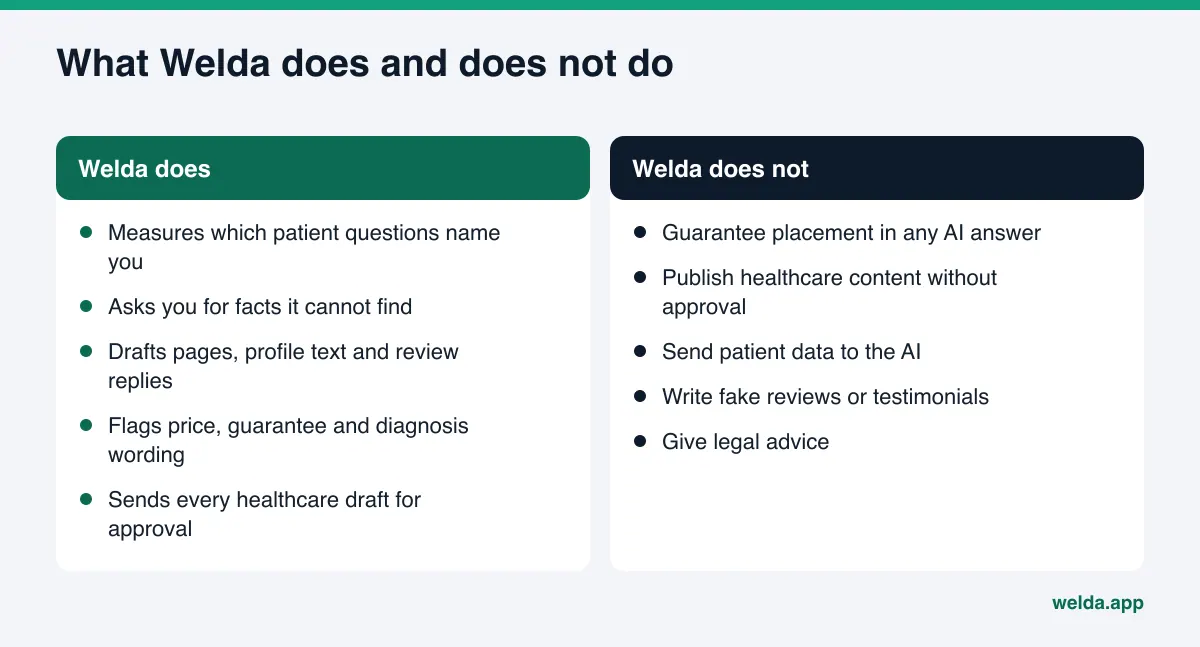
Welda is software that measures where your organization appears in AI answers and prepares the fixes on your behalf. For a healthcare marketing team, three parts do most of the work: the to-do list with its approval queue, the compliance check, and question-by-question measurement.
To-do list and approval queue. When Welda cannot find a fact on your site, it does not guess. It leaves the field empty and asks you. Your team sees fields like opening hours, full address or holiday schedule, each with a note on how many drafts will use it. Fill a field once and it flows into every draft, which is exactly the source-of-truth idea from step two. Below that, drafts prepared for your website and social profiles wait as items to read and approve. In healthcare there is no automatic publishing: every draft comes to you. That fits your review chain. Marketing reads the draft, forwards it to a physician or compliance if needed, and approves once it clears.
Where the content lives. On WordPress sites, Welda connects through a separate Editor user and an application password, with no code to install. Drafts open on your site as WordPress drafts and go live only when approved. On other platforms, Welda hands over a ready-to-apply package and your web team adds it. Content always stays on your own site; Welda does not host it. Patient data is never sent to the AI.
Compliance check. Before anything is published, Welda flags patterns such as pricing, guarantees, superiority claims and anything that reads like a diagnosis. That cleans up drafts before they reach compliance and cuts down on back-and-forth. It is not legal advice and has not been reviewed by legal counsel. The final call stays with your organization.
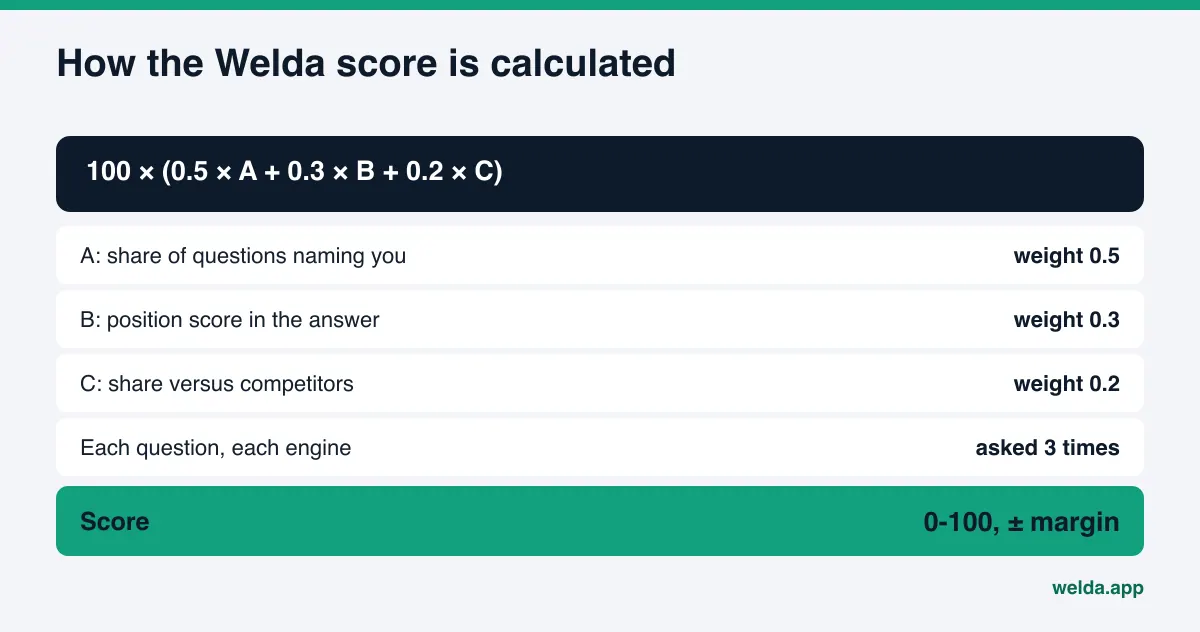
Question-by-question measurement. In the Welda panel, the questions your patients would ask are put to ChatGPT, Gemini, Perplexity and Google AI three times each. For every question you see whether you are named, in what position, and which competitor is ahead. For a marketing team, that turns into a practical view: "we show up for cardiology questions, but not for weekend questions." Questions can run in English or Turkish.
The panel also covers competitors, the sources AI draws on, before-and-after comparisons, inbound requests and a one-page monthly PDF report. For this topic, the to-do list, the approval queue and the questions view matter most.
A note on availability: the Welda panel is in early access and is opening first in Turkey. Regular four-engine measurement is being added during early access, and the panel screens you may see use illustrative data. What anyone can use today is the free site analysis, which works in English and German. Pricing is discussed in the early access conversation.
What to report to leadership
Healthcare marketing teams usually report to a CMO, a service line leader or the executive team. AI visibility is new to most of them, so explain what the number measures before you show it. A structure that works:
- Visibility by service line. Which service lines get you named, and which do not. A single system-wide score can hide that you are strong in surgery and invisible in primary care.
- Visibility by location. How each location does on questions that name a neighborhood or city.
- Work completed. Gaps closed, drafts approved, drafts waiting. The number waiting shows where the review chain is stuck.
- Listing consistency. Whether any conflicting facts remain across your site, Business Profile and directories.
Our guide to AEO KPIs covers which metrics mean something and when, and what a good AI visibility score looks like helps set expectations. Tell leadership early: the first month's report shows work done, not outcomes.
Limits: what Welda does not do
For a healthcare organization, honest limits matter as much as features. Welda does not guarantee that you will appear in ChatGPT or any other assistant, or in any particular position. No one can. It does not write facts it does not know; a provider's subspecialty or a location's Sunday hours are things it asks you about. It does not publish healthcare content without approval, and it does not write fake reviews. Negative reviews, directory account management and PR stay with your team.
The free analysis does not measure rankings either. It scores how readable your site is to AI, shows each gap with why it matters and how to fix it, and runs a one-time check: it asks an AI assistant with web search 5 questions customers might ask and looks for your name in the answers. That is a snapshot, not ongoing tracking.
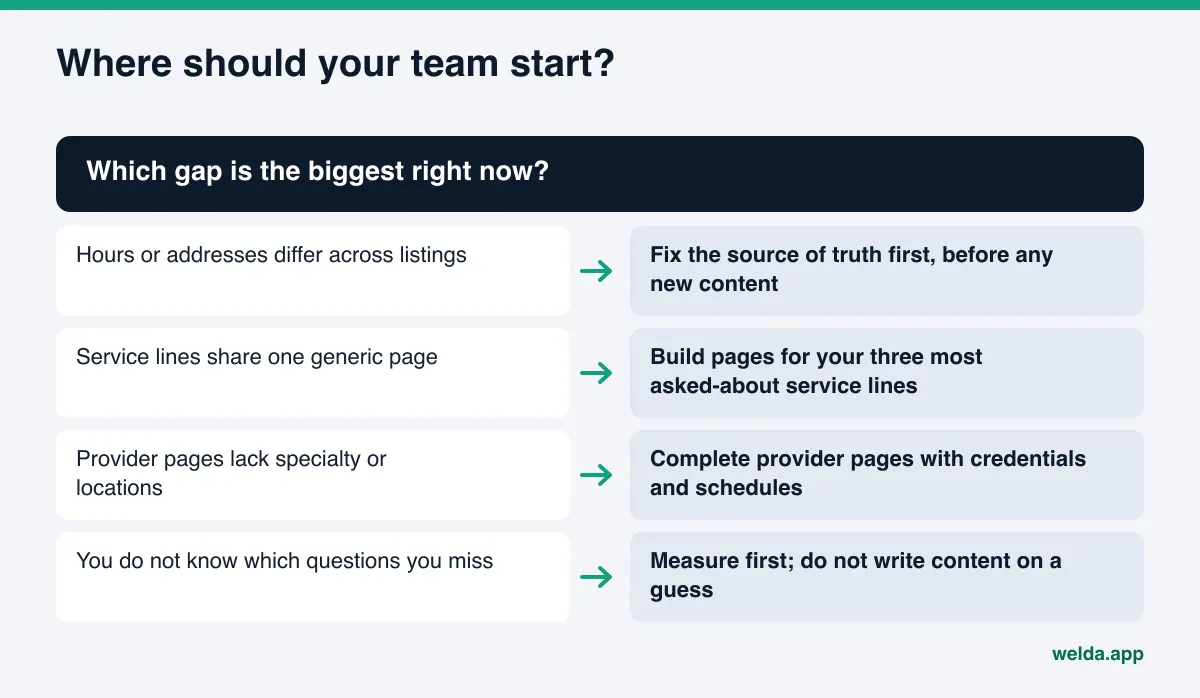
Decision checklist for your team
| Question | If yes | If no |
|---|---|---|
| Do hours and addresses match across every listing? | Move to service line pages | Fix this first; start nothing else |
| Does each service line have its own text page? | Move to provider pages | Start with your three most asked-about lines |
| Is accepted insurance published as text? | Keep it current monthly | Add a plans page per location |
| Is your review chain written down? | Increase volume | Turn the roles into an internal policy |
| Do you know which questions you miss? | Plan content for the gaps | Measure first; do not write on a guess |
Frequently asked questions
Can patient testimonials help us show up in AI answers?
Assistants already read reviews on Google, Yelp and Healthgrades. Publishing testimonials on your own site adds risk: the FTC treats testimonials that imply atypical results as likely deceptive. Your job is to reply to existing reviews without revealing patient information. This is not legal advice.
Do provider pages really make a difference?
For "specialist who does X" questions, assistants look for a match between a provider, a specialty and an organization. A page with credentials, subspecialty, locations and schedule makes that match easy. There is no guarantee, but a missing page makes the match nearly impossible.
Should we publish accepted insurance plans?
Insurance questions are among the most specific patients ask. A per-location plans page in plain text, kept current, gives assistants a fact to work with. Out-of-date plan lists do more harm than none.
Does Welda publish content automatically?
Not in healthcare. Every draft goes to your approval list and stays unpublished until someone on your team approves it. Patient data is never sent to the AI.
How many service lines should we start with?
Start with the three service lines patients ask about most and your busiest location. Once measurement and approvals run smoothly, add the rest using the same pattern.
When will we see results?
New content usually takes weeks to show up in AI answers. Fixes to hours and addresses can show up sooner than new pages. Report completed work in month one and visibility changes after that.
Start with a look at your own site
AEO for healthcare marketing teams begins with organized facts and a review chain that works. To see which facts are missing, whether AI crawlers can reach your site and how your homepage reads to an assistant, run the free AI visibility analysis. You get a score out of 100, each gap with its reason and fix, suggested homepage copy and a ready-to-apply fix package. The result link arrives by email and stays open for 14 days. The analysis is free once per site.