What does AI visibility software for dermatologists do? It checks whether your practice is named when patients ask ChatGPT, Gemini, Perplexity or Google's AI features for a dermatologist, and it shows what is missing when you are not. Good software does more than hand you a score: it shows which questions you miss, why, and what a compliant fix looks like. Nobody can guarantee a specific spot in an AI answer.
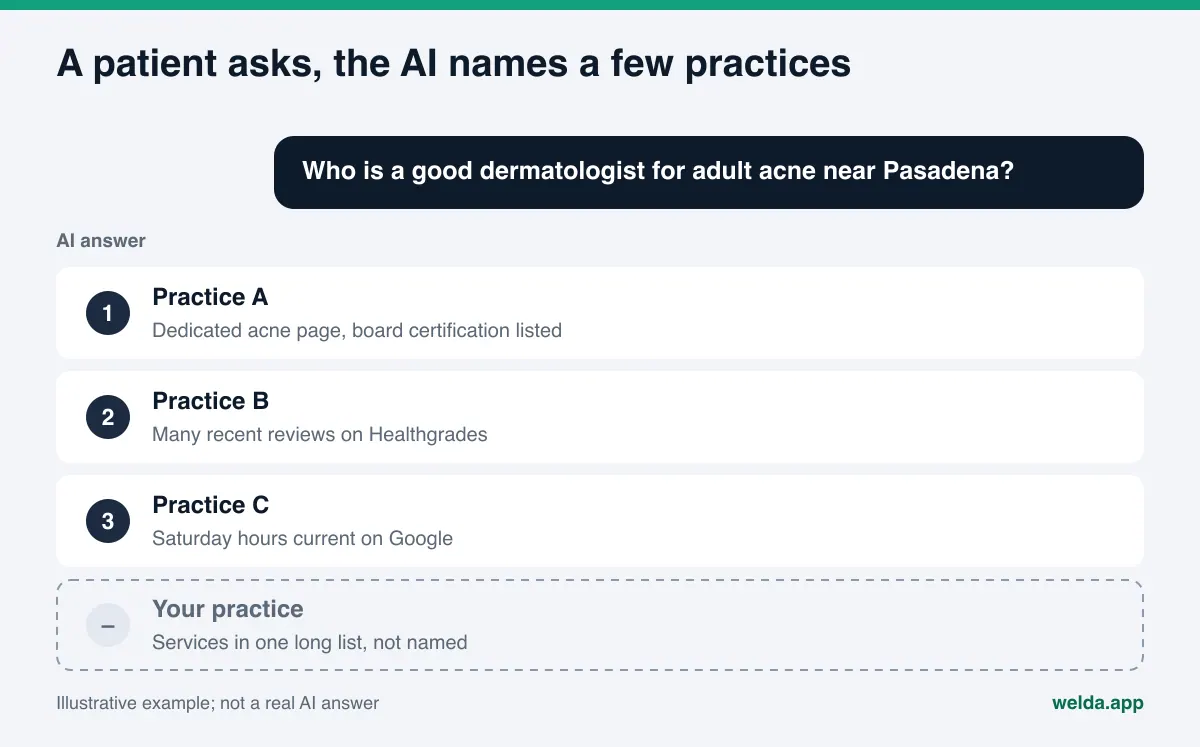
This guide is for dermatologists who own or run a practice, practice managers, and the people who look after a dermatology group's website and listings. The question is simple. When a patient types "Who is a good dermatologist for adult acne near me?" into an AI assistant, does your name come up? If not, why not, what should you fix first, and which part of that work can AI visibility software for dermatologists take off your plate? We cover the problem, the steps, how Welda handles the work and what it does not do. If you want to see where your own site stands today, start with the free site analysis.
Why AI visibility is its own problem for dermatology practices
Patients with a skin concern tend to ask two things at once: what this might be, and where to go. In a classic search, those were two separate steps. You read about rosacea, then searched "dermatologist near me" and compared a map. In an AI assistant, both steps happen in one conversation. The patient describes the concern, adds a city or neighborhood, maybe an insurance plan and a preferred day, and the assistant answers with a handful of names. If your practice is not one of them, you are not in the comparison at all.
This is what people now call AEO, answer engine optimization: making sure answer engines can find, understand and cite your business. You will also see the term GEO (generative engine optimization) used for the same idea. For a dermatology practice, AEO has four features that make it harder than for most local businesses:
- Medical and cosmetic work overlap. One practice may treat acne, eczema, psoriasis and suspicious moles, and also offer cosmetic procedures. If an AI cannot tell these apart on your site, it will match you to the wrong questions or skip you.
- Patients ask for a doctor, not a building. "Best board-certified dermatologist near me" is a question about a person. If your physicians' names, credentials and focus areas are buried or missing, there is nothing for the AI to connect to that question.
- Access details decide the visit. Insurance accepted, wait time for a new patient, Saturday hours, telehealth options, parking. These practical details drive choices as much as clinical content does.
- Health advertising rules apply. Outcome promises, superiority claims and content that reads like a diagnosis carry risk. Every new page written for AI visibility adds to that risk surface.
So AI search visibility for a dermatology practice is more than a generic "make the site AI friendly" project. It means thinking about which patient asks which question, what an answer engine will look for, and how that information can be written within the rules. Hair restoration clinics face a similar mix of medical and cosmetic questions; the guide on AI search optimization for hair transplant clinics covers that case.
What do patients ask AI about dermatologists?
We do not publish question volumes for the US market, so the examples below are illustrative, written the way patients tend to phrase things. What matters is the pattern. Dermatology questions fall into a few clear types, and each type looks for different information on your site:
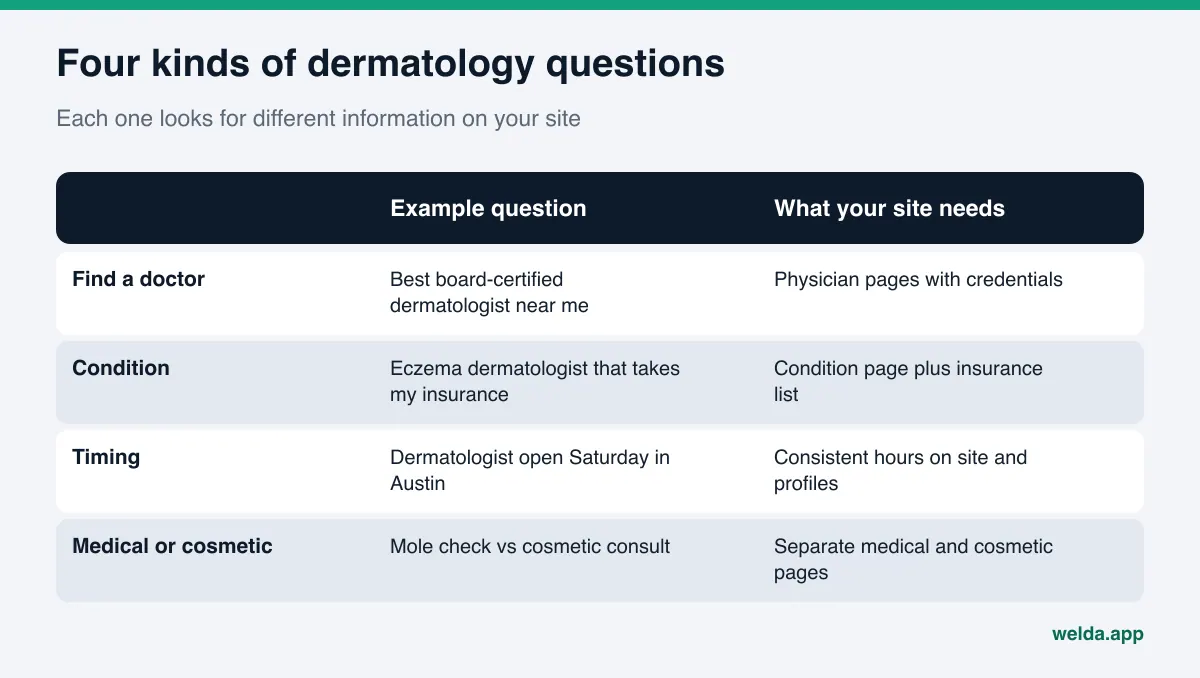
The types tell you where the gap is. If you do not show up for "best board-certified dermatologist near me," the problem is usually your physician pages. If you miss "dermatologist for eczema that takes my insurance," you probably lack a condition page, or your insurance list lives in a PDF the AI cannot read. If you miss "open Saturday," your hours on the website, Google Business Profile and booking platforms may not agree.
Medical versus cosmetic is the type dermatology practices underestimate most. A patient asking where to get a skin check is in a different frame of mind from one asking about a cosmetic consultation. Mixing both on one long services page makes it harder for an answer engine to cite you confidently for either.
What does an AI look at before naming a dermatology practice?
When an AI assistant answers with a web search, it reads your site and other sources that mention you, then picks names it can support with clear and consistent information. For dermatology, these are the signals that matter most:
| Information | Where it lives | What happens if it is missing |
|---|---|---|
| Specialty and location | Page title, main heading, first paragraph | The AI cannot match you to the right question |
| Physician names and credentials | Physician pages, business markup | You are skipped on "good dermatologist" questions |
| Conditions and services | Separate pages for acne, eczema, psoriasis, rosacea, skin checks | Competitors with dedicated pages get cited |
| Address, phone, hours | Site, Google Business Profile, directories | Conflicts lower trust and can lead to wrong hours in answers |
| Reviews and trust signals | Google, Healthgrades, Zocdoc, Yelp | You fall behind on comparison questions |
| Insurance and access | A readable page, not only a PDF | Insurance questions go unanswered |
Some of this lives outside your site. Physician directories such as Healthgrades, booking platforms such as Zocdoc, Yelp and your Google Business Profile all describe your practice, and an AI compares what they say with what your site says. Keeping them aligned is ongoing work. The guide to business directories for AI visibility goes deeper on which listings to maintain and how.
Step by step: what a dermatology practice should do
The order below starts with technical basics and moves to content and outside sources. If crawlers cannot read your site, writing new pages will not change anything, so keep the order.
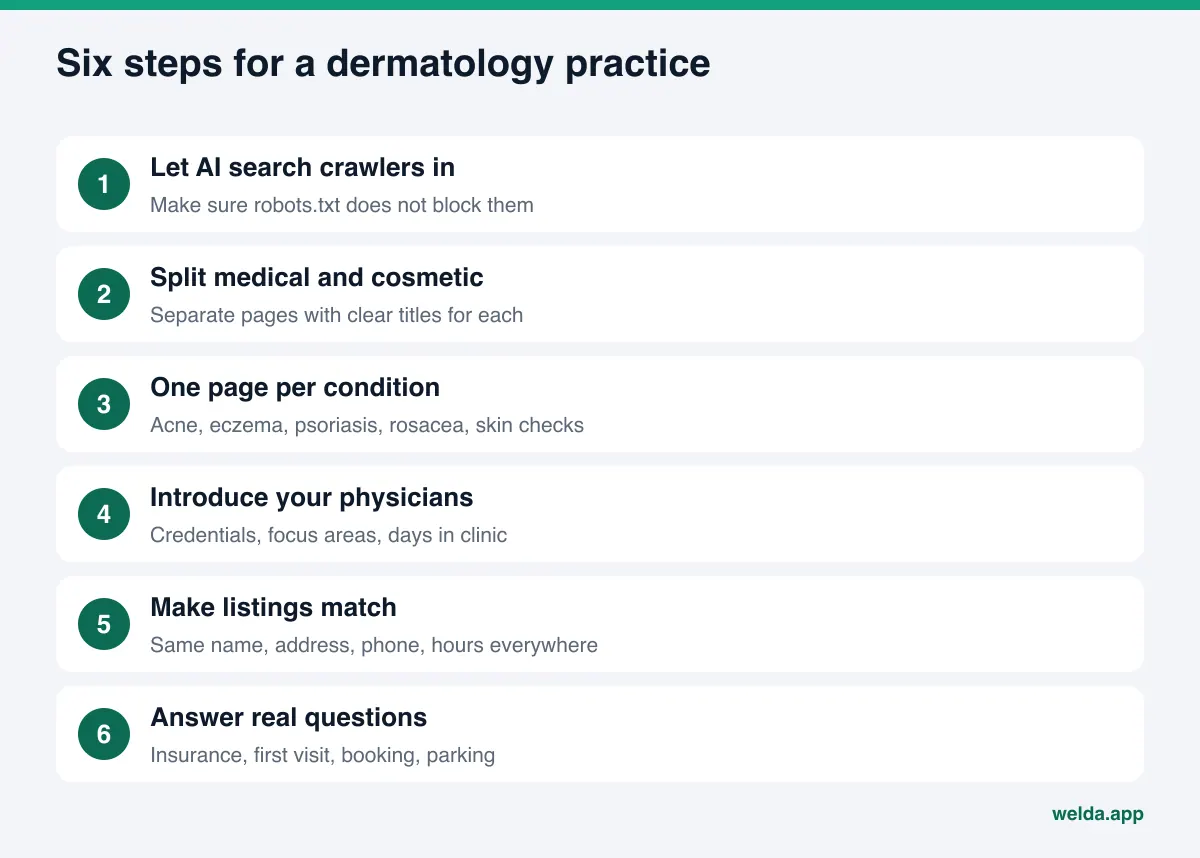
- Check that AI search crawlers can get in. If your robots.txt blocks them, you cannot be cited. OpenAI says ChatGPT search uses a crawler called OAI-SearchBot, and that sites which opt out of it will not appear in ChatGPT search answers. Some security plugins and site templates block these crawlers without anyone noticing.
- Make the title and main heading specific. Your homepage title should say "dermatology practice" or "dermatologist" and your city or neighborhood. A tagline like "Healthy skin for life" tells an answer engine nothing.
- Separate medical and cosmetic dermatology. Give medical dermatology and cosmetic services their own sections or pages with clear titles. Each page should say what is done, how a visit works and what a patient should expect, in plain language.
- Introduce your physicians. One page or section per physician: name, credentials such as board certification, areas of focus, which days they see patients. Avoid superlatives.
- Add business markup. Mark up name, address, phone, hours and specialty with structured data (Schema). Schema.org defines a Dermatology specialty value, which helps machines read your field correctly.
- Align your listings. Google Business Profile, Healthgrades, Zocdoc, Yelp and your hospital affiliation pages should show the same name, address, phone and hours as your site, with the primary category set to dermatologist.
- Answer practical questions. Which insurance plans you accept, how new patients book, how long a first visit takes, whether you offer telehealth, where to park. These are the questions patients actually ask.
- Reply to reviews carefully. Do not confirm that a reviewer is a patient or mention a diagnosis or treatment in a reply; that can raise HIPAA questions, so check with your compliance advisor. The guide on negative reviews in AI answers covers how to handle critical reviews.
None of these steps works alone. An example practice with a sharp homepage but no physician pages will still miss doctor questions. One with great physician pages but conflicting hours may be described with the wrong hours.
What should a condition page for a dermatology practice include?
Condition pages are the single most useful content type for AEO in dermatology. Length is not the point; answering the patient's question is. Take an acne page as an example. A useful one has:
- A short opening: that the practice evaluates and treats acne, which physicians focus on it, and where the practice is, in two or three sentences.
- How a visit works: what the physician looks at, which tests might be ordered, and that a plan is discussed with the patient.
- Treatments offered: names and short descriptions, without outcome promises and without hiding that results vary.
- Practical details: how to book, hours, insurance accepted, how follow-ups are scheduled.
- FAQs: three to five real patient questions with short answers.
Use the same structure for eczema, psoriasis, rosacea, hair loss and skin checks, with a title that names the condition and the location. Do not clone pages and swap one word; answer engines struggle to tell near-duplicates apart and may treat none of them as a strong source. Keep pages current too. When a physician leaves or hours change, update the page that day, because stale facts lead to wrong answers.
Compliant wording: risky phrases in dermatology marketing
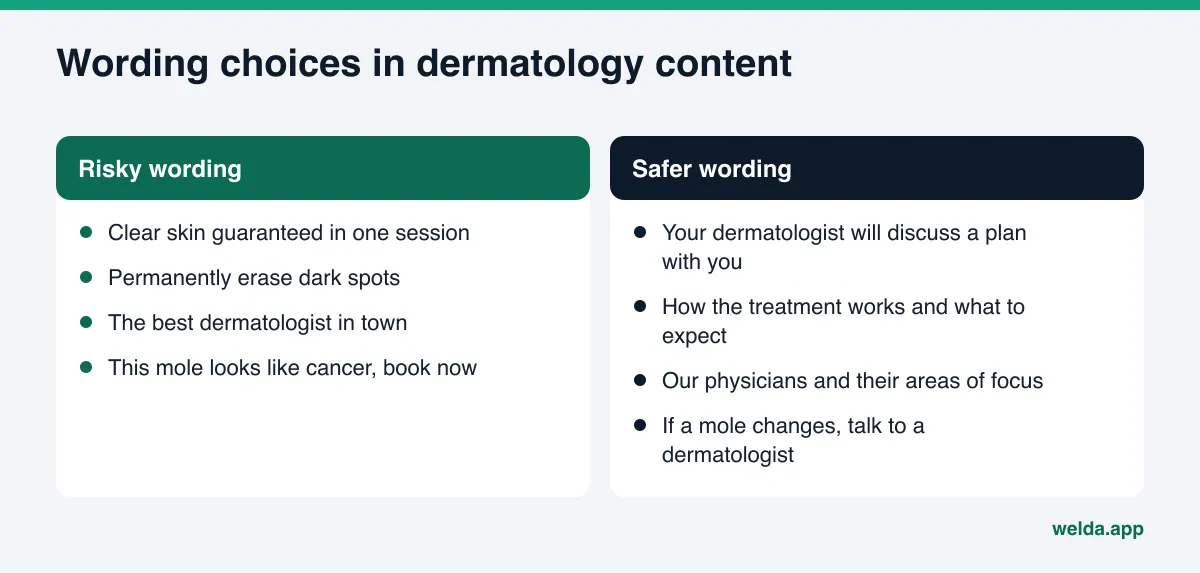
More pages means more chances to say something you should not. In the US, health-related advertising claims fall under the FTC Act. The FTC's health products compliance guidance says health claims need competent and reliable scientific evidence, and that consumer testimonials alone are never enough to back up a claim about effects. The FTC has also issued a final rule banning fake reviews and testimonials. State medical boards add their own advertising rules. This is not legal advice; check with your counsel.
Common risky patterns in dermatology content: outcome promises ("clear skin guaranteed"), permanence claims ("permanently erase dark spots"), superiority claims ("the best dermatologist in town"), copy that reads like a diagnosis ("if you have these symptoms, you have psoriasis"), and before-and-after claims that suggest typical results. Wording that explains what you do, how the process works and that the patient should discuss their own situation with a physician is safer, and it gives an answer engine more useful information.
The guide on "best" claims and advertising rules in AI content has a longer list. One dermatology-specific note: when writing about moles and skin checks, avoid language that frightens or rushes the reader. Describe calmly when an evaluation is recommended.
How to choose AI visibility software for dermatologists
Asking ChatGPT a few questions yourself is a reasonable first look. But answers vary by person, time and conversation history, and a single try can be lucky or unlucky. AI visibility software for dermatologists should measure that variation and respect healthcare rules. The guide on manual ChatGPT checks vs tracking tools explains the difference in detail. When you compare options, ask:
| Question | Why it matters |
|---|---|
| Which engines does it check? | Patients use different assistants; one engine gives a partial picture |
| How many times is each question asked? | One run is noise; repeated runs show a margin of error |
| Is the score formula public? | You need the math to understand what changed |
| Does it show why a competitor wins? | Without the topic and source, you cannot fix the gap |
| Does anything publish without approval? | In healthcare, every page should pass a physician or manager |
| Does patient data go to an AI? | Patient information has no place in visibility work |
| Where does the content live? | On your own site, not on the vendor's servers |
If the answer to any of these is "we don't know" or "we publish automatically," be careful.
How Welda works as AI visibility software for dermatologists
Welda is software that measures where a business appears in AI answers and prepares the fixes on the business's behalf. For a dermatology practice, three parts matter most: question tracking, a single to-do list, and the approval flow for healthcare.
Question tracking: which patient questions name you?
In the Welda dashboard, the questions patients are likely to ask are put to ChatGPT, Gemini, Perplexity and Google AI three times each. Each row is a question, such as "dermatologist for eczema near me" or "skin check open Saturday." For each engine you see whether your practice is named and in what position, and which competitors come ahead on which topic and from which source. An example practice might be named on general "good dermatologist" questions and missing on every condition-specific one. That points to missing condition pages, not a brand problem.
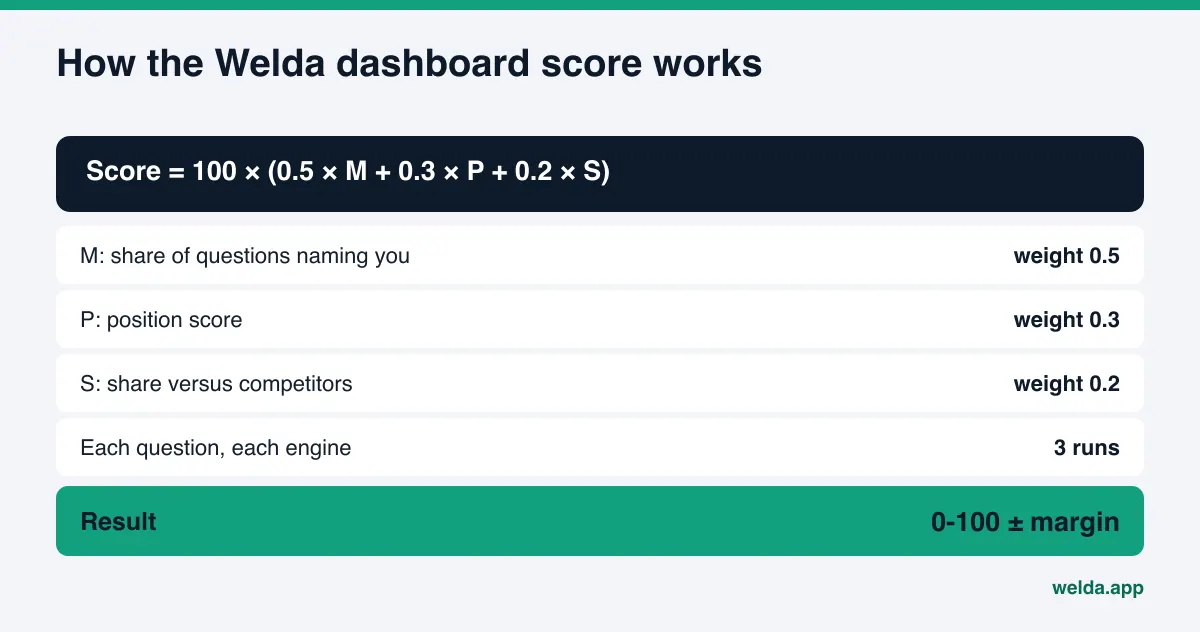
The score formula is public: 100 × (0.5 × share of questions that name you + 0.3 × position score + 0.2 × share versus competitors). The spread across three runs gives a ± margin, so you can tell real movement from noise.
To-do list: missing facts stay blank and get asked
Welda collects every gap in one list with three parts: information it needs from you, drafts waiting for your approval, and tasks that must be done by hand. For a dermatology practice, the first part might ask which days each physician sees patients, which insurance plans you accept, or whether you have Saturday hours. Welda does not invent facts; it leaves the field blank and asks. Once you answer, the fact flows into every draft that uses it. Drafts can include condition pages, a Google Business Profile description or review replies. If your site or a profile is not connected, the task shows up as "do by hand" with the ready text next to it.
Approval and compliance check
In healthcare, Welda never publishes automatically; every piece comes to you for approval. Before that, a compliance check flags patterns such as prices, guarantees, superiority claims and diagnostic suggestions. A line like "permanently erase dark spots" is flagged before it reaches you. This check is not legal advice and has not been reviewed by legal counsel; the final call stays with you and your advisor. Patient data is never sent to an AI. On WordPress sites, Welda connects through a separate Editor user and an application password, with no code to install, and approved content opens as a draft on your own site. Content always lives on your site.
What is available today
Welda's dashboard is in early access and opens in stages, starting in Turkey. Regular four-engine tracking is being added during early access, and the sample screens use representative data. The part anyone can use today is the free site analysis, which runs in English. It reads your homepage and a few inner pages such as services, about and contact, gives a score out of 100 split into technical and content parts, and explains each gap: what it saw, why it matters and how to fix it. It also asks a web-searching AI assistant five questions a patient might ask and checks whether your practice is named. That is a one-time check. Pricing is discussed in the early access conversation.
Limits: what Welda does not do
For a medical practice, knowing what a tool will not do matters as much as knowing what it will:
- No ranking guarantee. Welda does not promise that you will be named in ChatGPT or in a specific position. AI companies generate the answers.
- No invented facts. Credentials, hours and insurance details are asked of you.
- No unapproved healthcare content. Every piece comes to you first.
- No fake reviews. Welda drafts review replies; it does not write reviews.
- Some work stays with you. Handling negative reviews, managing directory accounts and press work remain the practice's job.
- Clinical accuracy is the physician's call. Welda drafts a condition page; a physician checks the medicine.
Timing matters too. New content usually takes weeks to show up in AI answers. In the first weeks, track whether gaps are closing rather than expecting big score moves.
Dermatology practice checklist and where to start
Use this checklist for a quick read on your site today. Answer yes or no to each item; the "no" items are your first tasks.
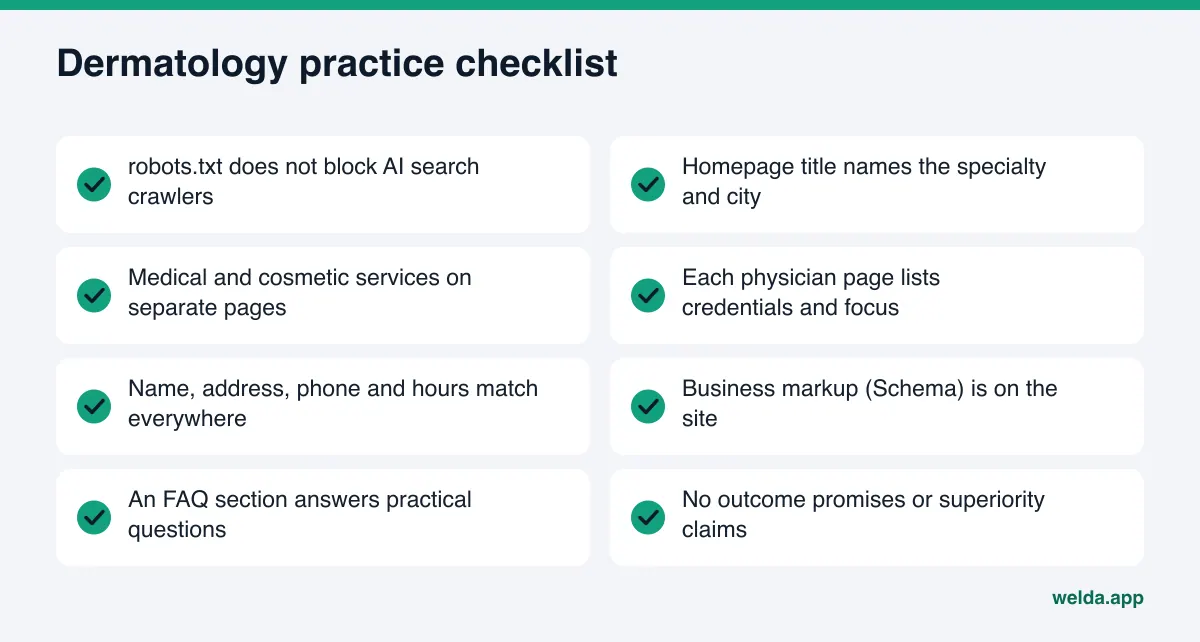
Then use your analysis results to decide where to begin:
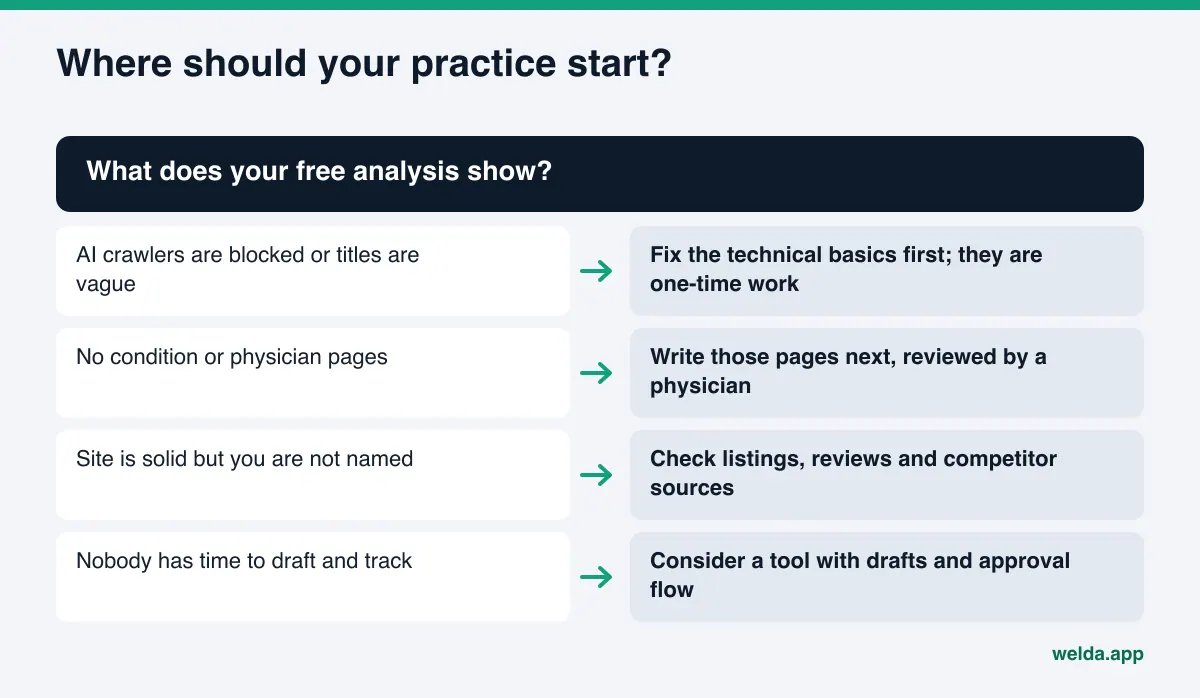
Frequently asked questions
What does AI visibility software for dermatologists measure?
Whether your practice is named in AI answers to patient questions, in what position, and where competitors come ahead. In the Welda dashboard, each question is asked on four engines, three times each.
Do medical and cosmetic dermatology need separate pages?
It is recommended. Patients search for them with different questions, and separate pages help an answer engine match you correctly while keeping each page within its own advertising rules.
Does Welda publish healthcare content on its own?
No. In healthcare there is no automatic publishing; every piece needs your approval. The compliance check flags risky patterns but is not legal advice.
Is patient information sent to an AI?
No. Welda does not send patient data to an AI. The work uses business information from your site and public sources.
Is AEO different from SEO for a dermatology practice?
They overlap. Clear pages, accurate listings and reviews help both. AEO adds a focus on whether AI answers actually name you, and on the sources those answers cite. Rankings in classic search still matter; AEO looks at the answer itself.
What does the free analysis show?
Your technical and content score, what is missing and how to fix it, suggested homepage copy, and a one-time five-question AI test. It is free once per site; results arrive by email and stay open for 14 days. It does not measure rankings.
First step: see where your practice stands
AI visibility for a dermatology practice starts with a few clear facts in the right places and in the right words: a site crawlers can read, condition pages, introduced physicians, matching listings and calm, compliant language. The quickest way to see which of these you are missing is Welda's free site analysis. It does not measure rankings or promise placement, but it shows you clearly where to start.