What does AI search optimization for hair transplant clinics actually involve? It means making your clinic easy for ChatGPT, Gemini, Perplexity and Google's AI Overviews to read, trust and name when a prospective patient asks where to get a hair transplant. In practice that is a short list of concrete jobs: let AI crawlers into your site, describe each procedure and each surgeon clearly, keep your address and hours consistent everywhere, and stay inside the advertising rules that apply to medical services. Nobody can guarantee a position in an AI answer, but clear and consistent information raises the odds that your clinic is mentioned.
This guide is for owners, practice managers and marketing leads at hair restoration practices in the US, whether you run a stand-alone clinic or a hair restoration service inside a dermatology or plastic surgery practice. The question is simple: when someone types "who does FUE hair transplants near me with the surgeon doing the work?" into an AI assistant, does your practice come up? If not, why not, and what should you fix first? We call this work AEO (answer engine optimization). You will also see it called GEO, short for generative engine optimization; the two terms describe the same goal. Below we cover the problem, the steps, how Welda handles this work, what Welda does not do, and a checklist. If you want a first read on your own site, the free AI visibility analysis produces one in a few minutes.
Why AI search optimization for hair transplant clinics matters now
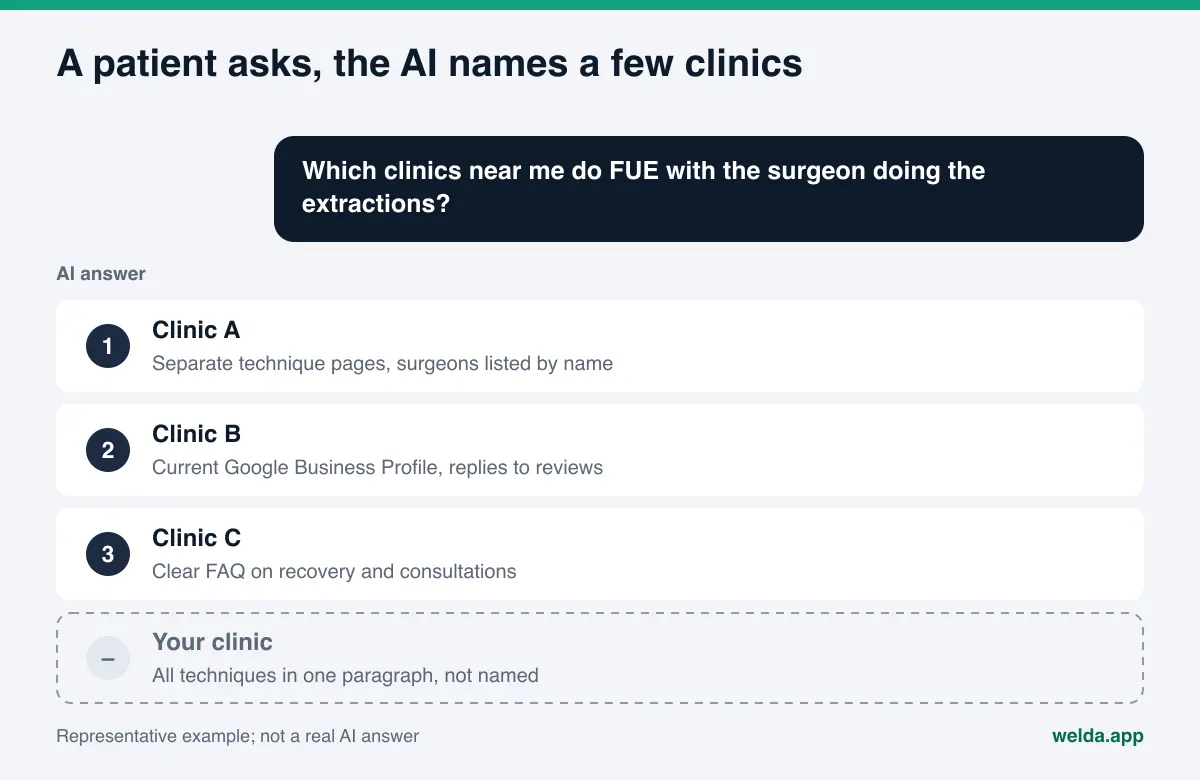
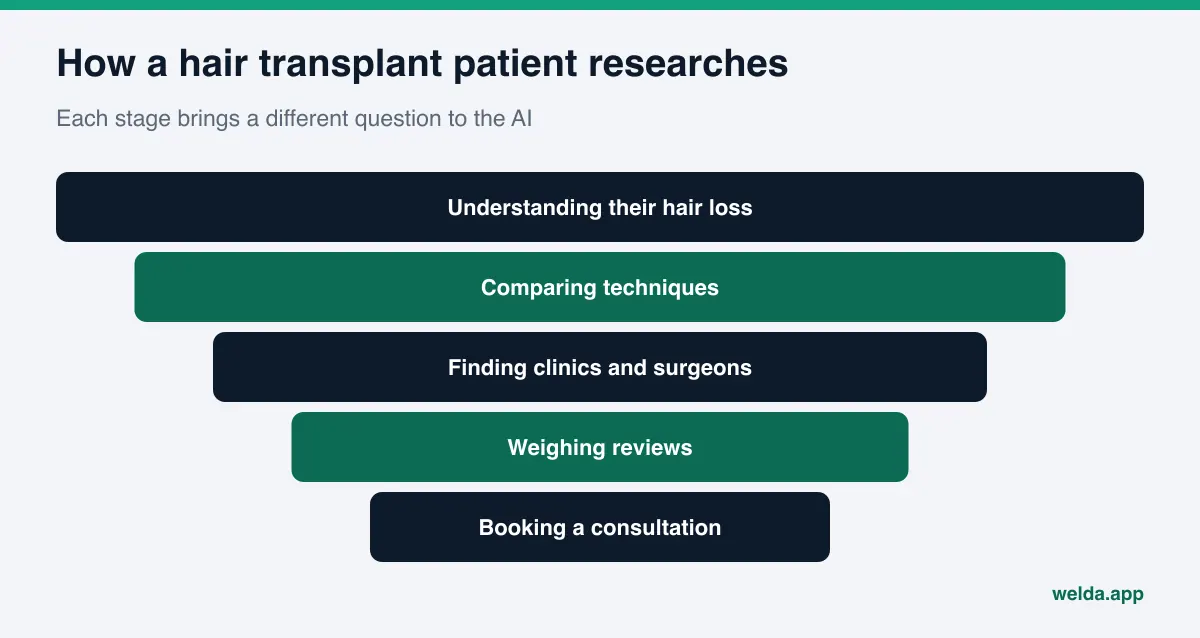
A hair transplant is a considered purchase. Patients research for weeks or months before booking a consultation. They want to understand their own hair loss, compare techniques, check who actually performs the procedure, read about recovery, and look for warning signs in reviews. In classic search, that research was spread over dozens of queries and tabs. In an AI assistant, much of it collapses into a few conversational questions, and the assistant answers with a handful of clinic names and short reasons for each.
If your clinic is not in that short list, the patient may never compare you at all. On a classic results page, ranking seventh still earned the occasional click. In an AI answer, there often is no seventh place. That is why AI search visibility is not a side project for a hair restoration practice. It is part of how new patients find you.
Three things make this especially relevant in hair restoration:
- Patients ask a lot of questions. Technique, surgeon, downtime, results timeline, candidacy for women, beard and eyebrow work. Each question needs a clear answer somewhere on your site.
- Trust is the deciding factor. AI answers draw on your site and on what others say about you: Google Business Profile reviews, Yelp, RealSelf, Healthgrades and forums. A thin or inconsistent picture across these sources weakens your case.
- Who performs the procedure matters. Patients increasingly ask whether a physician or a technician does each step. If your site does not say, the AI cannot say either.
What AI assistants look at before naming a hair restoration clinic
AI assistants that search the web combine two kinds of information: what your own site says, and what other sites say about you. They read several pages while writing an answer and often show the sources they used. So two questions decide a lot: is the information on your site readable and explicit, and is the picture elsewhere on the web consistent with it?
Sorting patient questions into types makes gaps easier to find. The table below shows what each question type needs from your site. The questions are examples; replace them with what your own patients ask at consultations.
| Question type | Example question | What your site needs |
|---|---|---|
| Technique | "What's the difference between FUE and FUT, and which clinics in Dallas offer both?" | A separate, plain-language page for each technique |
| Surgeon | "Which hair transplant clinics have the surgeon perform the extractions?" | A team page with names, credentials and each person's role in the procedure |
| Recovery | "How soon can I go back to work after a hair transplant?" | A clear description of procedure day, the first weeks and follow-up visits |
| Location | "Hair transplant clinic near downtown Chicago with weekend consultations" | Exact address, hours, consultation options, matching Google Business Profile |
| Candidacy | "Do any clinics near me do hair transplants for women?" | A page on who may be a candidate and how the consultation works |
| Trust | "Which hair transplant clinics have the best reviews in Phoenix?" | Consistent profiles on review sites, and thoughtful replies to reviews |
Every row without a clear answer on your site is a question where the AI has nothing to quote from you. If it finds that material at another clinic, it names the other clinic. For a deeper look at how sources get picked up and quoted, see our guide on how to get cited by AI.
The rules come first: health claims, testimonials and reviews
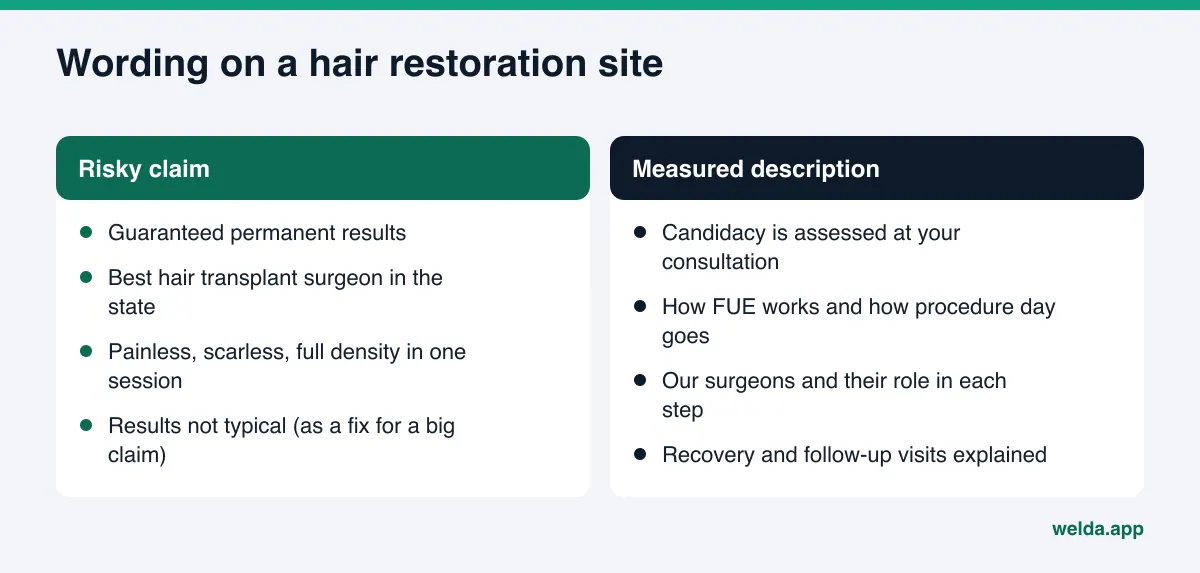
Hair restoration is a medical service, and claims about it are advertising claims. At the federal level, the FTC expects advertising to be truthful and backed by evidence. Its Health Products Compliance Guidance says that testimonials describing results better than what patients can typically expect are likely deceptive, and that a "results not typical" disclaimer does not fix that. It also says material connections with endorsers, such as payment, must be clearly disclosed. In addition, the FTC's final rule banning fake reviews and testimonials, announced in August 2024, prohibits fake reviews and buying positive or negative reviews. State medical boards and professional bodies may add their own rules on physician advertising and before-and-after photos. Check the rules that apply in your state with your counsel. This article is not legal advice.
For AEO, the practical point is this: the content an AI reads is also advertising that regulators and patients can read. Phrases like "guaranteed permanent results", "the best hair transplant surgeon in Texas", "painless and scarless" or "a full head of hair in one session" are risky, and they are also not the kind of specific, checkable information AI assistants tend to repeat. What does travel well is concrete description: what the technique is, who performs it, how the day goes and what follow-up looks like.
Step by step: getting your hair transplant clinic ready for AI answers
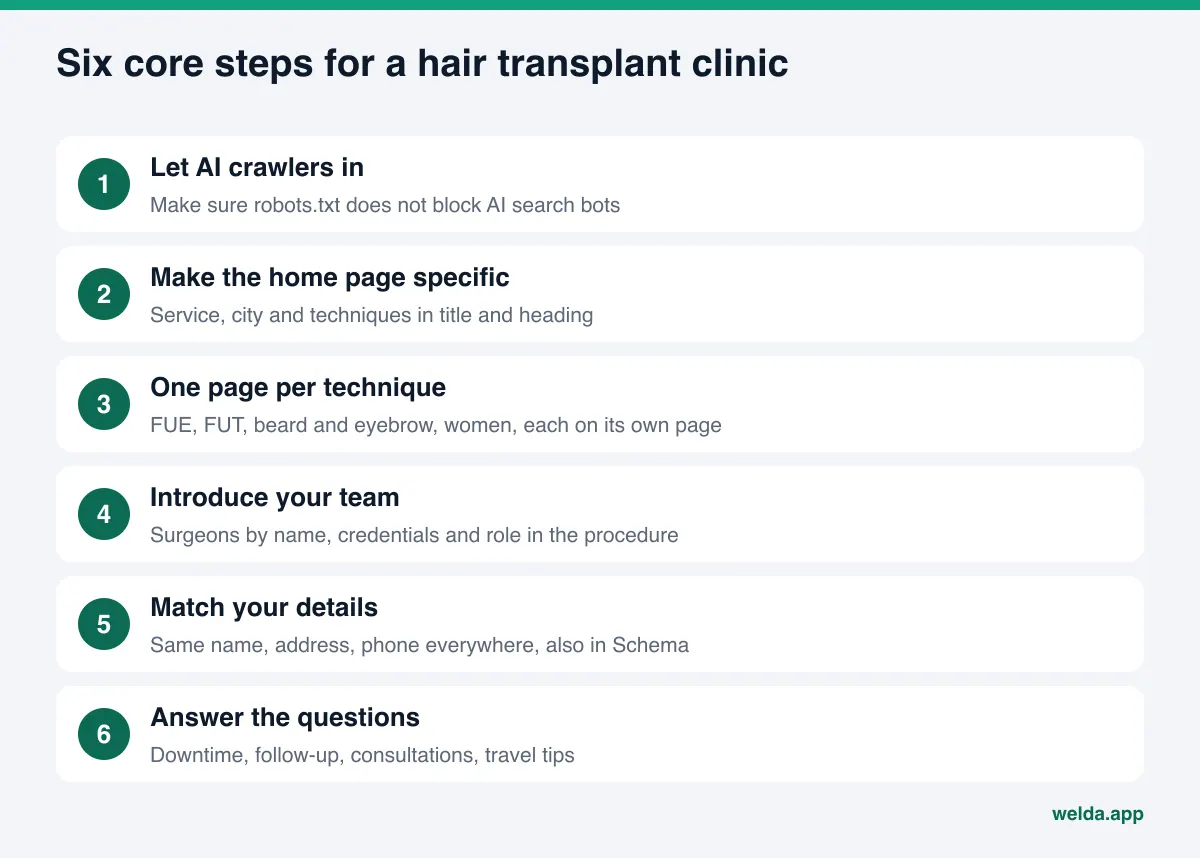
The order below starts with basics and moves toward trust signals. Order matters. If crawlers cannot read your site, new content will not help.
- Let AI crawlers in. Your robots.txt should not block AI crawlers. OpenAI documents its crawlers and what each one does; blocking its search crawler can keep your pages out of ChatGPT's search-based answers. Some security plugins and CDN settings block these bots without anyone noticing, so check once.
- Make the home page specific. The page title, meta description and main heading should state what you do, where, and which techniques you offer. "Your new confidence starts here" tells an AI nothing.
- Give each technique its own page. FUE, FUT, beard and eyebrow transplants, hair restoration for women and any non-surgical options you offer should each have a page that explains what it is, who may be a candidate, how procedure day goes and what to expect afterward. Describe the process. Do not promise outcomes.
- Introduce your team. List each surgeon and clinician by name, with credentials, board certifications you can document, and their role in the procedure. "Who actually does the work?" is one of the most common questions in this field.
- Make your details consistent. Name, address, phone and hours should match exactly across your site, Google Business Profile, Yelp, Healthgrades and any directories you use. Add the same details as structured data (Schema) on your pages. Google's documentation on AI features notes that the same foundational SEO practices apply to AI Overviews and AI Mode.
- Answer the common questions. Downtime, follow-up visits, how consultations work, virtual consultation options, and travel and lodging tips for out-of-town patients belong in a short FAQ.
- Reply to reviews with care. Respond to reviews without disclosing patient information and without debating medical details. We cover this in depth in review responses for AI visibility.
Example: rebuilding an FUE page so AI can use it
To make "one page per technique" concrete, picture the FUE page of an example clinic. Today it has two paragraphs of marketing copy, a photo gallery and a contact form. An AI reading it learns almost nothing about what FUE is, who performs it or what a patient can expect. Rebuilt on the skeleton below, the same page gives both patients and AI far more to work with:
- A one-sentence definition. The first sentence says what FUE is in plain words and names the clinic and its city.
- Who may be a candidate. State that candidacy is decided at a consultation. Do not diagnose on the page.
- Procedure day. Walk through the day from arrival to discharge, and say which steps the surgeon performs.
- The first weeks and follow-up. Washing, sleeping, returning to work and how follow-up visits are scheduled. Use measured wording such as "typically" and "as your surgeon advises".
- Technique-specific FAQs. Three or four short questions and answers about FUE.
- Contact and location. Address, phone and how to book a consultation, at the end of the page.
There is no price promise, no "guarantee" and no comparison with other clinics on this page, yet most of the patient's questions are answered. Build the FUT, beard and women's pages on the same skeleton and link them to each other, and the AI finds a separate, consistent source for every technique question, including the "what's the difference" questions patients ask so often.
How Welda handles AEO for a hair transplant clinic
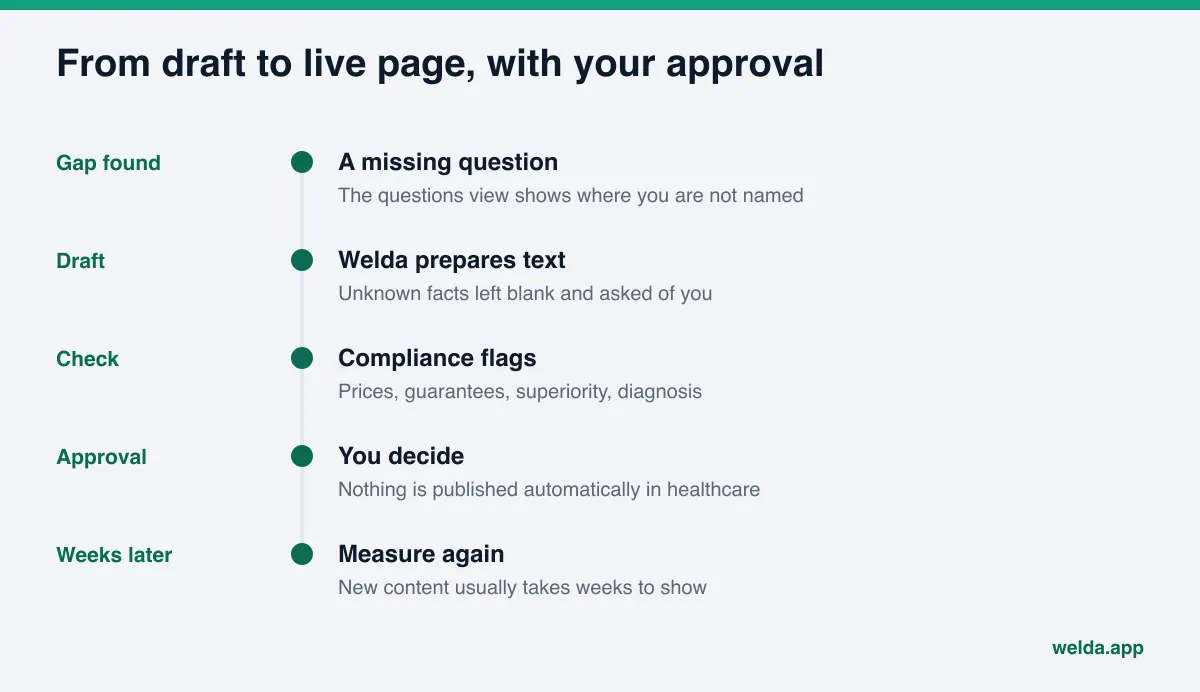
Welda is software that measures where a business shows up in AI answers and prepares the fixes on the business's behalf. For a hair restoration practice, three parts of that work matter most: seeing which patient questions you are missing from, catching risky claims before anything goes live, and routing every piece of content through your approval.
The questions view: where patients are not finding you. Welda asks ChatGPT, Gemini, Perplexity and Google AI the questions your patients are likely to ask, and asks each one three times, because AI answers vary. For a hair transplant clinic these are questions like "FUE clinic near me where the surgeon does the extractions" or "hair transplant for women in my city". For each question you see which engines name you and in what position. Questions can be run in English or Turkish. The decision this view supports is where to start: if you appear on technique questions but disappear on surgeon questions, your team page is the first job.
The compliance check: risky claims flagged before publishing. Everything Welda drafts goes through a compliance check before publishing. It flags patterns such as prices, guarantees, superiority claims and diagnostic suggestions. In hair restoration, that means catching phrases like "permanent results", "best surgeon in the state" or "you need a transplant if you notice these signs" before they reach your site. This check is not legal advice and has not been reviewed by legal counsel; the final call stays with you and your advisers.
The approval queue: no automatic publishing in healthcare. In the health sector, Welda never publishes on its own. Every page, profile text and review reply waits in your to-do list for approval. If Welda does not know something, such as a surgeon's credentials or how often you schedule follow-ups, it leaves the field empty and asks you instead of guessing. Patient data is never sent to AI.
The rest in brief: on WordPress sites Welda connects through a separate Editor user without installing code, and opens content as drafts; on other systems it hands you a ready package to apply yourself. A competitors view shows which clinic wins on which topic and from which source, and a one-page monthly report sums it up. Your content always lives on your own site.
A plain note on availability. The Welda dashboard is in early access and is opening first in Turkey. Regular four-engine tracking is being added during early access, and the sample screens are shown with representative data. What anyone can use today, in English, is the free site analysis. Pricing is discussed in an early access conversation.
What the free analysis shows on a hair restoration site
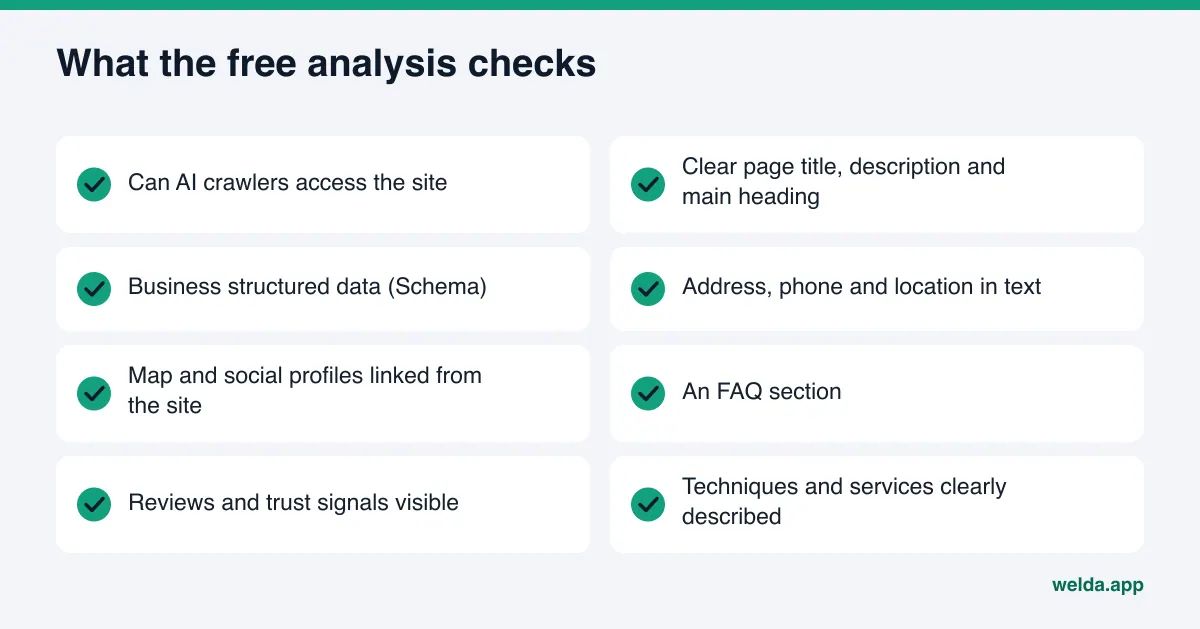
The free analysis reads your home page and a few inner pages (services, about, contact, pricing) the way Google and AI assistants do. On hair restoration sites, the gaps it surfaces tend to match the steps above: AI crawlers blocked in robots.txt, all techniques squeezed into one paragraph, no business structured data, an address that only appears in an image, social and map profiles not linked from the site, and no FAQ section.
For each issue it explains what it found, why it matters and how to fix it. It suggests a ready-to-use title, description, main heading, intro paragraph and FAQs for your home page, and a simulation shows how much each fix would move your score. It also asks five patient-style questions to an AI assistant that can search the web and checks whether your clinic's name appears in the answers. That is a one-time snapshot; ongoing tracking is what the dashboard is for. The analysis does not measure rankings and does not promise any.
Limits: what Welda does not do
Hair restoration is sensitive territory, so the limits should be stated plainly.
- No ranking guarantees. Welda does not guarantee that ChatGPT or any other engine will name your clinic or place it in a specific position. Answers vary, which is why each question is asked three times and the score comes with a margin of error.
- No made-up facts. Credentials, techniques and follow-up schedules come from you. Welda does not guess.
- No unapproved health content. Every piece of content goes to approval. Automatic publishing is off in healthcare.
- No fake reviews. Writing or buying reviews violates the rules and damages trust. See fake reviews rules and AI visibility for the regulatory side.
- Some work stays with you. Handling negative reviews, managing directory accounts and press work are yours. Welda can draft text for them, but it does not run those accounts for you.
- No instant results. New content usually takes weeks to show up in AI answers.
AEO checklist for hair transplant clinics
Open your site and go through this table line by line. Every "no" is a task.
| Check | Why it matters | Who does it |
|---|---|---|
| robots.txt does not block AI crawlers | If blocked, your site is never read | Whoever manages your site |
| Main heading names the service and city | AI places you in the right category | You, with Welda's suggestion |
| Each technique has its own page | Technique questions get material from you | You, Welda drafts |
| Surgeons listed by name, credentials and role | Answers "who does the work" | You supply the facts |
| Name, address, phone identical everywhere | Inconsistency lowers trust | You; Welda drafts if profiles are connected |
| No guarantees or outcome promises in copy | FTC and state rules on health claims | Compliance check flags, you decide |
| Reviews answered without patient details | Trust and privacy | You, Welda drafts replies |
A simple way to decide: if the first two rows are "no", fix them first, because content work is wasted while crawlers are blocked. If the technical side is clean but technique and surgeon pages are thin, start writing. If everything is in place and you still do not appear, the gap is usually in what other sites say about you, and you need to see which sources are lifting your competitors. For a broader list, our AEO checklist covers every business type, and the guide on AI visibility software for dermatologists covers a neighboring specialty.
Frequently asked questions
Is AEO for a hair transplant clinic different from regular SEO?
The foundation is shared: a readable site, clear information and consistent details. The goal differs. In AEO you want your clinic named inside the answer an AI writes, not just listed on a results page. That puts more weight on question-by-question content and on a consistent picture across other sites.
Can I use before-and-after photos?
Rules on before-and-after photos and patient testimonials can come from the FTC, your state medical board and professional bodies. Decide how to use them with your counsel. Welda does not give legal opinions.
Do I need to publish prices to be recommended?
AI assistants weigh technique, surgeon, location and reputation, not just price. Whether and how you publish pricing is a business and compliance decision. Explaining how consultations and quotes work is useful either way.
Will Welda publish content for me?
Not in healthcare without your approval. Welda drafts, runs the compliance check and sends everything to you. On a connected WordPress site, approved content moves from draft to live; otherwise you apply the ready package yourself.
How long until changes show up?
New content usually takes weeks to be reflected in AI answers. Removing a technical block, such as a crawler restriction, may show effects sooner, but no one can promise a timeline.
Can I use Welda's dashboard from the US today?
The dashboard is in early access and is opening first in Turkey. The free site analysis works in English today and is open to any site.
Start by seeing where you stand
AI search optimization for hair transplant clinics should start with measurement, not guesswork. Which patient questions are you missing from, what is missing on your site, and is anything blocking AI crawlers? The free AI visibility analysis gives you a first answer: a score out of 100, an explanation for each gap, ready-to-use copy for your home page, and a check of whether your clinic appears in answers to five patient-style questions. It is free once per site; the results link arrives by email and stays open for 14 days.