Are there reliable AI visibility benchmarks for my industry? Not in the form most people hope for. A single "industry average" for AI visibility mixes different prompts, engines, cities and time periods, so it rarely tells you where you actually stand. Useful AI visibility benchmarks are built, not downloaded: you run the same prompt set, on the same engines, in the same period, for yourself and for the handful of businesses you really compete with. This guide shows how to build that benchmark, how to read it, and how Welda approaches the job.
What AI visibility benchmarks actually measure
In traditional SEO, benchmarking felt simple. You checked your rank for a keyword, your competitor showed up on the same results page, and the gap was a number. AI answers do not work that way. A customer asks ChatGPT, Gemini, Perplexity or Google's AI Overviews and AI Mode a question, and the answer names a few businesses, or none. Ask the same question twice and the list can change. So visibility in answer engines is not one position. It is the sum of many prompts and many runs.
That is why answer engine optimization (AEO), which some people call GEO or generative engine optimization, needs a different kind of benchmark. Three measurements matter:
- Mention rate: the share of prompts in which your business is named at all.
- Position: when you are named, how early in the answer you appear.
- Share of voice: of all the mentions across your competitive set, how many are yours.
A benchmark is what you get when you calculate those three numbers for yourself and for your competitors under identical conditions. The "industry" part matters because the prompts customers ask, the sources engines read and the businesses that count as competitors all change from one vertical to another. A boutique hotel and a dental practice cannot share a template.
Why a published industry average is the wrong yardstick
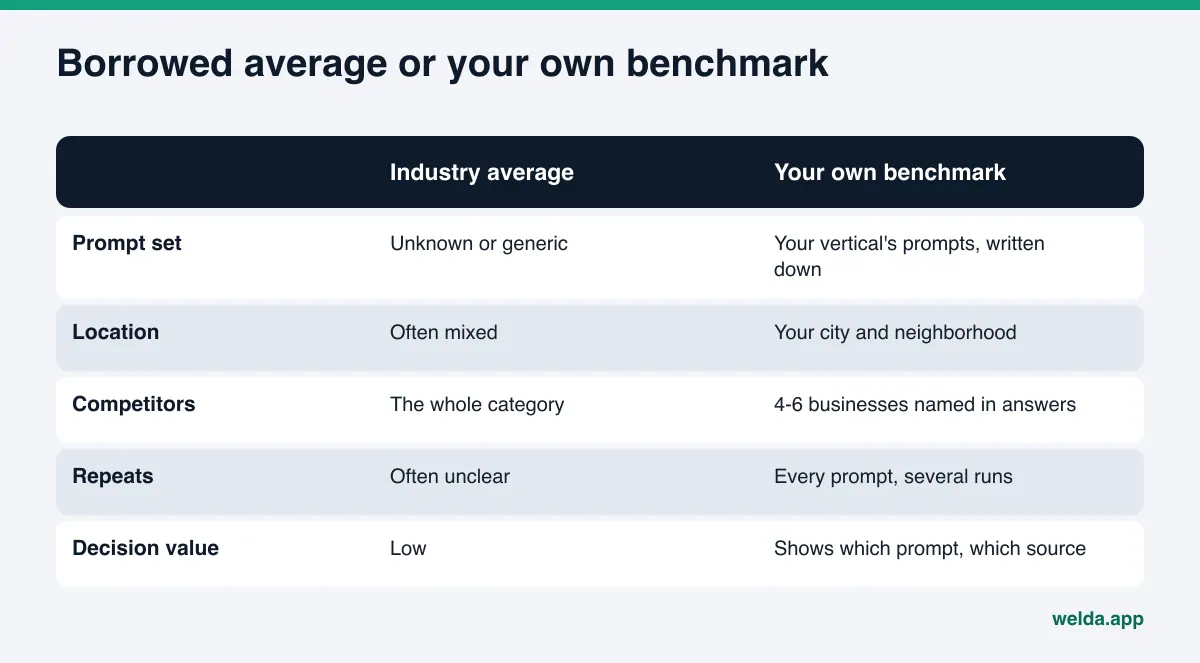
You will see claims like "restaurants average X% visibility in AI search." Treat them with caution. There are concrete reasons a borrowed number does not transfer to your business.
| Variable | Why it breaks the comparison |
|---|---|
| Prompt set | "Best pizza in Chicago" and "late-night pizza near Wicker Park that delivers" reward very different businesses. |
| Engine and access method | Engines that browse the web answer differently from those that do not, and app answers can differ from API answers. |
| Location | Local answers depend on the city and often the neighborhood. A Denver score says nothing about Austin. |
| Language | English and Spanish versions of the same question can pull different sources and different names. |
| Time | Engines update and sources change. A six-month-old average was not measured under today's conditions. |
| Repeats | A single run hides normal run-to-run variation, so small gaps look bigger than they are. |
The access-method point surprises many teams; we cover it in detail in our piece on API vs app answers in AI visibility tracking. The broader lesson is that two numbers are only comparable if they were produced the same way.
For that reason Welda does not publish industry averages or "good score" thresholds. The benchmark that matters is the one against the businesses that compete with you for the same customer, measured the same way. If you want a starting point today, run the free AI visibility analysis. It reads your site the way Google and AI systems do, returns a score out of 100, and includes a competitor comparison that shows where your site falls short of a rival's. It is narrower than ongoing tracking, but it is a clean baseline.
How AI visibility benchmarks differ by industry
Before you build anything, it helps to understand how your vertical gets asked about. Three things shift from industry to industry.
The mix of prompts. A restaurant gets a lot of "open right now" and "near me" questions. A hotel gets comparison questions ("downtown or near the convention center?") and condition questions ("pet-friendly with parking?"). A dental practice gets urgent questions ("emergency dentist open Saturday") alongside cost and trust questions ("does an implant quote usually include the crown?"). A home services company gets job-specific questions ("who fixes tankless water heaters in Plano?"). If your prompt set leans on generic "best X in city" questions, you will miss the prompts that actually bring customers.
The sources engines lean on. In hospitality, booking platforms, Tripadvisor and map listings tend to carry weight. In healthcare, Healthgrades-style directories, Google Business Profile and practice websites come up. In home services, Angi, BBB and Yelp profiles often appear next to the company's own site. Which sources dominate in your market is something you measure, not assume. But knowing that the source landscape is wide in some verticals and narrow in others changes how you read a gap. In a wide landscape, a competitor's lead may come from many small listings. In a narrow one, a few complete profiles can decide it.
Who counts as a competitor. In a national ecommerce category, your competitive set may be a few well-known brands. In local services, it is usually the business three blocks away at a similar price point, not the biggest name in the state.
Example: a prompt set for a dental practice
Here is an illustrative prompt set for an example dental practice in Phoenix. These prompts are written for this article as a model, not taken from measured data. The point is the spread across clusters.
| Cluster | Example prompt | What the benchmark checks |
|---|---|---|
| General | Can you recommend a good family dentist in north Phoenix? | Whether you are named for your core service |
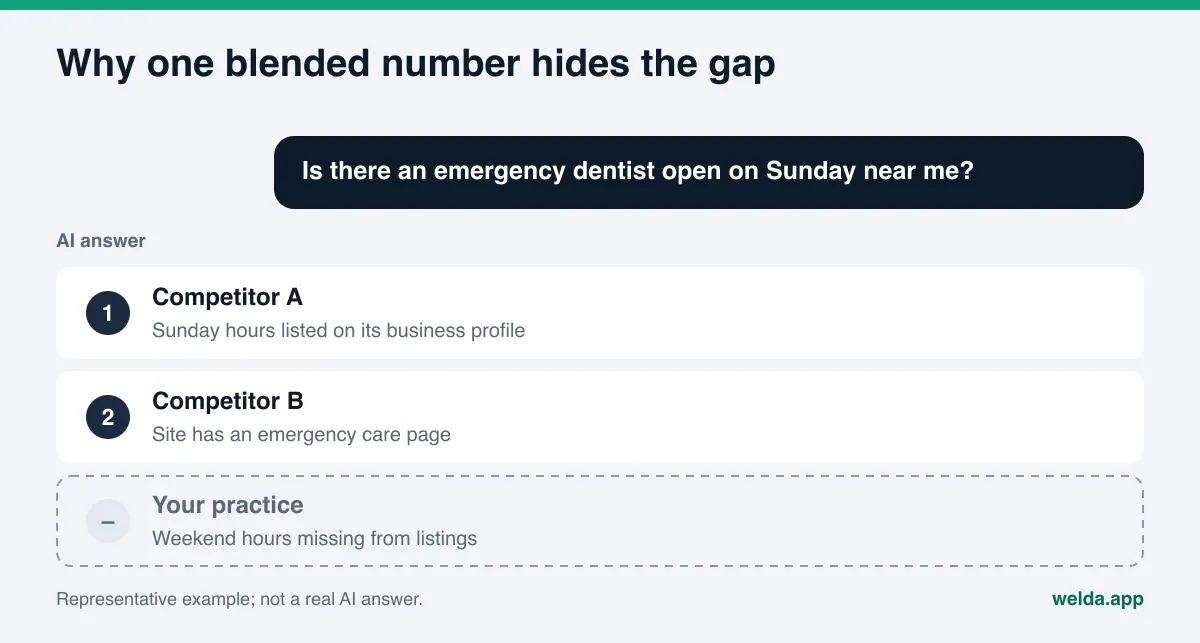
| Urgent | Is there an emergency dentist open on Sunday near Scottsdale Road? | Whether your hours are correct in the sources |
| Cost and trust | Does a dental implant quote usually include the abutment and crown? | Whether you have content that explains the process |
| Insurance | Which Phoenix dentists take my PPO dental plan? | Whether accepted plans are stated clearly on your site |
| Neighborhood | Dentist near Arcadia with evening appointments? | Whether location and evening hours are explicit |
Read cluster by cluster, the example practice might be level with competitors on general prompts but absent from urgent ones. The cause is often mundane: weekend hours missing from the Google Business Profile, or a site that never says it takes emergency patients. One blended score would hide that. A cluster-level benchmark ties each gap to a specific fix.
In healthcare, any content you add to answer cost and trust questions has to respect the advertising rules that apply to your profession. Avoid guarantees, superiority claims and anything that reads like a diagnosis. This is not legal advice; check with your own counsel before publishing.
Choosing your competitive set
The most common benchmarking mistake is picking the wrong competitors. Businesses tend to list the most famous name in their category. In AI answers, the business that takes your spot is more often a neighbor with a similar service and price.
- Start from the answers. Run your prompt set on a few engines and write down which businesses get named instead of you. That list is your first competitive set, not the one in your head.
- Narrow the geography. For a local business, keep the set to your city and ideally your part of town.
- Match the service. A boutique hotel does not necessarily compete with a large chain; an implant-focused practice does not necessarily compete with a general clinic.
- Include one leader. Add the business that gets named most often. The distance to the leader tells you how far away the goal is.
- Keep it small. Four to six competitors is enough for most local businesses. A bigger set dilutes share of voice and becomes hard to read.
Our guide to AI competitor analysis goes deeper on why a competitor leads and how to trace that lead to its sources.
How to build AI visibility benchmarks step by step
Once the competitive set is fixed, the measurement itself follows. You can do this by hand or with a tool. What matters is that conditions stay constant at every step.
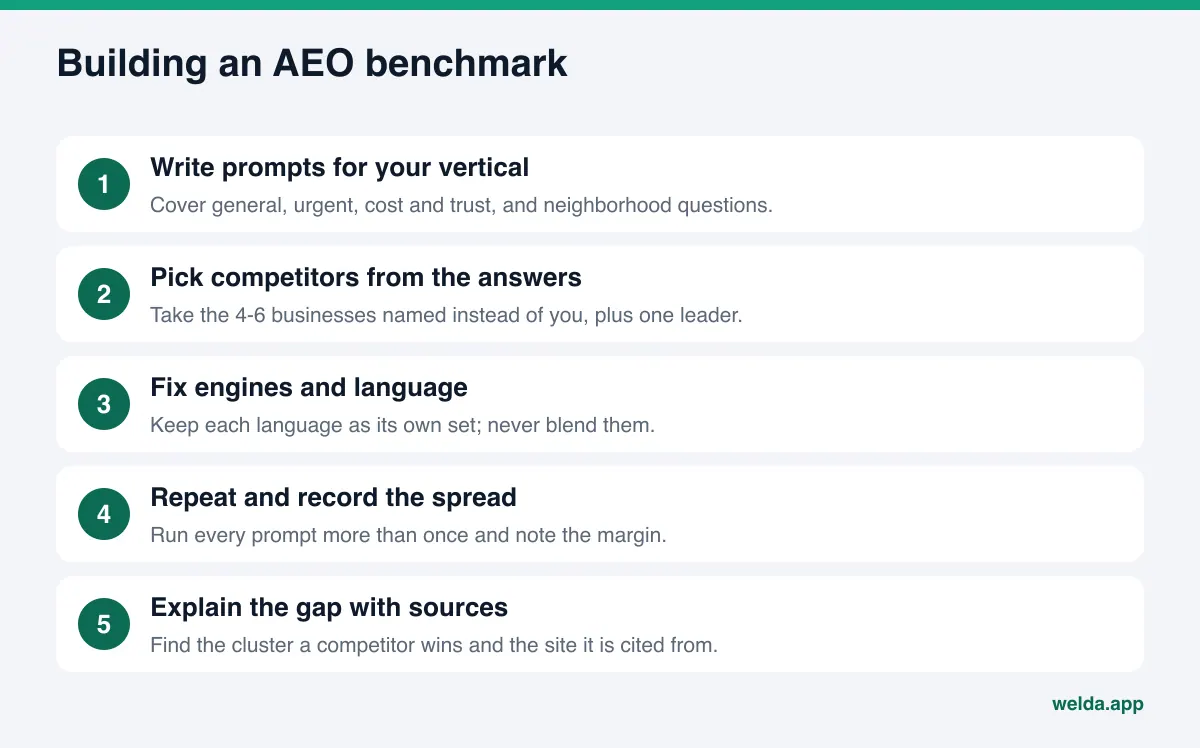
1. Write the prompt set for your vertical. Phrase prompts the way customers talk. Cover every cluster that matters in your industry: general, urgent or situational, cost and trust, neighborhood, and visitor questions if you serve travelers.
2. Freeze it. A benchmark is only valuable if it is repeatable. Lock the prompts for the period. If you want to add new ones, do it at the start of the next period and keep the old results as they were.
3. Fix the engines and the language. Decide which engines you track and which language each prompt runs in. If you serve Spanish-speaking customers, keep those prompts as a separate set; do not blend two languages into one number. Our article on multilingual AI visibility tracking covers the setup.
4. Repeat every prompt. AI answers are not deterministic. One run can catch a lucky mention or miss a real one. Run each prompt several times, average the results and record the spread.
5. Calculate the same three numbers for everyone. Mention rate, average position and share of voice, for you and for each competitor, from the same prompts and the same runs.
6. Explain the gap with sources. On which prompts does a competitor lead, and which sites are cited in those answers? A benchmark should end with "we trail on urgent prompts because of these two listings," not just "we trail."
7. Re-run under the same conditions. The first run is a baseline. The benchmark becomes useful when you change something and measure again with the same set. For timing, see how often to measure AI visibility.
Reading the results without fooling yourself
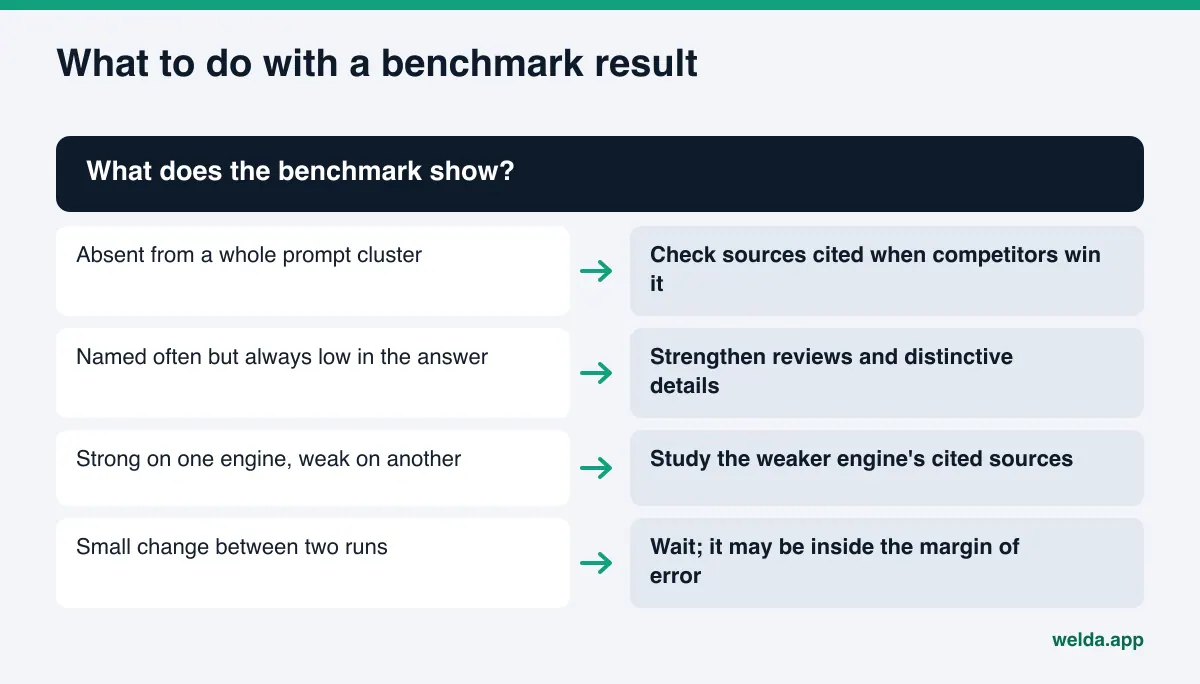
Your eye goes to the headline score first. Decisions usually come from the parts underneath it. This table maps common benchmark patterns to what they tend to mean. It is a qualitative reading guide, not measured data, and any single pattern can have more than one cause.
| What you see | Likely meaning | Where to look first |
|---|---|---|
| Named on few prompts, but near the top when named | Engines know you but do not connect you to many needs | Clear, separate service descriptions on your site |
| Named on many prompts, always near the bottom | You make the list but nothing sets you apart | Reviews, trust signals, distinctive details |
| Absent from an entire cluster | You are missing from the sources engines read for that need | Sites cited when competitors win that cluster |
| Strong on one engine, weak on another | Engines trust different sources | Sources cited by the weaker engine |
| Far behind the leader, level with everyone else | You share the same gaps as the rest of the set | The leader's winning clusters and sources |
| Small move between two runs | May be inside the margin of error | Run-to-run spread and the next scheduled run |
The last row deserves emphasis. It is tempting to read a two-point gain as "we passed them." If the margin of error from repeated runs covers that gap, the honest reading is that you are in the same place.
How Welda builds AI visibility benchmarks
In Welda, the benchmark is never an industry average. It is built against the competitors you choose and the ones that keep showing up in answers. Three parts of the product carry this work.
One prompt set, repeated runs. In the dashboard, the questions your customers would ask are defined once and sent to ChatGPT, Gemini, Perplexity and Google AI three times each. Your competitors are evaluated on the same prompts in the same run, so your number and theirs come from identical conditions. Prompts can run in English or Turkish.
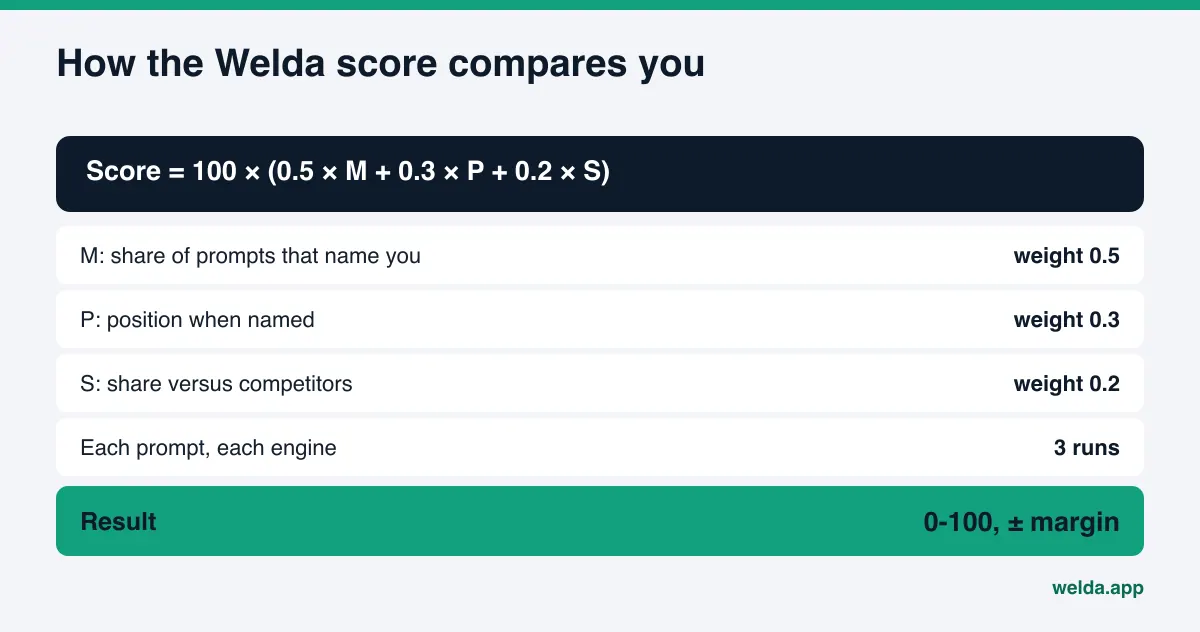
An open formula with a margin of error. The score weights mention rate at 50%, position at 30% and share versus competitors at 20%. Because the formula is visible, you can see which part explains the gap: are you named on fewer prompts, or named lower when you do appear? The spread across the three runs produces a ± margin, which keeps you from over-reading small changes.
The competitors view. This is where the benchmark is read. Each business in your set gets its score, mention rate and share side by side, with your row highlighted. Next to the table, Welda states which prompt cluster a competitor wins and which source it is cited from. The decision this screen supports is concrete: which cluster and which source to work on first.
Gaps found in the benchmark become items on a single to-do list. If information is missing, Welda asks you rather than guessing. If copy is needed, it drafts it. If a profile is not connected, the task is marked as manual. Publishing approval stays with you, and content always lives on your own site. A monthly one-page report then summarizes how your share against competitors moved; our monthly AEO report article explains how to read one.
Early access, limits and what Welda does not do
To be clear about where things stand: the Welda dashboard is in early access and is opening first to businesses in Turkey. Regular four-engine tracking is being added during early access, and sample dashboard screens use representative data. What anyone can use today is the free analysis, which works in English. Pricing is discussed in an early access conversation.
For benchmarking specifically, these are the limits:
- Welda does not publish industry averages or "good score for your vertical" figures. The benchmark is your competitive set.
- It does not guarantee rankings or placement in ChatGPT. A benchmark shows where you stand and what is missing; it does not promise an outcome.
- It does not invent facts about you or your competitors. When it does not know something, it asks.
- It does not write fake reviews. Handling negative reviews, directory accounts and press work stays with you.
- New content usually takes weeks to show up in AI answers. Do not expect a benchmark to move within days of a change.
The free analysis has its own limits as a benchmarking tool. It does not track rankings. It asks five customer-style questions, once, to an AI assistant that can search the web, and checks whether your business is named. That is a useful snapshot, not ongoing tracking.
Checklist before you trust a benchmark
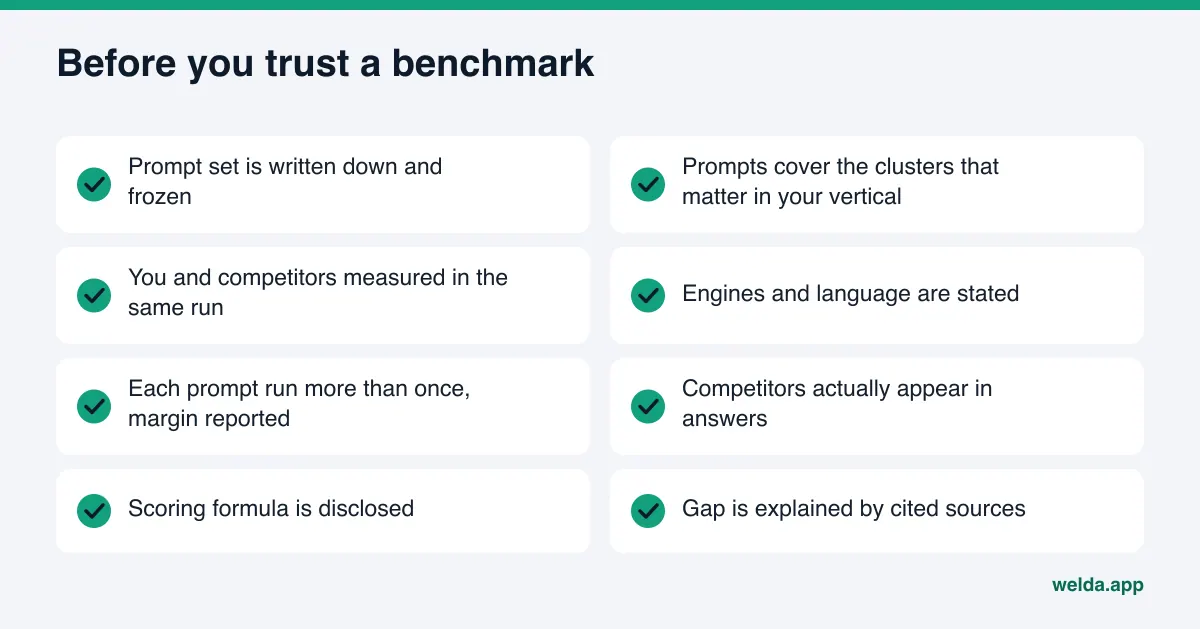
Whether you build the benchmark yourself or an agency or vendor hands you one, ask these questions first:
- Is the prompt set written down, and does it cover the clusters that matter in your vertical?
- Did you and your competitors get measured on the same prompts, in the same run?
- Are the engines and the language stated?
- Was each prompt run more than once, and is a margin of error reported?
- Are the competitors businesses that actually appear in answers, or a guessed list?
- Is the scoring formula disclosed, so you can see which part drives the gap?
- Is the gap explained by sources?
- Will the next run use the same conditions?
If most answers are no, you are holding a snapshot, not a benchmark. Snapshots have their uses, but they are not enough to make decisions on.
Frequently asked questions
What is a good AI visibility score for my industry?
There is no trustworthy single number. Scores depend on the prompt set, the engines, the location and the competitive set. What matters is your position against competitors measured the same way, and how that gap changes over time.
Can I compare my Welda score with a score from another tool?
Not directly. Tools use different prompts, engines and formulas. Compare within one tool, with the same prompt set and the same competitors.
How many competitors should I benchmark against?
Four to six is enough for most local businesses. Include one leader that gets named often and a few neighbors that look most like you.
My main competitor is a national chain. Should it be in the set?
Yes, if it actually appears in answers to your prompts. In neighborhood and service-specific prompts, though, your real competitors are often similar-sized local businesses. Keep the chain as the leader and build the benchmark around your neighbors.
What does the competitor comparison in the free analysis show?
The report includes a comparison of your site with a competitor's, which helps you see where your site falls short. It is not an ongoing share-of-voice measurement in AI answers; that belongs to the competitors view in the dashboard.
How quickly do benchmark results change?
New content usually takes weeks to be reflected in AI answers. Re-run the benchmark at a steady interval with the same prompt set rather than checking daily.
Start your own benchmark
Good AI visibility benchmarks come from your own competitive set, a frozen prompt set and repeated runs, not from a borrowed average. The first step is to see where your site stands today. Run the free AI visibility analysis to get your score, your gaps, a competitor comparison and a five-question AI test in one report.