How do you run an AI competitor analysis? You ask ChatGPT, Gemini, Perplexity and Google's AI answers the questions your customers actually ask, then record which competitors get named, in what order, with what reasoning and based on which sources. Each place a competitor wins becomes a specific gap on your side that you can close. This guide walks through the process step by step and shows which parts Welda handles for you.
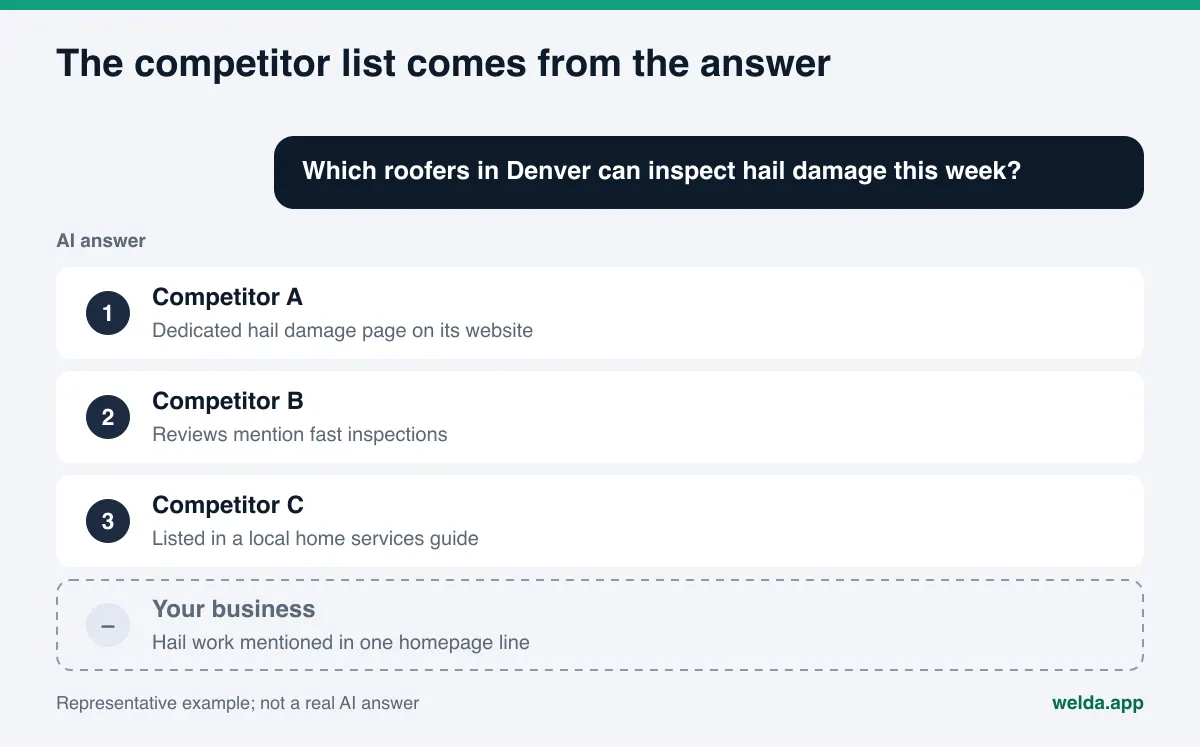
What is AI competitor analysis, and how is it different from SEO competitor research?
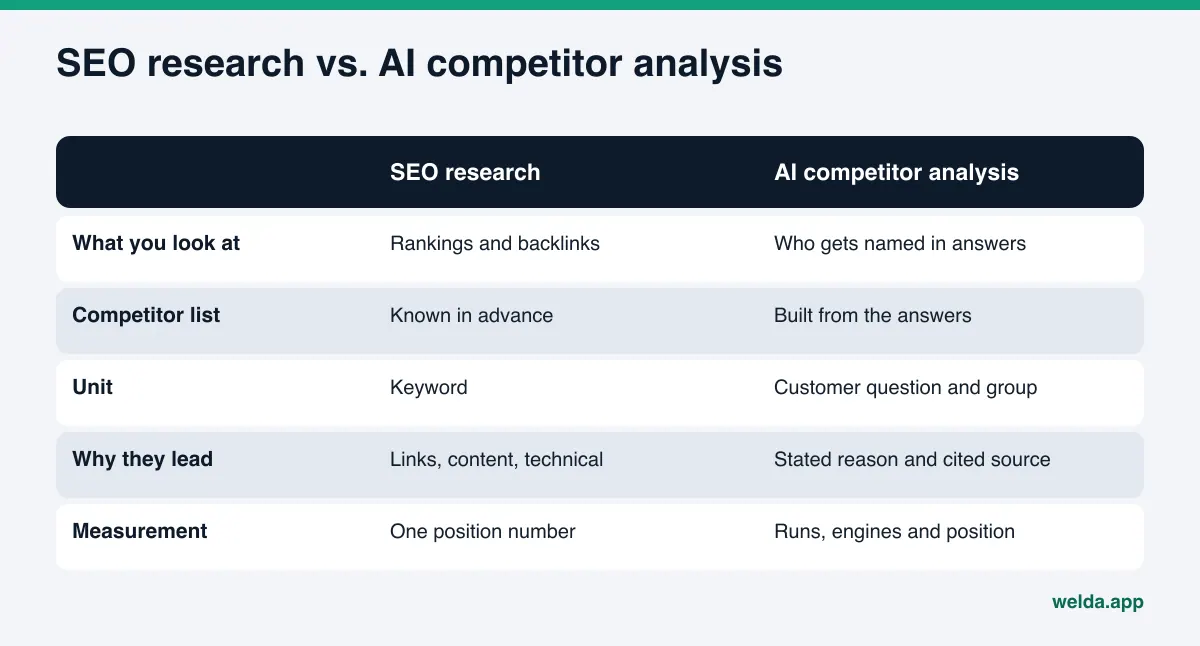
Traditional competitor research in SEO looks at rankings: who holds the top spots for which keywords, who has more backlinks, which pages drive their traffic. That still matters. But in AI answers, the decision happens somewhere else. A customer types a question, the assistant names a handful of businesses, and it adds a short reason for each one. The customer usually picks from that short list or narrows it with a follow-up question.
This is the core of AEO, answer engine optimization: earning a place in the answers that ChatGPT, Gemini, Perplexity and Google's AI Overviews and AI Mode give. You may also see the same work called GEO, generative engine optimization. AI competitor analysis is the part of AEO that studies that short list. It answers five questions:
- When customers ask the questions that lead to a purchase, who gets named, and are you one of them?
- In what order do those names appear, and who is consistently first?
- What reason does the assistant give for recommending a competitor: location, transparent pricing, reviews, a specific service?
- Where does that reason come from: the competitor's own website, their Google Business Profile, Yelp, Angi, the BBB, a local "best of" list?
- What does the competitor's website say clearly that yours does not?
The key difference is that the competitors you track in Google are not always the ones an AI assistant puts next to your name. A large regional chain may dominate the search results, but for a detailed question like "a contractor in north Austin who handles small bathroom remodels and gives written estimates," the assistant may name a smaller business that describes exactly that on its site. So an AI competitor analysis does not start from a list you already believe in. It builds the list from the answers.
The quickest way to see your own starting point is Welda's free AI visibility analysis. It asks an AI assistant with web search five questions your customers might ask, checks whether your business name appears in the answers, and runs the websites of the businesses that come up through the same technical checks as yours. That is a practical first round of AI competitor analysis.
Why AI search visibility against competitors matters for your business
An AI answer has no second page. In a list of ten blue links, even the tenth spot gets a chance at a click. If an assistant names three or four businesses and you are not one of them, you are simply absent from that conversation. And the assistant does not just list competitors. It vouches for them: "reviewers mention fast response times," "lists its pricing upfront," "open on weekends." Customers read that sentence as a recommendation.
Competitor analysis makes those reasons visible. Very often the reason is something you also offer but never wrote down anywhere a machine can read it. Your competitor states on its website and Google Business Profile that it offers same-day service. You offer same-day service too, but it only comes up on the phone. An AI assistant cannot hear your phone calls. That is why the most common output of an AI competitor analysis is not "build something new" but "describe what you already do in a way AI can read and quote."
The second reason is focus. The list of possible AEO work is long: structured data (Schema), FAQ sections, service pages, profile descriptions, review responses. Starting all of it at once rarely works. If you know which topics and which sources your competitors win with, you know where to start, and your effort goes to the questions customers actually ask.
The third reason is realistic expectations. Sometimes a competitor leads for reasons you cannot close quickly, for example years of mentions in local news and industry directories. Knowing that helps you separate the questions where you can expect movement soon from the ones that need a longer plan.
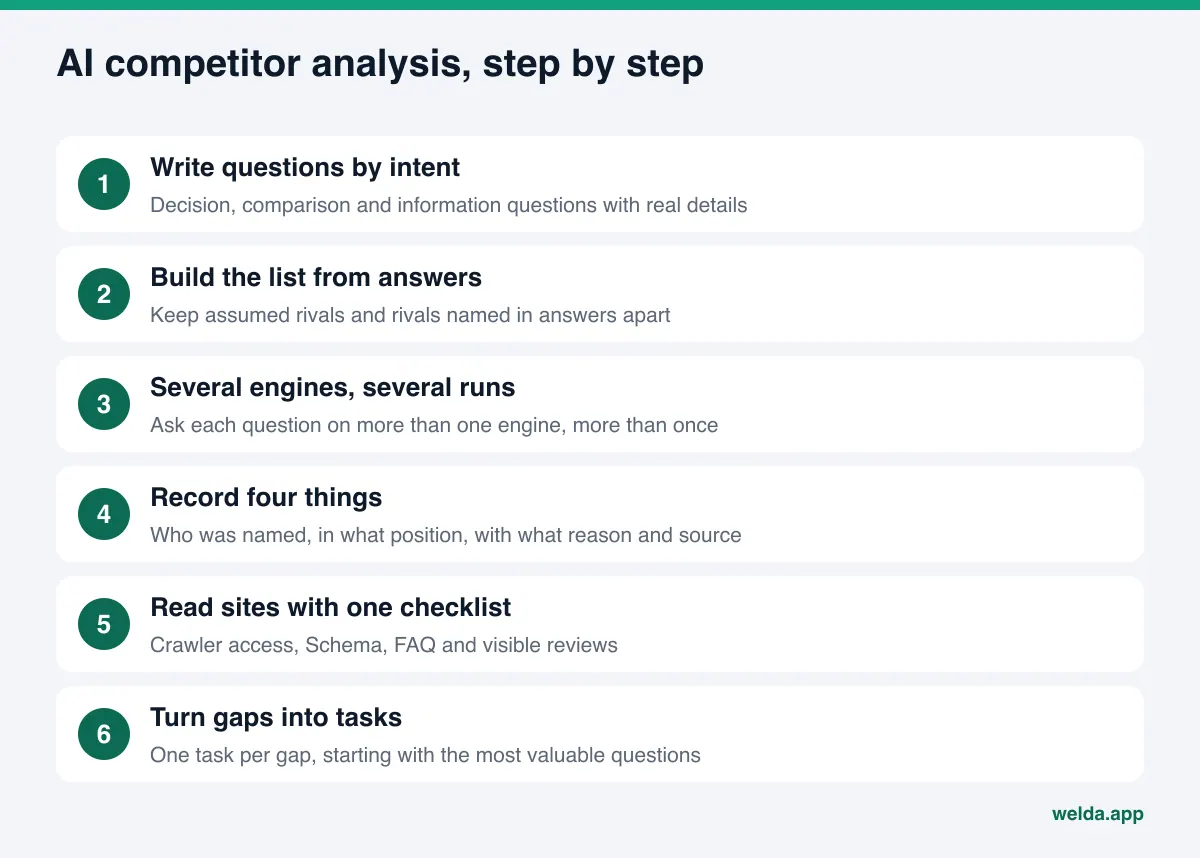
AI competitor analysis, step by step
You can do all of the following by hand with a spreadsheet and some discipline. It gets harder as the number of questions grows; we come back to that in the Welda section.
- Write the questions in your customers' words. Do not stop at "best roofer near me." Group questions by intent: decision questions ("Which roofers in Denver can inspect hail damage this week?"), comparison questions ("Is it better to repair or replace a 15-year-old roof?") and information questions ("How long does a roof replacement take?"). Add the details real customers add: a neighborhood, a timeframe, a constraint.
- Build the competitor list from the answers. Write down the competitors you believe you have, then ask the questions and add every business that appears in the answers in a separate column. If the two lists differ, the second one is your real AI competitor set.
- Ask every question on more than one engine. ChatGPT, Gemini, Perplexity and Google's AI answers draw on different sources. A competitor who leads in one may not appear in another at all.
- Ask every question more than once. AI answers vary from run to run. A single answer is a snapshot, not a result. Repeat the question and look at the pattern.
- Record four things for every answer. Who was named, in which position, with what reason, and which source was cited. If no source is shown, write "no source" rather than guessing.
- Group the reasons. As rows add up, patterns appear: one competitor is always praised for reviews, another for pricing transparency, another for a specific service. Tag them by type, using the table in the next section.
- Read competitor websites with the same checklist as your own. Can AI crawlers access the site? Is there business structured data (Schema)? Does it include contact details? Is there an FAQ section? Are reviews visible? Apply the same checklist to your site.
- Turn every gap into one task and rank the tasks. "Add Saturday hours to the homepage and Google Business Profile" is a task. "Improve AI visibility" is not. Then sort tasks starting with the question group closest to a booking or a quote request.
If you want to go deeper on the source side, the guide on citation gap analysis explains how to find the sites where competitors are cited and you are missing.
Why the competitor wins: reading the reasons in AI answers
The most valuable part of an AI competitor analysis is the short sentence the assistant uses to justify each recommendation. It shows what the model "knows" about the competitor and, often, where it learned it. The table below summarizes common reason types, where they typically come from, and what you can do on your side.
| Reason in the answer | Typical source | Your task |
|---|---|---|
| "Located in your area, serves these neighborhoods" | Website, Schema, Google Business Profile | State address and service area consistently everywhere |
| "Publishes pricing upfront" | Competitor's pricing or service page | Publish the price ranges you can share, or what drives the price |
| "Reviewers praise their communication" | Google reviews, Yelp, Angi | Ask real customers for reviews and respond to them |
| "Specializes in this service" | Dedicated service page, FAQ | Give each service its own clear description |
| "Recommended by local guides" | "Best of" lists, local news, directories | Apply or reach out to be listed where it fits |
| "Accredited, resolves complaints" | BBB profile and complaint history | Keep profiles accurate and answer complaints calmly |
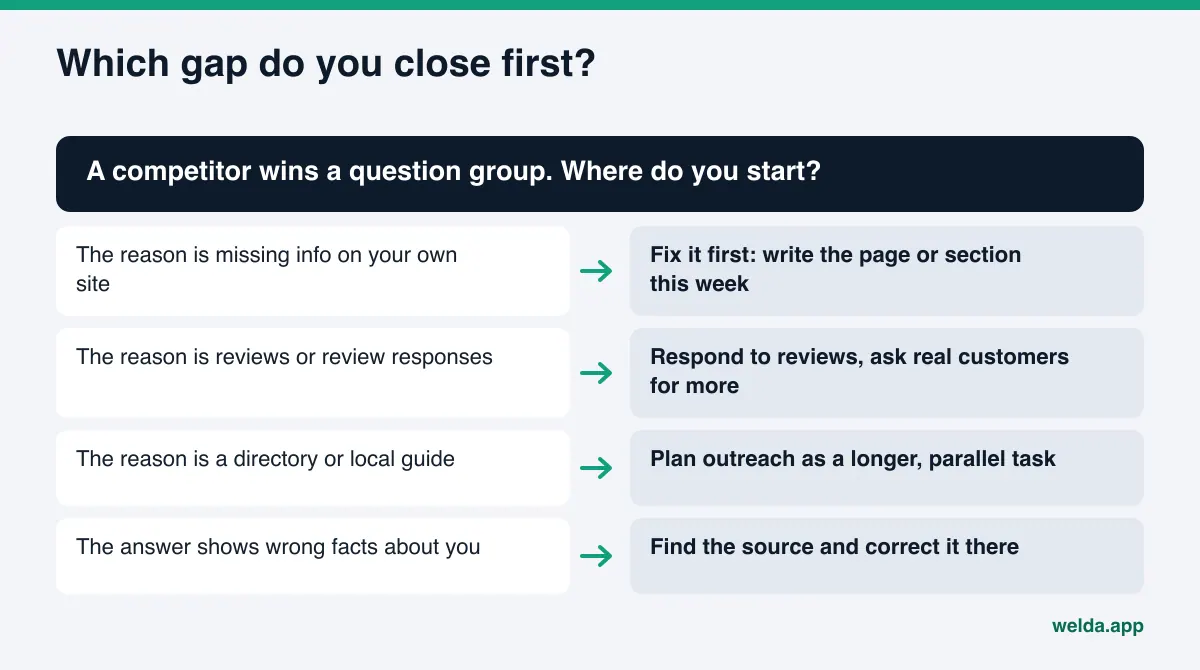
Two kinds of work show up here. The first four rows are largely under your control: your website, your profiles, your review responses. The last two depend on other people's sites and move more slowly. Closing the gaps you control first is faster and much easier to measure.
One caution: the reason sentence is not always accurate. Assistants sometimes repeat outdated information, a closed location or wrong hours. If you see something wrong about a competitor, it is not yours to fix. If you see something wrong about your own business, finding the source of that information and correcting it there becomes a priority.
Example: a contractor's AI competitor map
Here is an example scenario to make this concrete. A sample roofing contractor in the Denver area, family-owned, with one crew and a good local reputation. The owner names two large regional companies as the competition. Then he asks the questions his customers ask, and the picture shifts.
- For "who can inspect hail damage this week," two smaller contractors are named. Both have a dedicated page about hail damage inspections and insurance claims. The sample contractor does this work every spring, but his website mentions it in a single line on the homepage.
- For "a roofer with good reviews who shows up on time," one of the large companies leads, and the reason given is that reviewers on Google and Angi frequently mention punctuality. The sample contractor's reviews are just as good, but he has never responded to any of them, and his site says nothing about scheduling.
- For "a roofer who works on historic homes," the sample contractor is named, because his site has a project page about older homes and his Google Business Profile lists the service.
The real competitor set changes by question group: two small contractors for hail damage, a large company for reliability. The tasks become clear as well: a dedicated hail damage page, a short section on how scheduling and arrival windows work, responses to existing reviews. None of this requires a new service. All of it makes existing strengths readable.
Your tracking sheet, and how to prioritize the gaps
If you run AI competitor analysis by hand, the structure of your sheet matters as much as the questions. Give every answer its own row with the columns below. As rows accumulate, you will see the same competitor winning with the same reason again and again, a pattern you miss when you read answers one by one.
| Column | What to write | Why you need it |
|---|---|---|
| Question and group | Full question text and its intent group | Read results by group, not by single question |
| Engine and date | Which assistant, which day, which run | See engine differences and change over time |
| Businesses named | In the order they appear | Position and share of answers |
| Reason | The short justification for each business | See what information a competitor wins with |
| Source | The cited site, or "no source" | Know where a fix needs to happen |
| Your status | Named or not; if named, with what reason | Separate topics you need to defend |
When the gap list is ready, do not try to close everything at once. Three criteria are enough to sort it. First, the value of the question group: questions closest to a quote request or a booking come first. Second, control: a gap on your own website can close in days, while getting into a local "best of" list can take months. Third, reach: some tasks close several gaps at once. Adding business hours to your structured data and your Google Business Profile, for example, can answer the same reason across several question groups.
Sorted this way, the top of the list is usually made of small, high-leverage tasks: a dedicated service page, two or three real questions added to your FAQ, responses to reviews. External sources such as directories and press stay on the list, but they run in parallel as a longer-term effort.
How Welda handles AI competitor analysis
Welda takes over the repetitive part of the steps above: it asks the questions, records the answers, extracts competitors and sources, and turns gaps into tasks. Decisions and approvals stay with you. Three parts are directly relevant to competitor analysis.
1. The first round in the free analysis. The part anyone can use today is the free site analysis, and it works in English and German. It asks five customer questions to an AI assistant with web search and shows whether your name appears and who is recommended instead. It then runs the homepages of the businesses that come up through the same technical checks used on your own site: whether AI crawlers can access it, whether business structured data is present, whether that data includes contact details, and whether an FAQ and reviews are visible. The result is a side-by-side table, so you see at a glance what a competitor's site has that yours lacks. It is a one-time measurement and it does not track rankings, but it answers the first question of any competitor analysis: who am I actually up against, and what is on their site?
2. The Competitors view in the Welda dashboard. The full dashboard is in early access. It is opening in stages, first with businesses in Turkey, and regular four-engine tracking is being added during early access; sample screens are shown with representative data. In the dashboard, your customer questions are asked three times each on ChatGPT, Gemini, Perplexity and Google's AI answers. The Competitors view shows each competitor's share of answers, how often they are named and on which engine they are strongest. More useful still, it shows where a competitor wins, topic by topic, along with the sources it is cited from. Topics where you lead are listed separately, so you also know what to protect.
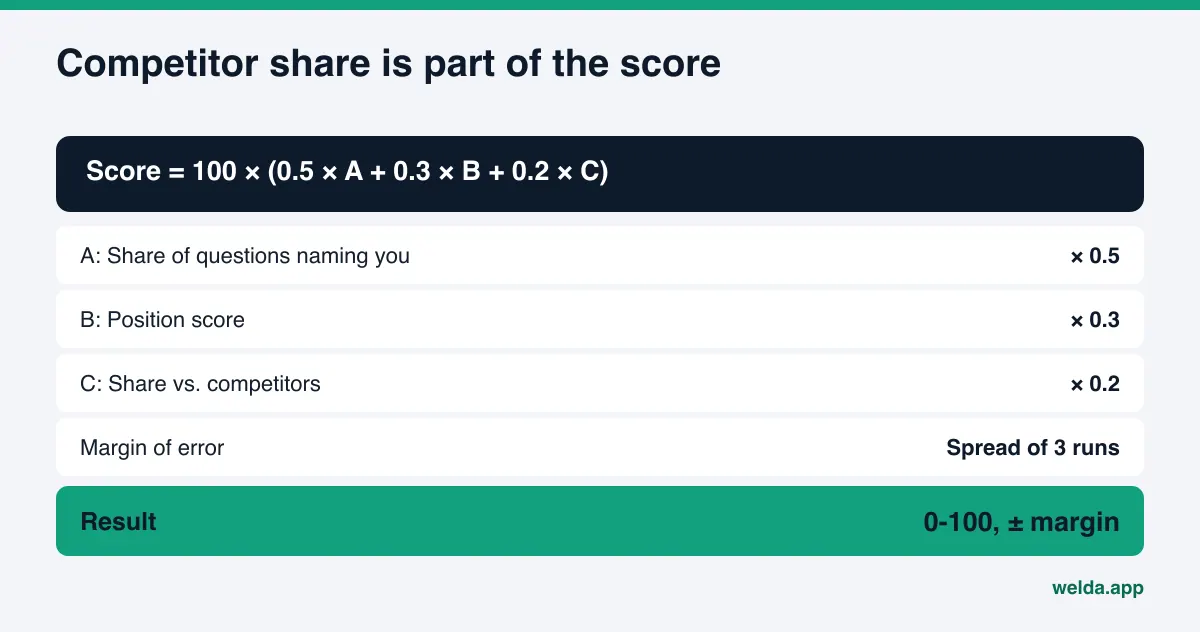
3. Competitor share inside the score. Welda's score formula is public: the share of questions where your name appears carries 50 percent of the weight, your position carries 30 percent and your share relative to competitors carries 20 percent. Competitor analysis is a built-in part of the score. If your competitor share drops while your mention rate holds steady, you know the competitor moved, not you. A margin of error from the spread of the three runs is shown with the score, so you do not mistake noise for a real shift. The guide on margin of error in AI visibility tracking explains how to read that range.
The gaps you find in these views land in a single to-do list. A finding such as "competitor is cited for scheduling details, you have none" becomes a task with suggested copy next to it. Welda drafts the text, but it does not invent facts it does not have; it asks you. Content always lives on your own website. On WordPress sites, Welda connects through a separate Editor user and an application password, content opens as a draft, and it goes live only after you approve it.
What stays with you is clear: which gap to close first, approving every piece of text, asking customers for reviews, and reaching out to directories or local media. Pricing is discussed in the early access conversation.
Limits, and what Welda does not do
AI competitor analysis is a useful tool, but it does not promise certain things. Knowing them up front keeps expectations honest.
- No ranking guarantee. Welda does not guarantee that you will overtake a competitor or appear in ChatGPT. No business controls AI answers on its own.
- No copying competitors. Taking a competitor's text is wrong and does not work; the assistant can already read that information from them. The goal is to write down what you have and have not yet described.
- No disparaging competitors. Naming competitors in comparisons or claiming to be "the best" can run into advertising rules. Welda's compliance check flags these patterns before publication; it is not legal advice. The guide on best claims and advertising rules in AI content covers this in more detail.
- No fake reviews. Welda never generates reviews to match a competitor's count. It drafts responses to real reviews; asking for reviews and handling negative ones stays with you.
- Directories and PR stay with you. If a competitor leads because a local guide or news site mentions them, Welda shows you that; getting into that source is your work.
- Time. New content usually takes weeks to show up in AI answers. Competitor analysis has to be repeated to see whether a change worked.
AI competitor analysis checklist
Use these questions when you run your own analysis or review a tool's output. If you can answer yes to each one, your analysis is solid enough to act on.
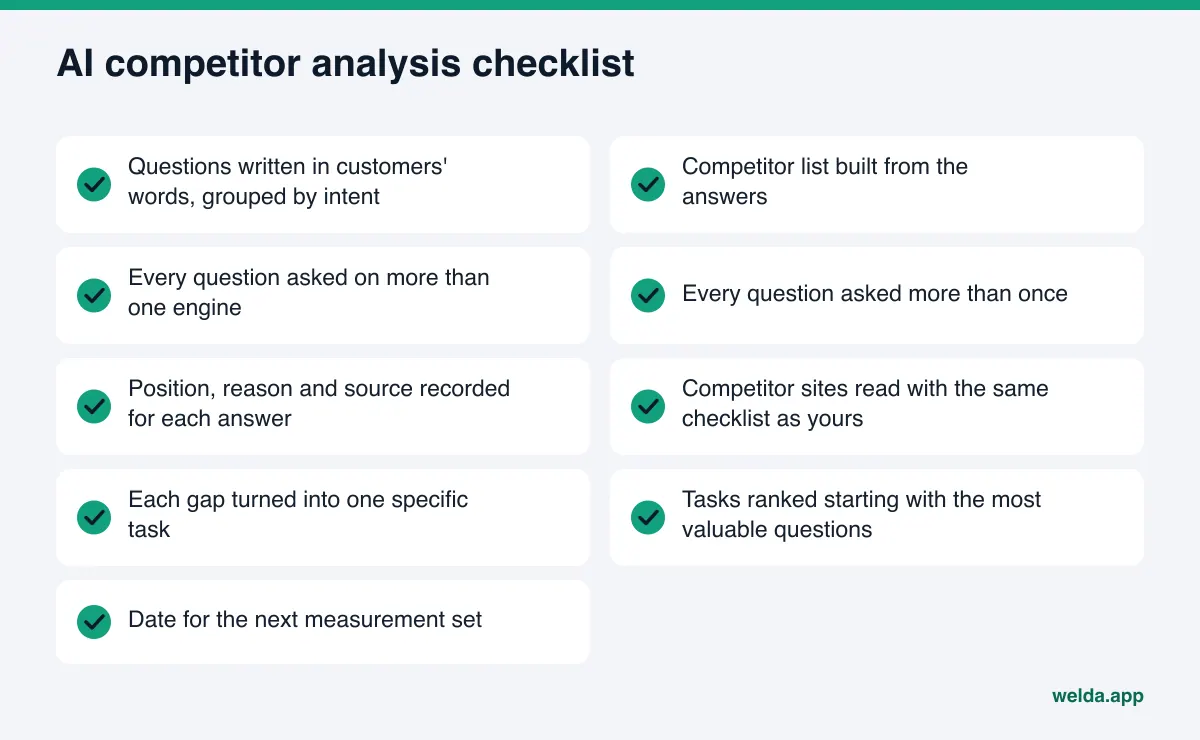
At the end, you should have three things: a competitor list by question group, a summary of each competitor's reasons and sources, and a ranked task list. If you need to present this to an owner or a leadership team, the structure in the monthly AEO report guide works well, and the guide on how often to measure AI visibility helps you set a rhythm for repeating the analysis.
Frequently asked questions
Is AI competitor analysis the same as SEO competitor analysis?
No. SEO competitor analysis looks at rankings and links. AI competitor analysis looks at who gets named in answers, with what reason and based on which source. The two lists may overlap, but they are often different.
How do I know who my AI competitors are?
Start with your own list, but build the real one from the answers. The businesses that come up again and again when you ask customer questions are your actual competitors in AI search.
How many questions do I need?
There is no fixed number. What matters is covering each customer intent with several questions and asking each question more than once. The free analysis gives a first picture with five questions; ongoing tracking needs a broader set.
A competitor leads on one engine but does not appear on another. Which one matters?
All of them. Each engine relies on different sources. Look at which source is cited where the competitor leads; it often points to the place you are missing.
Where does Welda get competitor data?
From AI answers and from competitors' public websites. Welda asks the engines the questions, records the businesses named and the sources cited, and in the free analysis runs the leading competitors' homepages through the same technical checks as yours.
How long until I overtake a competitor?
Giving a timeframe would not be honest. New content usually takes weeks to be reflected in answers, and competitors change too. Welda does not guarantee results; it lets you track changes with a before-and-after comparison.
How often should I repeat the analysis?
Regularly, and especially after a change. If you add a section to your site or update your profile, ask the same questions again a few weeks later. Competitors update their sites as well, so a one-time analysis goes stale quickly. Keeping the same question set makes changes comparable.
Where to start
The easiest first step is finding out who your real competitors are. Run the free AI visibility analysis: in one report, you see whether your name appears for five customer questions, who is recommended instead, and which basic checks competitor websites pass that yours does not. The analysis is free once per site; the results link arrives by email and stays open for 14 days. The suggested copy and the ready-made fix package in the report let you start closing the first gaps right away.