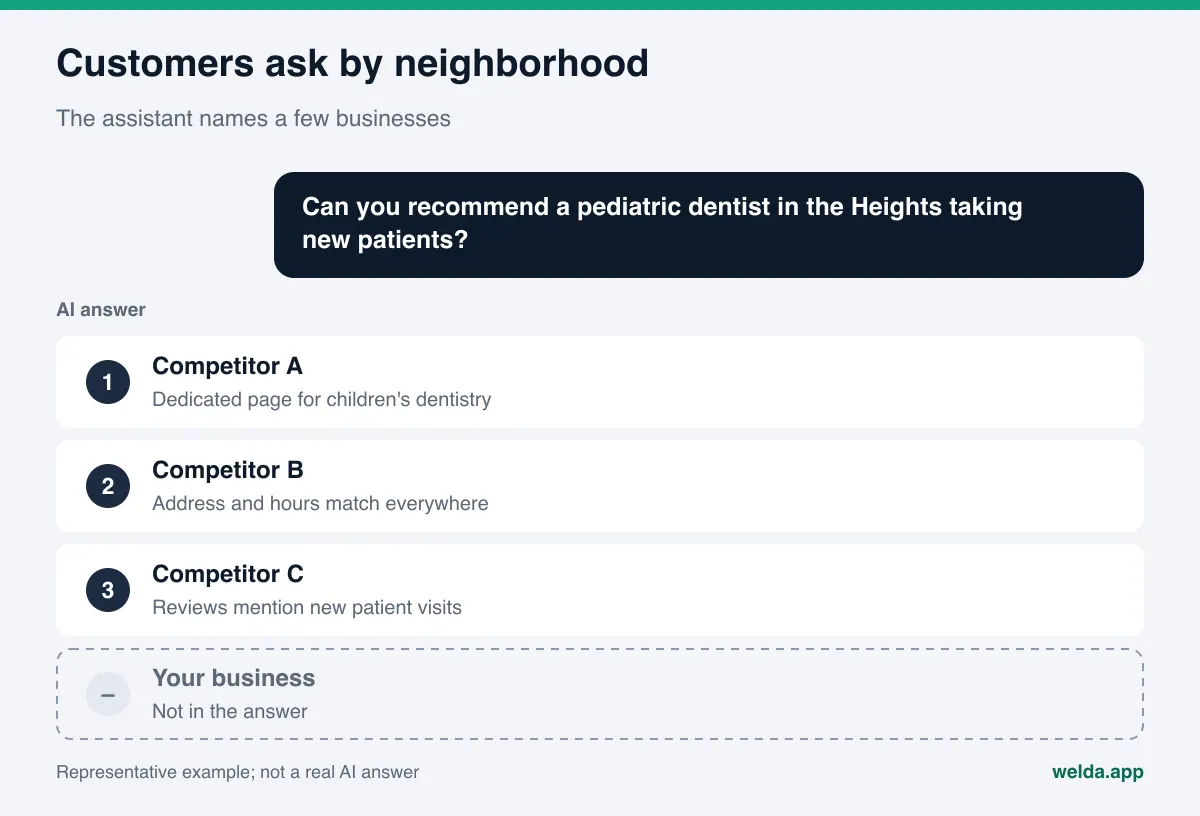
What does AEO mean for Houston businesses? Houston customers now ask ChatGPT, Gemini, Perplexity or Google's AI Overviews things like "Which pediatric dentist in the Heights takes new patients?" and get back a short list of names. AEO for Houston businesses is the work of making your site, your listings and the sources about you clear enough that AI assistants can find you and name you in that list.
This guide is for businesses that serve Houston or sell from Houston: a Tex-Mex spot in Montrose, a med spa in Sugar Land, a plumbing company covering Katy and Cypress, a boutique hotel near the Galleria, or an industrial supplier along the Ship Channel. They all have the same question: "When someone asks an AI assistant about what we do, do they hear about us?" Below we explain what AEO is, how Houston customers phrase their questions, which sources AI engines use to learn about local businesses, and what to do step by step. If you want a baseline first, run the free site analysis. It reads your site the way Google and AI assistants do and lists the gaps, why each one matters and how to fix it.
What is AEO, and why does it matter for Houston businesses now?
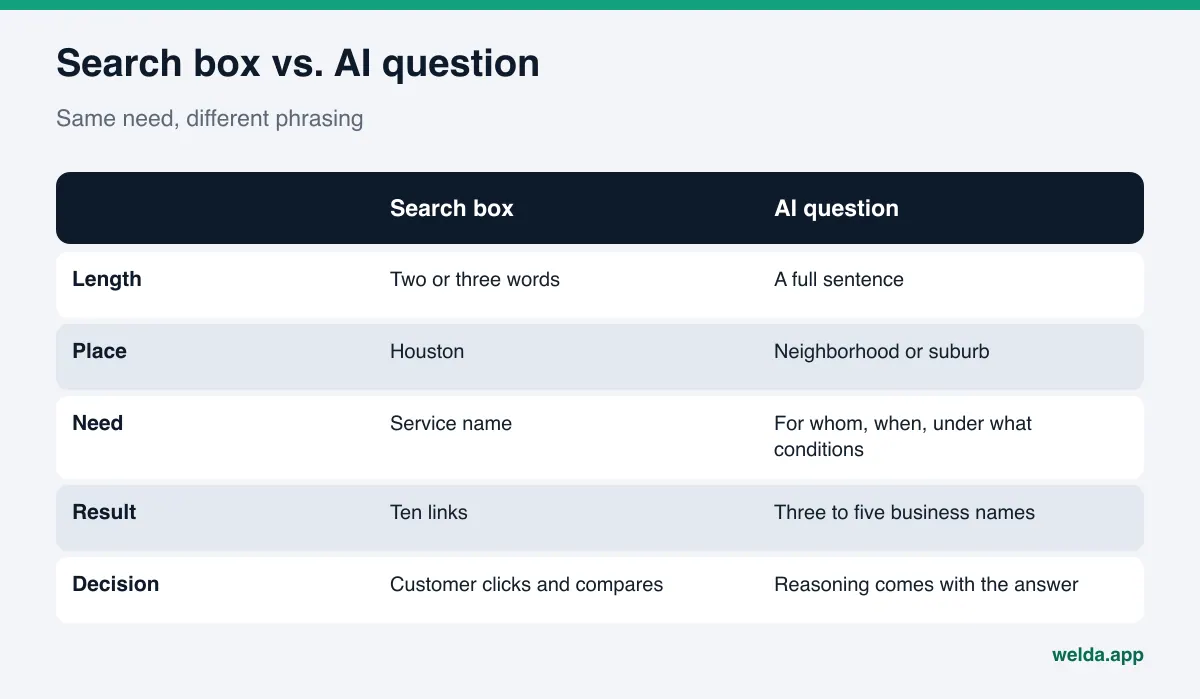
AEO stands for answer engine optimization. It is the work of making sure AI assistants mention your business when customers ask questions. You will also see it called AI search visibility, AI visibility, or GEO (generative engine optimization); they describe the same job. In a classic search, a customer sees ten links and clicks a few. In an AI answer, the customer usually sees three to five business names, each with a sentence explaining why. If you are not on that short list, the customer may never consider you.
Houston makes this harder in three specific ways. First, the metro is enormous and spread out. People do not search for "Houston"; they search for the Heights, Midtown, the Energy Corridor, Pearland, The Woodlands or Clear Lake, because a 25-minute drive in traffic is a real cost. AI assistants respond to the place named in the question. If your site does not say which neighborhoods and suburbs you serve, the answer goes to a competitor who does.
Second, a large part of Houston's economy is business-to-business. Buyers in energy, petrochemicals, logistics and the medical sector ask questions like "Which Houston companies fabricate pressure vessels to ASME code?" or "Who does industrial coatings near the Port of Houston?" AI engines answer those questions from company websites, industry directories and trade association member lists. If your capabilities, certifications and service area are buried in a PDF brochure, the assistant has little to work with.
Third, Houston is a city of newcomers and visitors. People relocate for jobs, come for treatment in the Texas Medical Center area, attend conventions downtown or fly in for a single meeting. They do not know your name yet, so the short list in an AI answer is their first and sometimes only point of contact.
We are not going to quote Houston-specific numbers here. We are not aware of a reliable published study measuring how often Houston businesses appear in AI answers, and we will not make one up. What follows is the method, and how to measure your own situation.
How do Houston customers ask AI assistants for local businesses?
Questions typed into an AI assistant are longer and more specific than keywords typed into a search box. People describe their situation in full sentences. The examples below are not from a research data set; we wrote them to show the kinds of questions different Houston businesses are likely to face:
- Neighborhood questions: "Best brunch in Montrose that takes reservations for groups", "Emergency AC repair in Katy open on Sundays", "Pet-friendly coffee shop in the Heights with a patio".
- Comparison questions: "Is it better to stay downtown or near the Galleria for a two-day conference?", "Which urgent care near Memorial is less crowded on weekends?"
- Supplier questions: "Houston machine shops that can do short runs in Inconel", "Industrial cleaning contractors near Pasadena with OSHA training".
- Practical questions: "Where can I park near a dentist in the Medical Center?", "Bilingual family lawyer in Southwest Houston".
What these have in common: the assistant looks for the place name, the need and a trust signal together. If it finds the match for "Montrose", "brunch", "groups" and "reservations" on your site, your Google Business Profile and your reviews, it can recommend you. If not, it moves to the competitor who wrote those details down. For a deeper look at proximity questions, see our guide to near me searches in AI.
Which sources do AI engines use to learn about Houston businesses?
AI engines rarely learn about a business from a single place. Engines that search the web (ChatGPT search, Perplexity, Gemini, and Google's AI Overviews and AI Mode) look at several sites and combine what they find. For a Houston business those sources typically include:
| Source | What the AI looks for there | What to watch in Houston |
|---|---|---|
| Your own website | Services, neighborhoods served, hours, how pricing works, FAQs | Name the areas you serve; "Greater Houston" is too vague |
| Google Business Profile and Google Maps | Category, address, hours, photos, reviews and replies | Category and service names should match your site |
| Yelp | Reviews, photos, what people praise or complain about | Unanswered complaints can color the tone of the answer |
| Tripadvisor, Healthgrades, Angi, BBB | Category-specific ratings and profiles for hotels, health care, home services | Keep name, address and phone identical everywhere |
| Industry directories and association lists (B2B) | Which company makes or services what | Use the same capability and certification names on your site |
| Local media and city guides | Openings, best-of lists, events | You do not control these sources |
On Google's side there is no trick. Google states in its developer documentation on AI features that there are no additional technical requirements or special optimizations needed to appear in AI Overviews or AI Mode; a page needs to be indexed and eligible to show with a snippet. The same page recommends keeping Business Profile information current and making sure structured data matches the visible text. Most AEO work for Houston businesses comes down to writing accurate information clearly and consistently.
On ChatGPT's side, it matters which crawlers can reach your site. OpenAI explains in its crawler documentation that OAI-SearchBot is used to surface sites in ChatGPT search, while GPTBot crawls content that may be used for model training, and that each can be managed separately in robots.txt. A hosting provider, CDN setting or security plugin that blocks these crawlers without anyone noticing is a common issue on small business sites. It is one of the first things the free analysis checks.
A step-by-step AEO plan for Houston businesses
The order below works for a small team. Each step builds on the one before it. Going in sequence makes it much easier to see later what actually helped.
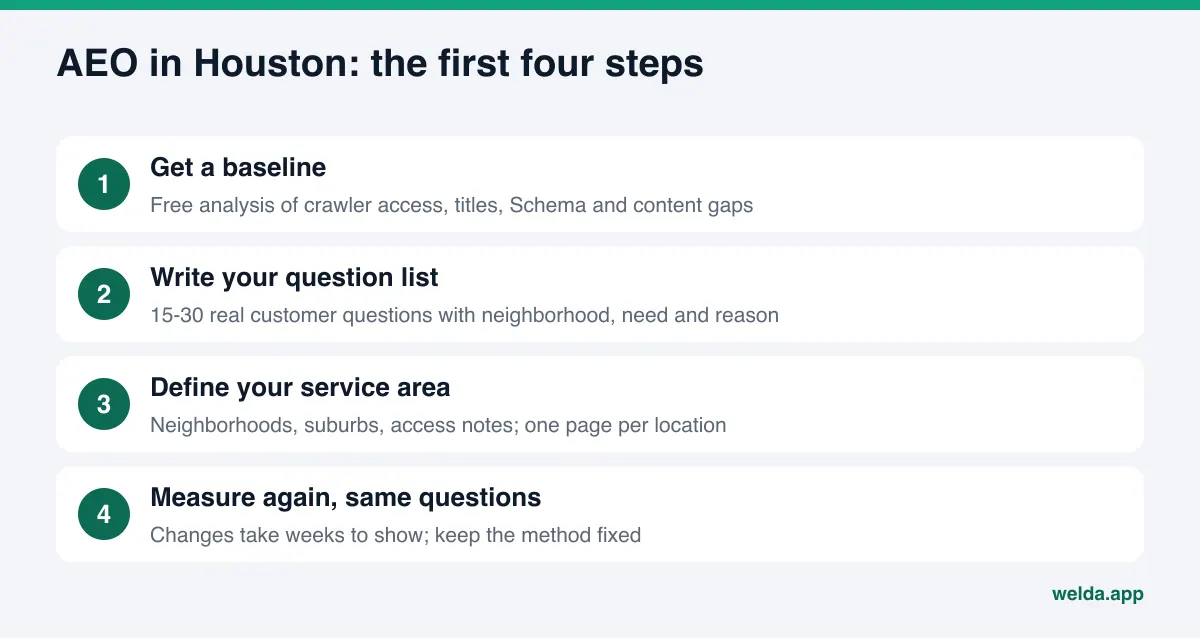
- Get a baseline. Check whether AI crawlers can reach your site, what your page title and description say, and whether you have business markup (Schema). The free analysis does this in a few minutes and returns a score out of 100, with technical and content scores reported separately.
- Write your question list. List 15 to 30 questions customers would ask to find a business like yours. Include neighborhood names, the specific need and the reason someone would choose you. Ask your front desk or sales team which questions they hear on the phone every week.
- Define your service area. Replace "serving Greater Houston" with the actual neighborhoods and suburbs you cover. If you have one location, add parking, the nearest major road and access notes. If you have several, give each location its own page.
- Write one page per core service. Keep it short and specific: what you do, for whom, where, how long it takes and under what conditions. If you are a supplier, list product groups, materials, certifications and the industries you serve.
- Add an FAQ section. Answer the questions on your list in your own words. AI assistants find direct answers easy to quote.
- Mark up your business information. Add Schema markup for name, address, phone, hours and service area, and make sure it matches the visible text. Details are in our guide to schema markup for AI search.
- Align your Google Business Profile with your site. Category, service names, hours and description should not contradict your site. Reply to reviews regularly and calmly; our piece on review responses for AI visibility covers how.
- Audit third-party sources. Are your name, address and phone the same on Yelp, BBB and the directories in your category? Fix old addresses and listings for locations that have closed.
- Measure again with the same questions. It usually takes weeks for new content to show up in AI answers. Repeat the measurement with the same questions and the same method, or you will not be able to tell what worked.
Where should your Houston business start?
The first step depends on the type of business. Because Houston's business mix is so broad, setting priorities by type saves time. The table below is a suggestion, not a measurement:
| Business type | Typical question | Where to look first |
|---|---|---|
| Restaurant, cafe, bar | "Where should I go in Midtown for ...?" | Google Business Profile, Yelp, menu and hours as text on your site |
| Dental, medical, med spa, veterinary | "Trusted ... in Sugar Land that ..." | Provider and service pages, FAQs, Healthgrades profile, careful claims |
| Hotel, short-term stay | "Hotel near the Medical Center for a week-long stay" | Room and amenity details, location description, Tripadvisor profile |
| Home services, contractors | "Emergency ... in Pearland" | Service area, hours, licensing, Angi and BBB listings |
| Manufacturer, supplier (B2B) | "Houston companies that make ..." | Capability pages, certifications, industry directories |
For Houston companies that sell overseas, one more point matters: international buyers frame questions differently and look at different sources. We cover that in AEO for exporters. For the full set of local steps that apply in any city, see AEO for local businesses.
Example scenario: a Katy HVAC company's first month
The scenario below is an example. It does not describe a real business and makes no claim about results. It shows how the steps connect in practice.
Picture a small HVAC company based in Katy that also covers Cypress and Fulshear. The owner hears from a few new customers that "the AI suggested you," but has no idea which question triggered it. In week one, the owner runs the free analysis. It shows that the site's service area is only listed in an image of a map, the hours on the site differ from the Google Business Profile, the home page title does not mention Katy, and there is no FAQ section.
In week two, the owner writes a question list: "AC repair in Katy open on weekends", "Who installs heat pumps in Cypress?", "Is it worth repairing a 15-year-old AC unit in Houston humidity?", "HVAC company in Fulshear that offers maintenance plans". The office manager adds what callers ask most: whether there is an after-hours fee, how fast a technician can arrive, and which brands the company services.
In weeks three and four, the service area goes onto the page as text, the hours are aligned everywhere, the home page title is rewritten, and the office manager's questions become an FAQ with real answers. A month later, the owner measures again with the same questions. The changes may not show up in AI answers yet, and that is normal. What matters is that the measurement can be repeated the same way next month and compared.
How Welda handles AEO for Houston businesses
Welda is software that measures where a business appears in AI answers and prepares the missing pieces on the business's behalf. For a Houston business, two parts of that work matter most: tracking questions at the neighborhood level, and seeing which source a local competitor wins from.
Question-by-question tracking. In the Welda panel, your question list is built the way customers actually ask: "in the Heights", "near the Galleria", "Houston companies that make". Each question is asked three times on ChatGPT, Gemini, Perplexity and Google AI, because AI assistants do not give the same answer every time. The questions screen shows one question per row and where your name appears on each engine. Click a question and you see a summary of the answer and the sources it cited. A Houston business might learn here that it shows up for general "in Houston" questions but disappears whenever a neighborhood is named. That points to a service area that is not written clearly on the site, and the fix is obvious.
Where the local competitor wins. The competitors screen shows your share of mentions against competitors on the same questions, and on which topic and from which source each one gets ahead. Between two businesses in the same part of town, the difference is often not on the website at all. One has a complete Yelp or Tripadvisor profile; the other replies to every Google review. This screen answers "why are they ahead?" with the name of the source. The decision stays with you: work on that source, or compete on a different topic.
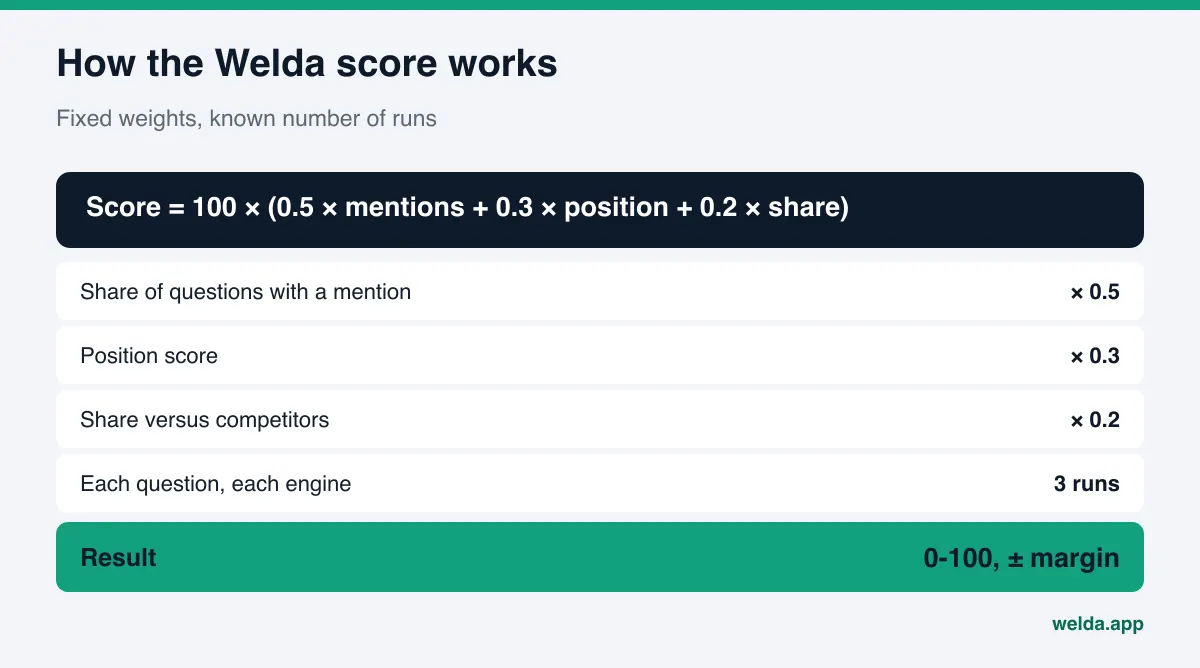
An open score formula. Welda calculates the score as 100 × (0.5 × share of questions where you are named + 0.3 × position score + 0.2 × share versus competitors). The variation across the three runs is shown as a ± margin. When the score moves, you can see which part moved: are you named in more questions, or higher up in the same ones?
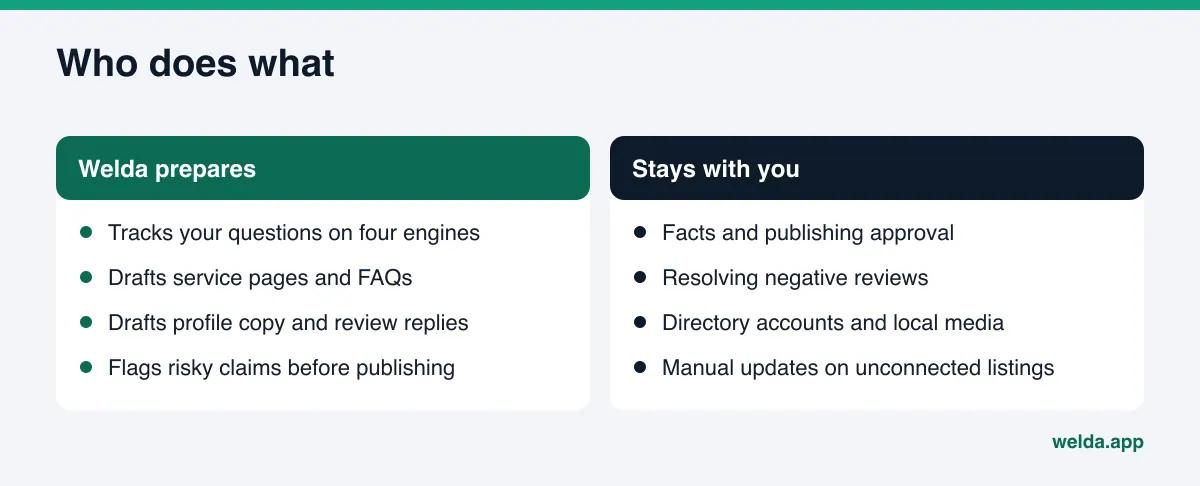
Who closes the gaps? Welda drafts missing service pages, FAQs, Google Business Profile copy and review responses, and puts them on a single to-do list. It does not invent facts; if it does not know which suburbs you serve, it asks. On WordPress sites, Welda connects through its own Editor user and an application password with no code to install, and content opens as a draft that goes live only after you approve it. Where no connection is possible, Welda provides a ready package and the change is made by hand. Content always lives on your own site. Before anything is published, a compliance check flags patterns such as price claims, guarantees and superiority claims; it is not legal advice.
An honest note on availability: the Welda panel is in early access. It is opening in stages, and it is launching first in Turkey. Regular four-engine measurement is being added during early access, and the sample panel screens use representative data. What anyone in Houston can use today is the free site analysis, which works in English. It also asks an AI assistant with web search 5 questions a customer might ask and checks whether your business name appears in the answers; that is a one-time snapshot. Question language in the panel can be set to English or Turkish; Spanish is not an option, which matters in a city where many customers ask in Spanish. Pricing is discussed in an early access conversation.
Limits: what Welda does not do for Houston businesses
In AI visibility it is easy to sell promises, so it is worth being plain about the limits. Here is what Welda does not do, and what stays with you:
- No ranking guarantee, no promise to "get you into ChatGPT". No tool or agency can guarantee that an AI model will recommend you. Welda shows what is missing and the measured effect of changes.
- No invented facts. Hours, service areas, licenses and certifications come from you.
- No unapproved sensitive content. In health care, nothing is published automatically; every item comes to you for approval, and patient data is not sent to the AI.
- No fake reviews. Reviews must come from real customers. The FTC's final rule on fake reviews, announced in August 2024, bans fake and AI-generated reviews from people who do not exist. Welda drafts replies to real reviews only.
- Some work stays in-house. Resolving negative reviews, opening directory accounts and working with local media are your team's job. Welda lists them as manual tasks.
- Results take time. New content usually takes weeks to show up in AI answers. Expecting a jump in the first month leads to disappointment.
Measurement has limits too. AI answers can vary by person, location and time. The same question asked from Clear Lake and from Spring may get different answers. Three runs and a margin make that variation visible; they do not remove it.
AEO checklist for Houston businesses
Before you hire an agency, buy software or do the work yourself, answer these questions. If you can say yes to all of them, the foundation is in place. Every "no" is your first task.
- Can AI crawlers reach my site, or is robots.txt, a CDN or a plugin blocking them?
- Do my home page title and description say what I do and where in Houston I do it?
- Are the neighborhoods and suburbs I serve written out as text?
- Does each core service have its own clear page?
- Are the questions customers actually ask answered in an FAQ section?
- Are my name, address and phone identical on my site, Google Business Profile, Yelp and directories?
- Do I reply to reviews regularly and calmly?
- Do I know on which questions, and from which sources, my competitors get ahead?
- Do I have a routine for repeating the measurement every month with the same questions?
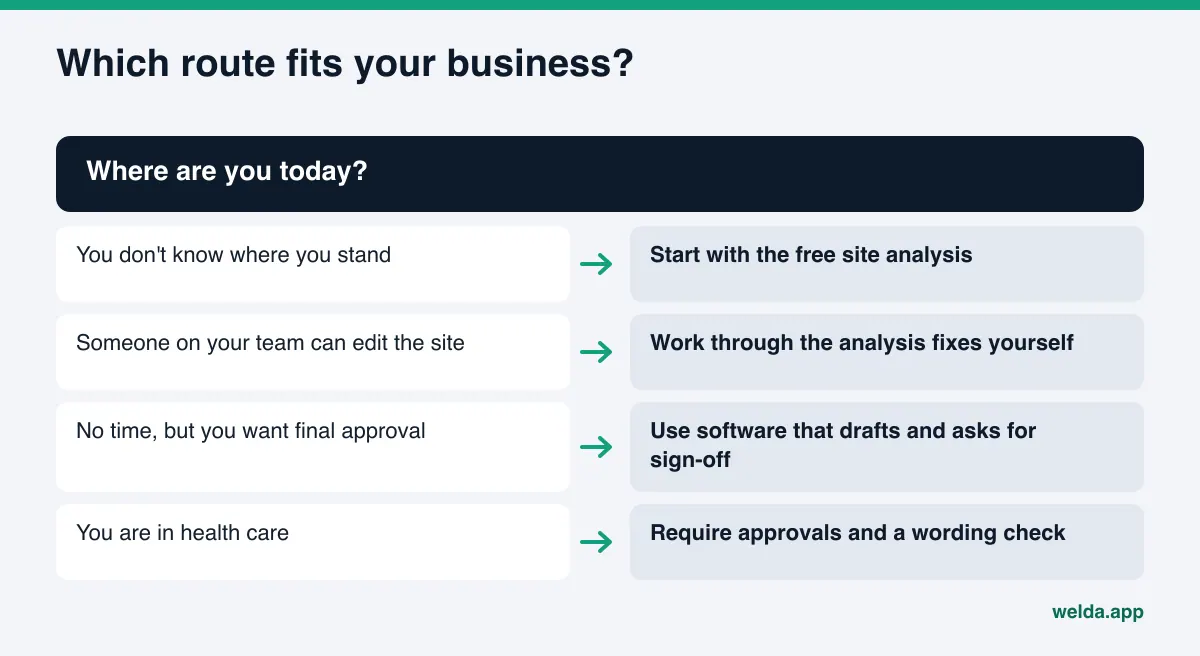
A simple way to decide: look at your time and at who can approve content. If someone on your team can write and update the site, starting from the free analysis recommendations may be enough. If you have no time but want to keep final approval, software that drafts the work and brings it to you for sign-off is a better fit. In regulated fields such as health care, do not move forward without an approval step and a check on wording, whichever route you choose.
Frequently asked questions
How is AEO different from local SEO for Houston businesses?
Local SEO aims at your position in Google results and the map pack. AEO aims at being named in answers from ChatGPT, Gemini, Perplexity and Google AI. Both rest on the same foundation: an accessible site, consistent business information and well-managed listings. The difference is the measurement. In AEO the question is not "what position am I in?" but "am I mentioned in the answer?"
Does a small Houston business really need AEO?
If your customers ask AI assistants to find businesses like yours, yes. Newcomers, visitors and buyers who do not know you yet rely on the short list an assistant gives them. For many small businesses, fixing the gaps the free analysis finds is a solid start.
My site says "Houston." Isn't that enough?
Usually not. Customers ask by neighborhood or suburb, and the assistant looks for that name. Writing out the areas you serve, your address and access details makes it more likely you appear for neighborhood questions.
How long until I see results?
Technical fixes are quick, but new content usually takes weeks to show up in AI answers. Record your first measurement and repeat it monthly with the same questions.
Can Houston businesses use Welda today?
The free site analysis works in English and is available today. The full Welda panel is in early access and is opening first in Turkey, so a Houston business can run the analysis now and ask about early access. Pricing is discussed in that conversation.
Does AEO help B2B suppliers in the Houston area?
Yes, if the question list reflects what buyers ask when they look for a supplier. Writing out product groups, materials, certifications and the industries you serve is the most important step. For a comparison with another large market, see AEO for New York businesses.
Where to start with AEO in Houston
AEO for Houston businesses starts with putting the city's detail onto your site and listings: which neighborhood, for whom, and what you offer, written so an AI assistant can read it. Then comes measuring the same questions on a regular schedule and looking at the sources your competitors win from. Trust a method that shows what it measures and how, not someone who promises a guaranteed result.
As a first step, run the free site analysis. In a few minutes you get your score, the reason behind each gap and how to fix it, ready-to-use copy suggestions for your home page, and a competitor comparison. The results link is sent to your email and stays open for 14 days.