Why does AEO for exporters matter now? A procurement manager in Monterrey, Rotterdam or Seoul can now ask ChatGPT, Gemini, Perplexity or Google's AI answers "Which US manufacturers make stainless hydraulic fittings to ISO standards?" and get back two or three company names. AEO for exporters is the work of making your site, your product data and your outside listings clear enough that an AI system can find you, trust you and name you in that answer. This guide is for US manufacturers, export trading companies and contract producers that sell to buyers abroad.
AEO stands for answer engine optimization. You will also see it called AI search visibility, AI visibility, or GEO (generative engine optimization), a term more common outside the US. The goal is the same: when a buyer asks an AI assistant about the kind of product you sell, your company shows up in the answer. Exporting adds a twist. The buyer often does not know your brand, may not ask in English, and has never seen your plant. To see how your site reads to an AI system today, start with the free site analysis. It works on English and German sites and lists what it found, why it matters and how to fix it.
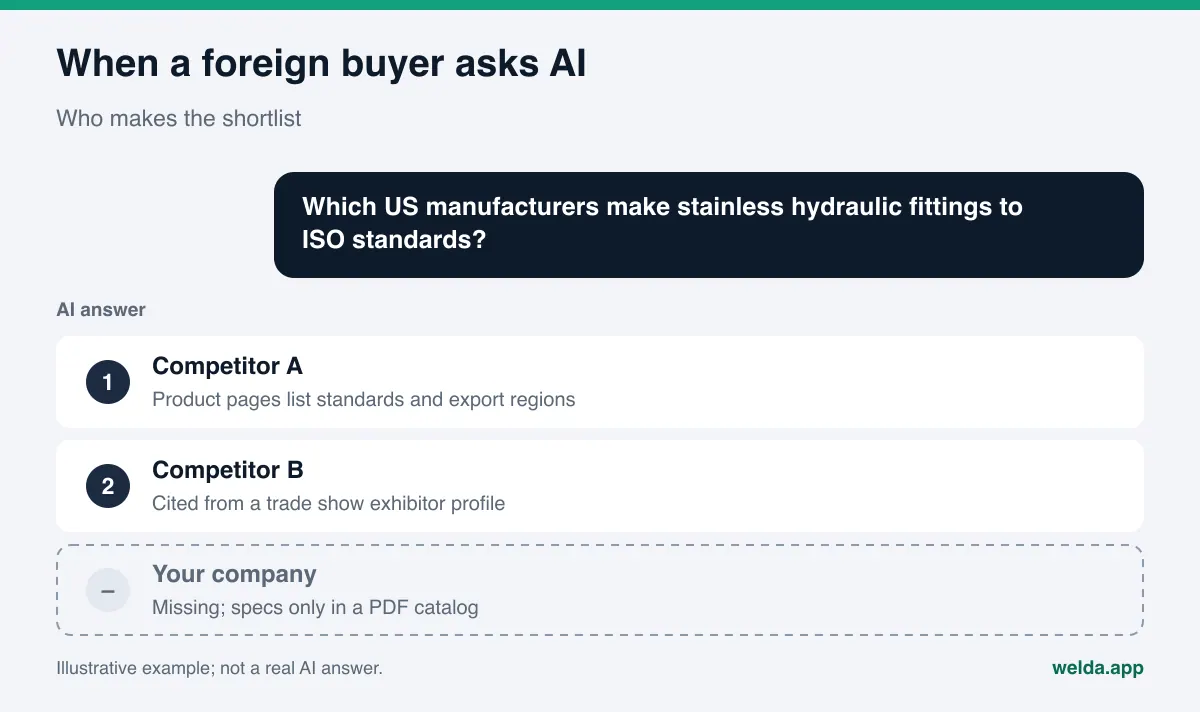
How is AEO for exporters different from domestic AI visibility?
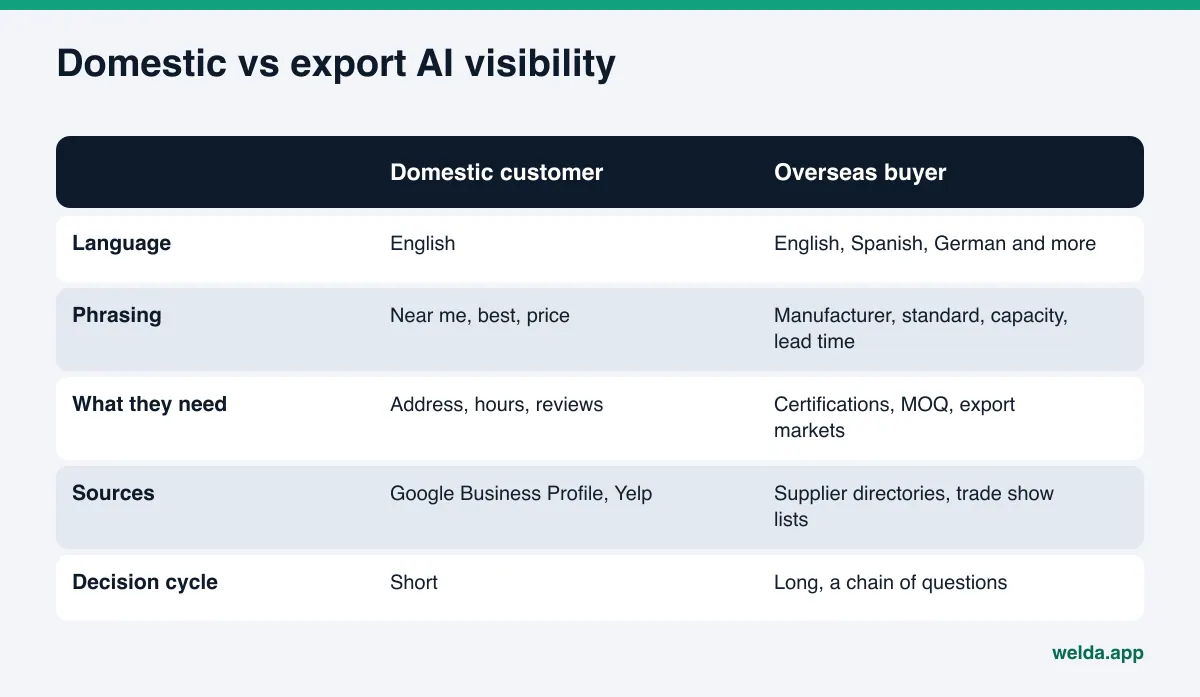
A coffee shop is found by someone nearby. An exporter is found by a buyer in another country, often thinking in another language, comparing you with suppliers from several other countries. That difference shows up in AI answers in four ways.
Language. Plenty of overseas buyers ask in English, but many ask in Spanish, Portuguese, German, French or Japanese. An AI answering a Spanish question may lean on Spanish-language sources. If your site is English only, you are relying on the model to bridge the gap for you.
Criteria. A domestic customer asks "near me," "best" or "how much." An overseas buyer asks about standards, certifications, production capacity, minimum order quantity, lead time, export documentation and which markets you already ship to. If those facts are not written on your site in plain text, the AI cannot match you to the question.
Sources. Domestic visibility leans on Google Business Profile, Yelp and local directories. Export visibility leans on industrial supplier directories, trade show exhibitor lists, trade association member directories, chamber of commerce listings and industry press. If your profile there is outdated or contradicts your site, the AI either skips you or repeats the old facts.
Decision cycle. A B2B purchase is a chain of questions. First "which countries make this," then "who makes it in the US," then "does this company hold the certification we need." Your name has to survive every link. We cover the wider B2B picture in how B2B buyers use AI to find vendors; this article focuses on the export side of it.
What do overseas buyers ask AI about US suppliers?
It helps to sort export questions by intent. The examples below were written for this article to illustrate the patterns. They are not results from a measurement. When you build your own list, pull from the RFQs your sales team receives, the questions you hear at trade shows and the emails your distributors forward.
| Intent | Example question | What the AI looks for |
|---|---|---|
| Country and supplier discovery | Which US companies manufacture food-grade conveyor belts? | Product line, where you make it, company name |
| Compliance and standards | US suppliers of medical device packaging with ISO 13485 | Certificate name, scope, issuing body |
| Capacity and terms | American furniture maker that accepts small export orders | MOQ, monthly capacity, lead time |
| Contract and private label | Private label supplement manufacturer in the USA that ships to Europe | Contract services, sampling, packaging options, regions served |
| Comparison | Compare US and German suppliers of industrial pumps | What sets you apart, markets served, typical customer type |
Two patterns stand out. First, almost every question names a country. If buyers ask for "US manufacturers," your English pages need to say clearly that you make the product in the United States, and where. Second, the questions are asked at the product-line level. A single "Products" page with thumbnails answers none of them well.
We walk through how to build the question list in how to find the questions customers ask AI. For exporters, add one rule: write a separate list for each target market. A buyer in Mexico and a buyer in Germany ask about the same pump with different standards, different documents and different delivery terms in mind.
AEO for exporters, step by step
This order puts the cheapest, fastest-acting work first. Working on outside listings before your own site is in order means pointing buyers to a page that cannot answer them.
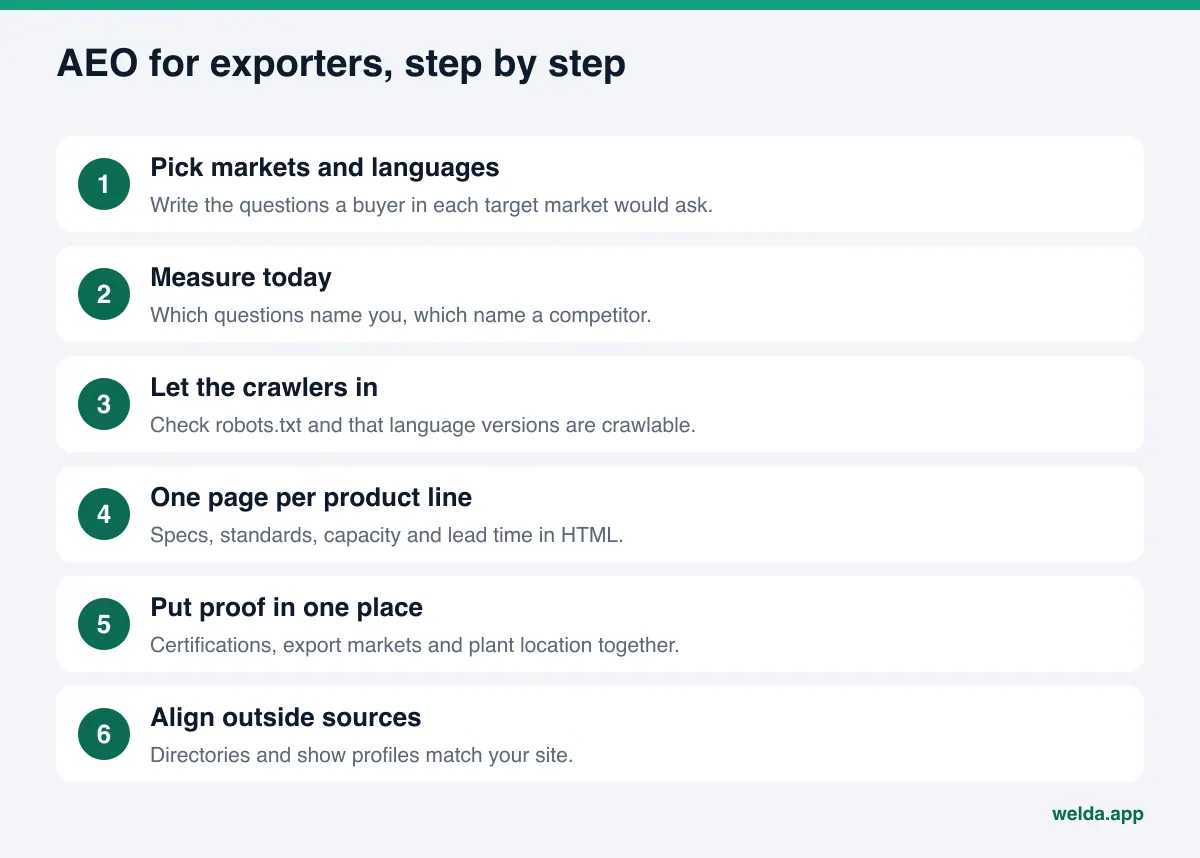
- Pick markets and languages. Start with three markets. Write 15 to 30 questions for each, in the buyer's vocabulary. The terms buyers use may not match the terms in your catalog.
- Measure where you stand. For each question, note who gets named and which sources get cited. One try is not enough, because AI assistants give slightly different answers each time.
- Let the crawlers in. If your robots.txt blocks AI search crawlers, the rest of the work is wasted. According to OpenAI's crawler documentation, sites that opt out of OAI-SearchBot are not shown in ChatGPT search answers, while GPTBot is a separate crawler used for model training. Which ones you allow is your call; just make it on purpose.
- Make language versions real pages. Translated content should live in crawlable HTML at its own URL, not in a widget that swaps text in the browser. Link the versions with hreflang. Google's guide to localized versions asks that each language version list itself and every other version.
- Give each product line its own page. Specs, applicable standards, materials, size or capacity ranges, MOQ, lead time and packaging in plain text or a table.
- Put your proof in one place. Certifications, quality system, plant location, export markets served and year founded on one page buyers and AI systems can find.
- Align outside sources. Supplier directories, trade show profiles, association listings and Google Business Profile should show the same company name, the same product description and the same contact details.
- Measure again every month. New content usually takes weeks to show up in AI answers. Without measurement you cannot tell which change helped.
Catalogs, specs and language pages: what can an AI actually read?
On exporter websites, the most valuable information often sits where AI systems read it poorly. Three cases come up again and again.
Specs live only in a PDF catalog. Some AI systems can read PDFs, but headings, tables and the split between product lines often get lost. Keep the catalog for buyers; also publish a summary and the key values for each product line as HTML.
Product data loads with JavaScript. Configurators, filterable catalogs and single-page apps build content in the browser after the page loads. Some crawlers never see it. We cover this in JavaScript rendering and AI crawlers.
The translated site is a shell. Many exporters translate the home, about and contact pages and stop there. The product detail stays in English. That may be fine for markets that buy in English. For a Spanish-speaking buyer asking in Spanish, it leaves the model to do your translation for you, and it may not.
On a product-line page, these are the facts an AI system typically looks for:
- What the product is and who it is for, in two or three plain sentences
- Materials, size or capacity range, and the standards it meets
- Certifications: name, scope, issuing body and validity
- Minimum order quantity, sampling process and typical lead time
- Packaging, shipping and the delivery terms you work with
- Whether you offer contract manufacturing or private label
- Countries or regions you already ship to
- Short answers to questions buyers ask often
Here is an example scenario. An example machine shop's English site has a headline reading "Precision parts since 1978" and a contact form. A buyer asks "US CNC machining supplier for aerospace parts with AS9100." The only fact the AI can take from that site is the founding year. Once the shop adds a page for aerospace machining that names the certification and its scope, the materials it works with, the part size range, typical lead time and the regions it ships to, every part of the buyer's question has a matching sentence on the site. Nobody can promise it will be named, but it has become a real candidate.
One caution for US exporters. Every claim you publish can now be repeated by an AI system to a buyer, so it must be accurate. That includes origin claims. The FTC's Made in USA guidance says an unqualified "Made in USA" claim means the product is "all or virtually all" made in the US, and it applies to online marketing too. If your product includes significant foreign content, word your pages accordingly. This is general information, not legal advice; check with your counsel.
Which sources does AI use when it answers an overseas buyer?
Your site is not the only source. When an AI answers a supplier question, it often reads several outside sources and builds the answer where they agree. If your site states your current capacity but a directory profile still shows a figure from years ago, the answer gets vague or carries the old figure.
| Source type | What to check | Common problem |
|---|---|---|
| Industrial supplier directories | Product categories, company description, contact | Profile created years ago, never updated |
| International trade show exhibitor lists | Company name, product group, website | Company name spelled differently |
| Trade association member directories | Industry, membership, contact | Website link missing or outdated |
| Google Business Profile | Plant address, category, hours | Category too generic for B2B buyers |
| Industry press | New certifications, expansions, capacity news | Article does not link to your site |
One thread runs through this table: the company name. A directory may use your full legal name with "Inc.", a show list may abbreviate it, and a trade publication may use a former name. AI systems do not always connect these. Pick one public name, use it the same way everywhere, and list it in your Schema business markup together with known alternates. Also make sure every outside profile links back to your site. A missing website field is a five-minute fix that often goes unnoticed for years.
How Welda handles AEO for exporters
Welda is software that measures where a business shows up in AI answers and fills the gaps on the business's behalf. For an exporter, three parts matter most.
Question-by-question measurement. In the Welda panel, the buyer questions you write, or that we work out together, are asked to ChatGPT, Gemini, Perplexity and Google AI three times each. Question language can be set to English, which lets an exporter track supplier questions in English as their own list. The questions view shows one row per question: which engine named you, in what position, and which sources the answer cited. Click a row to read the answer and its source list. The decision on that screen is simple: find the product line where you are never named and start there.
Competitor and source view. The question that matters most in exporting is "why does that competitor get named?" The competitors view shows which question group a competitor leads and which sources it is cited from. An example scenario: an example furniture maker never appears in "small export order" questions, while Competitor A appears in two engines for the same questions, cited from a trade show exhibitor page. The work that follows is clear. State your minimum order on your own site and update your own exhibitor profile. The sources view lists the sites AI draws on and where you are missing.
Ready-to-use drafts and a single to-do list. Welda drafts product pages, FAQ entries and profile copy for the gaps it finds, and each lands on the to-do list with the draft text next to it. It does not invent facts: if it does not know your MOQ or the scope of your certificate, it asks you. On WordPress sites it connects through a separate Editor user and an application password, with no code to install; drafts open on your site as drafts and go live only when you approve them. On other systems Welda hands you a ready package and your team applies it. Your content always stays on your own site.
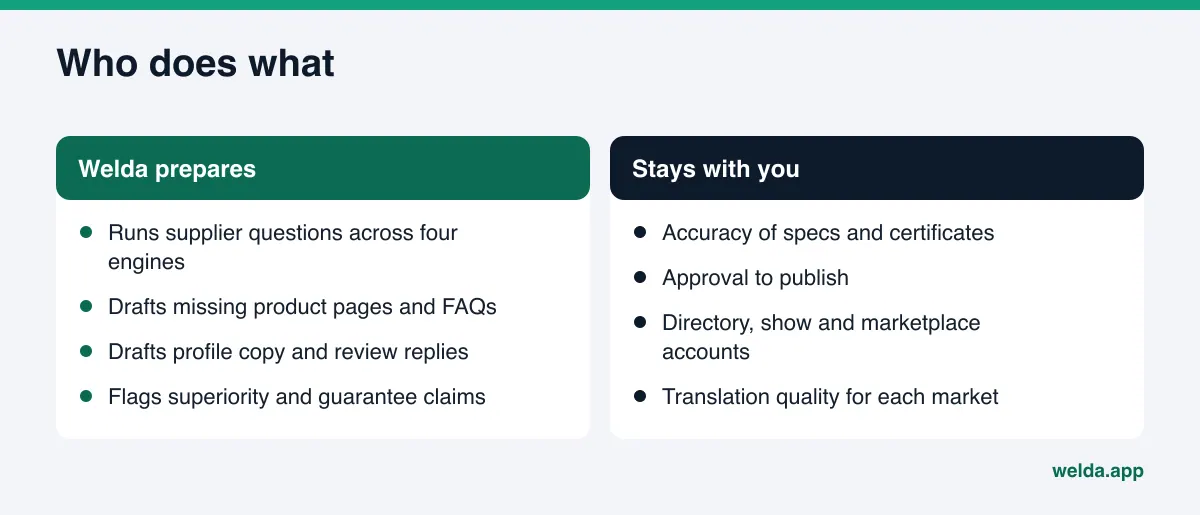
Beyond that, the compliance check flags patterns like "best," guarantees and superiority claims before anything is published, and the one-page monthly report gives leadership the summary. If you are comparing tools, our piece on AEO tool features lists what to look for.
Early access, plainly: the Welda panel is in early access and is opening first in Turkey. Regular four-engine measurement is being added during early access, and the sample screens are shown with representative data. What anyone can use today is the free site analysis, which works in English and German. Pricing is not published; it is discussed in the early access conversation.
What the free analysis checks on an exporter's site
Before the panel reaches your market, the free analysis shows where your English site stands. It reads your home page and a few inner pages such as services, pricing, about and contact. Here is how to read the results as an exporter.
| What the analysis checks | What it means for an exporter |
|---|---|
| AI crawler access (robots.txt) | Whether your site, including language versions, can be read at all |
| Title, description, main heading | Whether what you make, and where, is clear at first glance |
| Business information (Schema) | Company name, address and contact in machine-readable form |
| Clearly described services | Product lines and contract work explained separately |
| FAQ section | Whether MOQ, lead time and certification questions are answered |
| Reviews and trust signals | Whether certifications, memberships and company facts are visible |
You get a score out of 100, split into technical and content, plus an explanation for each gap, ready-to-use copy for the home page, a simulation of how much each fix would raise the score, a competitor comparison and a fix package to add to your site, including business markup code. The analysis also asks 5 questions a buyer might ask to an AI assistant that can search the web, and checks whether your company name appears in the answers. That is a one-time check, not ongoing tracking. It does not measure rankings and does not promise any.
Limits: what Welda does not do for exporters
- No guarantees. Welda does not promise a mention in any country, language or engine. Nobody honestly can; AI answers vary.
- No invented specs. Capacity, tolerances, certifications and lead times come from you. Welda asks when it does not know.
- Translation quality is yours. Knowing the right technical term in each market is your team's job. Have someone who knows the buyer read every draft.
- Outside accounts stay with you. Directory listings, show profiles, marketplace accounts and press outreach are run by your company. Anything not connected appears as a manual task.
- No fake reviews or references. In export sales a reference list carries real weight. A made-up one is a legal and reputational risk.
- Language coverage is limited. Panel questions can be asked in English or Turkish. Spanish, German or Japanese questions are not measured in the panel today; the free analysis can check the technical readiness of English and German pages.
There is also a time limit. New product pages and updated listings usually take weeks to show up in AI answers. If you want to be ready before a major trade show, start a few months ahead.
Where should you start? A decision guide and checklist
Few exporters can work on every market at once. Use the guide below to pick a starting point, then run the checklist once from top to bottom.
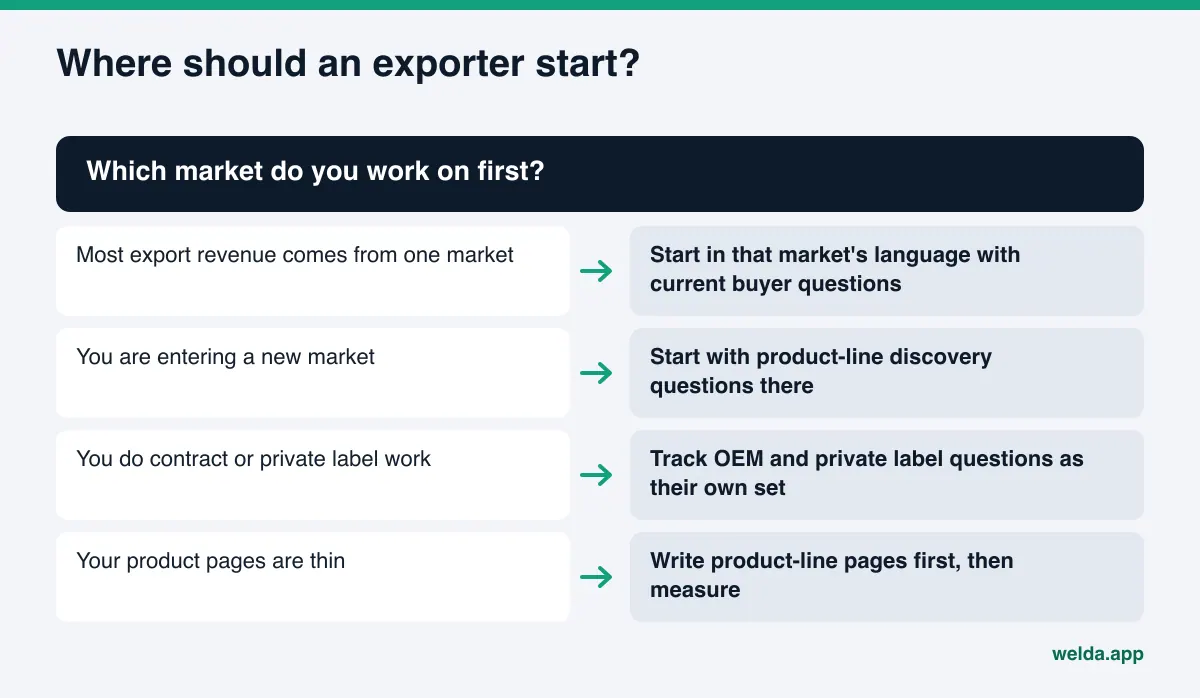
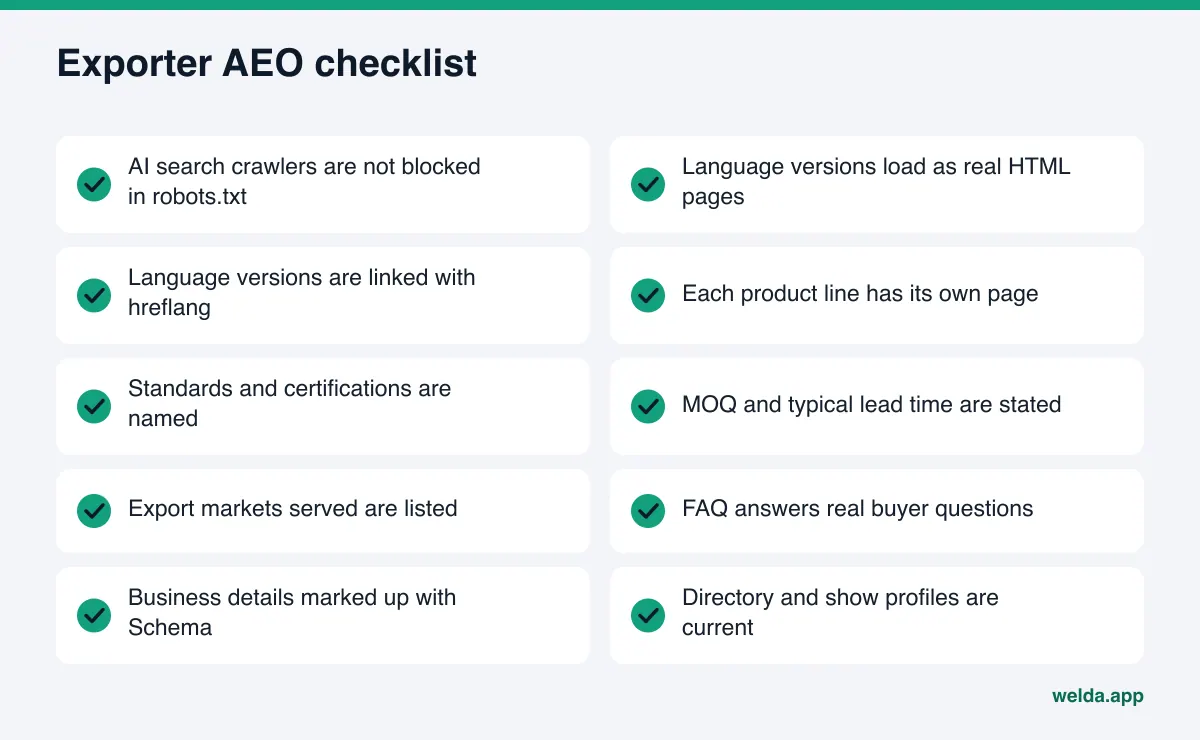
The list looks long, but most items are done once and then kept current. If you also sell domestically, AEO for local businesses covers the nearby-customer side of the same work.
Frequently asked questions
Is AEO for exporters the same as international SEO?
No, but they share a foundation. International SEO is about ranking your language versions in search results. AEO is about being named in an AI answer. Crawlable language pages, hreflang and clear product data help both.
Is an English site enough?
Often, to start. But if buyers in a key market ask in their own language, you need content in that language too. Set priorities by where revenue comes from.
Should I remove my PDF catalog?
No. Buyers find catalogs useful. Add an HTML summary and key values for each product line alongside it.
Which languages can Welda measure?
In the panel, questions can be asked in English or Turkish. The free site analysis works on English and German sites.
How long until results show?
New content usually takes weeks to show up in AI answers. Measure monthly and start well before trade show season.
Is Welda available in the US?
The free site analysis is available to anyone today. The full panel is in early access and is opening first in Turkey. Pricing is not published.
First step: check your English site
Stop guessing whether overseas buyers see you in AI answers. Run your English or German site through the free site analysis to see crawler access, business markup, product descriptions and FAQ gaps in one report, and share the fix package with your team. Your result link arrives by email and stays open for 14 days.