How does AEO work for New York businesses? New Yorkers rarely ask an AI assistant about "New York." They ask about a neighborhood, a subway stop or a block: "near the Bedford Ave L," "in Astoria," "on the Upper West Side." AEO for New York businesses therefore starts with stating your location, hours and way of working clearly, consistently and in the words customers use. This guide covers what New Yorkers ask, which sources AI answers lean on, a step-by-step work list, and which part of the job Welda takes on.
What is AEO, and why is it different in New York?
AEO (answer engine optimization) is the work of getting your business named and described correctly when people ask ChatGPT, Gemini, Perplexity or Google's AI Overviews and AI Mode for a recommendation. You will also see it called AI search visibility, AI visibility, or GEO (generative engine optimization); they describe the same job. The basics are the same everywhere: an AI assistant answers with information it can read, trust and match across several sources.
New York changes how that plays out in four ways:
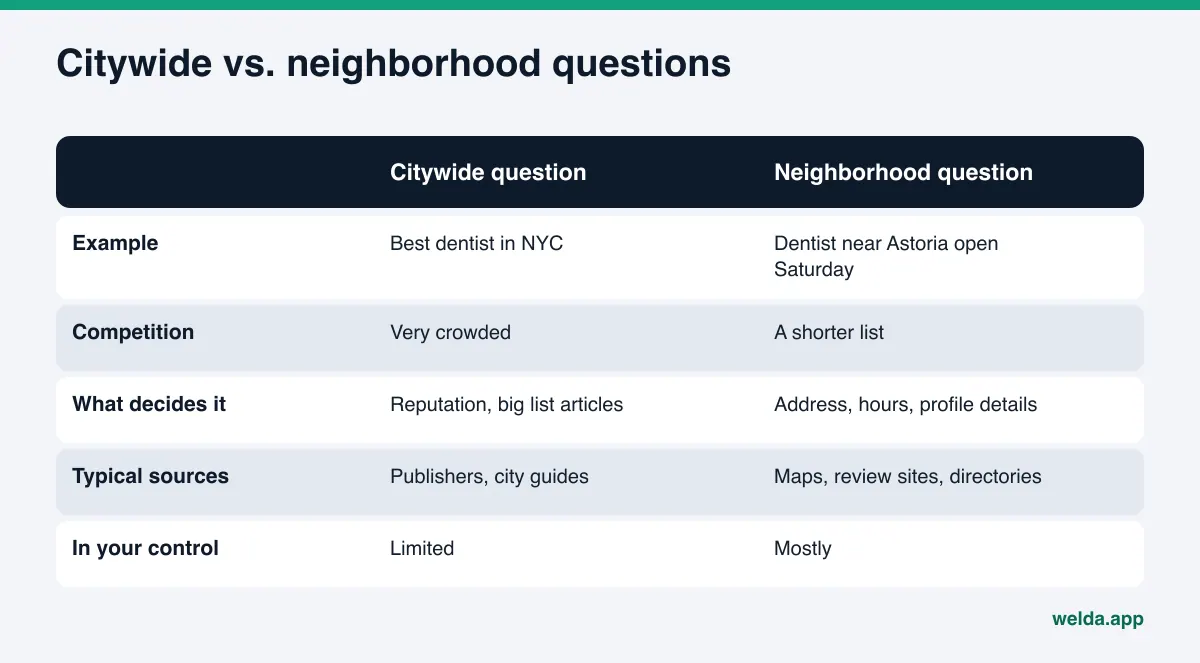
- Questions are hyperlocal. "Best pizza in NYC" is a question for tourists and list articles. A customer who is ready to buy asks about a neighborhood, a cross street or a train line. The city name alone narrows almost nothing.
- Five boroughs, short patience. Someone in Park Slope looking for a dry cleaner does not want an answer in the Bronx. If an AI tool cannot tell where you are, it has little reason to recommend you.
- Many languages, many visitors. Residents, commuters and visitors ask about the same businesses in different ways and sometimes in different languages. A visitor asks "near my hotel in Midtown"; a resident asks "on my block."
- Dense competition. Many blocks have several businesses offering the same thing. An AI answer usually names only a handful. Being nearby is not enough; being clearly described is what gets you on the list.
Put together, this makes AEO for New York businesses less about technical tricks and more about location data and sources. Your site needs to be technically sound, but what usually decides a neighborhood answer is whether your address, neighborhood, hours and services are stated the same way everywhere AI tools look.
If you are not sure where you stand, start with the free AI visibility analysis. It reads your site the way Google and AI tools do and lists gaps such as missing location details, missing business schema and a missing FAQ section, with an explanation of why each one matters.
What do New York customers ask AI assistants?
You do not need a study to know your customers' questions; you need to write them down. The examples below are illustrative, written in the way people phrase local questions to an AI assistant. They are not measurements.
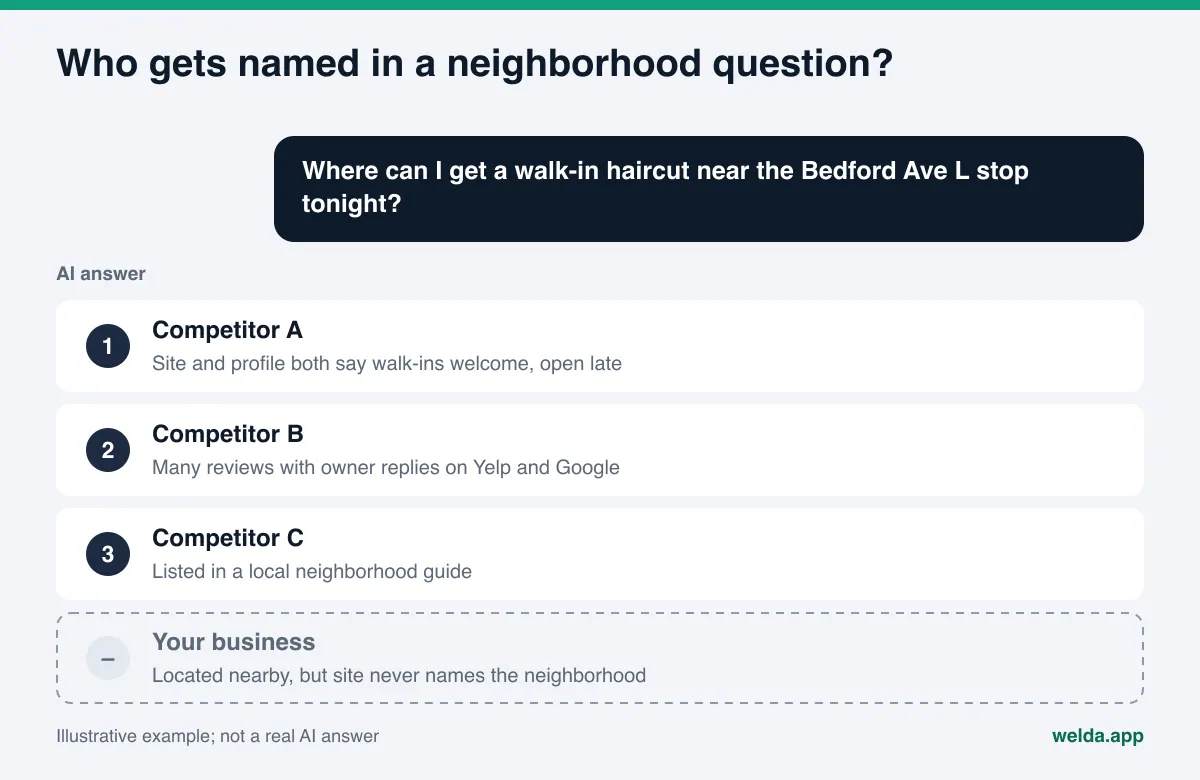
- "Where can I get a walk-in haircut near the Bedford Ave L stop tonight?"
- "Is there a dentist in Astoria open on Saturday who takes new patients?"
- "Quiet coffee shop to work from near Union Square with outlets?"
- "Emergency plumber in Bay Ridge that comes out after 9 p.m.?"
- "Hotel near the Javits Center that is walkable to Penn Station?"
- "Kid-friendly brunch on the Upper West Side that takes reservations?"
Notice three things these questions share. First, a place: a neighborhood, a station, a landmark or a street. Second, a time or a condition: "tonight," "Saturday," "after 9 p.m." Third, a way of working: "walk-in," "takes reservations," "new patients," "comes out." An AI assistant can only match your business to such a question if it finds those three pieces of information about you, stated plainly, in sources it reads. If your site and profiles never say "Astoria" or "open Saturdays," your Astoria address alone often will not carry you into the answer.
It also helps to sort questions by type and check where each answer should live:
| Question type | Example wording | Information needed | Where to state it |
|---|---|---|---|
| Place | "near the Bedford Ave L," "in Astoria" | Neighborhood, borough, nearest stop or landmark | Home page, contact page, Google Business Profile |
| Time | "tonight," "on Saturday" | Hours, holiday hours, late or early service | Plain text on site, schema, map profiles |
| Way of working | "walk-in," "takes reservations" | Booking, walk-ins, delivery, service area | Service pages and FAQ |
| Trust | "no hidden fees," "upfront pricing" | How pricing works, cancellation terms | FAQ, replies to reviews |
| Language | "Spanish-speaking," "staff speak Mandarin" | Languages your staff actually speak | About or service page, profile description |
Go through each row and check whether the information appears on your site as plain text. Details that only live inside an image, a PDF menu or an embedded map are often invisible to AI tools.
Why your neighborhood matters more than your name
Most New Yorkers who have never visited you do not know your name. Customers who ask for you by name have already found you. New customers describe a need and a place. That is why, for AEO in New York, the most valuable questions are the ones where your name does not appear but your neighborhood does.
For an AI assistant to pick you in that kind of question, it needs to know four things:
- Where you are. A street address is not enough. Write the neighborhood and borough in plain text: "Astoria, Queens" or "Williamsburg, Brooklyn." If locals use a different name for your area than the official one, mention both, as long as both are accurate.
- How to get there. "Two blocks from the 7 train," "across from the park entrance," "next to the ferry landing." Customers put these phrases directly into their questions. Include them where they are true.
- When you are open. Regular hours, weekend and holiday hours, late-night service. The same hours must appear on your site, your Google Business Profile, Yelp and any directory that lists you.
- How you work. Appointment only or walk-ins, delivery radius, languages spoken, whether you take new clients. Replace "we offer a full range of services" with specifics.
One caution: stuffing neighborhood names into every paragraph does not help. AI tools read a page for meaning, not keyword counts. "The best salon in Williamsburg" is a claim no one can check. "We are a walk-in friendly salon two blocks from the Bedford Ave L, open until 9 p.m. on weekdays" is a sentence an AI assistant can use.
Step-by-step AEO work list for New York businesses
The steps below are written for a single-location business that wants to run this itself. With several locations, repeat the steps for each one; each location needs its own neighborhood, hours and phone number on its own page. If you plan to do most of this yourself, the DIY AEO guide for small business owners goes deeper on the routine.
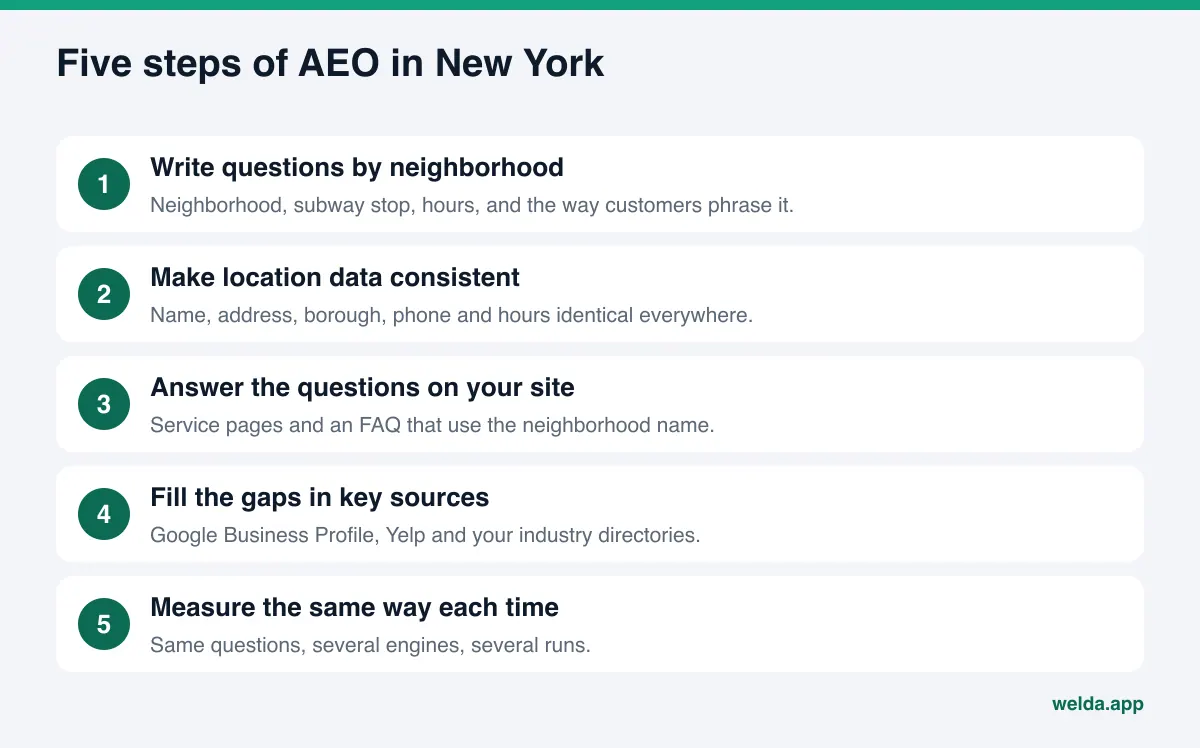
1. Write your question list by neighborhood
Write 20 to 40 questions a customer might ask before choosing you. Use three groups: discovery questions ("dentist in Astoria for kids"), situation questions ("open late in Bay Ridge"), and comparison or trust questions ("upfront pricing movers in Brooklyn"). Keep the list fixed. You can only see change if you check the same questions each time.
2. Make your location data consistent everywhere
Your business name, street address, neighborhood, phone number and hours should be identical on your site, Google Business Profile, Apple Maps, Yelp, social profiles and industry directories. A common New York problem is an old address that survives on one directory after a move. When an AI tool sees two addresses for one business, it cannot tell which is right and may leave you out.
3. Check the technical basics
AI search crawlers need to be able to read your site. OpenAI, for example, says in its crawler documentation that sites which opt out of OAI-SearchBot will not be shown in ChatGPT search answers, and it recommends allowing that crawler in robots.txt. Also check your page title and description, your main heading, your business schema markup (address, phone, hours, map link) and page speed.
4. Answer the questions on your own site
The answers to your question list should exist on your site. The simplest way is an FAQ section on your home or contact page: "Which train stops are closest?", "Do you take walk-ins?", "Are you open on Sundays?", "Do you speak Spanish?" Give each main service its own clear paragraph or page.
5. Fill the gaps in the sources AI tools read
AI answers draw on more than your site. Google Business Profile, Yelp, Tripadvisor for hospitality, Healthgrades and Zocdoc for health care, Angi and the BBB for home services, plus local guides and neighborhood forums are the kinds of sources that can appear. Complete the profiles that matter for your category, reply to reviews openly, and link your map and social profiles from your site. The guide to linking social profiles with sameAs explains the markup side.
6. Measure the same way each time
Ask the same AI tool the same question twice and you may get two different lists. A single test cannot tell you whether you "show up." Ask the same questions on several engines, several times, record the results, and look at how they change over weeks. Done by hand, this is the step that takes the most time and is the first to slip.
Which sources shape AI answers about New York businesses?
The sources that matter vary by category. Restaurant and cafe answers often lean on review sites, city guides and food publications. Hotel answers draw on travel and booking sites. Health care answers tend to cite doctor directories and review platforms. Home service answers often cite service marketplaces and business directories. So the place to look for your own gaps depends on your category.
Forums deserve a separate note. Local subreddits and neighborhood forums can be cited too, and you cannot control them. What you can do is answer openly and identify yourself when your business is discussed. The article on Reddit and AI answers covers how to do that without crossing any lines.
Reviews also come with rules. The FTC's rule on consumer reviews and testimonials, in effect since October 21, 2024, bars buying or selling fake reviews, among other practices. Any AEO plan that relies on manufactured reviews is a legal risk, not a shortcut. This is general information, not legal advice.
The fastest way to build your own gap list is to see which sources name your competitors and not you. The method is explained in the citation gap analysis guide.
How Welda handles AEO for a New York business
Welda is software (SaaS), not a local agency. It takes on the measurement and preparation side of the steps above and leaves the decision to publish with the business. Here is what that means for a New York business today, and what is still in early access.
The free analysis: available now, in English
The part anyone can use today is the free AI visibility analysis, and it works in English. It reads your home page and a few inner pages such as services, pricing, about and contact. For a New York business, the useful checks are these: is your address, phone and location stated clearly; is there business schema and is it correct; are your map and social profiles linked from the site; is there an FAQ section; are your services described clearly; can AI crawlers reach your site. For each gap you see what was found, why it matters and how to fix it.
You also get ready-to-use text for your home page (title, description, main heading, intro paragraph and FAQ), a simulation showing how much each fix would move your score, a comparison with competitors, a fix pack you can add to your site including business schema code, and a PDF with a shareable score card. Finally, the analysis asks five likely customer questions to an AI assistant that can search the web and checks whether your business name appears in the answers. That is a one-time snapshot, not ongoing tracking. The analysis is free once per site, verifies your email and phone, and sends a results link that stays open for 14 days.
The Welda panel: what regular measurement looks like
The Welda panel is where ongoing measurement happens. Your question list is built around your business; for a New York business that means neighborhood, transit and hours questions. Each question is asked three times on ChatGPT, Gemini, Perplexity and Google AI. A questions view shows, question by question, where your name appears and in what position. A sources view lists the sites AI tools cite and whether you are present, incomplete or missing there, so you start with the directories that actually shape answers in your category instead of signing up for every one.
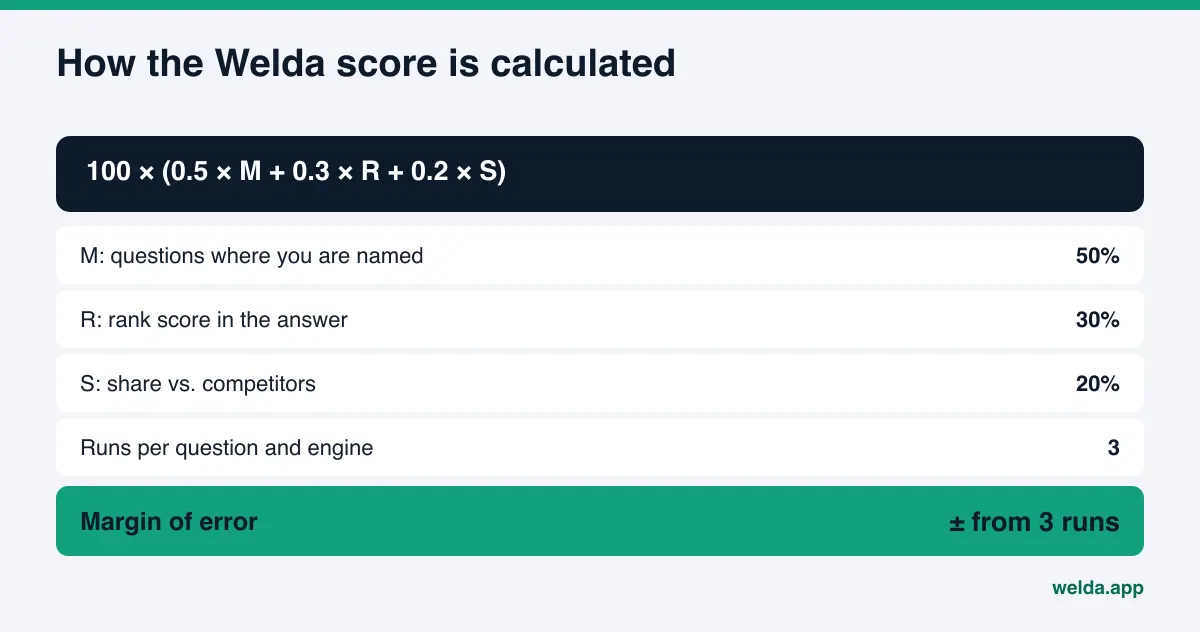
The score formula is open: 100 × (0.5 × share of questions where you are named + 0.3 × rank score + 0.2 × share against competitors), with a ± margin of error from the spread across three runs. Welda drafts content, profile text and review replies; you approve what gets published. On WordPress sites it connects through a separate Editor user and an application password, with no code installed, and opens content as drafts. Content always stays on your own site. A monthly one-page report sums up the change; see the monthly AEO report guide for what such a report should include.
Early access, stated plainly: the Welda panel is in early access and is opening first in Turkey. Regular four-engine measurement is being added during early access, and the sample screens are shown with representative data. Questions can be tracked in English, but the full panel is not yet open to New York businesses. What you can use now is the free analysis. Pricing is discussed in an early access conversation.
Limits: what Welda does not do
In a market as crowded as New York, be careful with promises, including your own. Welda's limits are clear:
- It does not guarantee rankings or that you will "show up in ChatGPT." No software or agency controls AI answers.
- It does not make up facts. If your neighborhood, hours or way of working is unclear, it asks you instead of guessing.
- It does not create fake reviews. Reviews come from real customers; Welda drafts replies only.
- Handling negative reviews, opening directory accounts and press outreach stay with the business.
- Health care content is never published automatically; every piece goes to approval, and patient data is not sent to AI.
Timing matters too. New content and corrected details usually take weeks to show up in AI answers. Seeing no change in the first week does not mean something is wrong.
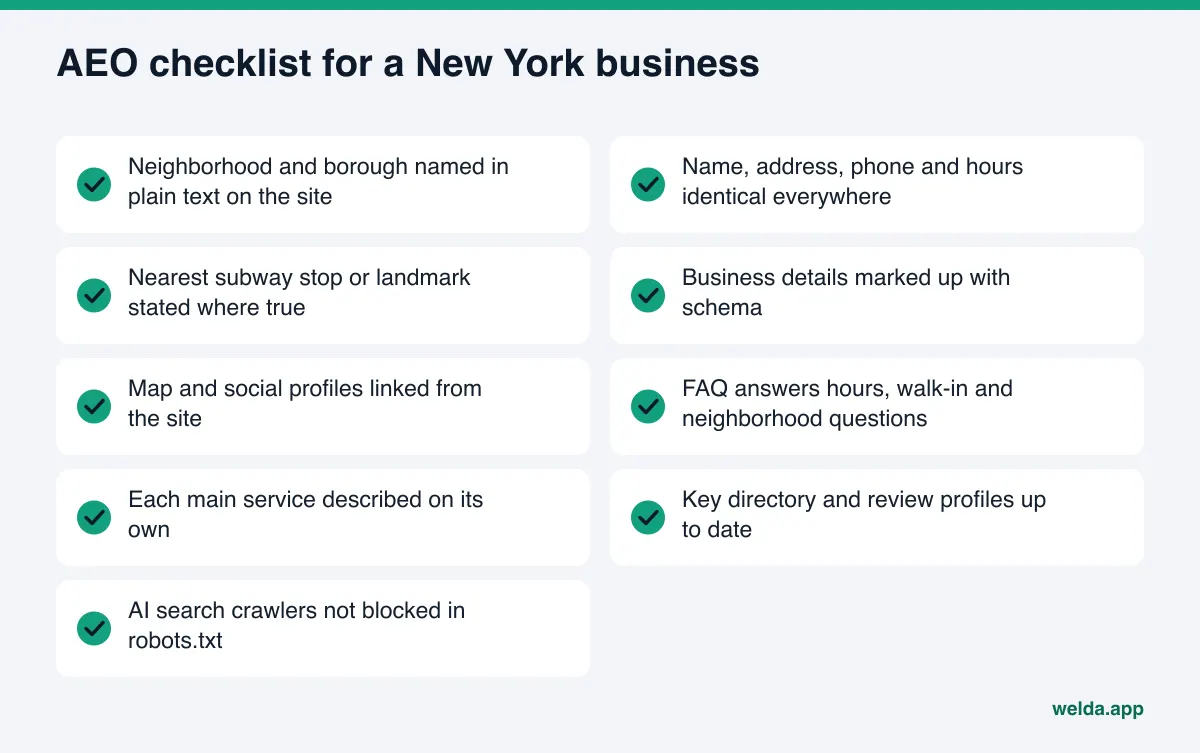
AEO checklist for New York businesses
Use the list below before you start and once a month after that.
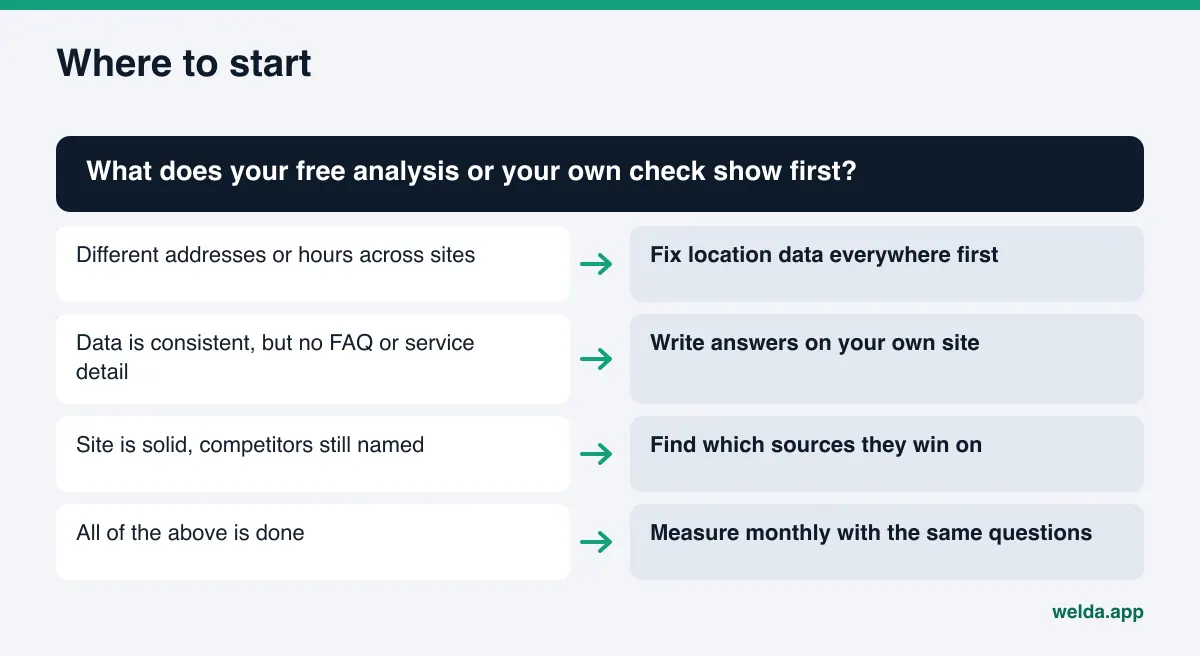
If you are not sure which item to tackle first, follow the problem you find first:
Frequently asked questions
Should I target "New York" or my neighborhood?
Both, together. Your site should state the city, borough and neighborhood: "Astoria, Queens, New York." Most buying questions are neighborhood-level, so the neighborhood carries more weight, but without the city and borough some neighborhood names can be confused with places elsewhere.
I have locations in two boroughs. Do I need separate work for each?
Yes. Each location needs its own page, its own Google Business Profile, its own schema and its own hours and phone number. Listing every location on one page makes it hard for AI tools to tell which location is where.
Can a Brooklyn business show up for Manhattan questions?
It depends on the question. For "open now near Union Square," AI tools generally pick businesses near Union Square. For questions not tied to a place, such as a specialty, a language or a specific service, location matters less. The realistic path is to get strong in your own neighborhood and the ones next to it first.
Does the Welda free analysis work for US websites?
Yes. The free analysis works in English and reads any public website. It is free once per site. The full Welda panel is in early access and is opening first in Turkey.
Is Welda a New York AEO agency?
No. Welda is software. It provides the analysis, the gap list and ready-to-use text; publishing decisions and business-specific facts stay with you. There are no office visits or on-site work.
How long until I see a difference?
There is no fixed timeline. Changes to your site and profiles usually take weeks to be reflected in AI answers. Measure before you change anything, then measure again with the same question list at regular intervals.
Where to start with AEO in New York
The first and most effective step in AEO for New York businesses is to state your neighborhood, hours and way of working clearly and identically everywhere. Then answer your customers' neighborhood questions on your own site, fill the gaps in the sources that matter for your category, and measure with a fixed question list. To see where your site stands today, run the free AI visibility analysis: you get a score, a list of gaps with fixes, ready-to-use text and a competitor comparison in one report.