What does AEO for florists actually involve? When an AI assistant recommends a florist, it relies on information it can read and cross-check: which neighborhoods you deliver to, your same-day cutoff, which occasions you design for, and what customers say about you on your website, Google Business Profile, Yelp and similar sources. When that information is written as text and matches everywhere, your shop is more likely to be named in AI answers. Nobody can guarantee a placement.
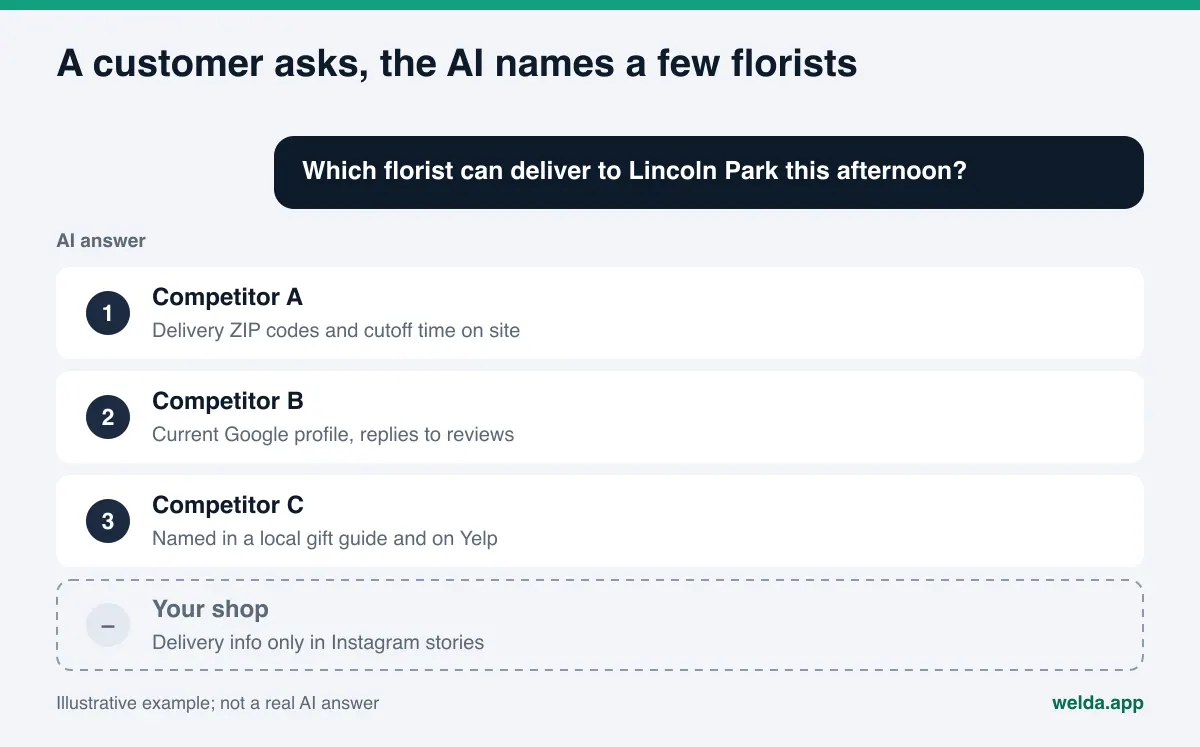
This guide is for flower shop owners, managers of small floral studios that take online orders, and whoever runs the shop's website and listings. The question is simple. When someone types "Which florist can deliver to Lincoln Park this afternoon?" into ChatGPT, or asks Gemini "Where can I order a sympathy arrangement for a funeral home in Pasadena?", does your shop come up? If not, why not, and what should you fix first? That is what answer engine optimization (AEO) means for a florist. You may also see it called GEO, short for generative engine optimization; in this guide we use AEO. Below we cover the problem, the steps, how Welda handles this work, and what it does not do. If you want a baseline first, run a free AI visibility analysis of your site.
Why AI search visibility matters for florists
Flower orders are often urgent decisions. A forgotten birthday, a funeral announced that morning, a friend's grand opening, a relative in the hospital. In those moments people rarely compare ten shops. They pick up their phone, describe what they need in one sentence, and choose from the first few names they see.
That sentence used to go into a search box, which returned a map pack, ads and a long list of links. Now the same sentence goes to ChatGPT, Gemini, Perplexity, or Google's AI Overviews and AI Mode. These tools reply with a short answer and usually name only a handful of businesses. If your shop is not in that short list, it is not in the customer's consideration set at all.
Florists face four specific obstacles:
- The storefront is visual. Florists sell with photos. However beautiful an arrangement looks, an AI assistant cannot reliably read "this shop delivers same day to Evanston" from a picture of peonies. If it is not in text, it does not reach the answer.
- Delivery area is the real question. Customers rarely ask for "the best florist." They ask for a florist that can deliver to a specific place, today. If your delivery area is not written down, the assistant has nothing to match you against.
- Order-gathering sites crowd the results. National flower ordering websites and marketplaces are highly visible for delivery searches. When a real local florist's own site and profile are thin, assistants tend to point to a broad platform instead.
- Holidays are time-bound. Questions spike around Valentine's Day, Mother's Day and the winter holidays. If you start preparing during the rush, new content usually reaches AI answers only weeks later, after the peak has passed.
A florist is also two businesses at once: a local shop and an online store. That means you need to show up in local questions ("florist near me open Sunday") and in product questions ("where to order a live orchid delivered in Chicago"). The same challenge applies to other online retailers; see how it plays out for jewelry brands trying to get recommended by ChatGPT.
What do customers ask AI assistants about florists?
It helps to sort questions into four groups. The examples below are typical questions we wrote for this guide; they do not come from a measurement, but they are a good starting point for your own list.
| Question type | Example question | What the answer relies on |
|---|---|---|
| Delivery and timing | "Florist that delivers to Brooklyn Heights tonight?" | Delivery page, same-day cutoff, Google Business Profile hours |
| Occasion | "Where to order funeral flowers delivered to a funeral home in Pasadena?" | Sympathy page, product copy, funeral home delivery details |
| Product | "Reliable place to order a potted orchid in Austin?" | Product descriptions, care info, reviews, complaint history |
| Trust and comparison | "Should I order from a local florist or a big national site?" | Reviews, owner replies, Reddit threads, local guides |
Notice that almost none of these questions is as broad as "best florist." The customer adds a neighborhood, a time or a situation, and the assistant builds its answer from businesses that clearly match that detail. Your job is to state each detail somewhere the assistant can find it.
Which sources do AI assistants use when recommending a florist?
Answers rarely come from a single place. The assistant runs a web search, pulls several sources, merges them and writes a summary. For florist questions, typical sources include:
- Your own website: the one place where delivery, product, occasion and contact details can be complete and accurate.
- Google Business Profile and Google Maps: address, hours, category, photos and reviews. These carry a lot of weight in local questions.
- Yelp: reviews and business details, often cited in "near me" style answers.
- BBB: complaint and response history, which matters for trust questions about online flower orders.
- Reddit and local forums: threads such as "which florist did you use for your wedding" show up in comparison questions.
- Local guides and lists: city magazines, wedding vendor directories, neighborhood gift guides.
- Order platforms: if you also sell through wire services or marketplaces, your shop name and details there should match your site.
Which source dominates in your area depends on the city, the neighborhood and the question. That is something to measure rather than guess. If assistants keep naming a rival when people ask about your shop, read why competitors show up when AI is asked about your brand.
AEO for florists, step by step
Work through these steps in order. Each one builds on the previous one.
- Check that AI crawlers can reach your site. If your robots.txt file blocks AI or search crawlers by mistake, nothing you write will be read. Some hosted store builders and security plugins change this setting without making it obvious. Details are in our guide to robots.txt for AI crawlers.
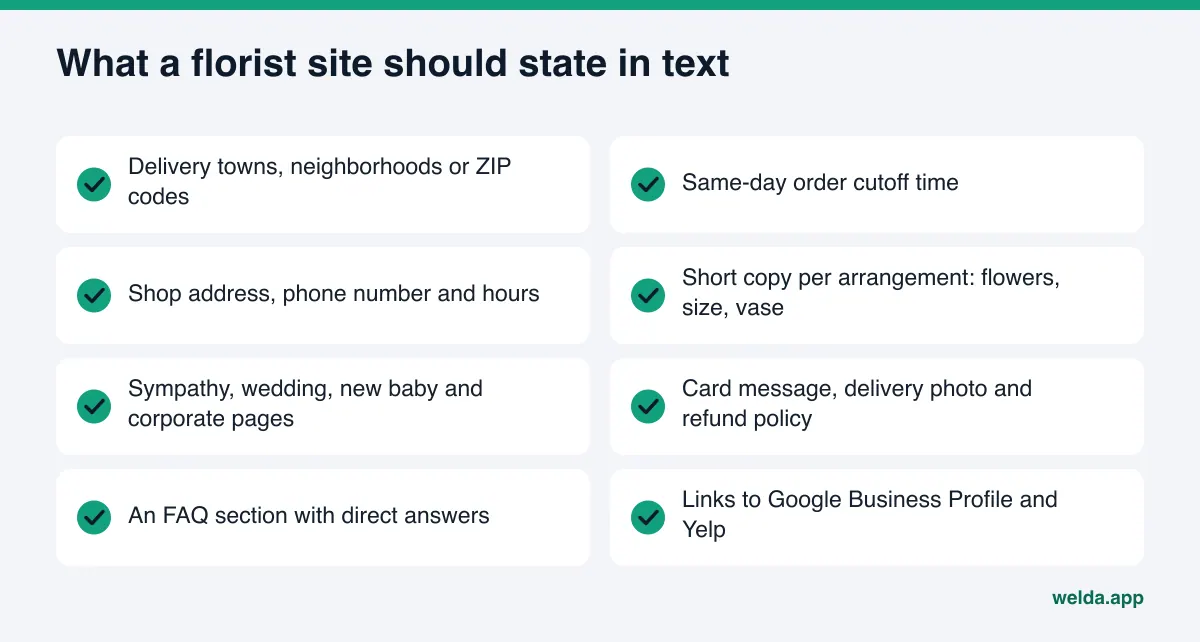
- Write a delivery page. List the towns, neighborhoods or ZIP codes you serve, by name. State your same-day cutoff time, weekend and holiday rules, and whether you deliver to hospitals, funeral homes, churches and offices. This single page supports most delivery questions.
- Describe every arrangement in words. Add two or three sentences next to each product: the flowers, the approximate size, colors, the vase or container, and the occasion it suits. Instead of "Red Roses," try "A dozen long-stem red roses in a clear glass vase, about 20 inches tall; a common choice for anniversaries and apologies."
- Build occasion sections. Sympathy and funeral, weddings, new baby, get well, corporate and grand openings, Valentine's Day, Mother's Day. For each: what you design, how much lead time you need, and what you pay attention to on delivery.
- Add structured data. The Schema.org vocabulary has a dedicated Florist type. Use it to state your address, phone, hours and social profile links in a machine-readable way.
- Write an FAQ section. Can I add a card message? Do you send a delivery photo? How long do the flowers last? What happens if the recipient is not home? Which payment methods do you accept? Give each a direct two or three sentence answer. Our guide to answer-first content shows the format.
- Make your listings match. Shop name, address, phone and hours should be identical on your site, Google Business Profile, Yelp, BBB, Instagram, Facebook and any platform you sell through. Conflicting details give an assistant a reason to skip you.
- Handle reviews honestly. Ask happy customers for an honest review and reply briefly and personally. Answer late-delivery complaints calmly and concretely: what happened and what you did about it. Since October 2024, the FTC's final rule banning fake reviews and testimonials also covers things like paying for positive reviews. This is not legal advice; ask your own advisor about specific cases.
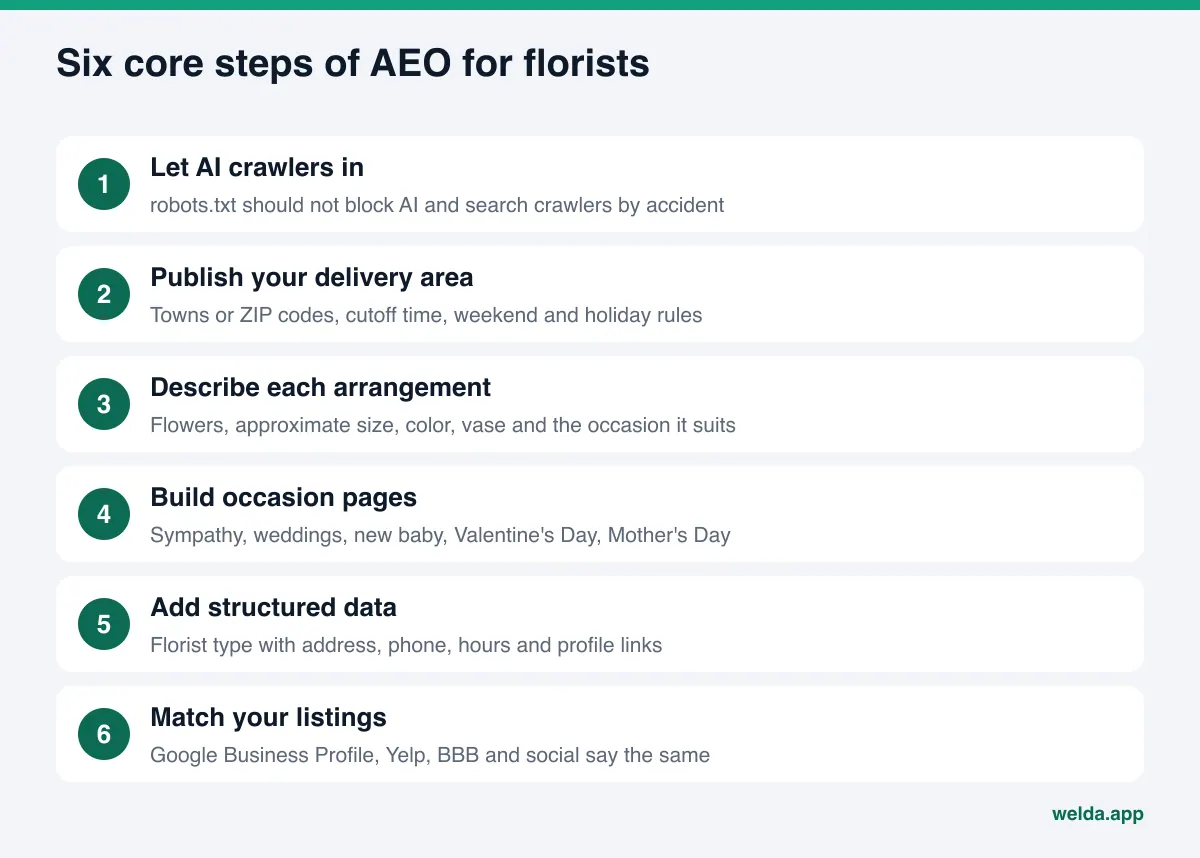
None of these steps works on its own. Together, they give the assistant a consistent, verifiable picture of your shop.
How should a florist write its delivery area and same-day cutoff?
Delivery details are the piece most often missing on florist sites. Many shops handle this by phone: "Where to? Sure, we can get it there today." That works for a person. It does not work for an AI assistant. If the assistant cannot tell whether you deliver somewhere, it recommends a competitor that says so clearly.
A good delivery section includes:
- The towns, neighborhoods or ZIP codes you deliver to, by name. "Chicago North Side" is vague; "Lincoln Park, Lakeview, Wicker Park, Evanston" is useful.
- The same-day order cutoff, and whether it changes on weekends or holidays.
- Whether customers can pick a time window, and whether you do early morning or evening delivery.
- What you cannot do: areas you do not cover, and what happens when an address is wrong or nobody is home.
- Rules for hospitals, funeral homes, churches and office buildings.
Whether to publish delivery fees is your call. If you do, keep them current and consistent between your site and any platform you sell through. Our guide to pricing claims in AI-ready content covers what to watch for.
Example: rewriting one product and one occasion page
The example below is not taken from a real business. It is a made-up neighborhood florist that also takes orders online.
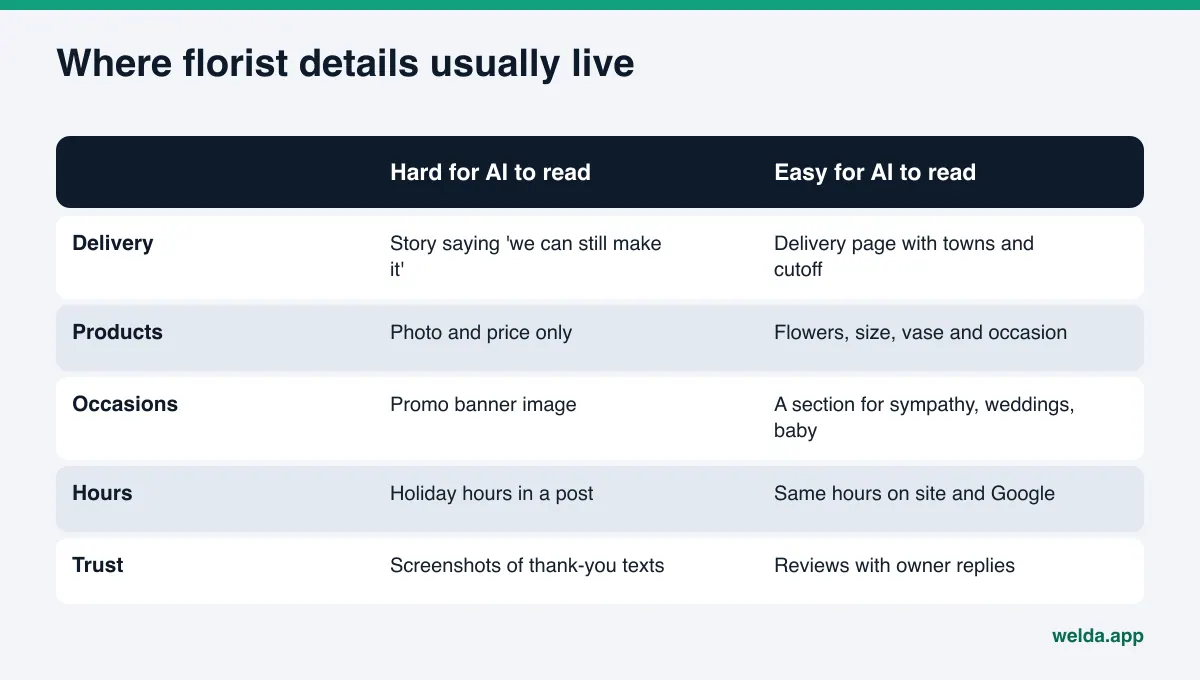
Before. The product page shows a photo, the title "White Orchid" and a price. Nothing else. Sympathy flowers appear only inside a homepage banner image that says "Call us for funeral orders."
After. Below the photo, the product page now reads: "Double-stem white phalaenopsis orchid in a ceramic pot, about 24 inches tall. A common choice for housewarmings, grand openings and get-well visits. Same-day delivery to Lincoln Park, Lakeview and Evanston for orders placed by 1 pm. Ships with a care card." Two FAQ items follow: "How long does an orchid bloom last?" and "Can I add a card message?", each with a two-sentence answer.
A separate sympathy section is added: the kinds of standing sprays, casket pieces and home arrangements the shop designs, how delivery to funeral homes and churches works, how to send ribbon wording, and how many hours ahead an order is needed. The shop can still write "call for pricing" here. What matters is that the assistant can read, in plain text, that this shop handles funeral work and which areas it covers.
Neither change needs a redesign, a new site or ads. They put into writing what the shop already knows. That is the gap at most florists: the information exists, but only in the owner's head and on the phone. Start with your ten best-selling arrangements, then move on to the occasion pages.
How Welda handles AEO for a florist
Welda is software that measures where a business appears in AI answers and fills the gaps on the business's behalf. Here are the three parts that matter most for a florist.
1. The free site analysis: can AI read your delivery and product details?
The free analysis reads your homepage and a few inner pages (services, pricing, about, contact) the way Google and AI assistants do. On a florist site, that means checking whether crawlers can get in, whether your title and description mention flowers and your area, whether address and phone appear as text, whether your Google Business Profile and Instagram are linked from the site, whether there is an FAQ, whether reviews and trust signals are visible, whether your products and services are clearly described, and how fast the page loads.
You get a score out of 100, with technical and content parts scored separately. For each gap, the report shows what was found, why it matters and how to fix it. It also gives ready-to-use homepage copy (title, description, main heading, intro paragraph and FAQ), a simulation of how much each fix could move the score, a comparison with competitors, and a fix package to add to your site, including the structured data code. You can download it as a PDF or share a score card.
The analysis also asks an AI assistant that can search the web five questions a customer might ask and checks whether your shop is named. It is a one-time snapshot of where you stand today. It is free once per site, works in English, and verifies your email and phone; the results link arrives by email and stays open for 14 days. It does not measure rankings and does not promise any.
2. Questions view: which delivery questions name your shop?
In the Welda dashboard, the questions your customers are likely to ask are sent to ChatGPT, Gemini, Perplexity and Google AI three times each. In the questions view, each row is one question, and for each engine you see whether your shop was named and in which position. For a florist, the rows would be questions like "same-day flowers to Lakeview," "funeral flowers delivered to a Pasadena funeral home" or "grand opening arrangement in Midtown."
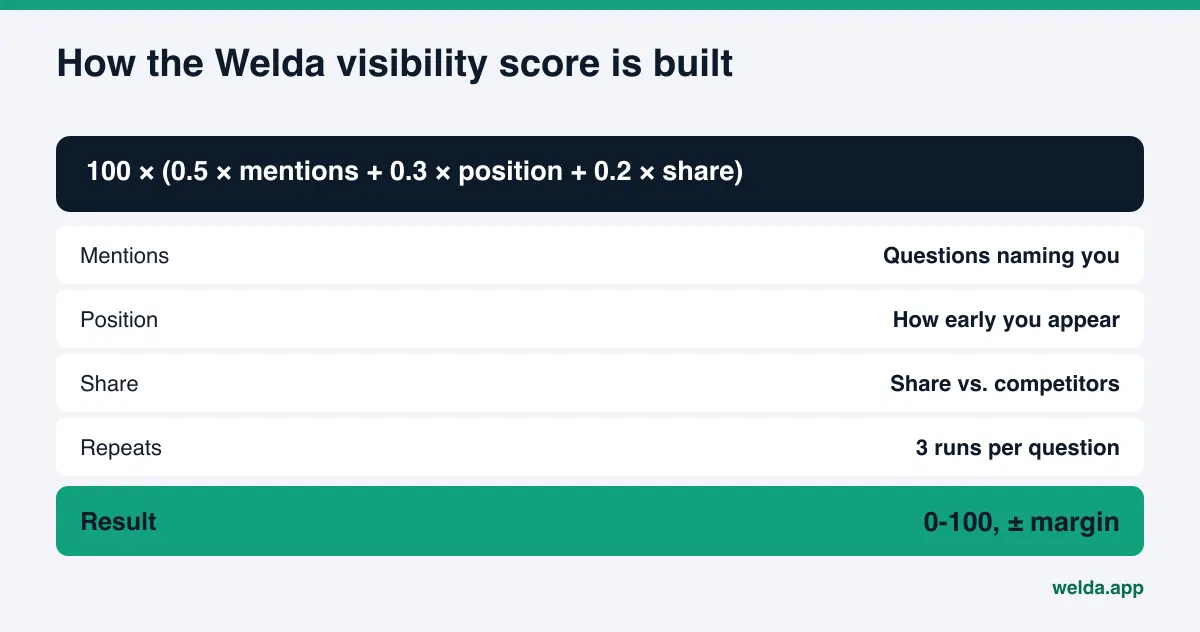
The decision here is simple: which type of question never names you? If you appear for delivery questions but never for sympathy questions, the sympathy section is your first job. The score formula is open: 100 × (0.5 × share of questions that name you + 0.3 × position score + 0.2 × share against competitors). Because each question runs three times, the score shows a ± margin; read the trend, not a single week.
3. Sources view: where does the AI look, and where are you missing?
The sources view lists the sites AI answers cite and your status on each one. For a florist this typically includes Google Maps, Yelp, order platforms, BBB and local guides, each with a status such as incomplete or missing and the next task. The decision is where to spend your effort. If assistants in your area lean on maps and reviews, your Google Business Profile comes first. If they cite complaint pages, unanswered old complaints come first.
The fixing part. Welda drafts delivery pages, product copy, occasion sections, profile text and review replies. It does not invent facts: it asks you which areas you deliver to and what your cutoff is, and lists those as missing information. You approve every publication. On WordPress sites, Welda connects through a separate Editor user and an application password, without installing code; content opens as a draft on your site and goes live when you approve it. On hosted store builders without a connection, Welda gives you a ready package to apply by hand. Google Business Profile, Instagram and Facebook can be connected; if they are not, the task is listed as manual. Your content always stays on your own site. The dashboard also has a to-do list, a competitors view, a compliance check, a before-and-after comparison and a one-page monthly report; see what goes into a monthly AEO report.
Where Welda stands today: early access
To be clear: the Welda dashboard is in early access and is opening in stages, starting in Turkey. Regular four-engine measurement is being added during early access, and the dashboard screens shown are illustrated with sample data. What anyone can use today is the free site analysis, which works in English. Pricing is discussed in the early access conversation.
Limits: what Welda does not do
- No guarantees. Welda does not promise that ChatGPT will name you, or in which position. AI answers vary.
- No invented facts. Delivery area, cutoff times and arrangement details are asked of you, not guessed.
- No fake reviews. Welda drafts replies to reviews; it never writes the reviews themselves.
- Some work stays with you. Handling negative reviews, creating directory listings and getting press coverage remain the shop's job. Welda can draft text for these, but it does not open accounts for you.
- It takes time. New content usually takes weeks to show up in AI answers. Holiday preparation should start well before the holiday.
The compliance check flags wording such as price claims, guarantees and superiority claims before publication, but it is not legal advice and has not been reviewed by legal counsel. Phrases like "freshest flowers in town" or "guaranteed on-time delivery" are worth checking with your own advisor.
Checklist: is your flower shop ready for AI search?
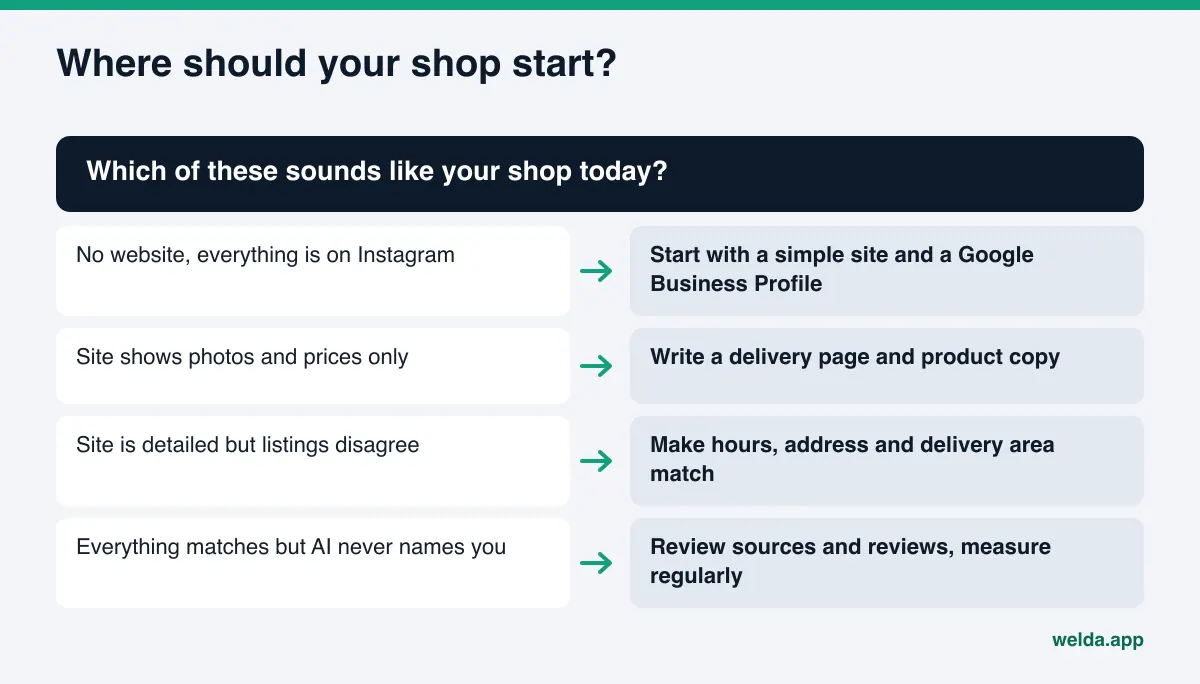
| Check | If yes | If no |
|---|---|---|
| Are your delivery areas listed by name on your site? | Confirm listings say the same | Write a delivery page first |
| Is your same-day cutoff stated? | Add holiday changes | Add it in one sentence |
| Does each arrangement have descriptive text? | Add the occasion it suits | Start with your top ten sellers |
| Do you have sympathy, wedding and new baby sections? | State the lead time | Write a short section for each |
| Do Google Business Profile hours match your site? | Enter holiday hours early | Fix them today |
| Are complaints on Yelp and BBB answered? | Keep it up | Reply calmly, oldest first |
If you have many "no" answers, finish the basics before you start measuring. If everything is "yes" and AI still does not name you, the gap is most likely in the sources and in how much weight competitors carry there.
Frequently asked questions
Is AEO for florists different from SEO?
The foundation is shared: a readable site, clear titles, business details. The difference is that an AI assistant writes one answer and names a few businesses, so details like delivery area, cutoff time and trust signals carry more weight.
I only sell through Instagram. Where do I start?
Instagram information mostly lives in images and stories, which are hard for AI to read. Start with a simple website and a complete Google Business Profile.
I already sell through national flower platforms. Isn't that enough?
Platforms add visibility, but the name in the answer is often the platform's, not yours. Keeping the same details on your own site and profile helps assistants recognize your shop as its own business.
When should I prepare for Valentine's Day or Mother's Day?
New content usually takes weeks to show up, so publish occasion pages several weeks ahead. A page written during the rush may miss that season's answers.
How many questions does Welda test?
The free analysis asks five questions once. In the dashboard, questions are sent to four engines three times each, and the question language can be English or Turkish.
Will Welda publish on my site without asking?
No. Welda prepares drafts and you approve publication. On WordPress, content opens as a draft and goes live only after your approval.
Next step
The quickest way to see how your flower shop looks to AI today is the free analysis. Is your delivery information readable, are your arrangements understood, are your profiles linked, and does your shop come up in five customer questions? It is all in one report. Start your free site analysis here.