How do jewelry brands get recommended by ChatGPT? AI assistants recommend jewelry brands they can read about and cross-check: the metal and karat, the stone and whether it is mined or lab-grown, sizes, price range, return and shipping terms, and what shoppers say about the brand elsewhere. If those facts live only in product photos, or if your site, Instagram and marketplace listings disagree, you are left off the short list. This guide walks through the work step by step and shows which parts Welda takes on.
Why AEO is its own problem for jewelry brands
AEO (answer engine optimization) is the work of getting your brand named in the answers ChatGPT, Gemini, Perplexity and Google's AI Overviews and AI Mode give to shoppers. You will also hear it called AI search visibility, or GEO (generative engine optimization); they all describe the same goal. We use AEO in this guide.
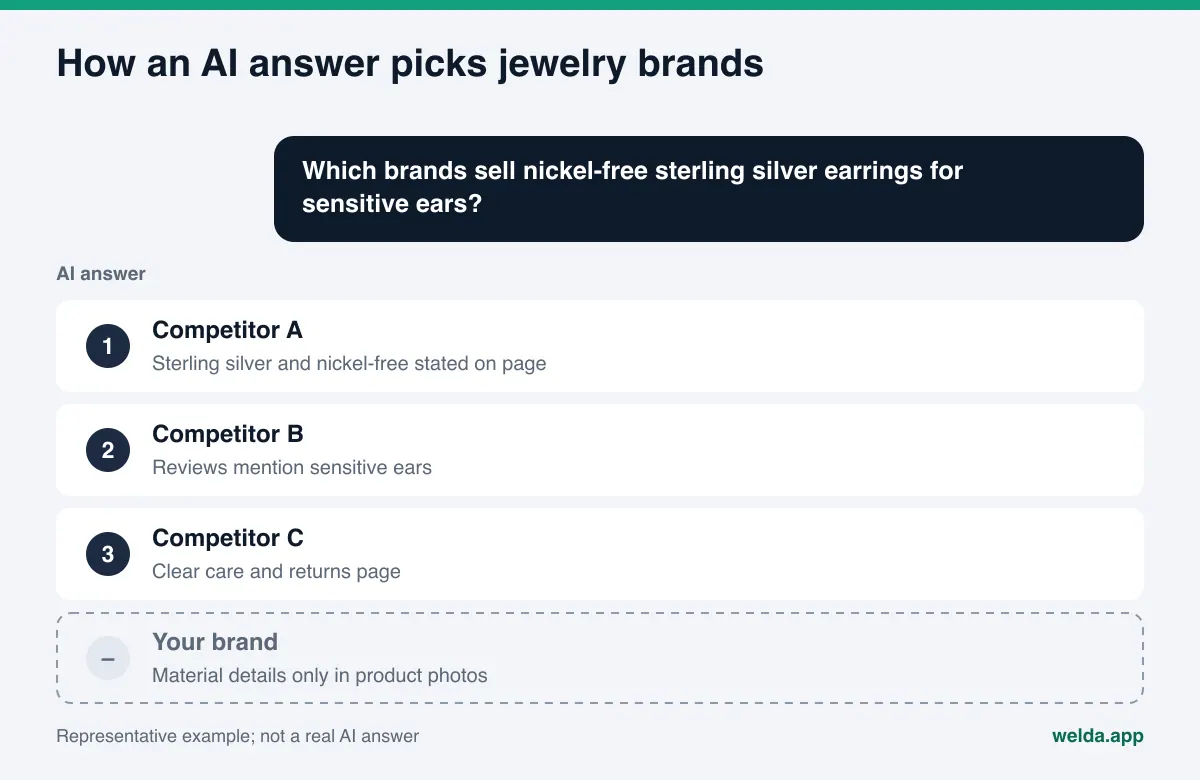
In classic search, a shopper scrolls ten links and a row of shopping results. An AI answer usually names three to five brands with a line or two about each. If you are not one of them, that shopper may never see your store at all.
Jewelry feels this more than most categories, because jewelry shoppers ask detailed questions. Nobody types "necklace" into ChatGPT. They ask "hypoallergenic earrings for sensitive ears that won't turn green", "a 14k solid gold chain that isn't just plated, under a certain budget", or "a personalized initial necklace that ships in time for Mother's Day". To answer, the assistant looks for brands that have written those details down somewhere it can read. A brand that has not, however beautiful its pieces, gets skipped.
Trust is the second reason. Jewelry is expensive, small, and easy to misrepresent. Shoppers ask assistants "is this brand legit", "is their vermeil real gold", "do they take returns on engraved pieces". The assistant builds its answer from reviews, Reddit threads and complaint sites. If your own site does not answer those questions clearly, other people's posts answer them for you.
The third reason is how jewelry sites are built. Most are image-first: large photos, a short product name, a price and an add-to-cart button. Metal, karat, plating, stone type, chain length and care instructions are either missing or baked into an image. That works for a human browsing on a phone. For an AI system reading text, the page is close to empty.
The quickest way to know where you stand is to measure. Welda's free site analysis reads your homepage and a few inner pages the way Google and AI assistants do, and lists every gap it finds. It runs in English. If you also sell apparel, our guide to AEO for fashion brands covers the overlapping ground.
What do shoppers ask AI about jewelry?
Jewelry questions tend to fall into five groups. The examples below are typical questions we wrote to illustrate each group; they are not measured data.
- Materials and skin: "nickel-free earrings for sensitive ears", "waterproof stainless steel necklace", "sterling silver ring that won't tarnish".
- Gifts and deadlines: "personalized necklace for Mother's Day", "jewelry brand with fast shipping before Valentine's Day", "bracelet that comes gift-wrapped".
- Trust and returns: "is this jewelry brand legit", "can I exchange a ring if the size is wrong", "online store selling certified lab-grown diamonds".
- Style: "minimalist gold vermeil jewelry brands", "independent jewelry designers in the US", "handmade silver jewelry".
- Comparison: "Brand A vs Brand B", "best online jewelry brands", "affordable 14k gold huggie earrings".
Each group leans on a different source. Material questions draw on product pages. Trust questions draw on reviews, the Better Business Bureau and forum threads. Comparison and "best of" questions draw on gift guides, editorial lists and blog posts. That is why one fix rarely opens every group at once.
Which sources does AI read about a jewelry brand?
Assistants do not rely on a single source. They read your site, your product pages, your social profiles, your marketplace storefront, your reviews and articles that mention you, and they weigh them together. Some of these you control completely. On others, all you control is your reply.
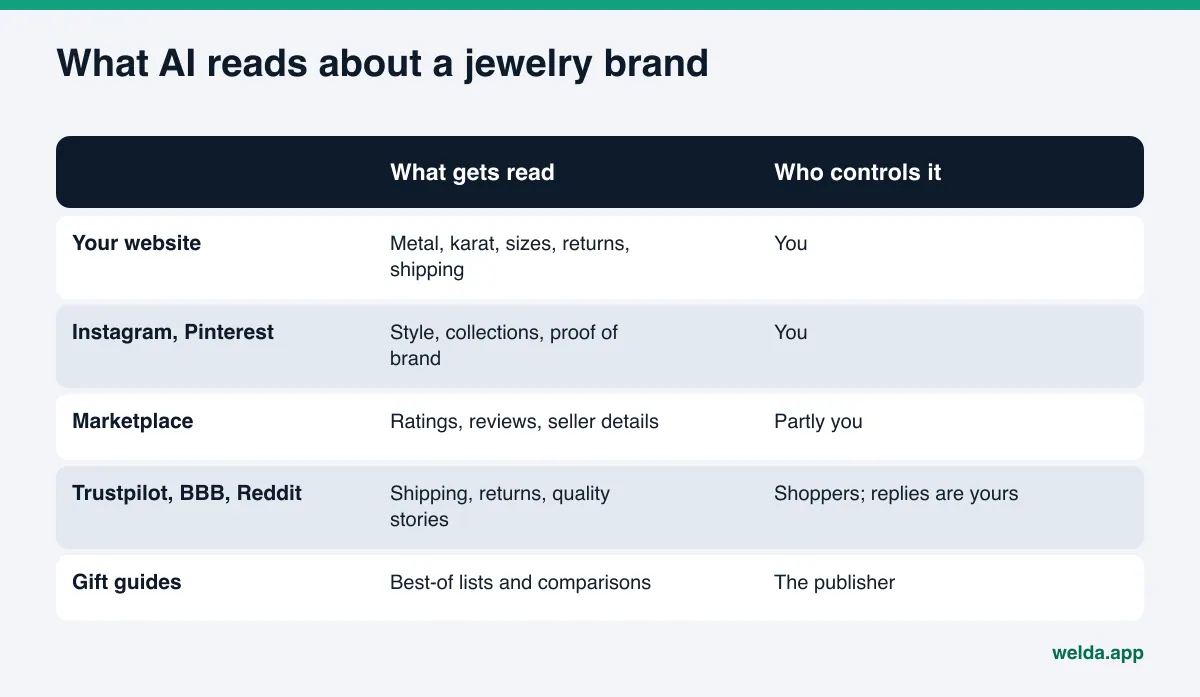
| Source | What AI takes from it | Who controls it |
|---|---|---|
| Your website | Metal, karat, stones, sizes, price, returns, shipping, brand story | You |
| Product structured data (Schema) | Product name, image, price, availability, brand | You |
| Instagram, TikTok, Pinterest | Style, new collections, proof the brand is real | You |
| Marketplace storefront | Ratings, review count, seller details | Partly you |
| Trustpilot, BBB, Reddit | Shipping, returns and quality experiences | Shoppers; replies are yours |
| Gift guides and editorial lists | Best-of lists and comparisons | The publisher |
The first three rows are fully yours, and for most jewelry brands that is where the fastest gains are: the same facts on the site and on Instagram, technical details written as text on product pages, and a site that AI crawlers can actually reach. Reddit deserves its own plan; we cover it in how Reddit shows up in AI answers.
How jewelry brands get recommended by ChatGPT: the steps
The order below is built to close the most gaps for the least effort. For most brands, the first four steps take a day or two.
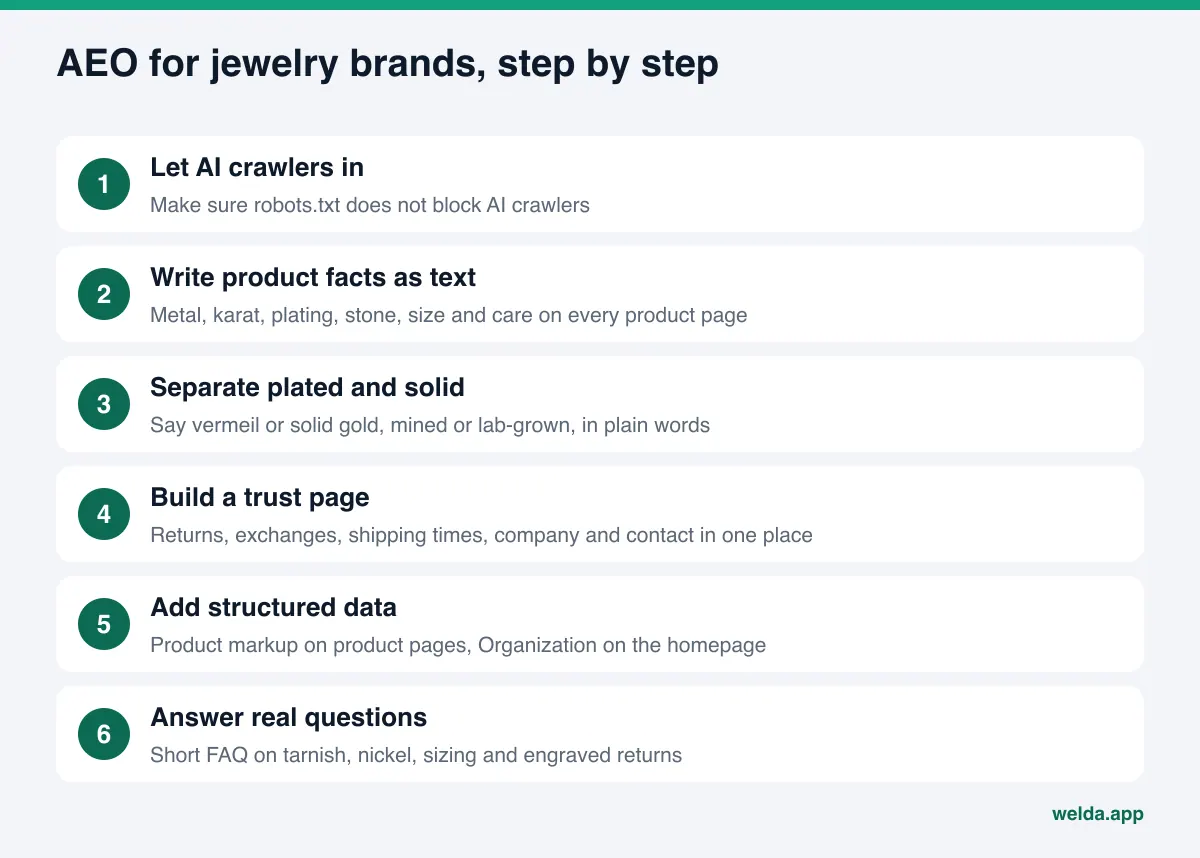
- Make sure AI crawlers can get in. Check your robots.txt for lines that block AI crawlers. Some ecommerce platforms, bot-protection settings or security apps do this without telling you. If crawlers are blocked, nothing else on this list matters.
- Write product facts as text. On every product page, state the metal (sterling silver, 14k solid gold, stainless steel), any plating and its type, the stone, weight, chain length, ring size range and care instructions. Do not leave these only in a photo or a video.
- Separate plated from solid, mined from lab-grown. Write "gold vermeil over sterling silver" or "14k solid gold" instead of just "gold necklace". Write "lab-grown diamond" when it is one. The FTC's Guides for the Jewelry, Precious Metals, and Pewter Industries set out how terms like "laboratory-grown", "cultured" and gold plating should be disclosed. Clear wording builds shopper trust and gives the assistant a fact it can repeat correctly. This is not legal advice; check your own wording with counsel.
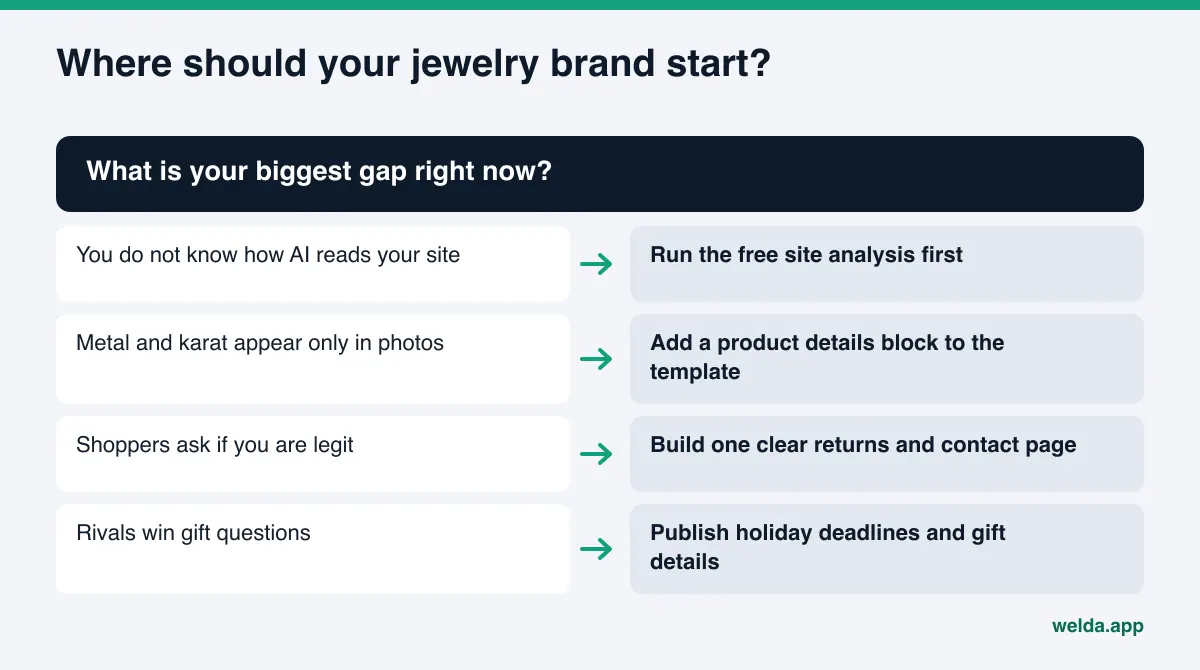
- Put trust information on one page. Return window, size exchanges, shipping times, payment options, company name, address and contact details should sit on one easy-to-find page. That page is where the answer to "is this brand legit" comes from.
- Add Product and Organization markup. Add Product structured data on product pages and Organization data on the homepage. Google's merchant listing documentation lists the required fields: product name, image, and an offer with price and currency. AI assistants can read the same data.
- Write an FAQ. Answer the questions shoppers ask AI, on your own site, in short plain answers: "Will your sterling silver tarnish?", "Is it nickel-free?", "What if the ring doesn't fit?", "Can I return engraved pieces?".
- Link your profiles. Instagram, Pinterest, your marketplace storefront and, if you have a showroom, your Google Business Profile should link from your site and use the same brand name and contact details. That tells the assistant these accounts belong to one brand.
- Publish buying guides. Pages such as "How to choose earrings for sensitive ears", "How to pick a chain length" or "How to care for sterling silver" become the text that gets quoted in comparison and advice answers.
- Reply to reviews. Answer negative reviews on Trustpilot or your marketplace calmly and specifically. Your reply gets read too.
Product copy, before and after
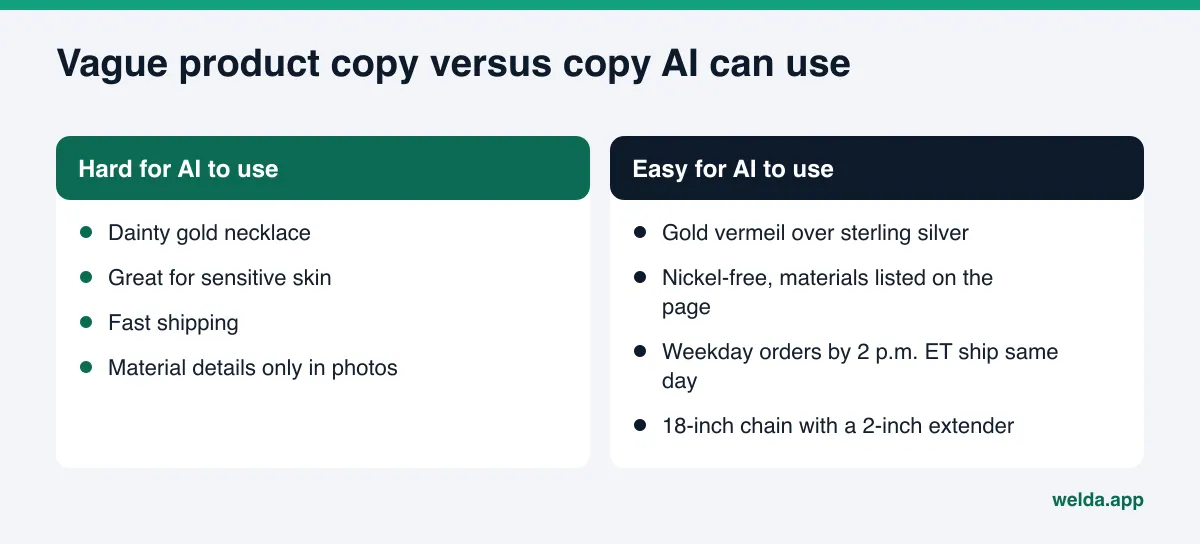
The comparison below is for an illustrative product, not a real brand. The left column reads fine to a person but gives an AI nothing specific to repeat.
| Vague copy | Copy AI can use |
|---|---|
| Dainty gold necklace | Gold vermeil over sterling silver, 18-inch chain with a 2-inch extender |
| Great for sensitive skin | Nickel-free; full material details listed on the product page |
| Fast shipping | Orders placed by 2 p.m. ET on weekdays ship the same day |
| Easy returns | 30-day returns; engraved pieces are final sale, size exchanges allowed |
The numbers on the right are placeholders; use your real terms. What matters is that each fact is specific and repeatable.
What to write on each product page, by jewelry type
Every jewelry type has its own detail that shoppers ask about, and the AI question gets built around that detail. Use the table below as a starting checklist for your product page template.
| Type | Must be on the page | Typical shopper question |
|---|---|---|
| Rings | Size range, how to measure, exchange policy | "Can I swap it if it doesn't fit?" |
| Necklaces | Chain length, extender, chain width, clasp | "Where will this sit on my neck?" |
| Earrings | Material, nickel content, closure, size | "Are these OK for sensitive ears?" |
| Bracelets | Inner circumference, adjustable or not | "Will it fit a small wrist?" |
| Stone pieces | Stone type, mined or lab-grown, any grading report | "Is the stone real, is it certified?" |
| Personalized pieces | Production time, character limit, return terms | "Will it arrive before the date?" |
Writing all of this for every product sounds heavy. The practical route is to add a fixed "product details" block to your product page template and fill in only the values for each item. When the same structure repeats across the catalog, both shoppers and AI systems find what they need in the same place.
Care information belongs on the product page too. "Does sterling silver tarnish?", "Can I wear stainless steel in the ocean?" and "How long does vermeil last?" are common AI questions. When you answer them for your own pieces, you raise the chance of being the source of the answer.
Gifts, personalization and holiday deadlines
A large share of jewelry is bought as a gift, and gift questions are tied to dates: Valentine's Day, Mother's Day, anniversaries, the holidays. In those questions the shopper wants two things: will it arrive in time, and what happens if it doesn't.
The fix is simple, and many brands skip it:
- Publish the last order date for each major holiday as text on your site, not only in an email banner.
- State production time for personalized pieces, such as initial necklaces or engraved bracelets, separately from shipping time.
- Say on the product page if gift wrap or a note card is available.
- Spell out the return policy for personalized pieces; ambiguity turns into complaints.
Once these facts are on the page, an assistant has a concrete reason to name you for "personalized necklace that will arrive before Mother's Day". Getting onto gift guides and editorial lists is a separate piece of work; our guide on getting on ChatGPT best-of lists covers it.
How Welda helps jewelry brands get recommended by ChatGPT
Welda is software that measures where your business shows up in AI answers and prepares the missing pieces on your behalf. Here are the three parts that matter most for a jewelry brand.
1. The free site analysis: what does your site actually say?
The analysis reads your homepage and a few inner pages, such as about, contact and pricing. For jewelry brands the common findings are predictable: a robots.txt line that blocks AI crawlers, a missing or duplicated page title, no Organization markup, an Instagram account that is not linked from the site, no FAQ, and return and shipping terms that are hard to find. For each gap it shows what it saw, why it matters and how to fix it.
You get a score out of 100, with technical and content scores shown separately. A simulation shows how much each fix would move the score, so you can decide where to start. You also get ready-to-use text for your homepage: title, description, main heading, intro paragraph and FAQ. A fix package you can add to your site includes the Organization markup; you or your developer add it to your platform. A competitor comparison and a PDF report are included too.
The analysis also asks five questions your shoppers might ask to an AI assistant that can search the web, and checks whether your brand name appears in the answers. It is a one-time snapshot, not ongoing tracking. The analysis is free once per site and does not measure rankings.
2. The questions view: which questions name your brand?
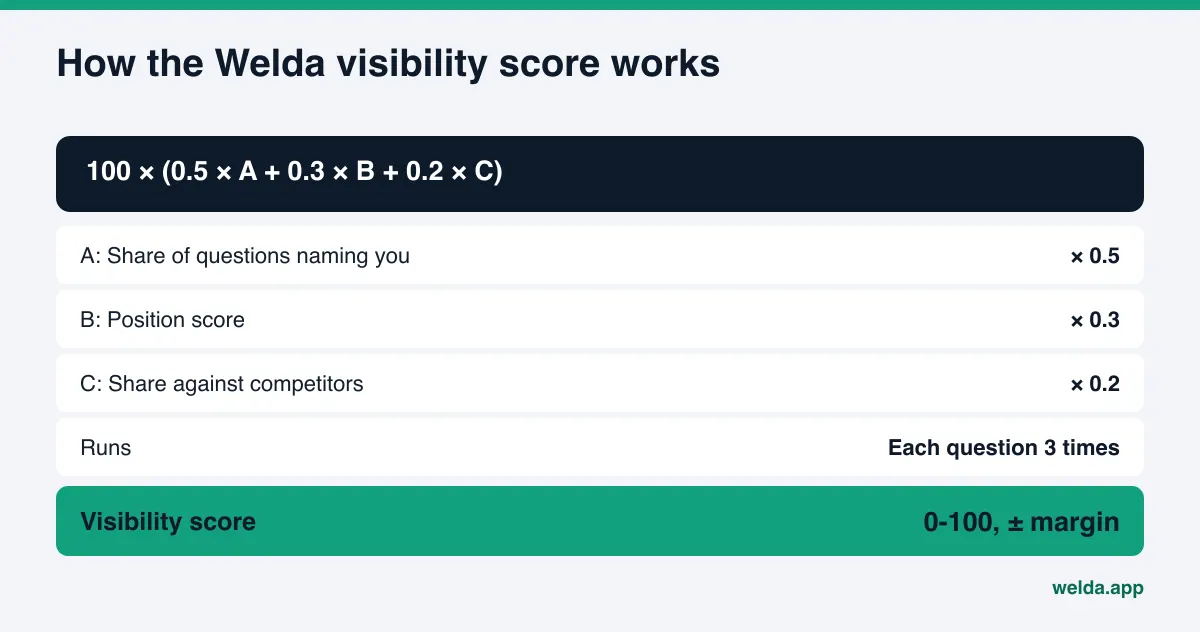
In the Welda panel, the questions your shoppers would ask are put to ChatGPT, Gemini, Perplexity and Google AI three times each. The questions view shows, for every question, which engines named you and in what position. For a jewelry brand it might show that you appear in "nickel-free earrings" answers but never in "personalized gift necklace" answers. That gap tells you which page to work on next.
3. The competitors view: where is a rival winning, and from which source?
The competitors view shows your share of answers next to your competitors' and the topics where each one leads. The most useful column is the source a competitor is winning from. In jewelry that is often a gift guide, a marketplace storefront or a Reddit thread. If you see Competitor A cited from an editorial list in "minimalist vermeil necklace" answers, you know exactly what to go after.
The rest in brief: a single task list gathers missing information, drafts waiting for approval and manual tasks, each with ready text. Welda drafts product copy, FAQ answers and review replies, and you approve what gets published. On WordPress sites it connects through a separate Editor user and an application password, and content opens as a draft. On other platforms Welda hands you a ready package and you apply it. A compliance check flags price, guarantee and superiority claims before publishing; it is not legal advice.
Where Welda is today: early access
Be clear on availability. The free site analysis works in English and German today, and anyone can run it. The full Welda panel is in early access and is opening first in Turkey. Regular tracking across all four engines is being added during early access, and the panel screens shown in our materials use representative data. Pricing is discussed during the early access conversation.
Limits: what Welda does not do
A question jewelry founders often ask is "will I show up in ChatGPT". The honest answer is that nobody can guarantee it, and Welda does not.
- No ranking or "you will appear in ChatGPT" guarantee. AI answers change from question to question and day to day.
- It does not invent facts. Welda does not guess your karat, plating thickness or return terms. It asks you.
- No fake reviews. It drafts review replies; it never writes reviews.
- No sensitive content without approval. Everything goes through you first.
- Some work stays with you. Handling negative reviews, managing marketplace and directory accounts, and press or influencer outreach remain your team's job.
- It does not host content. Everything lives on your own site.
Timing matters as well. New product copy or a new guide usually takes weeks to show up in AI answers. Seeing no change in the first week is normal. If you want to frame expectations for your team, our piece on AI reputation management covers the review side in more depth.
Checklist: is your jewelry brand ready for AI answers?
Open your own site and go through this list. Every "no" is next week's task.
| Check | Where to look | Why it matters |
|---|---|---|
| AI crawlers can reach the site | robots.txt | If they cannot, nothing gets read |
| Metal, karat and plating written as text | Product pages | Material questions are answered from here |
| Ring sizes and chain lengths listed | Product pages | Size questions need specifics |
| Mined vs lab-grown stated clearly | Product pages | Trust and correct AI answers |
| Returns, exchanges and shipping clear | Policy page | The basis of "is this brand legit" |
| Product and Organization markup present | Page source | Gives facts in a structured form |
| Social and marketplace profiles linked | Footer, contact page | Ties accounts to one brand |
| FAQ section exists | Homepage or own page | Short, quotable answers |
Frequently asked questions
Can an Instagram-first jewelry brand get recommended by ChatGPT?
It can, but relying on Instagram alone is hard. Assistants cannot always read Instagram content in detail. A simple site that states your products, returns and contact details makes it easier to confirm the brand behind the account.
I sell on a marketplace. Do I still need my own site?
A marketplace storefront is one source, but you control little of it. On your own site you can write your brand story, material details and FAQ the way you want. Ideally both say the same thing.
How much technical detail should product pages have?
Everything a shopper asks before buying: metal and karat, plating, stone and origin, size, weight, care and return terms. Keep it short and specific; long marketing copy is not needed.
Will Welda write my product descriptions?
Welda drafts them, but it does not invent facts. It asks you for karat, plating, stone origin and return terms. You approve what is published, and the content stays on your site.
How long until I see results?
New content usually takes weeks to show up in AI answers. No one can promise a timeline or a ranking.
Does the free analysis work with any ecommerce platform?
The analysis reads your site from the outside, the way a visitor or crawler sees it, so it does not need to connect to your platform. The results link arrives by email and stays open for 14 days.
Your first step
Getting a jewelry brand named in AI answers depends less on beautiful photos and more on writing product facts plainly and answering trust questions on your own site. To see where to start, measure first. Run the free site analysis and in a few minutes you will see whether AI crawlers can reach your site, whether your product and brand information is readable, and which fix will make the biggest difference.