What does AEO for fashion brands actually involve? When ChatGPT, Gemini, Perplexity or Google's AI Overviews recommend a clothing brand, they lean on plain facts they can find about it: what you sell, in what style, how it fits, what it is made of, how returns work, and what customers say about you elsewhere. When those facts are written in text, stated clearly and consistent everywhere, your brand has a better chance of being named in answers. Nobody can guarantee a mention or a position.
This guide is for direct-to-consumer fashion brands that sell from their own site: labels that grew on Instagram and moved to a store, independent designers with small-batch collections, and brands that also sell through a marketplace but want their own site to carry more weight. AEO, short for answer engine optimization, is the work of making your brand easy for AI assistants to understand and cite. You may also see it called GEO, generative engine optimization; in this article the two mean the same thing. The question is simple: when a shopper types "where can I buy well-made linen basics online?" into an AI assistant, does your brand come up? If not, why, and what should you fix first? If you want to see where your site stands today, start with the free AI visibility analysis.
Why AEO for fashion brands is its own problem
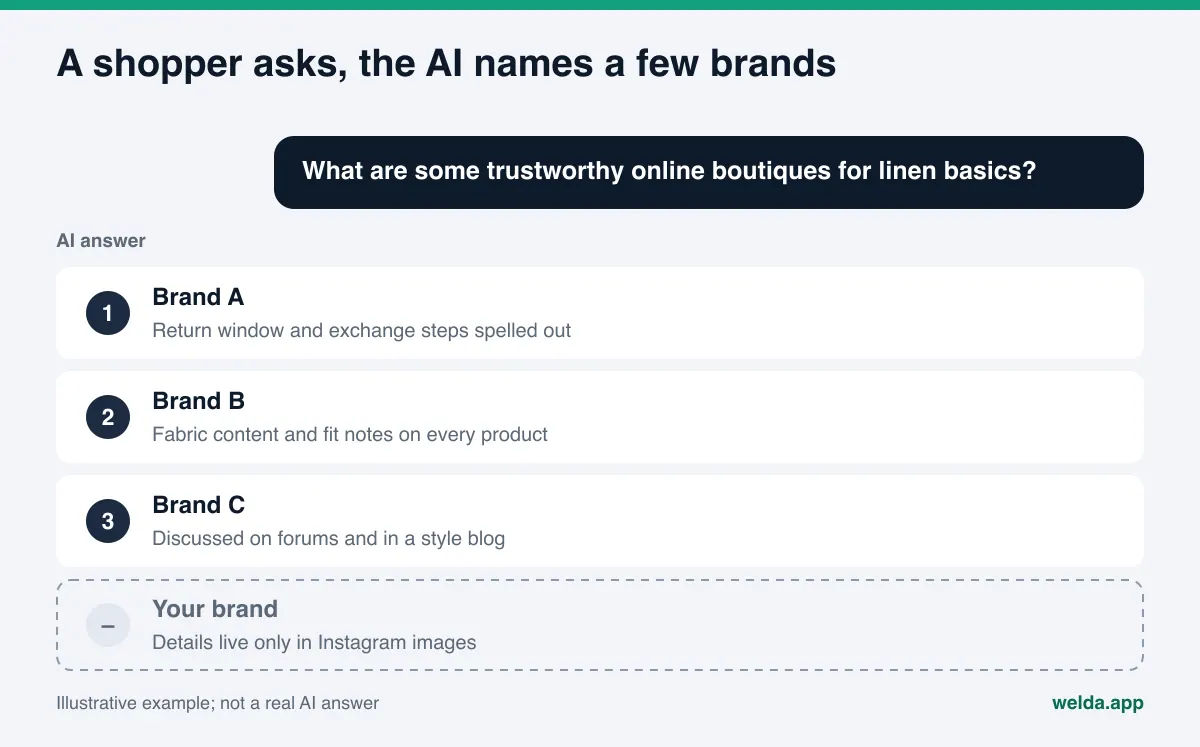
Clothing is a category where shoppers ask AI assistants for recommendations, not just for products. A shopper is often looking for a brand they can trust: one that matches their style, whose sizes run true, whose returns are painless and whose packages actually arrive. The answer to that kind of question is a short list of brand names, not a product grid. A brand that is not on that short list never makes it into the shopper's consideration.
Think about the questions people really type. They rarely name a single item. They describe a need:
- "Sustainable clothing brands that aren't super expensive"
- "Online boutiques with free returns for petite women"
- "Does this brand run small?"
- "Small US-made denim brands worth trying"
- "Is this Instagram boutique legit or a scam?"
These are example questions written for this article, not measured data. They show the pattern: price band, trust, fit, origin and delivery come up far more often than a specific SKU. An AI assistant answering them will favor brands it can describe in a sentence: "this label makes relaxed linen pieces in sizes XS to 3X, ships free in the US and accepts returns for 30 days." If that sentence cannot be assembled from your site and your profiles, the assistant has little reason to include you.
Why AI assistants skip clothing brands
Most fashion brands that are missing from AI answers are not missing because the product is weak. They are missing because the information sits where machines cannot read it.
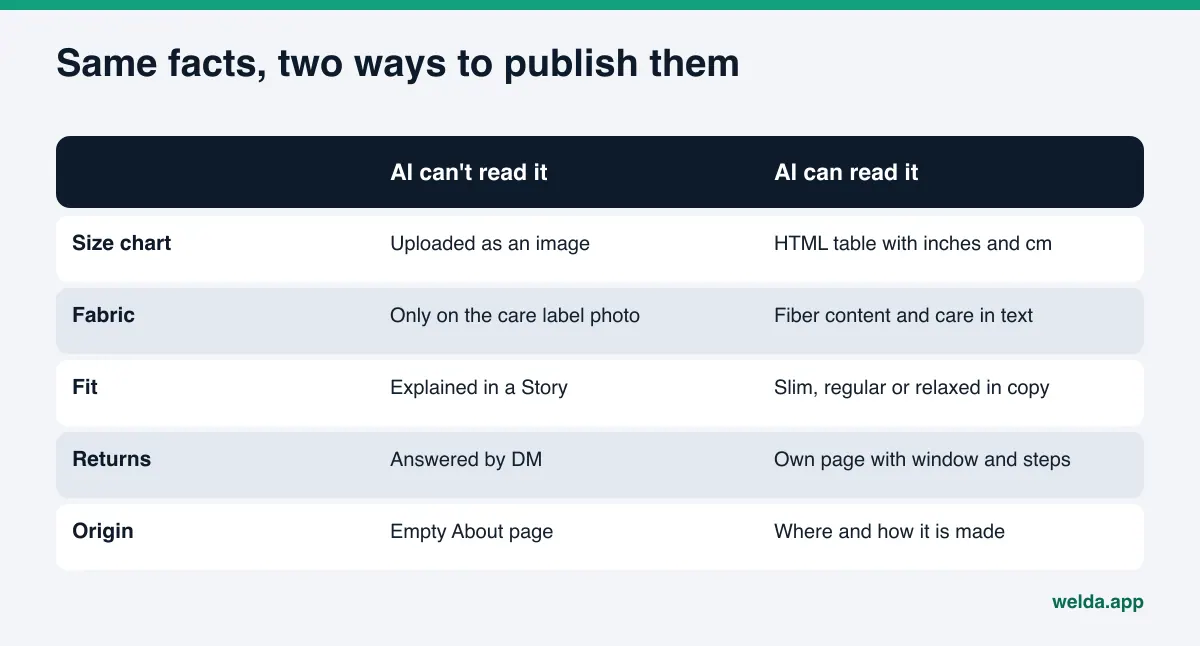
- The storefront is visual. Fashion sells with photography, and that is right. But an assistant cannot reliably read "relaxed fit, 100% linen, model is 5'9" wearing a small" from a lookbook image. If it is not in text, it is not in the answer.
- The size chart is a picture. Many stores upload the size chart as an image. Shoppers can read it. AI systems usually cannot. The question "does this brand run small?" then has no answer on your site.
- Trust details are buried. Return windows, exchange steps, shipping costs, your legal business name and a real contact address are tucked into a footer link or missing. On "is this legit?" questions, assistants lean toward brands that state these things openly.
- The brand lives on Instagram. Drops, campaigns, customer questions and social proof all happen in the app. The website works like a checkout page with no paragraph that explains who you are.
- The facts disagree. One email in the Instagram bio, another on the site, a slightly different brand spelling on the marketplace storefront. In that mess, an assistant cannot be sure which entity it is talking about.
Ecommerce teams run into the same patterns across categories; AEO for ecommerce managers covers the roles and process side. Below, we stay with what is specific to clothing.
AEO for fashion brands, step by step
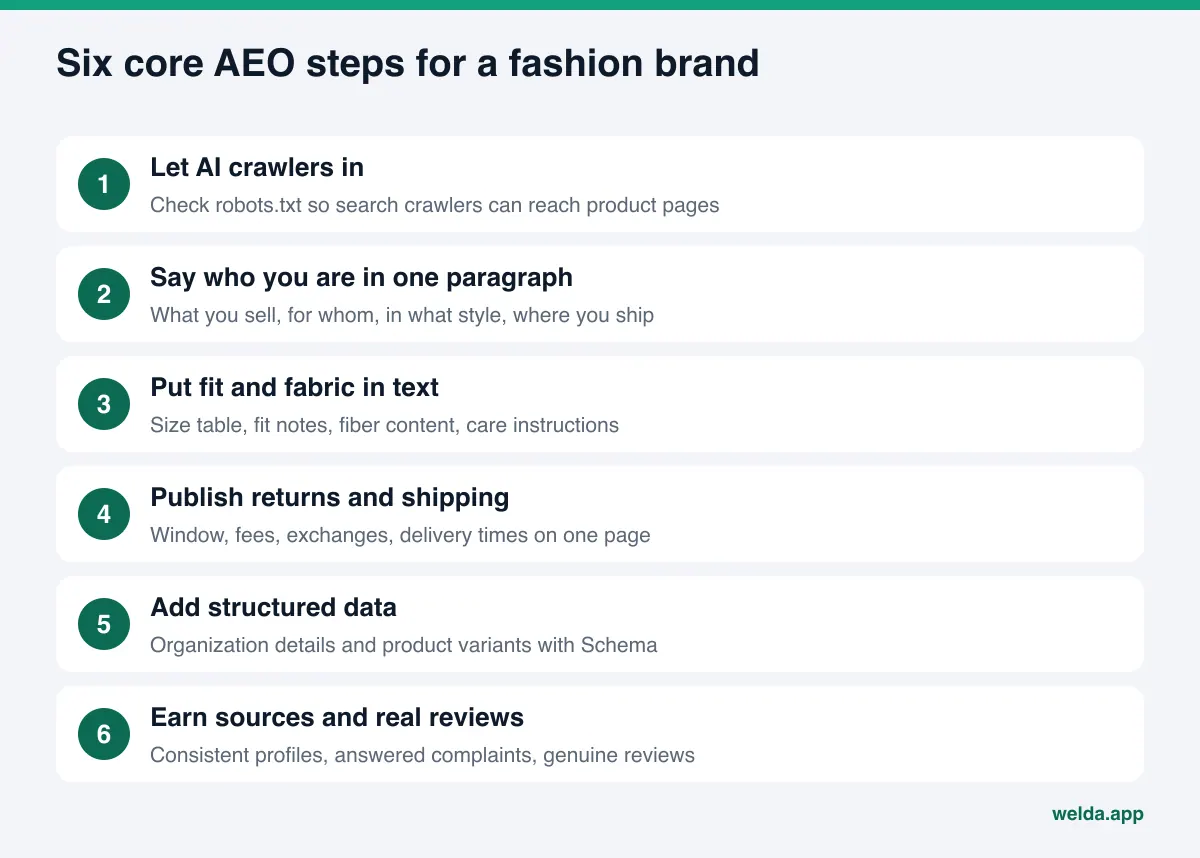
None of these steps needs a development team. The order matters, because each step depends on the one before it.
1. Make sure AI crawlers can reach your site
Your robots.txt file tells crawlers what they may read. Some ecommerce platforms, firewalls and bot-protection settings block AI search crawlers without anyone noticing. According to OpenAI's crawler documentation, sites that opt out of OAI-SearchBot are not shown in ChatGPT search answers, while GPTBot, which gathers content for model training, is a separate crawler with its own setting. That means "don't train on my content" and "show me in search answers" are two separate decisions. Check this once before you invest in anything else.
2. Explain the brand in one plain paragraph
Near the top of your homepage, even under the hero image, add a short block of text: what you sell, who it is for, your style, your rough price band, where it is made and where you ship. An example: "Example Brand makes relaxed linen and cotton basics in small batches in Los Angeles, in sizes XS to 3X, with free shipping across the US and 30-day returns." That single paragraph gives an assistant the words it needs for questions like "US-made linen brand" or "size-inclusive basics with free returns."
3. Put fit, sizing and fabric into text
Every product page should state fiber content (for example, 55% linen, 45% cotton), a fit description (slim, regular, relaxed, oversized), the model's height and size, and care instructions. Publish the size chart as a real HTML table with both inches and centimeters if you sell internationally. "Does it shrink?", "which size for a tall person?" and "does this brand run small?" are exactly the kind of questions shoppers ask AI assistants. If the answer is on your page, you are in a position to be cited.
4. Give returns, exchanges and shipping their own page
This is where trust questions are answered. State the return window, how exchanges work, who pays return shipping, delivery times, which regions you ship to, which payment methods you accept, and your legal business name. A shopper asking whether a boutique is a scam is really looking for this page. An assistant is looking for it too. If you want to go further on how pricing and policy pages feed AI answers, see how to write pricing pages for AI answers.
5. Mark up the brand and product details
Structured data, usually written as Schema markup, lets machines read your facts without guessing. For the brand: legal name, logo, contact details and links to your social profiles. For products: name, price, availability and variants. Variants matter a lot in apparel. Google's product variant documentation describes how to group the same item across size, color and material using ProductGroup and variesBy. Most ecommerce platforms generate product markup automatically; your job is to confirm it actually works and that the brand-level details are not empty.
6. Write an FAQ that answers your DMs
Collect the questions you answer every week in DMs and email: how to choose a size, whether the fabric shrinks, when orders ship, how exchanges work, whether you ship to Canada, whether there is a showroom to try things on. Answer them on your site in short paragraphs. Shoppers save time, and assistants get short, quotable answers.
7. Build sources and collect genuine reviews
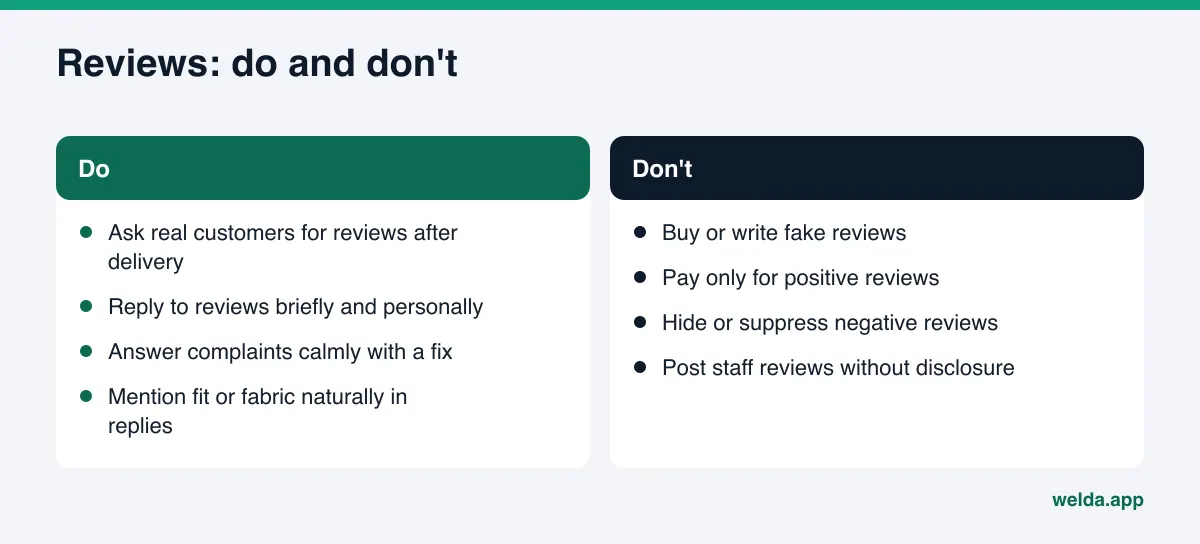
AI assistants do not only read your site. Your marketplace storefront, your Google Business Profile if you have a physical store or showroom, Yelp, the BBB, Reddit threads, style blogs and press coverage can all feed the answer. Keep your facts consistent across them and respond to complaints calmly and with a fix. Reviews must come from real customers. In August 2024 the FTC announced a final rule banning fake reviews and testimonials, including AI-generated ones, undisclosed insider reviews and the suppression of negative reviews. This is not legal advice; if you run a review program, have it checked against the rule.
Which details answer which shopper questions?
The table maps common clothing questions to the information that answers them and where it should live on your site. Use it to audit your own pages.
| Shopper question | Information that answers it | Where it belongs |
|---|---|---|
| Is this online boutique legit? | Legal name, contact details, return and shipping terms, reviews | Returns page, contact page, footer |
| Affordable linen shirts that hold up? | Product type, price band, fabric details | Collection page, product page |
| Does this brand run small? | Fit notes, size table, model measurements | Product page, size guide |
| Brands with free returns for petites? | Size range, petite fits, return policy | Size guide, returns page, homepage paragraph |
| Small US-made denim brands? | Brand story, where and how it is made | About page, homepage |
| Can I try it on in person? | Store or showroom address, hours | Contact page, Google Business Profile |
Each row is a DM answer turned into a permanent page. If you answer the same question on Instagram every day but it is not on your site, then for an AI assistant, the answer does not exist.
Collection pages: the part that survives every season
Product pages in fashion are short-lived. A season ends, a style sells out, the URL disappears. Collection and category pages are what stays. A page for "linen shirts", "oversized sweatshirts", "plus-size dresses" or "summer cotton sets" can live at the same address for years, and a short intro on top of it tells an assistant what your brand offers in that category.
A good collection intro says which product types are included, which fabrics you use, how the fits generally run, the size range, the approximate price band and who it is for. For example: "Our linen shirts come in 100% linen and linen-cotton blends, cut relaxed, in sizes XS to 3X." No hype, just the information shoppers and assistants are looking for. Apply the same rule to campaign and drop pages: next to the season name and the mood copy, say in plain sentences what is in the collection. Because collection pages stay put, the work is not lost when the season changes.
How Welda does this work for a fashion brand
Welda is software that measures where a business appears in AI answers and prepares the missing pieces on its behalf. For a clothing brand, three parts matter most: the free analysis as a starting point, question and competitor tracking, and prepared copy that comes to you for approval.
The free analysis: a first picture of your site
The part anyone can use today is the free AI visibility analysis, and it runs in English. It reads your homepage and a few inner pages such as About and Contact. It checks whether AI crawlers can get in, how your page title and description read, whether your brand details are marked up, whether your social profiles are linked from the site, whether there is an FAQ, and what trust signals are visible. For each gap it tells you what it found, why it matters and how to fix it, and it drafts a homepage title, description and intro paragraph. It also asks five likely customer questions to an AI assistant that can search the web and checks whether your brand name appears in the answers. That is a one-time snapshot. It does not audit every product page and it does not measure rankings; it shows how readable your brand is from the outside.
Question tracking and competitors
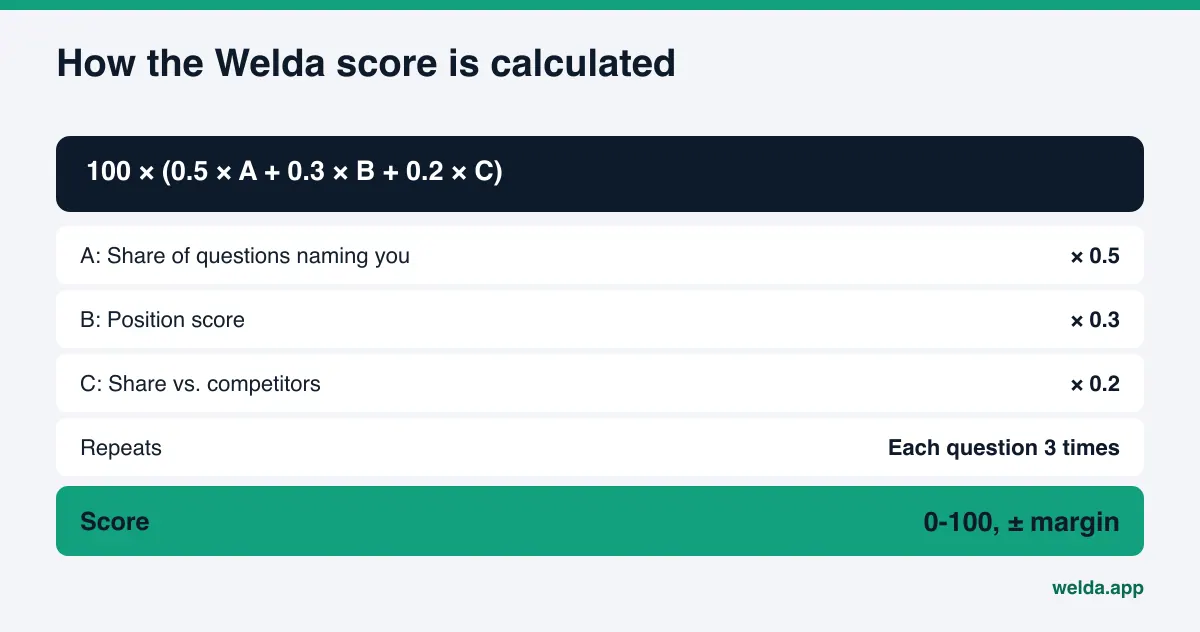
In the Welda dashboard, customer questions are asked to ChatGPT, Gemini, Perplexity and Google AI three times each. For a fashion brand those questions might be grouped into clusters: "affordable linen basics", "trustworthy online boutiques", "size-inclusive brands with free returns". For each question you see whether your name came up and at what position. The competitor view shows which cluster a rival is winning and which source it is winning from. If a competitor shows up on trust questions because of answered complaints on a review site, your next task is that source. If it leads on fabric questions, your product pages need work. The score formula is open, and the spread across the three repeats gives a margin of error, so you do not overreact to a single noisy run. The article on margin of error in AI visibility tracking explains why that matters.
Sources, to-dos and approval
The sources view lists the sites AI assistants lean on when they answer, and where your brand is missing or incomplete. For clothing, that list might include marketplaces, review sites, forums and style blogs. Gaps turn into items on a single to-do list. Welda drafts product copy, FAQs, About text, profile descriptions and review replies; publishing stays your decision. Content always lives on your own site; Welda does not host it. On WordPress sites, Welda connects through a separate Editor user and an application password, with no code to install, and content opens as a draft for your approval. On other ecommerce platforms, Welda hands you a ready-made package and the changes are applied by hand. Before anything goes live, a compliance check flags patterns like price claims, guarantees and superiority claims. It is not legal advice.
Early access, stated plainly
The full Welda dashboard is in early access and is opening first in Turkey. Regular four-engine tracking is being added during early access, and sample screens in the dashboard use representative data. What anyone can use today, in English, is the free analysis. Pricing is discussed in an early access call.
Limits: what Welda does not do
AEO is slow work and hard to measure, so it helps to be clear about what is not on offer.
- No guarantees. Welda does not guarantee a ChatGPT mention or a position. Nobody can.
- No invented facts. Welda does not guess fiber content, country of origin or your return window. It asks you. A wrong fabric claim misleads shoppers and assistants alike.
- No fake reviews. Reviews come from real customers. Welda only drafts replies to reviews you already have.
- Some work stays with you. Handling negative reviews, opening marketplace and directory accounts, press and collaborations remain the brand's own work.
- Results take weeks. New content usually takes weeks to show up in AI answers. Plan for that, especially around seasonal drops.
Brands in nearby categories face similar questions with different claims to watch; the piece on AI visibility software for beauty and skincare brands covers the claim-checking side in detail.
Example scenario: an Instagram boutique moving to its own site
Picture an example boutique: women's everyday wear, most sales through Instagram, its own store launched a year ago. The site looks good, but the homepage is only campaign imagery. Product pages have price and photos, fabric details on some items only. The size chart is an image. The return policy lives in an Instagram highlight.
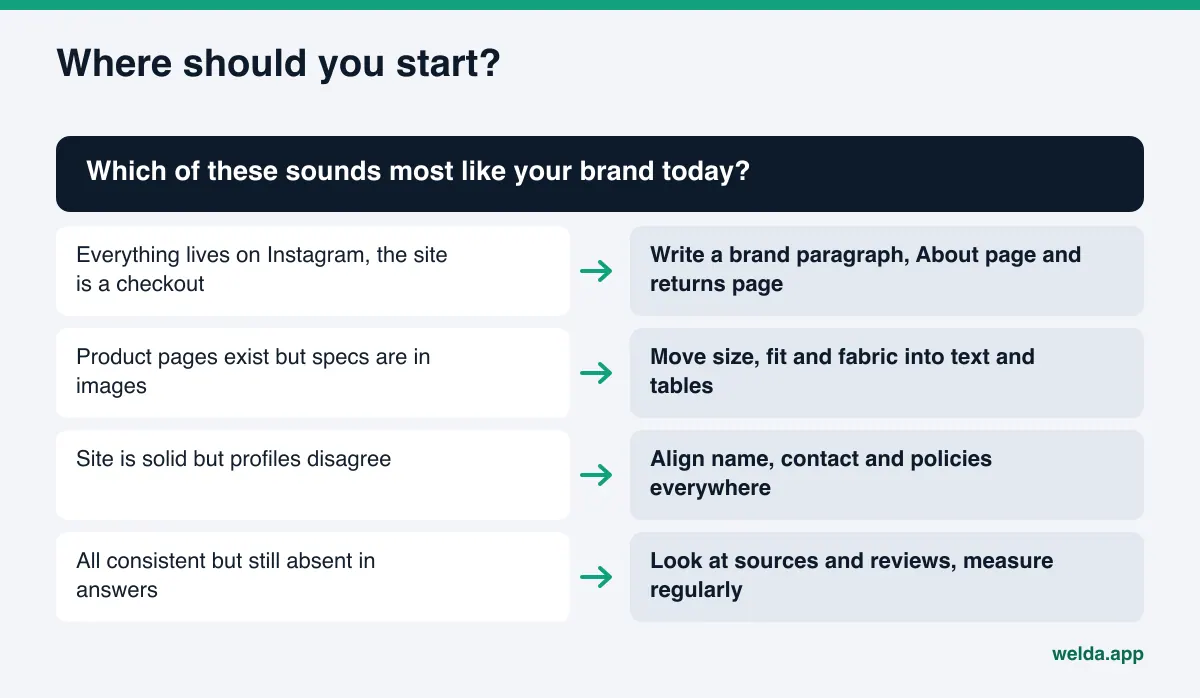
If that boutique never appears for "affordable linen dresses from small brands", the scattered information is the likely reason. Week one: check robots.txt, add a brand paragraph to the homepage, publish a returns and shipping page, and write an About page that says where things are made. Next: add fabric and fit notes to products, turn the size chart into a table, write the FAQ. Then look outward: is the brand name spelled the same on the marketplace storefront, are there unanswered complaints on review sites? This is an illustrative scenario, not the result of a real brand.
Checklist: is your brand ready for AI answers?
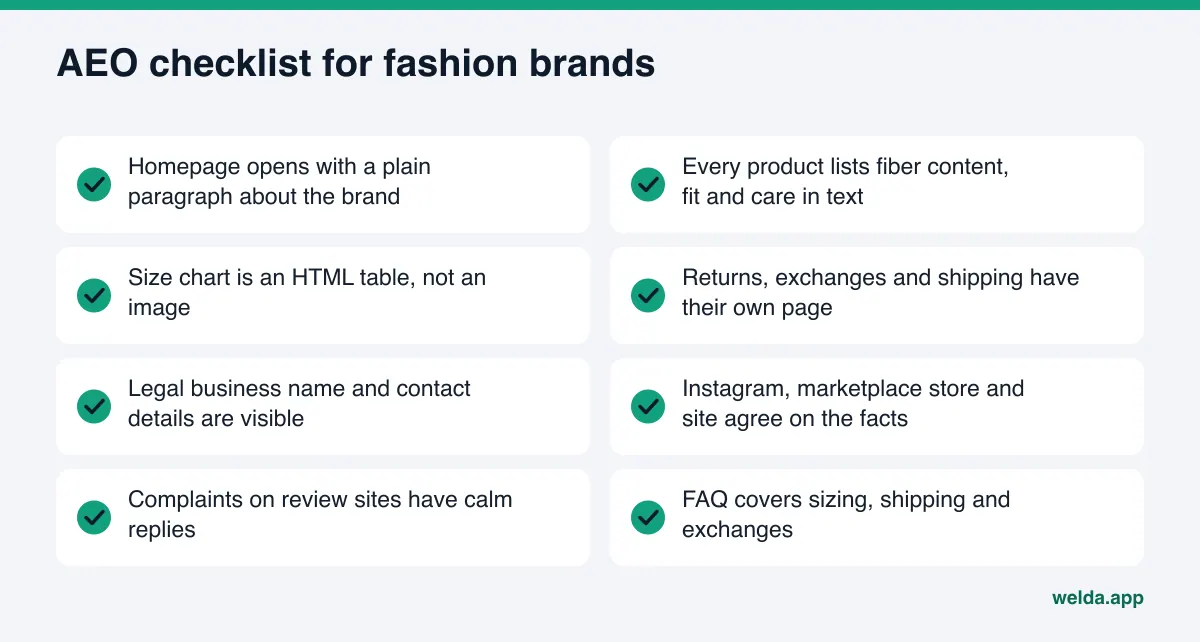
Go through the list. Wherever you answer "no", start there.
- Does robots.txt allow AI search crawlers?
- Does the homepage have a paragraph about the brand, its style and where you ship?
- Do product pages state fabric, fit and care in text?
- Is the size chart a readable table rather than an image?
- Are returns, exchanges and shipping on their own page?
- Are your legal business name and contact details on the site?
- Do Instagram, the marketplace storefront and the site agree on name and contact details?
- Have complaints on review sites received a reply?
Frequently asked questions
We are strong on Instagram but our site is thin. Is that enough?
Instagram is one of the sources AI assistants can draw on, but its content is mostly visual and not always readable. A site that explains your brand, products and policies in text makes it much easier for an assistant to recognize you.
Why does our own site matter if we sell on a marketplace?
A marketplace page describes a seller, not a brand. Your story, where you make things, your return terms and your style are only fully stated on your own site, and that is what an assistant looks for on "which brand" questions.
Do we need long copy on every product page?
No. Clarity beats length. A few clear lines on fiber content, fit, model measurements, care and sizing advice do more than a long, decorative description.
Our collections change constantly. Do we lose visibility each season?
Products change, but brand facts, return terms, collection pages and the FAQ stay. Those permanent pages are the foundation. For new products, keep the same information pattern.
Is AEO different from SEO for an online clothing store?
They overlap. Crawlable pages, clear titles and structured data help both. AEO adds the focus on whether an assistant can describe your brand in a sentence and whether outside sources back that description up.
Does Welda guarantee we will show up in ChatGPT?
No. Welda measures, prepares the fixes and brings them to you for approval. It does not guarantee a mention or a position, and new content usually takes weeks to show up in answers.
Next step
AEO for fashion brands mostly starts with moving facts you already know into places AI systems can read: sizing, fabric, returns, shipping and your brand story. To see where your site stands today, which gaps to close first and a drafted homepage intro, run the free AI visibility analysis. Your results link arrives by email and stays open for 14 days.