What should AI visibility software for beauty and skincare brands actually measure? It should measure whether your brand name shows up when shoppers ask ChatGPT, Gemini, Perplexity and Google's AI features about a skin concern, an ingredient or a routine, where in the answer you are mentioned, and which sources put competing brands ahead of you. Good software also drafts the missing product copy and FAQ answers, leaves publishing to you, and flags risky claim language before anything goes live.
This guide is for skincare, makeup, hair care, fragrance and clean beauty brands in the US. You may sell direct to consumer from your own store, through large retailers, on marketplaces, or all three. The question is the same: when someone asks an AI assistant "what's a lightweight moisturizer for dry, sensitive skin that won't break me out?", does your product come up? This is the work of AEO (answer engine optimization), also called AI search visibility. You will sometimes see the term GEO (generative engine optimization) used for the same idea. Below we cover why the problem looks different for beauty brands, what to do step by step, how Welda handles this work, and where its limits are. If you want to see where your site stands today, start with the free site analysis.
Why AEO is a different job for beauty and skincare brands
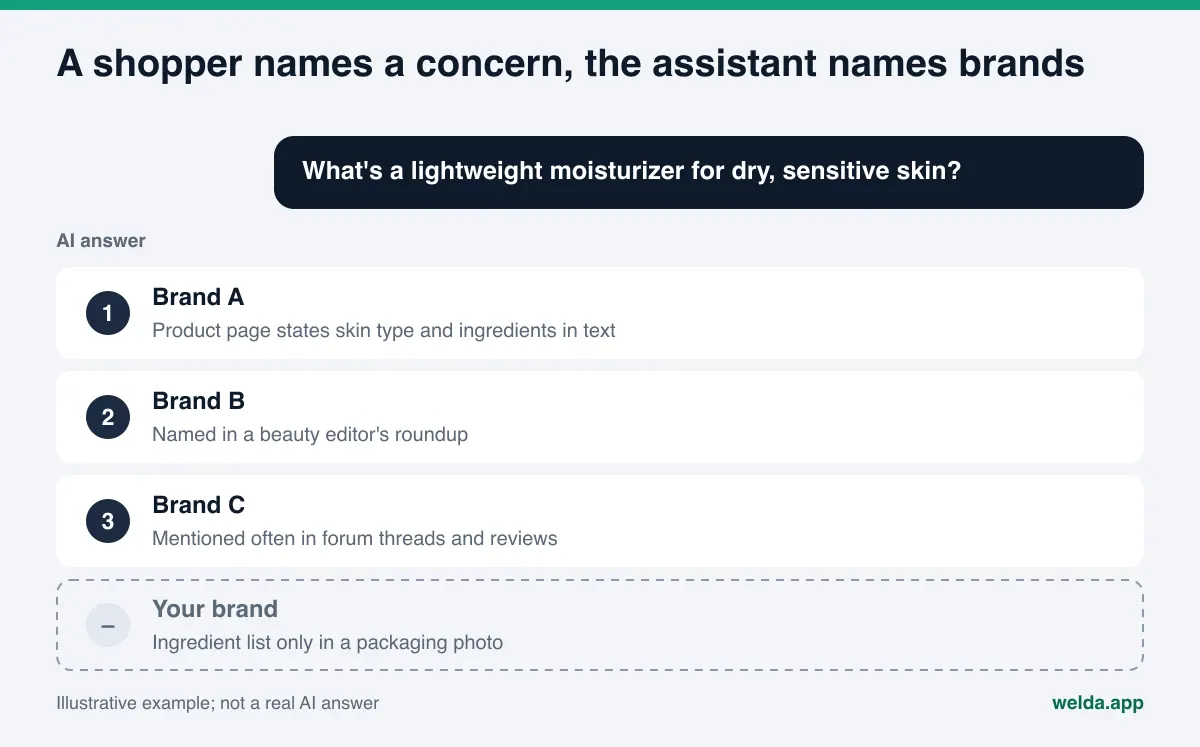
For a local plumber or a restaurant, AI visibility is mostly about location, hours and reviews on maps. A beauty brand faces a different kind of question. The shopper is not looking for a store nearby. They describe a concern, a skin type, a budget or a value, and the assistant answers with a short list of brands and products. If your brand is not in that list, you are not in the comparison the shopper makes next.
Five traits make AI search visibility harder for beauty brands than for most categories:
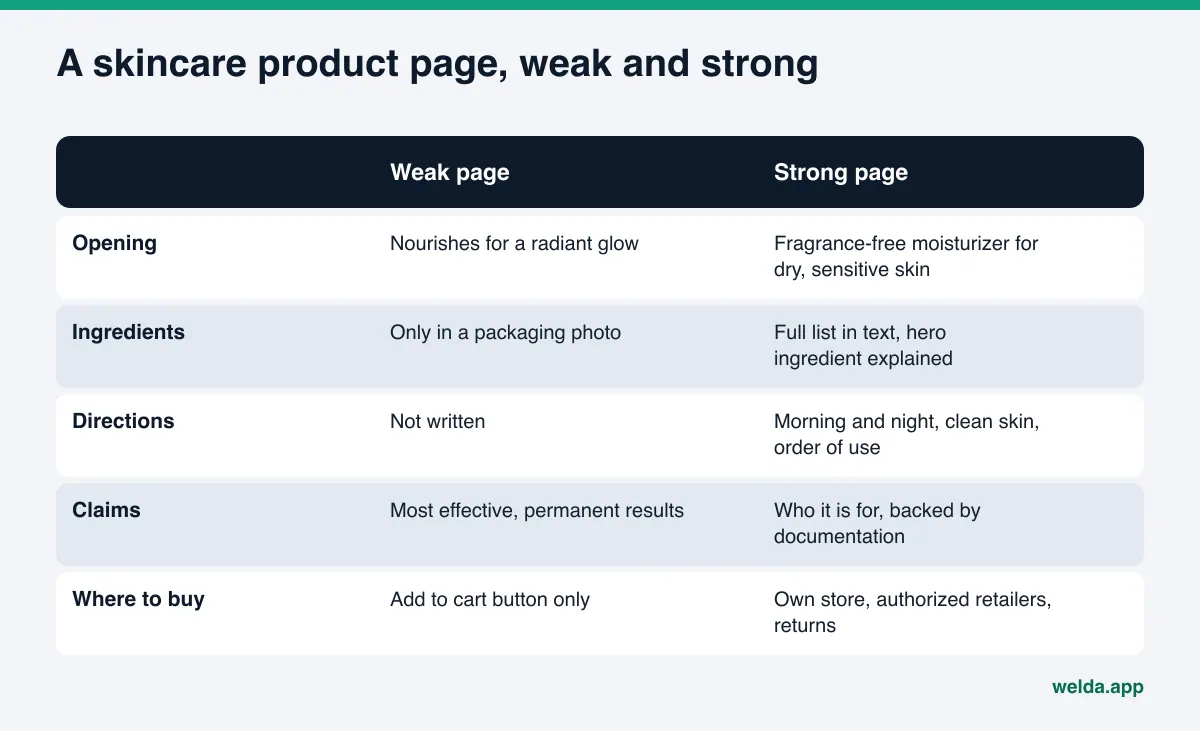
- Product facts live in images. The ingredient list, directions and skin type often sit on a packaging shot or a campaign graphic. An assistant that cannot find that information in text cannot match your product to the shopper's question.
- Product pages sound alike. "Nourishes and illuminates for a radiant glow" appears on thousands of pages. If an assistant cannot tell which product is for which skin type, it has no reason to name yours.
- Shoppers ask by ingredient. Questions name niacinamide, hyaluronic acid, retinol, ceramides, mineral versus chemical sunscreen filters. Brands that do not state ingredients and their role in plain text fall behind on these questions.
- Trust is built off your site. Retailer reviews, Reddit threads, beauty editors' roundups and dermatology-adjacent blogs are a large part of what assistants read. How your brand is described there shapes the answer.
- Claim language carries regulatory risk. In the US, words like "treats acne" or "repairs skin barrier damage" can move a product out of the cosmetic category. Copy written for visibility has to stay inside that line.
What shoppers ask AI assistants about beauty products
The questions below are examples we wrote to show the main question types a skincare or beauty brand faces. They are not drawn from a measured data set. Each type asks your site for a different piece of information.
| Question type | Example question (illustrative) | What your site needs to say |
|---|---|---|
| Concern and skin type | Best serum for combination skin and visible pores | Which skin type and which visible concern the product is for, in a plain sentence |
| Ingredient | Affordable niacinamide serum that's fragrance free | Full ingredient list in text, the hero ingredient, and why it is there |
| Routine and use | Can I use retinol and vitamin C in the same routine | Order of use, frequency, what not to combine, patch test advice |
| Values | Cruelty-free mineral sunscreen for sensitive skin | Claims you can document, and which certification backs them |
| Comparison | Brand A vs Brand B moisturizer for winter | Texture, size, ingredients and use differences, stated calmly |
| Where to buy | Where can I buy this brand without getting a fake | Your own store, authorized retailers, returns and shipping |
The pattern is clear. A single "About us" page or a product gallery answers none of these. Each question type needs its answer in text, in a place an assistant can find. The same product also needs different sentences for different questions: the paragraph that answers an ingredient question does not answer a where-to-buy question.
How AI assistants decide which beauty brands to recommend
When ChatGPT or a similar assistant gets a current, shopping-style question, it runs a web search, reads a handful of sources and names the brands that appear consistently across them. For beauty questions those sources usually include the brand's own site, retailer product pages, beauty editorial roundups, Reddit and other forums, and customer reviews. How much each source matters changes by question, by engine and over time. Nobody can give you a fixed percentage.
In practice the assistant needs to understand four things about your brand:
- Who each product is for. Skin type, hair type, age range, season. State it in the first paragraph of the product page.
- What is in it. The ingredient list belongs in text, not only in an image. Say in one sentence why the hero ingredient is there.
- Why the brand can be trusted. Where it is made, which certifications it holds, what reviewers say, and how you respond to complaints.
- Where to buy it. Your own store and authorized retailers. Counterfeit worries are common in beauty, so shoppers do ask.
Assistants do not always show which sources they used, and they do not give the same answer every time. One test in one chat window tells you very little. Our piece on why AI answers change every time explains that variability in more detail.
Step by step: AI visibility for beauty and skincare brands
None of these steps depends on a specific tool; your own team can do all of them. Order matters, because later steps do little if the early ones are missing.
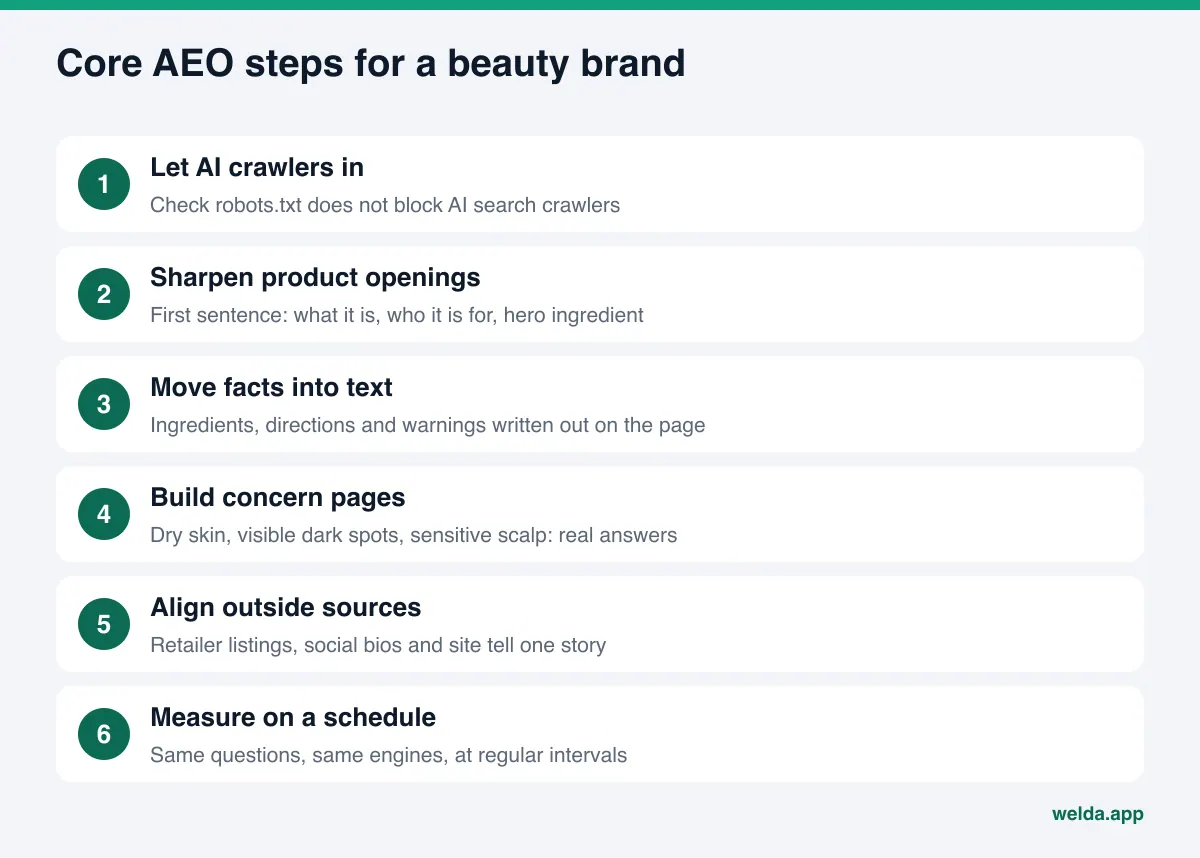
1. Make sure AI crawlers can reach your site. If your robots.txt blocks AI search crawlers, even a perfect product page is invisible. OpenAI states that it uses OAI-SearchBot to surface websites in ChatGPT search, and that sites blocking it will not appear in search answers. E-commerce platforms sometimes ship a default robots.txt; open it once and check.
2. Write a clear opening for every product page. The first two or three sentences should say what the product is, who it is for and what the hero ingredient is. Example: "A fragrance-free, lightweight moisturizer for dry and sensitive skin. Made with ceramides and glycerin. Apply morning and night to clean skin." It is not poetic, but it is the kind of sentence an assistant can quote.
3. Put ingredients and directions in text. Keep the packaging photo, and add the same information as text on the page. Order of use, frequency, what not to combine and storage notes help you show up in "how do I use" questions.
4. Build concern and routine pages. Pages like "dry skin routine", "products for visible dark spots" or "sensitive scalp care" connect several of your products to one real question. These are answers, not catalogs; product names appear naturally inside the answer.
5. Answer the questions shoppers actually ask. Is it safe to use during pregnancy, is it tested on animals, what is the shelf life after opening, how do returns work, where is it sold. Do not write anything you cannot document. Where the honest answer is "ask your doctor or dermatologist", say so.
6. Mark up brand and product data. Schema markup tells machines that a page is about an organization, a brand or a product. Your organization name, logo, contact details and social profiles should be consistent in that markup.
7. Make outside sources consistent. Retailer listings, marketplace descriptions, your social bios and your own site should agree. If one place says "vegan" and another says nothing, an assistant has two stories to reconcile. A citation gap analysis shows which sources assistants rely on and where your brand is missing.
8. Handle reviews honestly. Ask happy customers for reviews and reply calmly to negative ones. Do not buy reviews and do not offer rewards for positive ones. The FTC's final rule on fake reviews and testimonials prohibits fake reviews, including AI-generated ones, and incentives conditioned on a positive or negative sentiment. We cover the link between reviews and AI answers in reviews and AI recommendations.
9. Measure on a schedule. New content usually takes weeks to show up in AI answers. Without asking the same questions on the same engines at regular intervals, you cannot tell which change worked.
Cosmetic or drug: where your AEO copy has to stop
Every sentence you write so an assistant will quote it is also a marketing claim. In the US, the FDA explains in "Is It a Cosmetic, a Drug, or Both?" that the classification depends on intended use. A cosmetic is meant for cleansing, beautifying, promoting attractiveness or altering the appearance. A product intended to treat or prevent disease, or to affect the structure or function of the body, is a drug. The FDA also notes that claims on your labeling, advertising and website can establish that intended use.
The practical lesson: when you write copy for AI search visibility, do not inflate the claim. Instead of "treats acne", describe what the product does to look and feel, within what your evidence supports. Instead of "the most effective serum", say who it is for. Plainer claims lower your risk and give assistants a cleaner sentence to quote. This section is general information, not legal advice; talk to your regulatory counsel about your own claims.
| Risky pattern | Why it is a problem | Safer approach |
|---|---|---|
| "Treats", "heals", "cures" | Suggests a drug use, not a cosmetic one | Describe look and feel, within your evidence |
| "Permanent results", "guaranteed" | Hard to substantiate, can mislead | State time of use and expected effect calmly |
| "Best", "number one" | Superiority claim that needs proof | Say which skin type and need it is for |
| "Chemical free" | Everything is a chemical; misleading | Name the specific ingredient left out |
How Welda does this work for a beauty brand
Welda is software that measures where a business appears in AI answers and fills the gaps on the business's behalf. The full Welda dashboard is in early access and is opening first in Türkiye. Regular four-engine measurement is being added during early access, and sample dashboard screens use representative data. What anyone can use today, in English, is the free site analysis. Below are the three parts that matter most for a beauty brand, with an example of each.
Question-level tracking: which concerns mention your brand?
For a beauty brand, tracking starts with the shopper's concern, not with your brand name. Take an example skincare brand. The questions it tracks in Welda look like "fragrance-free moisturizer for dry skin", "niacinamide serum for oily skin" and "mineral sunscreen for sensitive skin". The dashboard asks each question three times on ChatGPT, Gemini, Perplexity and Google AI. On the questions screen you see, question by question, whether your brand is named on each engine and in what position. Question language can be set to English or Turkish.
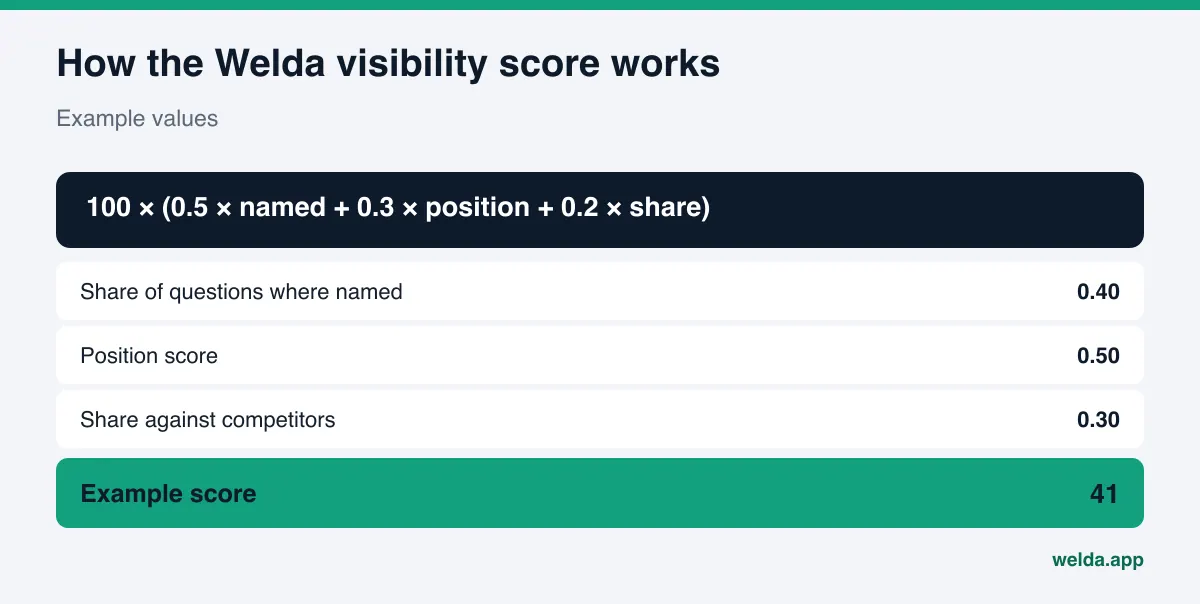
This is a decision screen. If your brand shows up in moisturizer questions on several engines but never in sunscreen questions, the sunscreen page is the first job. The score formula is published: 100 × (0.5 × share of questions where you are named + 0.3 × position score + 0.2 × share against competitors). The spread across the three runs gives a ± margin of error, so one lucky answer does not inflate the number. Our piece on what a good AI visibility score looks like goes deeper on reading it.
Competitors and sources: who wins, and from where?
The competitors screen shows which brand leads each question and which source it is leaning on. For beauty this often surprises people. A competing brand may be named not because of its own site, but because of an editor's roundup or a long forum thread. The sources screen lists the sites assistants draw on and your status on each: present, incomplete or missing. If a retailer listing is missing your ingredient list, or your social bio contradicts your site, that becomes a task on your to-do list.
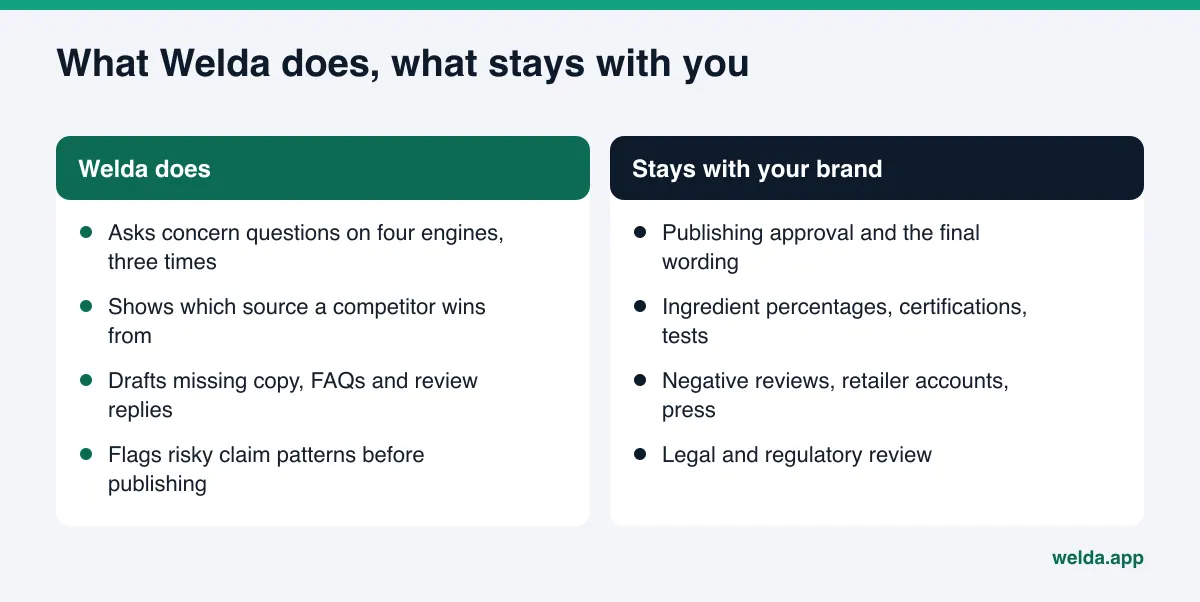
Negative reviews, directory and retailer accounts, and press or influencer work stay with your team. Welda shows what to do there and drafts responses, but it does not open accounts or post on forums in your name.
Ready pages and the compliance check: copy before it goes live
Welda drafts missing product and category copy, FAQ answers and review replies. It does not invent facts. If an ingredient percentage, a certification name or a usage warning is missing, Welda asks you. Every draft passes a compliance check before publishing that flags patterns like pricing statements, guarantees, superiority claims and diagnosis-style suggestions. For beauty, that means "treats" or "best" gets flagged before it reaches your site. The check is not legal advice and has not been reviewed by legal counsel; the final call is yours.
On WordPress sites, you create a separate Editor user and an application password for Welda, with no code to install. Drafts open on your site as drafts and go live only when you approve them. On other platforms, Welda hands over a ready package and your team applies it. Content always lives on your own site; Welda does not host it. Before-and-after comparisons and a one-page monthly PDF report show what changed on which question after each update.
What the free analysis checks on a beauty site
The free site analysis works in English today. It reads your home page and a few inner pages (services or products, pricing, about, contact) the way Google and AI assistants would. It checks whether AI crawlers can access the site, your page title and description, your main heading, your business markup, contact details, whether social and map profiles are linked, whether there is an FAQ section, reviews and trust signals, whether your offering is described clearly, and page speed.
You get a score out of 100, split into technical and content, plus what was found for each gap, why it matters and how to fix it. You also get ready-to-use copy for your home page title, description, main heading, intro paragraph and FAQ; a simulation of how much each fix could move the score; a competitor comparison; a fix package to add to your site, including business markup code; and a PDF with a shareable score card. The analysis also asks five questions a customer might ask to an AI assistant that can search the web and checks whether your brand name appears in the answers. That is a one-time snapshot, not ongoing tracking. It is free once per site. Email and phone are verified, the results link arrives by email and stays open for 14 days.
The analysis reads the home page and a few inner pages; it does not crawl your full catalog. For a beauty brand, it answers the question "what do my core pages tell AI assistants about my brand?" Product-level work is the job of the dashboard and your team. If your older product pages are thin, updating old content for AI search is a practical next read.
What Welda does not do
Knowing what a tool will not do is as useful as knowing what it does. For Welda:
- No ranking guarantees and no promise that you will "show up in ChatGPT". Nobody controls AI answers.
- No invented facts. Ingredient percentages, certifications and test results come from you.
- No publishing sensitive content without your approval. Publishing stays with the brand.
- No fake reviews of any kind.
- Negative review handling, retailer and directory accounts, and press work stay with your team.
- The compliance check is a warning layer, not a legal sign-off.
There is also a time limit. A new product page or a corrected ingredient list usually takes weeks to be reflected in AI answers. Keeping measurement running through that period is the only way to see which changes worked. Pricing is not published; it is discussed in the early access conversation.
Checklist: choosing AI visibility software for beauty and skincare brands
Whether you evaluate Welda or another tool, ask these questions:
- Does it build questions around shopper concerns and skin types, or only around your brand name? In beauty, real visibility is measured on the first kind.
- Is each question asked more than once, with a margin of error shown?
- Is the score formula published, or is it a single number with no explanation?
- Does it show which source a competing brand is winning from?
- Does it fill gaps with invented facts, or does it ask you?
- Does it flag claim language before anything is published?
- Do you keep publishing approval, and does content stay on your own site?
- Does it promise rankings? If so, treat that as a warning sign.
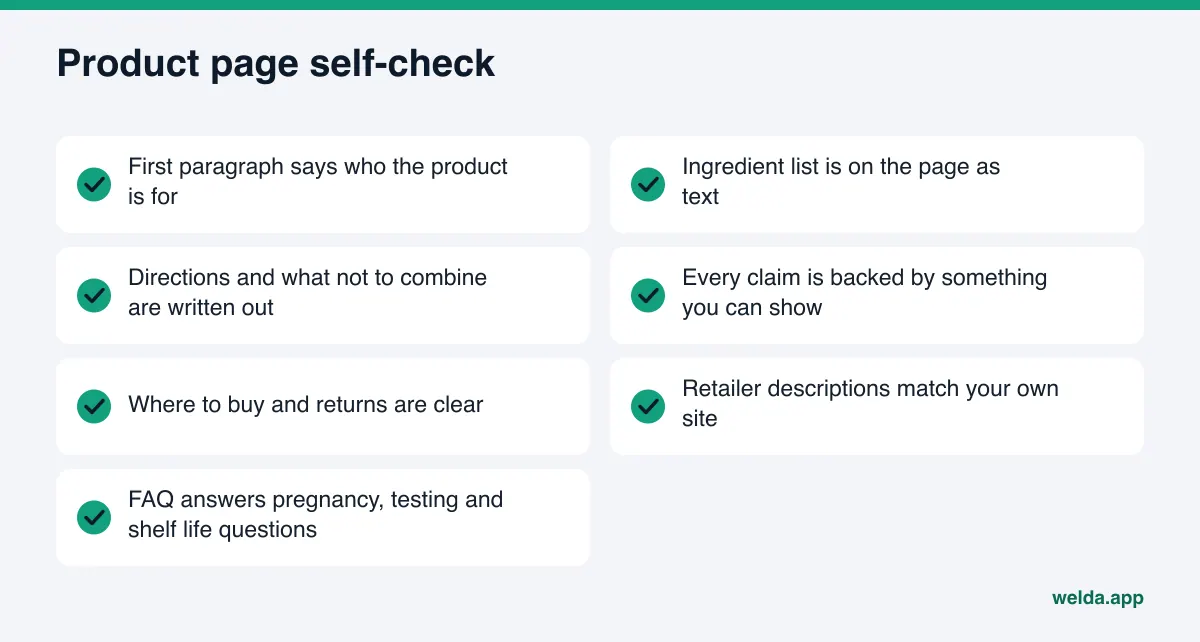
You can also run a quick self-check on your product pages. Does the first paragraph say who the product is for? Is the ingredient list in text? Are directions written out? Is every claim backed by something you can show? Are where-to-buy and returns clear? Do your retailer descriptions match your site? If you answer "no" to two of these, you already know where to start, before any measurement.
Frequently asked questions
How is AI visibility software different from an SEO tool?
An SEO tool tracks your position in search results. AI visibility software measures whether AI assistants name your brand, in what position, and which sources they lean on. The two are related, but they measure different things.
We mostly sell through retailers. Do we still need our own site?
Assistants read retailer pages too, but you do not control the copy or layout there. Your own site is the one place where you can give complete, consistent information about your brand. The free analysis also reads a site.
Does publishing our ingredient list help competitors?
The ingredient list is already on your packaging. Putting it on the page as text adds no new information; it only makes that information readable for AI assistants.
Will Welda tell me whether my claims are FDA compliant?
No. The compliance check flags risky patterns before publishing, but it is not legal advice and has not been reviewed by legal counsel. Talk to your regulatory counsel about your claims.
How soon will we see results?
New content usually takes weeks to show up in AI answers. No one can promise a timeline or an outcome, which is why measurement is repeated on a schedule.
Can US brands use the Welda dashboard today?
The dashboard is in early access and is opening first in Türkiye. The free site analysis works in English today for any site.
Start with the free analysis
The soundest first step is to measure where your beauty brand stands in AI answers instead of guessing. The free analysis shows what your core pages tell AI assistants, which gaps to fix first, and whether your brand name appears across five sample questions. With ready copy suggestions and a fix package, your team can start right away. Run your free site analysis here.