What is AEO for ecommerce managers? AEO (answer engine optimization) for ecommerce managers is the work of making sure your store is described accurately and recommended when shoppers ask ChatGPT, Gemini, Perplexity or Google AI where to buy something, or whether a store can be trusted. It has two halves: putting clear, consistent information on your site that AI can read, and then measuring, question by question, where you show up and where you do not.
This guide is written for the person who owns ecommerce growth: the ecommerce manager, the head of marketing at a DTC brand, or the founder who still answers support emails at night. You already track conversion rate, cart abandonment and return on ad spend. AI search visibility does not replace any of those. But a growing share of shoppers now start with a question typed into an AI assistant instead of a list of blue links, and the first thing they read about your category is a short AI-written answer. If you do not know whether your brand is in that answer, you are running a channel you cannot see.
Why AEO is a different job for ecommerce teams
You may also hear this called GEO, or generative engine optimization. In the US the more common label is AEO, and the work is the same: earning a place in AI-generated answers. For an online store, three things change compared with classic search.
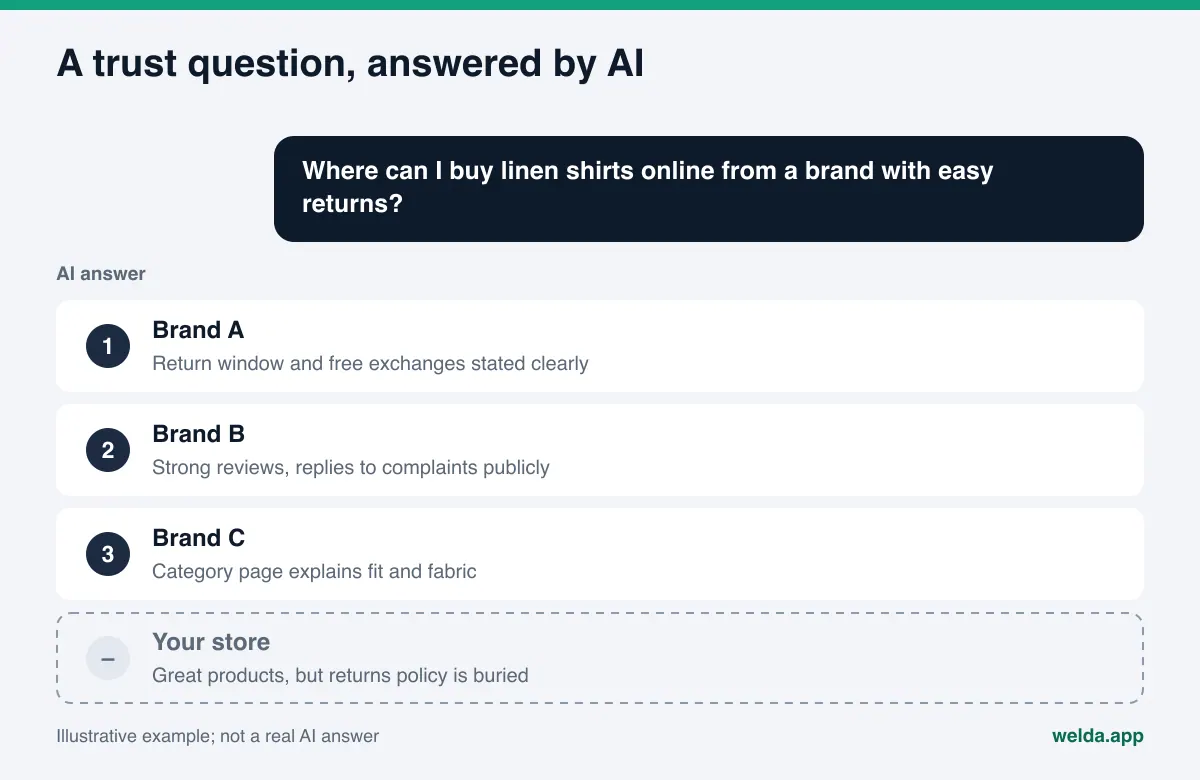
- The shortlist gets shorter. A search results page shows ten links. An AI answer usually names a handful of brands, each with a one-line reason. If you are not on that shortlist, you do not exist in that conversation, no matter how much you spend on ads.
- Reasons matter as much as relevance. AI assistants explain their picks: "easy returns," "ships fast," "good reviews for sizing." If those reasons are not stated plainly on your site and in what others write about you, the assistant has nothing to quote.
- Trust questions come before product questions. In ecommerce, the shopper's first worry is often the seller, not the item. Questions like "is this site legit" or "does this brand actually honor returns" go straight to answer engines.
In practice this means a great product page is not enough. If the information that explains your brand is missing or scattered, the AI channel stays closed to you. The quickest way to see where you stand is to run a free AI visibility analysis of your store and look at what an AI system actually reads on your homepage.
What US shoppers ask AI before they buy
Every store's list is different, but ecommerce questions tend to fall into a few groups. The examples below are illustrative, written to show the pattern; your own list should come from your support inbox, live chat logs and review replies.
| Question type | Example shopper question | Page that should answer it |
|---|---|---|
| Category recommendation | "Best place to buy linen shirts online under $80" | Category page intro, homepage |
| Trust and legitimacy | "Is this brand legit or a dropshipping site?" | About page, contact details, review replies |
| Shipping and timing | "Which online stores ship to Texas in two days?" | Shipping page, FAQ |
| Returns and exchanges | "Online clothing brands with free returns" | Returns page, FAQ |
| Comparison | "Brand A vs Brand B for sustainable basics" | About page, materials and sourcing page |
| Fit and use | "Do these run small? What should I size up to?" | Product page, size guide |
The lesson is that ecommerce AEO is not just about product queries. Trust, returns and shipping questions show up at least as often, and the answers live on pages most teams treat as an afterthought: the returns policy, the FAQ, the About page and your public replies to reviews. Your job as a manager is to make sure each of those questions has one clear, current answer somewhere on your site.
Where AI answer engines learn about your store
AI answers are not drawn from a single source. Engines that search the web read live pages, and they also pull in what other sites say about you. The useful question for an ecommerce manager is which of those sources you actually control.
| Source | What AI reads there | Who controls it | Your move |
|---|---|---|---|
| Your own site | Who you are, what you sell, returns, shipping, FAQ | You | The main work of month one |
| Category and product pages | Fit, materials, who the product is for | You | Start with best-selling categories |
| Google Business Profile and Merchant Center | Business details, product data | You | Keep them current and consistent with the site |
| Review sites (Trustpilot, BBB, Yelp) | How problems get resolved | Customers write, you reply | Reply publicly and specifically |
| Reddit and forums | How real people describe your brand | Users | Monitor, never plant fake posts |
| Press, blogs and gift guides | Brand story, category positioning | Publishers | Worth pursuing when you have real news |
A note on Google: its Search Central guidance on AI features says there are no additional requirements or special optimizations needed to appear in AI Overviews or AI Mode; a page needs to be indexed and eligible to show with a snippet. The same page lists keeping Merchant Center and Business Profile information up to date among general best practices. You do not need a separate "AI version" of your store. You need the store you have to be readable, consistent and honest.
ChatGPT also has its own shopping results. According to OpenAI's merchant page, as of November 2026 merchants can apply to share product feeds, shopping is live in the US, and some commerce platforms are already integrated. Product feeds are a separate channel from the work in this guide, and Welda does not manage them. What a feed cannot do is explain who you are and why a shopper should trust you; that still comes from your site and your reputation.
AEO for ecommerce managers: a step-by-step plan
The sequence below is designed for a small or mid-size ecommerce team that does not want to open a large technical project. Each step lists what you get at the end of it.
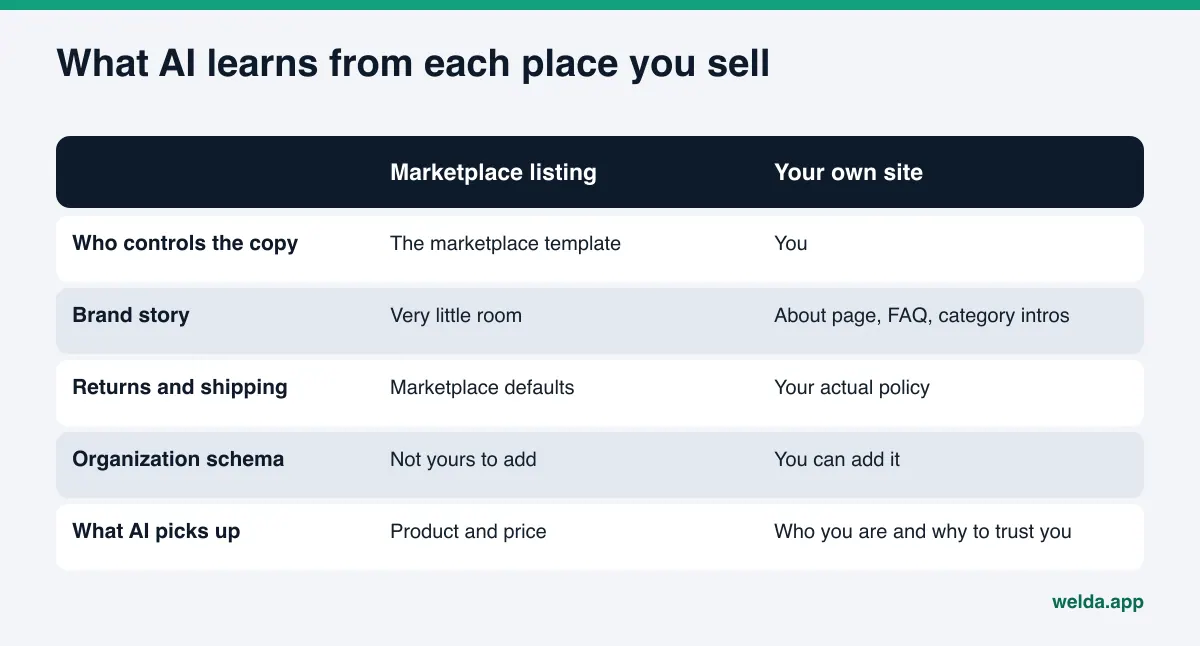
- Build your question list. Export the last two months of support tickets and chat transcripts. Group the 20 to 40 most common questions into four buckets: category recommendation, trust, shipping, returns. This list becomes both your content plan and your measurement list.
- Confirm AI crawlers can reach your site. A bot-protection rule or an old robots.txt entry can quietly block AI crawlers. OpenAI's crawler documentation states that sites that opt out of OAI-SearchBot will not be shown in ChatGPT search answers. It is a one-line setting that can undo everything else.
- Say who you are in one sentence on the homepage. "Summer drop is live" is a promotion. "Small-batch linen clothing made in Los Angeles, shipped across the US" is a definition. AI assistants place you into answers using definitions.
- Write short intros for your top category pages. Two or three paragraphs above the product grid: who this category is for, what problem it solves, the price range, how to choose. Write it like a good store associate would explain it, not like keyword filler.
- Put trust details in one place. Return window, who pays return shipping, typical delivery times, payment methods, legal business name and a real contact address. If these are scattered across footer links, the assistant has nothing to hold on to when someone asks whether you are legit.
- Turn support tickets into an FAQ. The trust and shipping half of your question list maps directly onto FAQ entries. Use exact numbers ("ships in 1-2 business days") instead of "as soon as possible."
- Add Organization schema and link your profiles. Structured data ties your brand name, logo, contact details and social profiles together. Make sure the name on Instagram, Google Business Profile and your site match.
- Reply to reviews in public. You cannot delete a bad Trustpilot or BBB review, but you can show how you fixed the problem. Clear, signed replies become part of what AI reads when someone asks if your store can be trusted.
Very little of this needs a developer: the crawler check, schema and page speed. The rest belongs to your content and customer experience teams. If your store runs on WordPress, we cover the specifics in our guide to WordPress AEO.
Which pages should you fix first?
An online store can have hundreds or thousands of URLs. You will not fix them all this quarter. A simple rule for setting priorities: how many of my tracked questions does this page answer?
| Page | Questions it answers | Priority | Common gap |
|---|---|---|---|
| Homepage | Who are you, what do you sell | 1 | Headline is a promo, no definition |
| Returns and shipping | Can I trust you, can I return it | 1 | Vague timelines, long legal wording |
| FAQ | Delivery, payment, sizing | 2 | Missing, or only a few generic entries |
| Top category pages | Which product is right for whom | 2 | Product grid only, no explanation |
| About page | Who is behind the brand, where it is made | 3 | Mission statement, no facts |
| Individual product pages | Materials, fit, care | 3 | Supplier copy pasted as is |
Treat this as a starting point, not a rule. If you have physical stores or pickup points, address and hours data climbs the list; see our piece on multi-location AEO. If you also sell abroad, language and market choices become their own project, covered in AEO for exporters.
An example first month for a DTC brand
The scenario below is an example, not a real company. Picture a small DTC apparel brand: a team of six, selling mainly from its own site, with some marketplace sales on the side.
Week one: the question list. The ecommerce manager sits down with the customer experience lead and reads two months of tickets. The patterns are obvious: shipping time, exchanges for sizing, whether the brand is a reseller, where the fabric comes from. Category questions are added on top. The list ends up at about thirty questions.
Week two: readability. A freelance developer checks robots.txt and the bot-protection settings. The homepage headline changes from a seasonal promo to a one-sentence definition of the brand. Organization schema goes in, and the Instagram and Google Business Profile links are added to the footer and the schema.
Week three: trust pages. The returns page is rewritten with an exact return window, who pays shipping and how exchanges work. A new FAQ opens with ten questions taken straight from week one. The team replies publicly to every unanswered review on its main review site.
Week four: the baseline. The same thirty questions are checked again and logged in a sheet: where are we named, who is named instead, which source the answer cites. Because changes usually take weeks to show up in AI answers, nobody expects a big shift yet. The point of month one is a clean baseline and a clear owner for the work.
How Welda does this work
Welda is software that measures where a business appears in AI answers and fills the gaps on the business's behalf. For an ecommerce manager, three parts matter most: question-level tracking, the sources view and a to-do list that comes with ready-to-use copy.
Question-level tracking. In the Welda dashboard, questions like the ones in your list are asked to ChatGPT, Gemini, Perplexity and Google AI three times each. The Questions view shows one question per row, for example "linen shirts with free returns" or "is [your brand] legit," and for each engine whether you were named and in what position. Click a row and you see the answer itself and the sources it cited. The decision becomes concrete: fix the trust questions where you never appear, or push up the category questions where you show up fourth?
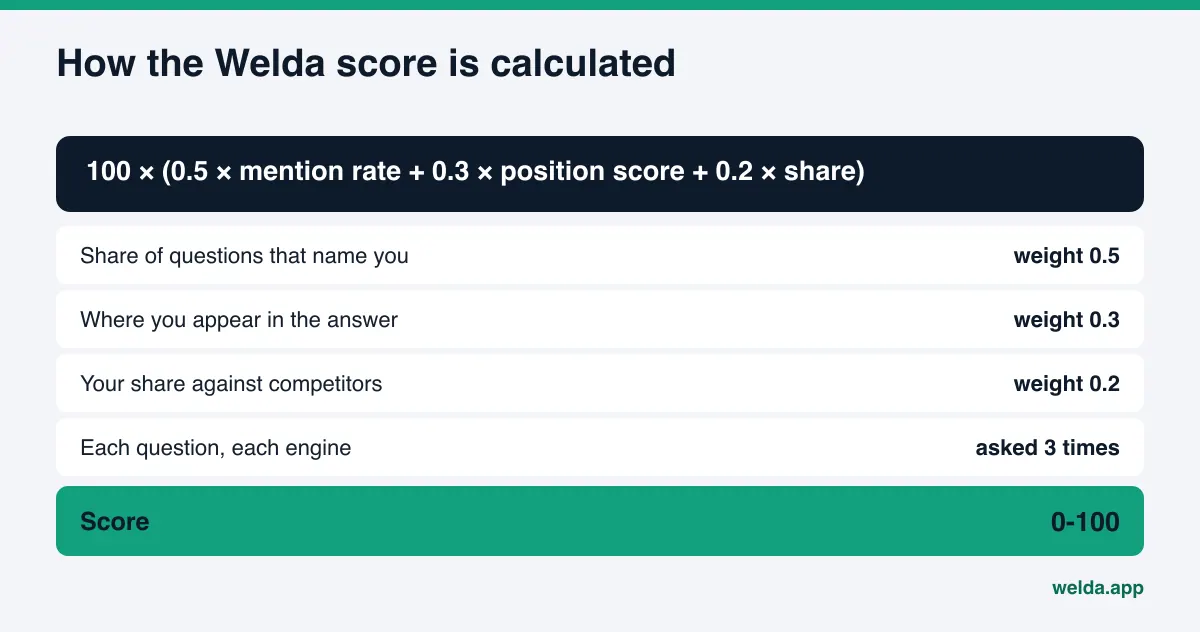
The score formula is public: 100 × (0.5 × share of questions that name you + 0.3 × position score + 0.2 × share against competitors), with a ± margin of error derived from the variation across the three runs. That makes the number something you can defend in a leadership review. Connecting that score to revenue is a separate exercise; we cover it in attribution for AI referrals.
The sources view. This screen lists the sites AI leans on when answering your questions and your status on each: missing profile, unverified, or not present at all. For a store, that list often includes review sites, gift guides, press and social profiles. Seeing which source a competitor wins from turns "we should do more PR" into a specific task.
A to-do list with the copy attached. Each task comes with a draft: a new homepage headline, a category intro, FAQ answers, a Google Business Profile description, a reply to a review. Welda does not invent facts; if your return window is not on the site, it asks you. On WordPress sites, Welda connects through a dedicated Editor user and an application password, with no code to install; content opens as a draft and goes live when you approve it. On other platforms, Welda hands you a ready-made package and your team applies it. The content always lives on your own site, and the publish decision stays with you.
There is more in the dashboard (competitor view, before-and-after comparison, a one-page monthly PDF report), but those three are where an ecommerce team spends its time.
What you can use today. The Welda dashboard is in early access and is opening first in Turkey; regular four-engine tracking is being added during early access, and sample dashboard screens use representative data. What anyone can use today is the free site analysis, which runs in English and German: it reads your homepage and a few inner pages, scores what it finds, explains each gap and how to fix it, and asks five shopper-style questions to an AI assistant with web search to check once whether your name comes up. Pricing is discussed in the early access conversation.
Limits: what Welda does not do
- No ranking guarantees. Welda does not promise that you will appear in ChatGPT or in any particular position. Read why guaranteed ChatGPT rankings are a red flag before you buy from anyone who does.
- No fake reviews. Welda never writes reviews or creates accounts. It drafts replies to real reviews. This also keeps you on the right side of the FTC's rule on consumer reviews and testimonials, which prohibits fake reviews; this is not legal advice.
- No made-up facts. Return windows, shipping times and sourcing details come from you, not from a guess.
- No publishing without approval. Sensitive content does not go live unless you approve it. The compliance check flags patterns like price claims, guarantees and superiority claims before publishing; it is not legal advice and has not been reviewed by legal counsel.
- Some work stays with you. Resolving negative reviews, directory listings and press outreach are yours; Welda lists them as manual tasks.
- Results take time. New content usually takes weeks to show up in AI answers. Do not plan it like a flash sale.
Your monthly AEO checklist
Bring this to your next team meeting and mark each line yes or no. Every "no" is a task for the coming month.
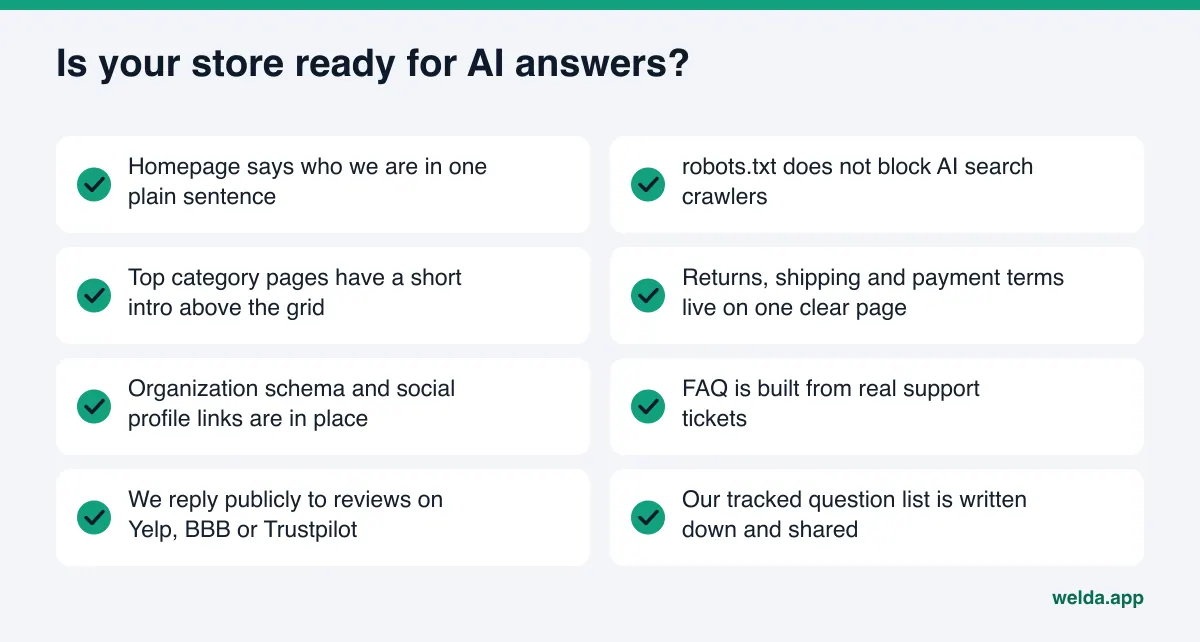
Once the checklist is done, three decisions remain. Which questions will you track (20 to 40 is a good start for a store)? Who owns the work across content, customer experience and development? And how will you measure: manually once a month, or with a tool? Manual checks are fine at the start. They get hard to keep consistent once you track dozens of questions across four engines.
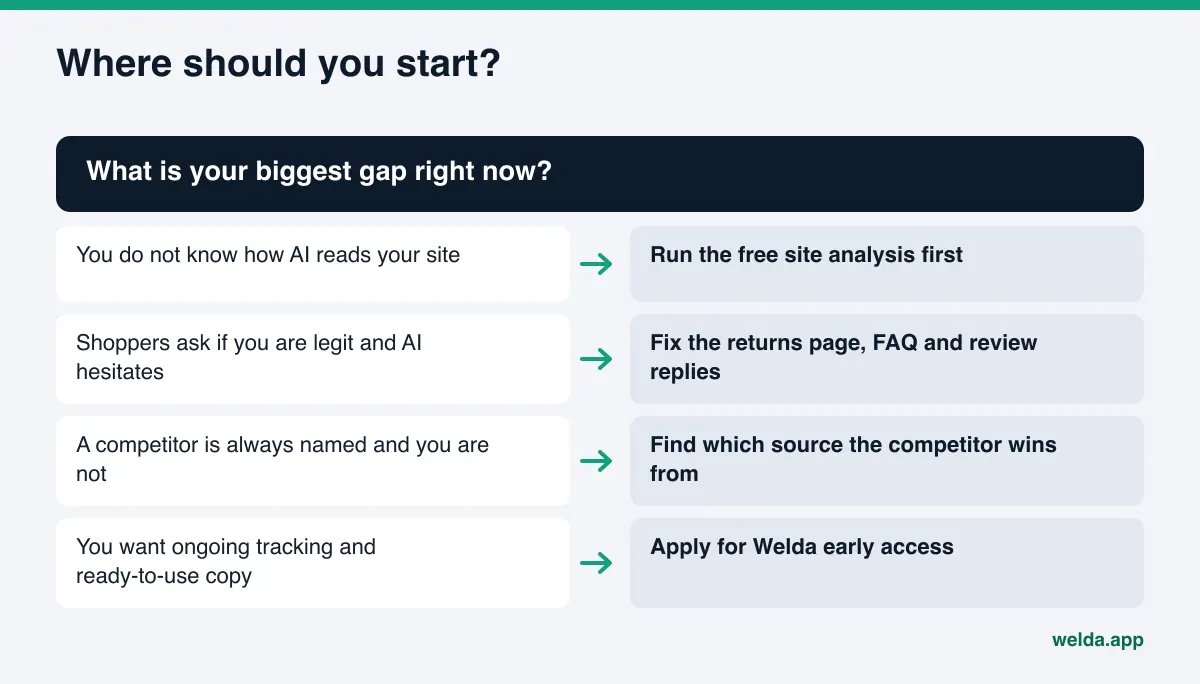
Frequently asked questions
Does AEO replace SEO for an online store?
No. AI answers lean heavily on pages that search engines can read and index; a page that is not indexed is invisible on both sides. AEO adds question-level measurement and a sharper focus on trust details on top of good SEO.
We sell mostly on marketplaces. Does our own site still matter?
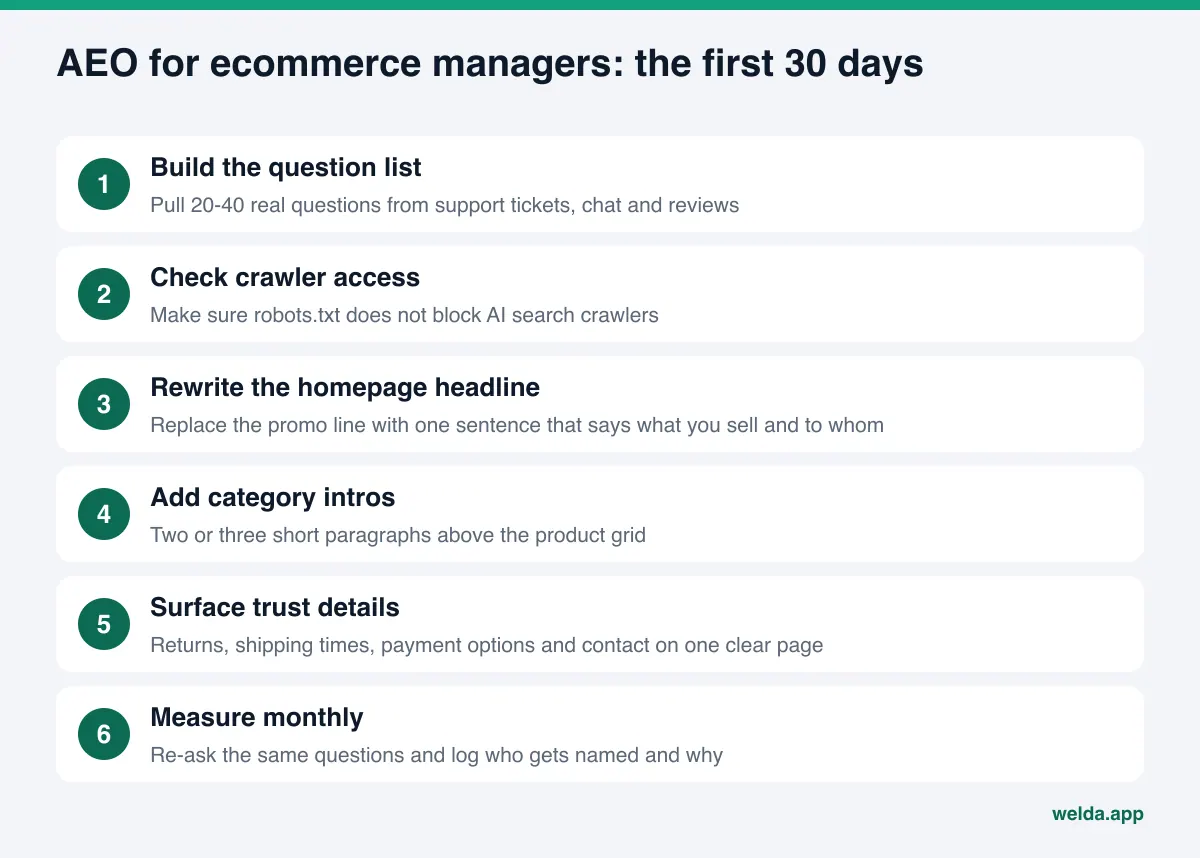
Yes. A marketplace listing describes the product well, but it leaves little room to explain who you are, what your return promise is and why you are trustworthy. AI assistants usually find that on your own site and in what others write about you.
Do we need to rewrite every product page?
Not at first. Start with the homepage, the returns and shipping page, the FAQ and intros for your best-selling categories. Go back to individual product pages when your tracked questions show a gap there.
Do negative reviews on Trustpilot or BBB affect AI answers?
AI answers can cite review sites. You cannot remove a fair review, but you can reply clearly and show how you fixed the issue. Welda drafts those replies; you decide what gets posted.
How long until we see a change?
Changes on your site usually take weeks to show up in AI answers. Measuring once a month with the same question list helps you separate real movement from day-to-day noise.
Can US stores use Welda today?
The free site analysis works in English today; it is free once per site and asks you to verify your email and phone number. The full dashboard is in early access and opening first in Turkey.
See how AI reads your store today
Instead of guessing which of these fixes matters most, measure first. The free site analysis reads your homepage and key pages like returns, contact and About the way Google and AI systems do. You get a score out of 100, an explanation of every gap with the fix, ready-to-use homepage copy, a competitor comparison and a fix package you can add to your site. The results link arrives by email and stays open for 14 days. Share it with your team and build next month's to-do list from it.