What does AEO mean for a Chicago business, and where do you start? AEO for Chicago businesses means getting named when a customer asks ChatGPT, Gemini, Perplexity, or Google "which bakery in Andersonville" or "a plumber who serves Oak Park." You start by writing down the questions your customers actually ask, making your neighborhood and service area obvious on your site and profiles, and measuring which questions mention you.
This guide is for owners and marketing leads at Chicago restaurants, clinics, salons, contractors, hotels, and professional offices who keep hearing that customers "asked AI" before they called. AEO (answer engine optimization) is the work of making your business easy for AI assistants to find, understand, and recommend. Some people call the same work GEO, short for generative engine optimization; in the US, AEO and "AI search visibility" are the more common terms. Chicago adds its own wrinkles: people search by neighborhood rather than by city, the suburbs behave like separate markets, and the seasons change what customers ask. Below we cover how those details affect AI answers, the steps to take in order, and the part Welda handles. If you want a quick read on where your site stands today, the free site analysis reads your site the way Google and AI assistants do and returns a scored list of gaps with fixes.
Why AEO for Chicago businesses is its own problem
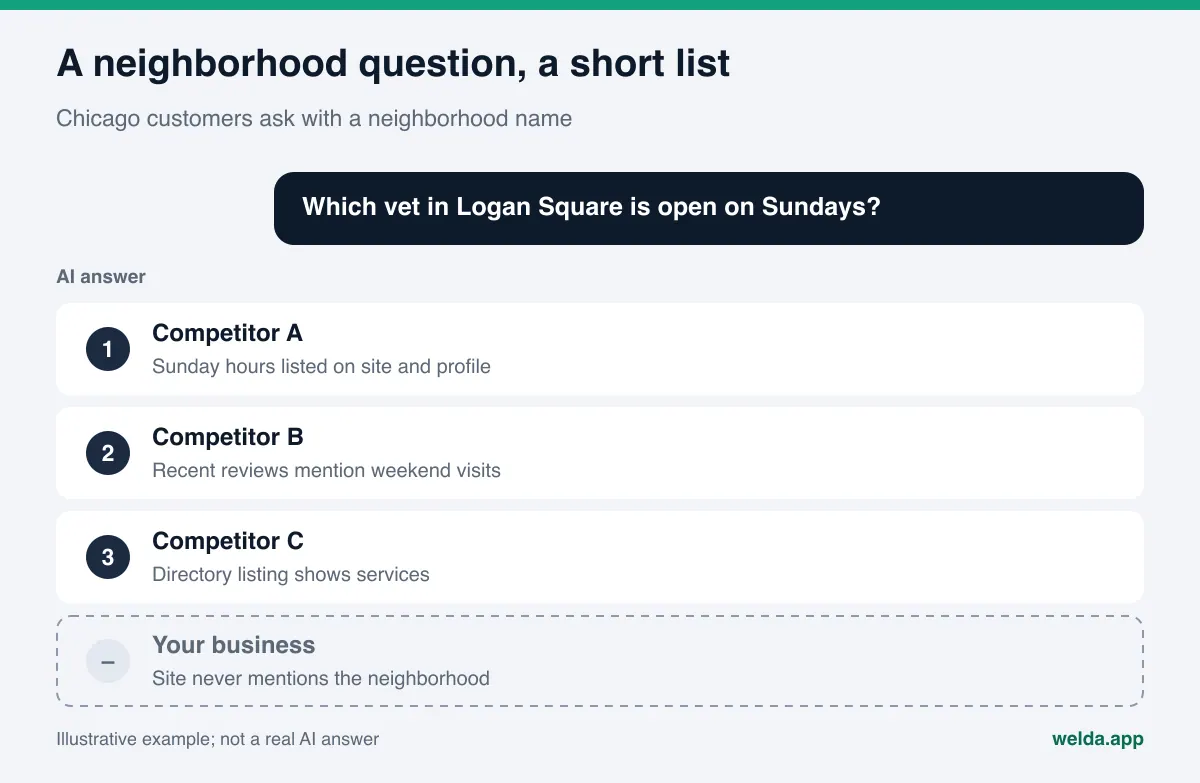
When someone asks an AI assistant for a recommendation, the answer usually names a handful of businesses, each with a one-line reason. Many people never look past that short list. A business that is not on it was never considered, and that loss does not show up anywhere: not in your web analytics, not in your call logs, not in your ad dashboards.
Three things make this sharper in Chicago. First, Chicagoans think and search in neighborhoods. A dentist in Lakeview and a dentist in Hyde Park are both "in Chicago," but their customers ask with the neighborhood name attached. If your website lists a street address but never says "Lakeview" in a sentence, an assistant may struggle to connect you to that question.
Second, the metro area behaves like many markets. Evanston, Oak Park, Naperville, and Schaumburg customers ask about their own suburb, and a contractor who serves some of them needs to say which ones. "Serving Chicagoland" is too vague to match a specific question.
Third, the city runs on seasons. Patio dining, rooftop bars, and lakefront activities dominate summer questions. Snow removal, furnace repair, and indoor activities take over in winter. Businesses with seasonal hours or services need their sites and profiles updated before the season shifts, not after. Our guide to AEO for seasonal businesses goes deeper on timing.
We are not going to quote a statistic about how visible Chicago businesses are in AI answers. We do not know of a reliable, public measurement of that, and Welda does not publish city-level data. The number that matters is whether your name appears in answers to your customers' questions.
What Chicago customers ask AI assistants
Your question list is the foundation. Measurement, content, and source work all follow from it. Build it from what you actually hear on the phone, at the counter, and in emails, not from guesses. The table below shows common question types with examples written for this article; they are not drawn from any study.
| Question type | Example | What the customer wants |
|---|---|---|
| Neighborhood plus need | "Kid-friendly brunch in Lincoln Park that takes reservations?" | Proximity and fit |
| Suburb plus service | "Which roofers serve Oak Park and do free estimates?" | Service area and terms |
| Comparison | "Quiet coffee shops near the Loop for a client meeting?" | Atmosphere |
| Seasonal | "Best heated patios in Wicker Park for October?" | Seasonal details |
| Practical detail | "Physical therapist near the Blue Line with evening hours?" | Transit and hours |
| Visitor | "Where should I eat near McCormick Place during a conference?" | Quick, nearby options |
Notice that most questions carry a detail: evening hours, free estimates, heated patio, near the Blue Line. AI assistants tend to favor businesses whose public information answers that detail directly. If your hours, transit access, or service terms are buried in an image or missing from your profiles, the assistant may not count you as a fit.
A practical size for a starting list is 20 to 40 questions. Mix neighborhood questions, plain "in Chicago" questions, and service-only questions. If you get conference or tourist traffic, include a few visitor questions.
Which sources AI assistants use for Chicago businesses
Most AI assistants use web search when they answer recommendation questions, and they cite the pages they rely on. What an assistant can say about you is limited to what the web says about you. For a local business, those sources fall into five groups.
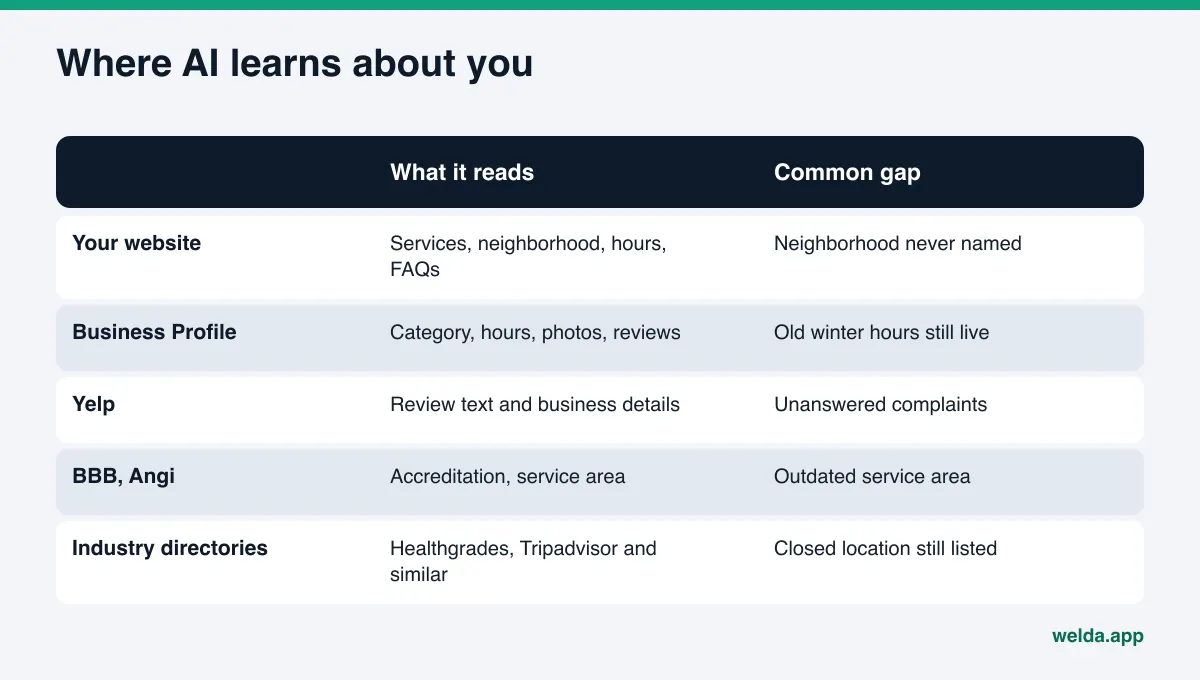
Your website. This is where you can state your services, neighborhood, hours, and answers to common questions most clearly. It also needs to be reachable by AI crawlers. OpenAI, for example, documents that sites blocking its search crawler in robots.txt will not be shown in ChatGPT search answers. A quick look at your robots.txt is worth the five minutes.
Google Business Profile and Google Maps. Category, hours, photos, and review text live here. Google says there are no extra technical requirements for AI Overviews or AI Mode: a page needs to be indexed and eligible to show with a snippet, and standard SEO practice still applies, according to its Search Central documentation. That makes accurate, consistent basics more important, not less.
Review platforms. Yelp is a common review source for restaurants and local services, and the review text itself carries information. A review that says "they came out to Evanston the same day" tells an assistant something your site may not. Our piece on reviews and AI recommendations covers how review content shapes answers.
Trust and service directories. BBB and Angi matter for home services. Healthgrades matters for clinics and practitioners. Tripadvisor matters for restaurants and hotels that see visitors. Outdated service areas or a closed location on these sites can work against you.
Community discussion. Local forums and neighborhood threads sometimes show up among cited sources. Posting there is not your job, but knowing that an old address or a closed branch is still circulating is useful.
Rather than guessing which directory matters most in your industry, look at which sites the assistants actually cite for your questions. That is the only reliable way to decide where to spend time.
Step-by-step AEO for Chicago businesses
Here is an order you can follow on your own. Each step uses the output of the one before it.
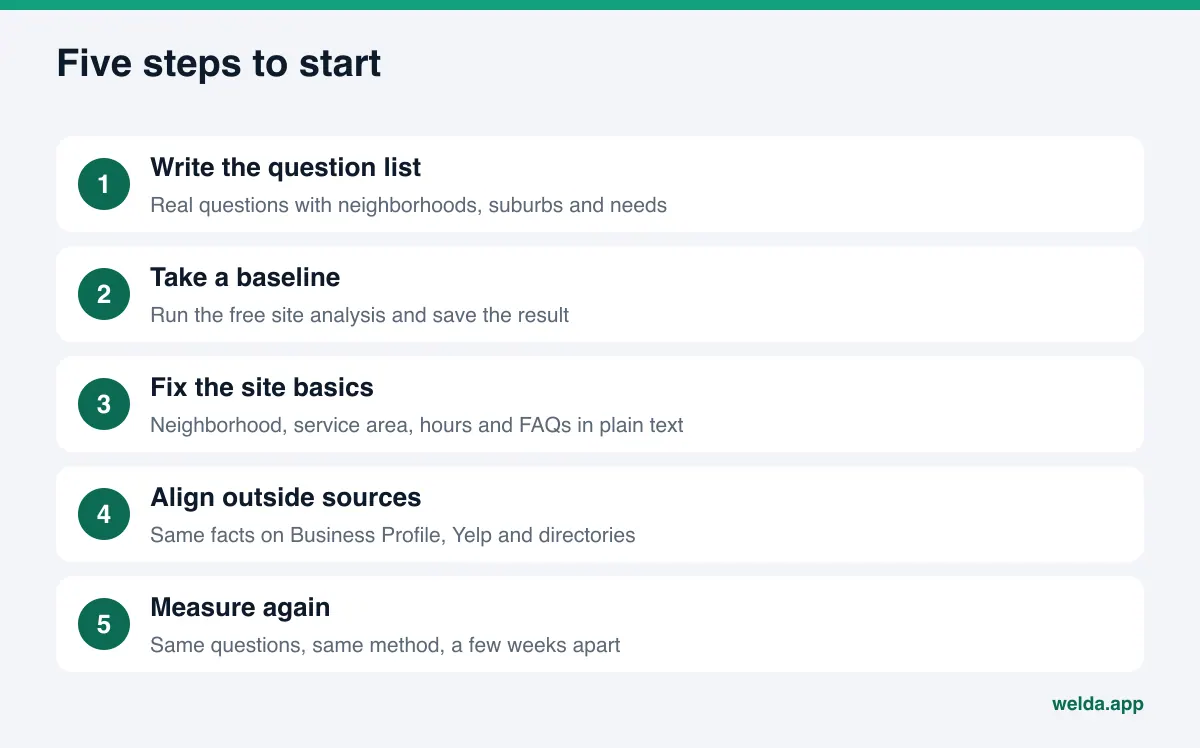
- Write the question list. Adapt the table above to your business. Tag each question: neighborhood, suburb, service, season, visitor. Tags show you later which kind of question you are weak on.
- Take a baseline. Record where you stand before changing anything. The free analysis scores your site out of 100 on technical and content factors, explains each gap and how to fix it, and asks five customer questions to an AI assistant that can search the web, checking whether your name appears. That is a one-time snapshot, but it shows you where to start.
- Fix the site basics. Make sure robots.txt is not blocking AI crawlers. Put "Chicago" and your main service in the homepage title. Keep your address, phone, and neighborhood identical on every page. Make sure your business schema matches the visible address.
- Name your neighborhood and service area. More on this in the next section.
- Build a real FAQ section. Answer the details from your question list in short, plain text: parking, transit, weekend hours, seasonal services, what drives your price.
- Align outside sources. Make hours, address, and services match across Google Business Profile, Yelp, BBB, and your industry directories.
- Respond to reviews. Reply to critical reviews calmly and with facts. Do not buy or invent reviews; the FTC's final rule announced in August 2024 bans fake reviews and testimonials, including AI-generated ones.
- Measure again. Changes usually take weeks to show up in AI answers. If you do not use the same questions and the same method each time, you cannot compare results.
If you plan to run all of this yourself, our guide to DIY AEO for small business owners has a fuller task list.
Getting neighborhood and service area details right
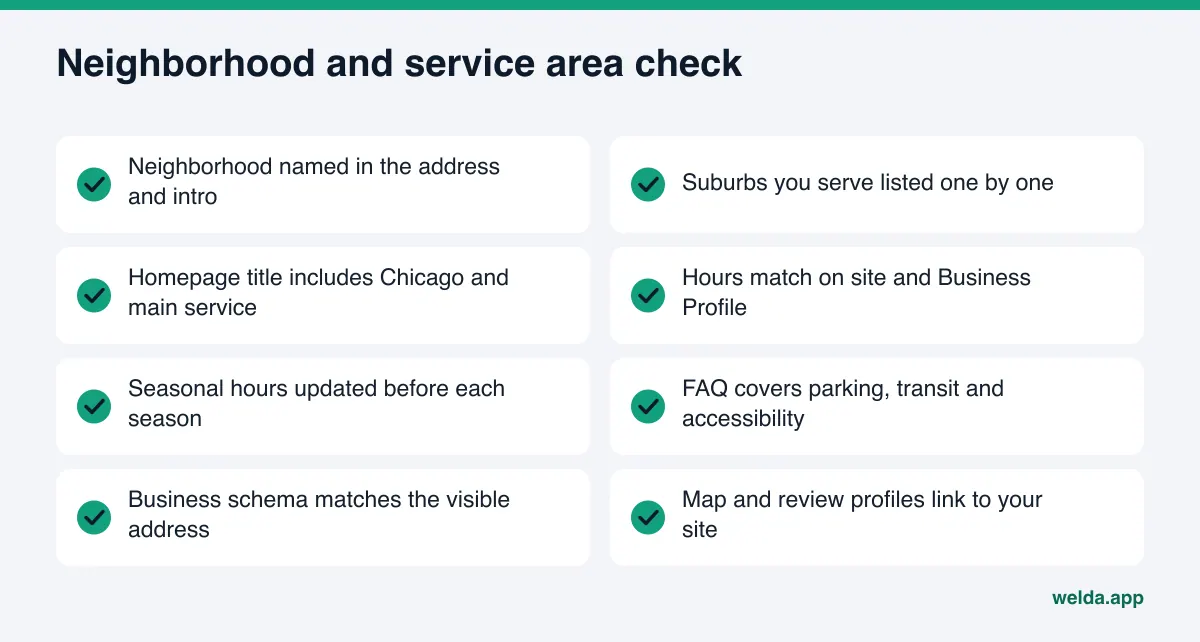
This is the step Chicago businesses skip most often. Many local sites have a full address on the contact page but never mention the neighborhood in running text. An assistant may read your address, but if your service page never says "serving Lakeview and Lincoln Park," it has less to connect you to that question.
What to write depends on how you operate:
- Single storefront (cafe, salon, clinic): name your neighborhood in the homepage intro and on the contact page. Mention real landmarks people use to find you, such as the nearest L stop or a well-known cross street. Only write what is true.
- Mobile or on-site service (plumbing, cleaning, moving, HVAC): list the neighborhoods and suburbs you serve one by one, and say which ones you do not. "We serve the North Shore suburbs by appointment" beats "serving all of Chicagoland."
- Multiple locations: give each location its own page or at least its own section with its own hours, phone, and Google Business Profile. Remove closed locations from profiles and directories.
Use "Chicago" and your main service in your homepage title, but do not try to cram every neighborhood into it. Stuffed titles look bad to people and to search engines. The natural home for neighborhood names is the intro paragraph, a service area section, and your FAQ. For the broader local picture, see AEO for local businesses.
How Welda handles AEO for a Chicago business
Welda is software that measures where a business shows up in AI answers and does the work to close the gaps on the business's behalf. For a Chicago business, two parts of that work matter most: tracking neighborhood and need-based questions over time, and seeing which sources the assistants lean on.
Question tracking. In the Welda panel, your question list is built with your own neighborhoods and services. Each question goes to ChatGPT, Gemini, Perplexity, and Google AI three times, because a single answer can be luck and three runs make the variation visible. You see one row per question and one column per engine. If you are named, the cell shows your position in the answer; if not, it stays empty. Open a question and you see the answer detail and the sources it cited.
The decision on that screen is simple: which kind of question are you weak on? Take an illustrative case. A Logan Square vet clinic appears in plain "vet in Logan Square" answers but disappears when "open Sundays" is added. The problem is not the neighborhood; it is that Sunday hours are missing from the site and profile. Questions can be tracked in English, so the same comparison works for the exact wording your customers use.
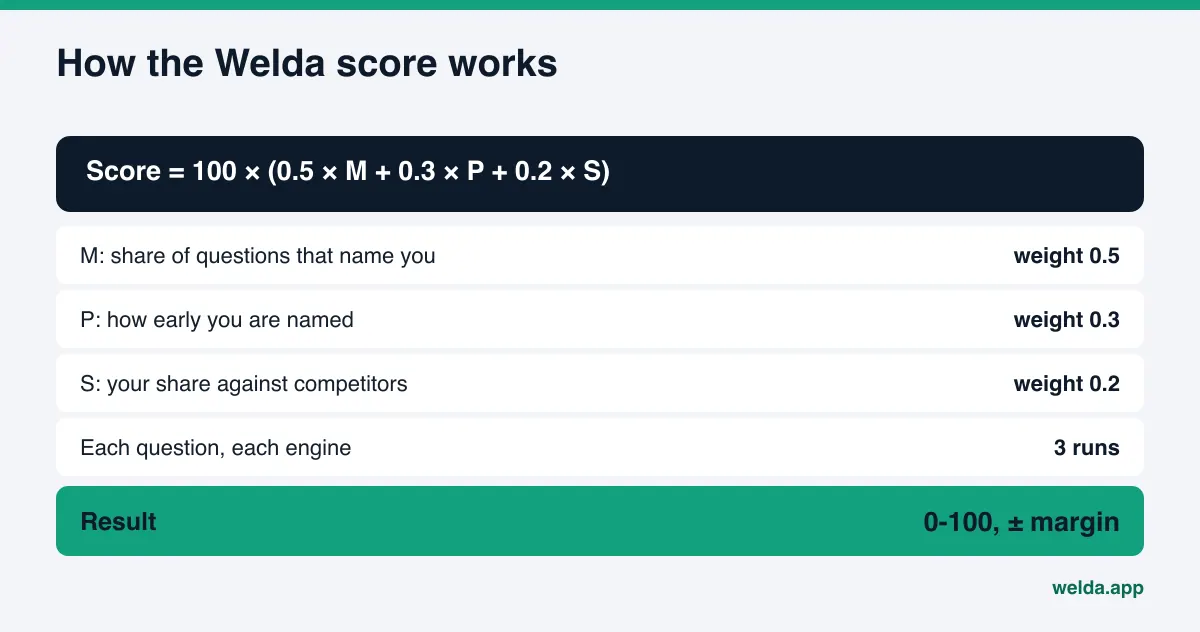
The score. The panel's headline score uses an open formula. When it moves, you can see why: more questions mention you, you are named earlier, or your share against competitors changed. Repeating each question three times also produces a ± margin, so you can tell a real change from noise.
Sources. The sources view lists the sites the engines cite for your questions and your status on each one. For a Chicago business that list might include Google Business Profile, Yelp, BBB, a forum thread, or an industry directory. Each row carries a next step: complete the profile, fix the hours, respond to a complaint. It answers "where should I spend time" with citation data instead of guesswork.
Fixes and approval. For each gap, Welda drafts the content, profile text, or review reply, for example a service area section or an answer to "are you open Sundays?" It does not invent facts; it asks you which suburbs you serve or whether you have parking. Drafts land in a to-do list, and publishing stays with you. On WordPress sites, Welda connects through a separate Editor user and an application password, with no code to install; content opens as a draft on your site and goes live when you approve it. For other platforms, Welda gives you a ready-made package and the change is applied by hand. Google Business Profile, Instagram, and Facebook can be connected; if they are not, the task is listed as manual. Your content always lives on your own site.
The panel also includes competitor comparison, a before-and-after view, and a one-page monthly PDF report. For a different big-city example, see AEO for New York businesses.
Limits: what Welda does not do, and where it stands today
First, the plain status. The Welda panel is in early access and opening in stages, starting with businesses in Turkey. Regular four-engine tracking is being added during early access, and the sample panel screens use representative data. What anyone can use today, including Chicago businesses, is the free site analysis, which works in English. Pricing is discussed in an early access conversation.
What Welda does not do matters as much as what it does:
- It does not promise rankings or guarantee that ChatGPT will mention you. No tool or agency controls AI answers.
- It does not make up facts. It asks you for hours, service areas, and other details.
- It does not publish sensitive content without approval. In healthcare, nothing publishes automatically, every draft goes to review, and patient data is never sent to AI.
- It does not create fake reviews.
- Handling negative reviews, opening directory accounts, and press work stay with you. Welda drafts review replies but does not argue on your behalf.
Set the timeline expectation early. A change on your site usually takes weeks to show up in AI answers, so leave a few weeks between measurements. Welda's compliance check flags patterns such as pricing, guarantees, superiority claims, and diagnostic suggestions before anything publishes, but it is not legal advice.
What to prioritize by industry in Chicago
The same steps apply everywhere, but what you write first depends on your industry. These are starting points drawn from how each industry works, not findings from a study.
Restaurants and cafes. Diners describe a situation: patio, kids, late night, a pre-show dinner near the theater district. Put your menu on the site as text, state reservation and takeout details clearly, and keep Business Profile photos current. If you are in a well-known area such as River North or Pilsen, say so in the opening paragraph.
Hotels. Downtown hotels see business travel and convention questions; others see weekend and event questions. State how you connect to transit and the airports, what parking costs depend on, and your cancellation terms. Check that travel sites do not contradict your own site.
Healthcare. For dentists, physical therapists, and other practices, questions focus on trust and logistics: evening hours, insurance accepted, languages spoken, parking. Healthcare marketing carries extra rules; avoid "best" and outcome promises. Describe services and logistics, and leave clinical claims to your compliance review.
Home services. Customers ask with a suburb and urgency. List the areas you serve, whether you take emergency calls, and what drives your price. You do not need to publish numbers, but explaining what affects price gives an assistant something to work with.
Decision checklist for Chicago businesses
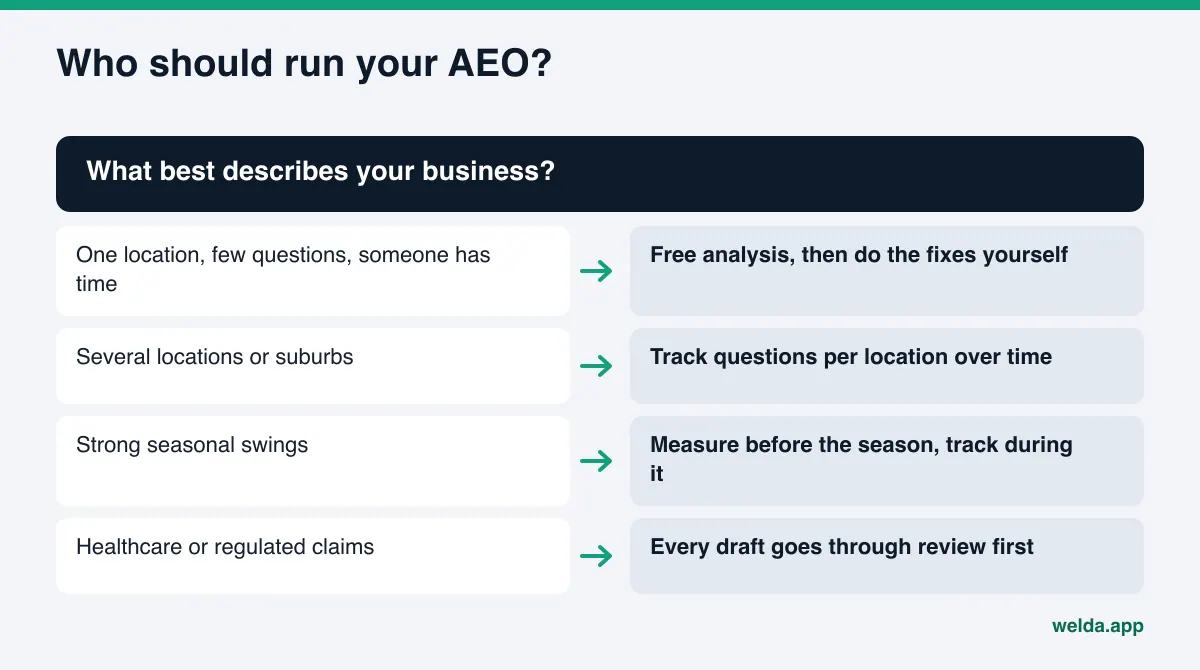
Before you choose how to run this, answer five questions honestly:
- Can I write at least 20 questions my customers actually ask?
- Does my site state my neighborhood, hours, and service area in plain text?
- Do my Business Profile, Yelp, and directory listings match my site?
- Who will approve changes, and who will publish them on the site?
- Who will repeat the measurement every month, the same way?
If you cannot put a name next to the last two, the problem is usually not knowledge; it is that nobody owns the process. That is the real difference between a tool that only measures and one that also does the work, which we compare in AI visibility monitoring vs done-for-you AEO.
Frequently asked questions
Is AEO different from local SEO?
The foundation is shared: accurate address, consistent profiles, a site that reads well. The measure is different. Local SEO asks where you rank. AEO asks whether the answer to a customer's question names you, and which source put you there.
Should I build a page for every Chicago neighborhood?
Only where you have a location or real, regular service. Do not publish copies with the neighborhood name swapped; they tell the reader nothing and erode trust. For mobile services, one clear service area section is usually enough.
Does the free analysis work for a US business?
Yes. The free site analysis works in English. It checks your site, gives a score with fixes, and runs five customer questions once. The full panel is in early access and opening first in Turkey.
How long until changes show up in AI answers?
Technical fixes are quick, but reflection in AI answers usually takes weeks. Compare the same questions measured the same way a few weeks apart.
Does Welda host content for me?
No. Content always lives on your own site. On WordPress it opens as a draft and goes live with your approval; elsewhere you get a ready-made package.
Which AI assistants should a Chicago business care about?
The ones your customers use. ChatGPT, Gemini, Perplexity, and Google's AI Overviews and AI Mode cover most cases. They draw on different sources, so showing up in one and not another is normal.
Next step
AEO for Chicago businesses starts with a question list that reflects how people here actually search: by neighborhood, by suburb, and by season. Before you write that list, see how your site looks to AI today. Run the free site analysis, get your score, your gap list, and the result of five customer questions, then use it to order the steps in this guide.