Tourists are asking AI for recommendations. How do you get named when they ask in their own language? Tourists asking AI for recommendations usually ask in their first language, and the answer is built from sources the AI can read in that language. If everything about your business exists only in English, a visitor asking in Spanish, Portuguese or German is less likely to see your name. The fix is a site that reads well in the visitor's language, complete outside profiles, and regular measurement.
In the US this work is usually called AEO, short for answer engine optimization, or AI search visibility. You may also see the term GEO (generative engine optimization), which describes the same goal; this article sticks with AEO. For hotels, restaurants, tour operators, attractions and shops that serve international visitors, AEO has an extra layer: the person asking may not be asking in English at all. This guide explains how those answers are formed, what to fix on your site and on outside platforms, step by step, and what Welda does in this work. To see how your own website reads to AI today, start with a free AI visibility analysis; it lists every gap it finds and how to fix it.
Why tourists asking AI for recommendations changes the game
A visitor planning a trip used to compare options on a booking site, a review site or a printed guide. Now many open ChatGPT, Gemini, Perplexity or Google's AI Mode and type one sentence: "family-friendly hotel near Disney Springs with a free shuttle", "where to get authentic Cuban coffee in Little Havana", "quiet cabin near the Smoky Mountains with a hot tub". The answer is a paragraph with two or three names.
Three things about that answer matter for visitor-facing businesses:
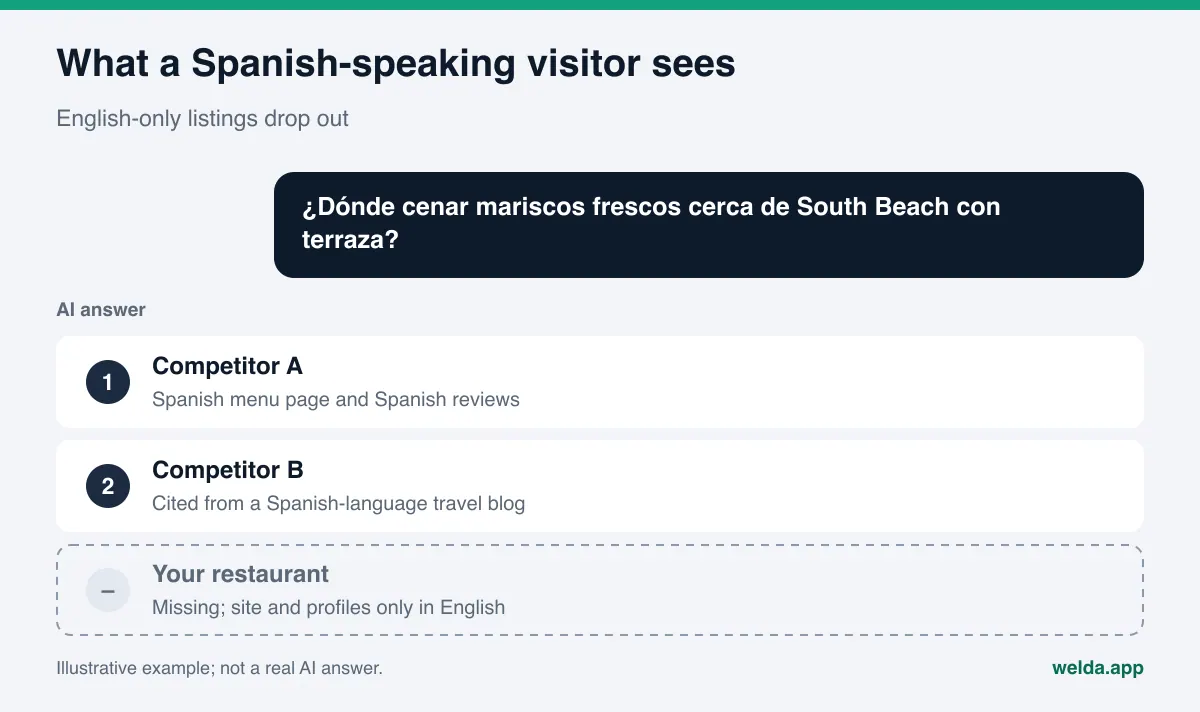
- The answer follows the language of the question. A question in Spanish gets a Spanish answer, and the AI often leans on pages, reviews and profiles it can read in Spanish. An English-only menu page is a weaker source for that answer.
- The list is short. A classic search showed ten links, a map pack and ads. An AI answer usually names a handful of businesses. If you are not on that list, the visitor may never consider you.
- The question is specific. Visitors rarely ask for "a hotel". They ask for "a quiet hotel with a pool, walkable to the boardwalk, with parking for an RV". If the AI cannot read those details about you in the visitor's language, it cannot match you to the question.
The US adds its own twist. Many of your "foreign-language" customers are not foreign at all. In cities like Miami, Houston, Los Angeles or San Antonio, many local customers speak Spanish at home and may ask an AI assistant in Spanish. So a multilingual approach serves two groups at once: international visitors and local residents who prefer another language.
Where does an AI answer in another language come from?
AI assistants that search the web build their answers from many sources, not one. For visitor questions, those sources usually fall into four groups:
- Your own website. If you have a Spanish or German version that clearly describes your services, location and price range, the assistant can use it directly as a source.
- Review platforms. Tripadvisor, Yelp and booking platforms carry reviews from visitors around the world. The language of those reviews matters: Spanish reviews match Spanish questions more easily.
- Map listings. Your Google Business Profile and, for iPhone users, Apple Maps hold your address, hours, category and photos. These are basic inputs for any question that names a place. If you have not claimed your Apple listing yet, see our piece on Apple Business Connect for AI assistants.
- Travel blogs, guides and forums. Articles written in the visitor's language can also feed the answer. You do not write these, but you can check whether what they say about you is correct.
Which source wins in which language is hard to guess. A Spanish travel blog may matter for Spanish questions and barely register for English ones. The only reliable way to know is to measure the same questions in each language you care about.
Which businesses depend on visitor questions most?
Not every business needs a multilingual AEO plan. A neighborhood dry cleaner can skip this. But if you operate in a tourist area or serve many international guests, the AI answer may be the first time a new customer hears your name. The table below shows typical visitor questions by business type. The questions are examples; the only way to know what is asked about your area is to measure it.
| Business type | Example visitor question | Where to look first |
|---|---|---|
| Hotel, inn, vacation rental | "Hotel near the Strip with a quiet pool, not a party place" | Room and location pages in the visitor's language, Tripadvisor reviews |
| Restaurant | "Restaurante con opciones sin gluten cerca de Union Square" | Menu in Spanish, Google Business Profile, review replies |
| Tour operator | "Private boat tour in Key West, what is included" | Itinerary, inclusions, cancellation terms |
| Attraction, museum | "Is there an audio guide in Portuguese" | Languages offered, hours, ticket information |
| Dental or medical practice | "Dentista que hable español en Houston" | Languages spoken, service pages, contact options |
| Shop, gallery | "Where to buy Native American jewelry in Santa Fe from the artists" | Product story, hours, visiting details |
For local businesses in general, the basics that drive AI answers are covered in AEO for local businesses. What follows focuses on the language layer on top.
How to reach tourists asking AI for recommendations, step by step
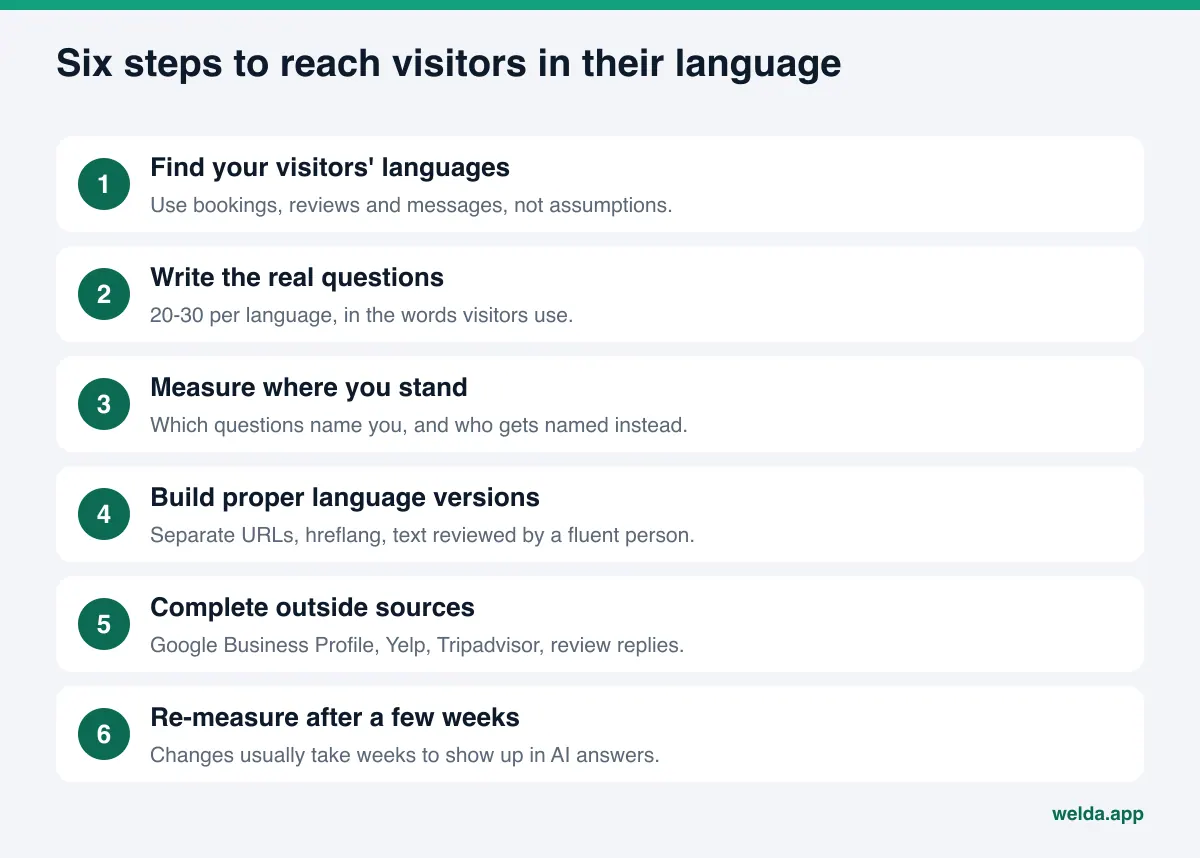
The steps below are a practical order for a visitor-facing business. Order matters: fixing things before measuring tends to put effort in the wrong place.
1. Find out which languages your visitors use
Look at booking records, the language of your reviews and the messages you receive. Are most international guests writing in English, or do Spanish, Portuguese, French or Mandarin speakers stand out? This tells you where to invest first. Use your own records, not national tourism headlines.
2. Write the questions in the visitor's words
The term you use for your service may not be the term a visitor uses. A "raw bar" or "happy hour" is clear to a local; a visitor might ask for "fresh oysters" or "cheap drinks before dinner". Pull phrases from your reviews and write 20 to 30 questions per language. Include neighborhood names, nearby landmarks and real needs: kids, wheelchair access, vegetarian food, airport shuttle, parking.
3. Measure where you stand today
Ask those questions to AI assistants and record the results: are you named, in what position, who is named instead, and which sources does the answer cite? One try is not enough. The same question can get a different answer an hour later, so each question should be asked more than once.
4. Build proper language versions
Your site's other-language versions have to be built in a way that search engines and AI crawlers can tell apart. The next section covers this in detail.
5. Complete your outside sources
Your Google Business Profile, Yelp and Tripadvisor listings, and your replies to reviews in other languages. These sources may be read more often than your own site.
6. Re-measure after a few weeks
New content and corrected profiles usually take weeks to show up in AI answers. Run the same question list again and compare. Using the exact same questions before and after is what makes the comparison meaningful.
Is your site readable in the visitor's language?
On many small business sites, the "Español" button either does nothing useful or runs a browser plugin that translates the page on the fly. That text is often invisible to crawlers and has never been read by a person. To work as a source for a visitor's question, a language version needs a few basics.
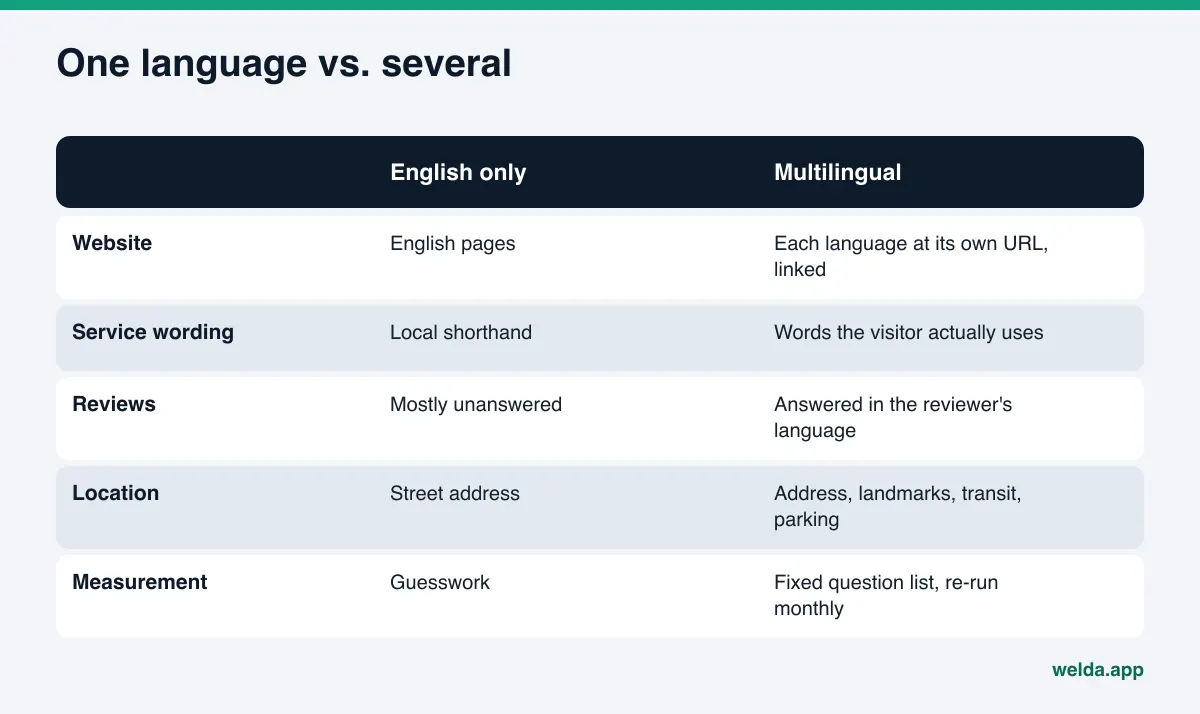
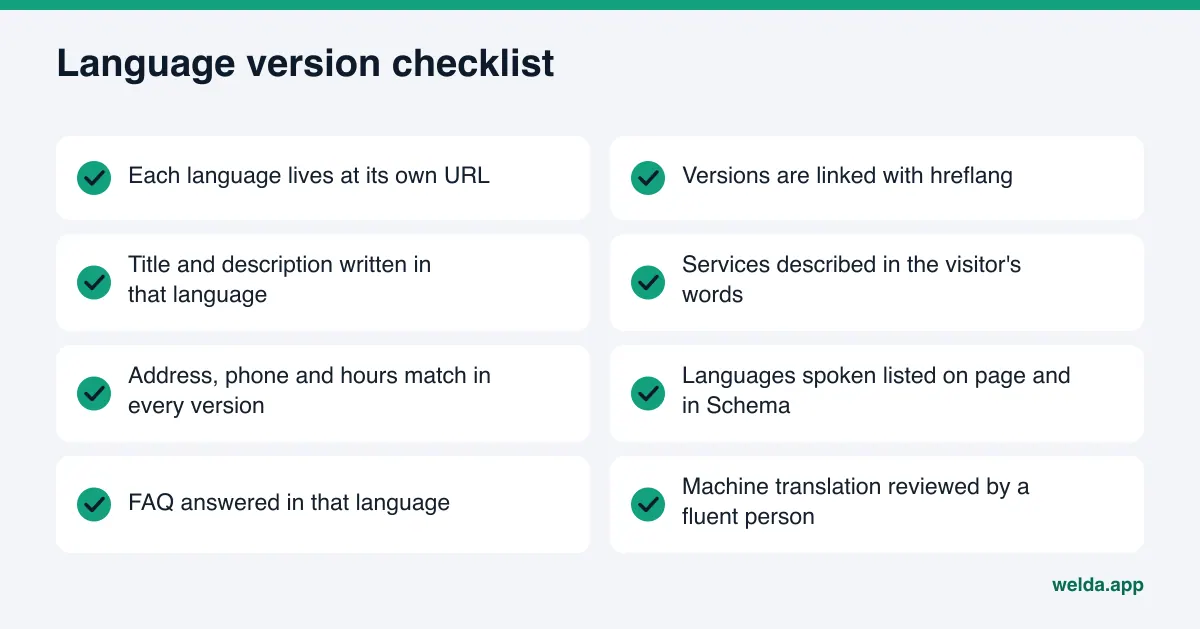
Each language lives at its own URL. The Spanish page should be a separate page at its own address (for example under /es/), not text swapped in by a script. Search engines and AI crawlers identify pages by URL.
Versions are linked to each other. Google recommends linking the language versions of a page with hreflang annotations. According to Google's guide to localized versions, each version must list itself and every other version; if two pages do not point to each other, the annotations are ignored. This does not put you in an AI answer by itself, but it makes clear which page is in which language.
A fluent person reads the text. Machine translation is a fine first draft. Before it goes live, someone fluent should read it. A mistranslated dish, a garbled cancellation policy or an odd sentence misleads both the guest and the AI reading the page.
Explain what visitors do not know. Locals know where "the Strip" or "the Quarter" starts; visitors may not. On the other-language page, describe your location with landmarks, distance to the airport and downtown, transit options and parking. State your hours, payment options and the languages your staff speak.
Mark up the languages you speak. In Schema markup, the availableLanguage property states which languages are available for a service or contact point; it is defined for lodging businesses and contact points, among others. Keep the markup consistent with what the page says. The general rules are in schema markup for AI search.
Keep address, phone and hours identical everywhere. If you update your hours on the English page and the Spanish page still shows the old ones, the AI sees two conflicting facts and may repeat the wrong one.
Reviews and outside sources in other languages
Reviews carry a lot of weight in visitor questions. People ask for "quiet", "clean" or "staff speaks Spanish", and the AI often finds those details in reviews. Here is what to do:
- Reply in the reviewer's language. A short, specific reply in Spanish to a Spanish review shows the next reader, and the AI, that you serve that language.
- Do not leave negative reviews unanswered. A calm, factual reply can change how a complaint is carried into an answer. More on this in reviews and AI recommendations.
- Complete every profile. Description, amenities, photos and languages spoken on Google Business Profile, Yelp and Tripadvisor. Write descriptions that explain what a first-time visitor would not know.
- Keep your listings consistent. An old phone number on one directory and a new address on another can lead the AI to give a visitor wrong directions. See wrong address or phone number in AI answers.
- Never buy or fake reviews. The FTC's final rule on fake reviews and testimonials, announced in August 2024, bans buying or selling fake reviews, including AI-generated ones, and paying for reviews with a particular sentiment. Asking real guests for honest reviews is fine. This is not legal advice.
An example: a small inn in a beach town
Here is an illustrative scenario. A small inn with a dozen rooms operates in a Gulf Coast beach town. English-speaking guests find it easily, and it shows up in English questions about the area. In winter, though, a good part of its guests come from French-speaking Quebec, and in summer from Mexico. The owners have no idea whether these guests ever see the inn in an AI answer.
The inn reads through a year of reviews and notes what French and Spanish speakers mention most: the breakfast, the quiet street, the walk to the beach, help with restaurant bookings. It writes a short question list in each language, for example:
- "Petit hôtel tranquille près de la plage avec déjeuner inclus"
- "Hotel pequeño y tranquilo cerca de la playa, con desayuno"
- "Inn with free parking and bikes, walk to the beach"
The results show the inn named regularly in English and rarely in French or Spanish. The competitors that are named have room and location pages in those languages and recent replies to reviews written in them. The inn's own site has a Spanish home page and nothing else. Free bikes and parking are not mentioned anywhere.
The work follows directly from the measurement: Spanish versions of the room, breakfast and location pages, a note on languages spoken, bikes and parking added to every version, short replies to recent non-English reviews, and a completed Tripadvisor description. A few weeks later the same question list is run again. This is an illustrative scenario, not a real business result, and every area will look different.
How Welda handles visitor questions
Welda is software that measures where a business appears in AI answers and completes the missing pieces on its behalf. For visitor questions, three parts matter most: the question language, question-by-question measurement, and the sources view.
Question language. In the Welda panel, questions can be measured in English or Turkish. For a visitor-facing business, that means the English questions a traveler would ask can be tracked separately from the rest.
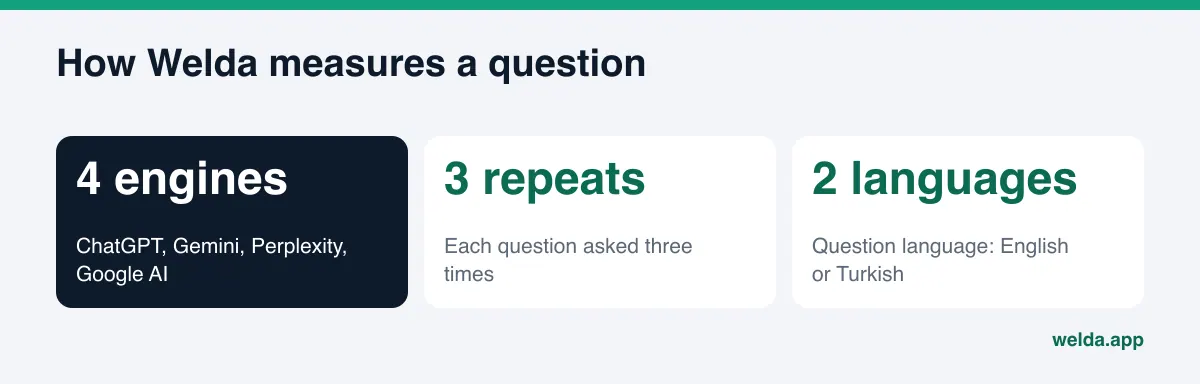
Question-by-question measurement. Each question is asked to ChatGPT, Gemini, Perplexity and Google AI three times. In the questions view, each row is one question: which engine names you, in what position, and which sources the answer relies on. If you are named second for a local-language question but never for its visitor-language twin, the problem is the language, not the service. The score behind it uses a published formula, with a margin of error from the spread between repeats.
Sources view. This view lists the sites the AI cites and your status on each: profile present, incomplete or not verified. For visitor questions, booking platforms, review sites and map listings usually rise to the top, and each row has a one-line action. You decide which source to tackle first by looking at that list.
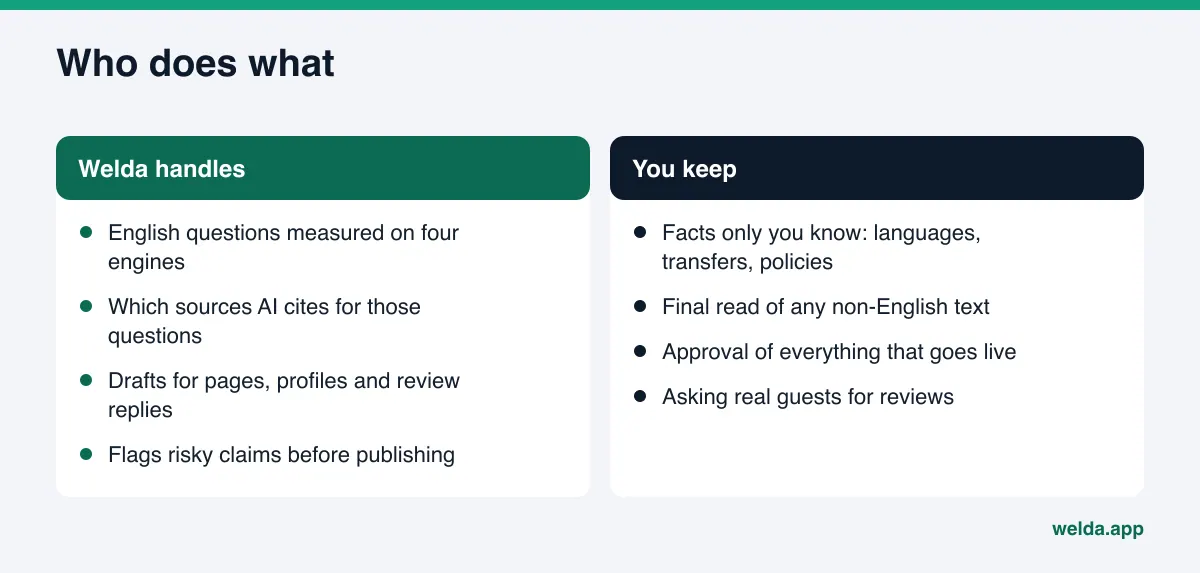
Gaps from the measurement land in a single to-do list. Welda drafts page content, profile text and review replies; you approve before anything goes live. On WordPress sites, Welda connects through a separate Editor user and an application password, and content opens as a draft; for other systems it hands you a ready package to apply yourself. Content always stays on your own site. Before publishing, a compliance check flags patterns such as price, guarantee and superiority claims. It is not legal advice.
The panel is in early access. It is opening in stages, starting with businesses in Turkey, and regular four-engine measurement is being added during early access; sample screens in the panel use representative data. What anyone can use today, in English, is the free site analysis. It reads your home page and a few inner pages and checks title, description, business Schema, address and phone, FAQ, review signals, service clarity and page speed. It also asks five questions a customer might ask to an AI assistant that can search the web, and checks whether your business name appears. Pricing is discussed in an early access conversation.
Limits: what Welda does not do
- Question languages are English and Turkish today. The panel does not measure questions in Spanish, French or Portuguese. Track those with your own spot checks and guest feedback.
- No placement guarantee. Welda does not promise that you will appear in any AI answer, in any language. AI answers vary, and no tool controls them.
- It does not invent facts. Which languages your staff speak, whether you offer a shuttle, what your cancellation terms are: Welda asks you instead of guessing.
- Nothing is published without approval. Every draft comes to you first. Having a fluent person read any non-English text is your call.
- No fake reviews. Handling negative reviews, directory accounts and press work stays with the business.
- Results take time. New content usually takes weeks to show up in AI answers.
Checklist: are you ready for visitor questions?
Use this table for a quick read on where you stand. Every "no" is a candidate for the top of your to-do list.
| Question | If yes | If no |
|---|---|---|
| Do you know which languages your visitors use? | Prioritize those | Check bookings and reviews |
| Does each language version have its own URL? | Check hreflang links | Start with home and service pages |
| Has a fluent person read the translated text? | Keep it current | Have it read before publishing |
| Are languages spoken listed on the site? | Match them in Schema | Add them to contact and about pages |
| Do you reply to reviews in other languages? | Keep it regular | Start with the most recent ones |
| Do you know where you stand in visitor questions? | Re-measure in a few weeks | Write a question list and measure |
One caution: every language version is a set of pages to maintain. A site half-translated into five languages causes more confusion than one done properly in two. For many US businesses in tourist areas, Spanish is a sensible second language because it serves both visitors and locals; your own booking data should make the final call. If you want to understand how location questions work in AI, read near me searches in AI.
Frequently asked questions
Are tourists really asking AI, or do they still use booking sites?
Both. Many travelers narrow their options with an AI answer and then move to a booking platform or the business's own site. So you need to be in the answer and on those platforms with correct information.
Is a translation plugin enough?
It can be a start, but usually not on its own. The translated page needs its own URL, the versions need to be linked, and someone fluent should read the text. Wrong information in another language misleads both guests and AI.
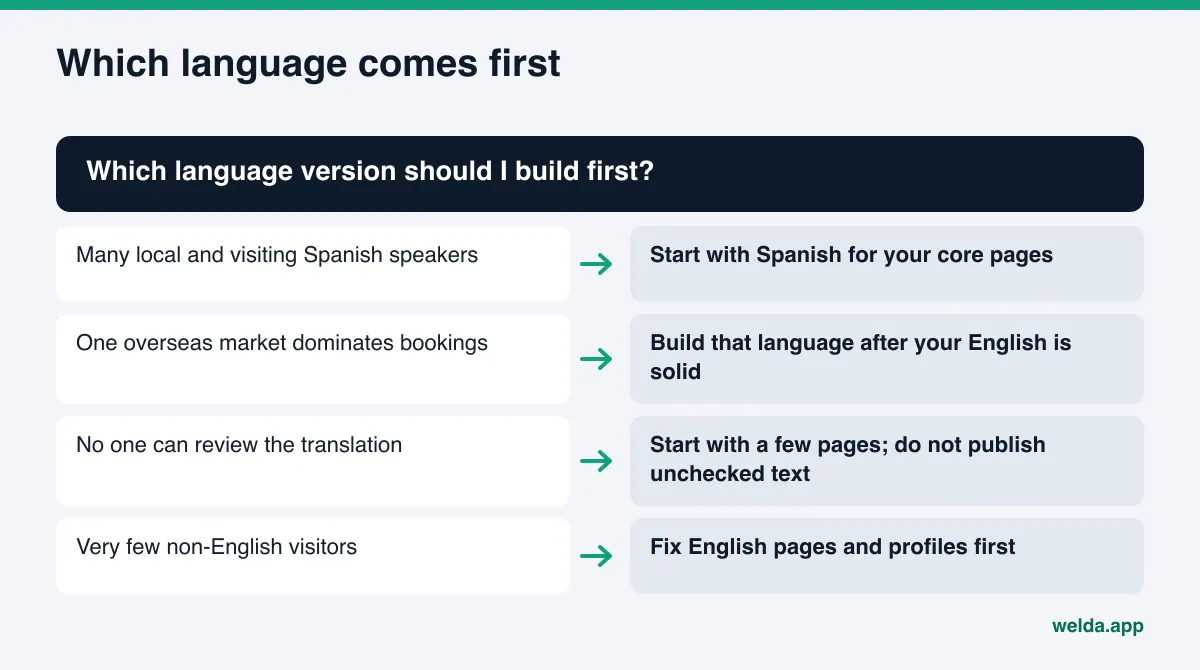
Which language should I add first?
Look at your own guest records. In many US markets Spanish is a natural choice. If one overseas market dominates your bookings, that language is a good next step once your English pages are solid.
Can Welda measure questions in Spanish?
No. The question language in the Welda panel is English or Turkish today. Track other languages with your own spot checks.
Do replies to reviews in other languages make a difference?
A reply shows that you serve that language and care about the guest, and AI assistants read reviews and replies when forming a picture of a business. There is no guaranteed effect, but an unanswered negative review usually does more harm.
How long until a new language version shows up in AI answers?
New content usually takes weeks to be reflected in AI answers. Re-running the same question list a few weeks apart is the most reliable way to see the change.
Start with your own site
Tourists asking AI for recommendations get answers built from what the AI can read about you. The first step is to see how your site reads today: your title, description, business Schema, address and phone, FAQ and service descriptions. The free AI visibility analysis checks each of these, explains why every gap matters and how to fix it, and suggests ready-to-use text for your home page. It is free once per site, works in English, and the results link arrives by email and stays open for 14 days.