How do veterinary clinics get recommended by ChatGPT? ChatGPT recommends a vet practice based on what it can read about it: which species you see, which services you offer, who your veterinarians are, where you are, when you are open, what happens after hours and what pet owners say about you. When that information is clear, consistent and easy to crawl, your practice is more likely to be named. No one can guarantee a specific position.
This guide is for owners, practice managers and marketing leads at general practices, animal hospitals and small multi-location veterinary groups in the US. The question is practical: when a pet owner asks ChatGPT, Gemini, Perplexity or Google's AI Overviews "Which vet near me is open late and good with anxious cats?", does your practice come up? If not, why not, and what should you fix first? Below we walk through how veterinary clinics get recommended by ChatGPT, what answer engine optimization (AEO) means for a vet practice, how Welda handles that work and what it does not do. You may also see this called GEO, short for generative engine optimization; it describes the same goal. If you want to see where your own site stands today, start with the free AI visibility analysis.
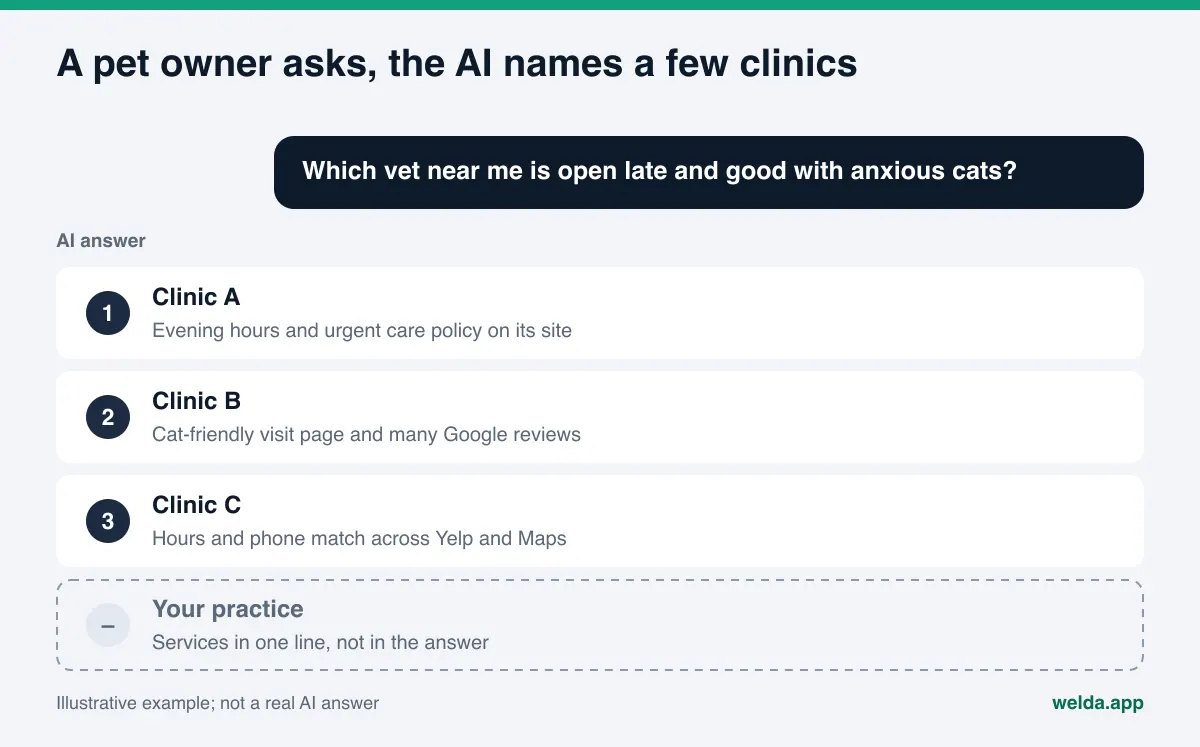
Why it matters how veterinary clinics get recommended by ChatGPT
Most vet searches start with worry, not with a clinic name. The dog will not eat, the cat threw up twice, the rabbit is sitting still in a corner. The owner first tries to figure out what is going on, then asks where to go. In classic search those were separate steps: read about the symptom, then search "vet near me" and compare a few pins on the map. With AI assistants the two steps merge into one conversation. The owner types the species, the symptom, the neighborhood and the time of day in one sentence, and the assistant replies with a handful of practice names.
If your practice is not in that reply, it is not on the list the owner calls. On a classic results page, being the seventh link still gave you a chance at a click. In an AI answer, usually only a few names appear. That makes AI search visibility less a branding question and more a question of how new clients find you at all.
A few things make veterinary AEO different from other local businesses:
- Species matter. Many owners first need to know whether you see cats only, dogs and cats, or also rabbits, birds, reptiles and pocket pets. If your site does not say it, the AI cannot know it.
- Time matters. Evening, weekend and "open now" questions are common. A practice whose hours differ between its site, Google Business Profile and Yelp is easy for an AI to skip.
- The client is not the patient. You write for the owner, but the subject is an animal's health. That calls for care in both trust signals and wording.
- Distance matters. Nobody wants to drive a sick pet across town. Questions are usually local, so your address, service area and neighborhood names need to be explicit.
If you also follow human healthcare, the logic is close to what we describe in how physical therapy clinics get recommended by ChatGPT, adjusted here for pets and their owners.
How veterinary clinics get recommended by ChatGPT: what the AI reads
When AI assistants run a web search, they pull from several sources and blend them into one answer. For a vet practice those sources typically include the practice website, its Google Business Profile and Maps listing, Yelp, local review and community sites such as Nextdoor, and discussion threads where owners compare vets. How much weight each source gets depends on the engine and the question. What they all reward is information that is written down plainly.
In practice the AI is trying to answer these questions about you:
| What the AI is looking for | Where it should live on your site | Common gap |
|---|---|---|
| Which species does this practice see? | Home page plus a "species we treat" section | Only says "pets" or "companion animals" |
| Which services are offered? | One page per core service | A single bulleted list with no detail |
| When is it open, and what happens after hours? | Contact page, after-hours section, business markup | Hours differ between site, Google and Yelp |
| Who are the veterinarians? | Team page with a short bio per DVM | Photos only, or no team page at all |
| Where exactly is it? | Full address, neighborhood, parking and directions | Address only in the footer |
| What do owners say? | Google reviews, Yelp, other independent sites | Reviews unanswered, profiles not linked to the site |
Each row maps to a type of question. The chart below shows the four main question types pet owners ask and what each one needs from your site.
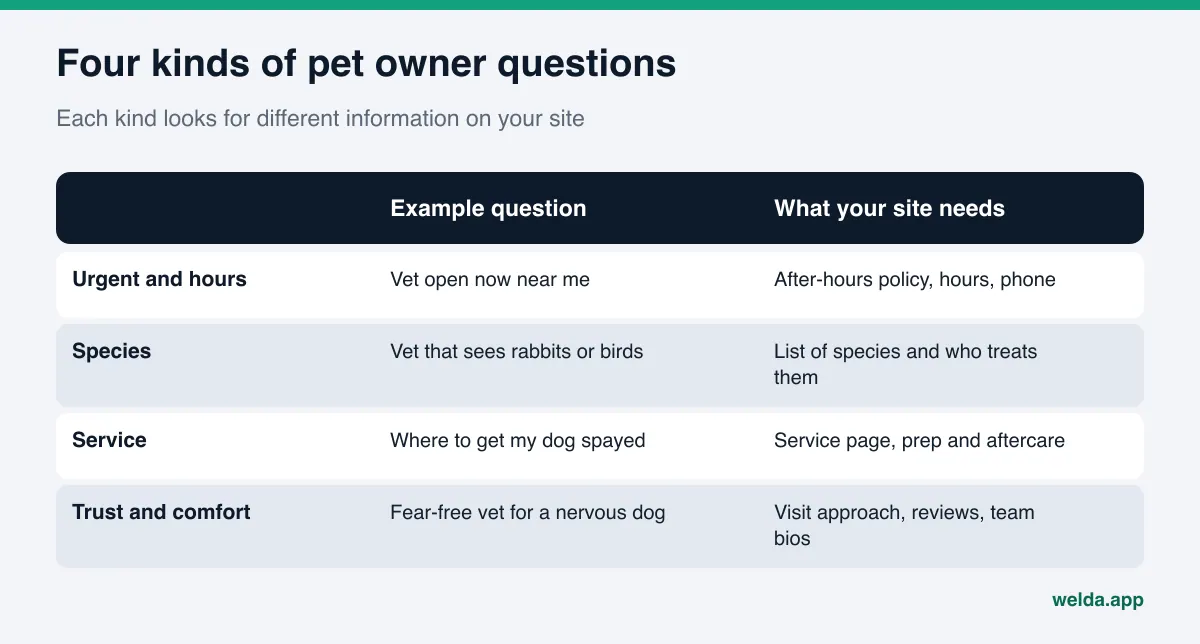
One more point: AI assistants tend to fill gaps. If your site never says whether you see exotics, the engine will either leave you out of that answer or rely on an older third-party listing. Missing information opens the door to wrong information.
AEO for vet clinics: the work, step by step
These are the core tasks that make a veterinary website ready for AI answers. They are ordered from highest impact and lowest effort.
- Make sure AI crawlers can reach your site. If robots.txt blocks search bots, nothing else matters. OpenAI, for example, explains in its crawler documentation that OAI-SearchBot is used to surface websites in ChatGPT's search features. We cover the details in are AI bots crawling my website.
- Rewrite the title tag and meta description. "Home" or just the practice name is not enough. Name the practice type (veterinary clinic, animal hospital), the city or neighborhood and your main focus. The description should say in two sentences who you treat and how.
- List the species you see. Dogs, cats, rabbits, birds, reptiles, small mammals. Saying which species you do not see is just as useful; it keeps the AI from sending the wrong owners to you. If one veterinarian handles exotics on certain days, say so.
- Give each core service its own page. Wellness exams and vaccines, spay and neuter, dental cleanings, imaging, senior care, surgery, hospitalization. On each page explain what the service is, how to prepare, what aftercare looks like and who performs it.
- Spell out after-hours care. If you are open 24/7, say it plainly. If not, say exactly what an owner should do outside your hours, including any emergency hospital you refer to. "Call us in an emergency" with no hours attached is not an answer an AI can use.
- Introduce your veterinarians. Name, DVM school, areas of interest, species they focus on. Why these signals help is covered in author bios and expertise signals for AI.
- Add structured business data. Schema.org has a dedicated type for vet offices: VeterinaryCare. Name, address, phone, hours and location should match in the markup, on the page and on your listings.
- Link your profiles. Google Business Profile, Yelp, Facebook and Instagram should be linked from your site, and each profile should point back to the correct URL.
- Add an FAQ section. Write down the ten questions your front desk answers most: vaccine schedules, spay and neuter recovery, walk-ins, payment options, visiting hours for hospitalized pets. Short, direct answers are easy for an AI to quote.
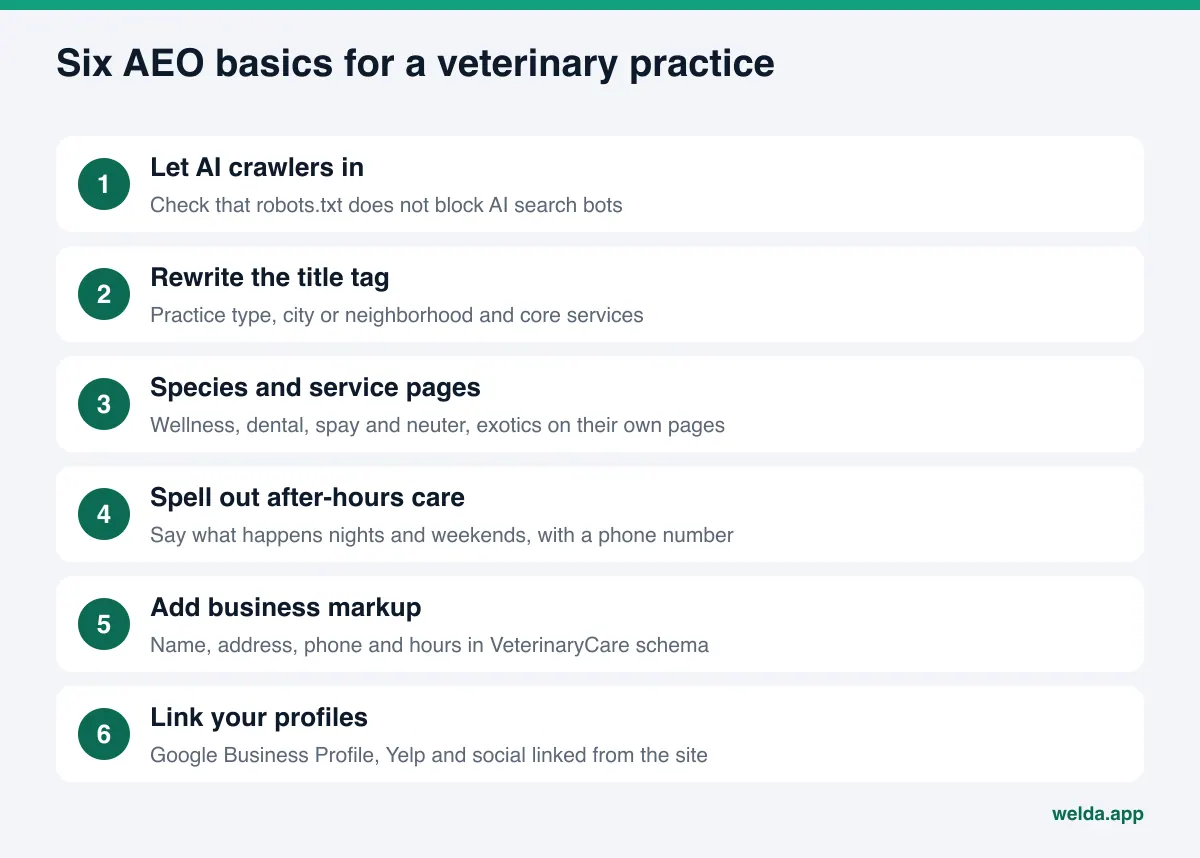
Most of this is one-time work. After that, the job is keeping details in sync whenever hours, doctors or services change. Inconsistency confuses AI more than anything: a practice that shows "closed Sunday" on its site and "open Sunday" on Google gives the engine two facts and a reason to trust neither.
Reviews, Yelp and community threads in vet AI answers
An AI assistant does not only read what you say about yourself. What owners write elsewhere shapes the answer too. For a question like "fear-free vet for a nervous dog," the engine may weigh how reviews describe the visit more than the "low-stress handling" line on your site.
- Reply to reviews. A short, personal thank-you for positive reviews; a calm, solution-focused reply to complaints. Never share a patient's medical details in a public reply.
- Ask happy clients for reviews. After a visit or a recheck, send the link. Do not trade discounts or gifts for reviews.
- Stay far away from fake reviews. In August 2024 the FTC announced a final rule banning fake reviews and testimonials, including AI-generated ones, and paying for reviews with a set sentiment.
- Watch community threads. If a local discussion mentions your practice with outdated information, start by stating the correct facts clearly on your own site. We look at this in Reddit and AI answers.
What to say, and what not to say, on a vet website
Veterinary medicine is a licensed profession, and advertising is shaped by state veterinary practice acts and board rules as well as federal consumer protection law. Rules vary by state, so check your state veterinary medical board for the current text. This article is not legal advice.
The good news for AEO: what AI assistants look for is mostly plain fact. An engine does not need you to say "best vet in town" to recommend you. It needs to know which species you see, when you are open and which services you offer. Claims add risk and carry little information.
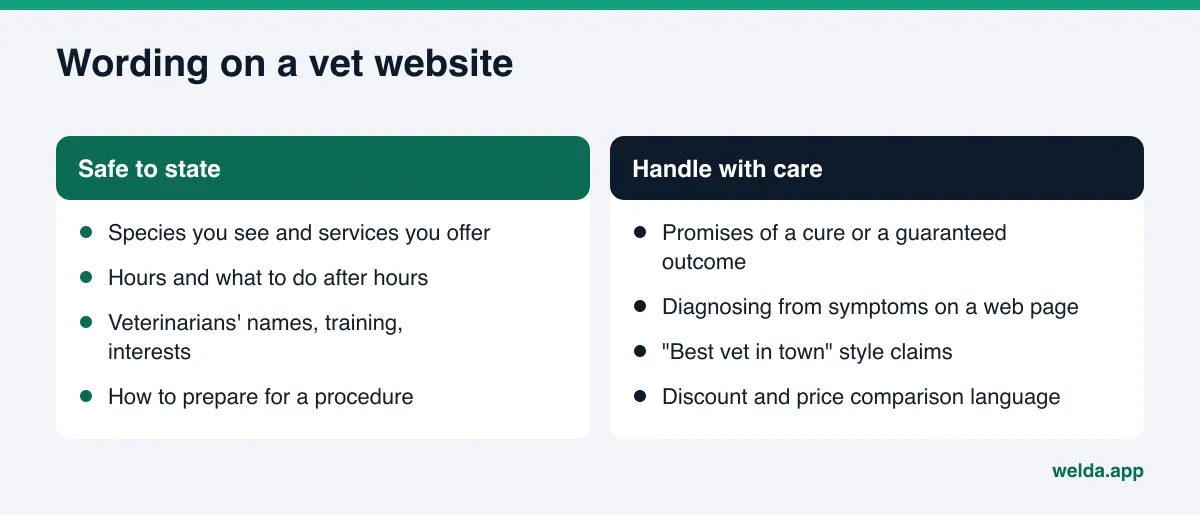
Patterns worth a second look before anything goes live:
- Outcome promises: "results guaranteed," "cures," "100 percent effective."
- Diagnosis on a web page: "If your dog does X, it has Y." Instead, explain which signs are urgent and when to call.
- Superiority claims: "number one animal hospital," "best vet in the county."
- Price and discount language: promotional pricing, comparisons with other practices.
How Welda handles AEO for a veterinary practice
Welda is software that measures where a business appears in AI answers and completes the missing pieces on the business's behalf. For a vet practice, three parts matter most: seeing which pet owner questions mention you, collecting the facts only you know, and sending prepared content live only with your approval.
Question by question: where are you named?
In the Welda panel, the questions view lists the questions pet owners are likely to ask and shows how ChatGPT, Gemini, Perplexity and Google AI answer each one. Every question is asked three times, because AI answers can change even for the same prompt. For a vet practice the rows would look like "vet open late near me," "where to get my dog spayed," "vet that sees rabbits," "fear-free vet for an anxious cat." Questions can be tracked in English.
The decision on this screen is simple: which question type do we never show up for? Picture an example practice that is named for routine wellness questions but missing from every after-hours question. That points to a thin after-hours section or hours that differ on Google. The competitors view shows who is named for the same questions and which sources they draw from, so "why does that clinic come up" stops being guesswork.
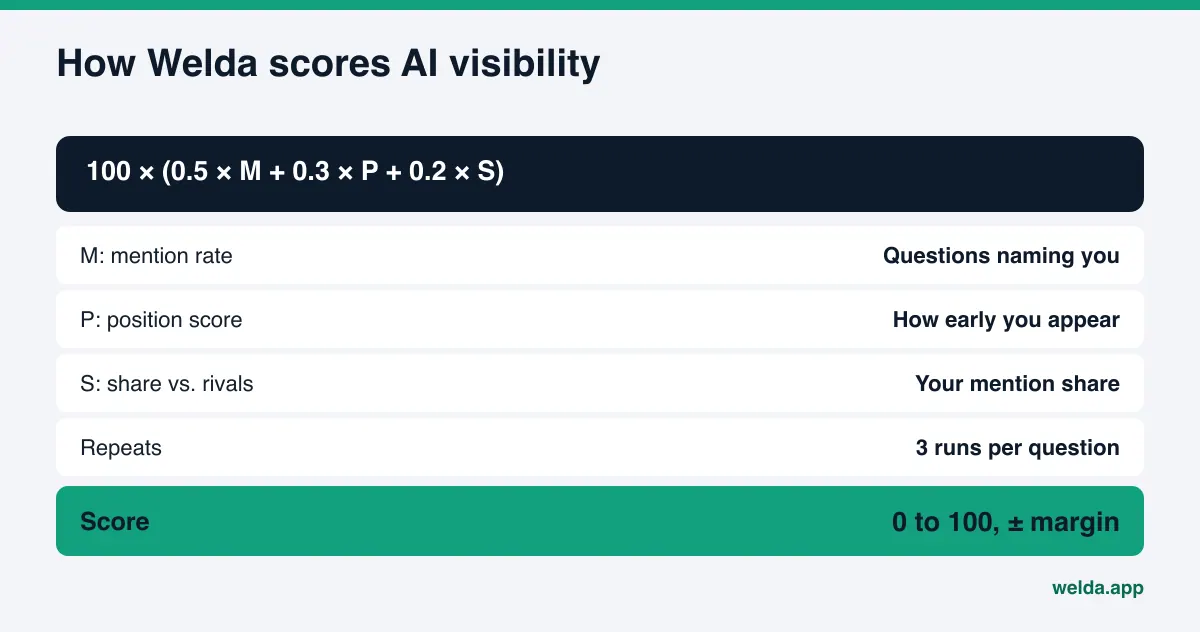
The score behind this view uses a published formula, so you can see exactly why it moved:
Missing facts: Welda asks instead of guessing
If your site does not say which species you see, what you do after hours or what your veterinarians focus on, Welda does not invent it. The to-do list shows these as open fields for you to fill in. Once you enter a fact, it flows into every piece of prepared content.
The same list holds content waiting for approval: a spay and neuter aftercare page, a Google Business Profile description, a draft reply to a review. You read, edit or approve each one. For healthcare businesses Welda never publishes automatically; every piece comes to you first. Patient records are not sent to AI. Content always lives on your own site; Welda does not host it.
Compliance check before anything goes live
Every draft is checked before publishing for patterns such as pricing, guarantees, superiority claims and diagnostic suggestions. A vaccine page that says "complete protection against every disease," for example, gets flagged with a more factual alternative. This check is not legal advice and has not been reviewed by legal counsel; the final call is yours.
Beyond that, Welda connects to WordPress sites through a separate Editor user and an application password, with no code to install; drafts open on your site and go live once you approve. On other platforms Welda hands you a ready-made package to apply yourself. A one-page monthly report sums up what changed.
To be clear about status: the Welda panel is in early access and is opening first in Turkey. Regular four-engine tracking is being added during early access, and sample screens use illustrative data. What anyone can use today, in English, is the free site analysis. Pricing is discussed in an early access call.
What the free analysis checks on a vet website
The free analysis reads your home page and a few inner pages (services, about, contact, pricing if you have one) the way Google and AI assistants do. For a vet practice, the most useful checks are:
- Whether robots.txt lets AI crawlers in.
- Whether the title, meta description and main heading name your practice type and location.
- Whether business markup exists and whether address, phone and location are consistent.
- Whether your Google Business Profile, Yelp and social profiles are linked from the site.
- FAQ content, reviews and trust signals, clearly described services and page speed.
You get a technical and a content score out of 100, and for every gap what was found, why it matters and how to fix it. The report includes suggested copy for your home page, a simulation of how much each fix could raise the score, a competitor comparison and a ready-to-paste fix package including business markup. The analysis also asks an AI assistant with web search five questions pet owners might ask and checks whether your practice is named. It is a one-time snapshot and does not measure rankings.
Limits: what Welda does not do
- No ranking guarantees. Welda does not promise you will be named by ChatGPT or appear in a certain position. Nobody can.
- No invented facts. Species, hours and doctor details come from you.
- No unapproved healthcare content. Every piece waits for your approval.
- No fake reviews. Welda drafts replies; it does not write reviews.
- Some work stays with you. Resolving a negative review, managing directory accounts and press outreach stay with the practice. See AI reputation management for that side.
- It takes time. New content usually takes weeks to show up in AI answers.
Example: where should a neighborhood vet start?
Take an example neighborhood practice: two veterinarians, dogs and cats, exotics one afternoon a week, closed nights with a referral to a nearby emergency hospital. The website is a single page with a bulleted service list.
| Gap | First fix | Who does it |
|---|---|---|
| Exotics not mentioned | "Species we treat" section with the exotics day | Practice supplies facts, copy is drafted |
| After hours unclear | Short section naming the referral hospital and phone | Practice supplies facts |
| Services in one line | Separate pages for wellness, dental, spay and neuter | Copy drafted, practice approves |
| Hours differ on Google | Sync hours on site and profile | Suggested if profile is connected, else manual |
| No doctor bios | Team page: name, school, interests | Practice supplies facts |
This practice should not expect to appear for "vet open now at midnight," and that should not be the goal. But the facts needed to appear for "vet that sees rabbits" or "where to get my cat spayed" are already in its hands. Picking the right questions saves months of effort on the wrong ones.
Checklist: is your practice ready for AI answers?
Open your website and go through this list. Every "no" is a task.
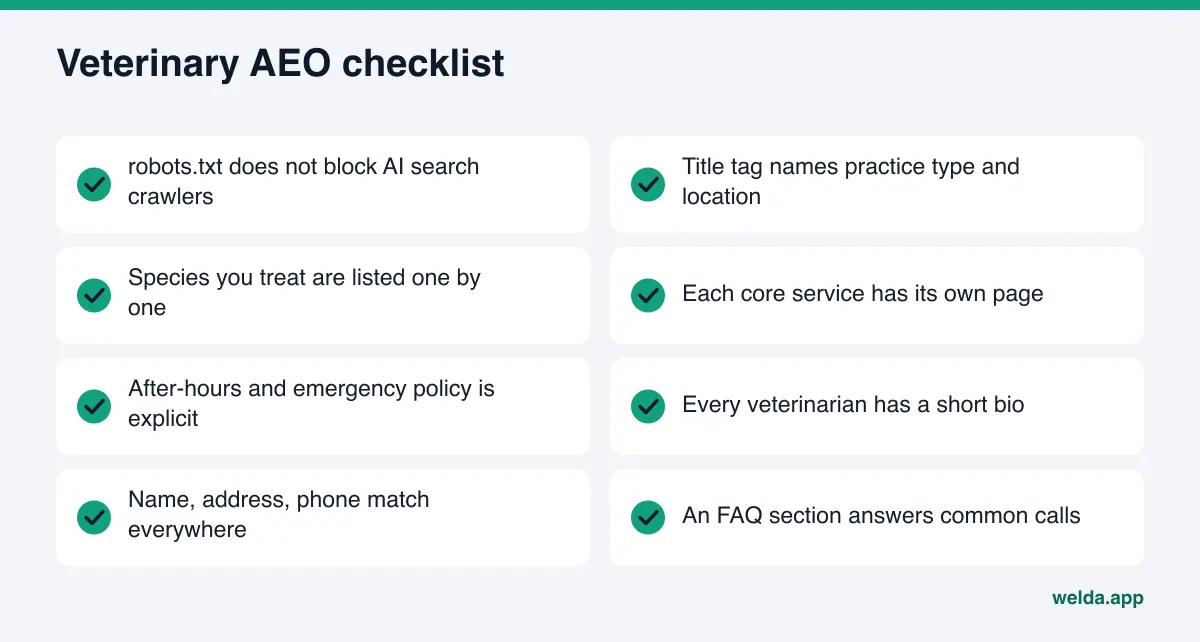
If more than three items are missing, fix the site basics first; tracking and competitor analysis make more sense once that foundation is in place.
Frequently asked questions
How does ChatGPT decide which vet clinics to recommend?
When it searches the web, it draws on what it can find: your site, your Google Business Profile, Maps, reviews and directories. Clear species, services, hours and location make a mention more likely. No exact formula has been published.
Is a Google Business Profile enough on its own?
No. The profile is an important source, but species lists, service details and doctor bios usually live on your site. Both need to agree.
We are not an emergency hospital. Can we show up for urgent questions?
You should not expect to, and it should not be the goal. Explaining clearly what owners should do after hours still helps them and keeps AI from stating wrong facts about you.
Does Welda publish content to our site on its own?
No. For healthcare businesses there is no automatic publishing; every piece comes to you for approval and lives on your own site.
Is the Welda panel available in the US?
The panel is in early access and opening first in Turkey. The free site analysis works in English today.
What do I need for the free analysis?
Your website address and a verified email and phone number. The results link arrives by email and stays open for 14 days. It is free once per site.
See where your practice stands today
Pet owners are already asking AI assistants where to go. Knowing where your practice stands in those answers is the shortest path to deciding what to fix first. Run the free AI visibility analysis to see how AI reads your site, which gaps it finds and which fixes would make the biggest difference.