How do steakhouses get recommended by ChatGPT, and why isn't mine showing up? When ChatGPT, Gemini or Perplexity recommends a steakhouse, it leans on information it can read clearly: your website, your Google Business Profile, review sites like Yelp and Tripadvisor, and local dining guides. If your cuts, sourcing, aging, prices, hours and reservation policy are not written out in plain text, the AI cannot describe you, so it recommends the place that did write them out. This guide walks through how steakhouses get recommended by ChatGPT, the steps to take, and which parts of the work Welda handles for you.
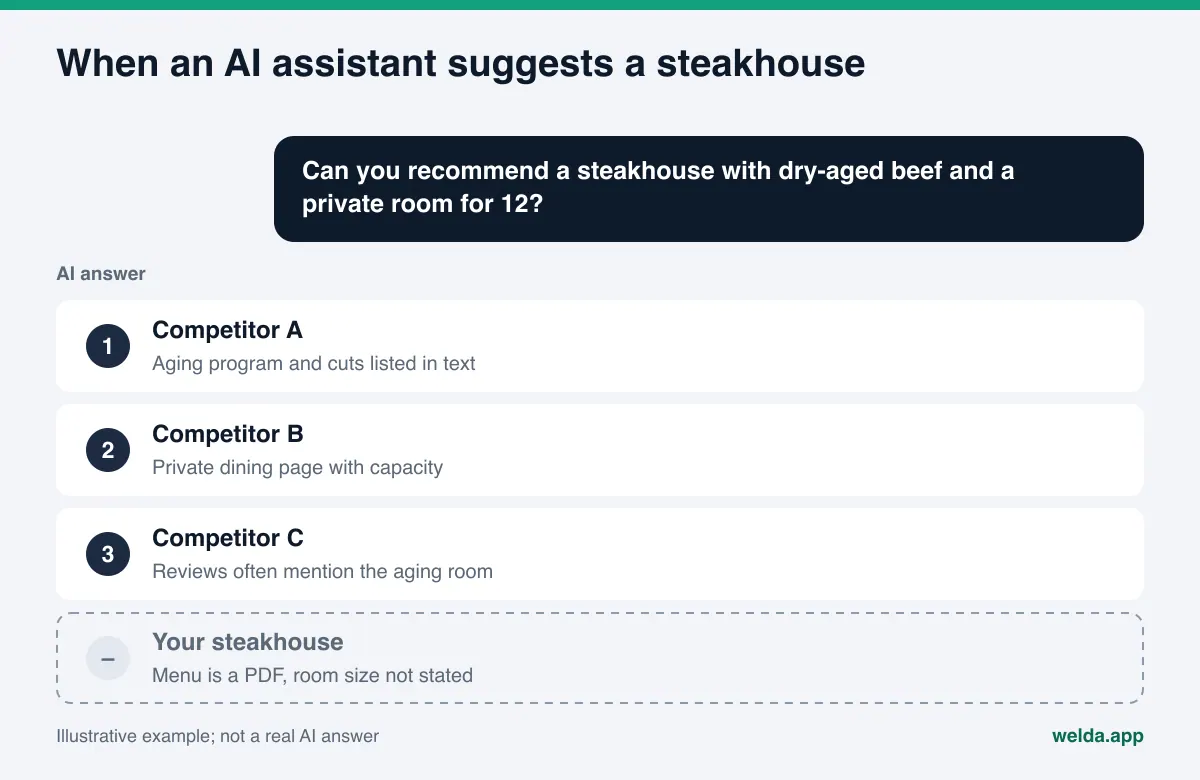
How steakhouses get recommended by ChatGPT, and why it matters now
AEO (answer engine optimization) is the work of making sure AI assistants can find, understand and recommend your business. You will also see it called AI search visibility, and some people use GEO (generative engine optimization) for the same idea. The term matters less than the shift behind it. In a classic Google search, a diner sees ten links and a map, then decides. In an AI answer, the diner usually sees a short list of three or four restaurants, each with a sentence or two of reasoning. If you are not on that list, the diner may never hear your name.
Steakhouses feel this more than most restaurants for two reasons. First, steak questions are specific. People rarely ask "where can I eat dinner." They ask for "a steakhouse with in-house dry-aged ribeye," "somewhere with a private room for a 12-person client dinner," or "a steakhouse open after 10 pm on a Sunday." An AI assistant can only match those details if it finds them written down somewhere. Second, a steakhouse check is a considered purchase. Diners planning an anniversary or a business dinner want reassurance before they book, and they increasingly ask an assistant to do that homework for them.
The other problem is that the details that make a steakhouse distinctive often live inside the building. Your team knows where the beef comes from, how long it ages, what the grill burns, and whether sides are shared. Online, the menu is often a PDF or a photo, and the "About" page says little more than "a classic American steakhouse experience." To an AI assistant, that looks like every other steakhouse in town.
The fastest way to see where you stand is to check your site the way an AI would. Welda's free site analysis reads your homepage and a few inner pages, lists what is missing, and tells you how to fix each item.
What diners ask AI assistants about steakhouses
Questions about steakhouses fall into a handful of patterns. Each pattern is answered from a different kind of information. Once you know which information feeds which question, it becomes clear what to write and where. The example questions below were written for this guide and are illustrative, not measured.
| Question pattern | Illustrative question | What the answer relies on |
|---|---|---|
| Location and proximity | "Best steakhouse near me for date night" | Address, map pin, neighborhood name, Google Business Profile category |
| Product and method | "Steakhouse that dry-ages its own beef" | Menu in text form, a page on sourcing and aging |
| Occasion | "Steakhouse with a private dining room for 12" | Private dining page, capacity, booking process |
| Hours and timing | "Steakhouse open late on Sunday" | Hours, last seating, structured data |
| Price and trust | "Is it worth the price, and are sides extra?" | Menu with prices, review themes, how you answer reviews |
| Dietary and practical | "Steakhouse with good gluten-free options and valet" | FAQ section, menu notes, parking details |
Notice how few of these questions are about "the best steak." Most are about fit: occasion, timing, method, logistics. That is good news, because fit is something you can describe accurately without making any claim you cannot back up.
What AI assistants read before they recommend a steakhouse
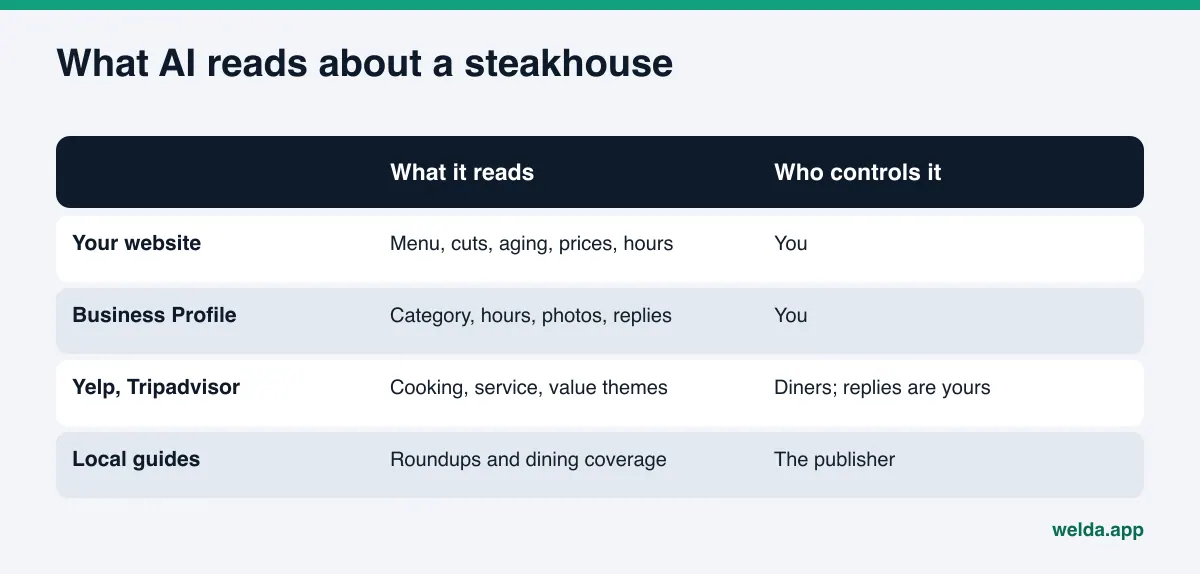
When an AI assistant answers with web search, it pulls from several types of sources and compares them. For a steakhouse, these are the ones that usually matter:
- Your own website: menu, cuts and weights, sourcing and aging, prices, private dining, hours and an FAQ. This is the source you control completely.
- Google Business Profile and Google Maps: category, hours, photos, attributes, reviews and your replies. Google's AI Overviews and AI Mode draw closely on this data.
- Review platforms: Yelp, Tripadvisor and Google reviews. Recurring phrases such as "perfectly cooked," "slow service," or "sides were small" shape the tone of an AI answer.
- Local guides and media: city magazine roundups, local newspaper dining sections and "best steakhouses in" lists. These are earned, not bought, and they carry weight.
The assistant cross-checks these sources. If your site says you dry-age in house and reviews mention the aging room, that detail can make it into the answer. If your site says you close at 11 and your Google profile says 10, the assistant cannot tell which is right, so it may skip you or give a diner the wrong time. Consistent name, address, phone and hours across every listing is basic hygiene; our guide on NAP consistency for AI search covers it in detail.
Access matters too. If AI crawlers cannot read your site, nothing on it can reach an answer. OpenAI's crawler documentation explains that OAI-SearchBot is used to surface websites in ChatGPT's search features, and that sites which opt out of it will not be shown in ChatGPT search answers. Some website templates, hosting firewalls and security plugins block these crawlers by default, often without the owner knowing. Checking this is step one.
How steakhouses get recommended by ChatGPT: the work, step by step
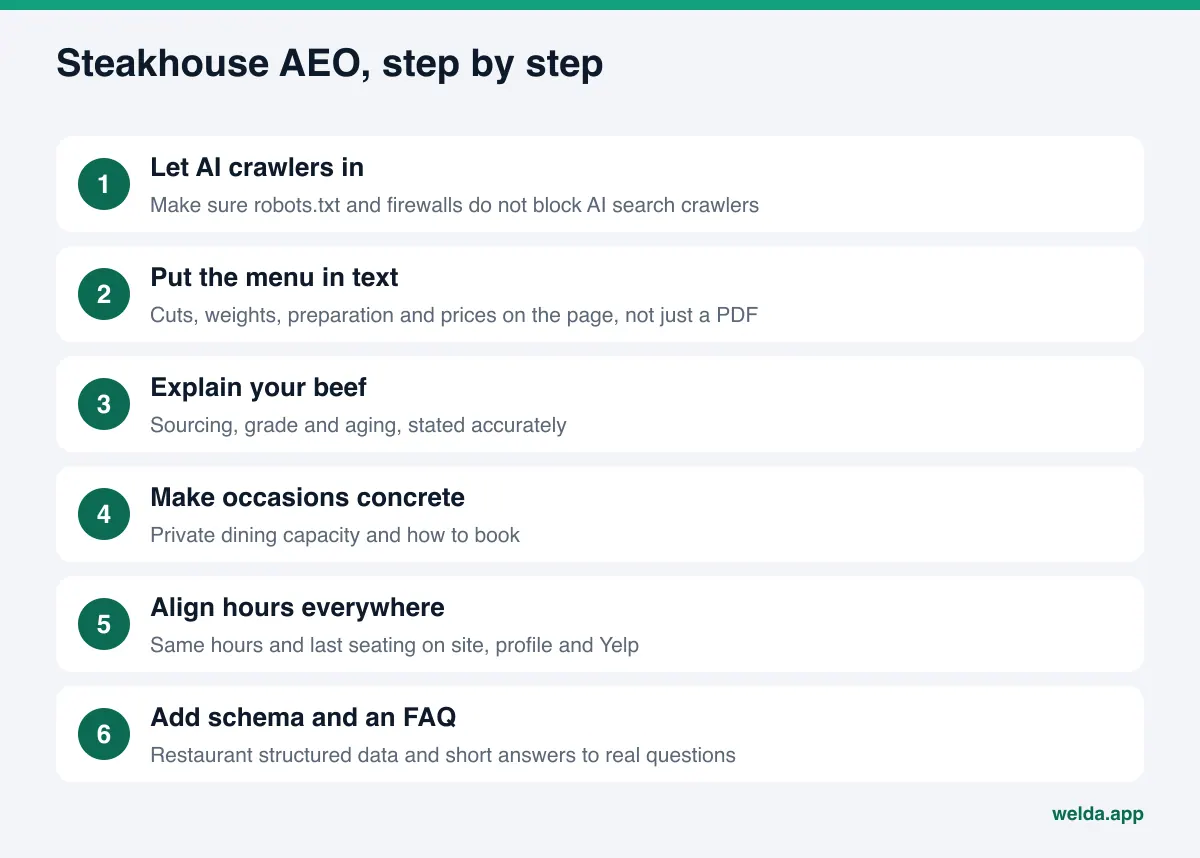
Most of these steps can be done by a restaurant team in a few working sessions. The order matters, because the early steps make the later ones count.
- Let AI crawlers in. Ask whoever manages your site to confirm that robots.txt and any firewall rules do not block AI search crawlers.
- Put the menu in plain text. A PDF or a photo of the printed menu is not enough. List cuts, weights in ounces, preparation and prices on the page itself. Keep the PDF as a download if you like.
- Explain your beef. Write a short page on sourcing, grade, and aging. If you serve USDA Prime on some cuts and Choice on others, say which. If you dry-age in house, say for how long. If a cut is wet-aged, say that too. Accuracy beats adjectives.
- Describe the method. What kind of broiler or grill do you use, what wood or fuel, how are steaks rested and finished. These are the details that answer "what is this place like."
- Make occasions concrete. Private dining capacity, minimums or set menus if you have them, how to book, whether you host business dinners, birthdays or rehearsal dinners.
- Align hours everywhere. Opening, closing and last seating on your site, Google Business Profile, Yelp and any reservation page. Add holiday hours ahead of time.
- Add structured data. Use Restaurant schema to describe your address, phone, hours, cuisine and menu link.
- Write a real FAQ. Answer the six or seven questions your host stand gets every week.
How to write the menu page
The menu page is the single most useful page for AI assistants. One line per item is enough: name, cut and weight, a short description, price. "Bone-in ribeye, 22 oz, dry-aged in house, finished with herb butter" tells both a diner and an AI exactly what you serve. Note which items are for sharing, which sides are a la carte, and whether you offer half portions or a lighter cut. Avoid "market price" where you can; if a price truly changes daily, say how it is set and where today's price is posted. Keeping prices current also matters for trust, which we cover in content freshness for AI search.
Structured data fields that fit a steakhouse
Schema.org's Restaurant type includes servesCuisine for the kind of food you serve, hasMenu for your menu, and acceptsReservations, which can take a booking URL. Add your address, phone, opening hours and geo coordinates and the assistant can treat your business as one clear record. For a steakhouse, servesCuisine can simply say "Steakhouse, American." Anything in the markup should also appear visibly on the page; data that exists only in code does not build trust.
A starter FAQ for steakhouses
The questions your host stand hears are a ready-made FAQ: Do I need a reservation? Is there a dress code? Do you have a private dining room, and for how many? Is corkage allowed? Are there options for guests who do not eat beef? Do you accommodate gluten-free diners? Is there parking or valet? Two or three honest sentences per answer are enough.
Reviews, trust and the rules on fake reviews
Price and trust questions are a large share of what people ask about high-ticket restaurants. An AI assistant answering "is it worth it" will look at review themes and at how the business responds. A steakhouse whose reviews repeatedly mention surprise charges or long waits, with no replies, is a harder recommendation to make.
It can be tempting to shortcut this. Don't. The FTC's Trade Regulation Rule on the Use of Consumer Reviews and Testimonials, published in the Federal Register in August 2024 (16 CFR Part 465), prohibits businesses from creating, buying or disseminating fake reviews, including reviews from people with no real experience of the business, and it addresses undisclosed insider reviews and review suppression. This section is a summary, not legal advice; check the rule itself or ask your attorney about your situation.
The legitimate path is slower but durable: reply to reviews, thank guests specifically, address complaints calmly and in public, and fix the underlying issue. Write your policies down on your site, too. "Sides are shared and serve two to three," or "We add no service charge; gratuity is up to you," answers the question a diner was about to ask. Our guide to negative reviews in AI answers goes deeper on handling criticism.
How Welda does this work for a steakhouse
Welda is software that measures where a business appears in AI answers and fills in the gaps on the business's behalf. There are two parts: a free site analysis anyone can use today, and the Welda panel, which is in early access.
The free site analysis: what you can use today
The free analysis works in English. It reads your homepage and several inner pages, such as menu or services, pricing, about and contact, the way Google and AI assistants do. It checks whether AI crawlers can reach the site (robots.txt), your page title and description, the main heading, business structured data (Schema), address, phone and location details, whether your social and map profiles are linked, whether there is an FAQ, reviews and trust signals, whether your offering is clearly described, and page speed.
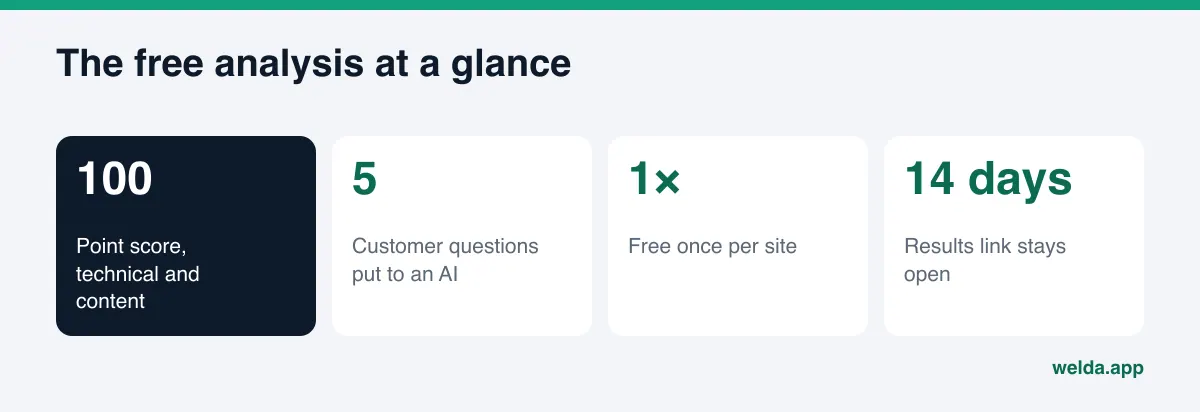
You get a score out of 100, with technical and content scores shown separately. For each gap, it shows what it saw, why it matters and how to fix it. It drafts homepage copy for you: title, description, main heading, intro paragraph and FAQ. It includes a simulation of how much each fix could raise the score, a competitor comparison, a ready-to-install fix package (including business schema code), a PDF and a shareable score card.
The analysis also asks five questions a customer might ask to an AI assistant that can search the web, then checks whether your business name appears in the answers. This is a one-time snapshot, not ongoing tracking. The analysis is free once per site. Your email and phone are verified, the results link is emailed to you and stays open for 14 days. It does not measure rankings and does not promise any.
The Welda panel: ongoing measurement and fixes
The Welda panel is in early access. It is opening in stages and is launching first with businesses in Turkey, so for a US steakhouse today the practical starting point is the free analysis. Regular four-engine measurement is being added during early access, and sample screens in the panel use representative data.
In the panel, the questions your customers would ask are put to ChatGPT, Gemini, Perplexity and Google AI three times each. You see which questions mention your name, where you appear in the answer, and where competitors are ahead. For a steakhouse, those questions might be "steakhouse with a private room downtown" or "where to get a dry-aged porterhouse," chosen to match real diners. Question language can be set to English.
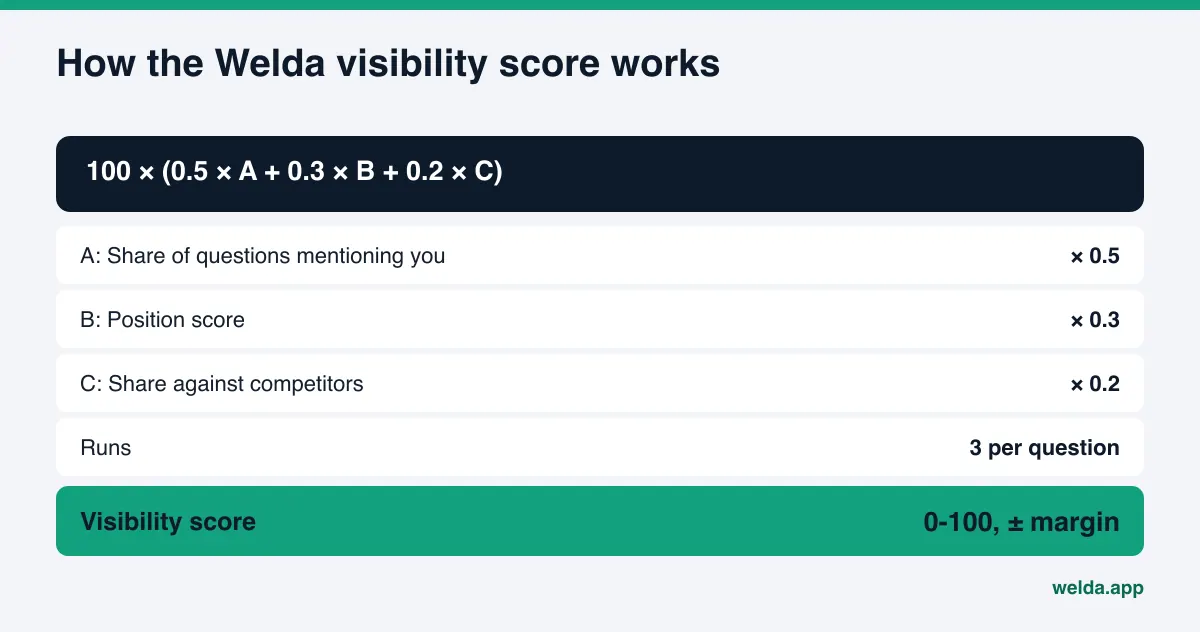
The score formula is published: 100 × (0.5 × share of questions where you are mentioned + 0.3 × position score + 0.2 × share against competitors). The spread across three runs gives a ± margin of error, shown next to the score, so you can tell a real change from normal AI variability. Why that matters is covered in manual ChatGPT checks vs tracking tools.
The panel's screens include a home view (score, a one-line summary, next tasks), a single to-do list (missing information, items waiting for approval, manual tasks with ready text beside them), questions (question by question, are you mentioned), competitors (which competitor wins on which topic and from which source), sources (the sites AI draws from and where you are missing), ready pages (applies the recommendations and prepares a page for preview), a compliance check, incoming requests (messages, sign-ups, calendar), before and after comparison, and a one-page monthly PDF report.
Fixes: Welda drafts, you approve
Welda drafts the content: menu copy, the sourcing and aging page, FAQ answers, profile descriptions and review replies. Publishing approval stays with you. Content always lives on your own website; Welda does not host it. On WordPress sites, Welda connects through a separate Editor user and an application password, with no code to install. Drafts open on your site as drafts and go live once you approve them. On other systems, Welda gives you a ready package and the change is made by hand. Google Business Profile, Instagram and Facebook can be connected; if they are not, the task is listed as manual.
Welda does not invent what it does not know. If it cannot find how long you age your beef or how many guests your private room seats, it adds that as a question on your to-do list. The compliance check flags patterns such as price claims, guarantees and superiority claims ("the best steak in the city") before anything is published. It is not legal advice and has not been reviewed by legal counsel.
Limits: what Welda does not do
Knowing what is not possible is as useful as knowing what is.
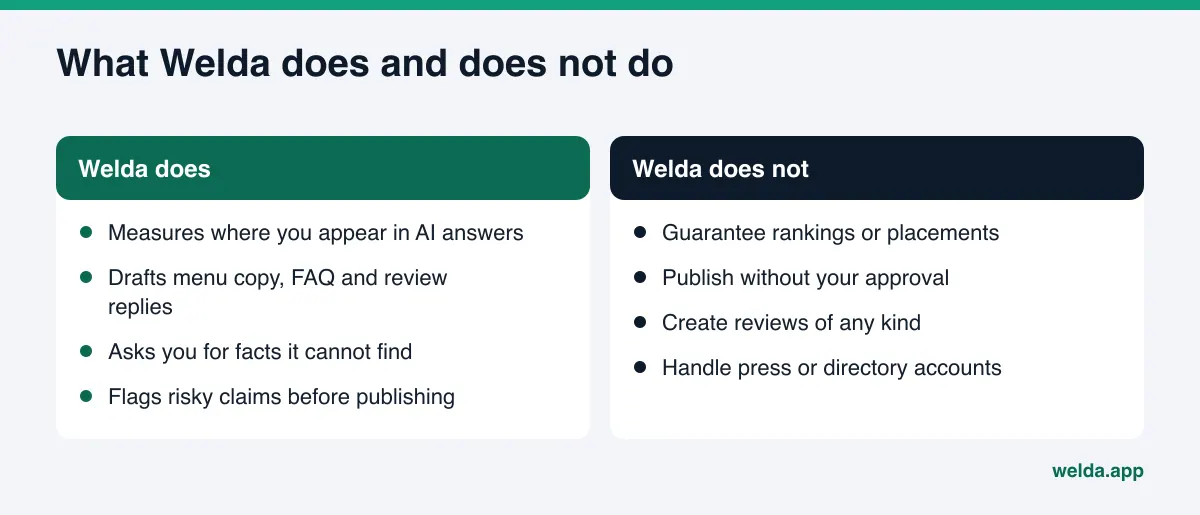
- Welda does not guarantee rankings or "showing up in ChatGPT." AI answers vary, and no one can promise a placement.
- It does not write information it does not have. Sourcing, grades, aging and capacity come from you.
- It does not publish sensitive content without approval.
- It does not create fake reviews. It drafts replies to real ones.
- Handling negative reviews, claiming directory listings and press outreach stay with your team. Welda shows the task and gives you ready text.
Time is the other limit. New content usually takes weeks to show up in AI answers. In the first month, measure whether the gaps are closing rather than expecting the answers to change overnight.
Steakhouse AEO checklist
Go through this list once. Mark each item as done, missing or conflicting. Fix conflicts first: when an assistant sees two different versions of a fact, it may leave you out entirely.
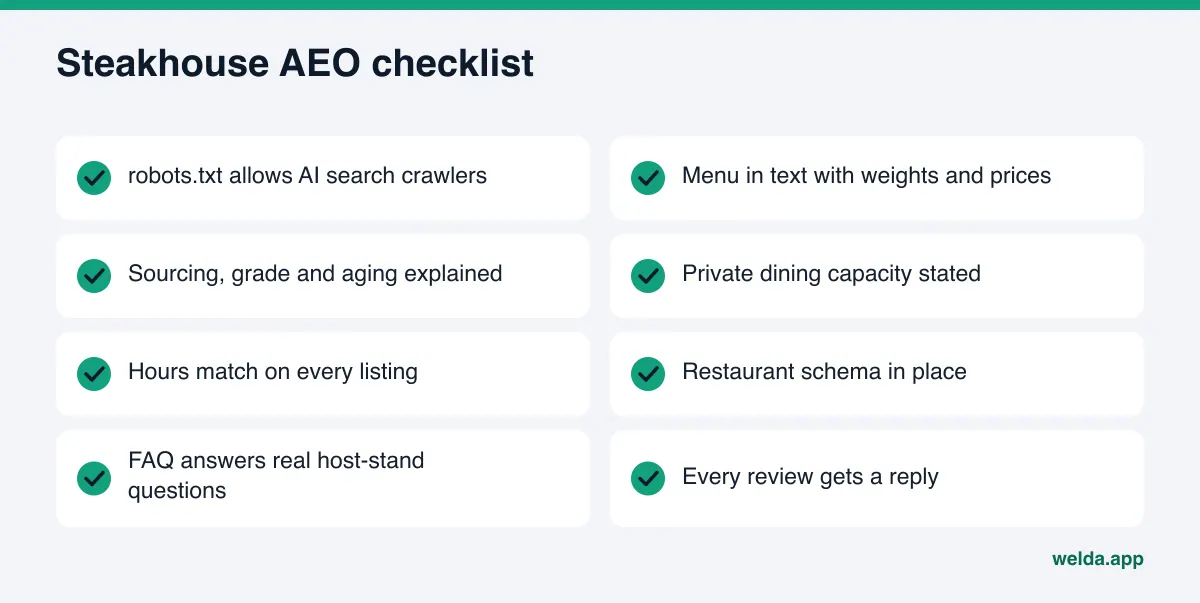
| Check | Where to look | When to recheck |
|---|---|---|
| AI crawlers can access the site | robots.txt, firewall, security plugins | After any site update |
| Menu is in text, with weights and prices | Menu page | Every price or menu change |
| Sourcing, grade and aging are explained | Menu or "Our beef" page | When a supplier changes |
| Hours and last seating match everywhere | Site, Google Business Profile, Yelp | Before holidays and seasonal changes |
| Private dining details are clear | Private dining page | When capacity or policy changes |
| Restaurant schema is correct | Page code, free analysis report | When address, phone or hours change |
| Reviews get replies | Google, Yelp, Tripadvisor | Weekly |
A neighborhood chophouse and a downtown expense-account steakhouse will weight these differently. The first leans on hours, value and parking; the second on private dining, wine and service. The same logic applies to other formats, as our guide on how fine dining restaurants get recommended by ChatGPT shows. Listings on local guides and directories also feed AI answers; see business directories for AI visibility.
Do it yourself, hire help, or use software?
None of the steps above requires deep technical skill. They require time and routine. A single-location steakhouse can handle the first round of fixes in-house. The harder part is keeping it up: prices change, hours change, new reviews come in, competitors update their pages. That ongoing loop of measuring, finding gaps, drafting copy and asking for approval is the work Welda is built to carry.
Frequently asked questions
How does ChatGPT know about steakhouses?
When it searches the web, it reads restaurant websites, Google Business Profiles, review platforms and local guides. Businesses whose details are clear and consistent are easier for it to describe and recommend.
Is a PDF menu good enough?
Not on its own. PDFs and photos are not always read reliably, and the assistant cannot tell whether prices are current. Put the menu in text on the page and keep the PDF as an extra.
Should I claim we serve the best steak in town?
Specific, verifiable details serve you better than superlatives. Describe the cut, grade, aging and method; let reviews and guides make the comparisons.
How long until changes show up in AI answers?
Usually weeks. No one can guarantee a timeline or a placement. Regular measurement is the honest way to see whether things are moving.
Can US restaurants use the Welda panel today?
The panel is in early access and is opening first in Turkey. The free site analysis works in English today. Pricing is discussed during the early access conversation.
Will Welda write reviews for us?
No. Welda never creates reviews. It drafts replies to the reviews you receive, and you approve them before anything is posted.
Start with one check
Getting a steakhouse recommended by AI assistants is not one big project. It is a set of small, specific tasks kept up over time: let crawlers in, put the menu in text, explain your beef, keep hours consistent, and answer the questions diners actually ask. To see where your site stands, run the free AI visibility analysis and work through the list it gives you.