How do fine dining restaurants get recommended by ChatGPT? ChatGPT recommends a fine dining restaurant based on clear information it can find on your website and in sources that mention you: what you serve, how the tasting menu works, how reservations are handled, who runs the kitchen, and what guests say about you. When that information is readable, consistent, and current, your odds of being named go up. No one can guarantee a specific position.
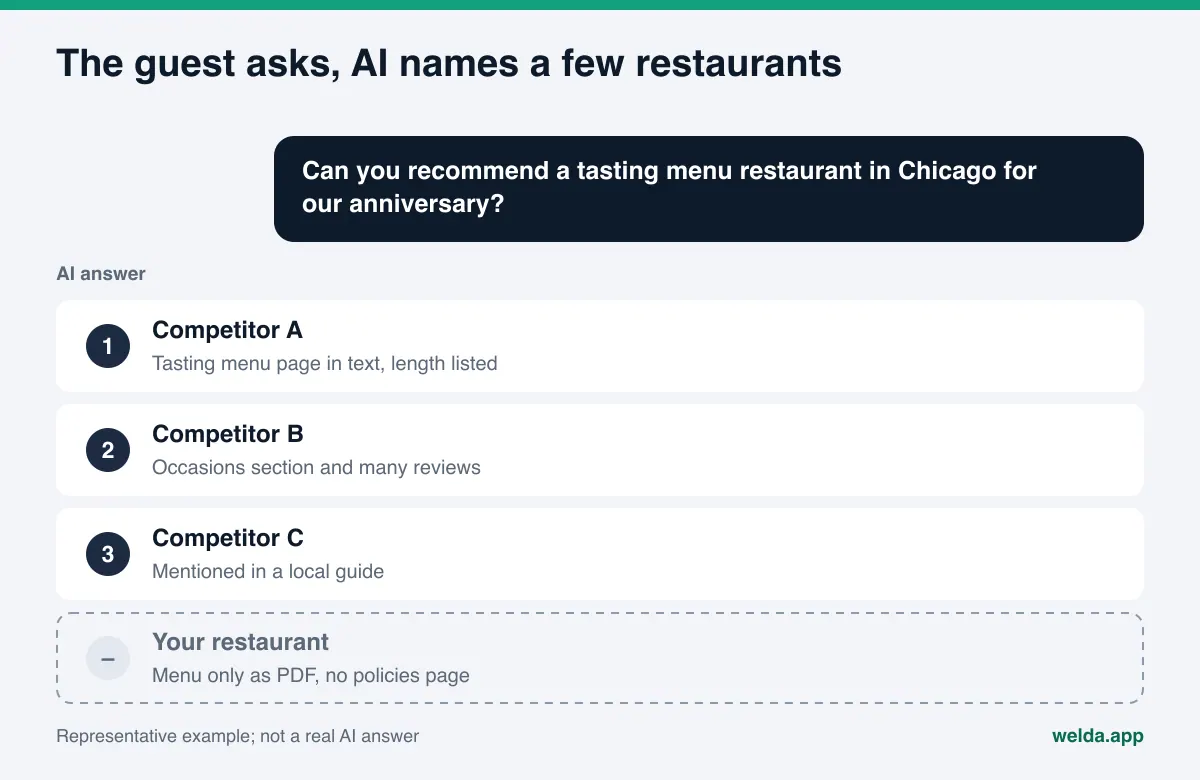
This guide is for owners, general managers, and marketing leads at restaurants that run a tasting menu, work mostly by reservation, and sell an evening rather than a meal. The question is simple: when a guest types "Can you recommend a tasting menu restaurant in Chicago for our anniversary?" into ChatGPT, Gemini, Perplexity, or Google's AI Overviews, does your name come up? If not, why, and what should you fix first? This is the work usually called AEO (answer engine optimization), or AI search visibility. Below we cover the problem, the steps, how Welda handles the work, and what it does not do. If you want to see where your site stands today, start with the free AI visibility analysis.
Why fine dining guests now ask AI where to book
A fine dining reservation usually starts with an occasion: an anniversary, a client dinner, a milestone birthday, a proposal, a visiting friend. Guests used to piece that decision together from several places. A guide's list, a critic's review, a few pages of Yelp, a friend's text. AI assistants compress that research into one conversation. The guest describes the occasion, the neighborhood, the budget, a dietary need, and the date, and the assistant answers with a short list of restaurants and a reason for each.
If your restaurant is not in that answer, it never makes the shortlist. That loss is expensive in fine dining. A table is often for two or more, carries a high check, and is booked days or weeks ahead. Once the guest decides, they rarely keep looking. The AI answer arrives at the exact moment when options narrow.
A few traits make AEO harder for fine dining than for a casual spot:
- Guests ask by occasion, not by cuisine. People rarely type "contemporary American with Nordic influences." They type "romantic," "quiet enough for a business dinner," or "special enough for a 40th." If your site does not talk about occasions, the assistant has nothing to match.
- The menu is often unreadable. Tasting menus change often, and many restaurants post them as a PDF or an image. Search engines and AI systems read plain text much more reliably.
- The house rules live on the phone. Dress code, kids policy, deposits, cancellation windows, menu length, and wine pairing details are often explained only when someone calls. Those are exactly the details guests ask AI about.
- Trust comes from other sites. Guides, critics, Google Business Profile reviews, Yelp, Tripadvisor, and local food media supply much of the reasoning an assistant gives when it names a restaurant.
What guests ask AI, and what the answer is built from
Fine dining questions fall into a handful of types. Each type looks for a different fact on your site or in outside sources. The table below maps them. The sample questions were written for this article; they are not measurement results.
| Question type | Sample question | What the assistant needs to find |
|---|---|---|
| Occasion | Best restaurant for an anniversary dinner in Georgetown? | An occasions section, a description of the room, how special requests work |
| Menu format | Which restaurants in Austin offer a chef's tasting menu? | Menu in text: number of courses, length, how often it changes |
| Dietary | Fine dining with a vegetarian tasting menu in Seattle? | Alternate menu, allergy policy, how much notice you need |
| Wine and drinks | Tasting menu with a strong wine pairing near me? | Pairing options, list scope, non-alcoholic pairing |
| Practical | Do fine dining restaurants in Manhattan require a jacket? | A policies page: dress code, kids, deposits, cancellations |
| Price and trust | Is the tasting menu price inclusive of service? | A clear note on what the price includes and any added fees |
That last row matters more than it looks. Many US restaurants add service charges, auto-gratuity for large parties, or a separate pairing price. Guests ask about this before they book. If your site states plainly what the price includes, the assistant has less room to guess on your behalf.
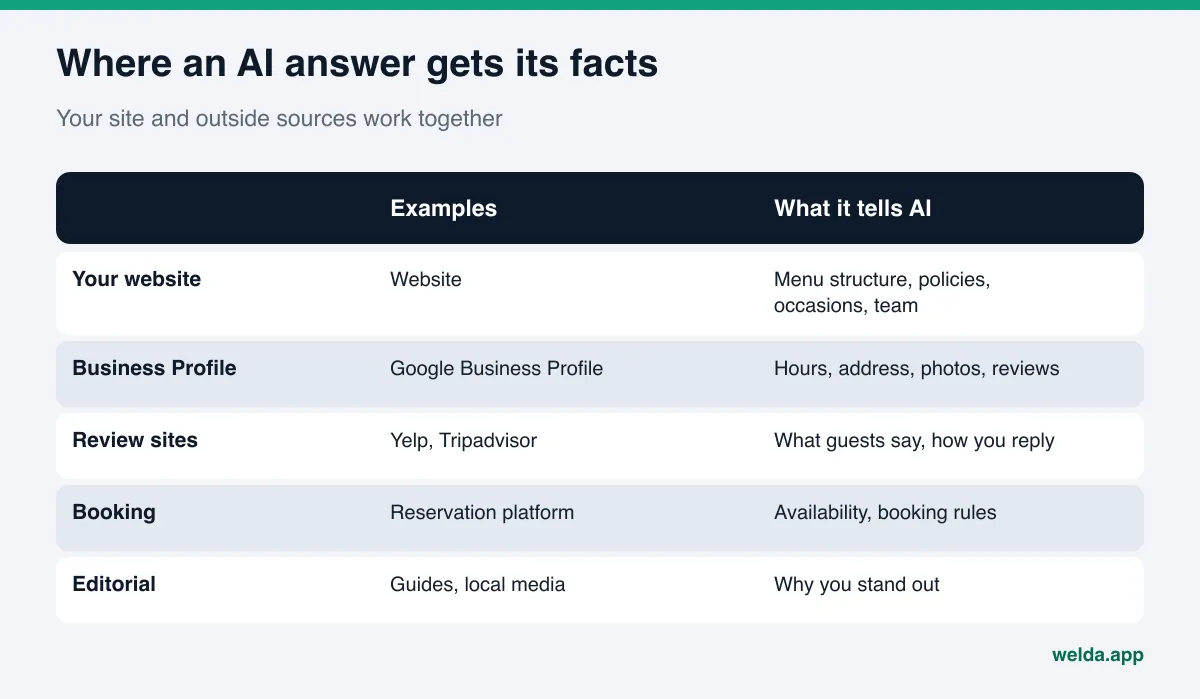
Notice how much of an answer depends on sources outside your site. Your Google Business Profile, Yelp listing, Tripadvisor page, reservation platform listing, local magazine coverage, and guide mentions all shape what the assistant believes about you. AEO for a restaurant is two jobs at once: make your own site easy to read, and make sure outside sources say the same thing your site says. We explain how to find where you are missing in our piece on citation gap analysis.
How fine dining restaurants get recommended by ChatGPT: the step-by-step plan
The order below starts with the most basic blocker and works outward. There is a reason for the order. If AI crawlers cannot reach your site, a new menu page does nothing. If your site is readable but your Google Business Profile shows different hours, the assistant cannot tell which one to trust.
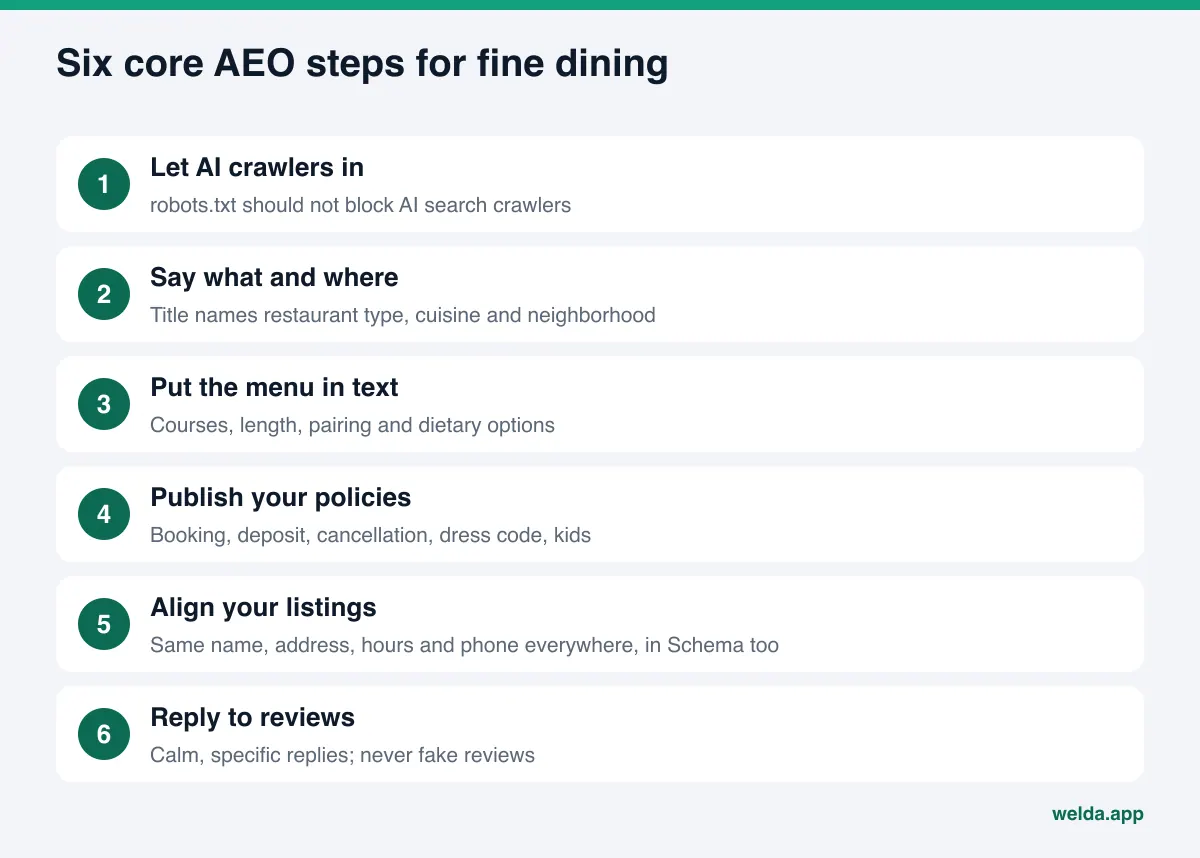
- Make sure crawlers can reach you. Your robots.txt should not block AI search crawlers. According to OpenAI's crawler documentation, OAI-SearchBot is used to surface websites in ChatGPT's search features, while GPTBot is used for model training, and each setting is independent. A blanket block written without that distinction can hide your site from the assistant entirely.
- Say what you are in one sentence. Your page title and main heading should name the type of restaurant, the cuisine, and the neighborhood. "An unforgettable culinary journey" does not give the assistant anything to match. "Seasonal tasting menu restaurant in Logan Square, Chicago" does.
- Put the menu in text. State how many courses the tasting menu has, roughly how long dinner runs, how often it changes, whether there is an à la carte option or a bar menu, and how wine pairing works. Keep the PDF if you like, but the core facts should be readable on the page. Dishes change; the structure does not, and the structure is what the assistant needs.
- Spell out dietary and allergy handling. Say what you can do for vegetarian, vegan, gluten-free, and allergy guests, and how much notice you need. These questions come up constantly, and a restaurant with no answer drops off the list.
- Publish a reservations and policies page. How to book, whether you take a deposit or a card hold, the cancellation window, dress code, kids policy, private dining, and large party rules. This page becomes the one guests and assistants lean on most.
- Introduce the chef and team. The chef's name and approach, the farms and producers you work with, your sommelier or beverage director. These are the reasons an assistant can give when it explains why it named you. Do not publish anything you are not sure is true.
- Mark up your business details. The schema.org Restaurant type offers properties such as servesCuisine, acceptsReservations, hasMenu, priceRange, and openingHoursSpecification. Whatever you mark up must match what is visible on the page.
- Align your listings. Name, address, phone, hours, and website should be identical on your site, Google Business Profile, Yelp, Tripadvisor, your reservation platform, and any guide listing. Seasonal closures and holiday hours should be current everywhere.
- Answer the questions your host stand hears. Collect the ten questions your team answers most by phone and publish short, direct answers. Valet or parking, accessibility, how long the menu takes, whether guests can bring a cake, corkage, service charge.
- Respond to reviews. Reviews are among the strongest outside signals an assistant uses. Reply to each, critical ones included, calmly and specifically. We go deeper in reviews and AI recommendations.
Do you need separate pages for occasions?
Much of fine dining is occasion-driven. Writing clearly about anniversaries, business dinners, proposals, and birthdays helps the assistant connect you to those questions. You do not need a page for each one, but each deserves at least one clear paragraph. The table shows what helps for each occasion and what to avoid.
| Occasion | What to publish | What to avoid |
|---|---|---|
| Anniversary, date night | Seating options, quiet corners or views, how to pass along a note | "Most romantic restaurant in the city" with nothing behind it |
| Client dinner | Lunch service, a shorter menu option, private room, invoicing | Vague "corporate solutions" copy |
| Proposal | How to plan ahead with your team, table setup, photo policy | Promises about arrangements you cannot always deliver |
| Birthday | Outside cake and cakeage policy, dessert personalization, party size | Rules that exist only on the phone |
| Out-of-town visitors | Neighborhood directions, parking or transit, booking lead time | Assuming guests already know the area |
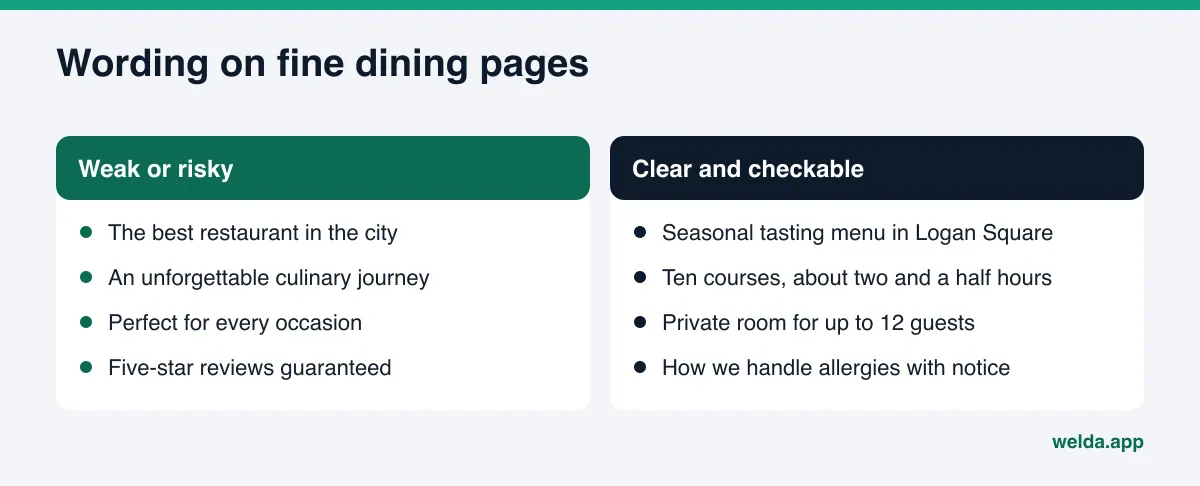
Wording deserves care. Superlatives and unverified claims are a poor fit for AI answers, and some of them can be a problem with regulators. On reviews in particular, the FTC's final rule on fake reviews and testimonials, announced in August 2024, bans fake reviews, including AI-generated ones, and buying positive or negative reviews. This is not legal advice; if you have a question about your own marketing, ask counsel.
If you run several concepts or locations, each one may have different occasion details and policies. We cover that in AI visibility software for restaurant groups.
How Welda handles AEO for a fine dining restaurant
Welda is software that measures where a business shows up in AI answers and fills in what is missing on the business's behalf. For a fine dining restaurant the work runs in two parts: the free site analysis that anyone can use today, and the Welda dashboard, which is in early access.
The free analysis: where do you stand today?
The free analysis reads your homepage and a few inner pages (services, pricing, about, contact) the way Google and AI systems do. It checks whether AI crawlers can get in through robots.txt, your page title and description, your main heading, business markup (Schema), address, phone, and location details, whether your social and map profiles are linked from the site, whether you have an FAQ section, review and trust signals, how clearly you describe what you offer, and page speed.
You get a score out of 100, with technical and content scores shown separately. For every gap you see what was found, why it matters, and how to fix it. You also get ready-to-use copy for your homepage: title, description, main heading, intro paragraph, and FAQs. A simulation shows how much each fix would move the score. There is a competitor comparison, a ready-made fix package to add to your site (including business markup code), a PDF, and a shareable score card.
The analysis also asks 5 questions a guest might ask to an AI assistant that can search the web, and checks whether your restaurant's name appears in the answers. That is a one-time snapshot, not ongoing tracking. The analysis is free once per site. Your email and phone are verified, the results link arrives by email, and it stays open for 14 days. The analysis works in English. It does not measure rankings and does not promise any.
The Welda dashboard: ongoing measurement and fixes
The dashboard asks the questions your guests would ask to ChatGPT, Gemini, Perplexity, and Google AI, three times each. You see which questions mention your name, where in the answer you appear, and where competitors are ahead. For a tasting menu restaurant that might mean seeing that you show up for the anniversary question but not for the vegetarian tasting menu question.
The score formula is open: 100 × (0.5 × share of questions that mention you + 0.3 × position score + 0.2 × share versus competitors). Because each question runs three times, the spread across runs gives a ± margin of error. AI answers shift from run to run, so a single screenshot is a poor basis for decisions. We explain why in why AI answers change every time.
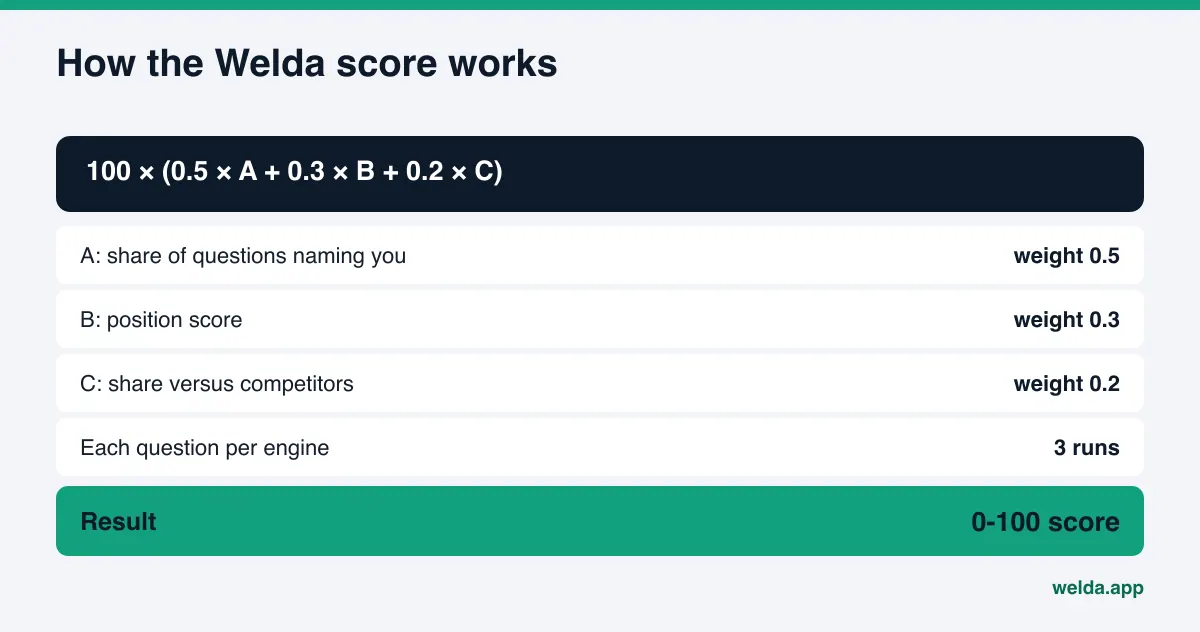
Here is how the dashboard screens map to fine dining work:
- Home: the score, a one-line summary, and what to do next.
- To-do list: missing information (for example, menu length or kids policy), content waiting for your approval, and tasks you need to do by hand, with ready copy next to each.
- Questions: question by question, whether your name appears.
- Competitors: which topic a competitor wins and which source it wins from. A competitor might lead on the wine pairing question because of a local magazine piece.
- Sources: the sites AI draws on and where you are missing.
- Ready pages: applies the recommendations and prepares a menu, policies, or occasions page for preview.
- Compliance check: flags price claims, guarantees, and superiority claims before anything is published. It is not legal advice and has not been reviewed by legal counsel.
- Inbound requests, before and after comparison, and a one-page monthly report (PDF).
On the fixing side, Welda drafts content, profile copy, and review replies. Approval to publish stays with you. Content always lives on your own website; Welda does not host content. On WordPress, Welda connects through a separate Editor user and an application password created for it, with no code to install. Content opens on your site as a draft and goes live when you approve it. On systems without a connection, Welda gives you a ready package and the change is made by hand. Google Business Profile, Instagram, and Facebook can be connected; if they are not, the task is listed as manual.
A plain note on early access: the Welda dashboard is in early access and is opening in stages, first in Turkey. Regular four-engine measurement is being added during early access, and sample dashboard screens use representative data. The part anyone can use today is the free site analysis, which works in English. Pricing is discussed in an early access call.
Limits: what Welda does not do
Like any tool in this space, Welda has limits. Knowing them up front keeps expectations realistic.
- No ranking or "get into ChatGPT" guarantee. No tool controls AI answers. Welda measures, shows the gaps, and fills them.
- It does not make things up. Your chef's background, your farms, menu length, your cancellation window: Welda asks you. Missing fields stay on the to-do list.
- No sensitive content goes live without approval. Sentences with prices, awards, or superiority claims are flagged and come to you.
- No fake reviews. Welda drafts replies to reviews. It does not write or solicit reviews.
- Some work stays with you. Handling negative reviews, managing directory and guide accounts, and press or critic relationships are not Welda's job.
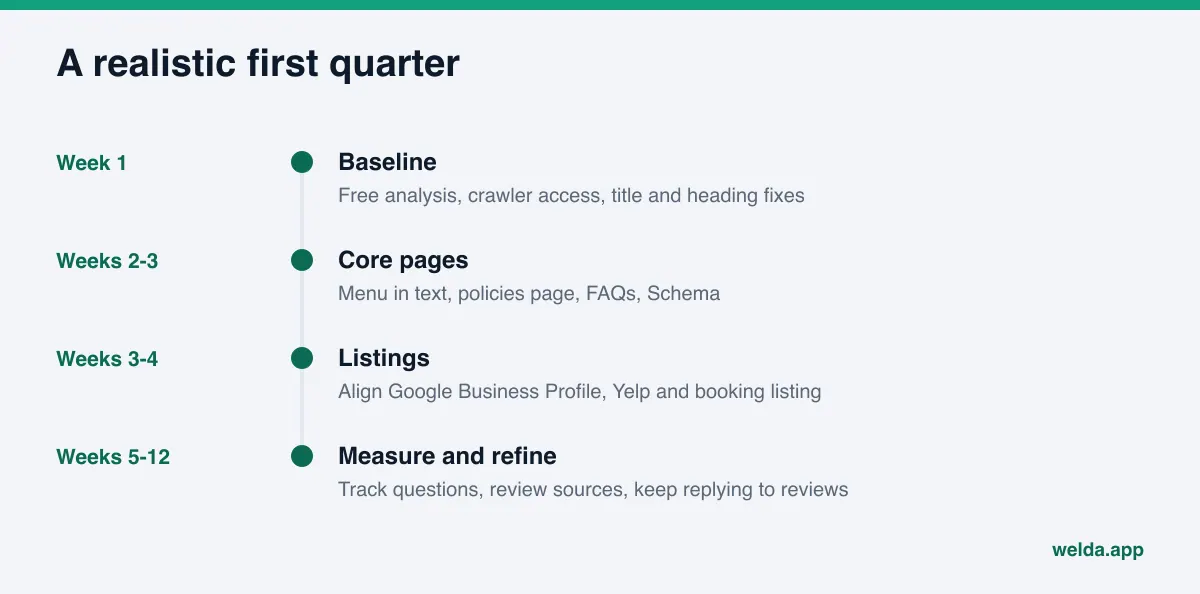
- It takes time. New content usually takes weeks to show up in AI answers. Expecting results the week a menu page goes live is not realistic.
Google's own documentation draws a similar line. Its page on AI features and your website says there are no additional requirements or special files needed to appear in AI Overviews or AI Mode; a page needs to be indexed and eligible to show with a snippet, and even then appearance is not guaranteed. The core work is readable, accurate, consistent information. Some people call this GEO (generative engine optimization); in the US the more common term is AEO, and the work is the same.
Fine dining AEO checklist
The list below works for a one-hour meeting with your team. Mark each item "yes," "no," or "not sure." The "not sure" items are usually where to look first.
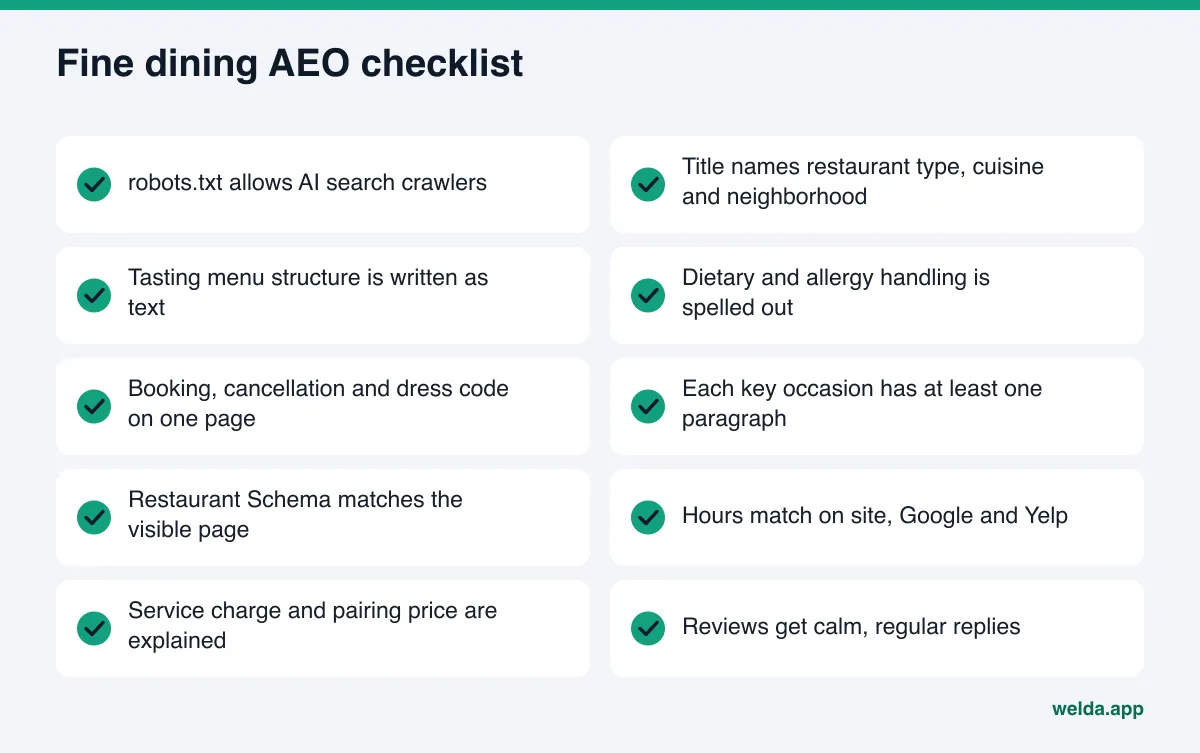
Once you have the checklist, use this to set priorities:
| Situation | Do this first |
|---|---|
| AI crawlers blocked in robots.txt | Fix access first; nothing else counts until you do |
| Menu only as a PDF or image | Write the menu structure as text |
| Hours or address differ across listings | Align Google Business Profile, Yelp, and your site |
| Policies explained only by phone | Publish a policies and FAQ page |
| Competitors lead on occasion questions | Write the occasion paragraphs, check the competitor's sources |
| Everything is in place, still not named | Keep measuring for a few weeks, review your outside sources |
Frequently asked questions
Can a restaurant without a Michelin star or major award still be recommended by AI?
Yes. Guides matter, but they are not the only source. Assistants also read your site, your Google Business Profile, reviews, and local food coverage. A site that answers occasion and menu questions clearly can earn mentions without awards, though no one can guarantee a specific outcome.
Our tasting menu changes every season. Do we rewrite the page each time?
No. Write the structure once: number of courses, approximate length, how often it changes, pairing options, dietary alternatives. Add a short "current menu" section for the season. The structure is what the assistant relies on.
Should we publish our prices?
That is your call. Either way, say what the price includes, whether a service charge applies, and whether pairing is separate. That keeps guests and assistants from guessing. For legal questions about pricing disclosures, talk to counsel; this article is not legal advice.
Does Yelp or a reservation platform matter more than our own site?
They work together. Your site is the one place you fully control, and outside listings confirm or contradict it. When they disagree on hours or details, the assistant has a reason to hesitate.
What does the free analysis tell a fine dining restaurant?
Whether AI can read your site, whether your business details are marked up, whether you have FAQs, and whether your name appears in 5 sample guest questions. Every gap comes with a fix and ready copy.
How long until we see a change?
New content usually takes weeks to show up in AI answers. Measure regularly and avoid deciding based on a single answer.
Where to start today
AEO for a fine dining restaurant starts with your site giving a clear answer to the guest's question: what you serve, how booking works, which occasions you suit, and what your policies are. The first step is seeing how your site reads today. Run the free AI visibility analysis to get your score, your gaps, and whether your name shows up in 5 sample questions.