What should AI visibility software for restaurant groups actually measure? It should show whether your brand, and the right location, gets named when diners ask ChatGPT, Gemini, Perplexity or Google's AI features where to eat. It should break the gaps down question by question and location by location, and it should help you fix them, not just report them. This guide covers what AI visibility software for restaurant groups needs to do, the work your team can do on its own, and which parts Welda takes on.
Why AEO is a different job for restaurant groups
AEO (answer engine optimization) is the work of getting your business named in the answers AI assistants give. You will also hear it called AI search visibility, or GEO (generative engine optimization); they describe the same goal. For a single-unit restaurant, AEO comes down to a fairly short question: can an AI assistant read your name, address, menu, hours and reviews, and do they agree with each other?
For a restaurant group, that question multiplies by the number of locations. Each unit has its own address, its own hours, often its own phone line, sometimes its own menu differences, and always its own review history. When a diner asks for a recommendation, the assistant has to keep all of that apart. If it cannot, it either merges details from two locations into one answer or leaves you out.
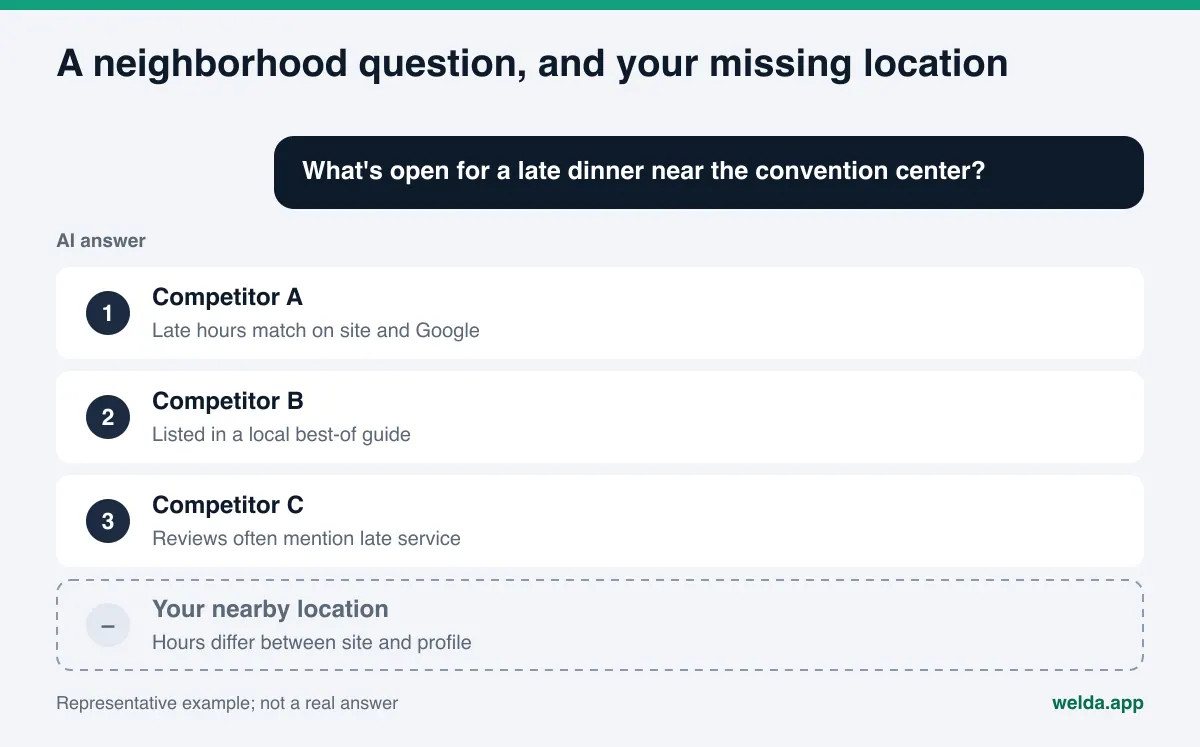
The second reason is how diners phrase their questions. People rarely ask an assistant about your brand by name. They ask about a neighborhood and a need: "where can I get a late dinner near Union Station", "kid-friendly brunch in the Gulch with outdoor seating", "a good place for a team lunch near the convention center that takes reservations for twelve". These are our own representative examples, not measured data, but the pattern is familiar to anyone who runs multiple units. Your brand only shows up if the assistant knows you have a location there, that it is open at that hour, and that it fits the request.
The third reason is drift. Groups open, close and relocate units. Holiday hours change. A location's phone number gets routed to a central line. Some of those changes reach your website and Google Business Profile; some never reach Yelp, Tripadvisor or the local "best of" lists. An AI answer that recommends a location you closed last spring does more damage than an answer that leaves you out.
So AI visibility software for restaurant groups has to go beyond one brand-level number. You need to see which questions you appear in, where a competitor is ahead, and which location's information is weak. If you want a baseline first, the free site analysis reads your homepage and several inner pages the way Google and AI assistants do.
What diners ask AI about restaurant groups
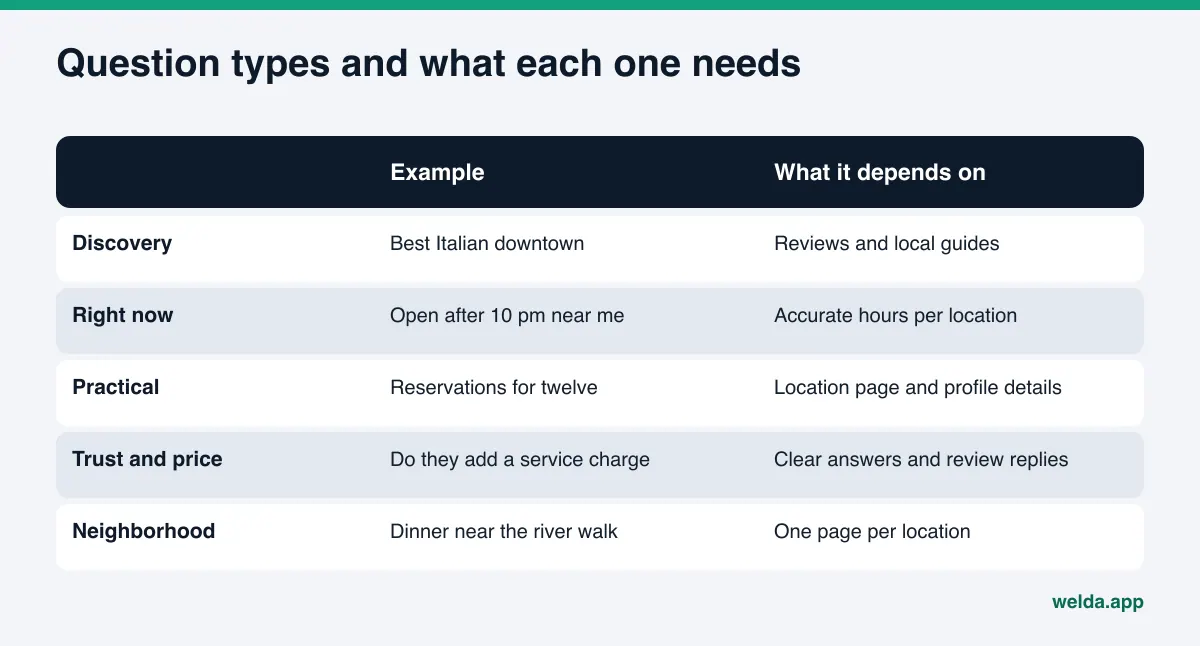
The questions that matter to a multi-unit operator tend to fall into a few groups. Each one points to a different kind of gap.
- Open-ended discovery: "best Italian restaurants downtown", "where should we eat tonight near the stadium". Your presence on review platforms and local guides carries a lot of weight here.
- Right-now questions: "what's open after 10 pm near me", "who serves breakfast on Sunday near the airport". Without accurate hours per location, you cannot win these.
- Practical details: "does this place take reservations for large groups", "is there parking", "do they have gluten-free options". The answer usually comes from your location page, your Business Profile attributes and review text.
- Trust and price: "is this chain worth the price", "do they add a service charge". Assistants often pull from review sites here, and one unit's complaints can color answers about the whole brand.
- Neighborhood questions: "good dinner spot near the river walk that isn't a tourist trap". This is where a group has the most to gain and the most to lose, because the neighborhood is the hook and the brand is not.
A useful exercise before you buy any tool: write down ten questions a guest might ask about each of your top three locations, in their words, not yours. You will notice quickly that almost none of them contain your brand name.
How to evaluate AI visibility software for restaurant groups
The number of tools that track AI answers keeps growing. When you evaluate one for a restaurant group, skip the broad promises and ask questions you can check.
| Criterion | Why it matters for a group | What to ask the vendor |
|---|---|---|
| Question-level results | A single brand score hides which neighborhoods you are losing | Can I see the result for each question separately? |
| Multiple answer engines | Guests use different assistants, and results differ by engine | Which engines are tested, and with the same questions? |
| Repeat runs and margin | AI answers vary even for the same prompt; one run misleads | How many times is each question asked, and is the spread shown? |
| Transparent scoring | You will report this number to ownership and need to explain it | Is the score formula published? |
| Competitor view | Your rival differs by neighborhood: another group here, an independent there | Do I see which topic and which source a competitor wins on? |
| Help with fixes | Measurement alone does not write location pages or profile copy | Does the tool draft the fixes, and who approves them? |
| Where content lives | Content hosted on someone else's platform is not under your control | Is everything published on my own website? |
The last two rows get overlooked most often. A tracking-only tool hands you a long list of gaps. Turning that list into location pages, Business Profile updates and review replies is still your team's job, and for a group that work scales with the number of units. If you are still deciding whether you need a tool at all, our comparison of manual ChatGPT checks vs tracking tools walks through the trade-offs.
Step by step: what a restaurant group can fix on its own
Some work comes before any software. Most of it can run from the central office and is largely a one-time setup.
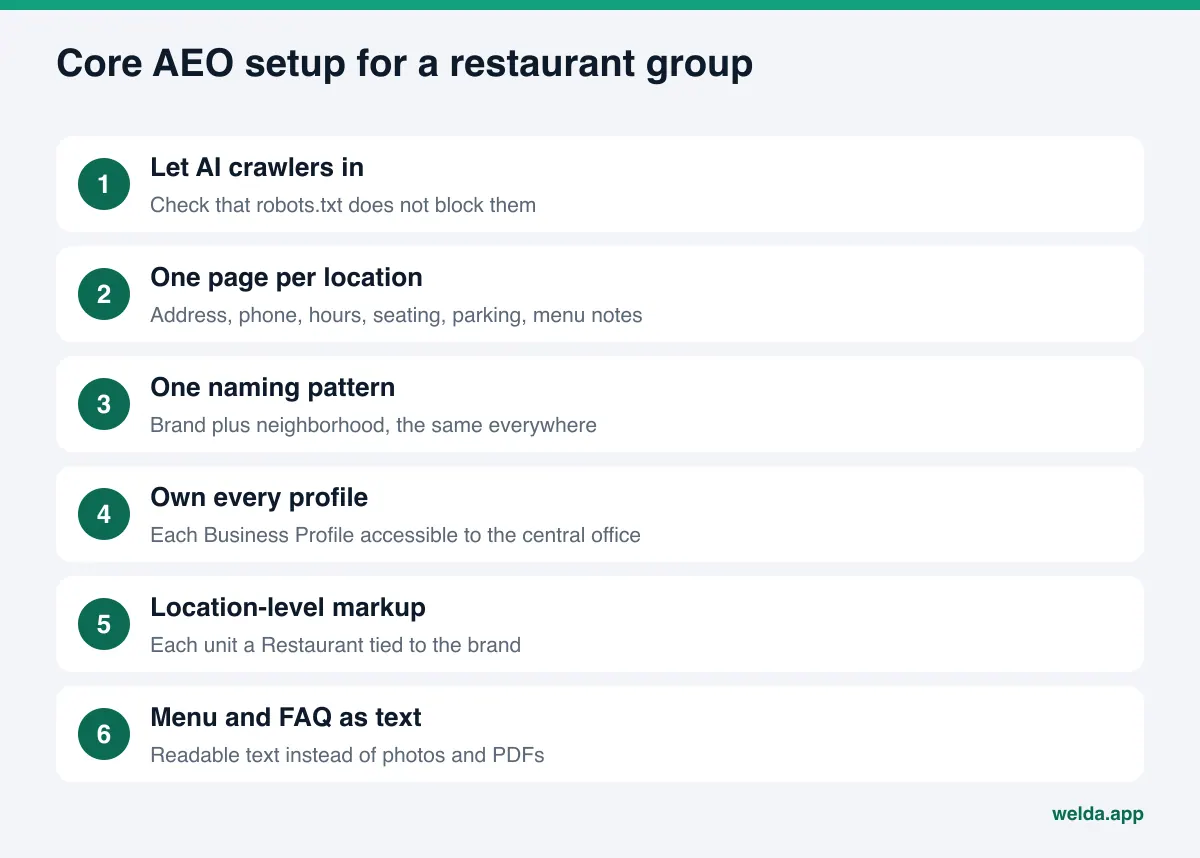
- Make sure AI crawlers can reach your site. If robots.txt blocks a crawler, that engine cannot use your pages in its answers. OpenAI's crawler documentation states that sites opted out of OAI-SearchBot will not be shown in ChatGPT search answers. On group websites, a block like this sometimes comes from a security plugin or an old setting nobody remembers.
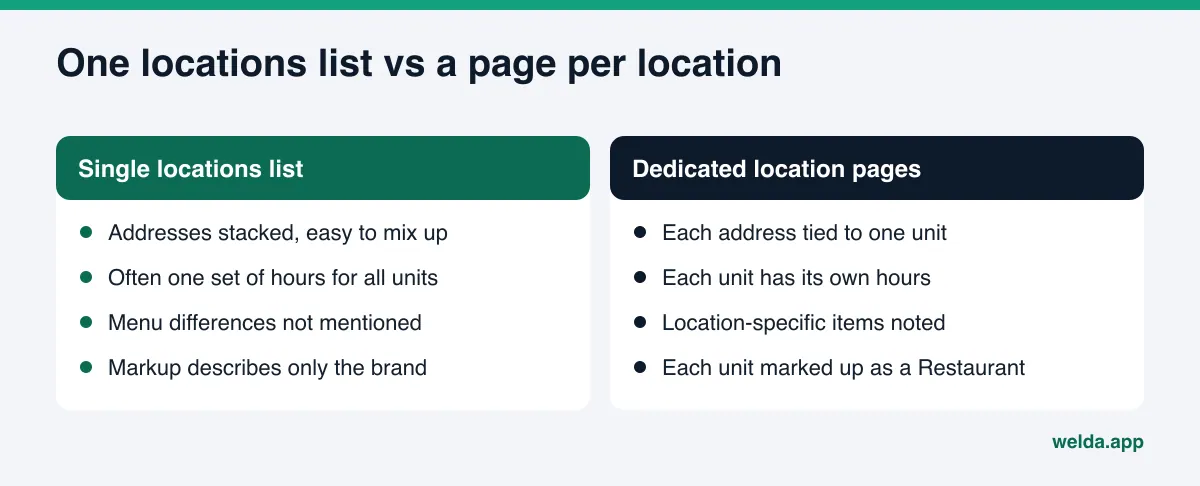
- Give every location its own page. A single "Locations" page with twelve addresses stacked on top of each other makes it easy for an assistant to mix up which details belong where. Each unit should have a dedicated URL with the full address, phone, hours, seating and patio details, parking and transit notes, and any menu differences.
- Pick one naming pattern and stick to it. If your site says "Downtown," Google says "Brand on Main," and Yelp says "Brand - Main St.," an assistant may treat those as three different businesses. Choose a single pattern, such as brand plus neighborhood, and use it everywhere.
- Align name, address and phone everywhere. Your website, Google Business Profile, Apple Maps, Yelp and Tripadvisor should all say the same thing. We cover this in detail in NAP consistency for AI search.
- Take ownership of every Business Profile. Google offers bulk verification when a business has 10 or more profiles. In groups, some profiles often sit in a former manager's or an old agency's account. Find out who holds what before you change anything.
- Mark up each location with structured data. Describe the brand as an organization on the homepage and each unit as a restaurant on its own page. The Schema.org Restaurant type supports properties such as hasMenu, servesCuisine, acceptsReservations, opening hours and parentOrganization, which ties each unit back to the brand.
- Publish the menu as text. A menu that only exists as a photo or PDF is hard for an assistant to read. Put the main dishes and dietary options on the page as text, and note location-specific items on that location's page.
- Add a short FAQ to each location page. "What time does this location close on Sunday?", "Do you take reservations for large parties?", "Is there a service charge?". Short, direct answers give an assistant something to quote.
Most of these steps are setup work. The hard part is keeping them current: every new opening, every closure and every change in hours means running the same list again.
How Welda handles AEO for a restaurant group
Welda is software that measures where a business shows up in AI answers and fills the gaps on the business's behalf. For a restaurant group, three parts matter most.
1. The free site analysis: your group's website through an AI's eyes
The free analysis reads your homepage and a few inner pages such as services, pricing, about and contact. For groups, the findings we would expect to come up most are things like: no business markup at all, or markup that describes the brand but not the locations; addresses and phone numbers shown as an image instead of text; social and map profiles not linked from the site; no FAQ section. You get a score out of 100, split into technical and content, and for every gap you see what was found, why it matters and how to fix it. A simulation shows how much each fix would move the score, and a competitor comparison shows where you stand.
The analysis also asks an AI assistant with web search five questions a guest might ask, and checks whether your brand appears in the answers. That is a one-time snapshot, not ongoing tracking, but it is a useful starting point for a leadership conversation: in how many of the five answers does the brand appear, and who shows up instead? The analysis has a limit worth knowing: it does not crawl every location page. Use its homepage and contact findings, then the checklist further down, to judge the state of your location pages. The analysis runs in English and German and is free once per site.
2. Questions and competitors: who wins in which neighborhood
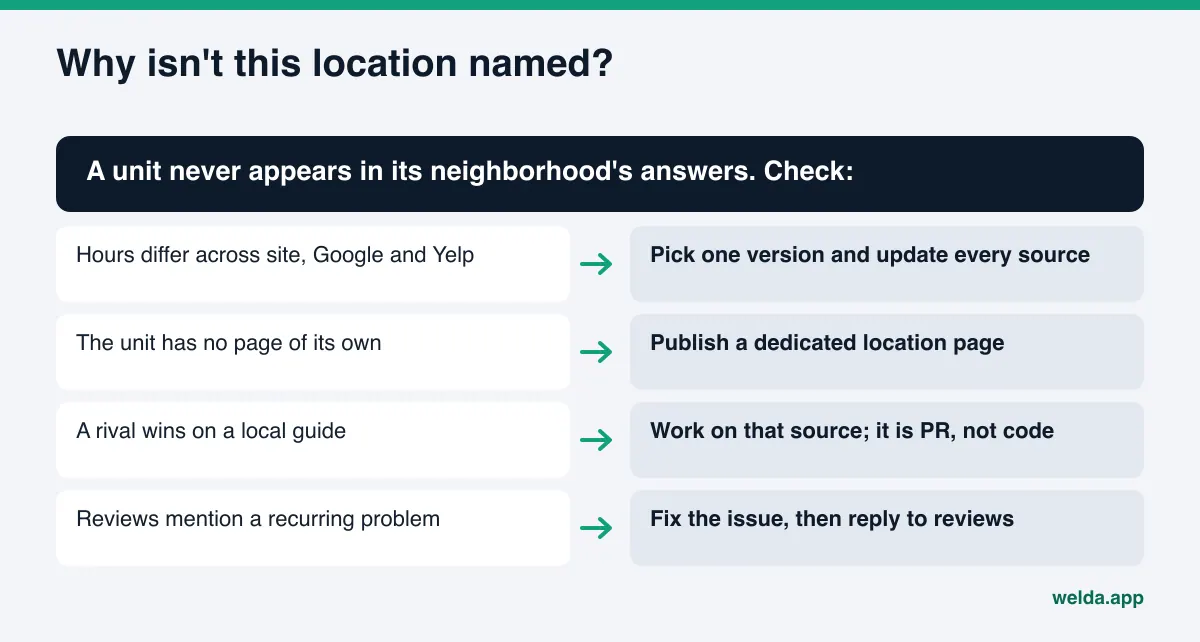
In the Welda dashboard, which is in early access, the questions your guests are likely to ask are sent to ChatGPT, Gemini, Perplexity and Google AI three times each. The questions view lists one question per row and shows, for each engine, whether you were named and in what position. For a group, the value is in reading those rows by neighborhood and need. If "late dinner near the convention center" never names you on any engine, the likely cause is that the nearby location's hours are missing or inconsistent somewhere.
The competitors view shows how those answers split across rivals, which topic a competitor wins on, and which source it is cited from. Groups often find this surprising. Your main rival is not the same in every neighborhood: in one, an independent place wins on the strength of local guide lists; in another, a competing group wins on map reviews. The view points to the source side of the problem: a guide you are missing from, a profile that has not been updated, reviews without replies.
3. One task list, with approval kept on your side
Everything the measurement turns up lands in a single task list. It holds three kinds of work: information Welda needs from you (a location's holiday hours, for example), ready drafts waiting for your approval (a new intro paragraph or FAQ for a location page) and manual tasks (updating hours on a profile that is not connected). Manual tasks come with the copy already written, so your team only has to apply it.
On WordPress sites, Welda connects through a separate Editor user and an application password, with no code to install. Drafted location copy opens on your site as a draft and goes live only when you approve it. Content always lives on your own site; Welda does not host content. Google Business Profile, Instagram and Facebook can be connected; anything not connected shows up as a manual task. For other site platforms, Welda provides a ready package and your team applies it.
Beyond that, a compliance check flags price claims and superlatives such as "best in town" before anything is published, and a monthly one-page report summarizes progress for ownership or franchise partners. We cover how to frame that report in AEO reporting for executives.
How to read the Welda score across a group
The score formula is public: 100 × (0.5 × share of questions that name you + 0.3 × position score + 0.2 × share against competitors). Because each question runs three times on each engine, the spread across runs gives a ± margin of error. In practice, for a group:
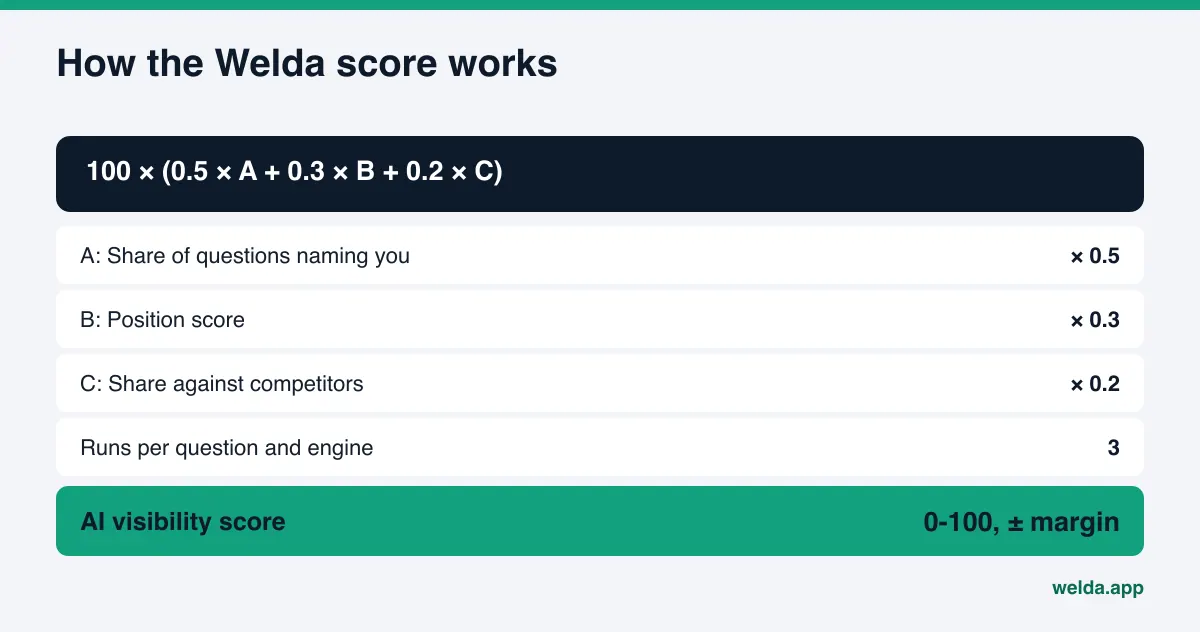
- Half the weight is on being named at all. If your units never appear in neighborhood questions, a good position elsewhere will not lift the score much. The first goal is getting each location into its own neighborhood's answers.
- Position comes second. Being the fourth name in an answer beats not being named, but diners tend to look at the first couple of suggestions.
- Share against competitors reflects local competition. Where a strong rival dominates a neighborhood, this number moves slowly, and source work (guides, reviews, profiles) is what moves it.
- Respect the margin. If a change between two months sits inside the margin of error, do not present it to ownership as a win or a loss.
Where AI reads your location data, and who owns each source
Knowing which sources an assistant reads, and who controls each one, also settles the split of work between the central office and general managers.
| Source | What gets read for a group | Who controls it |
|---|---|---|
| Your website | Location pages, menus, hours, FAQs | Central office |
| Google Business Profile and Maps | Address, hours, attributes, photos, reviews and replies | Central office or unit; ownership must be clear |
| Yelp and Tripadvisor | Reviews, photos, categories, price range | Guests write; replies are yours |
| Local guides and best-of lists | Neighborhood roundups and editorial picks | The publisher |
| Instagram and Facebook | Openings, closures, events, specials | Central office or unit |
Getting onto editorial lists is PR work. Welda does not do it, but its sources view shows which sites the assistants draw on and where you are missing. How negative reviews feed into answers is covered in negative reviews in AI answers.
Limits: what Welda does not do for a restaurant group
Knowing what a tool will not do matters as much as knowing what it will. Here is where Welda stops:
- No ranking guarantees. No tool controls AI answers, and Welda does not promise placement in ChatGPT or anywhere else. It measures and fills gaps.
- It does not invent facts. If a location's holiday hours, parking or menu differences are unknown, Welda asks you instead of guessing.
- No publishing of sensitive content without approval, and no fake reviews. It drafts review replies; you approve them.
- Reputation, directory accounts and PR stay with you. So does fixing the service issue behind a run of complaints at one unit.
- Results take time. New content usually takes weeks to show up in AI answers. Publishing a location page today does not mean it appears in an answer tomorrow.
- Market availability. The full dashboard is in early access and is opening first in Turkey; question language can be set to Turkish or English. The free analysis works in English and German today. Regular four-engine tracking is being added during early access, and the sample screens in the dashboard use representative data. How a multi-location setup is configured, and pricing, are discussed in an early access call.
The compliance check flags patterns; it is not legal advice and has not been reviewed by legal counsel.
Checklist before you buy AI visibility software for restaurant groups
Use this list to see whether your group is ready for a tool, and what a tool would really add.
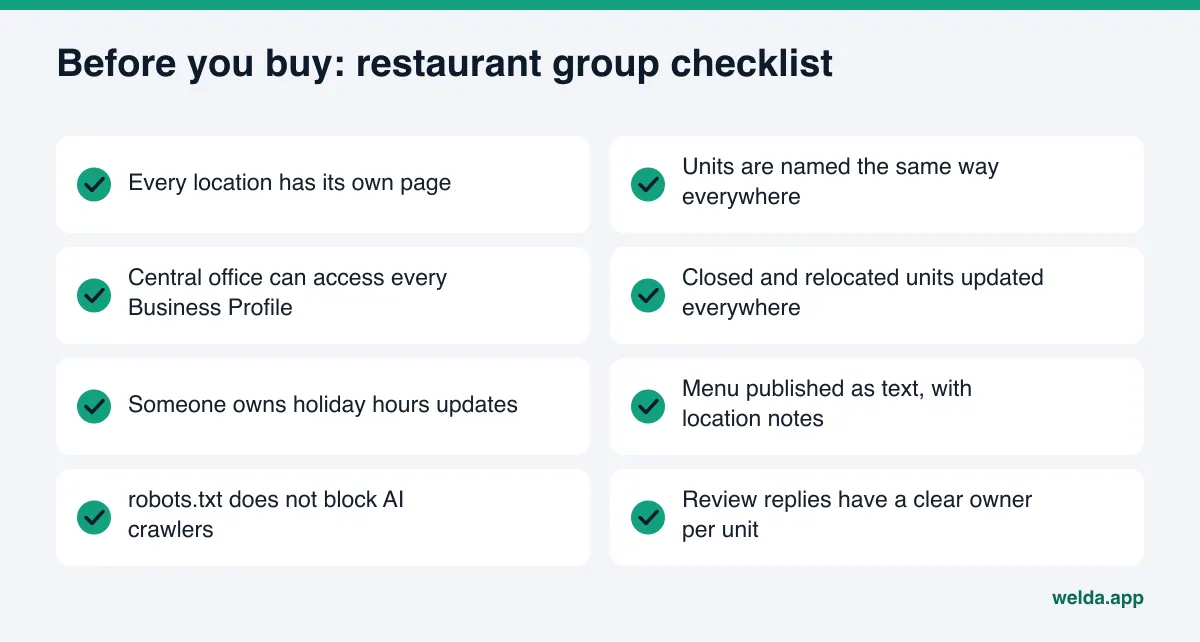
- Does every location have its own page on your site?
- Is each location named the same way on the site, on Google, on Yelp and on Tripadvisor?
- Does the central office have access to every Business Profile?
- Have closed or relocated units been updated everywhere?
- Who updates holiday hours, and where?
- Is the menu published as text, with location differences noted?
- Does robots.txt block any AI crawler?
- Who replies to reviews at each location, and how fast?
- Which number do you want to report to ownership, and how often?
If you have many gaps in the first seven items, closing them will do more than picking a tool. If most are in place, the question becomes "where do we stand, and where is the competition ahead", and a tool that both measures and drafts the fixes saves your team real time. For the single-unit view of the same problem, see AI visibility software for pizzerias, and for the terminology, GEO vs AEO.
Frequently asked questions
How is AI visibility software for restaurant groups different from a single-location tool?
The core measurement is the same: ask questions, check whether you are named. The difference is that results need to be read by neighborhood and location, and fixes land in many places: individual location pages, individual profiles. For a group, the key is a tool that shows results question by question instead of collapsing them into one brand score.
Do we need a separate website for each location?
No. One site with a dedicated page per location is usually enough, and it is easier to keep accurate. What matters is that each page carries its own address, hours, phone and structured data.
Does the free analysis read every location page?
No. It reads the homepage and a few inner pages; it does not crawl each location. It is a good first look at your markup, contact details and the five-question AI test. It is free once per site, both email and phone are verified, and the results link arrives by email and stays open for 14 days.
Will Welda publish our location pages for us?
On WordPress, Welda adds its drafts to your site as drafts, and you decide when they go live. On other platforms, it provides a ready package and your team applies it. Either way, the content lives on your own site.
A closed location still shows up in AI answers. What should we do?
Mark the unit as permanently closed on its Business Profile, update or redirect the page on your site, and request corrections on Yelp, Tripadvisor and any guide that lists it. AI answers can take weeks to catch up; keeping every source consistent in the meantime is what helps most.
What does Welda cost?
The dashboard is in early access and pricing is not published. It is discussed in an early access call based on your group's setup. The site analysis is free today.
See where your restaurant group stands in AI answers
AEO for a restaurant group starts with location information that is consistent, readable and current. Measure instead of guessing. Run the free site analysis to see your score, the list of gaps, ready-to-use homepage copy and the result of the five-question AI test. The full Welda dashboard is opening in stages through early access; if you want ongoing tracking and fixes for your group, your analysis result is a good place to start that conversation.