Why doesn't ChatGPT recommend my pizzeria, and can software actually measure that? AI assistants recommend pizza places based on what they can read on your website, your Google Business Profile and review sites. If your crust style, oven, delivery area, hours and menu are not written down clearly, your name stays out of the answer. AI visibility software for pizzerias measures which questions you show up in, finds the missing information and drafts the fixes. This guide walks through the work step by step and shows which parts Welda handles for you.
What does AI visibility software for pizzerias actually do?
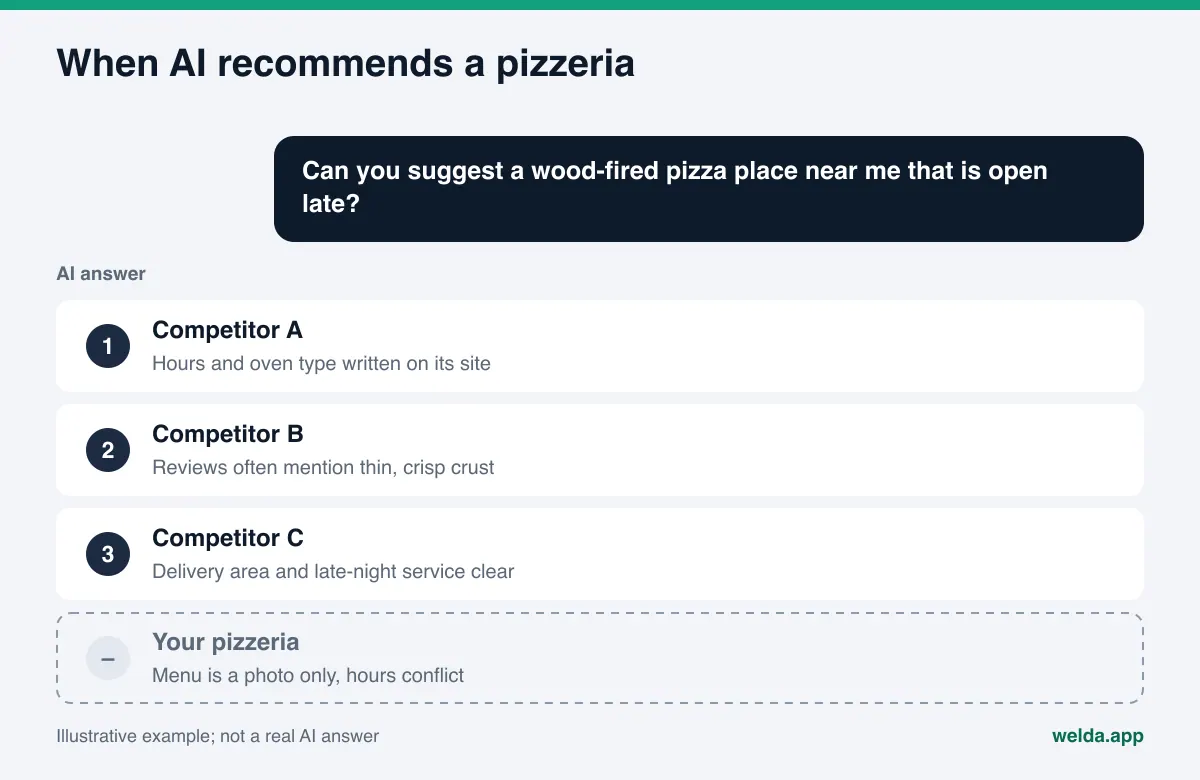
AI visibility, often called AEO (answer engine optimization), is about whether your business gets named in answers from ChatGPT, Gemini, Perplexity and Google's AI Overviews and AI Mode. You may also see the term GEO, short for generative engine optimization; it describes the same work. In classic search, a hungry customer scans ten blue links and a map pack and picks one. In an AI answer, they usually get a short list of three or four places. If your pizzeria is not on that list, the decision gets made without you.
Pizza is a fast decision. People ask on their phone at 9 p.m., before the game, or after a late shift. The questions are specific: "pizza open late near me", "best wood-fired Neapolitan pizza in my neighborhood", "gluten-free crust that is actually safe for celiacs", "thin-crust pizza that delivers to my area". To answer, an AI assistant looks for a page or profile that states those details plainly. If your competitor wrote it down and you did not, the competitor gets named.
AI visibility software does three jobs here. First, it measures: are you named for the questions your customers ask, in what position, and where does a competitor lead? Second, it diagnoses: what on your site or profiles can AI not read, or reads as conflicting? Third, it fixes: it drafts the copy, the structured data and the profile descriptions that close the gap. A tool that only measures hands you a number. Getting the work done takes the second and third step too.
The quickest way to see where you stand is to check your site as it looks today. Welda's free site analysis reads your homepage and a few inner pages the way Google and AI assistants do and lists each gap with a fix. If you also run a plant-based menu, the guide on AI visibility software for vegan restaurants covers that angle.
What do customers ask AI about pizza?
Pizza questions fall into a handful of patterns. Each pattern draws on a different piece of information. Once you know which detail feeds which question, it becomes clear what to write and where. The example questions below are illustrations of each pattern, not measured data.
| Question pattern | Example question | What the answer relies on |
|---|---|---|
| Location and distance | "Best pizza near me?" | Address, neighborhood name, map pin, Google Business Profile |
| Hours and status | "Pizza place open after midnight near downtown?" | Opening hours, late-night service, holiday hours |
| Pizza style | "Where can I get Detroit-style or New York slices?" | Crust style, oven type, style named in text on your menu page |
| Dietary needs | "Pizzeria with a gluten-free or vegan option?" | Options written on the menu, with their limits |
| Delivery and pickup | "Thin-crust pizza that delivers to my zip code?" | Delivery area, ordering method, pickup option |
| Groups and catering | "Pizza for a kids' party of 20 people?" | Large orders, party trays, lead time |
| Price and trust | "Cheap but good pizza for a family dinner?" | Menu prices, sizes, words used in reviews |
The takeaway is simple: every pattern depends on a different fact. "Detroit-style" depends on how you describe your pizza. "Open after midnight" depends on your hours. "Delivers to my zip code" depends on your delivery area. If those facts live only in a menu photo or an Instagram post, AI assistants often cannot read them. To decide which of these questions to watch every month, see the guide on prompts to track for AI visibility.
What sources does AI read before it recommends a pizzeria?
An AI answer rarely comes from one place. Depending on the question, the engine runs a web search and reads several sources together. For a pizzeria, those sources fall into four groups.
- Your own website: menu, crust and oven description, delivery area, hours, address and phone. You control this completely.
- Google Business Profile and Google Maps: category, hours, photos, reviews and your replies to them. Google's AI Overviews and AI Mode can use this information directly.
- Review sites: Yelp, Tripadvisor and reviews on delivery apps. You do not write these reviews, but you can respond to them.
- Local guides and lists: city food blogs, local news "best pizza" roundups and neighborhood guides. These are written by others and often decide who gets mentioned in "best of" questions.
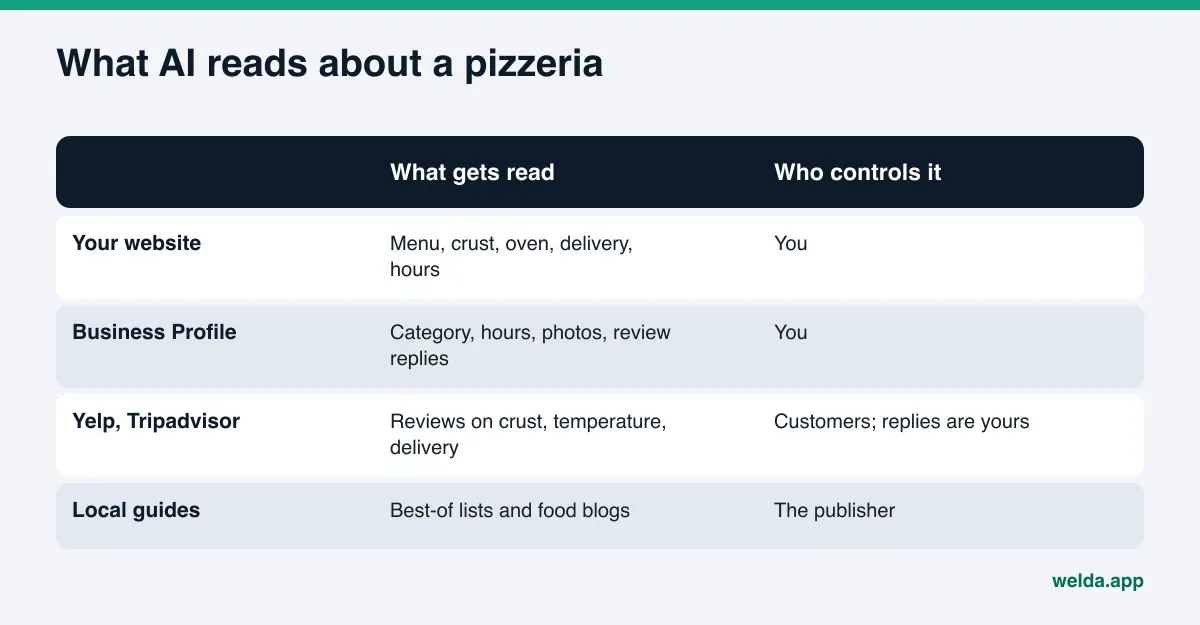
Two of those four sources are fully in your hands: your website and your Business Profile. Start there and make them complete and consistent. If your address, phone number or hours differ between the two, AI either skips you or repeats the wrong detail. The guide on wrong address or phone number in AI answers explains how that happens and how to fix it.
There is also a technical door. If AI crawlers cannot get into your site, even your best copy does nothing. OpenAI, for example, states in its crawler documentation that ChatGPT search uses a bot called OAI-SearchBot, and that sites blocking it will not be shown in ChatGPT search answers. Many restaurant websites ship with a template robots.txt file that nobody has opened in years. Checking it once is enough.
Step-by-step AEO checklist for a pizzeria
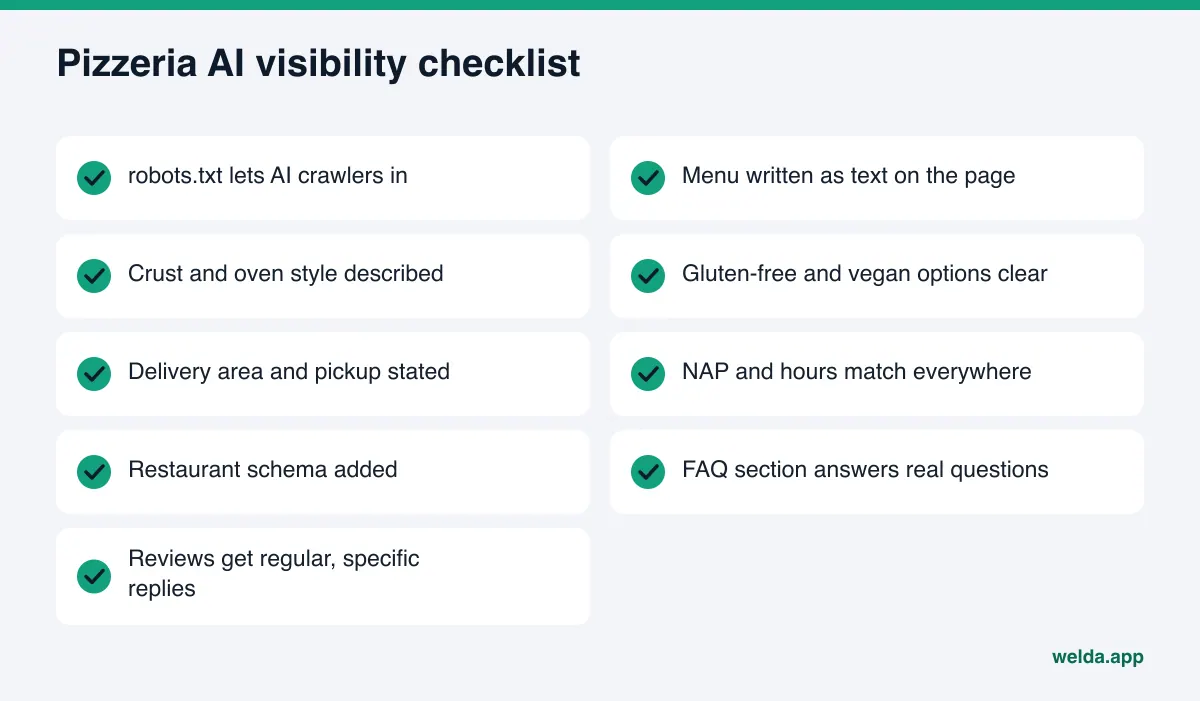
These are steps a pizzeria owner or manager can take without an agency. Order matters: open the door first, then write the facts, then add structure.
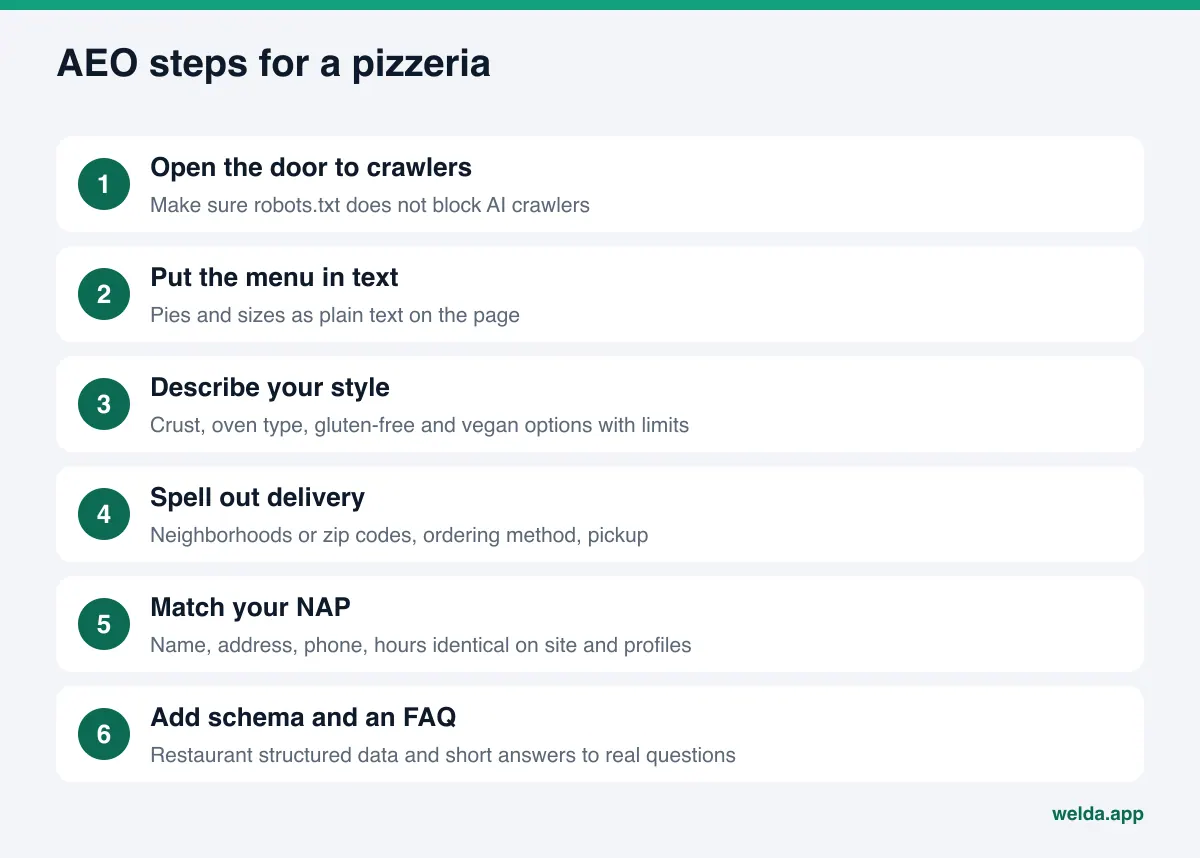
- Check robots.txt. Add /robots.txt to the end of your website address and open it. If a line blocks AI crawlers or all crawlers, talk to whoever built your site.
- Put your menu in text. If your menu is only a photo or PDF, also write your main pies and sizes as plain text on the page. Name, toppings and size options are enough.
- Describe your style in one paragraph. Is it New York, Neapolitan, Detroit, Chicago tavern-style, Sicilian? Wood-fired, deck oven, or conveyor? How long does the dough ferment? You know these facts; AI does not, until you write them.
- Be honest about dietary options. If you offer a gluten-free crust, say whether it is baked in the same oven as regular dough. If you have vegan cheese, list which pies can take it. Vague or inflated claims turn into wrong recommendations and bad reviews.
- Spell out delivery and pickup. Which neighborhoods or zip codes do you deliver to, how do people order, is there pickup? Keep this as plain text somewhere on the site.
- Match your NAP everywhere. Name, address, phone and hours should be identical on your site, Google Business Profile, Yelp and delivery apps. Update all of them when late-night or holiday hours change.
- Add structured data. The schema.org Restaurant type includes menu (hasMenu), cuisine (servesCuisine), reservations (acceptsReservations), opening hours, price range, address and phone. For a pizzeria, servesCuisine can be "Pizza" or "Italian".
- Write an FAQ section. Answer five or six questions customers actually ask: how late are you open, do you have gluten-free crust, which areas do you deliver to, do you take large party orders.
- Reply to reviews. Short, specific replies to reviews about crust, temperature and delivery time help. Your replies are part of the text AI reads.
If your site runs on WordPress, most of the text steps can be done in the page editor. The guide on WordPress AEO goes into detail.
Example: rewriting a pizzeria homepage for AI answers
The comparison below was written for a sample neighborhood pizzeria; it is not a real business. The left column shows generic lines found on many pizza websites. The right column describes the same place with facts an AI assistant can quote.
| Field | Generic line | Specific line |
|---|---|---|
| Main heading | "The best pizza in town" | "Wood-fired Neapolitan pizza in the East Village" |
| Intro paragraph | "Made with love and the freshest ingredients" | "Our dough ferments for 48 hours and bakes in a wood-fired oven. Open daily 11 a.m. to 1 a.m." |
| Delivery | "Fast delivery" | "We deliver to the East Village, Lower East Side and Gramercy; pickup available." |
| Dietary | "Something for everyone" | "Gluten-free crust available; it shares our oven, so we do not recommend it for celiac guests." |
Each specific line answers a question: neighborhood, style, hours, delivery area and limits. "The best pizza in town" answers nothing and reads as an unsupported superiority claim. Welda's free analysis follows the same logic in its ready-to-use copy for your homepage title, description, main heading and intro paragraph. It builds on what it can read on your site. Facts that are not there, such as how long your dough ferments, are left for you to fill in.
How Welda handles AI visibility for a pizzeria
Welda is software that measures where a business shows up in AI answers and fills the gaps on the business's behalf. For a pizzeria the work has two parts: the free site analysis anyone can use today, and the Welda dashboard, which is in early access.
The free site analysis: what you can run today
The analysis works in English and reads your homepage plus a few inner pages (services, pricing, about, contact) the way Google and AI assistants see them. It checks whether AI crawlers can get in, your page title and description, your main heading, your structured data, your address, phone and location details, whether your social and map profiles are linked from the site, your FAQ section, reviews and trust signals, whether your offering is clearly described, and page speed.
You get a score out of 100, with technical and content scored separately. Every gap comes with what was found, why it matters and how to fix it. You also get ready-to-use copy for your homepage: title, description, main heading, intro paragraph and FAQ. A simulation shows how much each fix would raise your score. The report includes a competitor comparison, a fix package to add to your site (structured data included), a PDF and a shareable score card.
The analysis also asks five questions your customers might ask to an AI assistant that can search the web, and checks whether your business name appears in the answers. This is a one-time measurement of where you stand today. It is free once per site. Your email and phone are verified, the results link arrives by email and stays open for 14 days.
The Welda dashboard: ongoing tracking and fixes
The full dashboard is in early access and is opening first in Turkey. Regular tracking across all four engines is being added during early access, and sample screens in the dashboard use representative data. Pricing is discussed in an early access call. For pizzerias in the US, the free analysis is the part you can use right now.
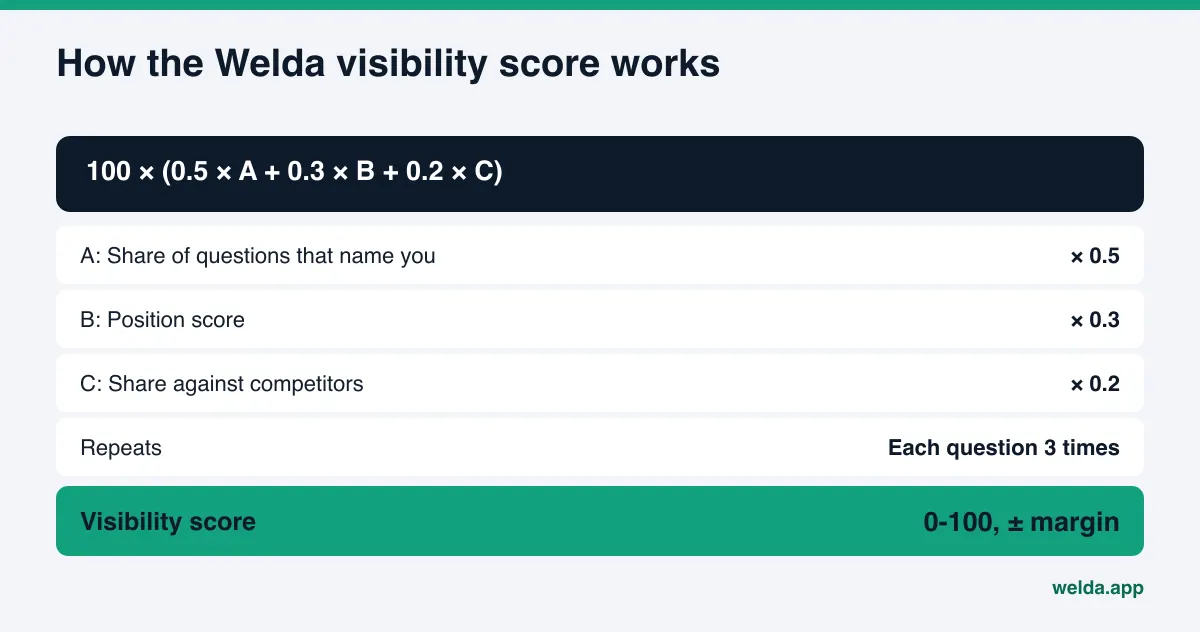
On the measurement side, the questions your customers would ask are sent to ChatGPT, Gemini, Perplexity and Google AI three times each. You see which questions name you, in what position, and where competitors lead. Questions can be tracked in English or Turkish. The competitors screen shows which topic and which source a competitor wins on. For a pizzeria that might read like "Competitor A leads on late-night questions because its hours are clear on its site and Business Profile." The sources screen lists the sites AI draws on and where you are missing.
The score formula is public. It combines the share of questions that name you, a position score and your share against competitors. Because each question is asked three times, the spread between answers gives a margin of error shown next to the score.
On the fix side, Welda drafts content, profile copy and review replies. The to-do screen is one list: information Welda could not read on your site and needs from you, drafts waiting for your approval, and manual tasks. Each manual task comes with ready copy. Welda does not invent facts; if it does not know your delivery area or your oven type, it asks you.
If your site runs on WordPress, Welda connects through a separate Editor user and an application password you create, with no code to install. Content opens on your site as a draft and goes live when you approve it. For other systems Welda gives you a ready package and the changes are made by hand. Google Business Profile, Instagram and Facebook can be connected; if they are not, the task is listed as manual.
What stays with you is clear. Approval to publish stays with the business. Content always lives on your own site; Welda does not host it. A legal check flags patterns such as price claims, guarantees and superiority claims before anything goes live, so "best pizza in town" gets flagged. That check is not legal advice and has not been reviewed by counsel. A before-and-after comparison and a one-page monthly report (PDF) show what changed. If you run several locations, the guide on AI visibility software for restaurant groups covers tracking by location.
How to choose AI visibility software for pizzerias
The tools in this space fall into three broad types: tracking tools that only measure, one-time audit tools, and software that drafts fixes alongside measurement. Which one fits a pizzeria depends on the answers to the questions below.
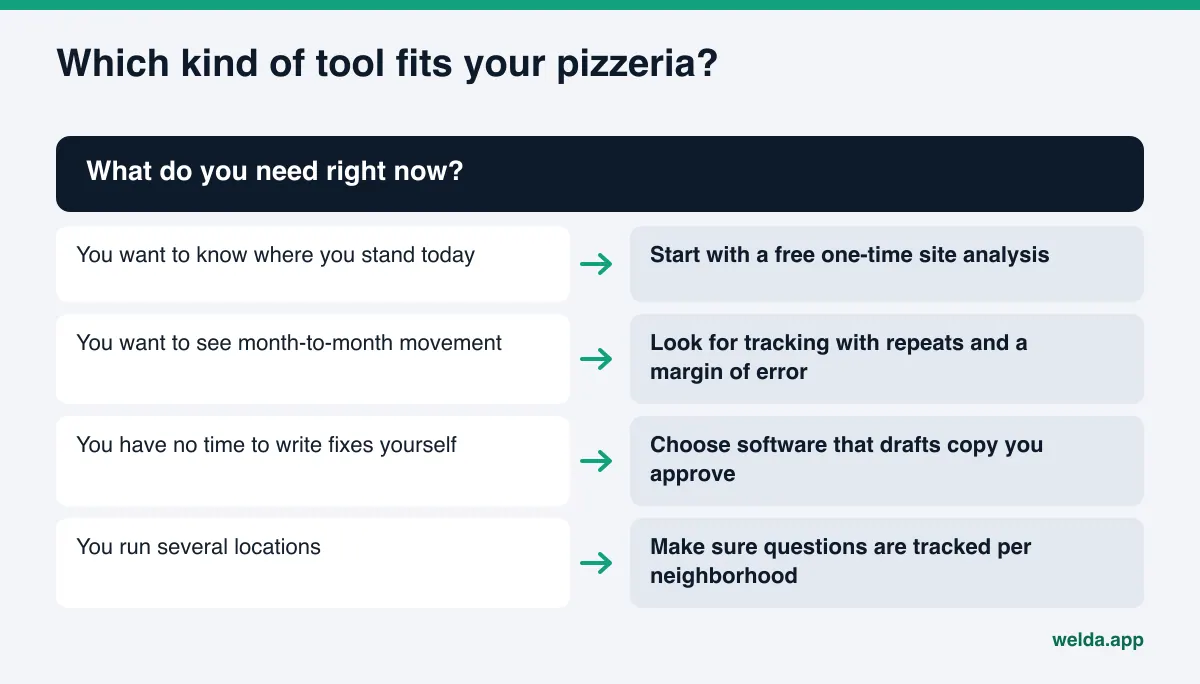
| Criterion | Why it matters | Question to ask |
|---|---|---|
| Local question tracking | Pizza decisions are about place and time | Can it track my neighborhood and "open now" questions? |
| Multiple engines | Each engine reads different sources | Are ChatGPT, Gemini, Perplexity and Google AI measured separately? |
| Repeats and margin of error | The same question can get different answers | Is each question asked more than once, and is the spread shown? |
| Transparent formula | You need to know why a score moved | Is the scoring method written down? |
| Fix output | Measurement alone changes nothing | Does it give ready copy, structured data and profile text? |
| Approval and ownership | Menu and prices are your responsibility | Do I approve everything, and does content stay on my site? |
For a broader buyer's list, see the guide on AEO tool features. For most independent pizzerias, the sensible first step is a free analysis to see today's state, then a decision about whether ongoing tracking is worth it.
Limits: what Welda does not do
AI visibility does not work like buying an ad slot. Nobody can promise you the top spot in ChatGPT, and Welda does not. The honest limits:
- Welda does not guarantee rankings or placement in ChatGPT. The free analysis does not measure rankings either.
- It does not write facts it does not know. It asks you about your dough, delivery area or gluten-free handling.
- It does not publish sensitive content without approval. Copy with prices, promotions or health claims comes to you first.
- It does not create fake reviews. It drafts replies; the reviews themselves come from customers. In the US, the FTC rule on consumer reviews and testimonials (16 CFR Part 465, effective October 21, 2024) prohibits writing or buying fake reviews. This is not legal advice.
- Handling negative reviews, setting up directory listings and press work stay with the business. Welda can draft copy and lists for them, but it does not run those tasks for you.
- New content usually takes weeks to show up in AI answers. Do not expect a change made today to appear tomorrow.
One limit sits with you: AI cannot taste your pizza. It only reads what is written, reviewed and listed. A good pizzeria's job is to describe what it does clearly and consistently. AI visibility software makes that work measurable and regular.
Frequently asked questions
What does AI visibility software for pizzerias measure?
It measures whether your name appears in answers to the questions customers ask AI, your position, and the questions where competitors lead. In the Welda dashboard each question goes to four engines three times, and a published formula turns the results into a score.
Is this worth it for a single neighborhood pizzeria?
Often yes, because pizza questions are local and time-bound. For "pizza open now near me" you compete with a handful of nearby places, not national chains. Clear, consistent facts tend to decide that contest.
My menu is only on Instagram. Is that enough?
Usually not. AI cannot always read text inside images. Write your main menu items as plain text on your site as well.
Does the free analysis work for US businesses?
Yes. The free analysis works in English and is free once per site. The results link arrives by email and stays open for 14 days.
Can I start using the Welda dashboard now?
The dashboard is in early access and is opening first in Turkey. Today, the part anyone can use is the free site analysis. Pricing is discussed in an early access call.
Do delivery app reviews matter?
AI answers draw on several sources together, and delivery app reviews can be among them. Welda can draft replies; posting them stays with you.
Where to start today
The first step is knowing how your site looks to AI. Run the free site analysis to see your score, your gaps, ready copy for your homepage and a fix package you can add to your site. The simulation shows which fix moves your score the most. If you later want ongoing tracking, you can ask about Welda's early access.