How do private hospitals get recommended by ChatGPT? When ChatGPT recommends a hospital, it leans on clear information it can find on your website and in the sources that talk about you: which service lines you offer, which physicians practice there, whether you run a 24/7 emergency department, which insurance plans you accept, and what patients and local media say about you. When that information is clear, consistent, and readable, your hospital is more likely to be named in AI answers. Nobody can guarantee a specific position.
This guide is for people who run a private or independent hospital, lead its digital or marketing team, or own the website for a hospital group. The question is simple. When a patient asks "Which private hospital near me has a 24/7 ER and takes my insurance?" or "Where should I go in Houston for a hip replacement?", do ChatGPT, Gemini, Perplexity, or Google's AI Overviews mention you? If not, why, and what should you fix first? This is what people now call AEO, answer engine optimization: making sure answer engines can find, understand, and cite your hospital. You will also see it called GEO, generative engine optimization; in practice the two terms describe the same work. Below we cover the problem, the steps, how Welda handles the work, and what it does not do. If you want to see where your site stands today, start with the free AI visibility site analysis.
Why AI visibility matters for private hospitals now
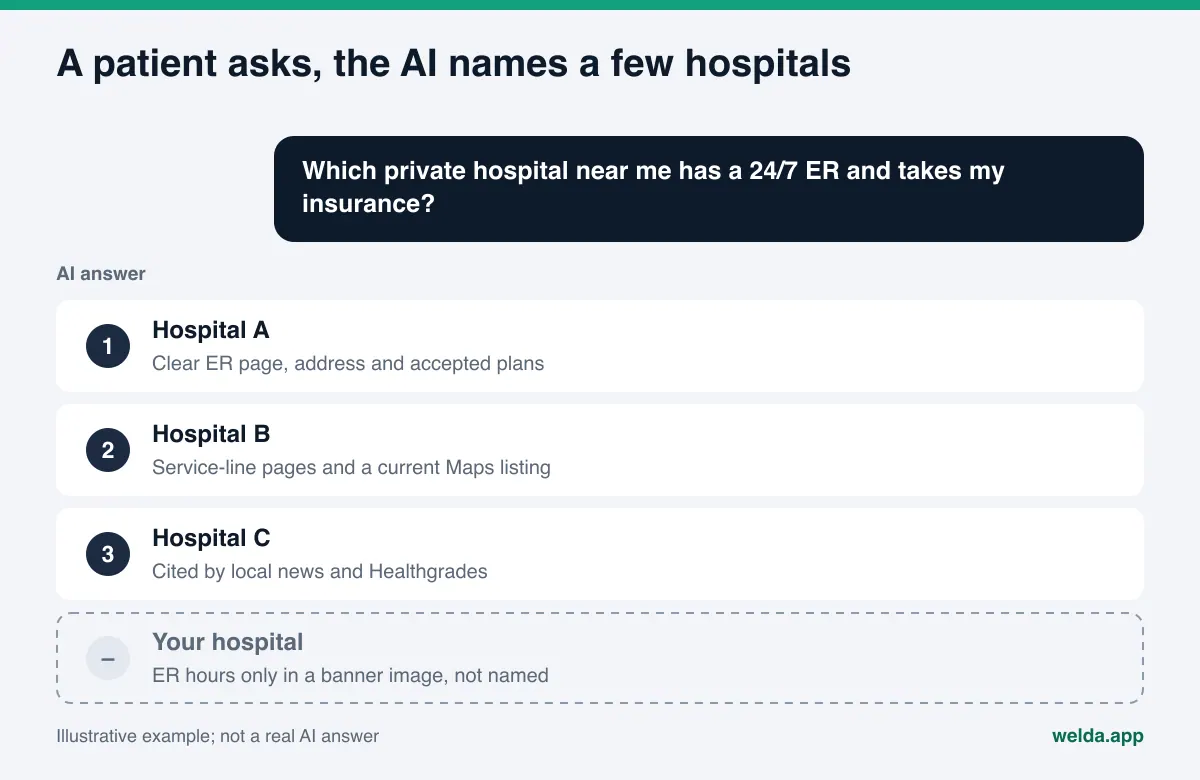
Choosing a hospital is often a rushed decision. A parent's child spikes a fever at night, an older relative falls, a primary care doctor orders a procedure and says "pick a facility." For years that meant a handful of separate searches: "hospital near me," then a map comparison, then a click through to each website to check the ER and the insurance list. AI assistants fold those steps into one conversation. The patient types their city, their symptom or procedure, their insurance, and their time constraint in one sentence, and the assistant answers with a few hospital names.
A hospital that is not in that answer never makes the shortlist. In classic search, ranking sixth on page one still earned some clicks. In an AI answer, usually only a few names appear, and the patient tends to choose among them. That makes AI search visibility less of a marketing preference and more a question of how new patients find you at all.
Hospitals face a harder version of this problem than single-specialty practices, for four reasons:
- The scope is wide. A hospital runs dozens of service lines, employs or credentials hundreds of physicians, and offers distinct services such as emergency care, imaging, labor and delivery, and surgery. Each is a separate question and a separate answer. A single "About us" page answers none of them well.
- Practical details decide. Is the ER open around the clock? Which plans are in-network? Where do I park? Can a family member stay overnight? These details often matter as much as clinical reputation.
- Third-party sources are loud. Local news, Healthgrades, Google reviews, Yelp, and BBB complaints all describe hospitals. If your own site is thin, other people's text builds the answer.
- The rules are real. Health claims, reviews, and pricing all carry regulatory weight in the US. Every page you write for visibility has to stay inside those lines.
Put together, the job is this: describe every service your hospital provides clearly enough for an AI assistant to read it, and do it as an information source, not as an ad.
What patients ask AI assistants about hospitals
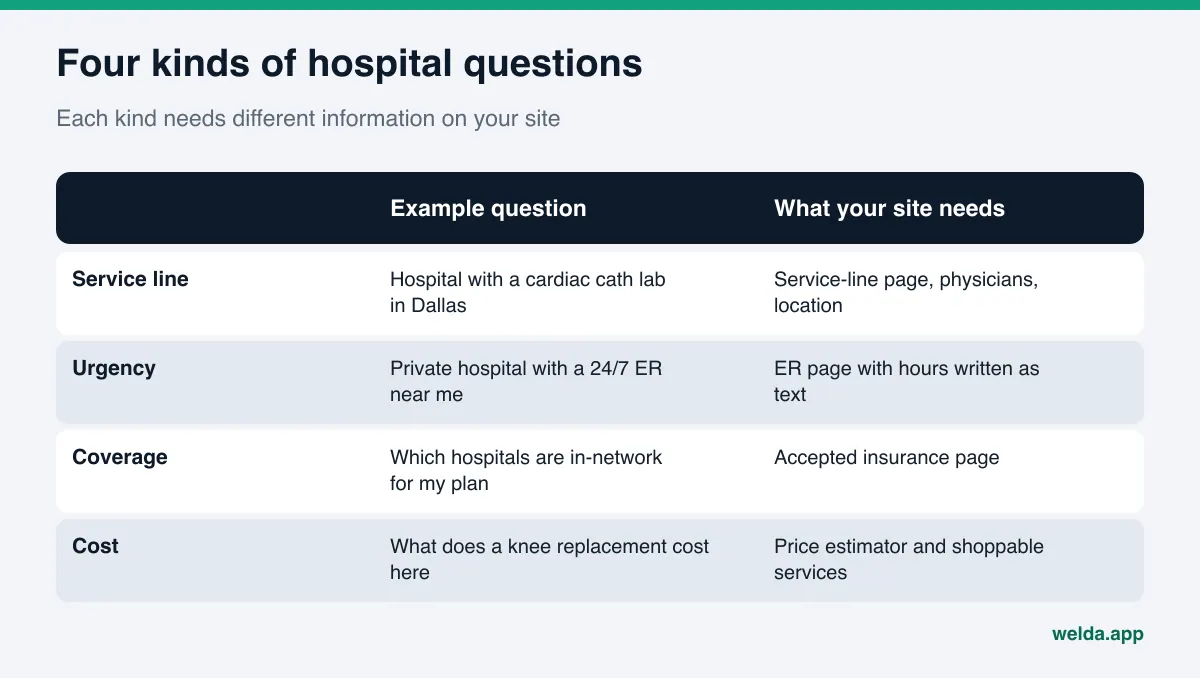
Patient questions about hospitals fall into a few recognizable groups. The examples below are illustrative, written to show the patterns rather than drawn from a measured data set:
- Service line and location: "Which hospital in Phoenix does robotic prostate surgery?"
- Urgency: "Private hospital with a pediatric ER open now near Tampa."
- Coverage: "Which hospitals near me are in-network for my plan?"
- Cost: "How much does an MRI cost at a hospital versus an imaging center?"
- Experience and trust: "What do patients say about the maternity ward at this hospital?"
Two things stand out. First, patients rarely ask only "what is the best hospital." They ask about hours, neighborhoods, insurance, and cost. Second, several of these questions are about how the system works, not about any one hospital. For cost and coverage questions, assistants often lean on insurer sites, news coverage, and government pages. If your own site does not explain your side of it clearly, your hospital is not part of the conversation.
Cost deserves special attention in the US. Under the federal hospital price transparency requirements from CMS, in effect since January 1, 2021, hospitals must post a comprehensive machine-readable file of their items and services and display shoppable services in a consumer-friendly format. That makes cost information something you already have to publish. The AEO question is whether a patient, or an assistant, can actually find and understand it from your public pages.
How private hospitals get recommended by ChatGPT: where the answer comes from
AI assistants draw on two kinds of information when they recommend a hospital. One is general knowledge left over from model training. The other is a live web search run at the moment the question is asked. For local, time-sensitive questions such as "this neighborhood, this service, tonight," live search dominates. ChatGPT's search feature uses a crawler called OAI-SearchBot; according to OpenAI's crawler documentation, sites that block it will not be shown in ChatGPT search answers. On the Google side, Google's AI features documentation says there are no extra technical requirements for AI Overviews or AI Mode beyond being indexed and eligible to show a snippet.
During that search, assistants typically pull from:
- Your own website: service-line pages, physician directory, ER page, locations, accepted insurance, FAQs, price estimator.
- Google Business Profile and Google Maps: address, phone, hours, category, reviews, for each campus and facility.
- Health directories and review sites: Healthgrades, Yelp, and similar listings for both the hospital and its physicians.
- Local news and community coverage: openings, new service lines, staffing changes.
- Complaint and discussion sources: BBB, forums, and social threads. How negative records surface in answers is covered in our piece on negative reviews in AI answers.
The assistant combines these and names the hospitals with the most consistent, clearly stated information. Your own website sits at the center because it is the primary source for your business facts and the one you control.
Common gaps on hospital websites
Hospital sites tend to be visual, brand-heavy, and campaign-driven. That design can look polished to a human visitor while giving an AI crawler very little to read. The gaps we see most often:
- Thin service-line pages. "Our heart center offers state-of-the-art care" does not answer "what do you treat, who treats it, where, and how do I book."
- ER details trapped in images. If "24/7 Emergency" exists only in a hero banner or a rotating slider, crawlers cannot read it as text.
- Physician directory behind filters. When doctors appear only in a JavaScript search tool, each physician's specialty and location is hard to read page by page.
- Campuses blended together. Health systems often list several facilities on one page. The assistant cannot tell which service is offered where.
- Inconsistent facts. One phone number on the site, another on Maps, an old address in a directory. Inconsistency erodes confidence.
- No structured data. There is no Schema markup describing the hospital type, address, and contact details in machine-readable form.
- No FAQ. Insurance, visiting hours, parking, and cost questions go unanswered.
None of these is about clinical quality. All of them are about how information is written, and all of them can be fixed.
How private hospitals get recommended by ChatGPT: step by step
This is the order we recommend. Order matters: make the site readable first, then fill in the content, then align outside sources.
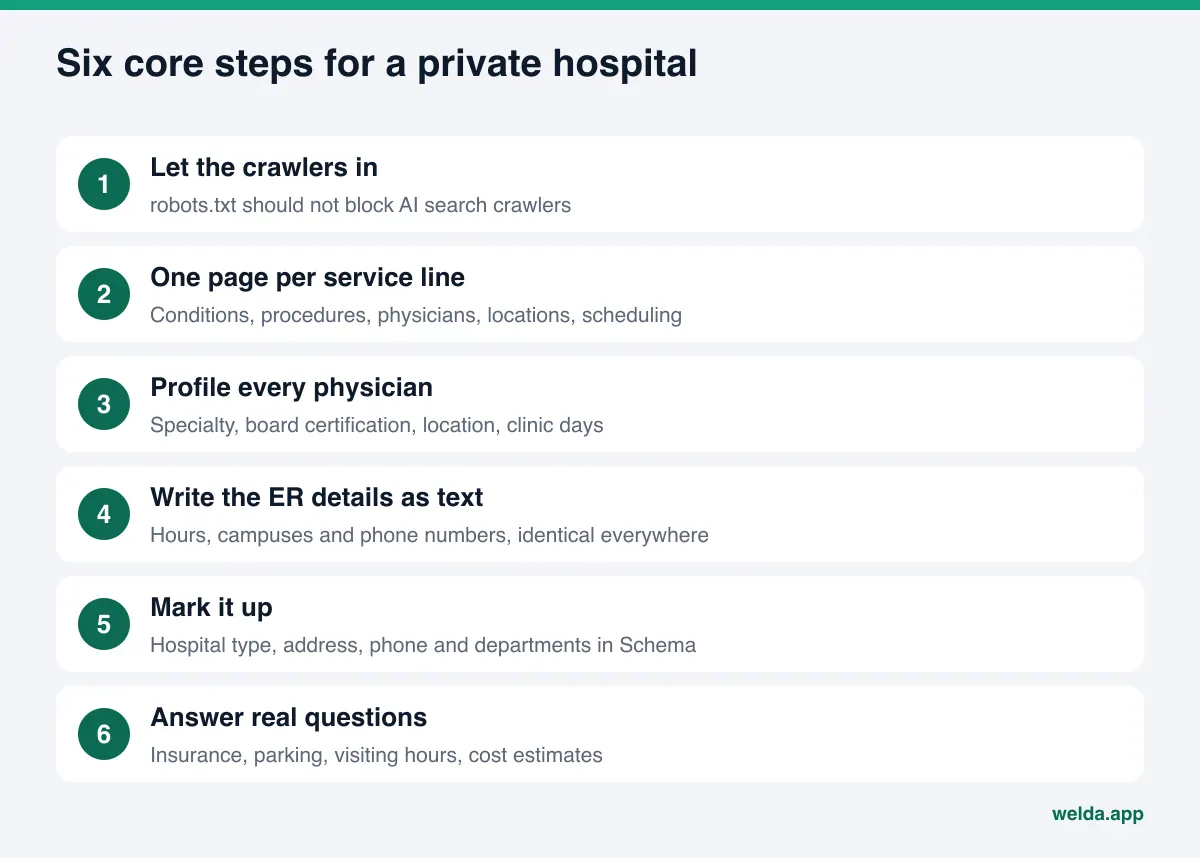
1. Make sure crawlers can get in
Open your robots.txt and check for lines that block AI search crawlers. Some security plugins and CDN settings block them by default. Patient portals, test results, and anything holding protected health information should stay closed. Service-line, physician, location, and ER pages should be open.
2. Build a full page for each major service line
Each service-line page should cover the name of the service, the main conditions and procedures it handles (as general information, not diagnosis), the physicians involved, which campuses offer it and on which days, and how to schedule. These pages answer "hospital with a cath lab" or "pediatric ER near me" directly.
3. Give every physician a real profile
List specialty, board certification, the service line and campus, clinic days, and languages spoken. Patients sometimes ask for a doctor rather than a hospital; a strong physician page ties your hospital to that question.
4. Write ER details, hours, and campuses as text
State whether you run an emergency department, what is open when, how weekends and holidays work, and the address and phone for each campus. In a multi-campus system, give each facility its own page.
5. Add structured data
Add Schema markup with the hospital type, name, address, phone, hours, and departments. Schema.org has a dedicated Hospital type. Each campus should be described on its own page with its own markup.
6. Answer the questions patients actually ask
Publish an FAQ covering accepted insurance, visiting hours, overnight stays for family, parking, interpreter services, and how to get a cost estimate. Link it to your price transparency pages so a patient can move from "how much" to an actual estimate.
7. Align outside sources
Make addresses, phones, and hours on Google Business Profile, Healthgrades, Yelp, and other listings match your site. Why this matters is explained in our guide to NAP consistency for AI search.
Writing compliant hospital content
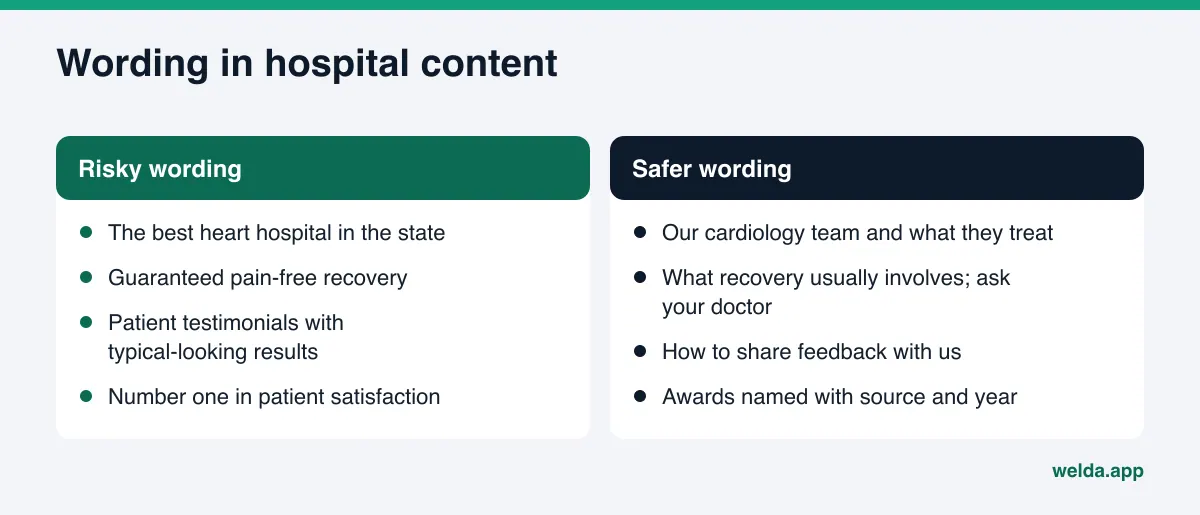
More pages mean more chances to publish a claim you cannot support. The FTC expects health-related advertising claims to be truthful and backed by appropriate evidence, and state rules may add their own requirements. Reviews have their own federal rule: the FTC's rule on consumer reviews and testimonials, published in August 2024, prohibits fake reviews, including AI-generated ones, and undisclosed insider reviews. Patient stories also raise privacy questions under HIPAA when they identify a patient. This is not legal advice; have your compliance team review your pages.
AEO does not conflict with these rules. What assistants look for is not praise but plain facts: which service lines you run, who practices there, where, when, and how to book. "The best heart hospital in the state" breaks the spirit of the rules and gives an assistant nothing to use. "Our cardiology team treats these conditions at these campuses, with clinics on these days" is both safer and more useful.
How Welda handles AEO for a private hospital
Welda is software that measures where a business shows up in AI answers and fills in the gaps on the business's behalf. The dashboard is in early access, opening first in Turkey; recurring measurement across four engines is being added during early access, and sample dashboard screens use representative data. What anyone can use today, in English, is the free site analysis. For a hospital, three parts matter most.
Question-by-question measurement with a competitor view
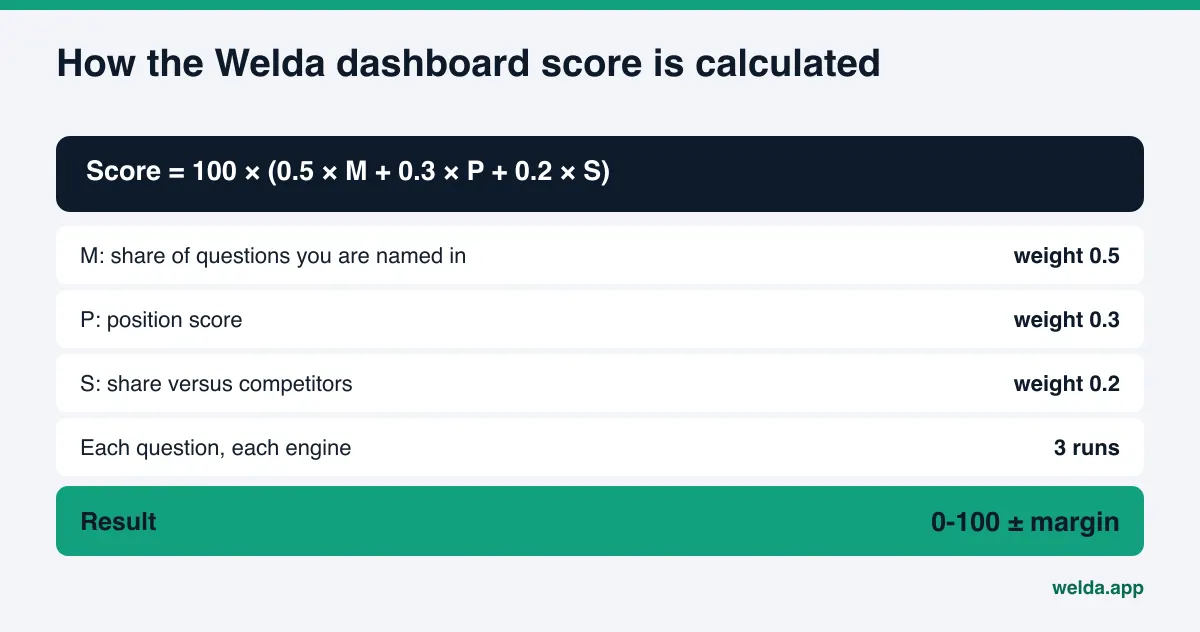
In the dashboard, Welda builds the set of questions your patients are likely to ask: service line and location, ER and hours, insurance, cost. Each question runs three times on ChatGPT, Gemini, Perplexity, and Google AI. You see which questions name your hospital, at what position, and where competitors lead. For example, you might show up for ER questions but never for orthopedic surgery. The competitor view goes further: it shows which question cluster a rival hospital wins and which source drives it. If the rival wins because of a directory or a news article rather than its own site, the fix is different from adding a page. The score formula is open, and the spread across three runs gives a margin of error, so small swings are not mistaken for real change.
An approval queue: in healthcare, nothing publishes on its own
Welda drafts missing service-line pages, physician bios, FAQs, profile copy, and review responses. In healthcare there is no auto-publishing: every item lands in the task list as something waiting for approval. Your team or the relevant physician reads it, edits it, and approves it. Welda does not invent facts. If it cannot confirm which campus offers a service on which days, it asks you, then applies your answer to every related draft. Patient data is never sent to the AI; drafts come only from your public information and your answers.
A compliance check flags patterns such as prices, guarantees, superiority claims, and diagnostic suggestions before anything goes live. It is a first-pass filter, not legal advice, and it has not been reviewed by legal counsel. The final call stays with you and your compliance team.
Content lives on your site
If your site runs on WordPress, Welda connects through a separate Editor user and an application password, with no code to install. Drafts open on your site as WordPress drafts and go live when you approve them. On other platforms, Welda hands you a ready-made package and your web team applies it. Either way, the content lives on your own site; Welda does not host content. Google Business Profile can be connected; if it is not, profile fixes are listed as manual tasks. A before-and-after comparison and a one-page monthly PDF report give leadership a short summary.
What the free site analysis shows a hospital
You do not need to wait for the dashboard. The free site analysis works in English today. It reads your homepage and a few inner pages, such as services, pricing, about, and contact, the way Google and AI assistants would. For a hospital site, the most useful checks are:
| What the analysis checks | What it means for a hospital |
|---|---|
| AI crawler access (robots.txt) | Are service-line and physician pages open to AI crawlers |
| Page title, description, main heading | Do hospital type, city, and key services read at first glance |
| Business information (Schema) | Is the hospital described in structured data |
| Address, phone, location | Are campus details clear and consistent |
| Social and map profiles | Are Google Maps and other profiles linked from the site |
| FAQ section | Are insurance, ER, and visiting questions answered |
| Reviews and trust signals | Can visitors see accreditation and how to give feedback |
| Clear service descriptions | Are service lines named and described |
| Page speed | Do heavy images slow down how the page is read |
You get a score out of 100 (technical and content scored separately), what was found for each gap and how to fix it, suggested homepage copy, a simulation showing how much each fix could move the score, a competitor comparison, and a ready-to-install fix package that includes the business Schema code. The analysis also asks a web-searching AI assistant five questions your patients might ask and checks whether your hospital's name appears. That is a one-time snapshot, not ongoing tracking. The analysis is free once per site, email and phone are verified, and the results link stays open for 14 days. It does not measure rankings or promise them.
Limits: what Welda does not do
- No ranking guarantee. Welda does not promise you will appear in ChatGPT or any other engine. Answers vary from run to run, which is why measurement is repeated.
- No made-up facts. If Welda does not know a physician's specialty or a campus schedule, it asks.
- No publishing without approval. In healthcare, every item needs sign-off.
- No fake reviews. Welda drafts responses to reviews, never the reviews themselves.
- Some work stays with you. Handling negative reviews and complaints, managing directory accounts, and media relations remain your hospital's job.
- It takes time. New content usually takes weeks to show up in AI answers.
Pricing is discussed in an early access call. The dashboard is opening first in Turkey; the free analysis is available in English now.
Private hospital checklist and decisions
Use this list in a team meeting. Mark each item yes, no, or "we don't know." A "we don't know" usually points to the first job.
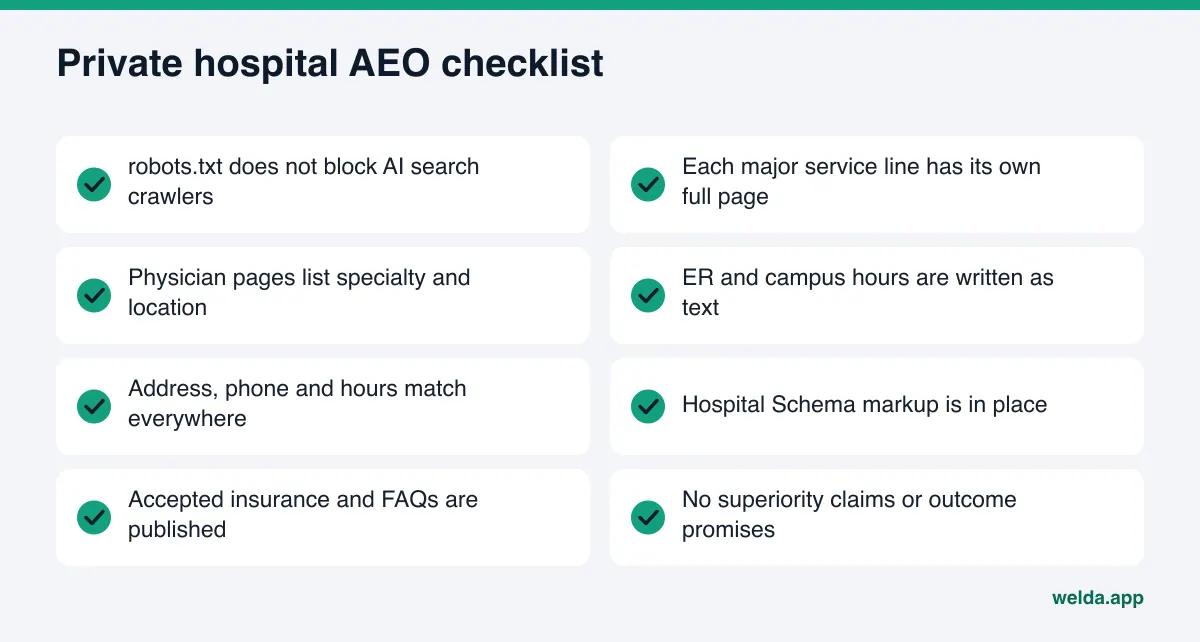
Then decide:
- Which three service lines matter most? Finish their pages first.
- Are campus details identical everywhere? If not, fix that before anything else.
- Who approves content: the physician, marketing, or compliance? Set the approval path up front.
- Will you check by hand or use a tool? A few manual prompts are fine to start; we compare the options in manual ChatGPT checks vs tracking tools. If you are weighing outside help, see our questions to ask an AEO agency.
Frequently asked questions
Do hospitals need to pay to be recommended by ChatGPT?
No. ChatGPT answers have no paid placement. The assistant relies on clear, consistent information it finds through search, on your site and in outside sources.
Is AEO the same as GEO?
In practice, yes. AEO (answer engine optimization) is the more common term in the US; GEO (generative engine optimization) describes the same work. Our GEO vs AEO article explains the overlap.
We are a multi-campus system. Do we need separate pages?
Usually yes. Patients ask by location. When each campus has its own page, address, phone, and services, an assistant can match the right campus to the right question.
Can we publish patient testimonials?
Testimonials must be real, must not mislead about typical results, and must respect patient privacy. The FTC's review rule and HIPAA both apply. Check with your compliance team.
Does Welda use patient data?
No. Patient data is never sent to the AI. Drafts come from public information about your hospital and your own answers.
How soon will we see results?
New content usually takes weeks to show up in AI answers, so measurement is repeated over time rather than judged in a day.
What is the first step?
The free site analysis. In a few minutes it shows whether crawlers can reach your site, whether your core facts read clearly, and whether your name appears for five sample questions.
See where your hospital stands today
Patients increasingly ask AI assistants where to go for care. Being in that answer takes clear, consistent information, not ads: service lines, physicians, ER details, campuses, insurance, and honest answers to cost questions, all written inside the rules. To see where to start, run the free AI visibility analysis; the results page lays out the gaps, suggested copy, and a first fix package together.