How do plumbers get recommended by ChatGPT? An AI assistant recommends a plumber when it can read, from sources it trusts, which towns or neighborhoods you serve, which jobs you take, whether you answer emergency calls, and what customers say about you. If that information is vague on your website and doesn't match your Google Business Profile, Yelp page, and other listings, the answer names another company. The work is making your business easy for an answer engine to describe accurately.
This guide is for independent plumbers, small plumbing companies, and drain and water heater specialists in the US. It covers the questions homeowners now ask AI assistants, what your site and listings need to say to be part of the answer, and which parts of that work Welda takes on. This discipline is usually called AEO (answer engine optimization); you may also see it called GEO, short for generative engine optimization, which means the same thing. If you want to see what your own site tells AI tools today, run the free website analysis first. The steps below are easier to follow with that report open next to them.
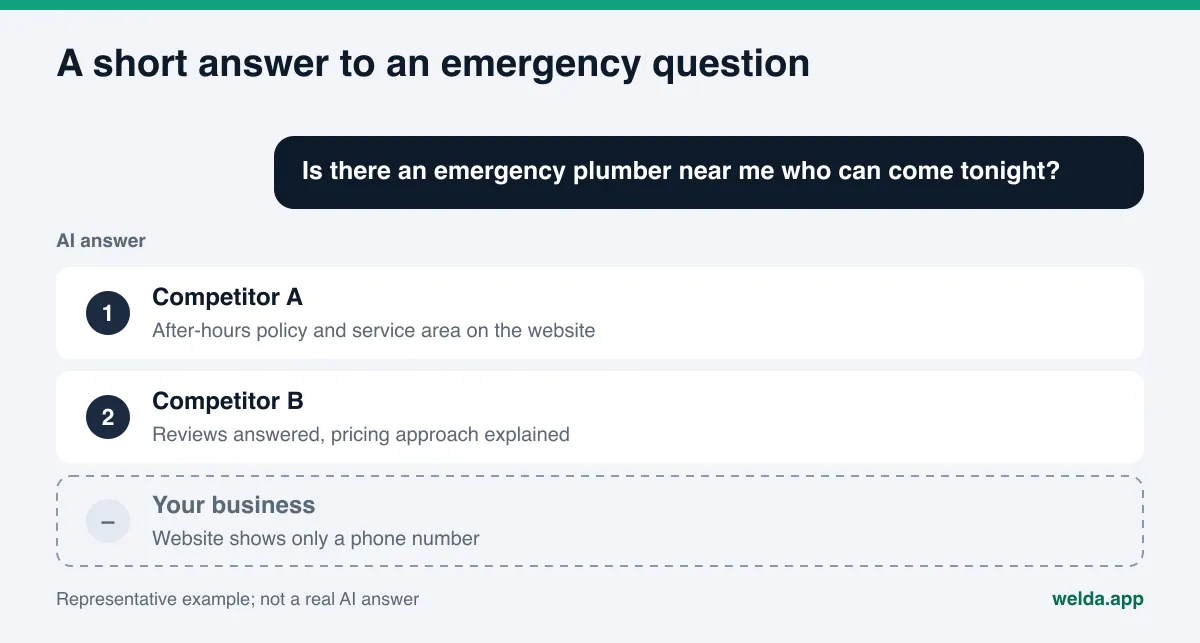
Why AI answers matter more for plumbers than for most trades
Plumbing work rarely waits. A pipe bursts under the sink at 11 p.m., the water heater quits on a Sunday, the basement floor drain backs up before guests arrive. In those moments people want one good name fast. More and more of them type or speak the question into ChatGPT, Gemini, Perplexity, or Google's AI Overviews instead of scrolling through ads and directory pages.
The answer they get is short. It usually names two or three businesses with a sentence about each. That changes the math for a local plumber. On a classic results page you could still be found in position six or seven. In an AI answer, if you are not one of the few names, the homeowner never sees you.
Trust is the second reason. Plumbing is one of the trades where customers worry most about surprise bills and upselling. AI assistants seem to lean toward businesses they can describe with confidence: clear service area, clear list of jobs, visible pricing approach, consistent reviews with owner responses. A plumber who leaves those things unsaid gives the assistant nothing safe to repeat.
What homeowners ask AI assistants about plumbers
The questions below are examples written for this guide, not measured data. They reflect the kinds of needs that come up again and again in local service searches: location, timing, job type, cost, and trust.
- "Is there an emergency plumber near me who can come tonight?"
- "Who's a reliable plumber in Plano that won't overcharge?"
- "How much does a plumber charge for an after-hours call?"
- "Best plumber for tankless water heater installation in Denver"
- "My kitchen drain is clogged and a plumber quoted me a lot. Is that normal?"
- "Licensed plumber for sewer line repair in Columbus, Ohio"
Each question carries a specific need. The table shows what information an answer engine looks for to answer each type, and where that information should live.
| Question type | Example | What the AI needs to know | Where it should live |
|---|---|---|---|
| Location | "plumber near me in Plano" | Cities, ZIP codes, or neighborhoods you serve | Service area page, Google Business Profile |
| Timing | "emergency plumber tonight" | Whether you take after-hours, weekend, and holiday calls | Homepage, contact page, listing hours |
| Job type | "tankless water heater install" | Each service you offer, named plainly | A section or page per service |
| Cost | "how much for an after-hours call" | How you price: trip fee, diagnostic fee, upfront quotes | Pricing page, FAQ |
| Trust | "licensed plumber that won't overcharge" | License status, reviews and responses, how quotes work | Website, Yelp, BBB, Google reviews |
If you want to build your own question set for regular checks, our guide to prompts to track for AI visibility walks through how to pick and phrase them.
How plumbers get recommended by ChatGPT: the sources that count
There is no published formula for which plumber an AI assistant names, and each engine behaves a little differently. Still, for local service businesses the same groups of sources keep showing up in the citations behind the answers.
Your own website. This is the one place where you control every word. Many plumbing sites are a single page with a phone number and a line like "all your plumbing needs." That line tells an answer engine nothing. "Drain cleaning, water heater repair and replacement, leak detection, and repiping in Plano, Frisco, Allen, and McKinney" tells it both the jobs and the area.
Google Business Profile. Most plumbers go to the customer rather than the other way around. Google's guidance for these businesses is to hide the street address and set service areas by city or ZIP code instead; the help page notes you can list up to 20 of them. Getting this right is how your coverage area becomes readable.
Review and directory sites. Yelp, Angi, the Better Business Bureau, Nextdoor recommendations, and similar platforms often feed local answers. An outdated or half-finished profile there can mean the assistant describes you with old hours or an old phone number.
Licensing information. In most states plumbing work requires a license, and homeowners often ask for a "licensed plumber." If your license number and the state that issued it appear on your site, you give the assistant a concrete fact to repeat. Rules vary by state, so state yours accurately.
Consistency matters more than any single source being perfect. If your site lists one number, your profile another, and an old directory a third, the assistant cannot tell which is current. Our article on wrong address or phone number in AI answers covers how to track down and fix those mismatches.
Step by step: AEO for a plumbing business
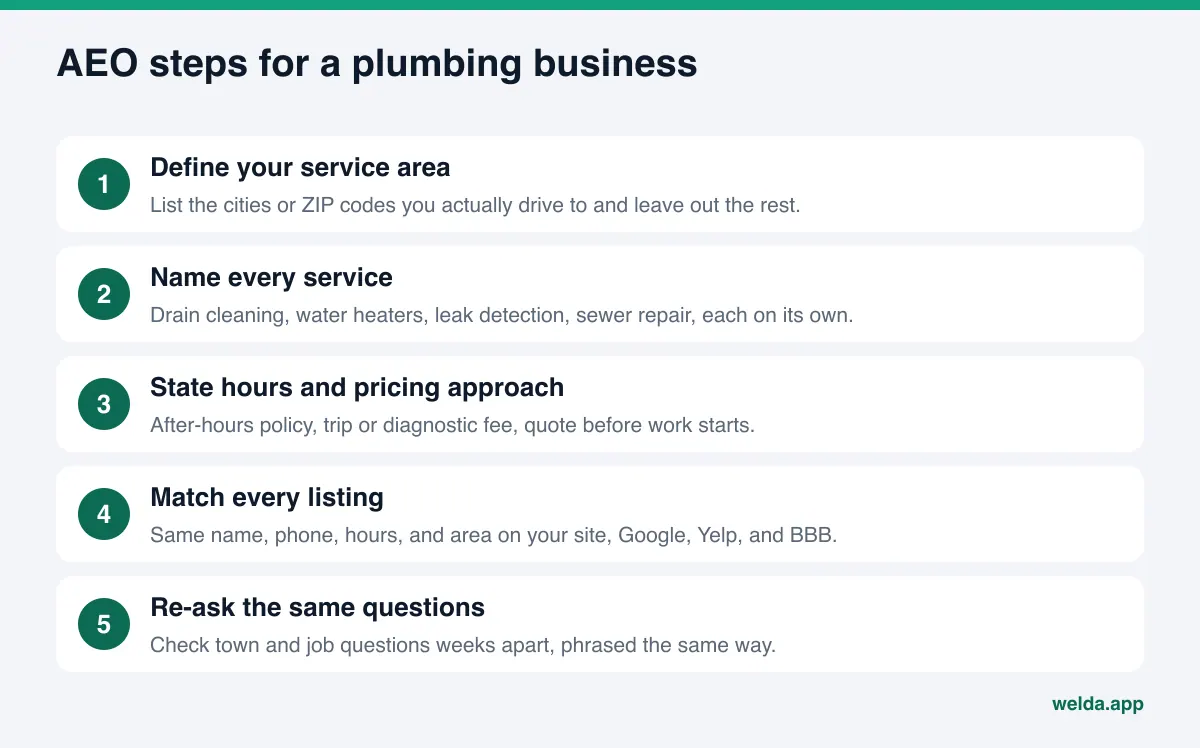
These are tasks a plumber can do alone or with a part-time helper. The order matters: get the facts straight first, then fix the places they are published, then measure.
- Write down your real service area. List the cities, ZIP codes, or neighborhoods you actually drive to. Leave out places you won't go. If an assistant sends a homeowner your way from 40 miles out, that is a bad call for both of you.
- Name each service separately. Drain cleaning, sewer line repair, water heater repair and replacement, tankless installs, leak detection, sump pumps, fixture installs, repiping. Say which ones you don't do, such as gas line work if you leave that to others.
- State your hours honestly. Do you take emergency calls at night? On weekends? Holidays? If not, say so. Writing "24/7" and then not picking up is the fastest route to one-star reviews.
- Explain how you price. You don't have to publish a rate card. Say whether there is a trip or diagnostic fee, whether after-hours calls cost more, and whether you give a quote before starting. Our guide on pricing questions in AI answers goes deeper.
- Add an FAQ section. Use the five or six questions you hear most on the phone, with short, honest answers.
- Add business markup. Structured data (Schema) with your business name, phone, service area, and hours helps machines read those facts reliably. Schema.org has a specific business type for plumbers.
- Match your listings to your site. Name, phone, hours, service area, and services should be identical on your site, Google Business Profile, Yelp, and BBB. Link your profiles from your site and your site from your profiles.
- Respond to reviews. A short thank-you to positive reviews, a calm explanation on negative ones. These responses are text an assistant may draw on when it describes you.
- Measure the same questions over time. Ask a handful of local questions and see whether your name appears. One check gives a rough picture; tracking needs the same questions asked the same way, repeatedly.
If you plan to handle this in-house, our DIY AEO guide for small business owners breaks down how much time each task takes.
Example: a service section an AI assistant can actually use
"Be specific" is easy advice. Here is what it can look like, written for a fictional plumbing company in north Dallas suburbs. Replace the details with your own.
Where we work. We serve Plano, Frisco, Allen, and McKinney, Texas. We schedule regular appointments in Richardson and Prosper but don't take emergency calls there.
What we do. Drain and sewer cleaning, camera inspections, leak detection without opening walls where possible, water heater repair and replacement including tankless units, and fixture installs. We don't install gas lines.
Hours. Monday through Saturday, 7 a.m. to 8 p.m. After 8 p.m. and on Sundays we respond to active leaks and sewer backups only, at an after-hours rate we tell you on the phone before we drive out.
How pricing works. We charge a diagnostic fee that is credited toward the repair if you go ahead. You get a written quote before any work starts.
Those four short paragraphs answer four of the five question types in the table above: location, timing, job type, and cost. The fifth, trust, comes from reviews, license details, and the same facts appearing everywhere. Note that the example also says what the company does not do. That keeps an assistant from recommending you for the wrong job or the wrong town.
Common gaps on plumbing websites
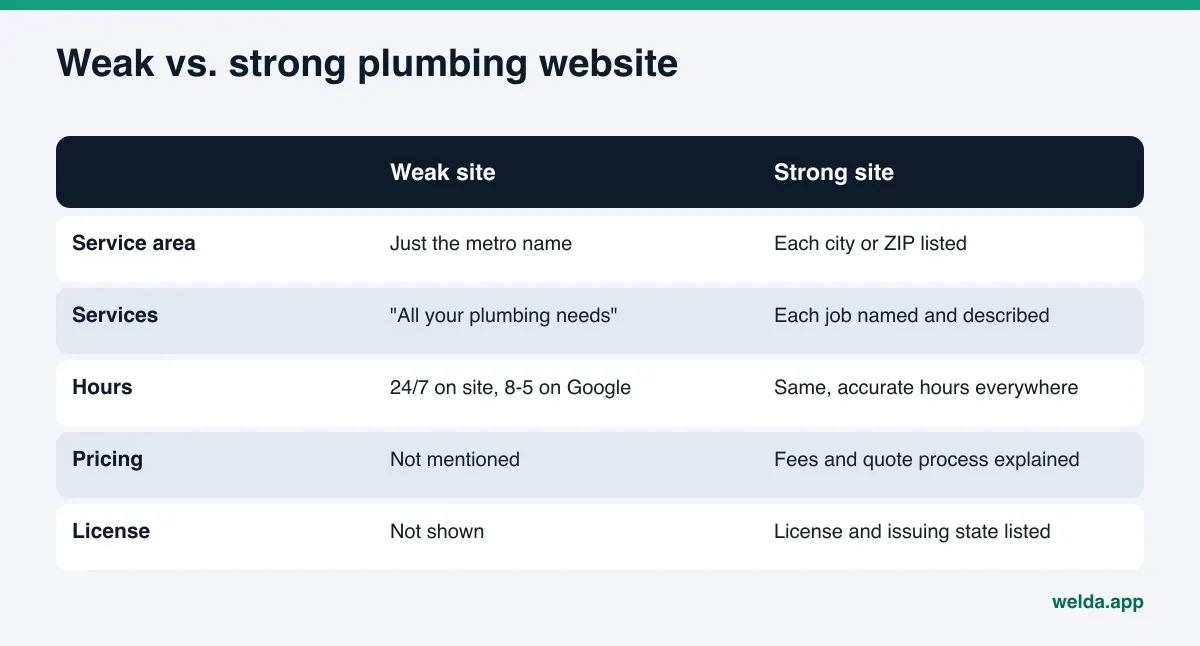
One page, one sentence. A phone number and "we do it all." An answer engine can't place you in any specific question.
City names stuffed in the footer. A long list of towns with no sentence about any of them reads as filler to people and machines alike. Name the places you serve in plain sentences.
Conflicting hours. "24/7" on the site, "8 to 5" on Google. The assistant sees the conflict and is unlikely to recommend you for a nighttime question.
Silence on pricing. Cost is one of the most common things people ask about plumbers. With nothing on your site, the assistant builds its answer from someone else's numbers.
AI crawlers blocked. Some sites block AI crawlers in robots.txt without the owner knowing. Then no amount of good content helps, because it can't be read.
Slow, broken mobile pages. Someone with water on the floor is on their phone. Speed is not what decides an AI answer, but it decides whether the person who clicks through actually calls.
How Welda does this work
Welda is software that measures where a business appears in AI answers and prepares the missing pieces on the business's behalf. For a plumber, three parts matter most.
The free website analysis: what your site tells AI tools. The analysis reads your homepage and a few inner pages, such as services, about, and contact, the way Google and AI tools would. On plumbing sites it most often flags vague service descriptions, missing or inconsistent phone and address details, no business markup, a map profile that isn't linked from the site, no FAQ section, and AI crawlers blocked in robots.txt. For each issue you see what was found, why it matters, and how to fix it. You also get ready-to-use text for the homepage title, description, main heading, intro paragraph, and FAQ, plus a simulation showing which fix would lift the score most. That answers the question every busy owner has: what should I do first. The analysis also asks five customer-style questions to an AI assistant that can search the web and checks whether your business name comes up. It is a one-time snapshot, not ongoing tracking. The analysis runs in English and gives you a 100-point score, a PDF, and a shareable score card.
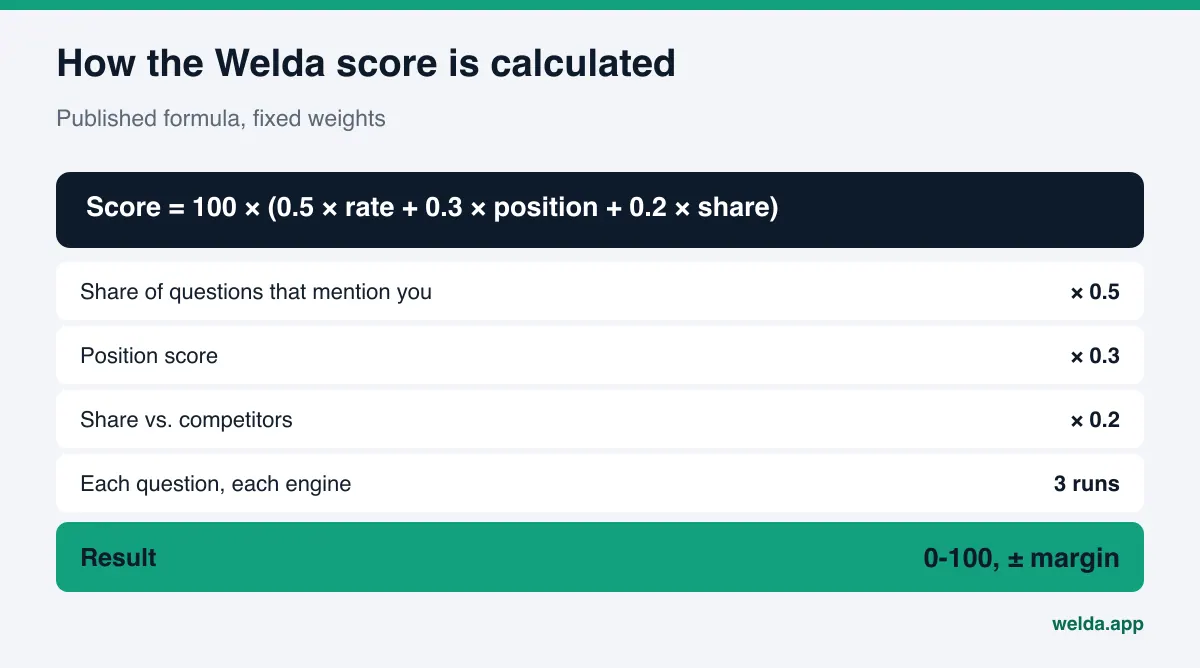
Question tracking: which towns and jobs you show up for. In the Welda dashboard, the questions your customers would ask are sent to ChatGPT, Gemini, Perplexity, and Google AI three times each. For a plumber that means a mix like "emergency plumber in Frisco," "tankless water heater install in Allen," or "licensed sewer repair near me." You see which questions mention you, in what position, and on which engine you are missing. The score behind it is published, not a black box.
The to-do list: Welda asks instead of guessing. Welda can't know whether you take Sunday calls or charge a diagnostic fee, and it won't make that up. Those facts show up as questions for you. Once you answer, they flow into the prepared text. Where a listing isn't connected, the task appears as something to do by hand, with the text ready to copy. If your site runs on WordPress, Welda connects through a separate Editor user and an application password, places content as a draft, and publishes only when you approve. Our WordPress AEO guide covers that setup.
What stays with you is clear: you approve what gets published, the content lives on your own website, and Welda does not host it. The Welda dashboard is in early access and is opening first in Turkey. Regular four-engine tracking is being added during early access, and dashboard examples shown today use representative data. The part anyone can use today is the free website analysis, which works in English. Pricing is discussed in an early access call.
Limits: what Welda does not do
You may hear offers to "get you to the top of ChatGPT." AI answers are written fresh for each question, so nobody can promise that. Here is where Welda stops:
- No ranking guarantee and no promise that you will appear in ChatGPT.
- It doesn't write facts it doesn't know. It asks you about your service area, hours, licensing, and pricing approach.
- It doesn't create fake reviews. It drafts review responses, never reviews. Fake reviews are also a legal risk: in 2024 the FTC announced a final rule banning fake reviews and testimonials, including AI-generated ones. This is not legal advice.
- It doesn't publish sensitive content without your approval.
- Handling negative reviews, claiming or updating directory accounts such as Yelp, Angi, or BBB, and press work stay with you. Welda can draft the text; it doesn't log into those accounts for you.
Timing is the other honest point. New content usually takes weeks to show up in AI answers. Check the same questions again a few weeks after a change, not the next morning.
Where should a plumber start?
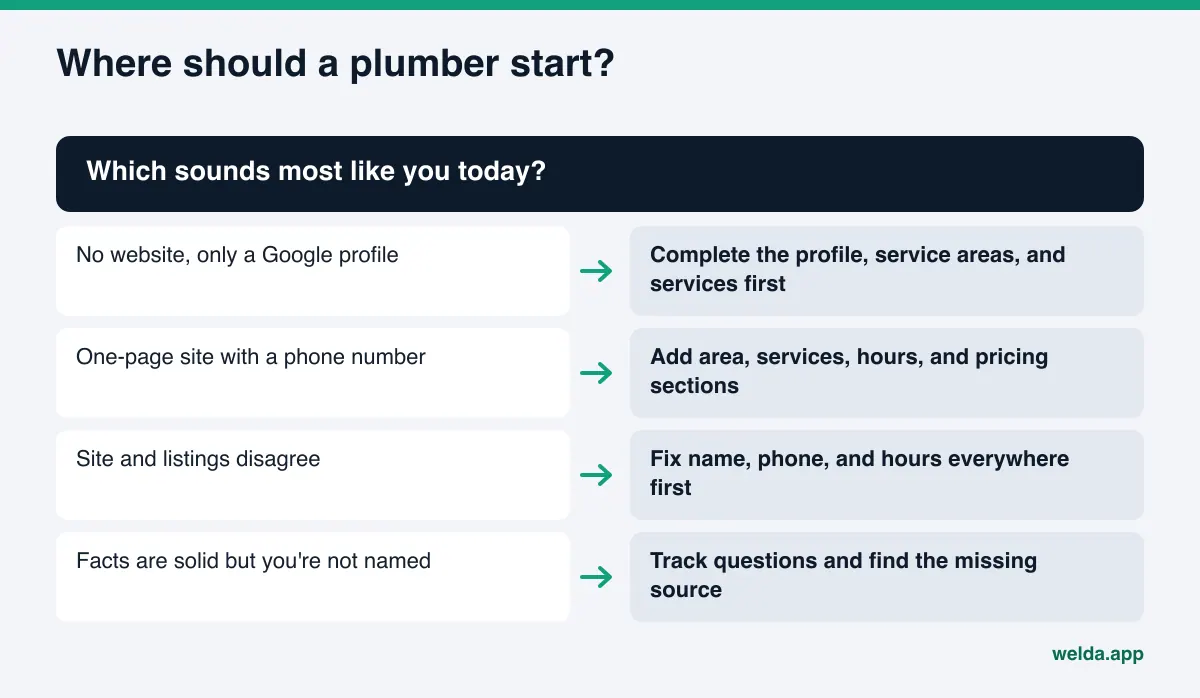
A one-truck plumber with no website and an established company with a site that never shows up in AI answers have different first steps. The decision chart gives a starting point. The general rule: facts first, consistency second, measurement third.
For a look at the same approach in another local service where trust drives the choice, see how accounting firms and CPAs get recommended by ChatGPT.
AEO checklist for plumbers
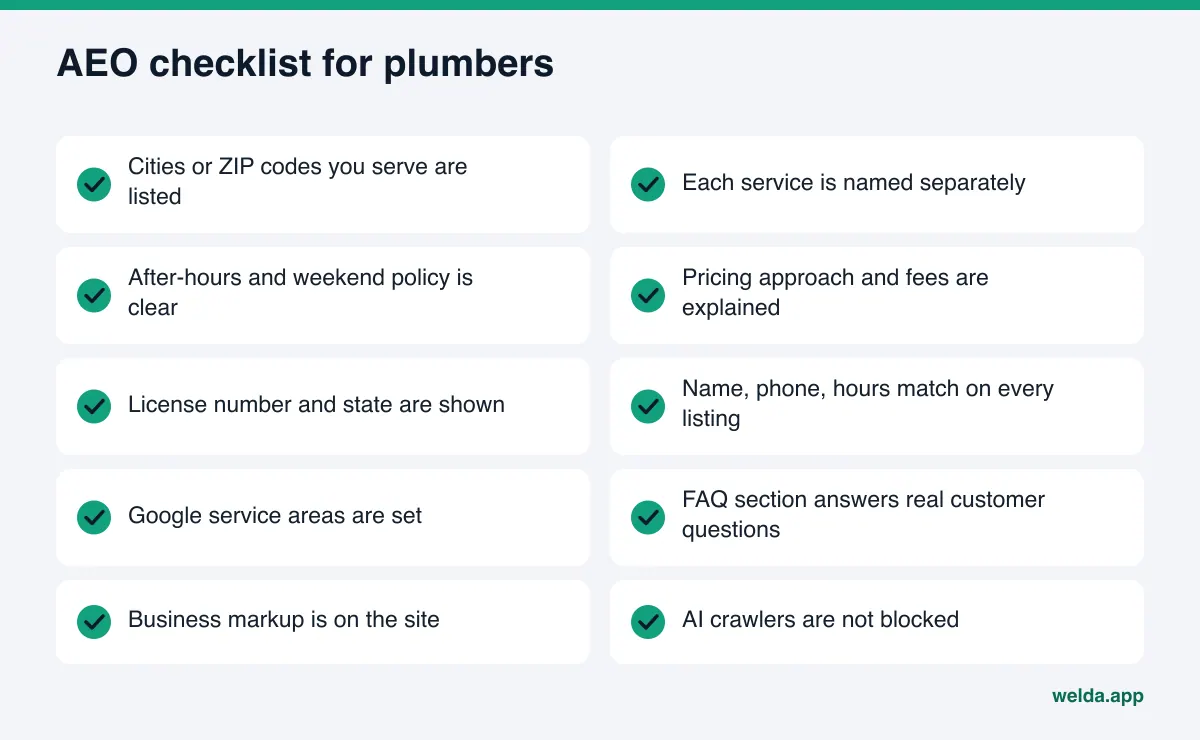
Open your site and your listings side by side and go through this list. Each "no" is a fact an answer engine can't find when it decides whom to recommend.
Frequently asked questions
Do I need a website to get recommended by ChatGPT as a plumber?
Not strictly, since assistants can also draw on Google Business Profile, Yelp, and other listings. But your own site is the only place where you can spell out every service, town, and policy in detail, so it helps a great deal.
Should I build a separate page for every town I serve?
Not if the pages would be copies with the town name swapped. For most plumbers a clear service area section is enough. A separate page makes sense when something is genuinely different in that town, such as different hours or services.
Do I have to publish my prices?
No. You can explain how you price, whether there is a trip or diagnostic fee, and whether you quote before starting, without listing numbers. That alone answers the main worry homeowners have.
Does my license number help?
It gives an assistant a concrete, checkable fact, and "licensed plumber" is a common phrase in questions. Requirements differ by state, so list the license exactly as issued.
How long until changes show up in AI answers?
Usually weeks, and it differs by engine. Re-check the same questions, phrased the same way, a few weeks apart.
Can US plumbers use Welda today?
Yes, the free website analysis works in English and is free once per site. The full dashboard is in early access and is opening first in Turkey.
See what your site says today
Getting recommended by ChatGPT as a plumber starts with giving AI tools facts they can repeat with confidence: where you work, what you fix, when you answer, and how you price. To see how much of that your site already communicates, run the free website analysis. Your results arrive by email with every gap explained and suggested text ready to use. What you change, and when, stays your call.