How do accounting firms and CPAs get recommended by ChatGPT? AI assistants name a firm when they can find clear, verifiable facts about it in several places that agree with each other: what services you offer, which clients you serve, where you are, and who is licensed. That work is called answer engine optimization (AEO). For CPAs it rewards the same plain, factual language that professional advertising rules already expect.
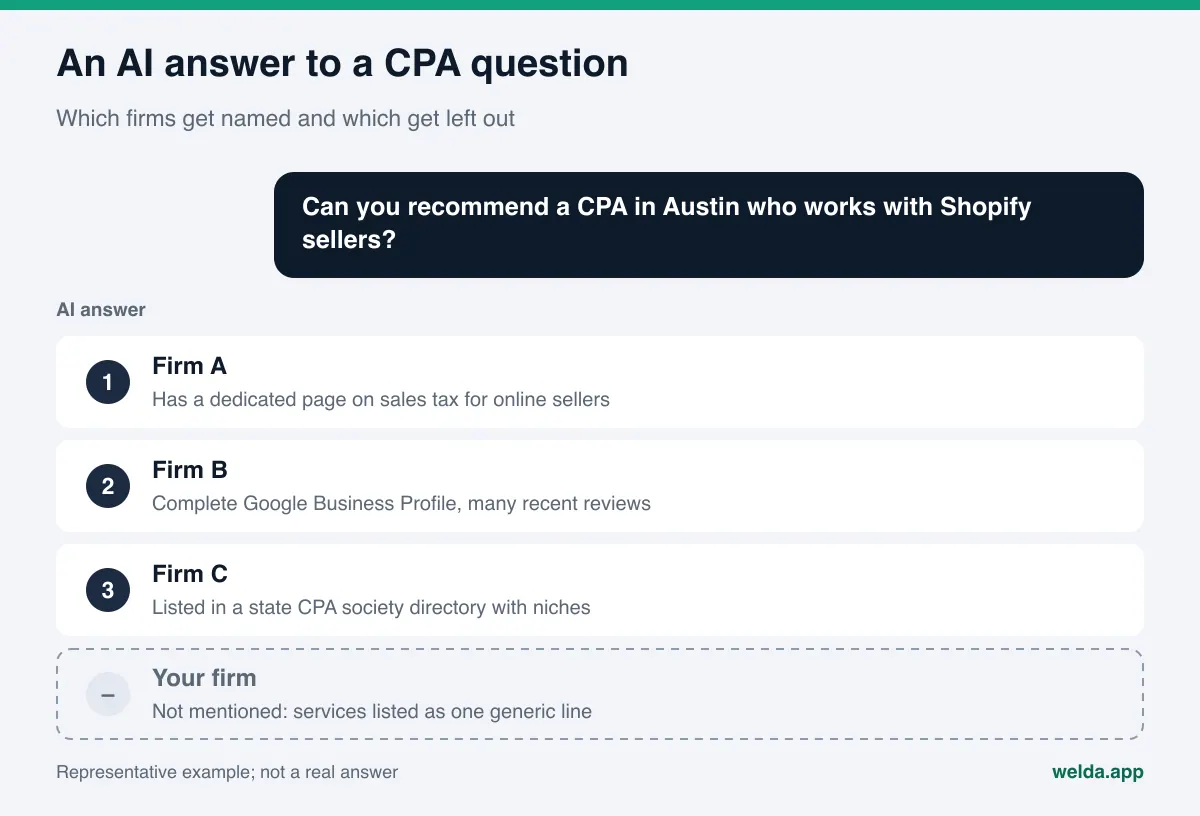
A founder forming an S corp, a freelancer with income from three states, or a small business owner unhappy with their current bookkeeper used to type "CPA near me" and scan the map. Many now ask ChatGPT, Gemini, Perplexity, or Google's AI Overviews and AI Mode a longer question: "Can you recommend a CPA in Denver who works with real estate investors?" or "Which accounting firm in Charlotte helps restaurants with payroll and sales tax?" The answer usually names a few firms, each with a short reason. If your firm is not on that short list, the prospect may never compare you at all. This playbook explains how accounting firms and CPAs get recommended by ChatGPT, step by step, what the ethics rules mean for the copy you write, and how Welda handles the work. If you want a baseline first, run the free AI visibility analysis on your site; the result helps you put the steps below in the right order for your firm.
Why AI search visibility works differently for CPA firms
For most local service businesses, AI visibility rests on three things: clear service information on the website, consistent business details on maps and directories, and mentions on independent sources. Accounting adds a fourth layer: professional conduct rules. A coffee shop can call itself "the best in town." A CPA firm writing in that tone runs into ethics and state board rules on advertising.
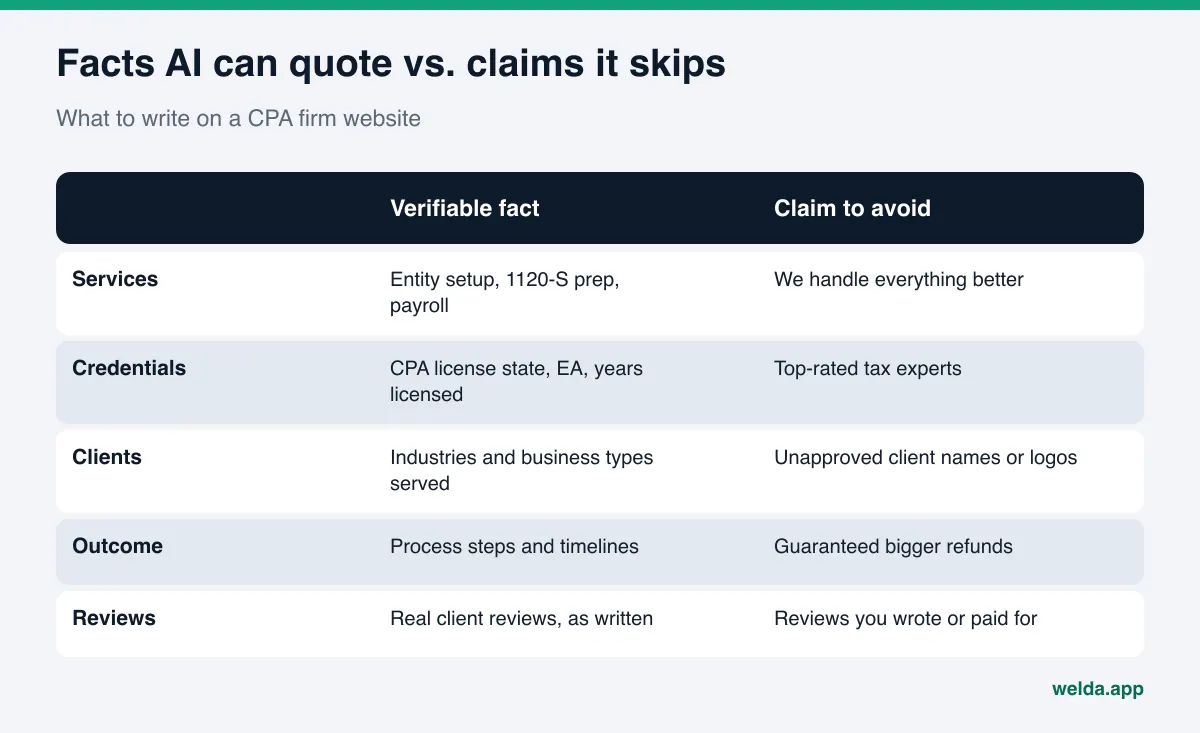
That sounds like a handicap. For AI visibility it is closer to the opposite. AI answer engines do not quote "best" or "top-rated" as facts, because they cannot be verified. What they quote is concrete: where the firm is, what it does, which industries it serves, how onboarding works, who holds which credential. The factual content that keeps you inside the advertising rules is the same content a model can match to a question.
There is another reason this matters more in accounting than in many fields: client relationships last. A business that picks a CPA firm often stays for years. Being named in one AI answer can open a long engagement, and being absent from it can send that engagement to a competitor.
A note on terms: some people call this work GEO (generative engine optimization). In the US, AEO and "AI search visibility" are the more common names, and they describe the same goal.
What questions do prospects ask AI about accountants?
Start by writing down the questions your firm should show up for. The examples below are written for illustration, not taken from a study. Adjust them to your market and your services.
- Location questions: "CPA in Scottsdale for small businesses," "accounting firm near downtown Columbus."
- Service questions: "Who can help me elect S corp status and set up payroll," "CPA for multi-state tax returns."
- Industry questions: "Accountant for Shopify and Amazon sellers," "CPA for dental practices," "bookkeeping for restaurants."
- Switching questions: "How do I switch CPAs mid-year," "what should I hand over to a new accountant."
- Trust questions: "How do I check if a CPA is licensed," "CPA vs. enrolled agent, which do I need."
The last group is interesting. Here the model usually does not name a firm; it lists criteria. But those criteria come from pages that explain the topic clearly, and many of those pages are firm websites. A short, factual section on your site that explains how to verify a CPA license, for example through NASBA's CPAverify lookup or your state board, is useful to prospects and to models alike.
One rule helps when you build this list: each question should describe a moment when someone is about to choose. "What is accrual accounting" brings traffic but rarely a client. "I'm forming an LLC in Texas, who should I work with" describes a prospect.
What signals help a CPA firm get recommended by ChatGPT?
No AI company publishes how much weight each signal gets, and it varies between engines. What you can observe is how answers are built: assistants with web search look up pages, read them, and summarize. That makes four areas decisive.
| Area | What the AI is looking for | What it means for a CPA firm |
|---|---|---|
| Access | Can it read your pages at all | robots.txt does not block AI search crawlers; service details are in page text, not PDFs or images |
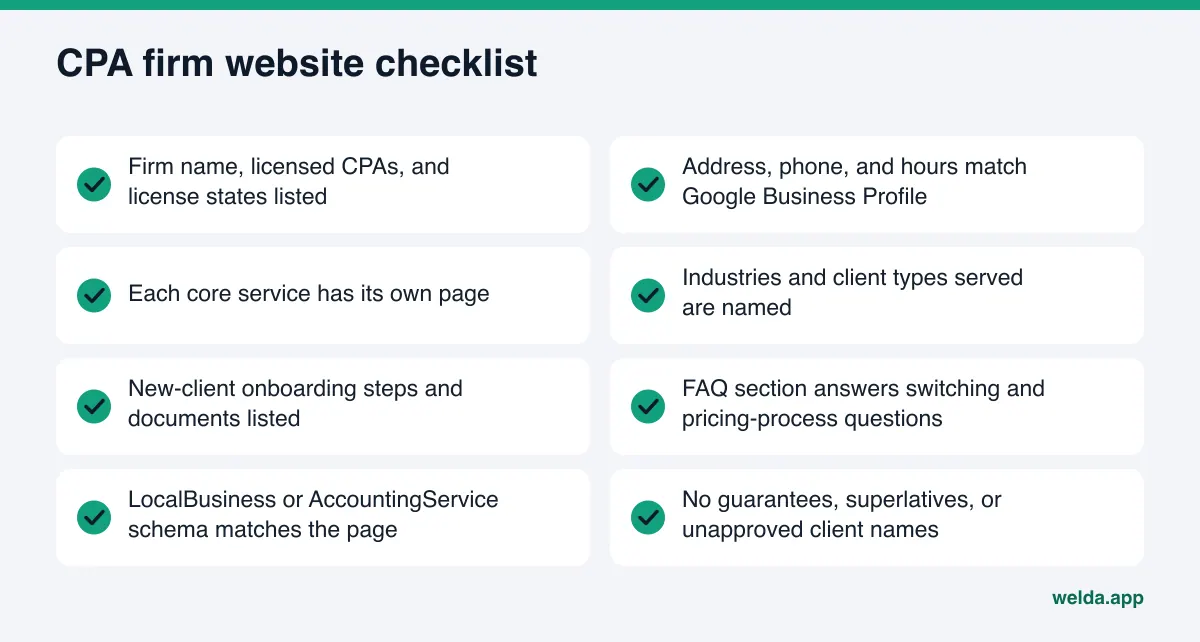
| Firm facts | Who you are, where, how to reach you | Firm name, licensed CPAs, license states, address, phone, hours, spelled the same everywhere |
| Service clarity | Does this firm do the thing asked | Separate, specific pages for entity setup, business returns, payroll, sales tax, bookkeeping, advisory |
| Third-party sources | Do other sites describe the same firm | Google Business Profile, Yelp, BBB, state CPA society directories, the IRS preparer directory where it applies |
Access is the one most firms overlook. Some website templates and security plugins block AI crawlers without anyone noticing. According to OpenAI, OAI-SearchBot is the crawler that lets sites appear in ChatGPT search, and it is controlled separately from GPTBot, which is used for model training (OpenAI crawler documentation). You can opt out of training and still be eligible for search answers. Google says there are no extra requirements for AI Overviews or AI Mode beyond being indexable and eligible for a snippet in normal Search, and no special AI text files or markup are needed (Google Search Central).
What the advertising rules mean for your AEO copy
This section is not legal advice. It points to where the rules live so you can check them for your own situation.
The AICPA Code of Professional Conduct includes an Advertising and Other Forms of Solicitation Rule (1.600.001) that bars members in public practice from seeking clients through advertising that is false, misleading, or deceptive. Your state board of accountancy has its own rules on advertising, firm names, and the use of the CPA title, and those vary by state. If you are an enrolled agent or work with non-CPA staff, the way you describe titles and credentials matters as well.
Reviews come with federal rules too. The FTC's rule on consumer reviews and testimonials took effect in October 2024. It prohibits fake reviews, including AI-generated ones, buying positive reviews, and undisclosed reviews from insiders (FTC announcement). Real client reviews on Google Business Profile or Yelp are fine; manufactured ones are a legal and reputational risk.
In practice, three habits keep AEO copy on the safe side:
- Describe what you do and for whom, not how much better you are.
- Do not promise outcomes like bigger refunds, lower taxes, or audit protection you cannot guarantee.
- Do not publish client names, logos, or quotes without written permission and a check against your confidentiality obligations.
Step by step: how CPAs get recommended by ChatGPT
The order below works for most firms. Every step produces information, not advertising.
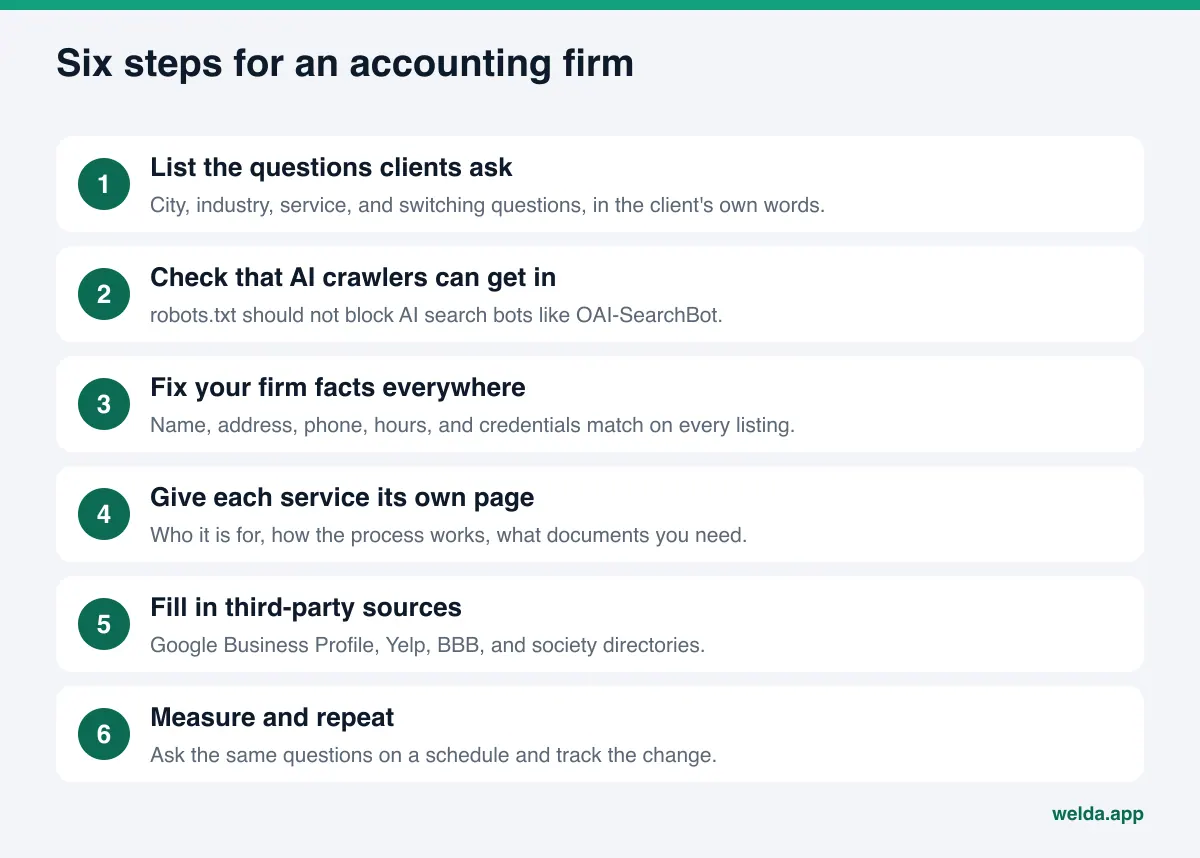
- Write the question list. Pick 15 to 20 questions from the groups above that fit your firm. For location questions, name only the areas you actually serve.
- Get a baseline. Ask those questions in AI assistants and note whether your firm appears. One-off checks give a feel, but answers vary between questions and over time; regular measurement is more reliable.
- Check access. Review robots.txt for blocks on AI search crawlers. Make sure service details sit in page text, not in a downloadable brochure.
- Lock down firm facts. Decide on one correct version of your firm name, address, phone, and hours. Use it on the site, Google Business Profile, Yelp, BBB, and your society directory listing. If you moved or merged, find every place the old details still live.
- Give each service its own page. A line that says "tax, accounting, advisory" tells a model nothing. A page on "S corp election and reasonable salary setup" should say who it is for, the steps, the documents needed, and the deadlines you work around.
- Name the clients you serve, without naming clients. "Real estate investors with rental portfolios," "e-commerce sellers on Shopify and Amazon," "medical and dental practices." This is what lets a model match you to an industry question.
- Add an FAQ. Answer switching, onboarding, and process questions in a few sentences each. If you mention a deadline, link it to the IRS or state source and keep it current.
- Add structured data. Schema markup repeats your firm name, address, and service type in a machine-readable form. See the guide on schema markup for AI search for the details.
- Measure and repeat. Ask the same questions before and after changes. New content usually takes weeks to show up in AI answers; judging after one week is misleading.
How to write a CPA service page AI can quote
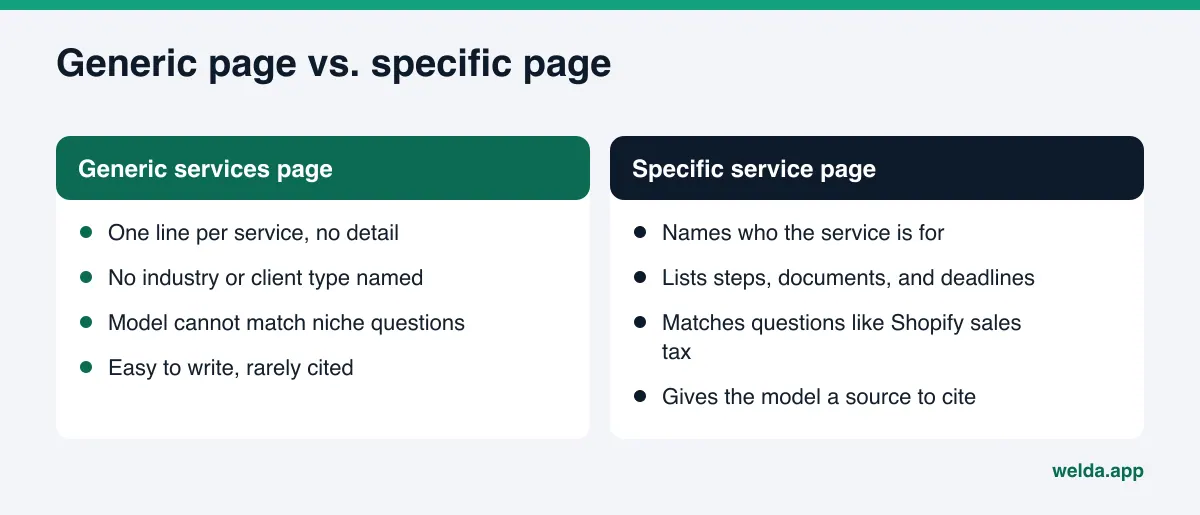
Of all the steps, service pages usually make the biggest difference. Take an example firm whose "Business Tax" page says only: "We provide fast, reliable tax services for businesses of all sizes." That sentence gives a model almost nothing. "Fast" and "reliable" cannot be checked, and there is no entity type, industry, or process.
The same page, written as information, could cover:
- Entity types: sole proprietors, single-member LLCs, S corporations, partnerships.
- Process: intake call, document checklist, bookkeeping review, return preparation, review meeting, e-file.
- Documents you need from the client: prior returns, year-end statements, payroll reports, 1099s.
- Calendar: which months you take on new business returns and when extension decisions are made.
- Who it fits: first-year businesses, owners moving from a sole proprietorship to an S corp, multi-state sellers.
Nothing in that list is a claim of superiority or a promise. It does give a model something to match when someone asks "Which CPA can help me with my first S corp return?" When you describe your own process, describe what your firm actually does. When you cite a rule or deadline, link the primary source.
Repeat this pattern for each core service: payroll and quarterly filings, sales tax for online sellers, bookkeeping cleanup, fractional CFO work, business sale or closure. If you have several offices, each one needs its own facts; the guide on AEO for local businesses covers how to structure location information.
How Welda does this work
Welda is software that measures where a business shows up in AI answers and prepares the fixes on its behalf. For a CPA firm, the two parts that matter most are question tracking and the to-do list. The third is the compliance check.
Question tracking. In the panel, the questions chosen for your firm are asked in ChatGPT, Gemini, Perplexity, and Google AI three times each. For each question you see whether your firm is named, in what position, and which sources the answer cites. For an example firm, the picture might look like this: the firm appears for "CPA in Plano" but not for "accountant for Amazon sellers in Texas," and the answers for that question cite competitors' dedicated sales tax pages. The decision is clear: the problem is not the firm's listings but a missing service page. The competitor view shows the same thing from the other side: which topic a competitor wins and which source it wins from. The results roll up into a score with a published formula; the guide on before and after AEO measurement explains how to read changes over time.
To-do list. Everything the measurement turns up lands in one list. Welda drafts the missing service page, FAQ answers, Google Business Profile description, and schema code. It does not invent facts. If it cannot find which states you are licensed in, which industries you serve, or when your firm was founded, it asks you instead of guessing. You answer once and the answer flows into every draft. Where Welda can connect to your site, content opens as a draft and you approve publishing. On WordPress, Welda connects through a separate Editor user and an application password, with no code to install. Without a connection, Welda hands you a ready-made package and you or your web person apply it. If Google Business Profile is not connected, that task stays on the list as "do it yourself," with the text ready.
Compliance check. Drafts are scanned before publishing for patterns like prices, guarantees, and superiority claims, and those lines are flagged. For accounting copy this catches phrases like "guaranteed refund" or "the best tax team in the city." The check is not legal advice and has not been reviewed by counsel; the final call on your professional rules stays with you.
Content always lives on your own website; Welda does not host it. The panel also has a monthly one-page report and a before-and-after view, but for a CPA firm the core decision is simpler: see which service questions you are missing from and fill that page with plain facts. The difference between tools that only measure and tools that also prepare the fix is covered in AI visibility monitoring vs done-for-you AEO.
What is available today. The Welda panel is in early access and opening in stages, first in Turkey. Regular four-engine measurement is being added during early access, and the sample panel screens use representative data. What anyone can use today, in English, is the free site analysis. It reads your homepage and a few inner pages such as services, about, and contact, and checks AI crawler access in robots.txt, title and description, main heading, business schema, address and phone details, linked profiles, an FAQ section, review and trust signals, how clearly services are described, and page speed. You get a score out of 100, an explanation and fix for each gap, suggested homepage copy, and a simulation of which fixes move the score most. It also asks an AI assistant with web search five questions a client might ask and checks whether your firm is named; that is a one-time check. Pricing is discussed in the early access conversation.
Limits: what Welda does not do
- No guarantees. No software or consultant can guarantee that ChatGPT will recommend a firm. Welda does not promise rankings or placement.
- No invented facts. If Welda does not know your licenses, niches, or history, it asks.
- No publishing without approval. Sensitive drafts come to you first. For a CPA firm, reading every draft before it goes live is a good habit.
- No fake reviews. Asking for reviews and responding to them stays with your firm.
- Some work stays with you. Negative reviews, directory accounts, PR, and conversations with your state society or board are your firm's job.
- No client data needed. AEO work uses your firm's public information, not your clients' financial records.
- No overnight results. A new service page usually takes weeks to show up in AI answers.
Checklist: is your firm ready?
Compare your own site against this table. Every "no" is an item for your to-do list.
| Question | If yes | If no |
|---|---|---|
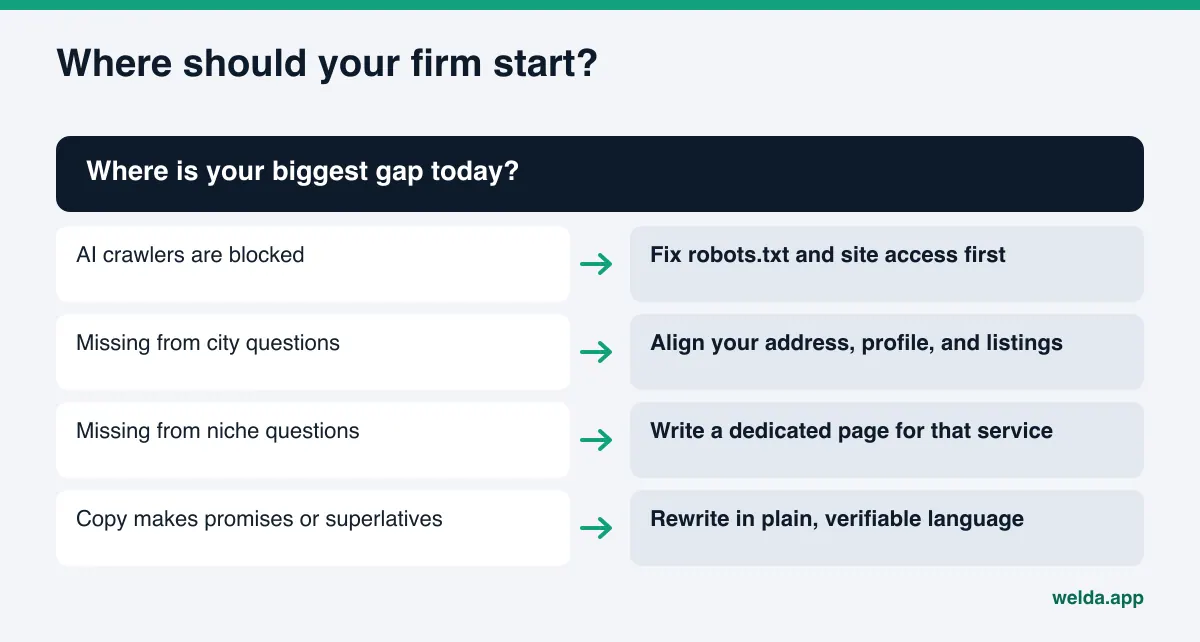
| Can AI search crawlers reach your site | Move to the next row | Fix robots.txt and security settings |
| Do name, address, phone, and hours match everywhere | Check third-party listings | Choose one version and update every listing |
| Does each core service have its own page | Add FAQs to each page | Start with the service that brings the most work |
| Are the industries you serve named | Link them from service pages | Describe client types without naming clients |
| Does your copy promise outcomes or claim to be the best | Rewrite it in verifiable terms | Move on to measurement |
| Do you know which questions you appear for | Track the change on a schedule | Start with the free analysis |
Frequently asked questions
Is AEO allowed under CPA advertising rules?
AEO is mostly about publishing accurate, specific information about your firm, which fits the general principle that advertising must not be false, misleading, or deceptive. Avoid guarantees, superlatives, and unapproved client names. Rules vary by state, so check with your state board. This is not legal advice.
How does ChatGPT decide which CPA to recommend?
OpenAI does not publish a formula. What you can observe is that assistants with web search read pages and summarize them. Firms with clear services, a named location, and consistent details on several sites are easier for the model to match and cite.
Do reviews on Yelp or Google matter for AI answers?
Review platforms can be among the sources AI answers draw on for local services. Real reviews help; fake or paid reviews violate the FTC rule and can damage trust. Welda does not write reviews.
How long does it take to see a change?
New or corrected content usually takes weeks to show up in AI answers, and it varies by engine. That is why you measure the same questions before and after a change.
Does Welda need access to client records?
No. Welda works with your firm's public information: your website, business profiles, and AI answers. It does not need client financial data.
Can US firms use the Welda panel today?
The full panel is in early access and opening first in Turkey. The free site analysis works in English today and gives you a score, specific fixes, and a one-time five-question AI check.
See where your firm stands today
The short version of how accounting firms and CPAs get recommended by ChatGPT: with facts, not slogans. Fix your firm details in one place and copy them everywhere, give each service its own page, describe the clients you serve without naming them, and take promises out of your copy. Then measure. If you are not sure where to start, run the free AI visibility analysis. You will see which gap to close first and whether your firm is named in five sample questions. The results link arrives by email and stays open for 14 days.