How do nail salons get recommended by ChatGPT? When ChatGPT recommends a nail salon, it leans on clear, consistent information it can find about you: the services you offer, your neighborhood, your hours, how to book, and what customers say on your website, your Google Business Profile, Yelp, and similar sources. When that information is written as text and matches everywhere, your salon is more likely to be named in AI answers. Nobody can guarantee a placement.
This guide is for nail salon owners, managers, and the person who handles a salon's website and listings. The question is simple: when someone types "Where can I get gel extensions near downtown Austin after 7pm?" or "Which nail salon in my area is good for a clean, non-toxic pedicure?" into ChatGPT, Gemini, Perplexity, or Google's AI Overviews, does your salon come up? If it doesn't, why not, and what should you fix first? This is what answer engine optimization (AEO) means for a nail salon. Below we cover the problem, the steps, how Welda handles this work, and what it does not do. If you want a baseline first, run a free AI visibility analysis of your site.
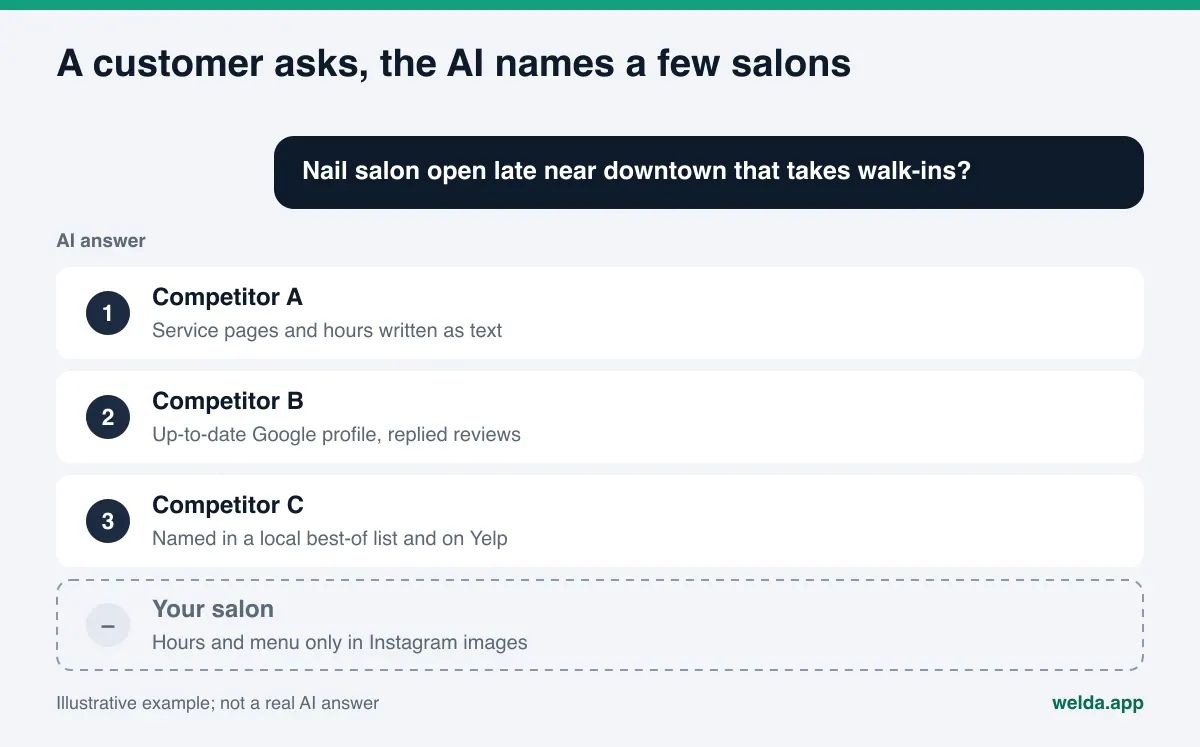
Why AI search visibility matters for nail salons
Nail services are repeat services. Gel manicures, fills, and pedicures bring the same customer back every few weeks. Winning a new client usually means winning many future appointments, not just one. People tend to look for a new salon at specific moments: they moved, their regular tech left, they need an appointment before a wedding or a trip, or they are visiting a city and want a quick mani-pedi near their hotel.
How people search in those moments is changing. A few years ago, the typical path was a map search for "nail salon near me," then scrolling photos and star ratings. Now the same person can describe exactly what they want in one sentence to an AI assistant: the service, the neighborhood, the budget, the time. The assistant replies with a short list of salon names. If your salon is not in that short list, you are not in the consideration set at all. That is the core reason AEO matters for local beauty businesses. For the broader picture, see our guide to AEO for local businesses.
Nail salons face four specific obstacles:
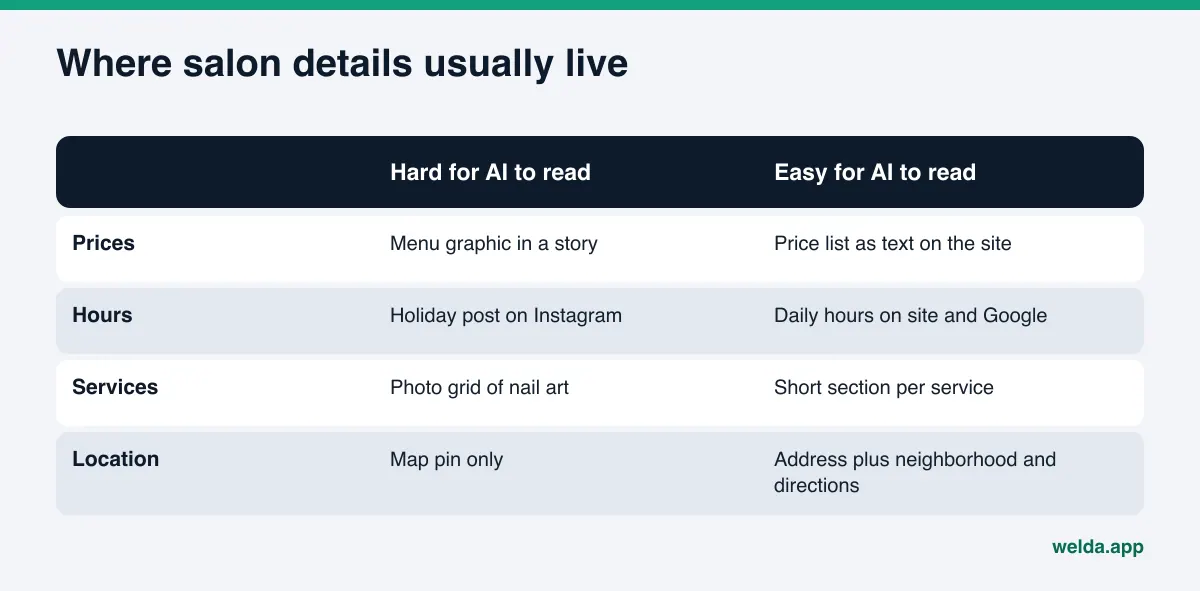
- The storefront is visual. Most salons show their work through photos. An AI assistant cannot reliably read "this salon does structured gel manicures in Midtown and is open until 8pm" from a photo of nail art. If the information is not in text, it does not make it into the answer.
- Service names vary. Gel polish, soak-off gel manicure, dip powder, acrylics, soft gel extensions, builder gel, hard gel, fills, rebalance: customers and salons use these words differently. The words you use on your site affect which questions you can be matched to.
- Key details live only on Instagram. A price menu in a story highlight, holiday hours in a post, the address in a bio. Scattered information is hard for an AI system to piece together.
- Decisions hinge on practical details. Customers ask "do you take walk-ins," "are you open Sunday," "how long does a full set take," "is there parking." Salons that answer those questions in plain text have an advantage.
What customers ask AI assistants about nail salons
The examples below are illustrative questions we wrote to show the main question types. They are not measured data. Each type looks for a different piece of information on your site.
| Question type | Example question (illustrative) | What your site needs |
|---|---|---|
| Service and location | Dip powder nails in Wicker Park | Each service named and described, full address, neighborhood name |
| Hours and booking | Nail salon open late on Sunday that takes walk-ins | Hours written out day by day, walk-in policy, booking link or phone |
| Price and time | How much is a full set of gel extensions and how long does it take | Your actual prices or price ranges, typical appointment length |
| Hygiene and products | Nail salon that sterilizes tools and uses non-toxic polish | The cleaning steps you really follow, product info you can stand behind |
| Occasion | Bridal party manicures for six people on a Saturday | Group booking policy, capacity, how far ahead to book |
One general "nail salon" page cannot answer all five. Each question type needs its own clear answer somewhere on your site.
What AI assistants look at before recommending a nail salon
When an assistant like ChatGPT gets a local question, it runs a web search, reads a handful of sources, and names businesses that show up consistently across them. Your own website, your Google Business Profile, and Google Maps are usually central. Yelp, local "best of" lists from city magazines and blogs, Reddit threads, and review platforms add to the picture. Which source matters most varies by question, by engine, and over time. No one can give you a fixed formula.
In practice, an assistant needs to understand four things about your salon:
- What you are. A dedicated nail salon, or a day spa that also does nails? Your page title, main heading, and structured data should make this obvious. Schema.org has a specific NailSalon type for exactly this.
- Where you are. Address, neighborhood, phone number, and map pin should match on your site, Google Business Profile, Yelp, and Instagram. After a move or rename, old details often linger somewhere.
- What you do. Which services, what each one is, how long it takes, how often it needs a refill, what it costs. This belongs in text, not only in a menu graphic.
- What others say about you. Reviews, your replies, mentions in local guides and forums. Assistants read these as trust signals.
There is also a technical prerequisite: AI crawlers must be able to reach your site. OpenAI documents that OAI-SearchBot is the crawler used to surface websites in ChatGPT search. If your robots.txt blocks it, even great content may not show up in ChatGPT's search results. Website templates and security plugins sometimes block crawlers without the owner knowing.
Step by step: how to get your nail salon recommended by ChatGPT
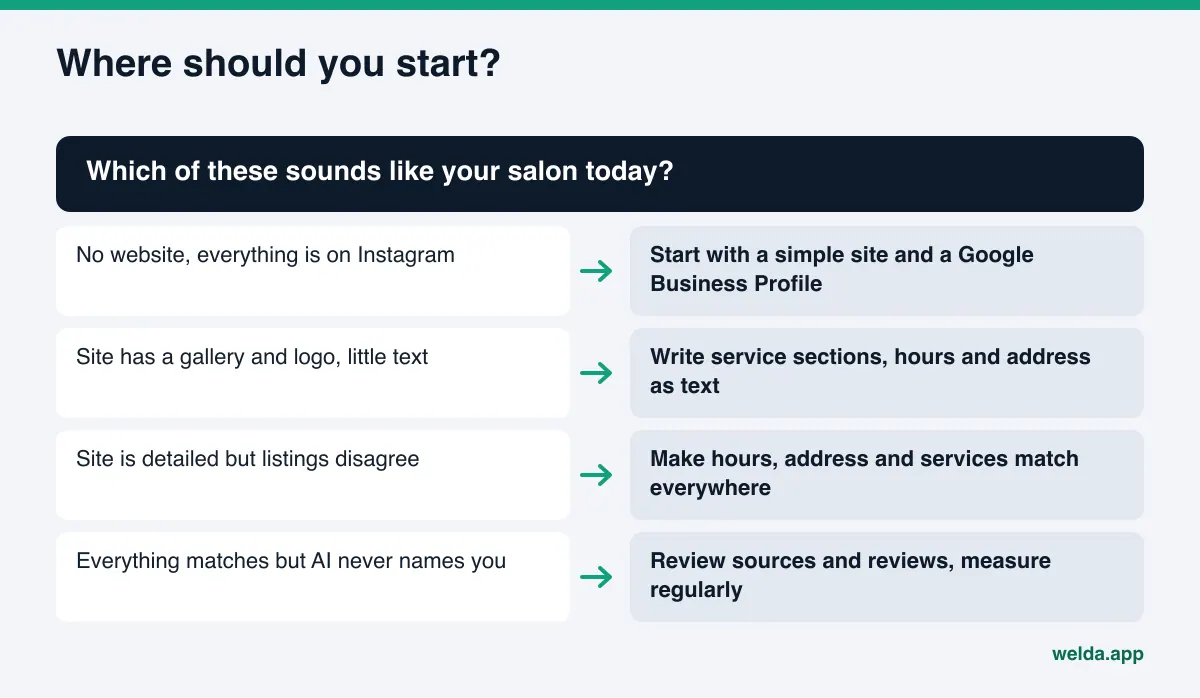
Order matters. If crawlers can't read your site, new service pages won't help. If your address is written three different ways, collecting reviews alone won't fix it.
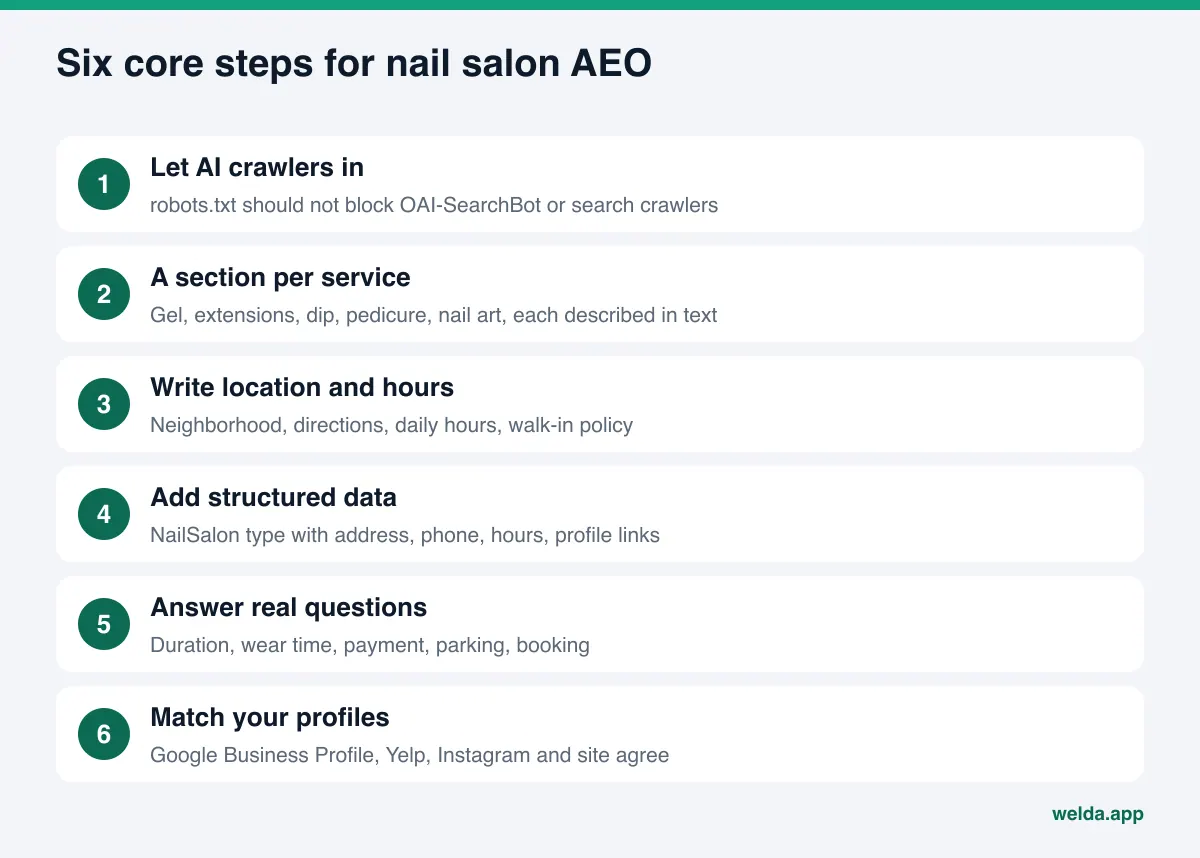
1. Make sure AI crawlers can get in
Add /robots.txt to the end of your domain and open it. If you see a "Disallow: /" rule that applies to OAI-SearchBot, Googlebot, or all bots, review it with whoever manages your website. This takes minutes and everything else depends on it.
2. Give every core service its own section
Write a short but complete section for each core service: gel manicure, acrylic or soft gel extensions, dip powder, pedicure, nail art. Include the service name (plus the words customers actually use, such as "gel extensions" and "builder gel"), what it involves, typical duration, how often it needs maintenance, your price or price range, and how to book. These should be your real prices and times.
Here is a short example of what a service section can look like. It was written for an example salon. Replace the bracketed details with your own.
Soft gel extensions
We apply soft gel tips over your natural nails and shape them to the length you want. A full set takes about [duration]; most clients come back for a fill or a new set after [interval]. Price: [price or range]. Book online at [booking link] or call [phone]. We take walk-ins [days and times] when a tech is free. We're on [street] in [neighborhood], [parking or transit note].
That one paragraph answers six questions a customer might ask: what it is, how long it takes, when to come back, what it costs, how to book, and where you are. An AI assistant reads it far more easily than a photo grid.
3. Write your neighborhood, hours, and directions as text
A sentence like "We're on Main Street in Old Town, two blocks from the light rail stop, with free parking behind the building" carries more information than a map pin. List hours for each day. State your walk-in policy clearly either way. Keep the same details on your Google Business Profile, Yelp, and Instagram.
4. Add structured data
Add LocalBusiness structured data (ideally the NailSalon type) with your name, address, phone, hours, and links to your social and map profiles. It helps assistants match you to the right category and location. Our guide to schema markup for AI search walks through the details.
5. Add an FAQ section built from real questions
Collect the questions your front desk hears every week and answer them briefly on your site: how long gel lasts, when a fill is needed, whether you take walk-ins, which payment methods you accept, whether you do kids' manicures. On hygiene, describe only the steps you actually follow. Avoid claims you can't back up, like "100% sterile" or "completely toxin-free."
6. Line up your profiles with your site
Make your Google Business Profile category, description, services, and hours match your site. Link your website in your Instagram bio and link Instagram and your map listing from your site. When you post a photo, put the service name and neighborhood in the caption. Our article on Instagram and AI search goes deeper.
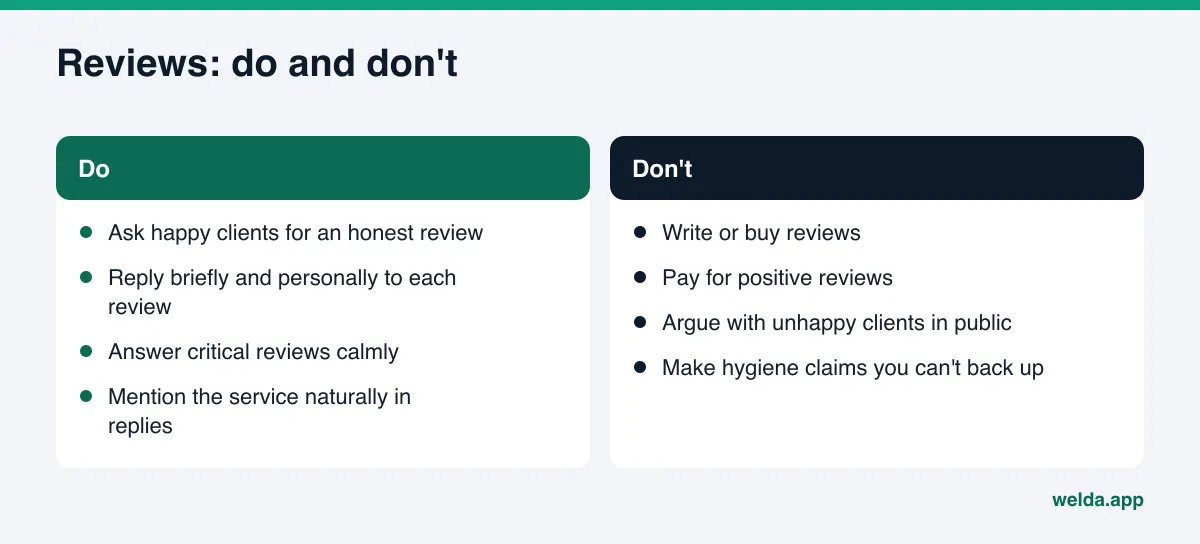
7. Ask for reviews the right way and reply to them
Asking happy clients for an honest review is fine. Writing reviews, buying them, or paying for positive ones is not. In the US, the FTC's 2024 rule on fake reviews and testimonials bans fake reviews and incentives tied to a particular sentiment. Reply to reviews briefly and personally. A calm reply to a critical review shows every future reader how your salon handles problems. This is general information, not legal advice.
Common mistakes that keep nail salons out of AI answers
A few issues are common on nail salon websites. In each case, the information exists, but in a place an AI assistant can't reliably use.
| What we see | Why it's a problem | Fix |
|---|---|---|
| Price menu only as an image | Assistants can't reliably read a menu graphic | Publish prices as text as well |
| One-page site with a gallery | It's unclear which services you offer | Add a description and duration for each service |
| Different hours on site, Google, and Yelp | Assistants are cautious with conflicting data | Pick one source of truth and update all listings |
| Old address still listed somewhere | Assistant may name the old location or name | Update every profile in one pass |
| Only branded service names | Customers ask for "gel extensions" or "dip," not your menu name | Include the common term too |
| Page title is just the salon name | The title doesn't say what you do or where | Add the main service and neighborhood |
If you have moved or rebranded, cleaning up old details is a project of its own. See how to update AI answers after a rebrand or move.
How Welda helps nail salons with AEO
Welda is software that measures where a business shows up in AI answers and fills the gaps on the business's behalf. For a nail salon, three parts of that work matter most: seeing which questions you are named in, seeing which sources the AI relies on, and getting the missing text ready to publish.
Start with the free site analysis
The part anyone can use today is the free site analysis, which works in English. It reads your homepage and a few inner pages, such as services, pricing, about, and contact. For a nail salon, the most useful checks are whether AI crawlers can access your site, whether your title and main heading say what you do, whether your services are clearly described, whether your address and phone are readable, whether Instagram and your map profile are linked from the site, and whether you have an FAQ section.
You get a score out of 100, with technical and content parts shown separately. For each gap, the report explains what it found, why it matters, and how to fix it. It also suggests ready-to-use text for your homepage: title, description, main heading, intro paragraph, and FAQs. Separately, it asks 5 questions a customer might ask to an AI assistant that can search the web, and checks whether your salon's name appears in the answers. That is a one-time check, not ongoing tracking. The analysis is free once per site, and the results link is emailed to you and stays open for 14 days.
Question-by-question tracking in the panel
The Welda panel is in early access. It is opening in stages, starting with businesses in Turkey, so the full panel is not yet available to US salons. Regular four-engine measurement is being added during early access, and sample screens use representative data. In the panel, customer questions are asked three times each on ChatGPT, Gemini, Perplexity, and Google AI. For a nail salon, those questions would group into clusters like "gel extensions in your neighborhood," "late-night manicure," or "pedicure prices." For each question you see which engines mention you and in what position.
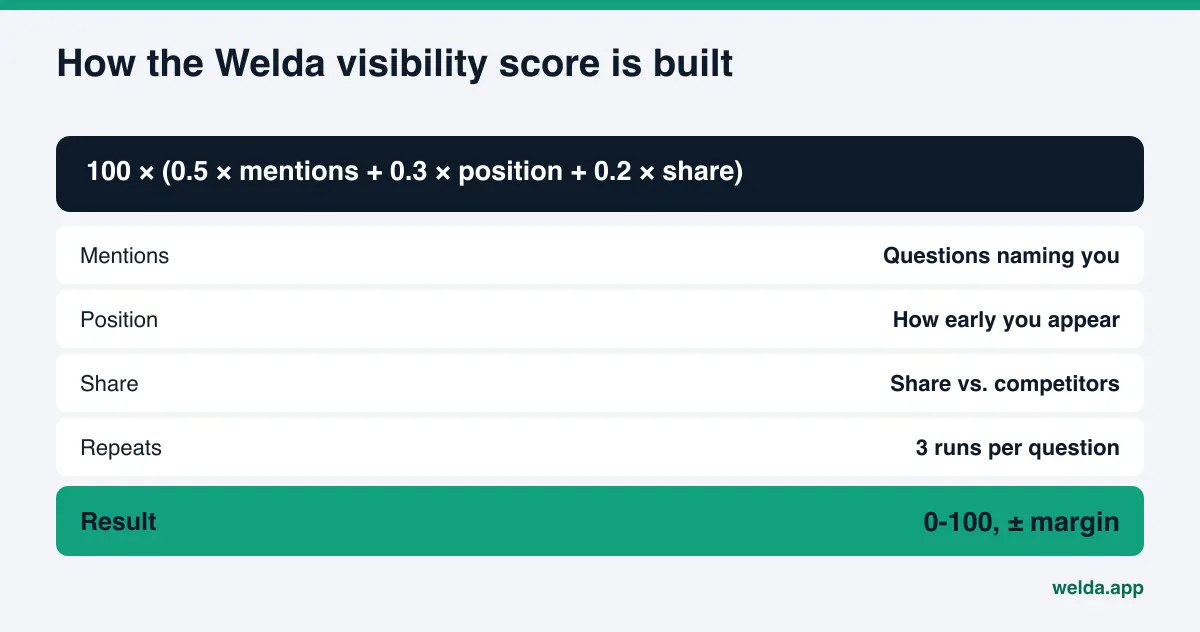
The decision this supports is practical: if you never appear in one cluster, that is where your information is missing. If you show up for "gel manicure" questions but never for "acrylic fills," your site likely doesn't describe acrylic services clearly enough. The score formula is published: share of questions where you're named counts 50 percent, position 30 percent, and share versus competitors 20 percent. The spread across the three repeats gives a margin of error, so you watch the trend over weeks rather than reacting to one day's number.
When something is missing, Welda drafts the text: service sections, Google Business Profile description, FAQs, and suggested review replies. It does not invent details it doesn't know. If it doesn't know your prices, hours, or the product brands you use, it asks. You approve everything before it goes live, and content always lives on your own website. WordPress sites connect through a separate Editor user and an application password, with no code to install; content appears as a draft and goes live once you approve it. For other platforms, Welda gives you a ready-made package to apply yourself. Google Business Profile and Instagram can be connected; if they aren't, the task is listed as manual.
Limits: what Welda does not do
Honesty matters here, because nobody fully controls how AI assistants answer.
- No guarantees. Welda does not promise rankings or that you'll "show up in ChatGPT." Answers vary by question, engine, and time.
- No made-up details. Prices, durations, product brands, and hygiene practices come from you, not from guesses.
- No fake reviews. Welda does not write or buy reviews. It drafts replies, and you approve them.
- Some work stays with you. Handling negative reviews, claiming directory listings like Yelp, and earning press mentions are your salon's tasks. Welda lists them and drafts the wording but doesn't open accounts for you.
- It takes time. New pages and updated profiles usually take weeks to show up in AI answers.
- No published pricing. Because the panel is in early access, Welda's pricing isn't listed; it's discussed in an early access conversation.
Nail salon AEO checklist
Work through this list once from top to bottom. Each item maps to one of the steps above.
- robots.txt does not block OAI-SearchBot or other search crawlers.
- Your page title mentions your main service and neighborhood.
- Each core service (gel, extensions, dip, pedicure, nail art) has a text description.
- Each service lists its duration and your price or price range in text.
- Hours and walk-in policy match on your site, Google Business Profile, Yelp, and Instagram.
- Address and phone are identical everywhere, and no old address remains.
- Structured data is on the site and uses the right business type.
- An FAQ section answers real customer questions.
- Instagram and your map listing link to your site, and your site links back.
- Reviews are requested honestly and answered.
We've written similar guides for neighboring businesses: how lash and brow studios get recommended by ChatGPT and AI search optimization for hair salons. If your salon offers both hair and nails, reading them together will help.
FAQ
My salon is very active on Instagram. Do I still need a website?
Instagram is a useful source, but much of its information sits in images and stories. AI assistants find services, address, hours, and prices most easily on a well-structured website and a Google Business Profile. A simple site with clear text complements Instagram rather than replacing it.
Do I have to publish prices?
No, but customers ask about price constantly. If you don't want to list exact prices, use "starting at" prices or ranges. What matters is that the information is accurate and consistent across your site and profiles.
Is AEO the same as GEO?
Mostly, yes. GEO (generative engine optimization) is another name for the same goal: being cited and recommended in AI-generated answers. In the US, AEO and "AI search visibility" are the more common terms.
How long until changes show up in ChatGPT?
New content and updated profiles usually take weeks to be reflected in AI answers, and timing varies by engine and question. That's why measuring regularly beats checking once.
Will Welda write reviews for my salon?
No. Welda doesn't create reviews. It drafts replies to the reviews you receive, and you approve them. Asking happy clients for reviews stays with you.
Can US nail salons use Welda today?
Yes, the free site analysis works in English today. The full panel is in early access and is opening first in Turkey. Pricing is discussed in the early access conversation.
See where your nail salon stands today
For most nail salons, AI search visibility is less about creating something new and more about writing what you already know in the right place and the right form: your services, neighborhood, hours, and how to book. The first step is to see how your site reads to an AI system right now. Run the free AI visibility analysis to get a list of gaps, suggested text, and the 5-question AI check in a results link sent to your inbox.