What is AI search optimization for hair salons? AI search optimization for hair salons is the work of getting your salon named when someone asks ChatGPT, Gemini, Perplexity or Google's AI Overviews something like "which salons near me are open Sunday?" or "who does good curly cuts downtown?" These answer engines build their reply from what they can read on your website, your Google Business Profile and the sites that mention you. Clear, consistent information raises the odds that you are named; no one can guarantee a specific position.
This guide is for salon owners and managers in the US who run their own website and listings, or who hand that job to a front desk lead or a freelancer. Your stylists may be excellent, your chairs may be full on Saturdays, and your Instagram may look great. Still, most owners have no idea whether their salon comes up when a new client types a question into an AI assistant. The practice of improving that is usually called AEO, short for answer engine optimization. You may also see the term GEO, generative engine optimization, which means roughly the same thing. Below we cover the problem, the steps, how Welda does this work, and what Welda does not do. If you want to see where your site stands today, start with the free site analysis.
Why clients now ask AI for a hair salon
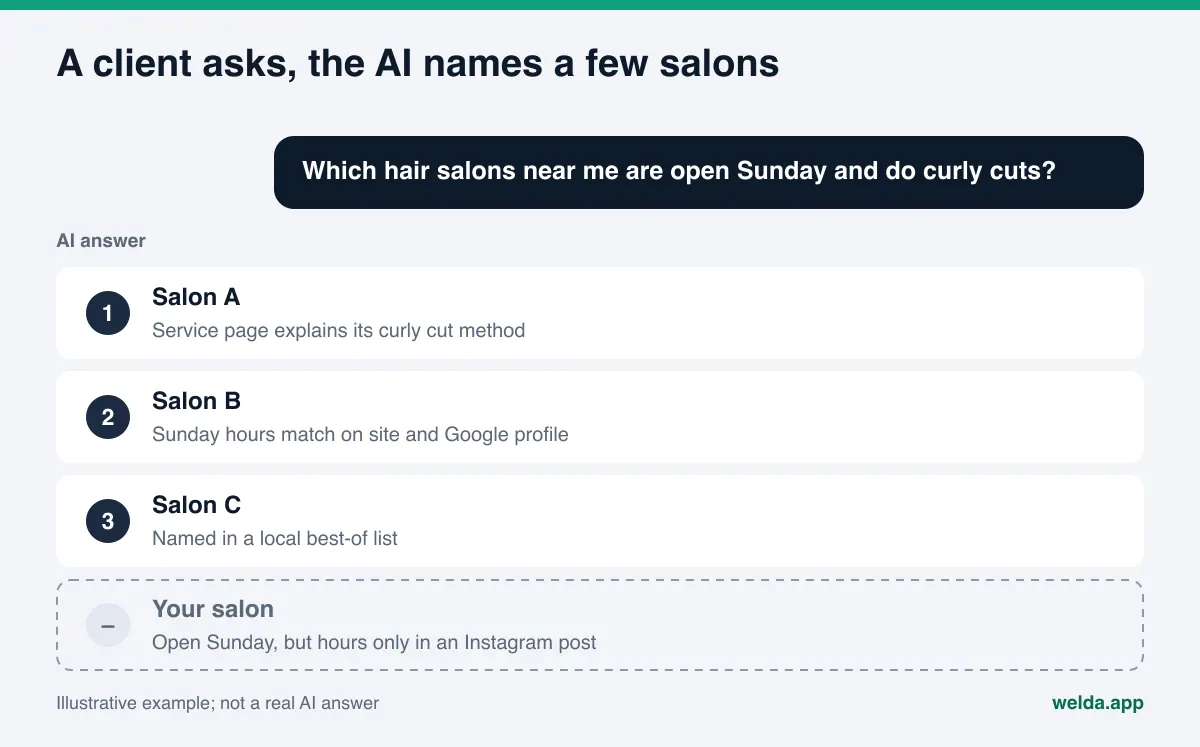
Choosing a salon often starts with a specific need. A wedding is two weeks away. Someone just moved to a new neighborhood. A client is unhappy with their last color and wants a specialist. A traveler needs a blowout before a dinner. In the past, that meant several separate searches: the neighborhood plus "hair salon," a scroll through the map, a look at a few Yelp pages, then a check of each salon's Instagram. AI assistants fold all of that into one conversation. The client types their neighborhood, the day, their hair type and what they want, and the assistant replies with a few salon names and a short reason for each.
A salon that is missing from that reply never makes the shortlist. On a traditional map listing, being the fifth result still gave you a chance to be seen. In an AI answer, there are usually only a handful of names. That is why AI search visibility is not a vanity metric for a salon. It affects how new clients find you in the first place.
Look closely at how people phrase these questions and a pattern appears. They rarely ask "what is the best salon in town." They ask about concrete situations:
- Is it open on Sunday or late on a weeknight?
- Does it take walk-ins, or do I need to book?
- Does a stylist there know curly or textured hair?
- How long does balayage take, and roughly what does it cost?
- Can I get a bridal trial in the next month?
- Is there parking, or is it near a train stop?
An answer engine can only answer those questions with information it finds written down somewhere. If your salon is open Sunday but that fact lives only in a story from three weeks ago, the assistant has no way to know it.
Which questions AI search optimization for hair salons can win
Questions that lead to a hair salon fall into a few types. Each type looks for different information on your site. Knowing which type you never show up for tells you which page or section is missing.
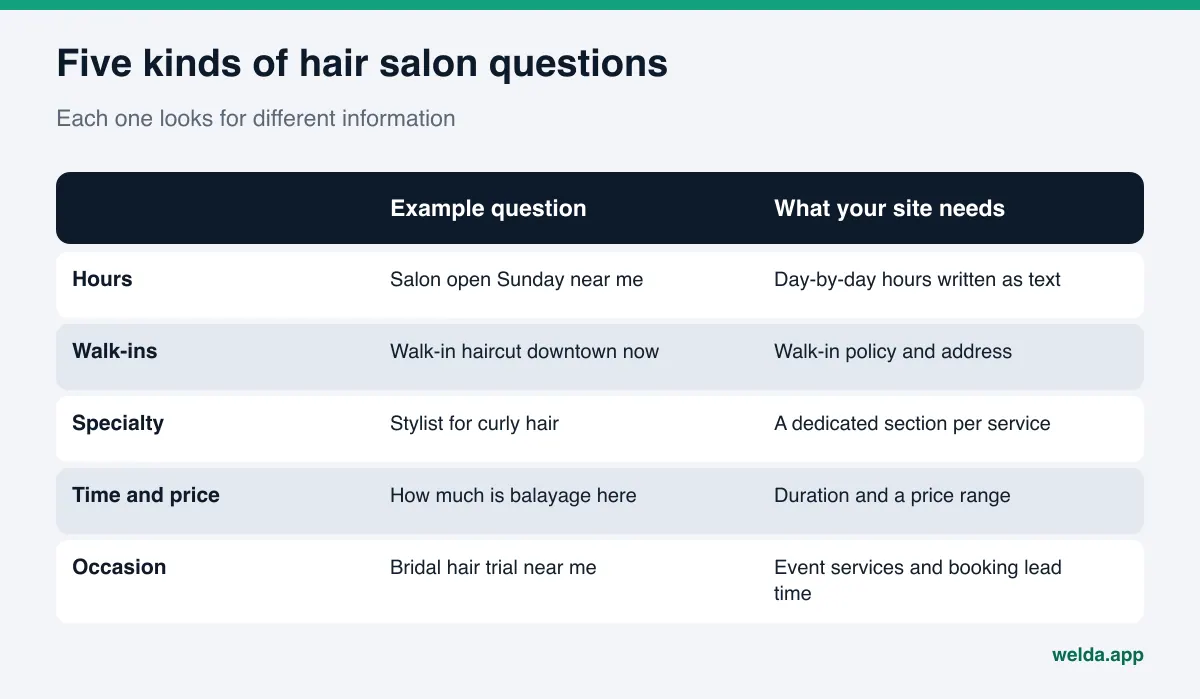
Hours questions. Many salons close on Mondays, some open Sundays, some stay late on Thursdays. Clients ask about this constantly. Answer engines tend to favor salons whose hours are consistent across the website, Google and Yelp. When your site says one thing, your Google profile another and your Instagram bio a third, the engine cannot tell which to trust. Wrong hours can also cause a worse problem, which we cover in what to do when AI says your business is closed.
Walk-in and location questions. "Walk-in haircut near Union Square" depends on your address and your policy. A full street address, the neighborhood name, the nearest transit stop, parking details and a clear walk-in policy all help here. If your address only appears inside an embedded map, write it as text too.
Specialty questions. Curly cuts, textured hair, color correction, balayage, extensions, men's cuts, kids' cuts, keratin treatments. Clients often look for a stylist who is good at one specific thing. A single line that says "full hair services" will not match those questions. Bridal work is a market of its own, which we cover in AI search optimization for bridal hair and makeup artists.
Time and price questions. "Quick haircut on my lunch break" is a question about duration. Price is asked even more often. Whether you publish prices is your call, but a salon that gives no range at all rarely appears when someone asks about cost. We go deeper on this in pricing pages for AI answers.
Occasion questions. Proms, weddings, graduations and holiday events bring a wave of "updo near me" and "bridal hair trial" questions. If you offer event work, say so, and say how far ahead people should book.
What answer engines read before naming a salon
When an AI assistant runs a web search to answer a question, it pulls from several kinds of sources. For a hair salon in the US, these usually include:
- Your own website: services, hours, address, pricing, stylists and FAQs.
- Google Business Profile and Google Maps: category, hours, photos, reviews and your replies to reviews.
- Yelp: reviews, photos and listed hours that answer engines can draw on for local questions.
- Booking platforms: service menus and hours on the platforms where you take appointments.
- Local media and community threads: "best salons in" lists from city magazines and local news sites, and discussions on neighborhood forums.
- Social profiles: Instagram and TikTok help to the extent they are linked from your site and say the same thing. Our guide to linking social profiles with sameAs explains how.
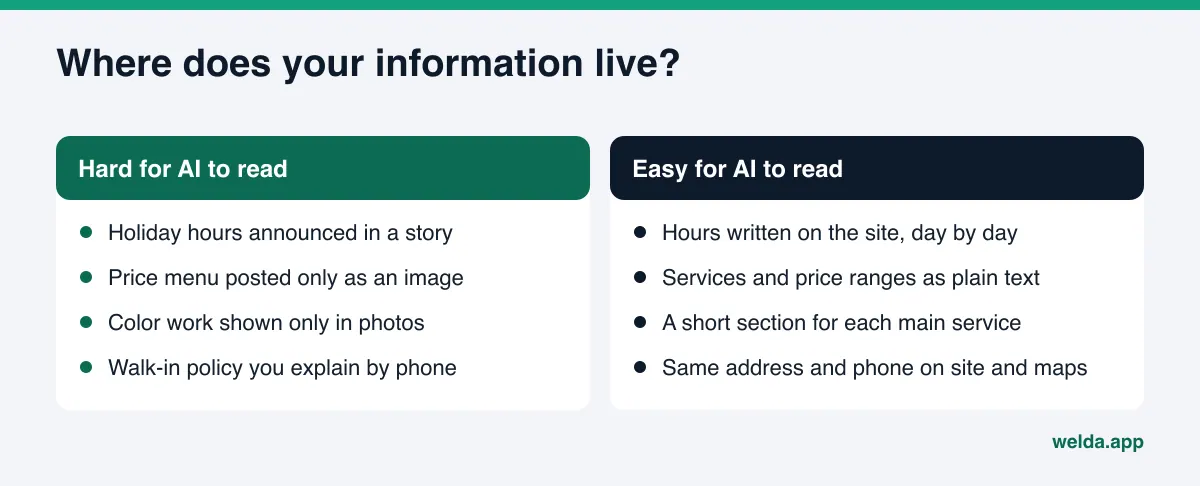
Google says in its Search Central documentation on AI features that there are no extra technical requirements for appearing in AI Overviews and AI Mode beyond the normal basics of Search. In practice, that means a page has to be crawlable, indexable and readable as text. That is exactly where many salon sites fall short. The information exists, but inside an image, a story or a phone call.
Step by step: AI search optimization for hair salons
The steps below fit most salon websites. Keep them in order. If step one is not done, later steps cannot do their job.
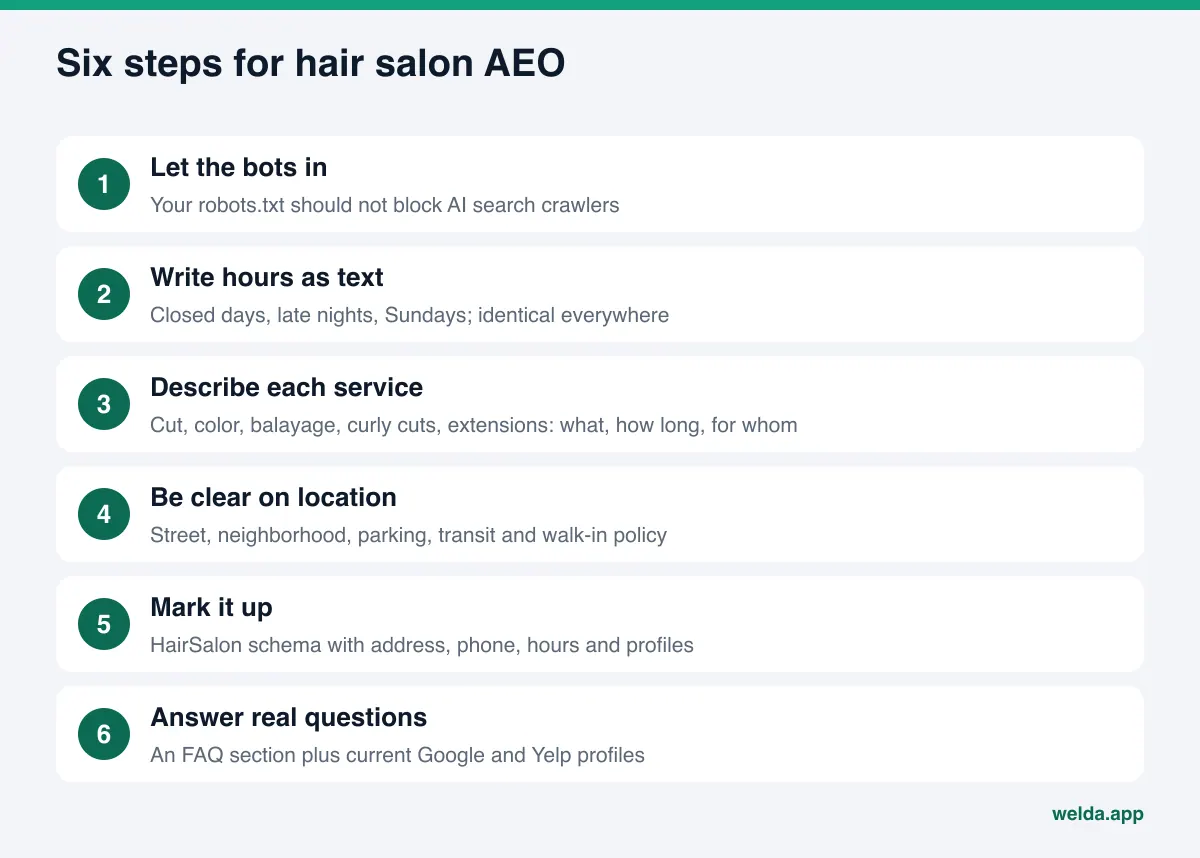
- Make sure AI crawlers can reach your site. Your robots.txt file should not block AI search bots. OpenAI states in its crawler documentation that ChatGPT search uses a bot called OAI-SearchBot, and that sites blocking it will not be shown in ChatGPT search answers. Salon sites built from templates sometimes block bots through a security setting that nobody remembers turning on. Check once.
- Write your hours as text. Opening and closing time for every day, your closed day, holiday hours and any late nights. Keep the same hours on Google Business Profile, Yelp and your Instagram bio. When hours change, update all of them on the same day.
- Describe each service. Cut, blowout, single-process color, highlights, balayage, color correction, curly cuts, extensions, keratin, men's cuts, kids' cuts, bridal. Two or three sentences each is enough: what it is, roughly how long it takes, who it suits, and whether a consultation is needed. If your team has real experience with a hair type or technique, say so plainly without superlatives.
- Be specific about location. Full street address, neighborhood, nearest transit, parking and accessibility. State whether you take walk-ins and when.
- Decide how you handle pricing. If you do not want to list exact prices, give "starting at" prices or ranges. If your menu is an image, publish the same information as text.
- Add structured data. Schema.org has a HairSalon type. Use it to describe your salon's name, address, phone, hours, location and social profiles in a form machines read reliably.
- Write an FAQ section. Use the questions clients actually ask at the front desk: "Do you take walk-ins?", "Are you open Sunday?", "Do you cut curly hair dry?", "How long does balayage take?", "What is your cancellation policy?". Keep answers short and honest.
- Reply to reviews. Respond calmly and briefly to real reviews on Google and Yelp, including the critical ones. Never buy reviews or write fake ones. The FTC's final rule on fake reviews and testimonials bans selling or buying fake reviews, among other practices. This is not legal advice; check details with your own counsel.
Common gaps on hair salon websites
Most salon sites have a home page, a gallery, a booking button and a contact page, sometimes a services page. They can look beautiful. Seen through the eyes of an answer engine, though, a few gaps show up again and again.
| What we see | Why it hurts | How to fix it |
|---|---|---|
| Hours only in a map embed or image | Not readable as text, so hours questions skip you | Write hours on the contact page and in the footer |
| One line: "full hair services" | No match for balayage, curly or color correction questions | A short section for each main service |
| Price menu only as a photo | Cost questions do not mention you | Publish the menu as text, at least as ranges |
| Different hours on site, Google and Yelp | The engine cannot tell which source to trust | One source of truth, updated everywhere |
| Page title is only the salon name | No neighborhood or service signal | Name, neighborhood and main service in the title |
| No structured data | Address, hours and phone are not machine-clear | Add HairSalon schema markup |
| Booking widget is the only service list | Content inside some widgets is hard to crawl | Repeat the service list as plain text on your site |
Most of these gaps can be closed in an afternoon. The hard part is knowing which ones actually apply to your site. Owners look at their own site the way a client does. An answer engine looks at it as text and code. The two do not see the same thing.
How Welda handles AI visibility for hair salons
Welda is software that measures where a business appears in AI answers and fills the gaps on the business's behalf. For a hair salon, three parts of that work matter most: measuring real client questions, collecting missing facts from you instead of guessing, and preparing copy that goes live only with your approval.
Question-by-question tracking. In the Welda dashboard, the questions your clients are likely to ask, such as "salon open Sunday in my neighborhood," "walk-in women's haircut" or "stylist for curly hair," are put to ChatGPT, Gemini, Perplexity and Google AI three times each. For every question you see which engine named your salon and in what position. Click a question and you see the answer itself plus the sources it leaned on. For a salon owner, the useful shift is this: "do I show up in AI?" becomes "which questions do I show up for, and which do I miss?" If you appear for hours questions but not for specialty questions, the gap is your service copy, not your hours.
It asks instead of inventing. When Welda prepares copy and cannot find a fact on your site, it does not fill it in. Your closed day, your walk-in policy, how long a balayage appointment usually runs, whether you want to show price ranges: these appear on the to-do list as information Welda needs from you. Once you enter them, they flow into every piece of copy, so your site, your profile text and your FAQ all say the same thing.
Ready-made copy, your approval. Welda drafts service descriptions, FAQ answers, Google Business Profile text and review replies. On WordPress sites, Welda connects through a separate Editor user and an application password, with no code to install. Content arrives on your site as a draft and goes live when you approve it. On other platforms, Welda provides a ready-made package that you or your web person applies. Your content always stays on your own site; Welda does not host it. Profiles that are not connected appear as manual tasks with the text ready to paste.
The dashboard also has competitor, source and monthly report views. The competitor view shows which question types a nearby salon wins and which sources help it.
Where Welda stands today. The Welda dashboard is in early access and opening in stages, starting with businesses in Turkey. Regular four-engine tracking is being added during early access, and sample dashboard screens use representative data. What anyone can use today is the free site analysis, which works in English. Pricing is discussed in an early access conversation.
What the free site analysis tells a hair salon
The free site analysis reads your home page and a few inner pages, such as services, pricing, about and contact, the way Google and an AI assistant would. For a salon, the most useful checks are whether AI crawlers can get in, whether your page title and description say who you are, where you are and what you do, whether your address, phone and hours are readable, whether structured data is present, whether your social and map profiles are linked from the site, whether your services are clearly described, and whether you have an FAQ section.
You get a score out of 100, with technical and content scored separately. Each gap comes with what was found, why it matters and how to fix it. You also get ready-to-use suggestions for your home page title, description, main heading, intro paragraph and FAQs; a simulation showing how much each fix could raise the score; a competitor comparison; a fix package for your site, including business schema code; a PDF; and a shareable score card.
The analysis also puts 5 questions your clients might ask to an AI assistant that can search the web, and checks whether your salon's name appears in the answers. This is a one-time measurement, not ongoing tracking. The check is free once per site. Your email and phone are verified, the results link arrives by email and stays open for 14 days. The analysis does not measure rankings and does not promise any.
Limits: what Welda does not do
Knowing what is not possible is as important as knowing what is. Welda:
- Does not promise rankings. No tool can promise a specific spot in ChatGPT or Google. We explain why in the truth about guaranteed ChatGPT rankings.
- Does not write what it does not know. Missing facts about hours, services, prices or staff are asked, not invented.
- Does not publish without approval. Every piece of copy comes to you first.
- Does not create fake reviews. It drafts replies to real reviews, nothing more.
- Leaves some work with you. Handling negative reviews, claiming and updating directory listings, and earning a mention in local media remain the salon's own job.
Timing matters too. New information on your site does not show up in AI answers right away. It usually takes weeks. Engines have to recrawl pages, sources have to update, and answers have to be rebuilt. Seeing no change in the first week is normal.
Hair salon checklist and where to start
Use this list to check where your salon stands today. Answer each point with a plain yes or no.
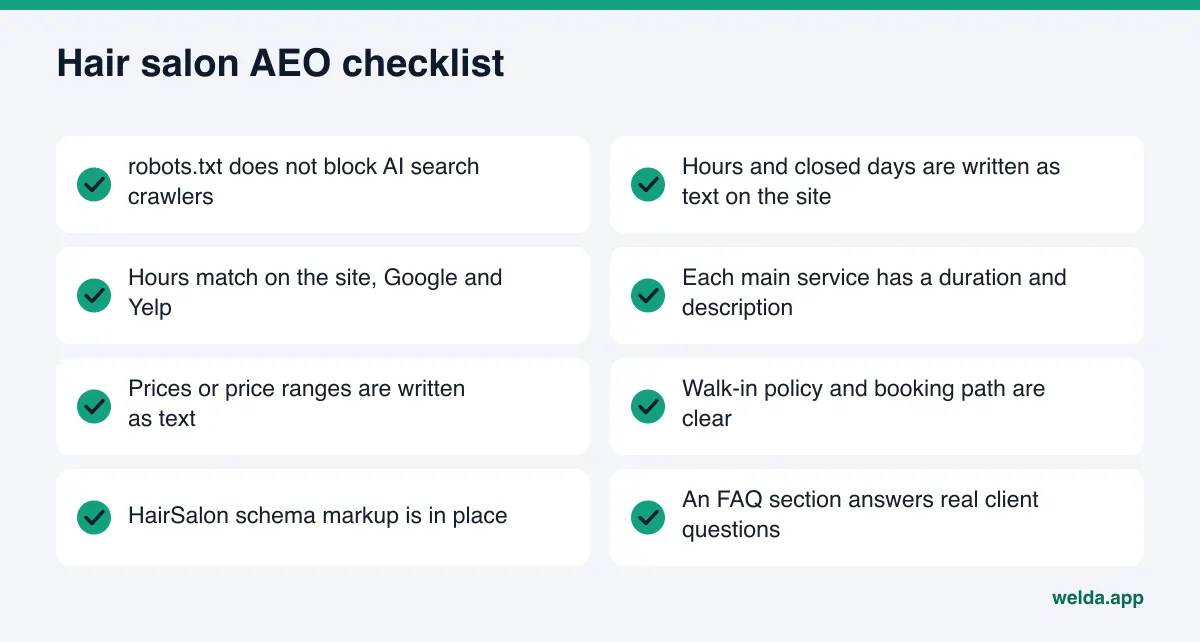
Once you have your answers, decide how to proceed. The chart below is a rough guide.
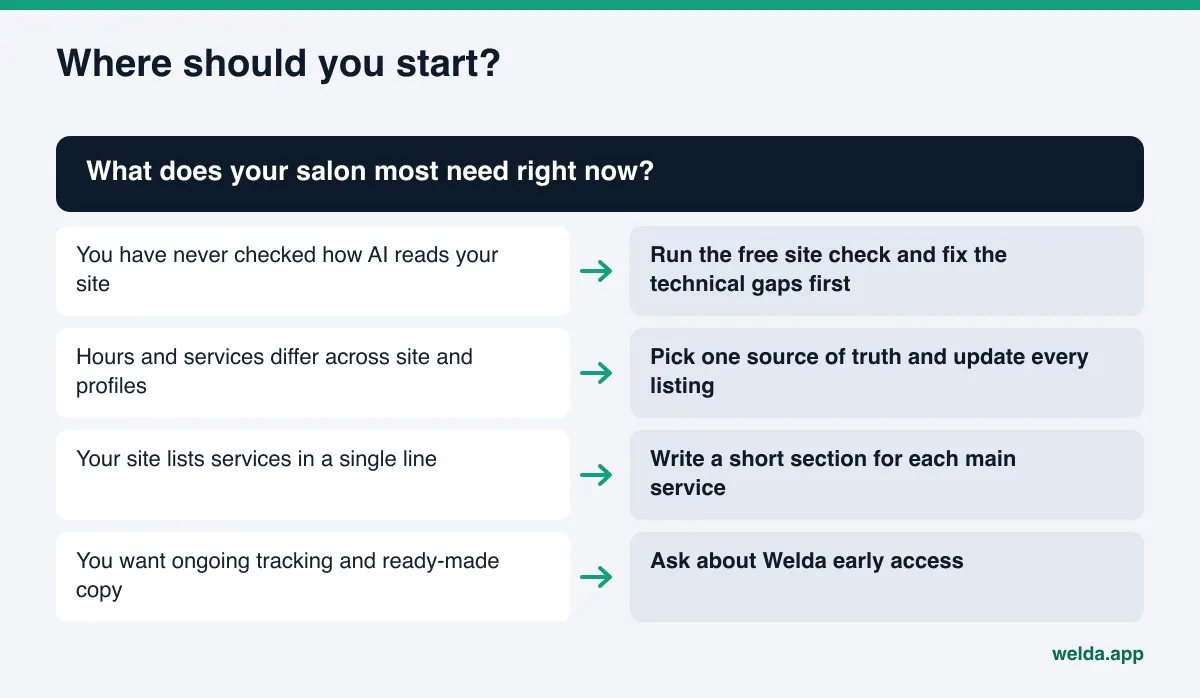
A few more practical notes for salons with special situations:
| Your situation | Sensible approach |
|---|---|
| Several locations | A separate page, address and hours for each location |
| Booth rental or suite salon | Make clear which stylists work there and how clients book each one |
| Strong specialty, such as curly or textured hair | A dedicated page that explains the method and consultation |
| Bilingual clientele | A short section in the second language with hours and services |
| No time for this work | A tool that drafts the copy and waits for your approval |
Frequently asked questions
Is AI search optimization for hair salons the same as local SEO?
No, but they overlap. Local SEO focuses on rankings in maps and search results. AEO focuses on being named in AI answers. A crawlable site, consistent hours and address, and a complete Google Business Profile are the foundation of both.
My Instagram is active. Isn't that enough?
Usually not. Stories disappear, text inside images is not always read, and bio details can conflict with your site. Link Instagram from your site, but also write hours, services and address on your site as text.
Do I have to publish prices?
That is your decision. If you want to appear when people ask about cost, a range or a "starting at" price helps. Do not rely on a menu image alone.
How long until I see results?
New information usually takes weeks to show up in AI answers, and no one can give an exact timeline. Measuring at intervals gives a truer picture than a single check.
Can Welda get my salon to the top of ChatGPT?
No, and it does not promise that. Welda measures where you appear, shows the gaps, drafts the copy and publishes it with your approval. The answer engine builds the answer.
Is the Welda dashboard available for salons in the US?
The dashboard is in early access and is opening first in Turkey. The free site analysis works in English today and is open to anyone.
See where your salon stands today
AI search optimization for hair salons is not a big project. It is the work of writing the right information in the right places and keeping it consistent. When your hours, services, location and pricing approach are readable to answer engines, you raise the odds of being named when someone asks for a salon that is open today. Start by measuring instead of guessing. Run the free site analysis and see your score, your gaps and ready-made copy suggestions for your home page in a few minutes.