What does AI search optimization for bridal hair and makeup artists actually involve? It means making sure that when an engaged couple asks ChatGPT, Gemini, Perplexity or Google's AI Overviews for "an on-location bridal hair and makeup artist for a June wedding near Napa," the assistant can find, understand and trust what you offer. In practice that comes down to writing your services, travel area, trial process and booking terms as clear text that matches everywhere you appear online. Nobody can guarantee a mention, but an artist the assistant cannot read is very unlikely to be named.
This guide is for freelance bridal hair and makeup artists, on-site beauty teams that travel to hotels and venues, and salons that run a bridal department. We start with why bridal work is a special case for answer engines, then walk through the work step by step, then explain how Welda handles it and where its limits are. If you want to see how your site reads to AI right now, you can start with the free site analysis.
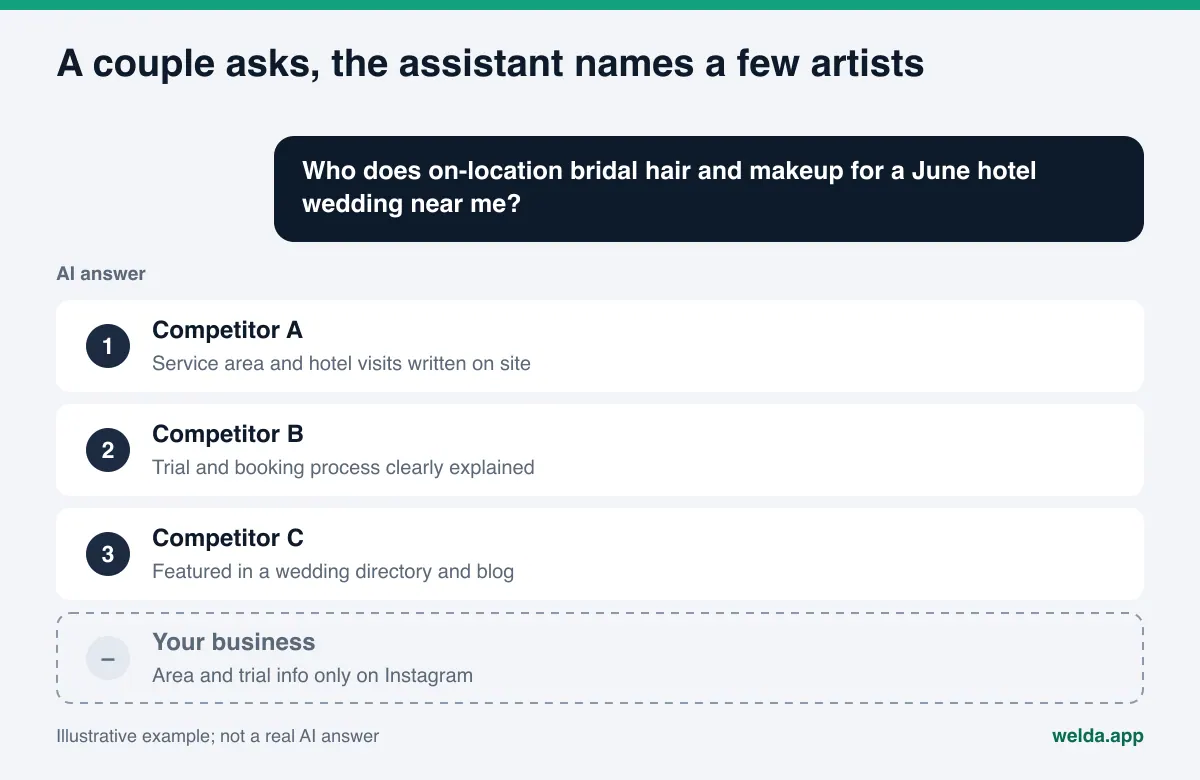
Why AEO for bridal artists is different from other beauty businesses
Answer engine optimization, or AEO, is the work of getting your business named and described correctly in AI-generated answers. You will also see it called GEO, short for generative engine optimization; in the US the two terms describe the same work, and AEO is the one people search for more. For most beauty businesses, AEO looks a lot like local search: a storefront, an address, opening hours, reviews. Bridal hair and makeup does not fit that pattern, and that is exactly why so many talented artists are invisible in AI answers.
Five things set bridal work apart:
- You serve an area, not an address. Many bridal artists go to the client: a home, a hotel suite, a winery, a ballroom getting-ready room. When an assistant answers "bridal makeup artist who travels to Lake Tahoe," it needs to know where you go. Most artist websites never say.
- The calendar drives everything. Saturdays in peak months book early. Couples ask about availability months ahead, and how you explain your booking window shapes whether you look like a fit.
- The trial is its own service. Whether you offer a trial run, when and where it happens, and whether it is included or billed separately are among the first questions a bride asks.
- You serve a group. The bride, the mother of the bride, bridesmaids, sometimes the groom. How many people your team can handle in one morning, and what time you start, is a deciding factor.
- There is more than one event. Engagement photos, the rehearsal dinner, the ceremony, a cultural ceremony such as a mehndi night or a tea ceremony. Each can be its own search.
The common thread: your strongest marketing asset, your portfolio, answers none of these questions. A beautiful bridal photo on Instagram shows your style. It does not tell an AI assistant that you travel to the Hill Country, how and where your trials happen, or that you bring a second artist for parties over five people.
What engaged couples ask AI assistants
The examples below are written by us to illustrate the kinds of questions bridal clients bring to an assistant. They are not measured search data. Each type of question looks for a different piece of information on your site.
| Question type | Example (illustrative) | What your site needs to say |
|---|---|---|
| Location and venue | On-site bridal makeup for a hotel wedding in Scottsdale | Cities and counties you cover, travel fee policy |
| Event type | Hair and makeup for an engagement shoot | Separate descriptions for each event you serve |
| Trial | When should I book a bridal makeup trial | Trial timing, location, whether it is included |
| Group size | Makeup for a bride and six bridesmaids on the same morning | Team size, time per person, start time |
| Style | Natural bridal makeup that photographs well | A short written description of your style |
| Price and booking | Bridal hair and makeup cost and retainer | Your own starting price or range, retainer terms |
The takeaway is simple: one line that says "we do bridal" is not enough. Every question type needs a clear, separate answer somewhere on your site.
How AI assistants decide which bridal artist to recommend
When an assistant gets a question that needs current information, it runs a web search, reads a handful of sources and names the businesses that show up consistently across them. For bridal artists those sources usually include your own website, your Google Business Profile, wedding vendor directories such as The Knot and WeddingWire, Yelp, local wedding blogs and real-wedding features, and discussion threads where couples compare vendors. How much weight each source gets varies by question, by engine and over time; nobody can give you a fixed formula.
In practice the assistant has to be able to work out four things about you:
- What you do. Hair, makeup or both? A studio, a traveling artist or both? This should be obvious from your page title, your main heading and your structured data.
- Where you work. Your studio address if clients come to you, your service area if you go to them. Schema.org has an areaServed property for exactly this: the geographic area where a service is provided.
- How you work. Trials, booking, retainer, start time, team size, travel fees. These are the details couples decide on.
- What others say. Reviews, your replies to them, and mentions in directories and wedding features.
There is also a technical gate. OpenAI says OAI-SearchBot is used to surface websites in ChatGPT's search features. If your robots.txt blocks it, even a perfect bridal page may never make it into a ChatGPT answer. Our guide to robots.txt for AI crawlers shows how to check.
AI search optimization for bridal hair and makeup artists, step by step
Order matters here. If crawlers cannot read your site, a new bridal page will not help. If your service area is described three different ways in three places, more reviews alone will not fix it.
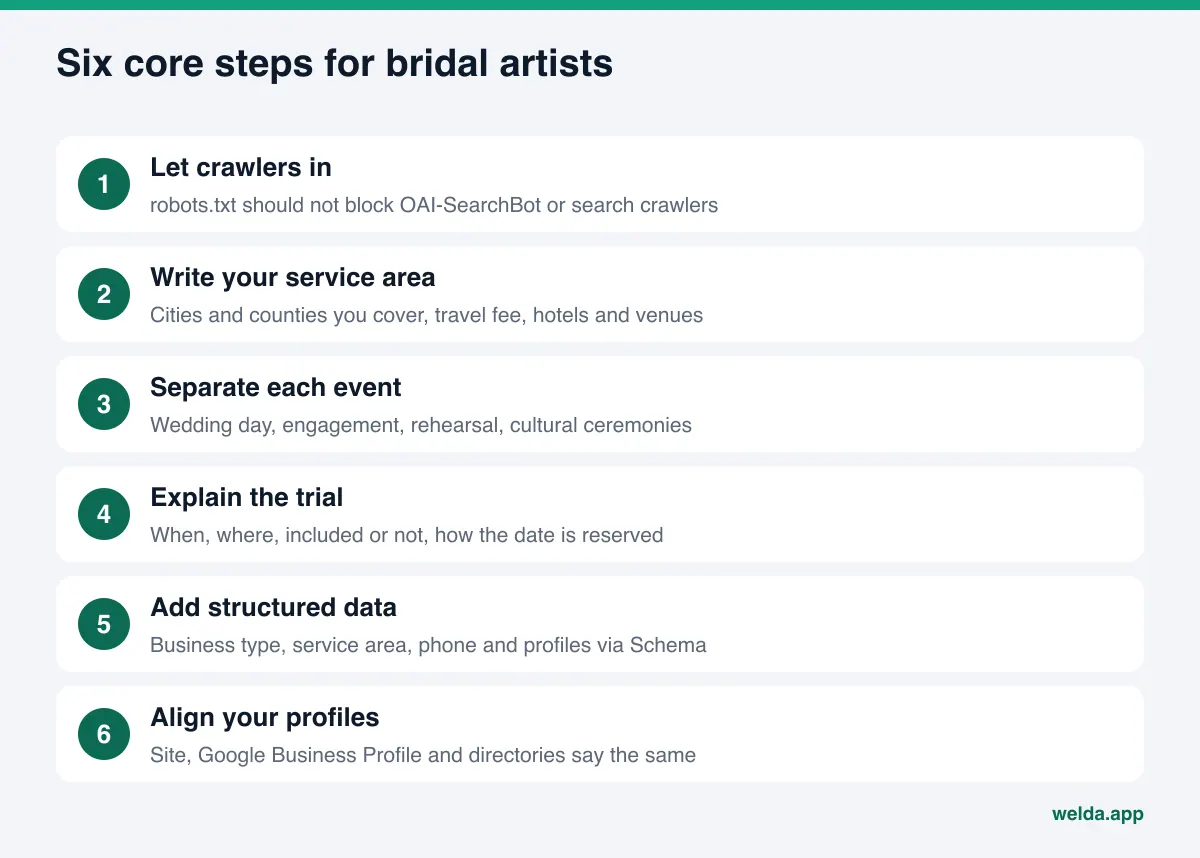
1. Make sure AI crawlers can reach your site
Add /robots.txt to the end of your domain and open it. If you see "Disallow: /" for OAI-SearchBot, Googlebot or other search crawlers, review it with whoever manages your site. It takes minutes and everything else depends on it.
2. Spell out your service area
This is the most common gap for traveling artists. A sentence such as "We travel to homes, hotels and venues throughout Maricopa County; travel outside the county is quoted per event" tells an assistant far more than a map pin. If you take destination weddings, say so and explain how you plan them.
The same logic applies on Google. Google's help page on service areas for service-area and hybrid businesses tells businesses that do not serve customers at their address to remove the address from their Business Profile and list only the service area. If you have a studio and also travel, you are a hybrid business and can show both. Whatever you choose, your site, your profile and your Instagram bio should describe the same area.
3. Give each event and service its own section
Bridal hair, bridal makeup, trials, bridal party services, mother of the bride, engagement sessions, rehearsal dinner looks, cultural ceremonies. For each one you actually offer, write a short section that covers what it includes, how long it takes, where it happens, who does it (you or your team), your price or price range and how to book. That structure lets an assistant match "hair and makeup for an engagement shoot" directly to your page. For more on writing sections that answer the question in the first sentence, see our guide to answer-first content.
Here is what a service section can look like. It is written for a hypothetical artist; replace everything in brackets with your own details.
Wedding day bridal hair and makeup (on location)
We come to your home, hotel suite or venue getting-ready room. Hair and makeup for the bride takes about [time], and we start [hours] before your first look or ceremony. A separate trial takes place [weeks] before the wedding at [location] and is [included or priced separately]. We cover [cities or counties]; travel beyond that is [policy]. Your date is reserved with [retainer terms]. Bridal pricing starts at [your price].
That one paragraph answers at least seven questions a bride will ask: what is included, where, how long, what time you start, whether there is a trial, where you travel and how to lock in the date. An assistant reads that kind of paragraph far more reliably than a gallery.
4. Explain your trial and booking process
Replace "contact us for details" with the actual process: first inquiry, date check, trial appointment, contract and retainer, wedding-morning timeline. A couple who sees the process knows what to expect, and an assistant answering "how does a bridal makeup trial work" can use your page as a clear source. You do not need to publish open dates. It is enough to say, from your own experience, which months and days book first and how far ahead you recommend inquiring.
5. Keep price and performance claims honest
You do not have to publish prices, but couples ask about them constantly, and a starting price or range gives the assistant something to cite. Avoid claims you cannot back up, such as "guaranteed flawless all day" or "lowest prices in town." They create risk with clients and weaken the impression of a trustworthy source. Our guide to pricing claims in AI-ready content goes deeper.
6. Add structured data and a real FAQ
Add Schema markup that states your business type, name, phone, service area, studio address if you have one, and links to your social and directory profiles. Then collect the questions couples ask you by text and email and answer them on your site: is the trial included, how many people can you do in one morning, what time do you arrive, do you travel for destination weddings, is the retainer refundable, are lashes or hair accessories included.
7. Align your profiles and handle reviews properly
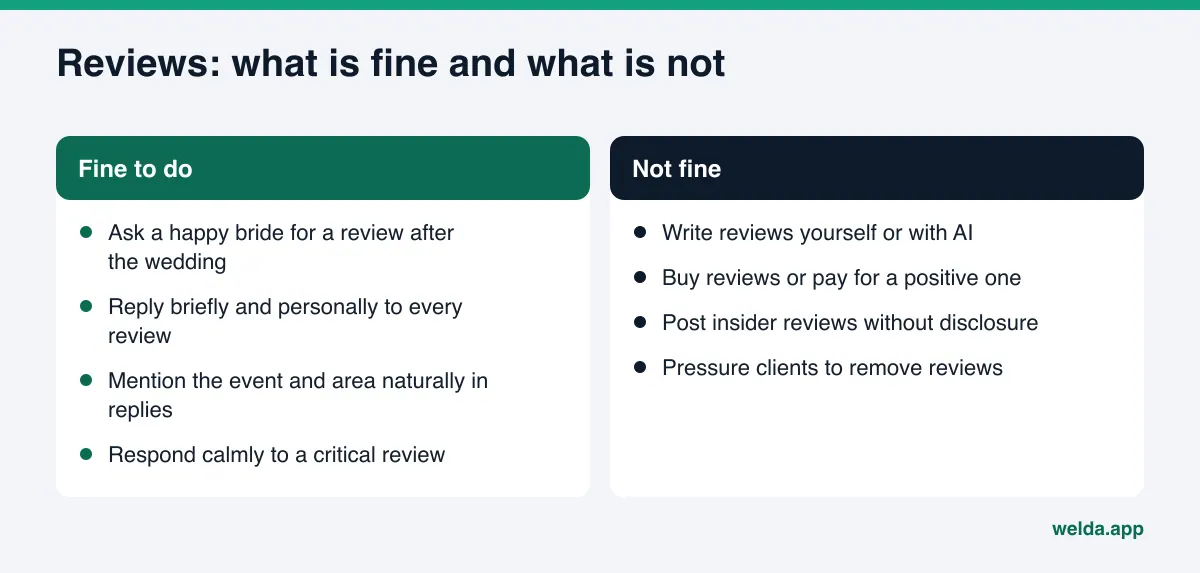
Your Google Business Profile, your directory listings and your website should use the same service names, the same area and the same contact route. Your page title and meta description matter here too; see title tags and meta descriptions for AI search. Asking a happy bride for a review after the wedding is fine. Writing reviews yourself, buying them or paying for positive ones is not: the FTC's final rule banning fake reviews and testimonials, announced in August 2024, prohibits fake reviews, including AI-generated ones, and buying reviews conditioned on a positive or negative sentiment. This is general information, not legal advice. Reply to reviews briefly and personally; mentioning the event type and location naturally in your reply helps readers understand what you do.
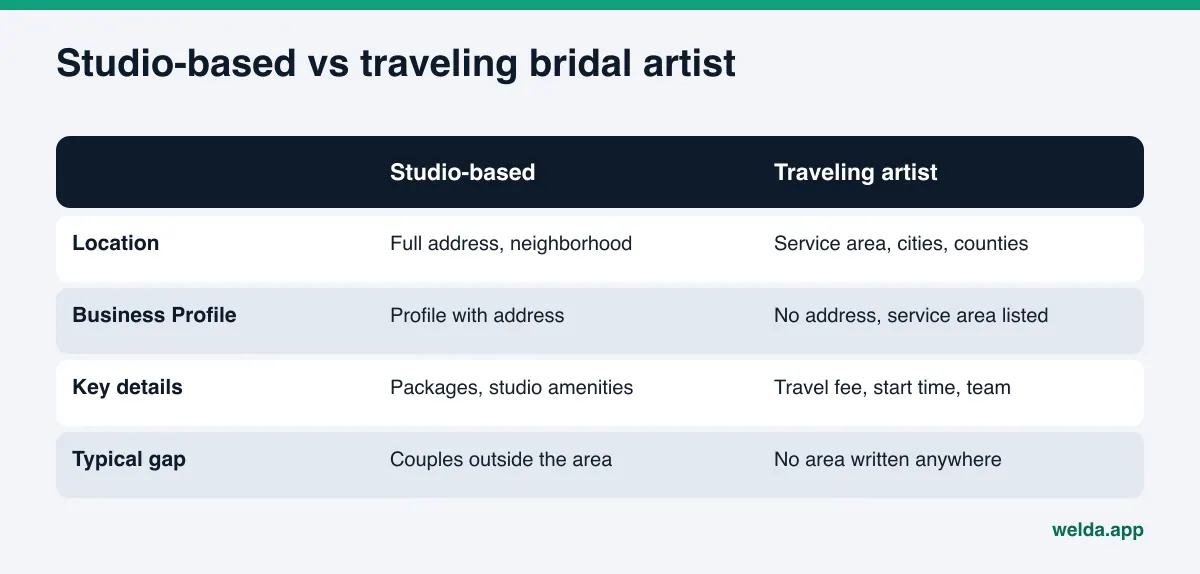
Studio or on location: which setup needs what
Some bridal businesses work only from a studio, some only travel, and many do both. For AI visibility, each setup needs different information. Knowing yours tells you where to put your effort first.
| Topic | Studio-based | Traveling artist |
|---|---|---|
| Location info | Full address, neighborhood, parking | Service area, cities and counties covered |
| Google Business Profile | Profile with address | No public address, service area listed |
| Key page | Bridal packages and studio amenities | Travel area, travel fee, wedding-morning plan |
| Common question | Is there room for the bridal party | What time you arrive, how many artists come |
| Typical gap | Missing couples outside the area | No area or address written anywhere |
If you run both, separate them clearly on your site with two sections, one for studio appointments and one for on-location service, so an assistant can match you to either kind of question.
How Welda handles AI visibility for bridal artists
Welda is software that measures where a business appears in AI answers and fills in the gaps on the business's behalf. For a bridal artist, the parts that matter most are seeing which event and location questions name you, collecting the facts only you know, and preparing the missing text for your approval.
Start with the free site analysis
The part anyone can use today is the free site analysis, which works in English. It reads your homepage and a few inner pages such as services, pricing, about and contact. For a bridal artist, the most useful checks are whether your page title and main heading make it clear that you do bridal hair and makeup, whether services are spelled out, whether your location and phone can be read, whether your Instagram and map profiles link to the site, and whether you have an FAQ. You get a score out of 100 split into technical and content, an explanation and fix for each gap, and ready-to-use homepage text: title, description, main heading, intro paragraph and FAQ suggestions. A simulation shows how much each fix could raise the score, and a competitor comparison shows where others are ahead. The analysis also asks five questions a client might ask to an AI assistant that can search the web and checks whether your business name comes up. That is a one-time check, not ongoing tracking. It is free once per site, your email and phone are verified, and the results link arrives by email and stays open for 14 days.
Event-by-event question tracking in the dashboard
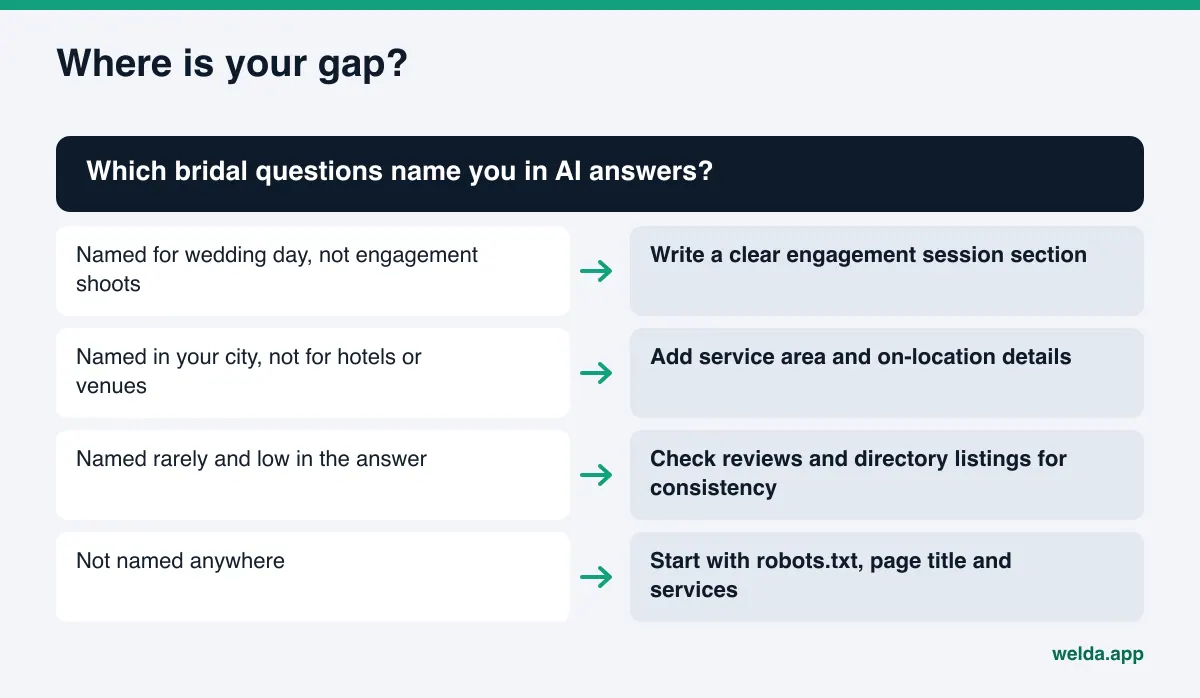
The full Welda dashboard is in early access and is opening first in Turkey. Regular four-engine measurement is being added during early access, and sample screens use representative data. Once active, the questions your clients would ask are put to ChatGPT, Gemini, Perplexity and Google AI three times each, and questions can be tracked in English. For a bridal artist, those questions group naturally by event and by area: "bridal makeup in your county," "on-site bridal hair for a hotel wedding," "engagement shoot hair and makeup," "makeup for a large bridal party."
The decision this gives you is concrete. If you are named for wedding-day questions but never for engagement shoots, your engagement service is probably not described clearly enough. If you show up for your home city but not for venue or hotel questions, the gap is in your service area and on-location section. The score formula is published: the share of questions that name you counts 50 percent, your position in the answer 30 percent, and your share against competitors 20 percent. Running each question three times produces a margin of error, so during wedding season you watch the trend over weeks rather than one day's number.
The to-do list: facts from you, drafts from Welda
In bridal work, accuracy is everything: trial fees, retainer terms, travel fees, team size. Welda does not guess them. Anything it cannot read on your site stays blank in the to-do list and is asked of you; once you answer, it flows into every draft. Welda prepares service and event sections, FAQ answers, profile descriptions and review reply suggestions. You approve before anything goes live, and content always lives on your own site. On WordPress, Welda connects through a separate Editor user and an application password, without installing code; content opens as a draft and goes live when you approve it. On other platforms, Welda gives you a ready-made package to apply yourself. A compliance check flags phrases such as guarantees or superiority claims before publishing; it is not legal advice.
What Welda does not do
AI answers come from systems nobody fully controls, so here is what Welda does not do.
- No guarantees. Welda does not promise rankings or a spot in ChatGPT answers. Answers change by question, engine and time.
- No invented facts. Trial fees, retainer terms, travel fees and the products you use are never guessed; Welda asks you.
- No fake reviews. Welda does not write reviews. It suggests replies, and you approve them. Asking brides for reviews stays with you.
- Some work stays with you. Resolving negative reviews, setting up directory accounts and press features are yours. Welda lists them and drafts the text but does not open accounts for you.
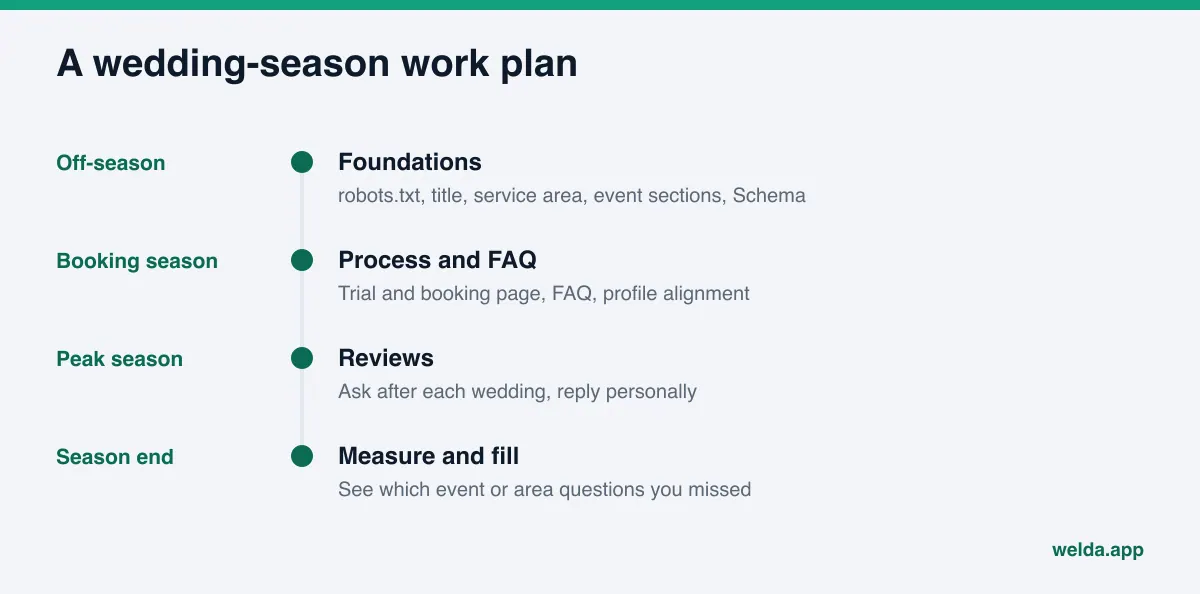
- It takes time. New content usually takes weeks to show up in AI answers, which is why starting before peak season matters.
- No published pricing. Because the dashboard is in early access, pricing is discussed in the early access conversation.
Checklist for bridal hair and makeup artists
Work through this list once from top to bottom. Each item maps to a step above.
- robots.txt does not block OAI-SearchBot or other search crawlers.
- Your page title includes bridal hair and makeup and your city or region.
- Your service area or studio address is written in text and matches your Google Business Profile.
- Each event you serve (wedding day, engagement, rehearsal, cultural ceremonies) has its own section.
- Your trial process, location and fee policy are written out.
- Booking and retainer terms, team size and start time are written out.
- A starting price or range is in text, with no guarantee or "best" claims.
- Structured data (Schema) is on the site.
- An FAQ built from real client questions is on the site.
- Your Instagram and Google Business Profile link to the site, and the site links back.
If you also offer lash extensions or brow work for brides, our guide on how lash and brow studios get recommended by ChatGPT complements this list.
Frequently asked questions
Is AI search optimization for bridal hair and makeup artists a replacement for Instagram?
No, it complements it. Instagram shows your style, but service area, trial and booking details usually sit in images and stories. AI assistants read those facts most easily from a clear website and a Google Business Profile.
I don't have a studio. Can I still have a Google Business Profile?
Yes. Google tells businesses that don't serve customers at their address to remove the address and list a service area instead. Check Google's help page for the current requirements.
Will AI skip me if I don't list prices?
Prices are not required, but couples ask about cost constantly. A starting price or range means the answer to that question can be found on your page. What matters most is that it is accurate and consistent everywhere.
When should I start?
New content usually takes weeks to appear in AI answers, and couples research months ahead. The quiet months before peak season are the best time to start.
Will Welda write reviews for my business?
No. Welda does not create reviews. It drafts replies to reviews you receive, and you approve them.
Can I use the Welda dashboard in the US today?
The dashboard is in early access and is opening first in Turkey. The free site analysis works in English today, and pricing for the dashboard is discussed in the early access conversation.
See where you stand today
For most bridal artists, AI visibility is less about creating something new and more about writing down what you already know in the right place: the events you serve, where you travel, how trials and booking work. The first step is seeing how your site reads to AI today. Run the free site analysis; your list of gaps, ready-to-use text suggestions and the five-question AI check will be waiting in the results link sent to your email.