How do lash and brow studios get recommended by ChatGPT? ChatGPT and other AI assistants recommend a studio based on clear, consistent information they can read about it: which services you offer, where you are, how fills and touch-ups work, how to book, and what clients say about you. When that information is written out as text on your website and matches your Google Business Profile and review sites, your odds of being named in AI answers go up. No one can guarantee a specific spot.
This guide is for owners of lash and brow studios and permanent makeup (PMU) artists, and for whoever runs their website. Think lash extensions, lash lifts, brow lamination, microblading, lip blush and permanent eyeliner. The question is simple: when someone asks ChatGPT "Who does natural-looking lash extensions near Park Slope?" or "Can you recommend a microblading artist in Austin who includes the touch-up?", does your studio come up? If it doesn't, the cause is usually not one big problem but several small gaps. This is the work of AEO (answer engine optimization), sometimes also called GEO, generative engine optimization. Below we cover why it matters for lash and brow studios, the steps, how Welda handles the work and what Welda does not do. If you want a baseline first, run a free AI visibility analysis of your website.
Why AI search visibility matters for lash and brow studios
Lash and PMU services are high-trust, high-commitment decisions. A bad haircut grows out in a few weeks. Microblading or lip blush stays on the face for a long time. So clients research hard before they book: Who is the artist? How long have they been doing this? What does healing look like? Is the touch-up included? How often do lash fills happen? Will it look natural?
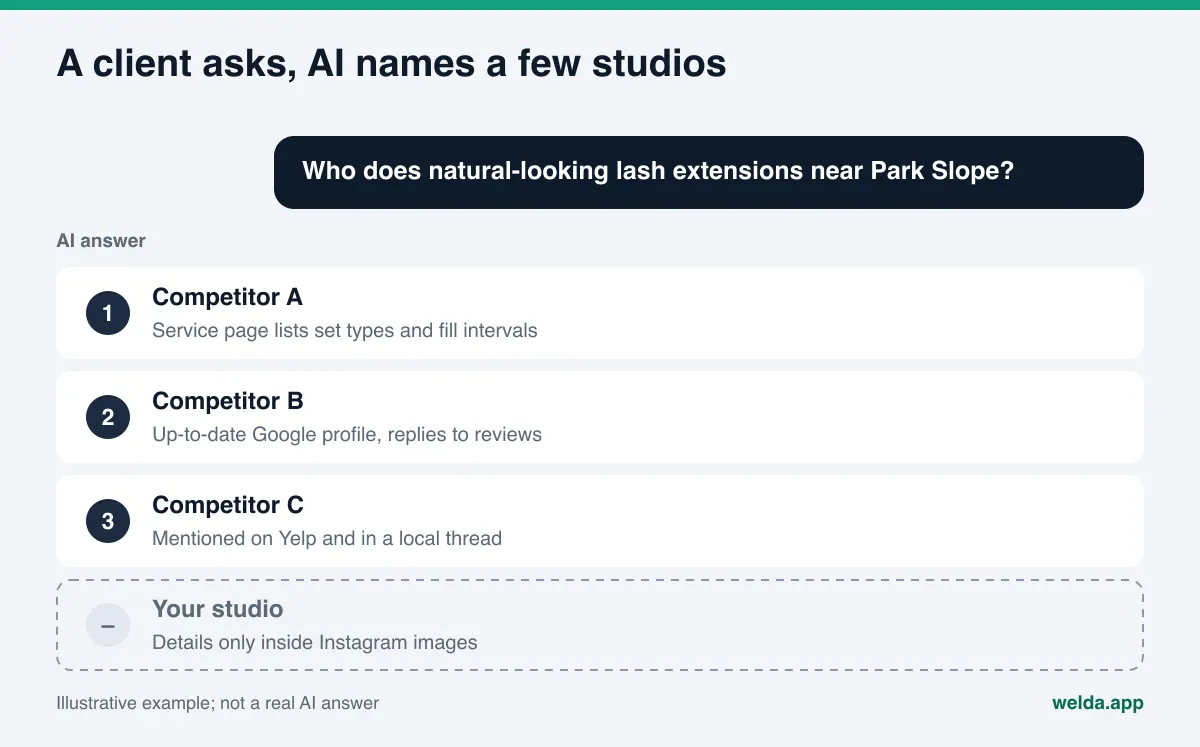
More and more of that research happens inside an AI assistant. A client types one sentence with the service, the neighborhood and the worry, and the assistant replies with two to four studio names and a short reason for each. If you're not on that short list, you're not in the running for that client at all.
Lash and brow studios face three specific problems in AI search:
- Service names overlap. Clients say "lash extensions", "classic lashes", "volume lashes" or "hybrid set". Microblading, "nano brows", "powder brows" and "combo brows" are related but different. The words on your site decide which questions AI can match you to.
- The information lives in photos. Instagram is the storefront in this industry. Before-and-after photos sell, but prices, timing, fills and aftercare often sit in an image overlay or a story highlight. AI assistants can't reliably read that.
- Safety and trust questions are common. Permanent makeup puts pigment into the skin, so clients ask about hygiene, products and reactions. Overblown or medical-sounding claims can mislead clients and AI assistants alike, and they can put you at risk.
What clients ask AI about lashes, brows and permanent makeup
Sorting questions by type tells you what each page needs to say. The questions below are examples we wrote to illustrate each type, not measured data.
| Question type | Example question | What the answer needs |
|---|---|---|
| Service and location | Who does lash lifts near South Congress in Austin? | The service name and your address and neighborhood in text |
| Result | Where can I get microblading that looks natural? | Technique, artist experience, real client reviews |
| Process | How many sessions does permanent eyeliner take? | Session and touch-up schedule, healing, aftercare |
| Trust | Which PMU studio near me is known for good hygiene? | Hygiene practices, single-use supplies, licensing where it applies, reviews |
| Price | How much is a lash fill and how often do I need one? | A price range or how pricing works, fill intervals |
| Timing | Brow lamination open Sunday in Brooklyn? | Hours by day, how to book, walk-in policy |
| Language | Lash artist who speaks Spanish in Houston? | Languages spoken, stated plainly on the site |
The takeaway: saying "we're a lash studio" is not enough. Each question type needs a readable answer, either on your site or in a source tied to your business. If you want to decide which questions to watch over time, see our guide to prompts to track for AI visibility. Price questions need extra care; our piece on pricing questions in AI answers covers them in detail.
What ChatGPT checks before lash and brow studios get recommended
ChatGPT, Gemini, Perplexity and Google's AI Overviews and AI Mode build answers from pages they find through web search. For a studio to make it into that answer, two things must be true: the information has to be findable, and it has to say the same thing everywhere.
In the lash and PMU space, the sources that tend to feed those answers include:
- Your website. Service descriptions, address, hours, FAQ and structured data (Schema). This is the source you control most.
- Google Business Profile and Google Maps. Category, services list, hours, photos and reviews. For local questions this is one of the most common sources.
- Review and booking platforms. Yelp and the booking platform you use often show up for "near me" style questions.
- Community discussion. Local forums and threads where people trade recommendations can show up in trust questions.
- Instagram. Your bio and caption text can be read; text inside an image usually can't.
If one source says "closed Mondays" and another lists Monday hours, the assistant either repeats the wrong one or leaves you out. Consistency matters more than filling every profile on the internet.
How lash and brow studios get recommended by ChatGPT: step by step
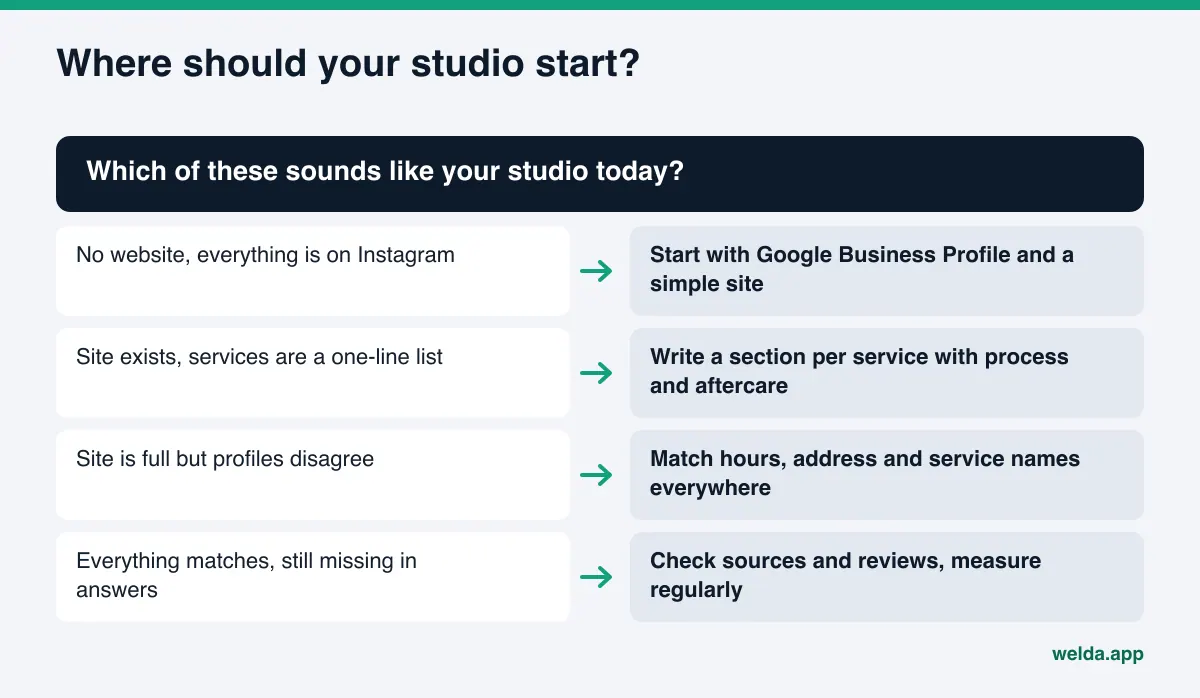
The order here is deliberate. First make sure AI crawlers can read your site, then add content, then fix outside sources.
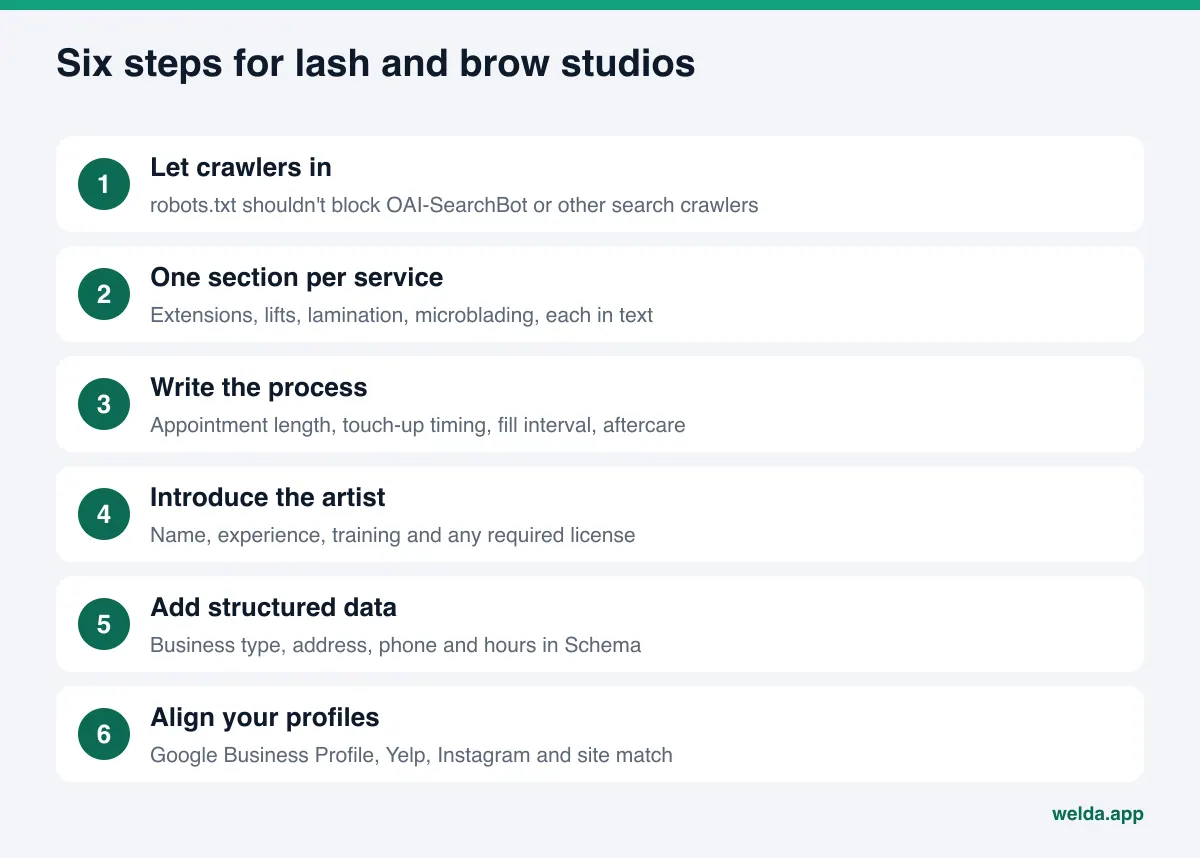
- Check that AI search crawlers can access your site. If your robots.txt blocks search crawlers, nothing else works as well. OpenAI documents that it uses a crawler called OAI-SearchBot to surface websites in ChatGPT search; sites that opt out don't appear in ChatGPT's search answers.
- Give every service its own section or page. Lash extensions, lash lifts, brow lamination, microblading, lip blush and permanent eyeliner each get a written description. Mention the other names clients use, naturally.
- Write down the process. Appointment length, number of sessions, when the touch-up happens, fill intervals and aftercare basics. Plain language, no medical claims.
- Introduce the artist. Who does the work, what training they have, how long they've been doing it, and any license your state requires. Only what's true and documented.
- Put location and hours in text. Neighborhood, parking or transit, hours by day, whether you take walk-ins and how to book.
- Mark up your business info. Use Schema to describe business type, address, phone, hours and services. schema.org has a BeautySalon type that fits this kind of business.
- Add an FAQ. The eight to ten questions clients ask you by text or DM, answered briefly.
- Align profiles and reply to reviews. Google Business Profile, Yelp, Instagram bio and your site should say the same thing. Reply to reviews briefly and personally.
What to write on a lash or PMU service page
Many studio sites list services in one line: "Lashes, lifts, microblading". That tells AI you offer them. It doesn't tell AI why to recommend you. Here's what clients want to know for each service and what you can put on the page.
| Service | What clients wonder | What to put on the page |
|---|---|---|
| Lash extensions | Will it look natural, will it damage my lashes? | Set types (classic, volume, hybrid), appointment length, fill interval, aftercare |
| Lash lift | How long does it last, is it right for me? | What the service does, a typical range for how long it lasts, aftercare |
| Brow lamination | How is it different from microblading? | The difference between the two, timing, how often it's repeated |
| Microblading | Will it look natural, is the touch-up included? | Technique, consultation, touch-up timing, healing do's and don'ts |
| Lip blush | How long does the color last, what's healing like? | Color consultation, session and touch-up schedule, healing tips |
| Permanent eyeliner | Is it safe around the eyes? | Consultation, who it isn't for, when to check with a doctor first |
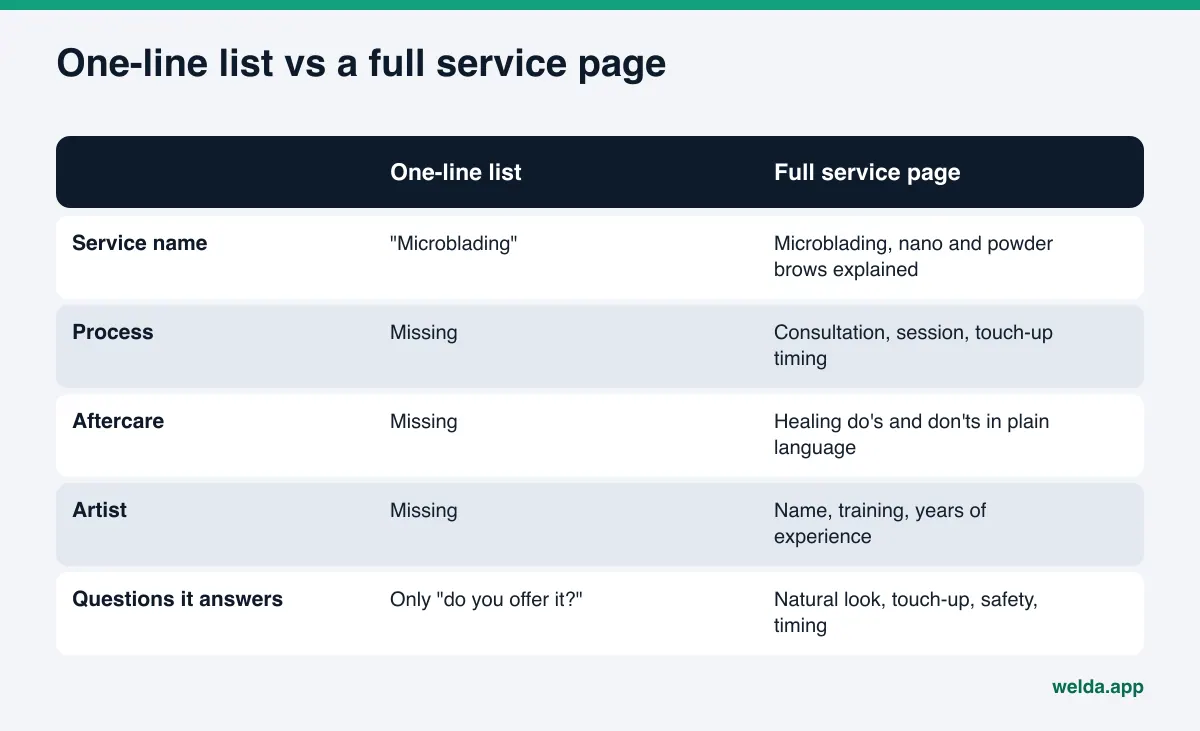
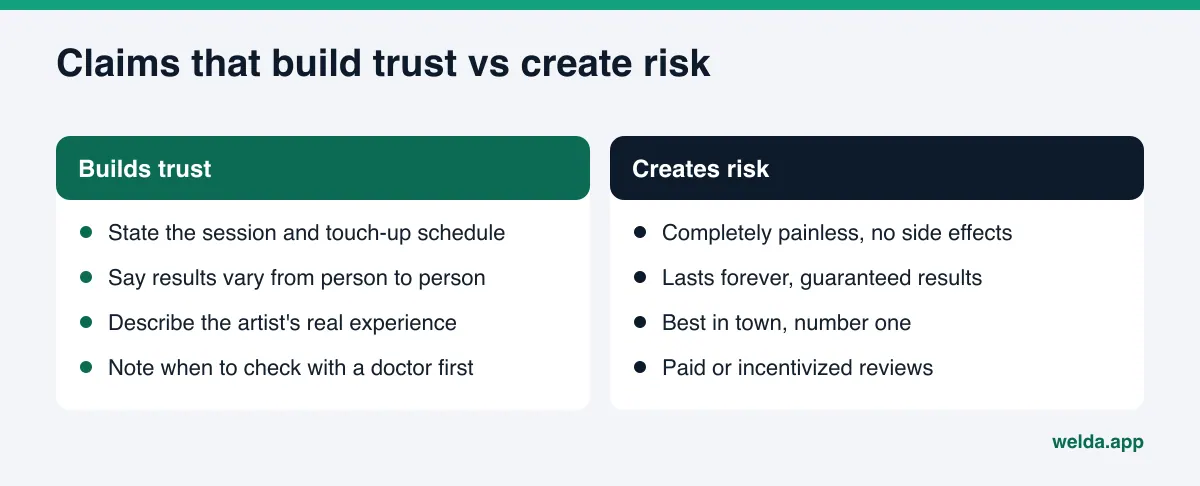
When you write ranges like "typically lasts" or "touch-up after", base them on your own practice and say results vary. AI assistants can pass your sentence to a client nearly word for word, so only write what you can stand behind.
Claims and reviews: what builds trust and what creates risk
Rules for permanent makeup are split between levels of government. According to the FDA, the agency considers the inks used in permanent makeup to be cosmetics, while the practice itself is regulated by local jurisdictions. That means licensing and health rules differ by state, county and city. This isn't legal advice; check what applies where you work and say it accurately on your site.
Claims like "completely painless", "no side effects", "lasts forever" or "best in Dallas" can mislead clients. Reviews are a similar story. The FTC has issued a final rule banning fake reviews and testimonials, including buying reviews and paying for reviews that express a particular sentiment. AI assistants lean on reviews for trust questions, so a fake signal tends to backfire.
Fixing the text problem in a photo-first studio
Most lash and brow studios win clients on Instagram. That's fine, but it isn't enough for AI search visibility. AI can't judge the result in a photo. It can read the words around it.
A practical habit: in every before-and-after caption, name the service, the neighborhood and one line about the process ("Brow lamination at our Park Slope studio, about an hour start to finish"). If you have a gallery on your site, give every image alt text that describes the service. Put your neighborhood and website in your Instagram bio, and link to Instagram from your site, so AI can tell both belong to the same business.
Other visual-first businesses face the same challenge; our guide on AEO for tattoo shops covers how to turn a portfolio into readable text. If you offer lashes and brows inside a hair salon, the guide on AI search optimization for hair salons is also useful.
Example scenario: why a studio misses the microblading answer
The studio and competitors in this section are examples. Picture a lash and brow studio in Austin. Its Instagram is active, its reviews are good and clients are happy. Someone asks an AI assistant: "Can you recommend a microblading artist in Austin who includes the touch-up?" The answer names Competitor A and Competitor B. The example studio isn't mentioned.
The usual reasons look like this. The studio's site lists microblading as one line with no word about the touch-up. The Google Business Profile has a generic category and an empty services list. Competitor A has a dedicated microblading page that explains the technique, the consultation, when the touch-up happens and what to avoid while healing. Competitor B is mentioned by name on a booking platform and in a local discussion thread. Because the question asks about "touch-up included", the assistant names the studios whose information answers that.
The fix in this example isn't a big campaign: write the microblading section, add the touch-up policy, fill in the services list on the profile and ask happy clients for reviews. Then ask the same question again at regular intervals to see whether anything actually changed.
How Welda handles this work
Welda is software that measures where a business shows up in AI answers and fills the gaps on the business's behalf. For a lash and brow studio, the work centers on two things: tracking the questions that matter and keeping a clear to-do list.
Question tracking: which services are you named for? Welda sets up the questions your clients are likely to ask, such as "lash extensions near Park Slope", "microblading in Austin with touch-up" or "brow lamination open Sunday". Each question is asked three times on ChatGPT, Gemini, Perplexity and Google AI. You see, question by question, where your studio is named, in what position, and which sources the answer relied on. If you're named for lash lifts but never for microblading, the problem is likely your microblading content, and this view makes that visible.
The score formula is published, not a black box. Here it is with its weights:
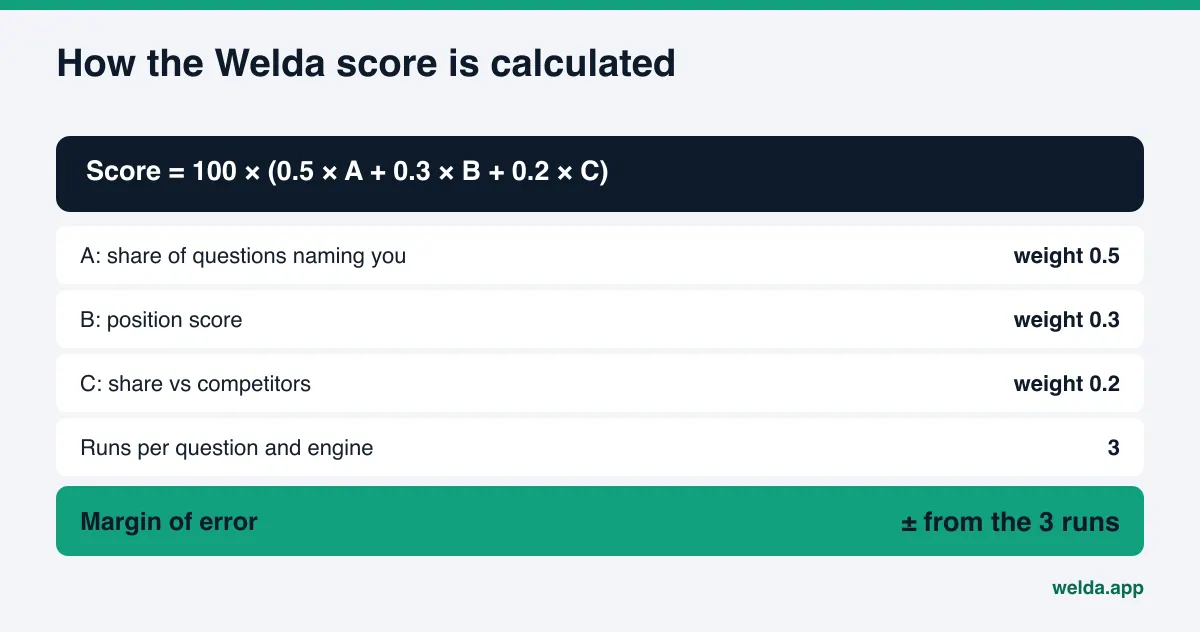
The spread across the three runs gives a margin of error, so one lucky or unlucky answer isn't mistaken for real change.
To-do list: what do you need to do? Gaps from the measurement go into one list. Welda doesn't make things up: if your touch-up policy or the artist's training isn't on your site, Welda asks you and leaves the field empty until you answer. Once you fill it in, it flows into every draft. Ready-to-use text for the microblading section, the FAQ or your Google Business Profile description sits right next to the task. Before anything goes live, Welda's compliance check flags patterns such as pricing, guarantees, superiority claims and diagnosis-like statements, so "painless" or "best in town" comes back to you with a note. That check is not legal advice and hasn't been reviewed by legal counsel. Publishing approval always stays with you, and content always lives on your own site.
A note on availability. The Welda dashboard is in early access, opening in stages and launching first in Turkey. Regular four-engine tracking is being added during early access, and sample screens use representative data. What anyone can use today is the free site analysis, which works in English: it reads your homepage and a few inner pages, gives a score out of 100, explains each gap and how to fix it, and asks an AI assistant with web search five questions your clients might ask to see whether your business is named. Pricing is discussed in an early access call.
Limits: what Welda does not do
Realistic expectations matter. Welda does not:
- Guarantee rankings or "showing up on ChatGPT". AI answers vary, and no software controls them.
- Write facts it doesn't know. Artist experience, products used and touch-up policy come from you.
- Create fake reviews. It drafts replies to your reviews. It never writes or solicits reviews.
- Publish sensitive content without approval. Text with health-related claims comes to you for sign-off.
- Take over everything. Handling negative reviews, setting up directory listings and press work stay with the business.
Timing matters too. New content usually takes weeks to show up in AI answers. Seeing no change in week one is normal, which is why repeated measurement beats a single check. Our piece on AEO for laser hair removal clinics covers a similar trust-heavy service if you want a second example.
AEO checklist for lash and brow studios
Go through this once from top to bottom. Every "no" is a gap that makes it harder for AI to recommend you.
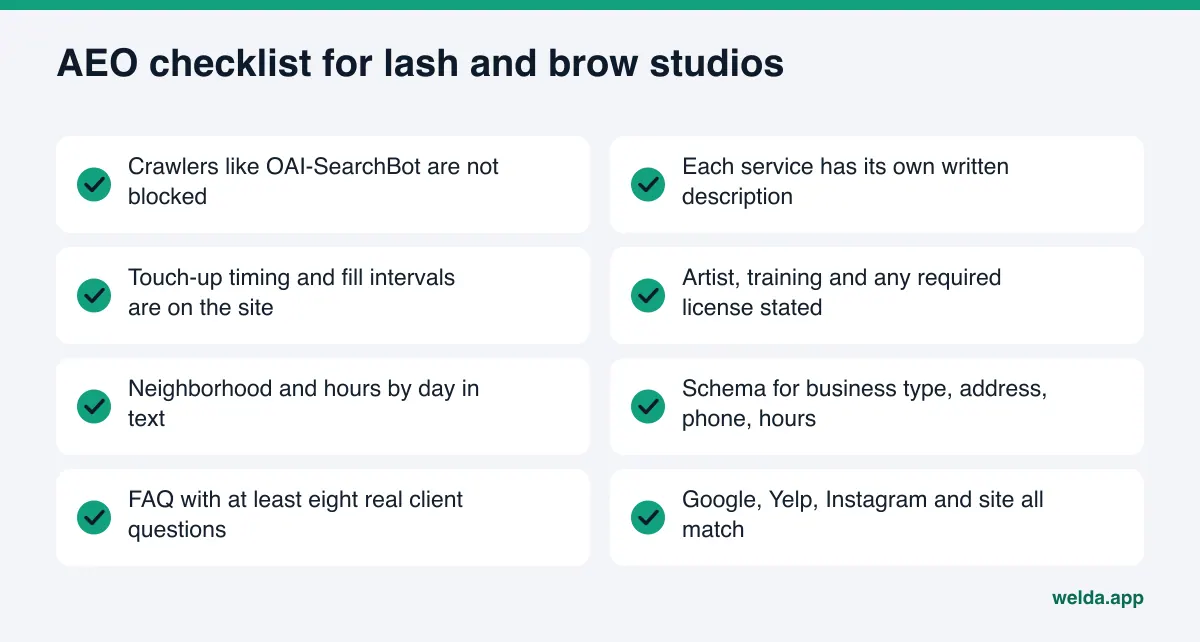
- robots.txt doesn't block OAI-SearchBot or other search crawlers.
- Each service has its own written description, using the names clients search for.
- Appointment length, touch-up timing and fill intervals are on the site.
- The artist's name, experience, training and any required license are stated accurately.
- Address, neighborhood, parking or transit and hours by day are in text.
- Schema marks up business type, address, phone and hours.
- An FAQ answers at least eight real client questions.
- Google Business Profile, Yelp, Instagram and your site match.
- Reviews get short, personal replies; no paid or incentivized reviews.
- No "painless", "guaranteed" or "best in town" claims you can't back up.
Frequently asked questions
I only have Instagram. Can ChatGPT still recommend my studio?
It's possible but harder. AI gets limited information from images. A complete Google Business Profile is the first step; a simple, text-first website is the most reliable place to explain your services and process.
Should I put prices on my site?
Price questions come up often, and studios with no answer can lose out. If you don't want exact prices online, give a range or explain how pricing works. What matters is that your site and profiles don't contradict each other.
Do before-and-after photos help with AI search visibility?
The photo itself helps little. The caption, alt text and a short process note next to it can be read. Adding the service, neighborhood and a line of context makes the photo meaningful to AI.
Will Welda publish PMU content without my approval?
No. Publishing approval always stays with the business. Welda drafts the text, flags risky phrasing and sends it to you. On WordPress sites, content opens as a draft first.
How long until changes show up in AI answers?
New content usually takes weeks to be reflected, and there's no exact timeline. Measuring at regular intervals is more reliable than reading one answer.
Is the Welda dashboard available in the US?
The full dashboard is in early access and opening first in Turkey. The free site analysis works in English today, so you can check your site's readiness now.
Next step: see where your studio stands
AI search visibility for a lash and brow studio comes from well-written service information, consistent profiles and honest trust signals, not one big move. To know where to start, you need to see where you are today. Run the free site analysis to see how AI reads your site, which fixes would move your score the most, and ready-to-use copy suggestions for your homepage. It's free once per site; your results link arrives by email and stays open for 14 days.