What does AEO for laser hair removal clinics actually involve? It means making sure that when someone asks ChatGPT, Gemini, Perplexity or Google's AI features for a laser hair removal clinic near them, your clinic is one of the names in the answer. You get there by answering the real questions patients ask (cost, sessions, skin type, safety, who does the treatment) on your own site, keeping your business details identical everywhere, and measuring which questions you show up for. Nobody can guarantee a spot in an AI answer.
This guide is for owners and managers of laser hair removal clinics and med spas, and for the people who run marketing for multi-location practices. AEO for laser hair removal clinics (answer engine optimization) is a narrower job than general marketing: you are not trying to win a click on a list of ten links, you are trying to be one of the two or three clinics an assistant names when a prospective client asks for a recommendation. If you want a baseline before you start, run the free AI visibility analysis on your site and keep the report next to this guide.
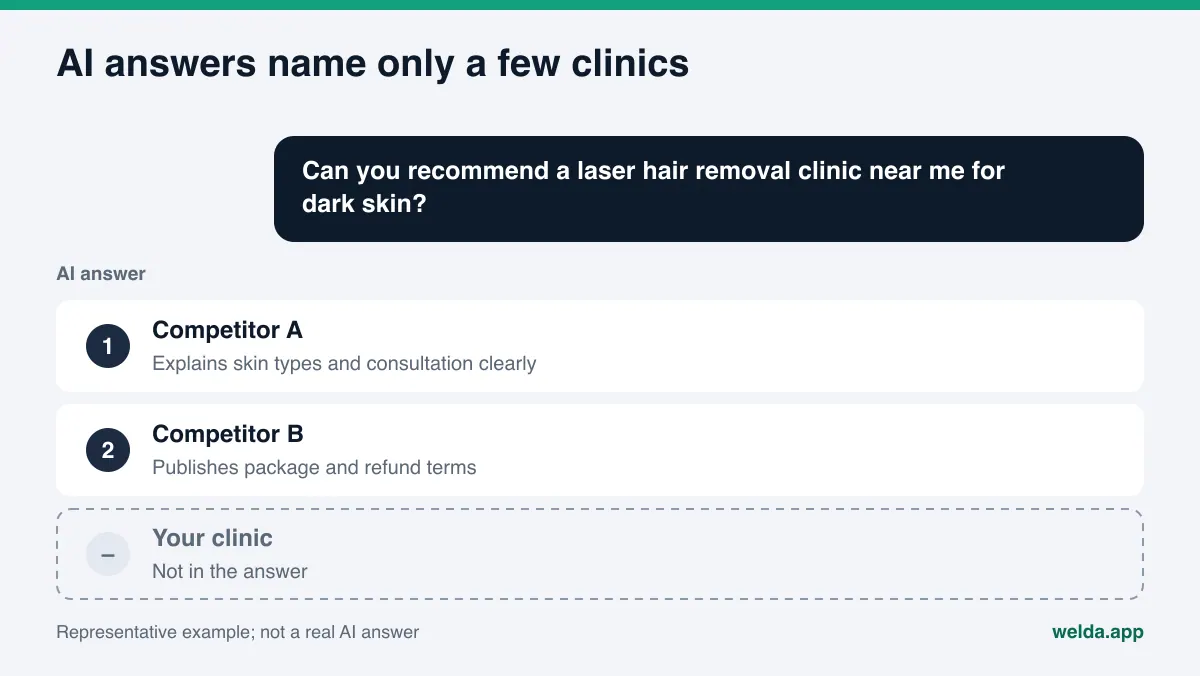
Why AEO matters for laser hair removal clinics
Laser hair removal is a considered purchase. A client commits to a series of sessions over several months, often prepays for a package, and lets someone point a medical-grade device at their skin. People who are about to make that kind of decision do research, and more of that research now happens in a conversation with an AI assistant instead of a page of search results.
That changes what "being found" means. In a traditional search, a clinic in position six still gets seen. In an AI answer, the assistant typically names a few clinics and explains why. If you are not one of them, the client never considers you. Some people call this work GEO (generative engine optimization); in the US the more common term is AEO, and both describe the same goal: being cited and recommended inside AI-generated answers.
Three things make laser hair removal different from, say, a nail salon or a barbershop:
- The questions are detailed. Clients ask about skin tone and hair color, the number of sessions, the time between sessions, whether a package is better than paying per session, and what happens if they move away before finishing.
- It sits close to healthcare. The treatment involves a laser or light device, so safety, side effects and who performs it come up constantly. Claims about results are regulated, and careless wording can mislead.
- Trust drives the decision. Clients read reviews on Google and Yelp, check BBB complaints, and want to know whether a medical professional is involved. An assistant pulls from the same sources.
What clients ask AI assistants before booking
Start from the question, not the keyword. The questions below are typical of what a prospective client might type into an assistant. They are written as examples for this guide, not taken from a measured dataset, and your own list should come from your front desk, your inbox and your consultation notes.
- "Best laser hair removal near me for dark skin"
- "Is laser hair removal worth it compared to waxing?"
- "How many sessions of laser hair removal do I need for underarms?"
- "Laser hair removal package or pay per session, which is better?"
- "Is a doctor or a nurse doing laser hair removal at med spas?"
- "What happens to my prepaid laser package if the clinic closes?"
Notice how many of these are comparison and trust questions. An assistant answering "package or pay per session" will lean on sources that explain terms clearly. If your site says nothing about what a package includes, how unused sessions are handled, or whether packages can be frozen or refunded, the assistant will answer using someone else's page. For a structured way to build your own list, see our guide on how to find the questions customers ask AI.
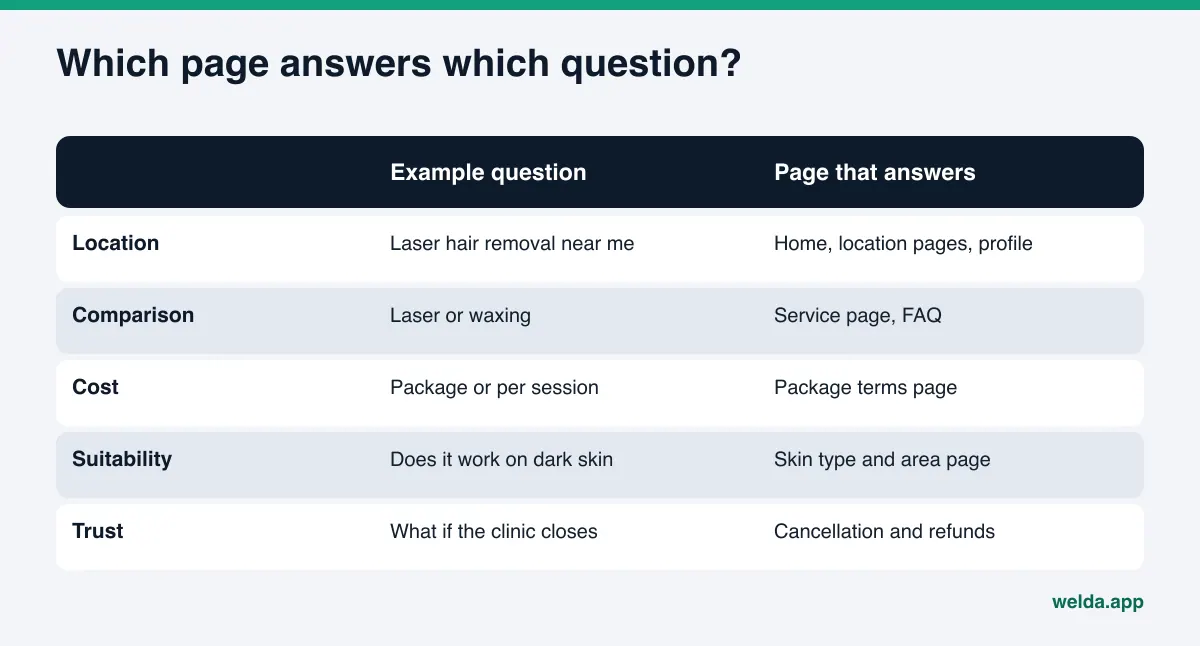
Which page should answer which question?
An assistant looks for the page that answers a question most directly. A single "Services" page with a one-line bullet for laser hair removal cannot answer a question about dark skin or package refunds. Map each question type to a page.
| Question type | Example | Page or section that should answer it |
|---|---|---|
| Location and recommendation | "Laser hair removal near me" | Home page, location pages, Google Business Profile |
| Comparison | "Laser or waxing" | Laser hair removal service page, FAQ |
| Cost and packages | "Package or per session" | Pricing or package terms page |
| Suitability | "Does it work on dark skin" | Skin type and treatment area page, consultation process |
| Trust and refunds | "What if the clinic closes" | Package terms, cancellation and refund section |
| Who performs it | "Is a nurse doing it" | About and team page with roles and credentials |
Most clinics find two gaps right away: written package terms and a clear explanation of who performs treatments and under what supervision. The second one is covered in detail in our piece on about page trust signals for AI.
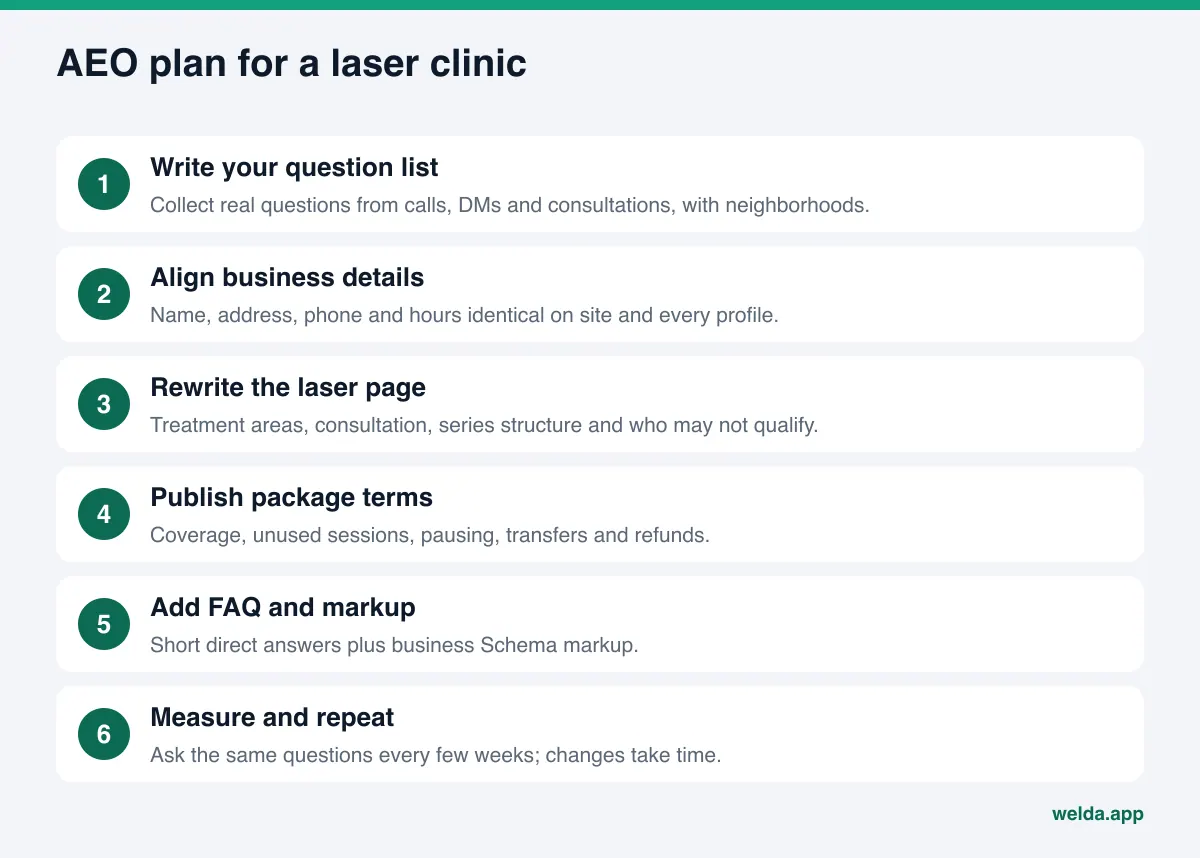
Step by step: an AEO plan for a laser hair removal clinic
The order below is realistic for a small team over a few weeks. Fix the basics first, then add content, then measure.
- Write your question list. Collect 15 to 20 questions from calls, DMs and consultations. Add your city and neighborhoods, the treatment areas you offer (legs, underarms, face, full body) and the comparisons people ask about.
- Make your business details identical everywhere. Name, address, phone, hours and service list should match on your site, Google Business Profile, Yelp, Instagram and any directory you are listed in. If you have several locations, each needs its own page and its own profile.
- Rewrite the laser hair removal page. Explain treatment areas, what happens at the consultation, how a typical series is structured and who may not be a good candidate. Do not promise a fixed number of sessions or a specific result; say plainly that it varies by person.
- Publish your package terms. What a package covers, how unused sessions are handled, whether it can be paused or transferred, and how refunds work. Whether you publish prices is your call, but written terms give an assistant something trustworthy to cite on trust questions.
- Add an FAQ section. Short, direct answers. Answer comparison questions like "laser or waxing" fairly. Clients notice, and balanced pages make better sources.
- Add structured data. Business information markup (Schema) restates your business type, address, hours and services in a form machines read reliably.
- Respond to reviews. Short and personal for positive ones, calm and solution-focused for negative ones. Never mention a client's health details or treatment in a public reply. See review responses for AI visibility for examples.
- Check that AI crawlers can reach your site. If your robots.txt blocks AI crawlers by accident, good pages go unread. Google's documentation on AI features and your website states that no special markup is needed for AI Overviews and AI Mode; normal Search requirements apply.
- Measure, then repeat. Ask the same questions again every few weeks. New content usually takes weeks to show up in AI answers, so do not judge the work after a few days.
Google Business Profile, Yelp and other sources
AI answers draw on more than your website. Google Business Profile, Google Maps reviews, Yelp, BBB, local directories and community forums can all feed an answer. For laser hair removal clinics, these are the fields most often left incomplete:
- Category and services. Your primary category and service list should show laser hair removal clearly. Listing treatment areas as separate services helps with narrow questions like "underarm laser near me".
- Description. Plain and consistent with your site. Describe what you do, where you are and how the consultation works, rather than repeating a promotion.
- Holiday hours. Keep special hours updated. People do ask whether a clinic is open on weekends or holidays.
- Photos. The space, treatment room and waiting area. Avoid photos that show clients' faces or bodies.
- Questions and answers. Answer questions on your listings as the business. An unanswered question invites someone else's answer.
If a directory still lists an old address or a closed location, you will need to follow that site's own correction process. That work is usually manual and stays with you.
Claims, reviews and FTC rules to keep in mind
More pages mean more chances to say something you should not. In the US, advertising claims fall under the FTC Act. The FTC's health products compliance guidance says health-related claims need competent and reliable scientific evidence, and that consumer testimonials alone do not substantiate a claim. The FTC's final rule banning fake reviews and testimonials prohibits buying fake reviews and certain review-suppression practices. Rules on who may perform laser hair removal and under what supervision vary by state; check with your state medical or cosmetology board. None of this is legal advice.
Whatever your state, these phrases are worth removing from your site and profiles:
- "Painless", "permanent results", "hair-free after one session" and similar absolute promises.
- "Best in the city", "number one" or other superiority claims you cannot back up.
- Before-and-after photos without the client's written consent or that are not representative.
- "Safe for every skin type" and other blanket statements; suitability is assessed per person.
- Promotional prices that look permanent when they are not.
Our article on fake reviews rules and AI visibility explains why bought or gated reviews are both a legal risk and a visibility risk.
How Welda handles AEO for a laser hair removal clinic
Welda is software that measures where a business appears in AI answers and prepares the fixes on the business's behalf. For a laser hair removal clinic, three parts matter most.
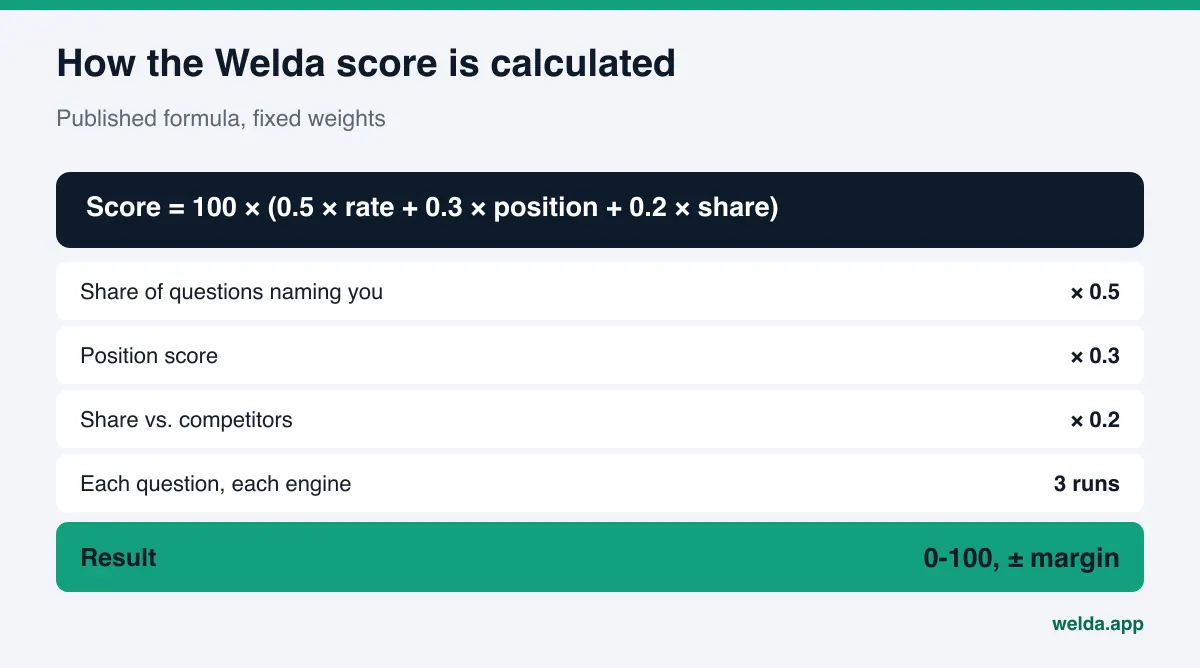
Question-by-question measurement. In the Welda panel, the questions your clients would ask, for example "laser hair removal near me for dark skin" or "laser or waxing for bikini area", are sent to ChatGPT, Gemini, Perplexity and Google AI three times each. The questions view shows, for every question, whether your clinic is named, in what position, and which sources the answer leaned on. A typical clinic sees an uneven picture: named on neighborhood questions, absent on package and safety questions. That tells you which page to work on first. The score behind it uses a published formula, shown below, with an error margin from the spread of the three runs.
Approval queue for health-adjacent content. In health-related sectors, Welda never publishes automatically. The draft laser hair removal page, FAQ answers, profile descriptions and review replies wait in your to-do list for approval. When Welda does not know something, such as which device you use, who performs treatments or your refund terms, it leaves the field empty and asks you instead of guessing. You answer once, and the answer flows into every draft that needs it. Client and patient data is not sent to the AI.
Compliance check before publishing. Every draft is scanned for patterns such as guarantees, superiority claims, price statements and anything that reads like a diagnosis. Flagged sentences are yours to fix or remove. The check is a reminder, not legal advice, and it has not been reviewed by legal counsel.
On WordPress sites, Welda connects through a separate Editor user and an application password, so approved content opens as a draft on your site and you hit publish. On other platforms you get a ready-made package to apply yourself. Content always lives on your own site. A competitors view shows which clinic is ahead on which topic and which source it is winning from.
What stays with you: the accuracy of your consultation process, device and staff details, the decision on how to respond to a negative review, complaint threads on third-party sites, directory accounts and the final approval of every text.
Example scenario: a two-location laser clinic
This is an example, not a real clinic or result. Picture a laser hair removal clinic with two locations in the same metro area. Its website is a single page with a short intro, a photo gallery and a phone number. Its Google Business Profiles list different hours for the two locations, and only one address appears on the site.
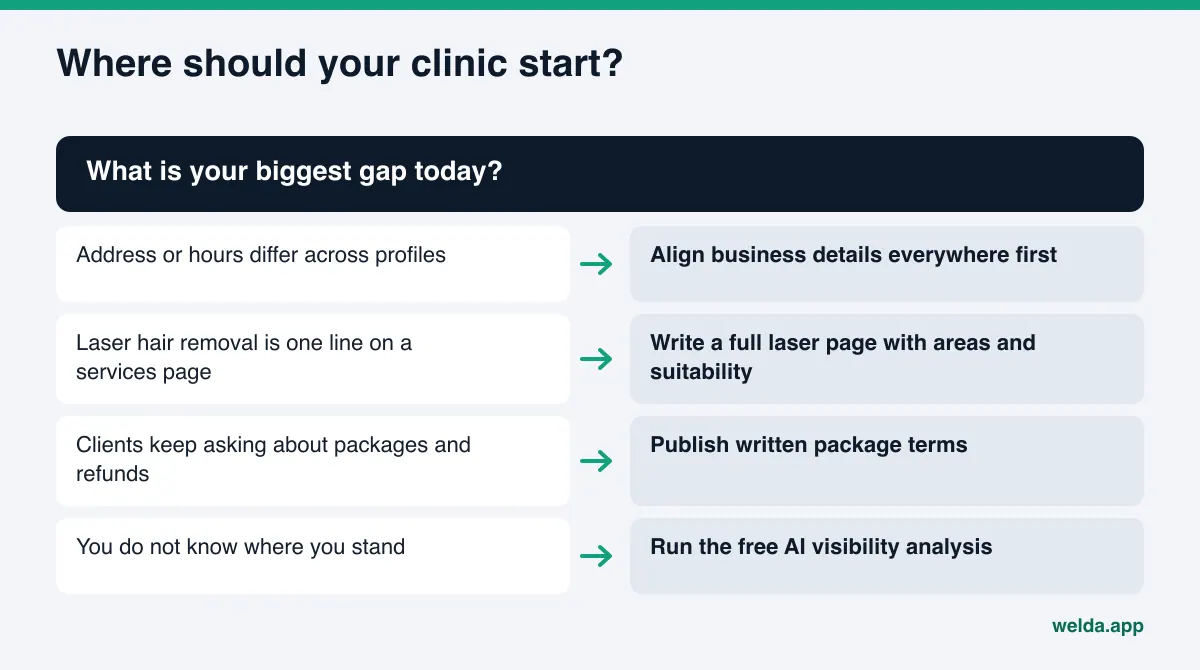
The free analysis would likely flag missing business markup, no FAQ section, services listed in one line and the second address missing from the site. Its simulation ranks which fixes would raise the score most. A sensible order: align both locations' details everywhere and give each a page, then expand the laser page with treatment areas and suitability, then publish package terms, then add FAQs. Once in the panel, question tracking would show whether the clinic is weaker on neighborhood questions or comparison questions. For businesses with several locations, our guide to AEO for franchises covers per-location pages and profiles in more detail.
Limits: what Welda does not do
- It does not guarantee rankings or a mention in ChatGPT. Answers change between engines and from day to day.
- It does not invent facts. Device, staff, session length and refund terms come from you.
- It does not publish without approval. In health-related sectors, every piece of content goes through you.
- It does not create fake reviews or suggest buying them.
- It does not remove negative reviews; complaint threads, directory accounts and press work stay with you.
- It does not give medical or legal opinions.
A note on availability: the Welda panel is in early access and is opening first to businesses in Turkey. Regular four-engine measurement is being added during early access, and sample screens in the panel use representative data. What anyone can use today is the free site analysis, which works in English. Pricing is discussed in the early access conversation.
Checklist: AEO for laser hair removal clinics
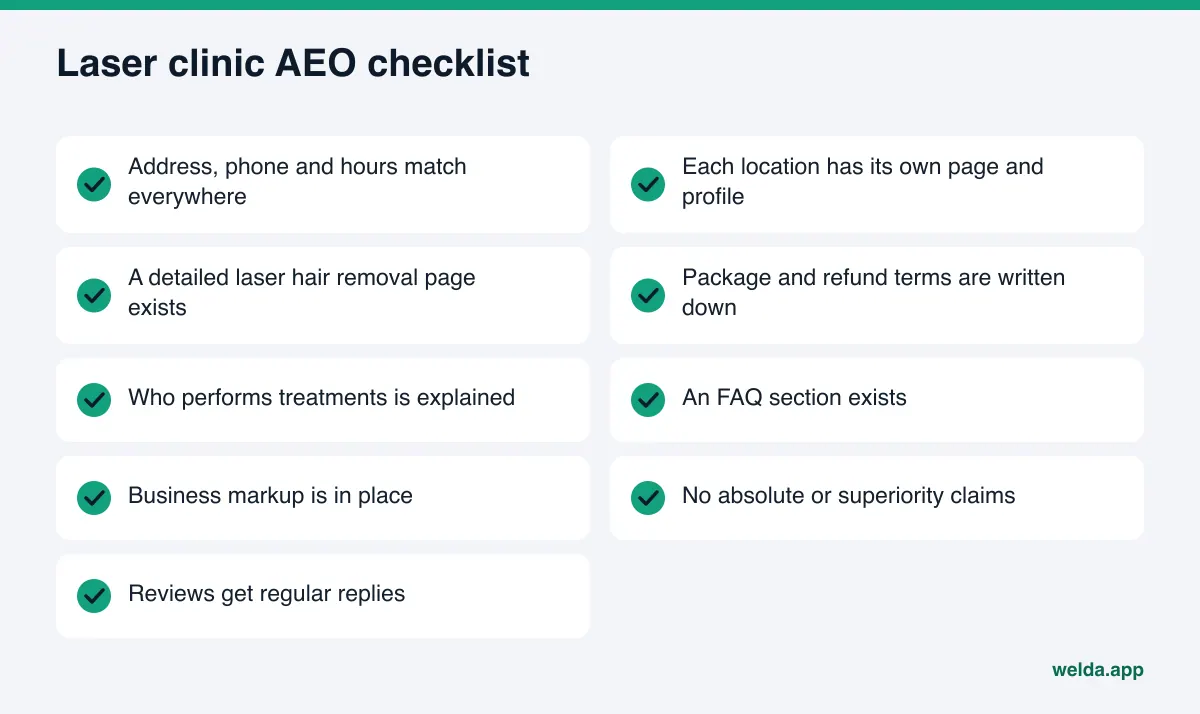
Open your site and profiles side by side and work through the list. Every "no" is a task.
| Check | Why it matters |
|---|---|
| Address, phone and hours match everywhere | Conflicting details can make an assistant hesitant to recommend you |
| Each location has its own page and profile | The right location can be named on neighborhood questions |
| A detailed laser hair removal page exists | Comparison and suitability questions are answered from it |
| Package and refund terms are written down | Gives a citable source for trust questions |
| Who performs treatments is explained | A trust signal clients ask about directly |
| An FAQ section exists | Short, direct answers are easy to cite |
| Business markup is in place | Helps machines read your business type and address |
| Absolute and superiority claims are removed | Regulatory and trust risk |
| Reviews get regular replies | Reviews are among the sources AI draws on |
| robots.txt allows AI crawlers | Blocked pages are not read |
Frequently asked questions
Why doesn't my laser hair removal clinic show up in ChatGPT?
The usual reasons: no detailed laser page, inconsistent address or hours across profiles, few or unanswered reviews, or a robots.txt that blocks AI crawlers. The free analysis surfaces most of these in one report.
Should I publish prices on my website?
That is a business decision. Even without prices, writing down what a package includes and how refunds work answers the trust questions clients and assistants ask. If you publish prices, keep them current and state when a promotion ends.
Can I use before-and-after photos?
Get written consent, make sure the photos are representative and avoid implying a guaranteed result. Your state's rules and FTC guidance on claims apply. Ask your counsel if unsure; this is not legal advice.
How long does it take for AEO work to show up?
New content and corrected details usually take weeks to be reflected in AI answers, and the timing varies by engine and source. Regular measurement lets you see the change instead of guessing.
Is AEO different from local SEO for a clinic?
They overlap. Consistent business details and good reviews help both. AEO adds a focus on answering full questions clearly and on measuring whether assistants actually name you.
Will Welda publish content for me?
No. In health-related sectors Welda does not publish automatically; every draft comes to you for approval. On WordPress, approved content opens as a draft and you decide when it goes live.
Start with the free AI visibility analysis
The fastest way to start AEO for your laser hair removal clinic is to see where you stand today. The free analysis reads your home page and a few inner pages, gives you a score out of 100 split into technical and content, and explains each gap: what was found, why it matters and how to fix it. You also get suggested copy for your home page, a competitor comparison, a ready-to-install fix package including business markup, and a simulation of which fixes would move the score most. It also asks an AI assistant with web search five questions your clients might ask and checks whether your clinic is named. The analysis is free once per site, and the results link arrives by email and stays open for 14 days. Run your free AI visibility analysis and use the report to pick your first task from the checklist above.