What does AEO for tattoo shops actually involve? When ChatGPT, Gemini, Perplexity, or Google's AI Overviews recommend a tattoo shop, they lean on text they can read: your website, your Google Business Profile, and the pages that mention you. That text needs to say which styles you tattoo, who your artists are, where you are, how booking and deposits work, and how you handle hygiene. When that information is clear and consistent, your odds of being named go up. Nobody can guarantee a specific position or a recommendation.
This guide is for street shops, private studios, and shops that offer piercing alongside tattooing. The question is simple: when someone types "who does good fine line tattoos in Williamsburg" or "I need a cover-up artist in Austin, who should I talk to," does the AI assistant say your name? If not, why not, and what should you fix first? We cover the problem, a step-by-step plan, how Welda handles the work, and what it does not do. If you want to see where your site stands today, start with the free AI visibility analysis.
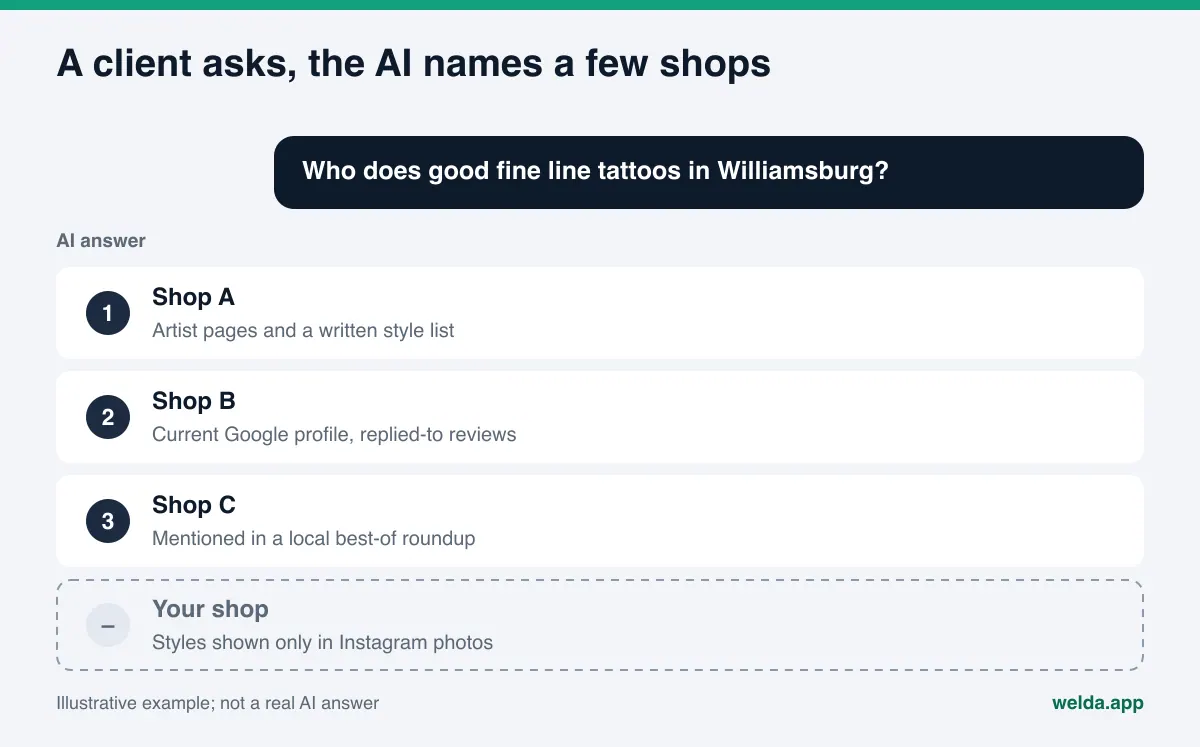
Why AEO for tattoo shops matters now
AEO stands for answer engine optimization: making sure AI assistants that answer questions directly can find, understand, and cite your business. You may also see the term GEO (generative engine optimization); it describes the same work. For a tattoo shop, AEO is mostly about one thing: turning what you tell clients in a consultation into text that a machine can read.
Getting tattooed is a considered decision. It is permanent and visible, and clients take their time. They browse portfolios, read reviews, and increasingly ask an AI assistant to narrow the field. A client can now describe the style, the placement, the neighborhood, and the worry in one sentence. The assistant answers with a short list of shops or artists. If you are not on that list, you are not part of the comparison, no matter how strong your Instagram grid is.
Tattoo shops face five specific hurdles in AI search visibility:
- The portfolio is visual. Shops show their work in photos and reels. An AI assistant cannot reliably infer "this shop does black and gray realism, by appointment, in East Austin" from a photo of a forearm piece. If it is not in the text, it is usually not in the answer.
- Clients look for artists, not shops. Someone who wants a portrait or fine line script wants a specific hand. If your site does not list artists, their styles, and their days in the shop, the assistant cannot connect an artist's reputation to your address.
- Style names are fuzzy. Fine line, American traditional, neo-traditional, blackwork, dotwork, micro-realism, Japanese, lettering, cover-ups. Clients use these terms loosely. If you do not state what you do and what you do not, the assistant guesses or skips you.
- Pricing is not a single number. Price depends on size, placement, detail, and time. Many shops therefore say nothing about pricing at all. Explaining how pricing works, whether there is a shop minimum, and how deposits work answers the question without listing figures.
- Trust decides first tattoos. For a first-timer, sterilization, single-use needles, age policy, and aftercare matter as much as style. Shops that never write this down are weak on "safe tattoo shop near me" type questions.
What clients ask AI assistants about tattoos
Tattoo questions cluster around a few intents. The questions below are examples we wrote to illustrate the pattern; they are not measured search data. They show which information each question depends on.
| Intent | Example question | What the answer needs |
|---|---|---|
| Style and location | "Best fine line tattoo shop in Williamsburg?" | A written style list, address, neighborhood name |
| Artist | "Who is a good black and gray portrait artist in Chicago?" | Artist pages with styles and described work |
| Cover-ups and fixes | "Where can I get an old tattoo covered up in Austin?" | A cover-up page, the consult process, honest limits |
| First tattoo and safety | "Clean, beginner-friendly tattoo shop near me?" | Hygiene practices, aftercare, reviews |
| Process and cost | "Do tattoo shops charge a deposit for custom work?" | How pricing works, deposit and cancellation rules |
| Timing | "Any shops doing walk-ins or flash this Saturday?" | Hours, walk-in policy, flash day announcements |
Each row maps to something that should be written somewhere on your site. An assistant can only match your shop to the right question when it finds that piece of information.
Which signals tell AI who your shop is?
AI assistants build an answer about a local business from several sources at once: the business website, Google Business Profile and Maps, social profiles, review sites such as Yelp, local roundups, and discussion threads. What matters for a tattoo shop is that those sources agree. If your site says one neighborhood, Google says another, and Instagram lists an old phone number, the assistant has no clear version of you to repeat.
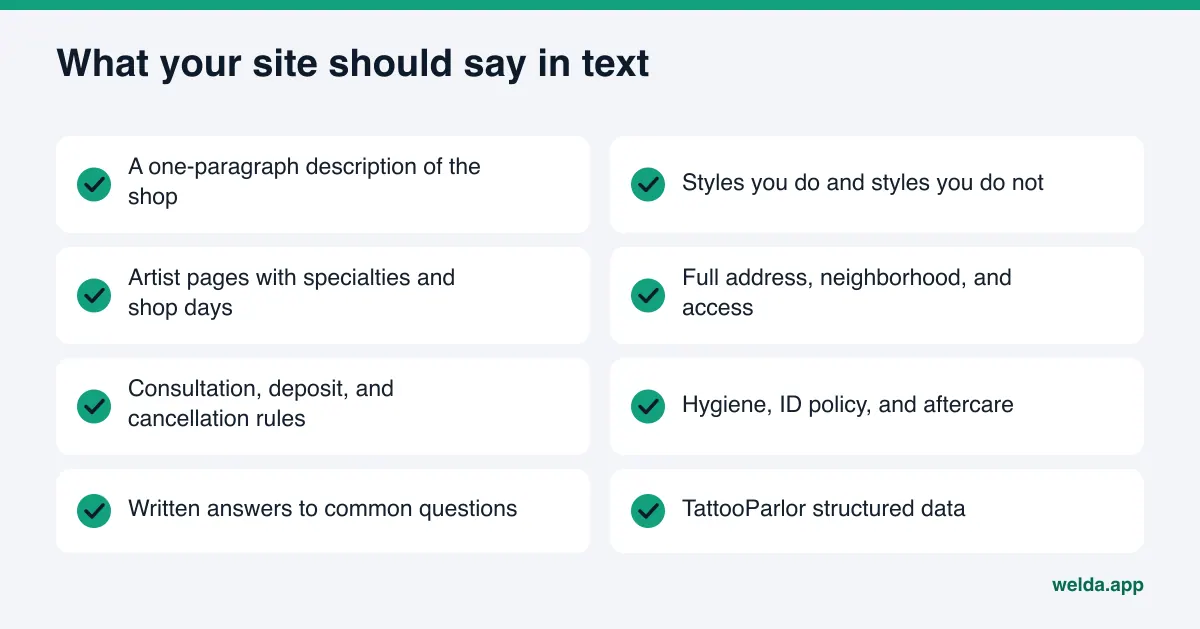
Here is what your site should contain, roughly in order of impact:
- A one-paragraph description. Something like "Appointment-only studio in East Austin with three artists focused on fine line, blackwork, and cover-ups." This is the sentence an assistant is most likely to paraphrase.
- A style list. What you tattoo and what you do not. "We do not do color realism" is useful information; it filters out the wrong clients.
- Artist pages. Name, specialties, preferred kinds of projects, days in the shop, and booking route. For guest artists, the exact dates.
- Address and access. Full address, neighborhood, nearby landmarks, parking or transit, and which door to use.
- Process. How consultations work, how long designs take, deposits, rescheduling and cancellation, what affects session length.
- Trust information. Sterilization and single-use supplies, age and ID policy, aftercare instructions, and your state or local license if you choose to display it.
- FAQ. Written answers to the questions you hear at the counter every day.
- Structured data. Schema markup that states the same facts in machine-readable form.
Step-by-step AEO for tattoo shops
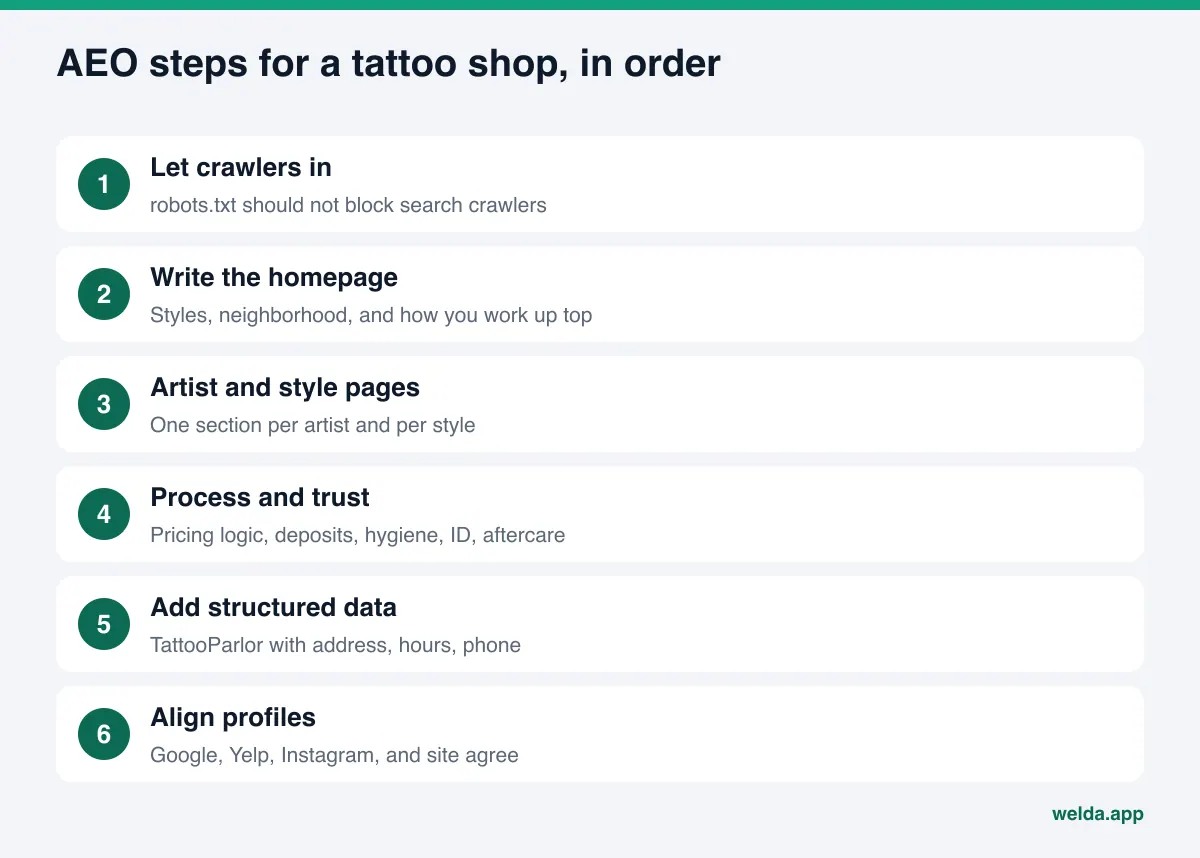
Work through these in order. Order matters: if crawlers cannot reach your site, new pages do nothing, and if your profiles disagree, new copy adds to the confusion.
1. Make sure AI crawlers can reach your site
Your robots.txt file tells bots what they may read. Themes and security plugins sometimes block AI crawlers without anyone noticing. OpenAI says ChatGPT's search features rely on a crawler called OAI-SearchBot, separate from GPTBot, which is used for model training. You can block training crawlers and still allow search crawlers. The point is to make that choice on purpose.
2. Put real text on the homepage
Many shop homepages are a full-screen photo, a logo, and a "Book now" button. That looks good to people and says almost nothing to an AI system. Add two or three sentences near the top that state what you do, where, and how you work. Make the page title and meta description say the same thing: "Fine Line and Blackwork Tattoo Studio in East Austin" rather than just the shop name.
3. Give every artist and every style a home
Because clients search for artists, artist pages are the most valuable content a tattoo shop can publish. Each page should name the artist, list their styles, describe the kind of work they like, and explain how to book them. Add short captions under portfolio images: "Black and gray lion, outer forearm, two sessions." Use the same wording in image file names and alt text. Do the same for style pages. A cover-up page should explain honestly what can be covered, when laser lightening may come first, and why a consultation is required.
4. Explain process and pricing logic
You do not have to publish prices. A paragraph like "Pricing depends on size, placement, detail, and time. We quote after a consultation. Custom designs require a deposit, which applies to your final session and is refundable if you reschedule with enough notice" answers the most common question clients and assistants have. If you have a shop minimum, say so.
5. Publish hygiene, age, and aftercare information
Write down what you actually do: which supplies are single-use, how equipment is sterilized, your ID and age policy, and aftercare steps. Tattoo regulation in the US is set at the state and often the county or city level, so describe your own practice and follow your local health department rather than making general legal claims. Avoid promises you cannot back up, such as "100% safe," "painless," or "no scarring." For medical questions such as allergies, medications, or skin conditions, a sentence pointing clients to their doctor is enough.
6. Answer the questions people actually ask
Collect the consultation questions you hear daily into one FAQ page: which placements hurt least for a first tattoo, how long healing takes, when you can swim or work out, whether walk-ins are welcome, whether clients can bring their own design, whether touch-ups are free. Keep each answer to two or three sentences. These questions closely match what people type into AI assistants.
7. Add structured data
Schema.org has a dedicated type for this business: TattooParlor. Use it to mark up your name, address, phone, hours, geo coordinates, social profiles, and map link. The markup must match what the page says; never put information in code that is not visible on the page.
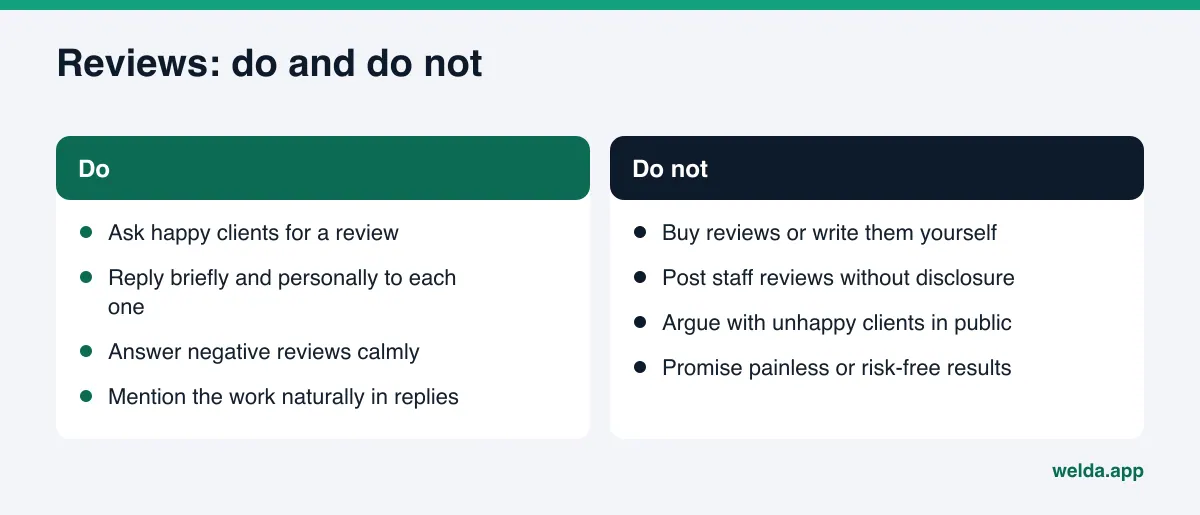
8. Align profiles and handle reviews honestly
Your Google Business Profile, Yelp listing, Instagram bio, and website should show the same address, phone, hours, and category. When hours change, change them everywhere; our guide on keeping business hours accurate for AI walks through it. Ask happy clients for reviews and reply to each one briefly and personally. Mentioning the work in your reply ("glad the fine line script healed well") adds useful context. Do not buy reviews or write them yourself: the FTC's rule on consumer reviews and testimonials, in effect since October 2024, prohibits fake reviews, bought reviews, and undisclosed reviews written by owners or managers.
Is an Instagram portfolio enough for AI search visibility?
For most shops Instagram is the main storefront, and that is reasonable; nobody books without seeing the work. But for AI search visibility it is not enough on its own. Posts are mostly visual, captions are short and hashtag-heavy, and address and process details are often missing. How much social content an AI assistant can access also varies by platform and assistant.
The answer is not to leave Instagram. It is to give it a text counterpart that assistants can read. The comparison below puts the two approaches side by side.
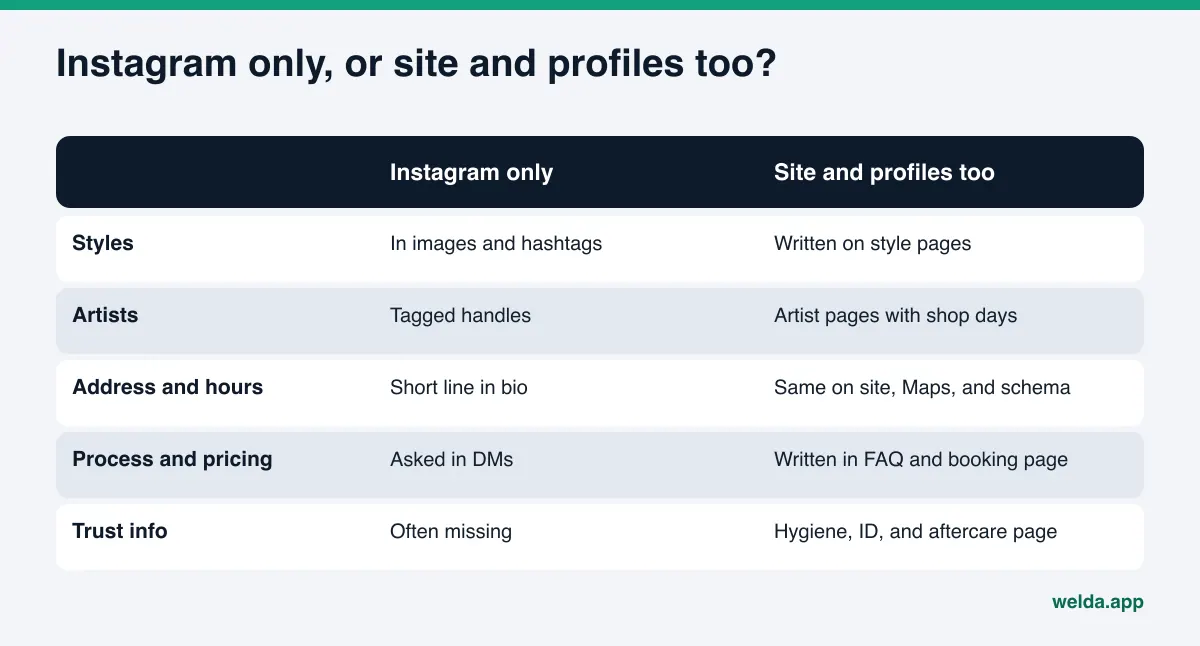
If you have no website at all, the first step is a complete Google Business Profile and a simple one-page site. Our article on AI visibility without a website covers that starting point. If you do have a site, the main job is to repeat what lives on Instagram in permanent, written form: a caption for each key series, a page for each artist, a paragraph for each style.
Look closely at the shops that are named ahead of you. Do they have artist pages? Clearer hygiene information? A mention in a local "best of" roundup? Our guide to AI competitor analysis shows how to ask that question systematically. The pattern is similar to other appointment-driven businesses; see how nail salons get recommended by ChatGPT for a close parallel.
How Welda handles AEO for a tattoo shop
Welda is software that measures where a business shows up in AI answers and helps fill the gaps, with the owner approving what gets published. Three parts matter most for a tattoo shop.
The free site analysis: what your site tells AI today
The analysis reads your homepage and a few inner pages (services, pricing, about, contact) the way Google and AI systems do. For tattoo shops, the usual findings are: a homepage with no real text, styles that exist only in images, no business schema at all, an address or phone number embedded in an image, no FAQ section, and Instagram and Maps profiles that are not linked from the site. For each issue you see what was found, why it matters, and how to fix it. You also get suggested homepage copy (title, meta description, main heading, intro paragraph, and FAQ) to edit into your own voice, plus a simulation that shows which fix is likely to move your score most.
The analysis also asks five client-style questions to an AI assistant that can search the web and checks whether your shop's name appears in the answers. That is a one-time snapshot, not ongoing tracking, but it gives you a first answer to "am I being mentioned at all?" Our guide on how to read your AI visibility report explains each section.
Question tracking: which style and neighborhood questions mention you
In the Welda dashboard, the questions your clients are likely to ask are sent to ChatGPT, Gemini, Perplexity, and Google AI three times each. For a tattoo shop, the question set is built around style, artist, neighborhood, and trust: fine line in your area, cover-up specialists, beginner-friendly shops. The questions view shows, question by question, which engine mentioned you and in what position. If you appear for minimalist tattoo questions but never for cover-ups, the gap points straight at a missing cover-up page.
The to-do list: it asks what it does not know, then drafts the copy
Everything the measurement surfaces lands in one list. Welda does not invent facts. If your site does not say which days an artist works, what your deposit policy is, or your age policy, the list asks you. You answer once, and the answer flows into every draft that needs it. Profile descriptions and review replies arrive as ready-to-edit text.
On WordPress sites, Welda connects through a separate Editor user with an application password, with no code to install; new pages open on your site as drafts and go live only when you approve them. On other platforms, Welda hands you a ready-made package and the changes are applied by hand. Google Business Profile, Instagram, and Facebook can be connected; if they are not, the task appears as a manual item. Your content always stays on your own site.
The dashboard also includes competitor and source views, before-and-after comparison, and a one-page monthly report. A compliance check flags pricing claims, guarantees, and superiority claims such as "best in town" before publishing; it is not legal advice and has not been reviewed by legal counsel.
To be clear about where things stand: the Welda dashboard is in early access and opening first in Turkey. Ongoing four-engine tracking is being added during early access, and the sample screens use illustrative data. The free analysis works in English today and is the part anyone can use now. Pricing is discussed during the early access conversation.
Limits: what Welda does not do for tattoo shops
Knowing which work sits with the software and which stays with you sets the right expectations.
- No ranking guarantee. AI answers vary; the same question can produce different answers at different times. Welda measures each question three times and shows a margin of error for that reason.
- No made-up facts. Artist experience, ink brands, sterilization method: Welda asks rather than guesses.
- No fake reviews. It drafts review requests and replies; it never writes reviews on behalf of clients.
- No generated portfolio. Tattoo photos are your work and should come from your shop. Welda can suggest captions and alt text for existing images; it does not create images.
- Negative reviews, directory listings, and press stay with you. Welda prepares reply drafts and lists; sending and relationship-building are yours.
- No decisions about client photos. Posting a client's tattoo involves their consent and privacy. Getting and documenting that permission is your responsibility. This article is not legal advice.
- Results take time. A new artist page or FAQ usually takes weeks to show up in AI answers, if it does.
Where to start: a decision guide and checklist
Every shop starts from a different place. The decision chart below helps you pick the first task based on where you are today.
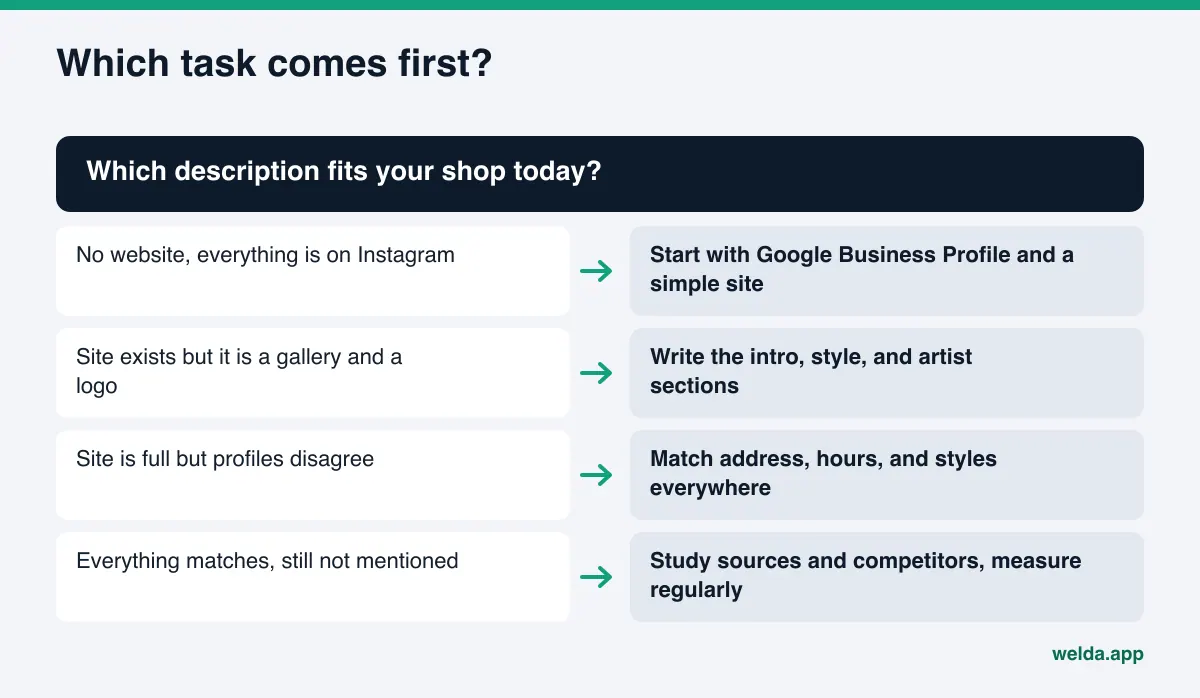
Use this table as a self-audit. Mark each row "yes" or "no"; every "no" is a task.
| Check | Where to look | Why it matters |
|---|---|---|
| Search crawlers are not blocked | robots.txt | Blocked crawlers mean unread content |
| Homepage describes the shop in text | Top of the homepage | The first thing an assistant summarizes |
| Styles are listed in text | Services or styles page | Style questions are matched on this |
| Each artist has a page | Artists page | Links artist reputation to your shop |
| Process and pricing logic are written | Booking page or FAQ | Answers the most common question |
| Hygiene, ID, and aftercare are published | FAQ or dedicated page | First-tattoo and safety questions |
| TattooParlor schema is in place | Page source | Address, hours, phone become unambiguous |
| Profiles match the site | Google Business Profile, Yelp, Instagram | Conflicting details erode trust |
Frequently asked questions
Is AEO for tattoo shops different from regular SEO?
The foundations overlap: a crawlable site, clear titles, structured data. The difference is that an AI assistant answers with a handful of names instead of ten blue links. That makes it even more important to write style, artist, and neighborhood details as plain sentences.
Will AI skip my shop if I do not post prices?
Listing prices is not required. Explaining how pricing works, your deposit and cancellation rules, and how consultations happen answers most of what clients ask. If you have a shop minimum, stating it helps.
How should we handle guest artists?
Give each guest artist a short page or announcement with their name, style, and exact dates. Update or remove it when they leave; outdated dates in AI answers create the wrong expectations.
We also pierce. Do we need a separate page?
Yes. Piercing questions differ from tattoo questions: placements, jewelry materials, healing time, age rules. A separate page lets you match both sets of questions.
Does Welda use my tattoo photos?
Welda does not create images and does not publish your photos on its own. It can suggest captions and alt text for images you already have; publishing depends on your approval.
How fast will I see results?
New pages usually take weeks to show up in AI answers, and nothing is guaranteed. The free analysis shows where you stand today; ongoing measurement in the dashboard lets you track change over time.
What do I need for the free analysis?
Your website address plus email and phone verification. It is free once per site; the results link arrives by email and stays open for 14 days.
See where your shop stands today
AEO for tattoo shops comes down to writing down what you already say in every consultation: your styles, your artists, your location, your process, and how you keep clients safe. When that information is clear and consistent across your site and profiles, AI assistants have something solid to repeat.
To see what your site tells AI right now, run the free AI visibility analysis. The report lists what is missing, suggests homepage copy, and shows which fix to tackle first.