Can you get AI visibility without a website? Partly. Without a site, ChatGPT, Gemini, Perplexity and Google's AI Overviews learn about you from your Google Business Profile, map listings, Yelp, social accounts, directories and reviews. If those sources are complete and agree with each other, you can show up for simple local questions. But when there is no page where you describe your services, service area and policies in your own words, AI answers can only repeat what other people wrote about you.
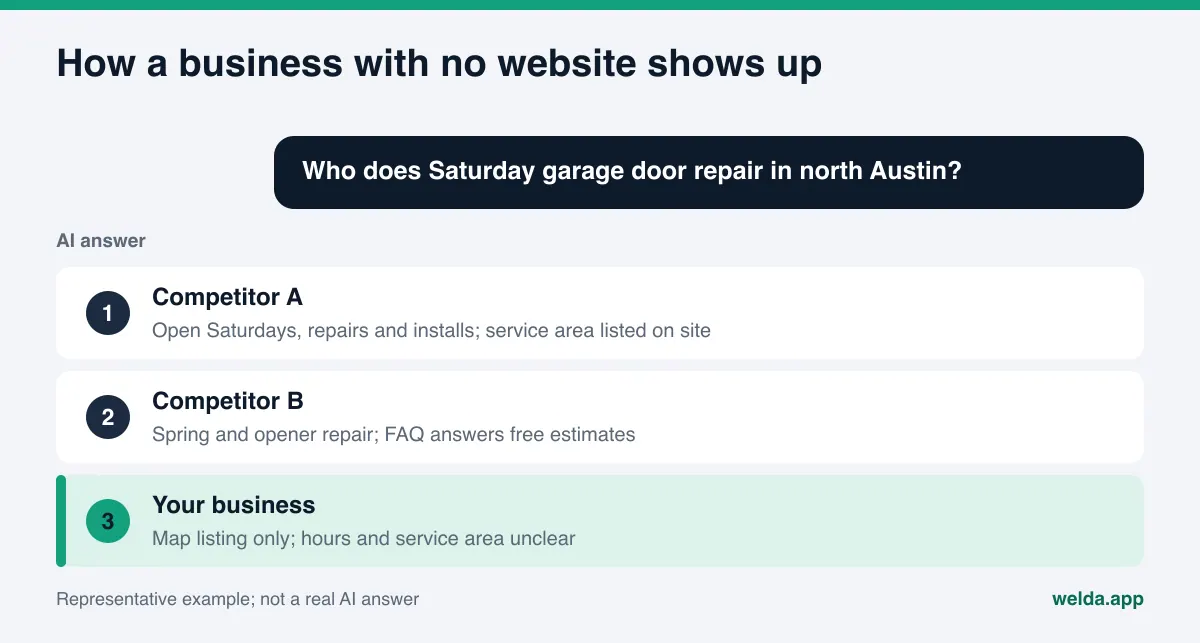
Why AI visibility without a website is its own problem
Plenty of small businesses in the US run without a website. A barber who books through text messages, a food truck that posts its location on Instagram, a handyman who gets jobs from Nextdoor and word of mouth, a home baker with a Facebook page. For years that worked well enough. Someone searched, saw the map pack, tapped the listing and called.
AI search changes the path. Customers now ask an assistant things like "Who does same-day garage door repair in north Austin?" or "Find me a quiet brunch spot in Uptown Dallas that is good with toddlers." The assistant reads several sources, writes a paragraph and names two or three businesses. To land in that paragraph, the assistant needs clear, current and consistent information about you.
That is the core of AEO (answer engine optimization): making sure answer engines describe your business accurately and mention it when it fits the question. You will also see the term GEO, generative engine optimization, used for the same idea. Most AEO advice assumes you have a website to optimize. If you don't, the work looks different.
A business with a website has one place where it speaks for itself: what it does, where it works, when it is open, what customers usually ask. A business without one lets other people do the talking. A few lines in a Google Business Profile, a short Instagram bio, a half-finished directory listing, a two-year-old Yelp review. The assistant stitches you together from those fragments.
So AI visibility without a website really splits into two questions. First, how do you clean up the sources you already have? Second, at what point can you no longer move forward without a page of your own? This guide covers both. If you already have even a single-page site, the free site analysis shows whether AI assistants can read it.
Where AI finds information about a business with no website
AI assistants that search the web read pages to build an answer. For a business without a site, those pages all belong to someone else. The table below lists the sources that most often describe small US businesses and what each one tells an assistant.
| Source | What it tells AI | Who controls it |
|---|---|---|
| Google Business Profile | Name, category, address, phone, hours, description, reviews, photos | Mostly you; the public can suggest edits |
| Apple Business Connect | Name, address, hours and details shown in Apple Maps | You, once you claim the place card |
| Bing Places | Listing data used across Microsoft's search products | You, once claimed |
| Yelp | Category, hours, detailed reviews, owner responses | Reviews belong to customers; the business page and responses are yours |
| Facebook and Instagram | Short description, contact details, services mentioned in posts | You |
| Angi, BBB, Nextdoor, trade directories | Service categories, service area, complaints and responses | Shared; profile is yours, ratings and complaints are not |
| Reddit and local forums | Threads where people recommend or warn about you | The people posting |
Notice the pattern. The fields you control are short and templated. A Google Business Profile description has a character limit, and an Instagram bio is even shorter. The long, detailed descriptions of your business mostly live in places you don't control: Yelp reviews, Reddit threads, BBB complaints. Assistants learn a lot about you from exactly those places.
We cover two of these channels in more depth: Bing Places for ChatGPT visibility and how Reddit shows up in AI answers.
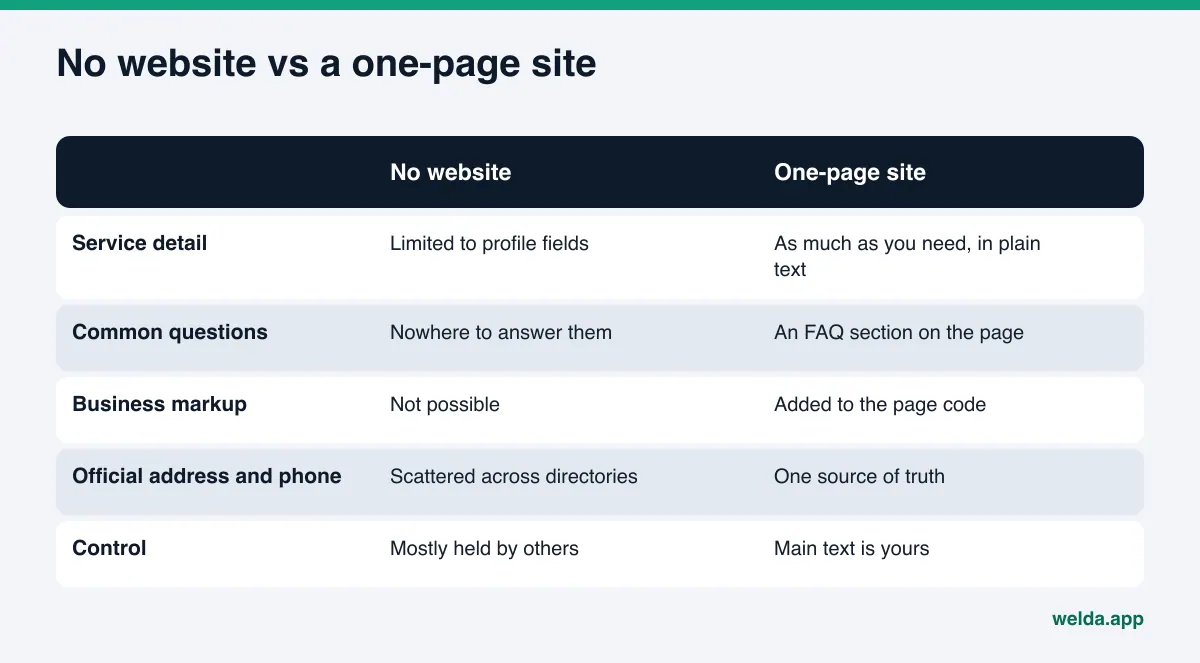
What you cannot do for AI search without a website
A business without a site can still appear in AI answers. Some things, though, are impossible or very hard without a page of your own. Knowing them tells you where your effort pays off.
- You cannot describe your services in detail. "We fix HVAC" and "We repair and maintain heat pumps and gas furnaces in Round Rock, Pflugerville and north Austin, with Saturday appointments" are very different sentences. The second one answers a customer question directly. Profile fields rarely leave room for that.
- You cannot answer common questions. "Do you take walk-ins?", "Are you dog-friendly?", "Do you offer free estimates?" Assistants get these questions constantly. Without a page where you answer them, the assistant guesses or skips you.
- You cannot add structured data. Business markup such as schema.org LocalBusiness lives in the code of a web page. No page, no markup.
- There is no single source of truth. If your address or phone number differs across directories, nothing official shows which one is right. The assistant has to pick between conflicting data.
- Your name can get confused with someone else's. If another business shares your name in a nearby town and it has a website, an assistant may blend the two or mention them instead of you.
- You depend on platforms you don't own. If a social account gets locked or a platform changes its rules, a big part of what exists about you online can disappear at once.
None of this means a website is mandatory. A neighborhood taco spot with a well-kept Google Business Profile and actively answered Yelp reviews can show up for "good lunch near me." But for detailed questions like "taqueria in East Austin with vegan options and outdoor seating," a competitor with its own page usually gets described better.
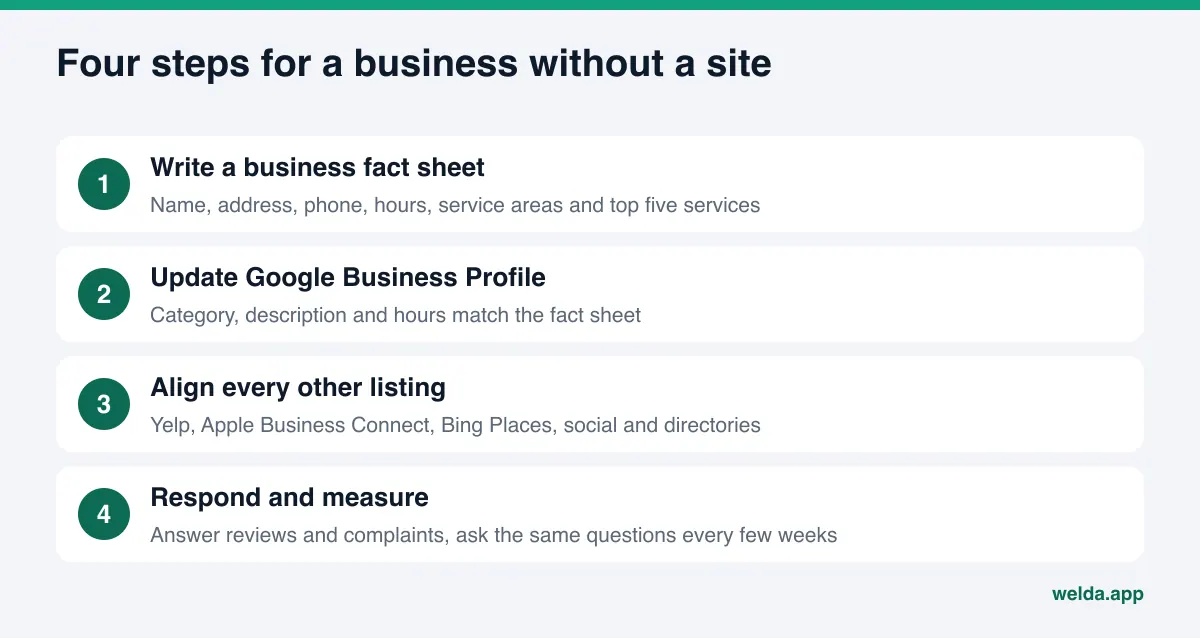
How to build AI visibility without a website, step by step
These steps use only the sources you already have. Order matters: first you settle on one version of the truth, then you push that version everywhere.
- Write one business fact sheet. Put your exact business name, full address (or service area if you don't serve customers at a storefront), phone number, hours, the areas you serve and your top five services into a single document. From now on, every listing uses this exact wording.
- Update your Google Business Profile to match. Check your primary category; it should name the job customers ask about. Write the description in plain sentences that cover what you do and where. Keep hours current, including holiday hours.
- Claim Apple Business Connect and Bing Places. Many iPhone users see Apple Maps data, and some AI assistants draw on Bing data. Claiming both takes little effort and widens the set of sources that agree with you.
- Align Yelp, Facebook and Instagram. Use the same name, phone number and hours. Write your Yelp business description and Facebook "About" section from the fact sheet. Keep the important facts in text fields, not only in images or stories, because it is unclear how much assistants read from visual content.
- Find and fix directory listings. Search your business name and phone number, list every directory that shows up (Angi, BBB, trade associations, local chambers) and correct outdated data. Our guide to NAP consistency for AI search explains why this matters so much.
- Respond to reviews. Review responses are one of the few places a business without a site can speak in its own voice at length. Mention the service and the area naturally: "Glad the water heater install in your Cedar Park home went smoothly."
- Reply to complaints in public. An unanswered BBB complaint or a one-sided Reddit thread gets read as-is. A short, calm, signed reply gives the assistant your side.
- Ask the questions your customers ask. Write down five to ten realistic questions, ask ChatGPT, Gemini and Perplexity, and save the answers with a date. Ask again a few weeks later.
Writing listing text that AI can actually use
Without a website, your profile text has to do the job a site would do. To tell an assistant anything, it needs to carry facts rather than slogans. The table below shows common listing copy next to versions that carry more information. The examples are illustrative.
| Field | Weak copy | Copy that carries facts |
|---|---|---|
| Google Business Profile description | "Quality you can trust." | "Interior painting, drywall repair and small remodels in Plano and Frisco. Free estimates, Monday through Saturday." |
| Instagram bio | "Best tacos in town" | "Taco truck, East 6th St Austin. Tue to Sun 11am to 9pm. Vegan options." |
| Review response | "Thanks." | "Thank you. Glad the kids enjoyed the Saturday morning pancake menu." |
| Directory category | "Other" | The category that names the job, for example "Garage door repair" |
Keep three principles in mind. First, every piece of text should answer what, where and for whom. Second, don't claim what you can't back up; "best price in Texas" or "fastest service guaranteed" costs trust and can raise advertising concerns. Third, write the same fact the same way everywhere. "Ste 200" and "Suite #200" look identical to a person; a machine may read two records.
One warning about reviews. Writing, buying or incentivizing fake reviews breaks platform rules and distorts the signal assistants read. In the US it is also a legal issue: the FTC's final rule banning fake reviews and testimonials, announced in August 2024, covers fake reviews including AI-generated ones. This is not legal advice. Asking real customers for honest reviews is legitimate; sending your profile link after a finished job is a fine start.
When is a one-page website worth it for AEO?
Not every business needs a full website. But for AI visibility, even one page adds things no listing can: a home for your structured data, answers to common questions, a clear list of services and service areas, and an "official" address and phone number. The decision chart below helps you judge when listings alone are enough and when they aren't.
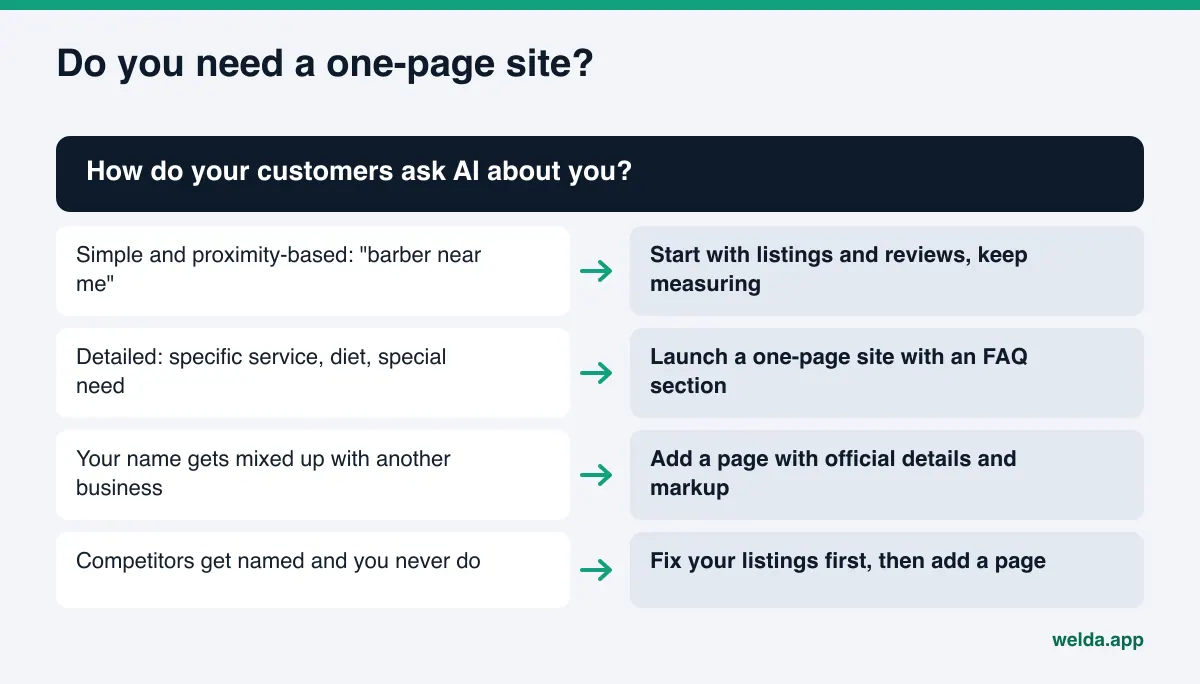
If you decide to put up one page, a few details matter for AI search. The page title and meta description should say what you do and where. Address, phone and hours should be plain text, not baked into an image. Add an FAQ section and business markup. Link your Google Business Profile, Yelp page and social accounts from the page. And make sure AI crawlers are not blocked. OpenAI, for example, documents that it uses OAI-SearchBot to surface websites in ChatGPT search; if your robots.txt blocks it, your page may not appear as a source in ChatGPT search answers.
The test is simple. If customers ask AI detailed questions and your competitors get named in those answers, you need a place to write the details down.
Priorities by business type
The first job differs by business. What customers ask AI depends on the trade, and so does the source that deserves most of your effort. The table below suggests a starting order for a few common types. Treat it as a framework, not a rule.
| Business type | What customers usually ask | Start with | Biggest gap without a site |
|---|---|---|---|
| Barber or salon | Nearby, walk-ins, hours | Google Business Profile, Yelp reviews | No written list of services and pricing approach |
| Food truck or cafe | Menu features, location today, kid or dog friendly | Profile, Instagram, Yelp | Menu details not in readable text |
| Home services | Service area, type of job, estimates | Profile service area, Angi, BBB | Services and areas scattered across listings |
| Home baker | Custom orders, gluten-free or vegan options | Profile, Instagram, Facebook | Order terms never written down |
| Fitness studio | Class types, levels, trial class | Profile, reviews, social accounts | Schedule and levels not explained |
The last column tells the story. In every trade, the biggest gap without a site is plain text that answers a detailed question. Listings and reviews work for proximity and general impressions. For "gluten-free birthday cake in Plano" or "beginner reformer classes in Brooklyn," you need a place where you state the facts yourself.
Take an example scenario. An example home bakery runs only on Instagram and Google Business Profile. Its posts often show gluten-free cakes, but that fact lives in photos and a few captions. When someone asks an assistant for a gluten-free bakery nearby, there may be no clear text for the assistant to find, and the bakery goes unmentioned. Once the same fact appears in plain sentences in the profile description, in review responses and on a single page, the assistant has something to read. That does not guarantee a mention. It removes the simplest obstacle to one.
How Welda handles AI visibility for businesses with little or no website
Welda is software that measures where a business appears in AI answers and prepares the missing pieces on its behalf. For a business with no site or a very small one, two parts of Welda matter most: the sources view and the to-do list.
The sources view: who is AI learning about you from? This view lists the sites that AI answers cite for your questions: directories, review sites, social networks, forums and, if you have one, your own site. Next to each source is your status there: unverified, incomplete or missing. For a business without a website, this list is a map of where to spend effort. If a directory that answers cite often has no listing for you, that is your first job. If a forum thread mentions you, the suggestion is a clear, signed reply.
The to-do list: ready-made text and manual tasks. Welda can connect to Google Business Profile, Instagram and Facebook. When those accounts are connected, Welda prepares profile text and review responses, and they go live after your approval. When they are not, the task appears as "do it yourself" with the text ready next to it, and you paste it in. Most directory listings fall into this second group. Welda does not invent facts it cannot find; if it cannot tell which areas you serve, it leaves the field empty and asks you.
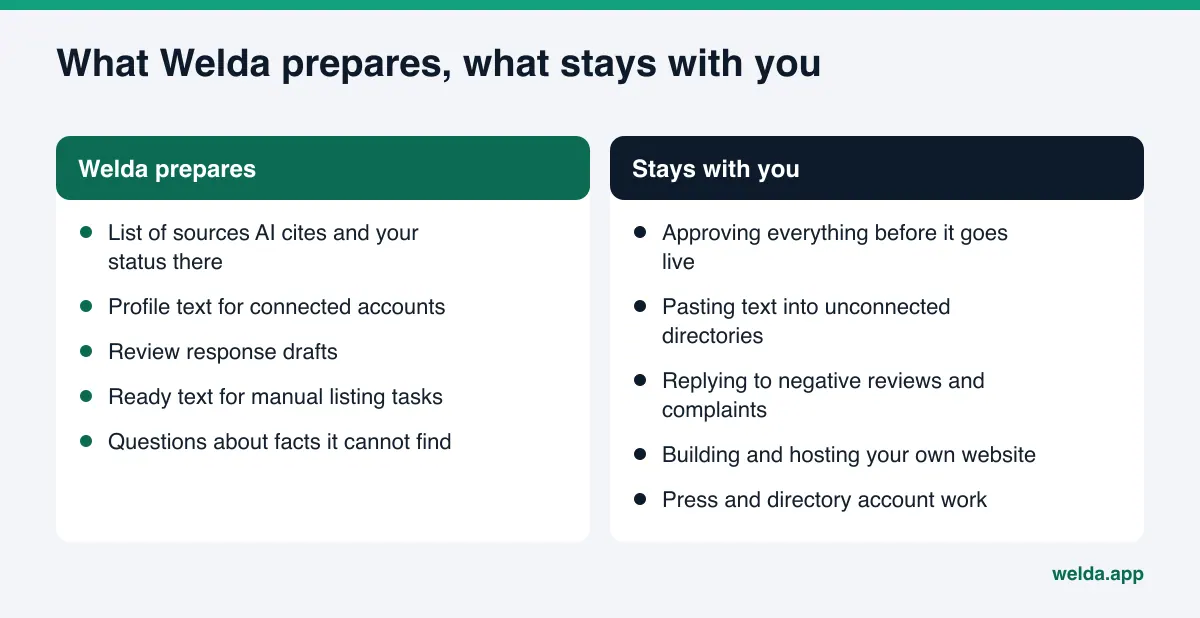
What Welda does not do if you have no site. Welda does not host content. Everything it writes is meant to live on the business's own website, and it does not build or publish a site for you. On the measurement side, the logic does not depend on a site: customer questions are asked to AI engines and Welda checks whether your name appears. How a business without a site would be set up in the panel is something to discuss in an early access conversation.
The free site analysis does need a web address. If you have a page, it reads that page plus a few inner pages and checks whether AI crawlers can get in, whether your address and phone are readable, and whether business markup and social profile links are present. It also asks an AI assistant that can search the web five questions your customers might ask and shows whether your name comes up. For a freshly launched one-page site, that is an easy way to catch gaps early. The free analysis works in English.
Be clear on where things stand. The Welda panel is in early access and is opening first to businesses in Turkey. Regular measurement across four AI engines is being added during early access, and sample panel screens use representative data. What anyone can use today is the free site analysis. Pricing is discussed in an early access conversation. For a wider look at what to expect from this kind of tool, see our guide to an AI visibility platform for small business.
Limits: what Welda won't do and what stays with you
Setting the right expectations matters, especially without a website. Welda does not do the following for you:
- No ranking or "show up in ChatGPT" guarantee. The engines decide which businesses an answer names. Welda measures it and fills gaps; it does not guarantee results.
- No fake reviews. Welda drafts review responses. It does not write reviews.
- Negative reviews, directory accounts and press work stay with you. Welda gives you ready text, but posting a reply, opening a directory account or talking to a reporter is your job.
- Nothing sensitive goes live without approval. The business always holds publishing approval.
- Changes take time. New or corrected information usually takes weeks to show up in AI answers. We go into the timeline in how long AEO takes.
One more limit applies to businesses without a site. Because the part you control is small, a larger share of the work stays manual. That is the nature of the situation, not a flaw. Welda keeps those tasks on a list so they don't get forgotten and prepares the text; doing them is up to the business.
Checklist for AI visibility without a website
Work through this list once, then revisit it every quarter. Writing a date next to each item makes it easy to see later which change happened when.
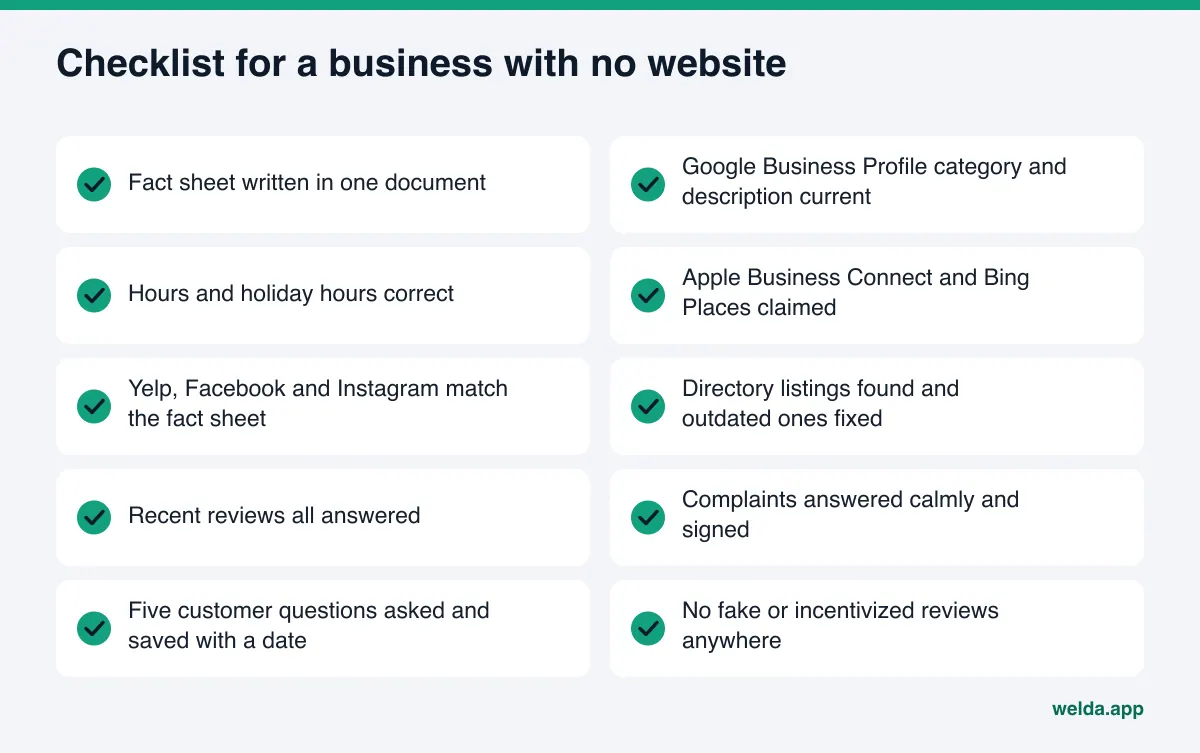
The last item is the one people skip most. A change you never measure is a change you can't judge. Asking the same questions at the same intervals shows whether fixing a source actually changed the answer.
Frequently asked questions
Can my business show up in ChatGPT without a website?
Yes, especially for simple local questions. When ChatGPT searches, it can read Google Business Profile data, map listings, directories and review sites. For detailed questions, competitors with their own pages are usually described more completely.
Is an Instagram account a substitute for a website?
Not fully. The bio is short, posts are mostly visual, and it is unclear how much assistants read from them. Keep Instagram consistent with your fact sheet, but don't treat it as your main source of facts.
Which listing should I fix first?
For most local businesses, Google Business Profile. Name, address, phone, hours, category and description should be correct and complete there. Then align Yelp, Apple Business Connect, Bing Places and directories with the same data.
Is a one-page website enough for AEO?
For most small businesses it is a solid start. Services, service areas, hours, FAQs and business markup all fit on one page. What matters is that the facts are written clearly in plain text, not how many pages you have.
Can I use the free analysis without a website?
No. The free analysis asks for a web address and reads that site's pages. Once your page is live, run it to catch gaps from the start. It is free once per site.
Will Welda build a website for me?
No. Welda does not host content and does not build sites. What it writes is prepared for the business's own website, and publishing approval stays with you.
How soon will changes show up in AI answers?
Usually within weeks. Sources need to be recrawled and answers need to pick them up. Note the date of each change and ask the same questions again a few weeks later.
Your next step
AI visibility without a website starts with turning scattered sources into one consistent story. Write your fact sheet, align your Google Business Profile, Yelp and social accounts with it, respond to reviews and ask the same questions on a schedule. If you keep losing detailed questions to competitors, a one-page site is usually the most efficient next move. When that page is live, run the free site analysis: you will see whether AI can read your page, which fixes would move your score most and whether your name shows up for five customer questions.