How do language schools get recommended by ChatGPT? AI assistants recommend a language school when they can clearly read which languages it teaches, at which levels, on which schedule, in which format, and where, and when they find those details consistent across several sources. If your programs sit in a one-line list, the AI has nothing to match a student's question against. The work is done with specific, verifiable information, not with promises.
Someone who wants to learn a language no longer just types "Spanish classes near me" and scrolls the results. They ask ChatGPT, Gemini, Perplexity, or Google's AI Mode a long, personal question: "I need to get my English to a professional level for work, can you suggest an ESL program in Queens with evening classes?", "I'm moving to Japan next year, is there an online Japanese course for complete beginners with small groups?" The answer usually names three or four schools, each with a short reason. If your school is not on that short list, the prospective student enrolls somewhere else without ever hearing your name. This guide walks through how language schools get recommended by ChatGPT and other AI assistants: what to publish, where to hold back, and how Welda handles the work. If you want to see where you stand first, run the free site analysis; the result shows which of the steps below you are missing.
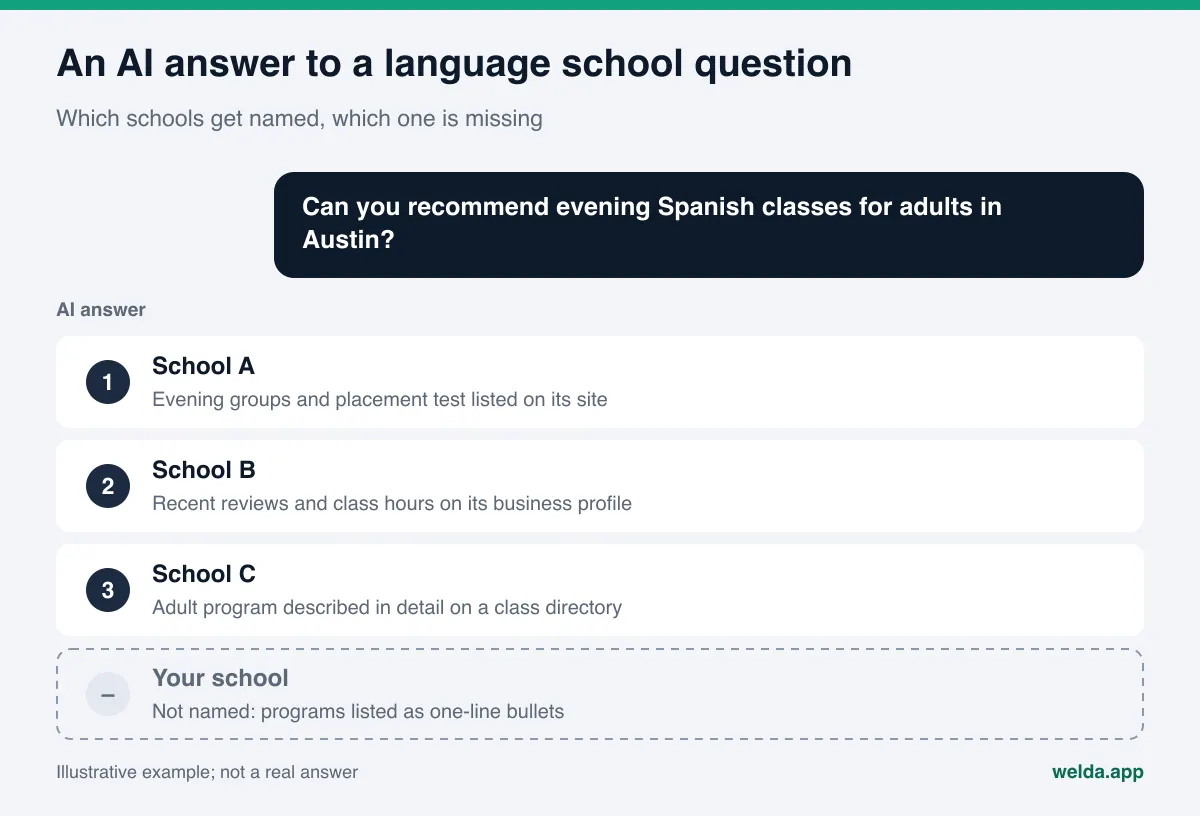
What AEO means for a language school
AEO, short for answer engine optimization, is the work of making a business show up accurately in AI-generated answers from tools like ChatGPT, Gemini, Perplexity, and Google's AI Overviews. You will also see it called GEO (generative engine optimization) or simply AI search visibility; the terms describe the same goal. If you want the distinction spelled out, we cover it in GEO vs AEO.
The basics are the same in every industry, but language schools have a few traits that make the job harder.
First, the student's decision has many dimensions at once. For a restaurant, "where" and "what kind of food" often settle it. Someone choosing a language program weighs several conditions together: which language, which level, group or private, in person or online, weekday evenings or weekends, and for what purpose (work, an exam, a move abroad, a child's schooling). An AI answer combines all of those conditions in one reply. If even one is missing from your site, the AI has no basis for naming you on that question.
Second, language school marketing leans heavily on promises. "Fluent in 90 days", "guaranteed results", and "the best teachers in town" tell a student nothing they can check, and they give an AI assistant nothing it can quote as a reason. They also carry advertising risk, which we come back to below.
Third, schedules change constantly. New session dates, groups that open and close, moved class times, a summer intensive that runs one year and not the next. If the information is not kept current, an AI answer can describe a session that no longer exists, and the student's first impression of you is a wrong detail.
So AEO for a language school is not a general "refresh the website" project. The core task is to write each program so it matches the conditions a student will ask about, and to keep the same facts consistent on every site that describes you.
What students actually ask AI about language classes
The questions below are examples we wrote based on common intents in this category; they are not measured data. When you build your own list, use the sentences students really say to you on the phone, in emails, and at enrollment.
| Question type | Example question | What the AI needs to find on your site |
|---|---|---|
| Neighborhood and schedule | "Where can I take evening ESL classes in Queens after work?" | Address, evening class times, how to get there |
| Level and goal | "I'm intermediate in French, what's a good intensive course to reach advanced?" | Level structure, placement test, intensive program length |
| Exam prep | "Is there a TOEFL prep class in Chicago with practice tests?" | Exam prep program, content, whether practice tests are included |
| Format | "Can you recommend a school offering private online Mandarin lessons?" | Private and online options described on their own pages |
| Age group | "Looking for weekend Spanish classes for my 8-year-old in Denver" | Kids program, age range, class structure |
| Trust and comparison | "Which language schools in Seattle have the best reputation?" | School details, teachers, real reviews, any accreditation |
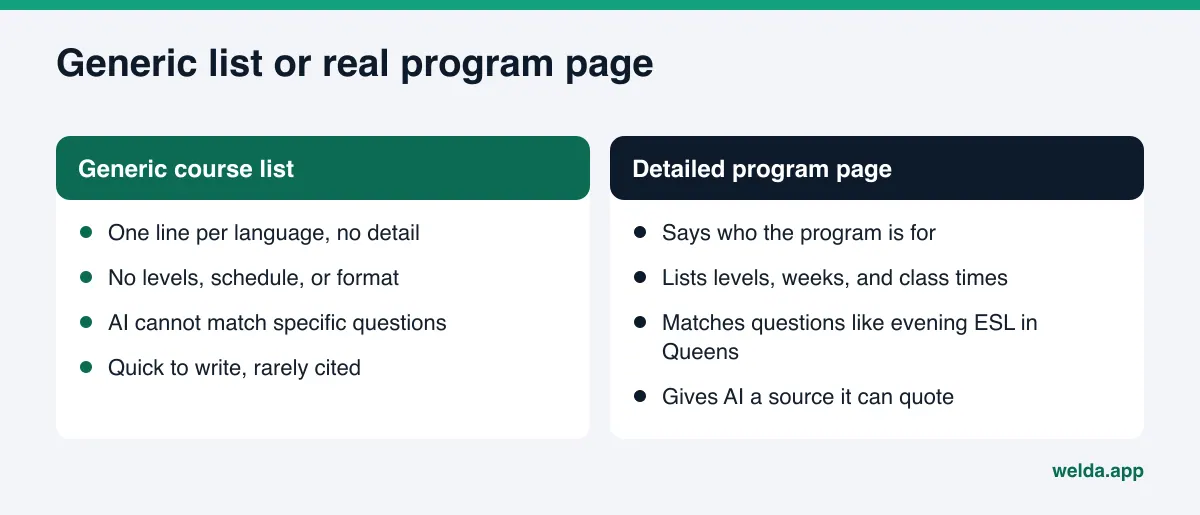
Each row points to a separate page or at least a separate section. A single "Our Courses" page listing every language and level in one line each cannot fully answer any of these. Rather than leaving the selection to the AI, put the answer on the page in plain words.
How AI assistants decide which language schools to recommend
When AI assistants answer a question like this, they usually run a web search and summarize what they find. Google says in its documentation on AI features and your website that there are no special technical requirements beyond the usual Search fundamentals. In practice, these sources carry the most weight for language schools:
- Your own website: program pages, level structure, class times, teachers, enrollment steps, FAQs. This is where the AI can find the most detail about you.
- Google Business Profile and Google Maps: address, hours, category, photos, and student reviews. For "near me" and neighborhood questions, this listing matters a lot.
- Yelp and similar review sites: reviews and basic details. Inconsistent hours or an outdated address here feed the AI conflicting data.
- Class directories and community sites: local class listings, community education boards, and discussion threads on Reddit where people compare schools in their city.
- Local press and roundups: "best places to learn a language in [city]" articles. You do not control these, but it helps to know which ones exist.
What ties these together is consistency. If your website says the evening group starts at 7:00 p.m. and your Google Business Profile says 6:30, the AI cannot tell which is right. We cover keeping your name, address, and phone identical everywhere in NAP consistency for AI search, and which listings deserve attention in business directories for AI visibility.
There is one technical prerequisite too: AI search crawlers have to be able to reach your site. OpenAI's crawler documentation notes that sites that want to appear in ChatGPT search results should not block OAI-SearchBot in robots.txt. Some sites block these crawlers without knowing it, through a security plugin or an old setting.
Step by step: how language schools get recommended by ChatGPT
The order below is designed to cover the most questions with the least effort. Each step builds on the one before.
- Write down student questions. Aim for fifteen to twenty: for each language, each level, exam prep, kids programs, and each neighborhood you serve. The list shows what is missing on your site and becomes the basis for measurement.
- Check crawler access. Look for any line in robots.txt that blocks AI search crawlers. Content they cannot read will not be cited.
- Settle your school details once. Legal name, campus addresses, phone, office hours, and class hours should match on your site, Google Business Profile, Yelp, and directories. If you run more than one location, give each its own page and its own profile.
- Give every program its own page. "Adult general English", "TOEFL prep", "Spanish for kids", "Private online Japanese": each deserves a page. The next section shows what to put on it.
- Add structured data. You can describe your school with EducationalOrganization and each program with Course, which includes fields such as the language of instruction and educational level. Anything in the markup should also be visible on the page.
- Write an FAQ section. Answer how placement works, what happens if a student misses a class, how moving between levels works, and whether a certificate is issued.
- Fill in outside sources. Update your Google Business Profile category, description, and hours; check what your Yelp listing and class directories say about you.
- Measure and repeat. Ask the questions from step one again at regular intervals. New content usually takes weeks to show up in AI answers, so do not judge by a single try.
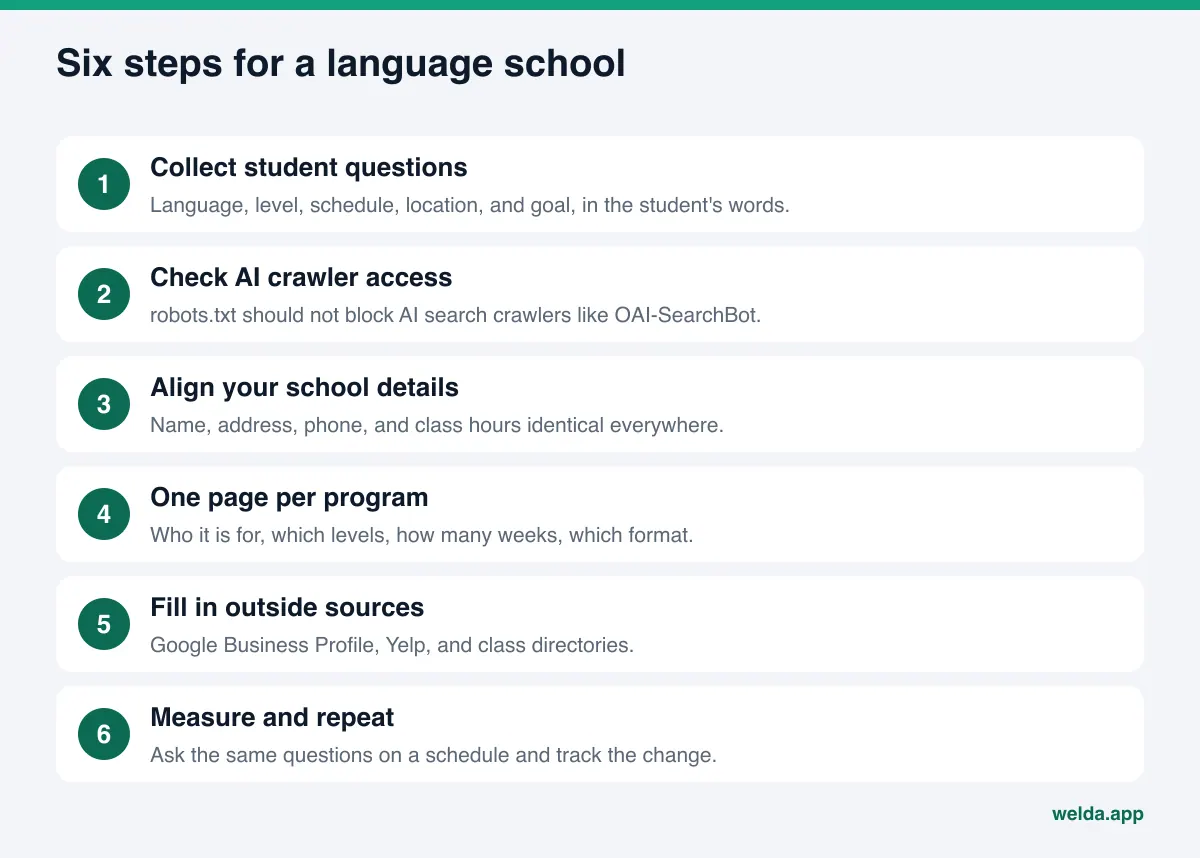
If you want to put these steps on a calendar, the 90-day AEO plan gives you a workable starting frame.
What a program page needs so AI answers can cite it
For language schools, program pages are where the difference is made. A good program page answers the questions a student would ask at enrollment before they have to ask. A skeleton for an adult ESL program might look like this:
- Who it is for: "Adults who need English for work and already have basic conversational skills." One sentence, but enough for the AI to match it to a question.
- Levels and structure: which levels you offer (many schools use the CEFR scale from A1 to C2, others use their own beginner to advanced levels) and how students move between them.
- Length and schedule: how many weeks each level runs, how many hours per week, which days and times. These numbers come from your real schedule.
- Format: group, private, in person, online, or hybrid. If you cap class size, say so.
- Placement and enrollment: whether there is a placement test, how it works, and what the enrollment steps are.
- End of level: how progress is assessed and whether a certificate is issued. If you are an official test center or hold an accreditation, name it exactly and describe its scope.
- Teachers: which languages they teach, their background and experience, with their permission and without inflation.
- FAQs: three or four questions specific to that program.
Whether to publish tuition is your call. If you do, keep it current and state what is included; an outdated price circulating in AI answers can cause more trouble than no price at all. The same structure applies to your homepage: the first paragraph should say which languages you teach, to whom, and where or online. We go deeper on that in homepage copy for AI search.
Claims, reviews, and advertising rules for language schools
The most common problem on language school sites is overpromising. "Guaranteed fluency", "speak like a native in three months", "the #1 school in the city" hurt in two ways. They carry no usable information for an AI answer, because there is no concrete fact a student could check. And unsupported superiority claims or outcome guarantees can create deceptive advertising risk. We cover the general framework in best claims and advertising rules in AI content. This article is not legal advice; have your own copy reviewed by counsel if you are unsure.
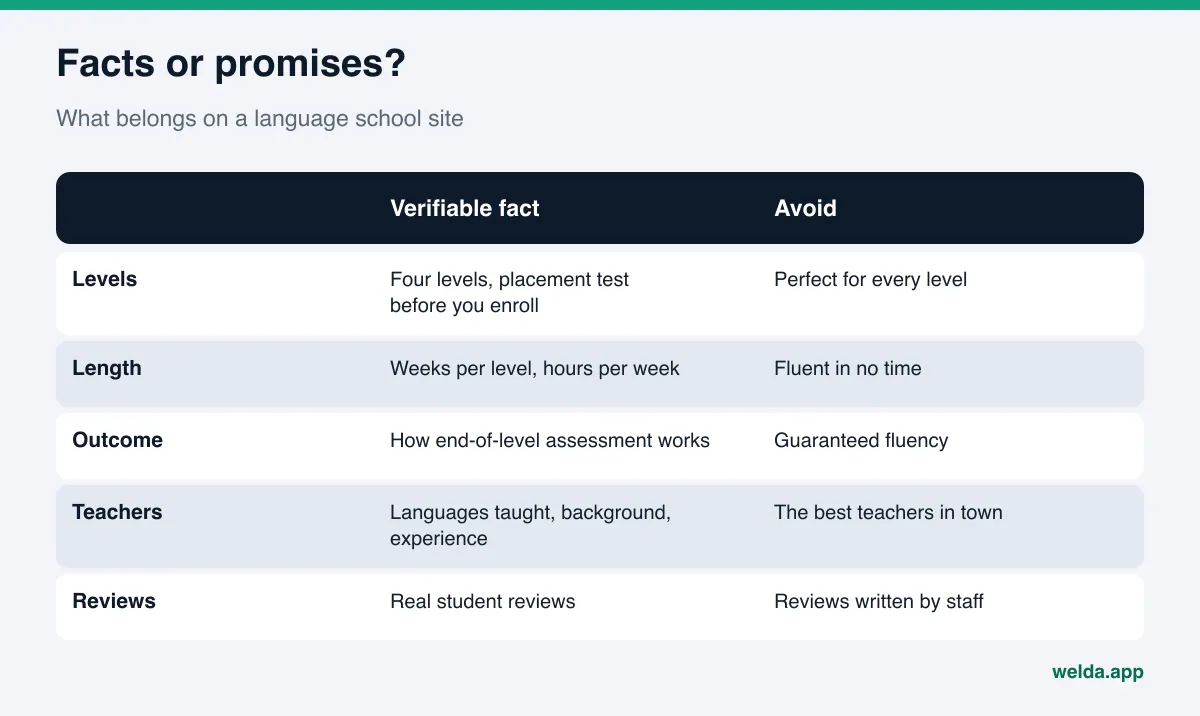
What you can say instead is often more convincing. Instead of "fluent in 90 days", try "each level runs eight weeks, two evenings a week, and ends with a speaking assessment." The numbers must come from your actual program. That sentence gives the student a real picture and gives the AI a reason to cite you.
Reviews follow the same principle. Asking real students for reviews is normal. Reviews written by staff or bought from a vendor put both trust and visibility at risk, and the FTC has announced a final rule banning fake reviews and testimonials, including AI-generated ones. Calm, specific replies to critical reviews also shape the picture an AI forms of your school.
How Welda handles AEO for a language school
Welda is software that measures where your business appears in AI answers and prepares the fixes on your behalf. For a language school, three parts do most of the work.
Question-by-question measurement. The panel lists the questions your prospective students are likely to ask, one by one, so a question about evening ESL in your neighborhood is tracked separately from one about TOEFL prep or kids classes. Each question goes to ChatGPT, Gemini, Perplexity, and Google AI three times, because the same question does not always get the same answer. For each one you see which engine names your school, in what position, and which sources the answer relied on. The decision this view supports is simple: the questions where you never appear, which program do they belong to, and does your site say enough about that program? The competitors view shows which school wins a question, on what topic, and from which source: perhaps a rival's detailed exam prep page, perhaps a thorough directory listing.
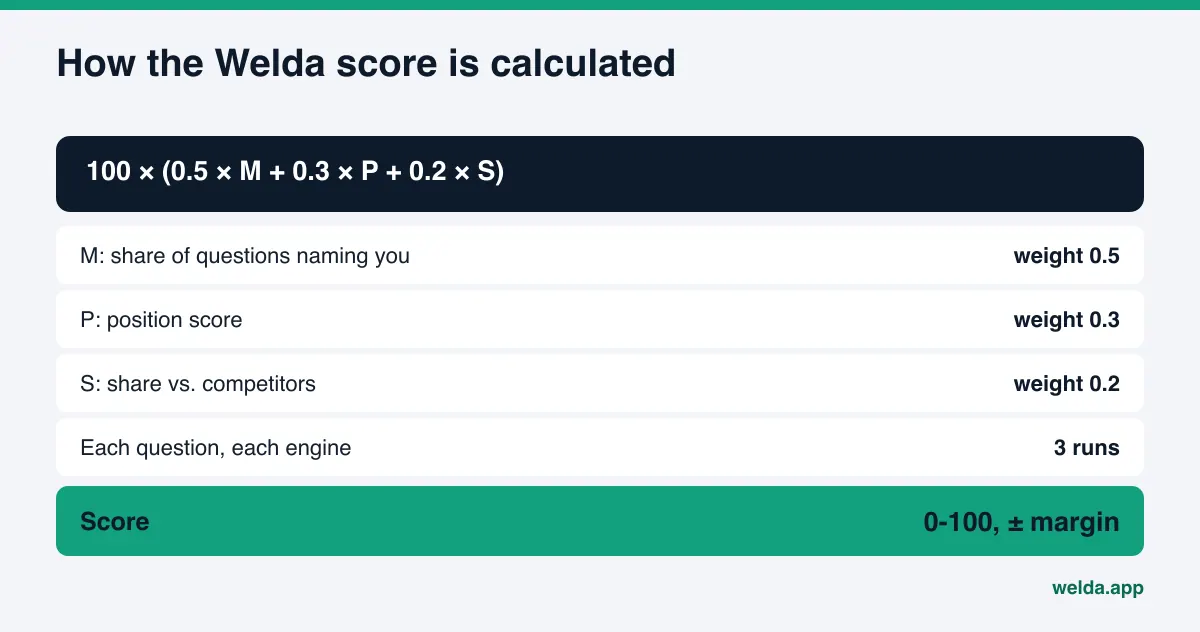
The score formula is open: the share of questions that name you counts for half, your position for 30 percent, and your share against competitors for 20 percent; the spread between the three runs gives a margin of error. When the score moves, you can see why.
A single to-do list with ready-to-use copy. Every gap the measurement finds lands on one list. Welda drafts, for example, a program page for your TOEFL prep course, a new Google Business Profile description, or replies to reviews. It does not invent what it does not know: if it cannot read how long a level runs, whether you are a test center, or what your teachers' backgrounds are, it asks you, then carries your answer into every draft. You approve what gets published. On WordPress sites, Welda connects through a separate Editor user and an application password, with no code to install; drafts open on your site, and you publish them when you approve. On other platforms, Welda hands you a ready package and the changes are applied manually. Content always lives on your own site.
Compliance check. Before anything is published, drafts are flagged for patterns such as guarantees, superiority claims, and pricing. For a language school, that keeps "guaranteed fluency" type sentences from slipping into the copy. The check is not legal advice and has not been reviewed by legal counsel; the final call stays with you.
Beyond that, a sources view shows which sites AI answers draw on for language school questions and where you are missing, and a one-page monthly report sums up the state of things for whoever runs the school.
An honest note on availability: the Welda panel is in early access. Regular measurement across all four engines is being added during early access, and sample screens in the panel use representative data. The full panel is opening first in Turkey. What anyone can use today is the free site analysis, which works in English. Pricing is discussed in an early access conversation.
What the free site analysis shows a language school
The free analysis reads your homepage and a few inner pages (services, pricing, about, contact) the way Google and AI assistants see them. For a language school, these findings tend to matter most:
| What the analysis checks | Why it matters for a language school |
|---|---|
| AI crawler access | Whether your program pages can be read at all |
| Title, description, main heading | Whether it is immediately clear which languages you teach, to whom, and where |
| Structured data | Whether your school and programs are described in machine-readable form |
| Address, phone, location | Whether neighborhood questions have the details they need |
| Clearly described services | Whether each language and program is explained on its own |
| FAQ, reviews, trust signals | Whether placement, enrollment, and make-up classes are answered |
You get a score out of 100 (technical and content scored separately), what was found for each gap and how to fix it, suggested homepage copy, a simulation of how much each fix would raise your score, a competitor comparison, and a ready-made fix package to add to your site. The analysis also asks an AI assistant with web search five questions your students might ask and checks whether your school is named in the answers. That is a one-time snapshot, not ongoing tracking. The analysis is free once per site; email and phone are verified, and the results link arrives by email and stays open for 14 days.
Limits: what Welda does not do
- It does not guarantee rankings or "getting into ChatGPT." No software or agency can guarantee AI answers.
- It does not write what it does not know. Level length, teacher backgrounds, and test center status are things it asks you about.
- It does not generate fake student reviews, and it does not publish without your approval.
- Negative reviews themselves, your directory accounts, and press outreach stay with you; Welda drafts text for them, but does not run that work for you.
- It does not measure search rankings, and the free analysis does not report them.
Timing matters too. After you publish a new program page, it usually takes weeks before it shows up in AI answers. Starting a few months before a new enrollment season is more realistic than starting the week before.
Checklist: is your language school ready for AI answers?
Open your site and go through this list item by item. Every "no" maps to one of the steps above.
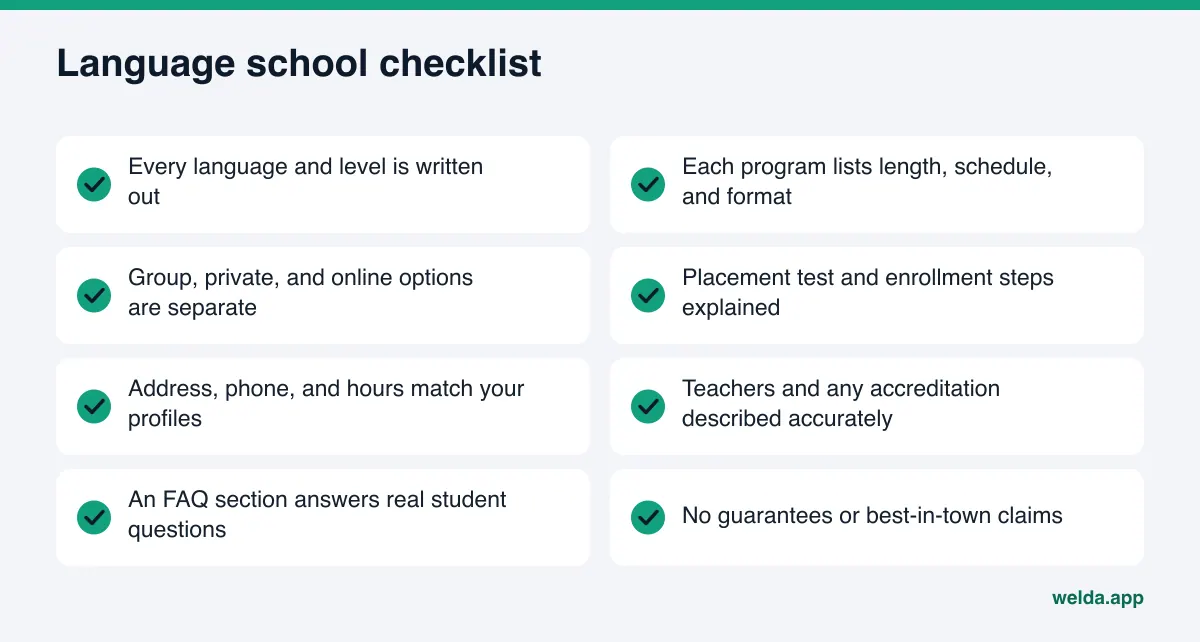
If several items come up "no", do not try to fix everything in one week. Pick the gap that blocks the most questions. Blocked crawlers come first, because nothing else can be read until that is fixed. After that, the order depends on which questions you are missing.
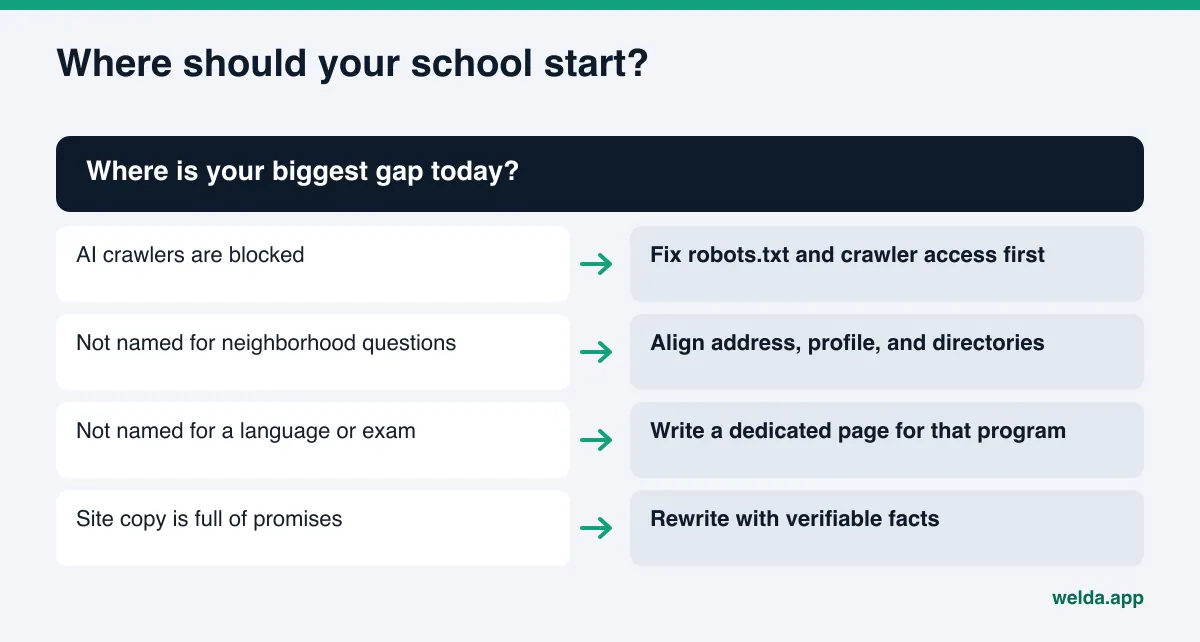
| Situation | First task |
|---|---|
| AI crawlers are blocked | Fix robots.txt |
| Never named for neighborhood questions | Align address, Google Business Profile, Yelp, and directories |
| Not named for a specific language or exam | Write a dedicated page for that program |
| Named, but with outdated details | Update session dates and class times everywhere |
| Copy full of guarantees and superlatives | Rewrite with specific, verifiable sentences |
Frequently asked questions
How does ChatGPT decide which language schools to recommend?
It usually summarizes what it finds through web search: the school's own site, Google Business Profile, review sites, directories, and community discussions. It tends to name schools whose details clearly match the conditions in the question (language, level, location, schedule, format) and are consistent across sources.
Can an online-only language school show up in AI answers?
Yes, for online questions. Without a physical location you are unlikely to be named for neighborhood questions, so focus on "online" queries and describe your online programs on their own pages, with time zones, class platform, and group structure.
Do I need a separate page for each language?
Usually yes. Students ask with a language and a goal in mind, so a dedicated, detailed page for each language and each key program (exam prep, kids, business English) matches far more questions than one long list.
Can I publish pass rates or guaranteed results?
Unsupported guarantees and superiority claims carry deceptive advertising risk, and they give AI answers nothing useful to cite. Describe the program's structure, length, and assessment instead. For a legal opinion on your own copy, talk to counsel.
How long does it take to see results?
There is no fixed timeline. New content usually takes weeks to be reflected in AI answers, which is why measuring the same questions on a schedule tells you more than a single check.
Does Welda need access to student records?
No. Welda's work is about the public information on your site and profiles and about AI answers; it does not ask for student records for measurement. Content stays on your site, and you approve what goes live.
See where your school stands today
How language schools get recommended by ChatGPT comes down to clearly written programs, consistent school details, and regular measurement, not a trick. The first step is knowing where you stand. Run the free site analysis to see how AI assistants read your site, which gaps to fix first, and whether your school is named for five sample student questions.