How do car rental companies get recommended by ChatGPT? When someone asks an AI assistant for a rental car, it names the agencies whose pickup locations, vehicle classes, deposit and card rules, fees and reviews it can actually read and confirm. If those facts are clear and consistent on your site and your listings, your odds of being named go up; nothing guarantees it, but an agency with missing facts cannot make the list at all. This guide covers what to fix and how Welda takes on that work.
Why AI answers now shape who gets the rental
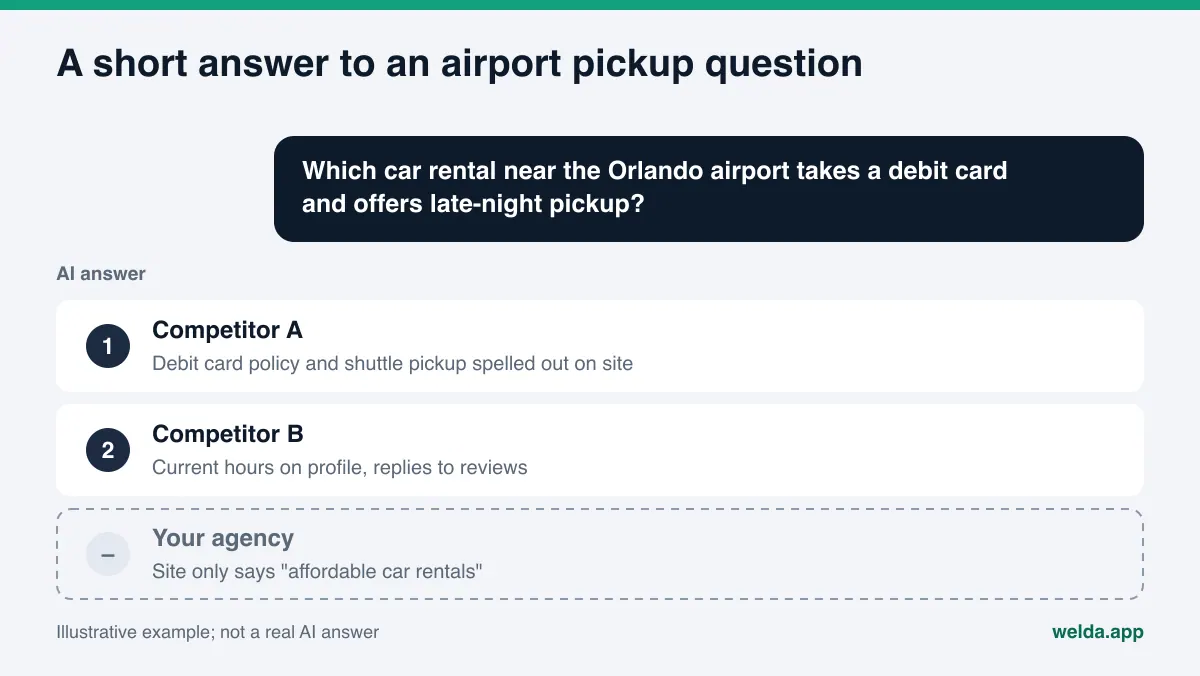
People renting a car are usually in motion. The flight is booked, the hotel is set, and the car is the last piece. Instead of opening ten rental sites side by side, more travelers now type a single question into their phone: "Which rental near the Denver airport takes a debit card and has SUVs?" ChatGPT, Gemini, Perplexity and Google's AI Overviews do not return ten blue links for that. They name two or three agencies and give each a one-line reason.
Who makes that short list is not random. The answer engine tries to work out, from whatever it can read, which agency picks up where, which vehicle classes it has, what it requires at the counter and what renters say afterward. Many independent and franchise rental sites answer none of that. The homepage says "affordable car rentals" above a booking widget. Pickup locations hide in a dropdown. Deposit, debit card and insurance rules sit in a long rental agreement PDF, or nowhere. The Google Business Profile still shows last year's hours. From that scattered picture, an AI cannot conclude "this agency has an airport shuttle and accepts debit cards," so it recommends the competitor whose facts are plain.
Car rental adds a trust layer, too. Renters worry about surprise fees at the counter, a large hold on their card, and damage disputes at return. Answer engines look for signals that address those worries: policies written in plain language, reviews, replies to reviews, and complaint patterns on public sites. So AEO (answer engine optimization) for a rental agency is not "put your city name on the homepage." It is stating your pickup options, fleet, policies and fee approach clearly, and making them match everywhere they appear. You may also see this work called GEO (generative engine optimization); in the US the two terms describe the same goal of AI search visibility.
If you want to see how ready your own site is today, run the free site analysis. It reads your site the way Google and AI systems do and lists each gap, along with how to fix it.
What renters ask AI about car rental companies
Rental questions fall into a handful of patterns, and each pattern sends the answer engine looking for a different fact. The questions below are examples we wrote to illustrate the point; they are not survey data.
| Question type | Example (written by us) | What the AI looks for |
|---|---|---|
| Airport pickup | "Car rental at Phoenix Sky Harbor open after midnight" | Counter or shuttle details, hours, late flight policy |
| Payment | "Can I rent a car with a debit card in Tampa?" | Debit and credit card rules, deposit hold |
| Driver rules | "Car rental for a 22-year-old near me" | Minimum age, young driver fee, license requirements |
| Vehicle | "Minivan rental for 7 people in San Diego" | Fleet by class, seats, luggage space |
| One-way | "One-way rental from Las Vegas to Los Angeles" | Drop-off locations and how one-way fees work |
| Trust | "Rental agency with no surprise fees at pickup" | Written fee policy, reviews, replies to complaints |
| Long term | "Monthly car rental for a work assignment" | Monthly option, mileage limits, maintenance rules |
The takeaway: each question type maps to a specific fact on your site. "Affordable car rentals" answers none of them. For a debit card question, the answer engine looks for a source where the card policy is written down. For a midnight question, it looks for hours and a late flight rule. If it cannot find them, it names someone else.
How car rental companies get recommended by ChatGPT, step by step
Work through these steps in order. Each one builds on the last. Measurement comes at the end, because while facts are missing, a measurement can only tell you that you are absent, not why.
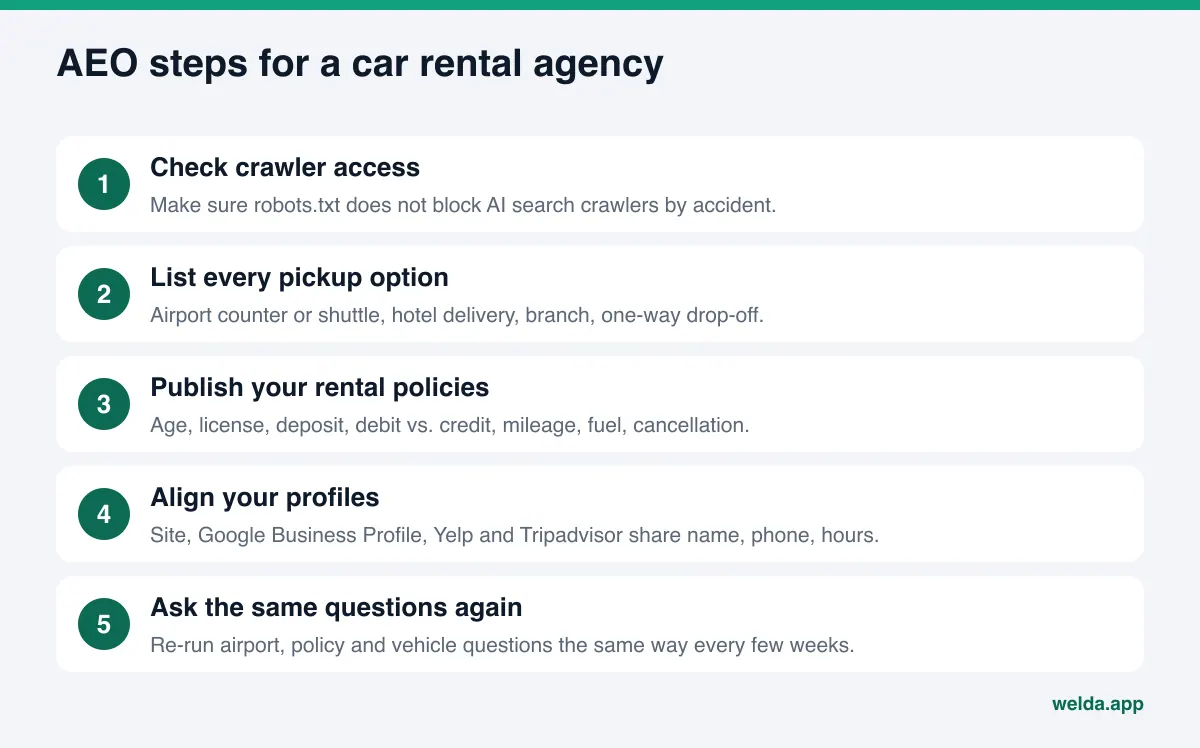
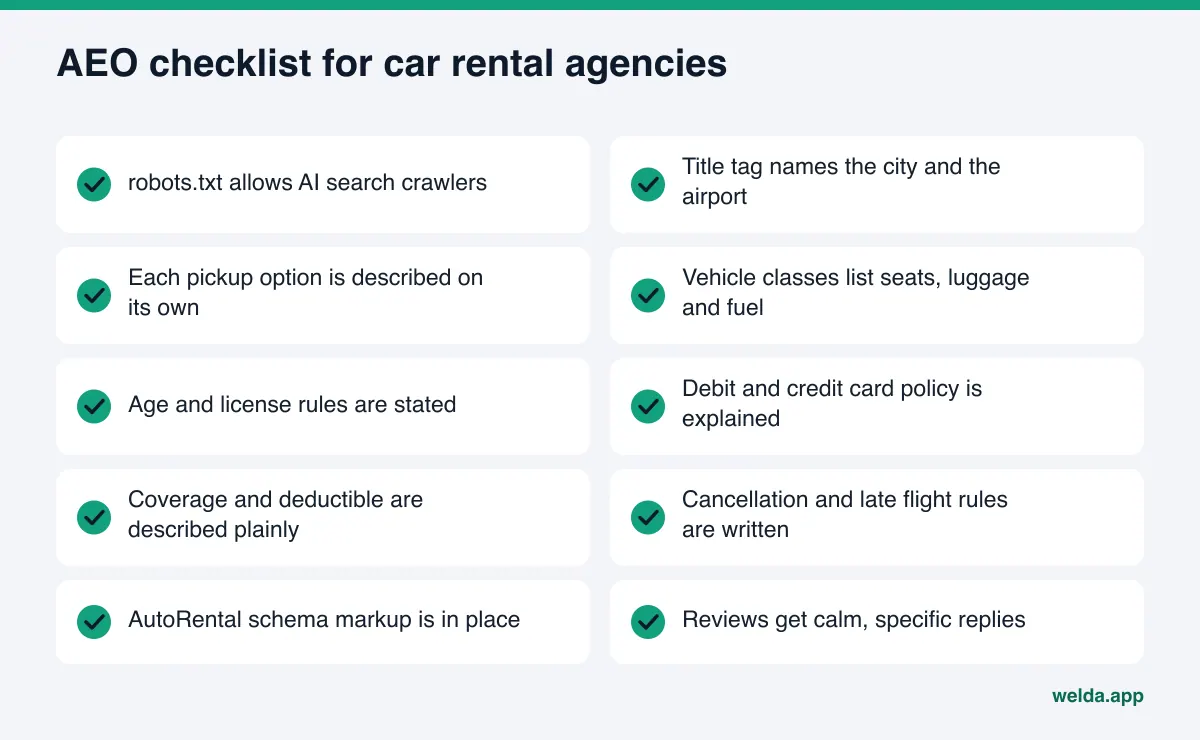
- Confirm AI crawlers can reach your site. Some themes, booking platforms and security plugins block unknown bots wholesale through robots.txt. OpenAI states that sites opted out of its OAI-SearchBot crawler will not be shown in ChatGPT search answers. Check your robots.txt before anything else.
- Describe every pickup option on its own. Replace "we deliver anywhere" with separate sections for the airport counter or shuttle, hotel delivery, and each branch. Say where the shuttle stops, whether after-hours pickup exists, and what happens if a flight is delayed. List the cities where one-way drop-off is allowed.
- Describe the fleet by class. Economy, midsize, full-size SUV, minivan, pickup truck: give each class its seat count, luggage space, transmission and fuel type. A photo gallery is not information to an answer engine; the text next to it is.
- Put your rental policies on one page. Minimum age and young driver rules, license requirements, debit versus credit card, deposit hold, mileage limits, fuel policy, additional drivers, child seats, cancellation and refund. Write them in the words renters use, not contract language.
- Explain coverage honestly. Instead of "full coverage available," explain what the base rate includes, what optional protection products cover, and how the deductible works. If you are not sure of a detail, confirm it with your insurance partner before you publish it.
- Explain how pricing works. You do not have to list every rate, but explaining what moves the price (season, rental length, class) and which extra fees can apply answers the "are there hidden fees" question directly.
- Add an FAQ section. Write down the questions your counter staff hear every day, with real answers. Short, direct paragraphs are exactly what an answer engine can quote.
- Add business schema. Schema.org has a dedicated type for rental agencies, AutoRental. Use it to mark up your name, address, phone, hours and each location in a machine-readable way.
- Align your profiles. Your Google Business Profile, Yelp, Tripadvisor, BBB listing and social accounts should show exactly the same name, phone, address and hours as your site. If you have an airport location and a downtown branch, each needs its own profile.
- Reply to reviews. Pay special attention to reviews about deposit refunds and damage claims. A calm, specific reply shows how you handle problems, and answer engines can read it.
For a closer look at how to structure a page an assistant can quote, see our guide on service pages AI can quote. If you run several locations, the multi-location AEO guide covers how to give each one its own clear set of facts.
What an answer engine reads on a rental agency website
The comparison below shows two example rental agencies in the same city, seen through the eyes of an answer engine. Their fleets, prices and service might be nearly the same. The difference is what each site is able to say.
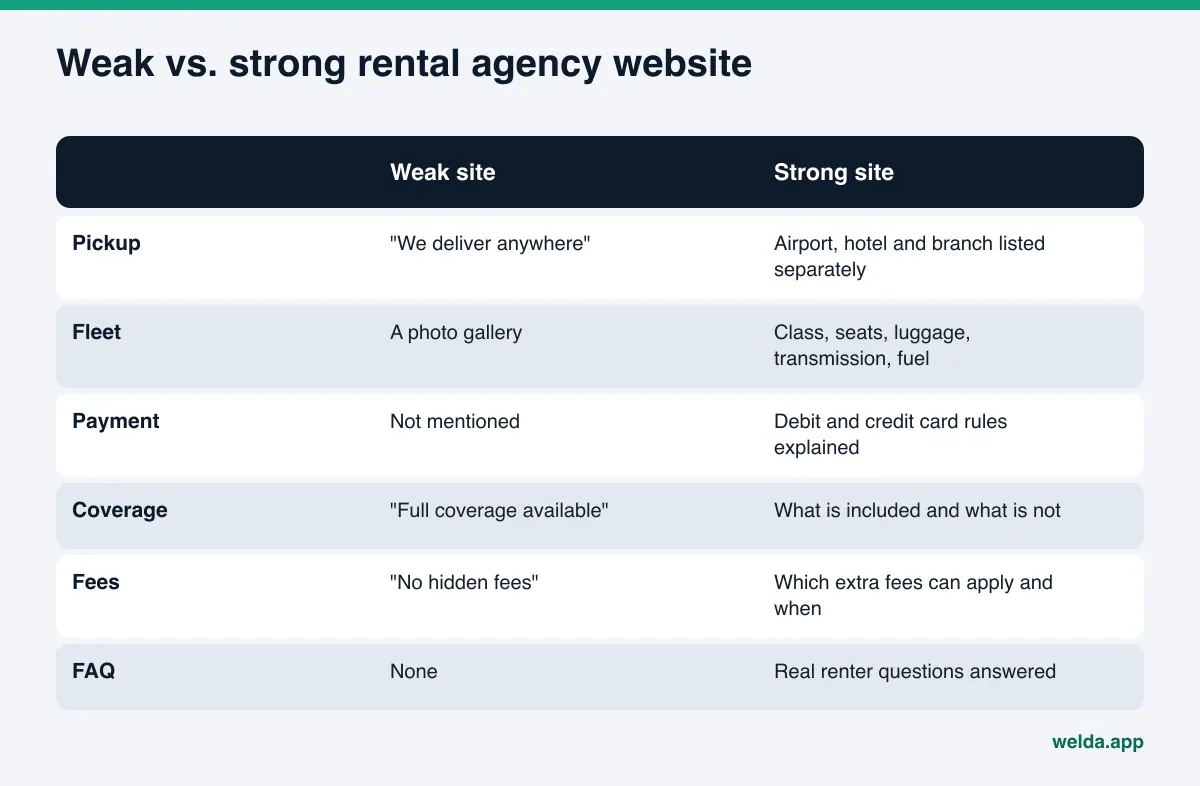
Most of what the weak site is missing already exists inside the business. Counter staff explain the debit card hold, the shuttle stop and the late flight rule to callers every day. But because none of it is on the site, it does not exist for an answer engine. Much of AI search visibility work for a rental agency is not creating something new; it is writing down what you already know in a form that can be read.
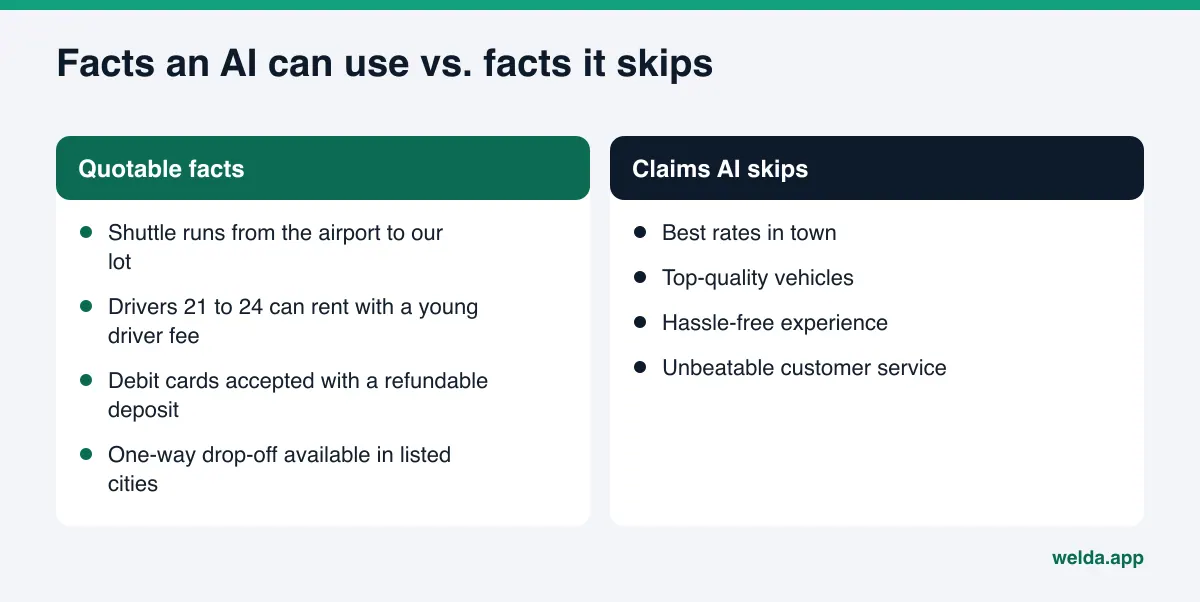
Consistency matters just as much. If your site says "24/7 airport pickup" and your Google Business Profile shows 8 a.m. to 6 p.m., the answer engine sees two conflicting facts and cannot tell which is true. It tends to avoid recommending on facts it cannot trust. Pick one source of truth and use it everywhere.
Which sources do answer engines rely on?
An AI answer is not built from your site alone. For rental questions, answer engines commonly draw on Google Business Profile and Google Maps, Yelp, Tripadvisor, the BBB, travel forums, Reddit threads, travel blogs and rental comparison sites. If a competitor is strong on one of those sources, the answer engine may know them from there.
That is why "where am I missing" matters as much as "how is my site." Seeing which sites an AI cites for your questions, and where you stand on each, tells you where to put effort. We explain the method in our citation gap analysis guide, and the role of ratings in our piece on reviews and AI recommendations.
One warning: fake reviews and staff-written reviews are not a shortcut. The FTC's final rule on fake reviews and testimonials bans buying or creating fake reviews, including AI-generated ones, and undisclosed reviews from company insiders. The durable path is to ask real renters for reviews and answer them openly.
How Welda handles AEO for a rental agency
Welda is software that measures where a business shows up in AI answers and fills in what is missing on the business's behalf. For a car rental agency, three parts do most of the work.
1. The free site analysis: finding the policy gaps. The analysis reads your homepage and a few inner pages (services, pricing, about, contact). On rental sites, the findings that come up most often are a title tag with no city or airport name, no business schema, no FAQ section, services (pickup types, vehicle classes) that are never spelled out, and maps or social profiles that are not linked from the site. For each finding you see what was found, why it matters and how to fix it. You get ready-to-use homepage text: a title, a description, a main heading, an intro paragraph and FAQ suggestions, plus a simulation that shows how much each fix would move your score, a competitor comparison and a fix package you can add to your site. The analysis also puts 5 questions a renter might ask to an AI assistant that can search the web, and checks whether your agency's name appears in the answers. That is a one-time snapshot, not ongoing tracking. It works in English.
2. Question tracking: where you appear and where you do not. In the Welda dashboard, the questions your renters would ask are put to ChatGPT, Gemini, Perplexity and Google AI three times each. For a rental agency, those questions can be grouped by intent: airport pickup, debit card, minivan, one-way. For every question you see which engine names you and in what position. Say your agency shows up for downtown questions but never for airport questions. That usually points to airport pickup details missing on the site and the profile, and it tells you what to fix first.
The score is not a black box. It follows a published formula: 100 × (0.5 × share of questions where you are named + 0.3 × position score + 0.2 × share against competitors). The spread across the three repeats gives a ± margin, so one lucky answer does not fool you into thinking you have improved. Our guide to what a good AI visibility score is explains how to read it.
3. Sources and the to-do list: filling in the facts. The sources view shows which sites the AI leans on for rental questions and how you stand on each: incomplete profile, unverified details, or not present at all. The to-do list turns that into work. Welda drafts the policy page copy, FAQ answers, profile descriptions and review replies. It does not invent facts; if it does not know your deposit method or your after-hours window, it asks you. The draft sits next to the task, and you approve it.
On WordPress sites, Welda connects through a separate Editor user and an application password, with no code to install; content opens on your site as a draft and goes live when you approve it. On other platforms, Welda hands you a ready package and the change is applied by you or your developer. Content always lives on your own site. Before anything is published, a compliance check flags patterns such as price, guarantee and superiority claims; it is a warning, not legal advice. You also get a one-page monthly report.
What stays with you is clear: confirming the real policies, approving the copy, asking real renters for reviews, and owning your replies to complaints.
Where Welda stands today: the free site analysis works in English and German, and anyone can use it now. The full Welda dashboard is in early access and is opening first in Turkey. Regular four-engine measurement is being added during early access, and the sample dashboard screens use illustrative data. Pricing is discussed in an early access call.
Limits: what Welda does not do
AI visibility is a field with plenty of easy promises, so it is worth being direct.
- No guarantees. Welda does not guarantee that you will appear in ChatGPT or any other engine, and it does not promise rankings. AI answers vary; the same question can get a different answer at a different time.
- No guessing. Deposit amounts, deductibles and pickup hours are not estimated. Welda asks you.
- No publishing without approval. Every draft comes to you first. The publishing decision is yours.
- No fake reviews. Welda drafts review replies, never reviews.
- Some work stays with you. Resolving negative reviews and complaints, managing your directory and comparison site accounts, and press work are the business's job.
- It takes time. New content usually takes weeks to show up in AI answers, which is why starting before your peak travel season makes sense.
Rental agreements, fee disclosure and consumer protection rules vary by state. Have your own attorney review policy language before you publish it. This article is not legal advice.
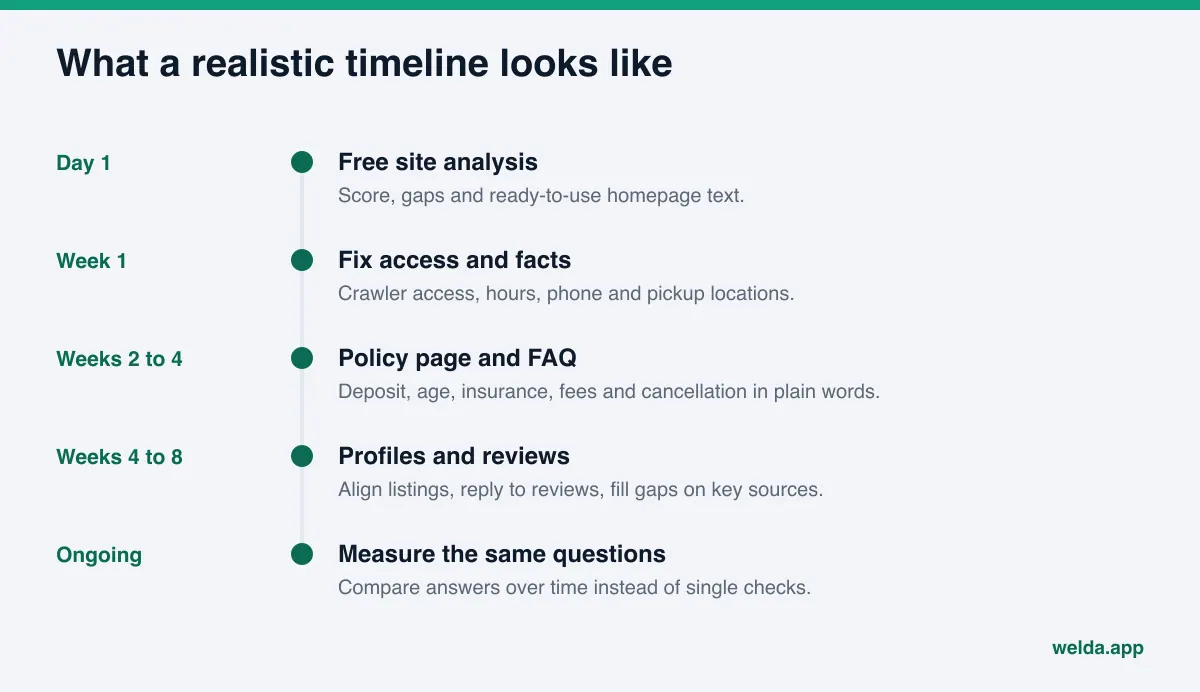
Decision guide and checklist for rental agencies
If you are not sure where to begin, find the row in the table below that sounds most like you today.
| Where you are today | First move | Next |
|---|---|---|
| No website, only a Google Business Profile | Complete the profile with pickup options and hours | Build a simple site that states your policies |
| One-page site with a booking widget | Add pickup, fleet and policy sections | FAQ and AutoRental schema |
| Site and listings show different hours or phone | Make one set of facts match everywhere | Re-run the analysis to confirm |
| Facts are complete but you are not named | Measure regularly to see which questions you miss | Focus on the source a competitor wins on |
For a parallel example from another local trade, our guide on how plumbers get recommended by ChatGPT shows the same logic applied to emergency service calls.
Frequently asked questions
Does ChatGPT favor the big rental brands?
Organic answers rely on information the engine can read and confirm. Large brands often have more of it online, but an independent agency with clear, consistent facts gives the engine something to work with. Clarity raises the odds; it does not guarantee a mention.
Do I really need to publish my debit card and deposit rules?
Renters ask AI those exact questions. An agency that does not state its rules cannot be named in those answers. Explaining the method, even without exact amounts, already helps.
Should my airport location and my downtown branch have separate pages?
If each has its own address, hours and pickup process, giving each its own section or page, plus its own profile, makes it easier for an answer engine to tell them apart.
Do I need to be on Yelp and Tripadvisor?
Answer engines may use them as sources. Measure first to see which sites matter for your questions, then make sure your details there are accurate and current.
How long until I see results?
New content usually takes weeks to be reflected in AI answers. Starting before your busy season gives it time to settle.
Can I start with Welda in the US today?
The free site analysis works in English today. The full dashboard is in early access and is opening first in Turkey; pricing and access are discussed in an early access call.
Start with the free analysis
The quickest way to see how your rental agency looks to an answer engine is to have your site read. The free site analysis gives you a score out of 100, what to do about each gap, ready-to-use homepage text and a fix package you can add to your site. It is free once per site; the results link arrives by email and stays open for 14 days. Your pickup options, policies and fleet are already decided. What is left is writing them down so an AI can read them.