How do you get a new business found in ChatGPT? An AI assistant can only recommend a business it can read about, and a business that just opened has almost nothing written about it yet. Your first job is to create that record: one consistent name, address and phone number, a verified Google Business Profile, a website that plainly says what you do, and then real reviews and directory listings. This guide walks through the first 90 days in order.
When you open a new coffee shop, dental office, salon or boutique inn, some of your future customers will never type your category into a search box. They will ask ChatGPT, Gemini or Perplexity: "Where can I get coffee open late near downtown?" or "Which dentist near me is good with nervous kids?" The answer names three or four businesses. Competitors that have been around for years land on that list easily because the web is full of information about them. The business that opened last month usually does not. That is not a verdict on your service. It is a footprint problem. The work of fixing it is called AEO (answer engine optimization), or AI search visibility; you may also see it called GEO, short for generative engine optimization, which means the same thing. The best starting point for a new business is to see what your website tells AI today. You can get a baseline in your opening week with a free AI visibility analysis of your site.
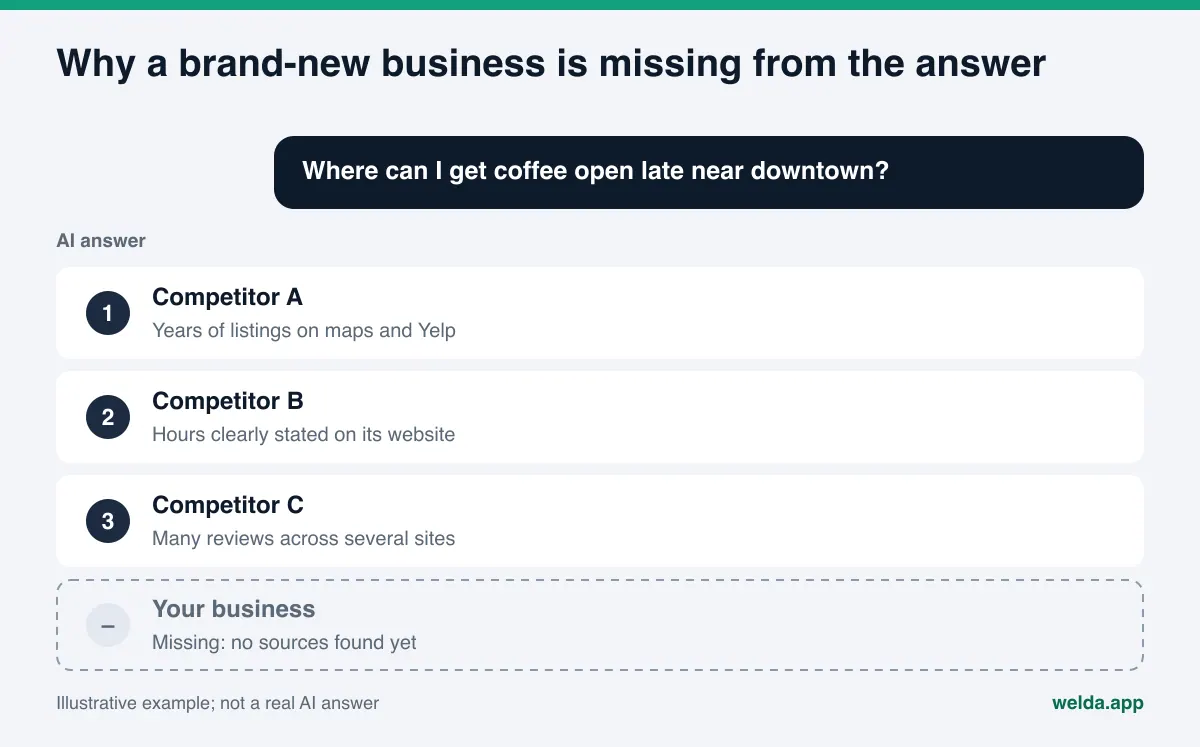
Why a new business does not show up in ChatGPT right away
ChatGPT and similar assistants draw on two things when they recommend a business. The first is the large body of text the model was trained on. That body is frozen at a certain date, so it does not include businesses that opened recently. The second is web search: the assistant takes the question, searches the web, reads the pages it finds and builds the answer from them. For a new business, the second path is the one that matters. If the search step cannot find you, the answer cannot include you.
For search to find you, several things have to be true at once. Your website has to be crawled and indexed. AI crawlers have to be allowed onto your site. Your map listing has to be verified. And your name has to appear on other sites, not only your own. An established business accumulates all of this over years without trying. A new business starts with none of it and has to build each piece on purpose.
Then there is time. A page you publish today usually takes weeks to show up in AI answers. It has to be crawled, indexed and cross-checked against other sources. That is why starting before opening day, rather than waiting until traffic is slow, is the most efficient path.
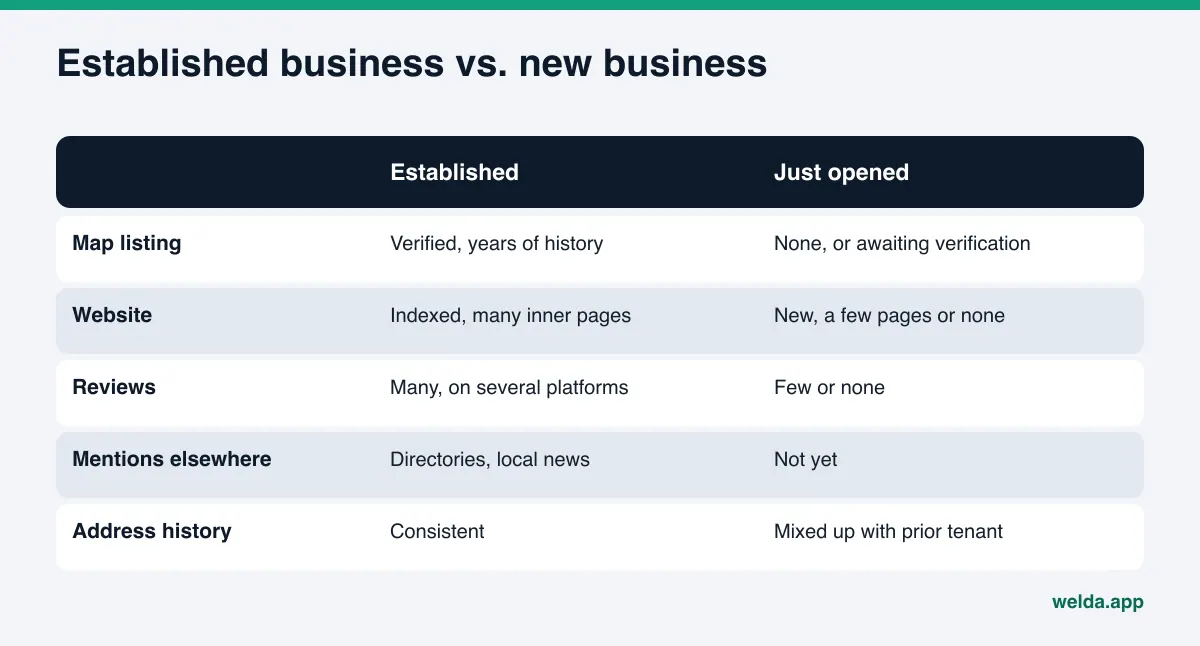
The bigger risk for a new business: being identified wrong
Being invisible is frustrating. Being described incorrectly costs more. Three situations come up again and again with businesses that just opened.
- The previous tenant. Another business used to operate at your address. Its listing is still on Google Maps and Yelp, and its phone number is still in directories. An assistant asked about that address may describe the old business or say the location is closed.
- The name that changed. You used one name during build-out and switched before opening. Instagram shows one name, the sign shows another, the website a third spelling. An assistant may not connect these as the same business.
- The name twin. A business with the same name operates in another city or state. If your city and neighborhood are not stated clearly, the answer may describe the other one.
The fix in each case is the same: write your name, address and phone number identically everywhere and correct old records. We cover the details in wrong address or phone number in AI answers. For a new business this is far easier than it will be later, because very little wrong information has spread yet.
What does AI need to know about a new business?
When an assistant answers a customer's question, it looks for a handful of basic facts. The table below lists them, where they should live, and what new businesses most often leave out.
| Fact | Where it should live | Often missing at a new business |
|---|---|---|
| Name, address, phone | Website, Google Business Profile, Apple Maps, social profiles | Different spellings, prior tenant's listing |
| What you do | A separate description for each service on your site | A one-line "our services" list |
| Who you serve | The opening paragraph of your homepage | A slogan with no concrete facts |
| Hours | Map listings and website | Soft-opening hours never updated |
| Location and access | Written out as text on your site | Only an embedded map, no written address |
| Trust signals | Yelp, Google reviews, BBB, licenses, team info | No reviews at all |
| Common questions | A dedicated FAQ section | None |
Assistants compare these facts against each other. If your site says "open until 10 p.m." and your Google listing says 6 p.m., the model cannot tell which to trust and may choose not to recommend you at all. Hours deserve special attention in the first weeks, because they change often after opening. See keeping business hours accurate for AI. Apple Maps is one more place your address and hours live, so claim it early; we explain the setup in Apple Business Connect for AI assistants.
How to get a new business found in ChatGPT: the first 90 days, step by step
The order below moves from the most basic facts outward to outside sources. Each step builds on the one before.
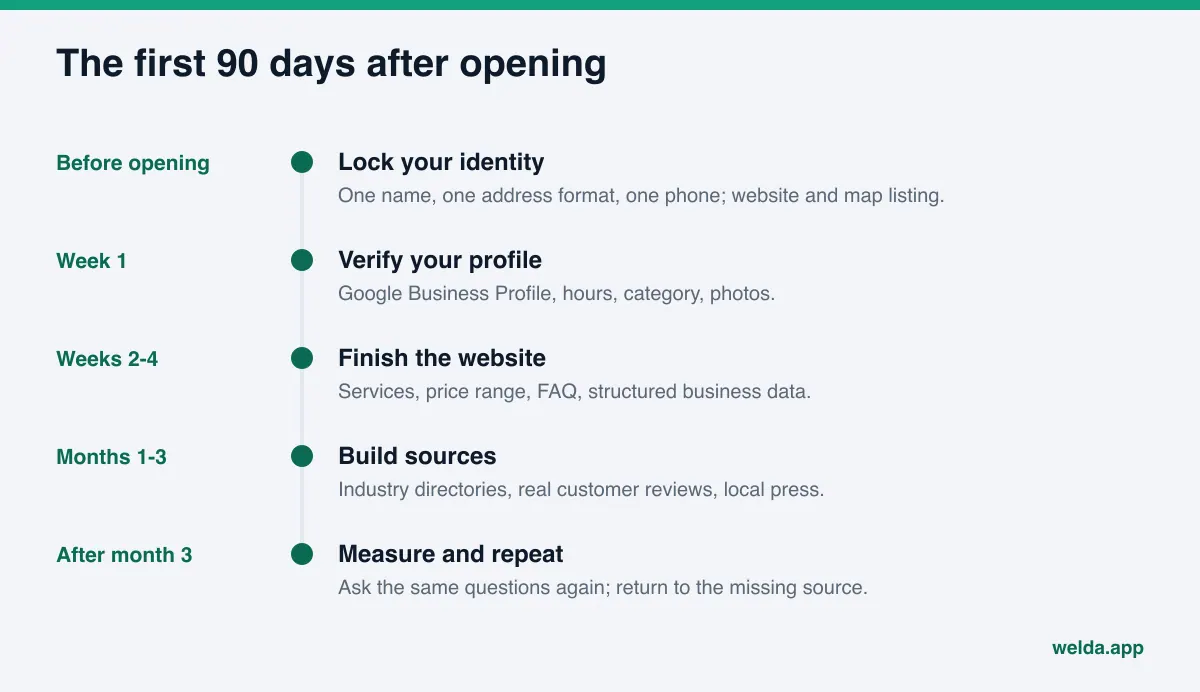
- Lock your identity (before opening). Decide on your legal name, the name on your sign and any short form, once. Pick one format for the address (suite numbers included or not, street abbreviations or not). Use one main phone number. Write these down and copy them exactly into every listing.
- Create and verify your Google Business Profile. For local questions, AI answers often rely on map data. Google decides which verification method you can use based on factors such as business type and region, offers options like phone, email and video, and says reviews usually take up to five business days, according to its Business Profile help page on verification. If the previous tenant's listing is still live at your address, report it as closed or request ownership at this stage.
- Build a website AI can read. In the first paragraph of your homepage, say in plain sentences what you do, where you are and who you serve. Give each service its own page or at least its own section. Put your address and phone in text, not inside an image.
- Open the door to crawlers. Many new sites are set to block search engines while under construction, and the setting is forgotten after launch. Check your robots.txt. OpenAI's crawler documentation explains that OAI-SearchBot is the bot used to surface sites in ChatGPT search, and that robots.txt changes can take about 24 hours to apply there.
- Add structured business data. Schema markup states your name, address, hours and business type in a format machines read without guessing. On a new site this is a one-time task.
- Write an FAQ section. Note the first ten questions people ask on the phone or at the counter: Is there parking? Do I need a reservation? Do you take walk-ins? Is it kid-friendly? Answer each in two or three sentences. To find out what customers actually ask, use the method in finding the questions customers ask AI.
- Link your profiles. Link from Instagram, Facebook and your map listings to your website, and from your website back to them. These links show that records in different places belong to the same business.
- Get listed on outside sources. Claim your Yelp page. Join the directories for your industry, such as Angi for home services, Healthgrades for medical practices or Tripadvisor for hospitality. If you are eligible, a BBB profile adds another trusted record. A write-up in a local paper or neighborhood blog about your opening is a source AI can read as well.
- Ask for real reviews. Ask satisfied early customers to leave a Google or Yelp review. Do not buy reviews or have friends and staff write them. In August 2024 the FTC announced a final rule banning fake reviews and testimonials, including buying them; this is not legal advice, so check the rule itself or ask counsel if you are unsure.
- Measure and repeat. At the end of month three, ask the questions your customers would ask. Which ones now mention you? Which still do not? Where you are missing, look at which sources the assistant used for the competitor it recommended.
Short on time: what comes first?
In opening week, an owner is busy with staff, suppliers and the first customers. Doing all ten steps at once is not realistic. One question sets the priority: does AI know you, and does it know you correctly?
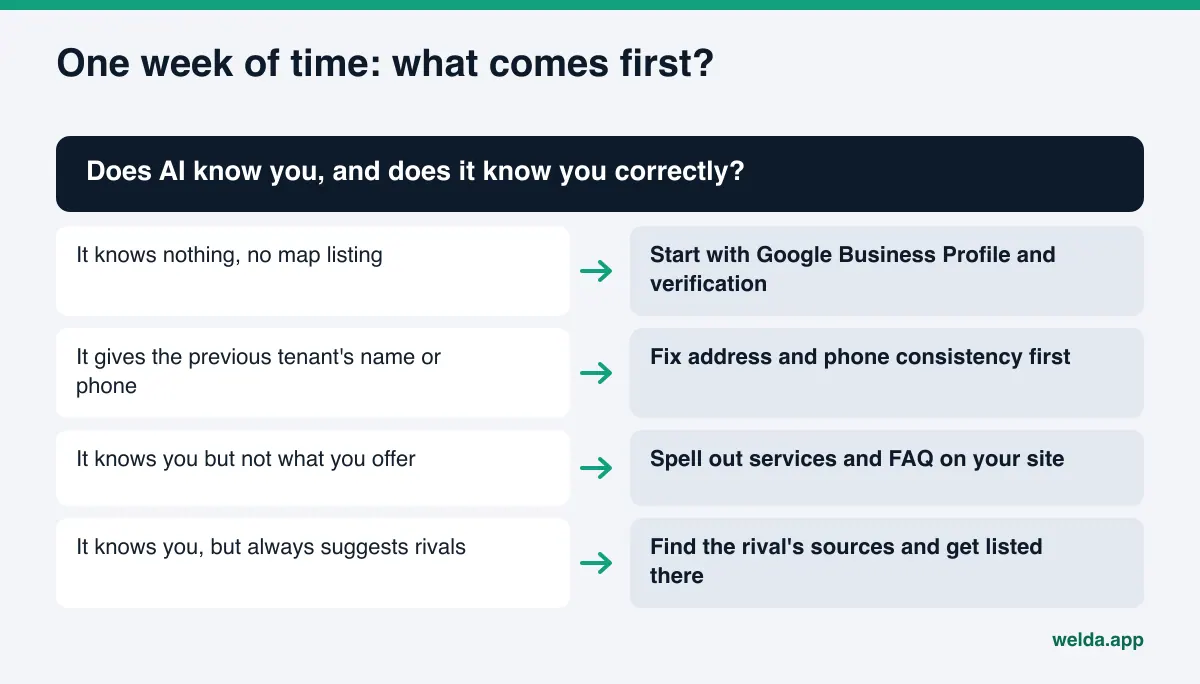
To answer it, ask ChatGPT what it knows about your business name and city. If it knows nothing, your map listing and website come first. If it gives the previous tenant's name or a wrong phone number, fix consistency first; publishing new content now only spreads the error. If it knows you but calls you a bakery when you are a coffee shop, go back to your service descriptions. If it knows you but recommends competitors for every neighborhood question, look at where those competitors are mentioned. Usually what you are missing is a presence on those same sources.
Example: the first month of a new coffee shop
To make this concrete, here is an example scenario. It is made up and does not describe a real business. An example coffee shop is opening in a mid-sized US city, in a storefront that used to be a dry cleaner. The owner starts two weeks before opening.
Before opening. The owner settles the name first. The sign uses a short name; the LLC has a longer legal name. Customers will search for the sign name, so that name goes on the website title, Google Business Profile, Yelp and Instagram, with the legal name only in the site footer. The dry cleaner's listing is still live on Google Maps; the owner reports it closed and creates a new listing.
Opening week. The website has four pages: home, menu, about, contact. The homepage opens with a paragraph like this (sample text): "We are a neighborhood coffee shop two blocks from Main Street, open weekdays 7 a.m. to 9 p.m. We serve drip coffee, espresso drinks and pastries baked each morning. There is seating for 20 and work tables with outlets." That paragraph gives an assistant what it looks for in questions like "open late," "good for working" or "near me." Menu prices are written as text, not inside a photo.
Weeks two and three. The owner keeps a notebook at the register for questions customers ask: oat milk, dogs on the patio, Wi-Fi, group orders. Those become the FAQ. The same week, structured business data is added and robots.txt is checked; the site builder had left search engines blocked during setup, and the setting is turned off.
Week four. Happy early customers get a small card at checkout asking for an honest Google review. The shop is added to a local "best coffee" roundup that accepts submissions. Instagram links to the site and the site links to Instagram.
The point to notice: at the end of month one, the shop may still not appear in ChatGPT. That is not failure. What exists by then is accurate, consistent information that AI will read over the following weeks. Judge the result in month three, by asking the same questions again.
The same logic applies in other industries, with different priorities. A new dental practice leans on provider credentials, services offered and Healthgrades. A new inn depends on Tripadvisor and booking-site profiles. A new contractor needs service areas, licenses and Angi or BBB records. Whatever the industry, the first step is the same: one correct identity.
How Welda handles AEO for a new business
Welda is software that measures where a business appears in AI answers and prepares the missing pieces on the business's behalf. For a business that just opened, three parts matter most.
A baseline in your opening week. The free site analysis reads your homepage and a few inner pages (services, about, contact and similar) the way Google and AI do, and gives a score out of 100. On a new site the score is usually low; what matters is why. For each gap, the report says what it found, why it matters and how to fix it. Typical findings for new businesses: a robots.txt block left over from the build, an address and phone that only appear in an image, no structured business data, no FAQ section. The analysis also suggests a ready-to-use title, description and opening paragraph for your homepage and gives you a fix package to add to your site. It asks an AI assistant with web search five questions your customers might ask, once, and checks whether your name appears. For a new business, not appearing in any of the five is normal. That check is the starting point you compare against three months later.
Asking instead of guessing. Most facts about a new business are not written down anywhere yet: the founding story, the owner's name, capacity, which service runs on which day. In the Welda panel, the to-do screen starts with a section of information Welda needs from you. Anything it could not read from your site appears as an empty field. Welda does not fill it with a guess. You type it once and it flows into every piece of text Welda prepares. For a new business, that means the first facts AI reads about you are facts you approved, not assumptions you will have to correct later.
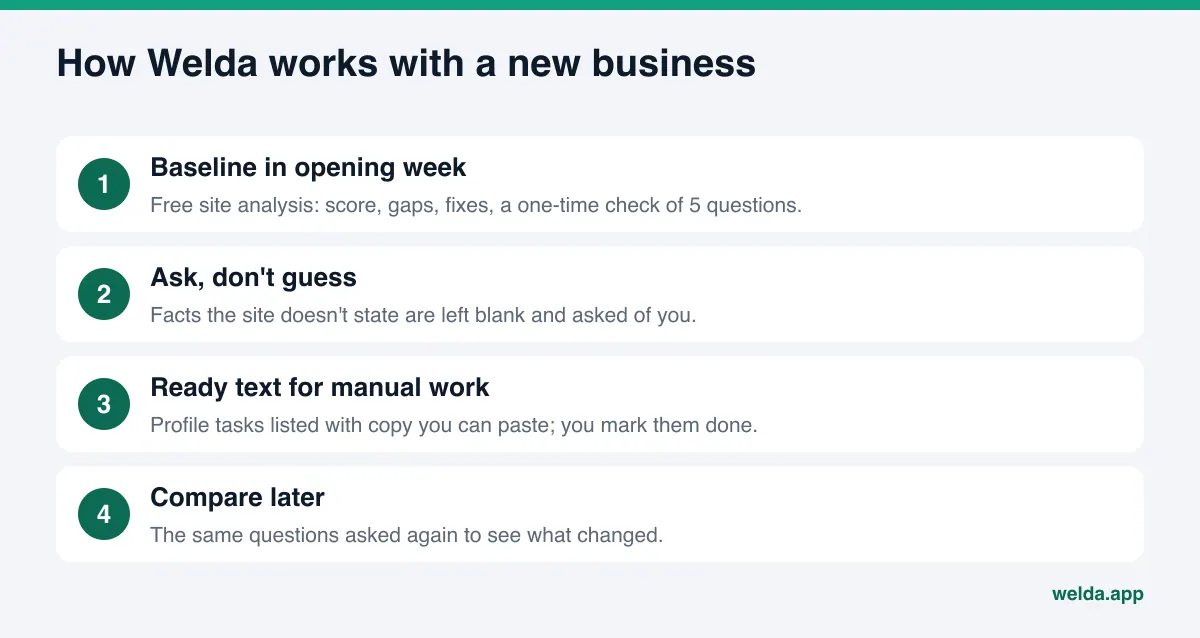
Ready text for the manual work. Much of a new business's work is creating and filling out profiles. Google Business Profile, Instagram and Facebook can be connected to Welda; if they are not, the task is listed as manual with ready-to-paste text next to it. Directory and booking profiles without a publishing API appear the same way. Verification, account ownership and submitting stay with you; Welda writes the text and you mark the task done.
Later, the panel helps you follow progress: the questions screen shows, question by question, whether ChatGPT, Gemini, Perplexity and Google AI mention you, with each question asked three times. A before-and-after view sets opening week next to month three.
An honest note on availability. The free site analysis works in English and anyone can use it today. The full Welda panel is in early access and is opening first in Turkey; regular four-engine measurement is being added during early access, and the sample screens in the panel use representative data. Pricing is discussed in an early-access conversation.
Limits: what Welda does not do
A new business is impatient. Opening costs are real and customers need to come in. So it is worth being clear about what cannot be promised.
- No guarantees. Welda does not guarantee rankings or that you will "show up in ChatGPT." AI answers vary from one query to the next, and no software controls them.
- Time cannot be skipped. New content usually takes weeks to show up in AI answers. In month one, focus on building the foundation correctly rather than expecting results.
- No fake reviews. Welda does not generate reviews. It can draft replies to reviews, but the reviews themselves have to come from real customers.
- No invented facts. Welda does not guess your prices, hours or services; it asks you.
- Some work stays with you. Verifying map listings, opening directory accounts, handling negative reviews and press outreach belong to the business. Welda prepares text and lists, but does not submit them.
New business AEO checklist
Go through this list twice: once before opening and once a month after. Each item is one-time work that keeps paying off once it is done right.
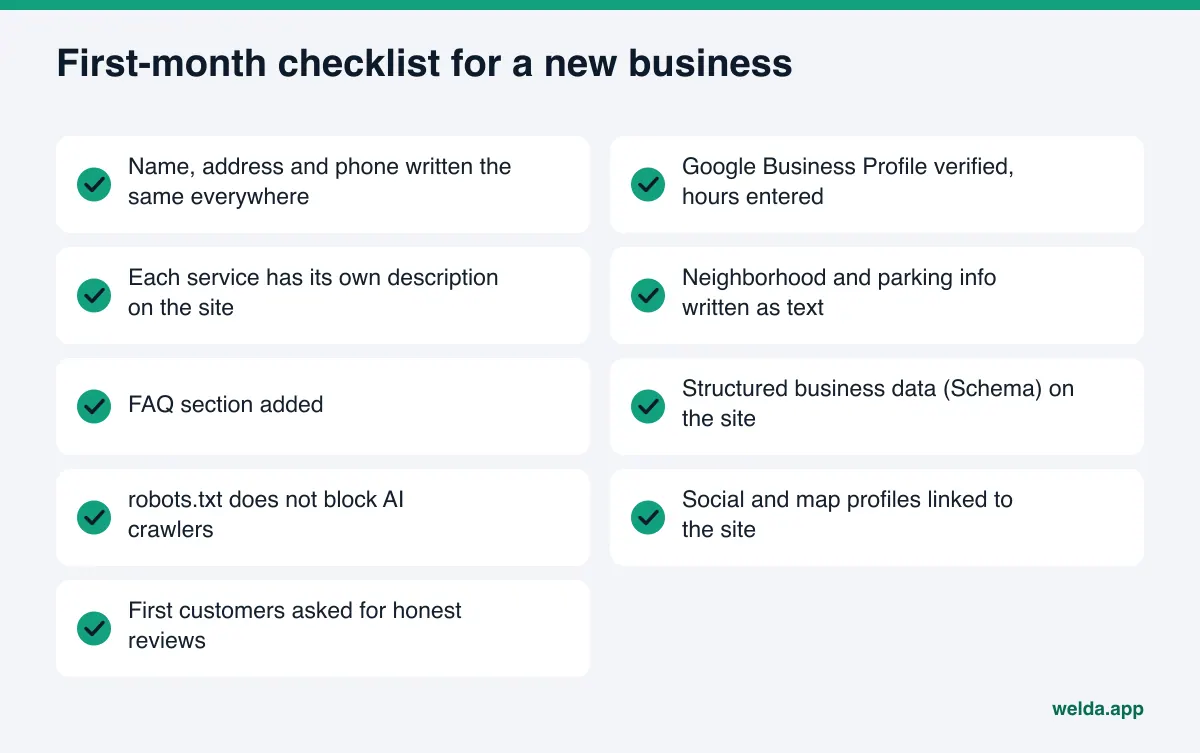
After you finish, keep two habits. When something changes (hours, phone, services), change it everywhere on the same day. And if you plan to open a second location, each location needs its own listing and its own page; see multi-location AEO.
Frequently asked questions
How long does it take for a new business to show up in ChatGPT?
There is no fixed timeline. New content usually takes weeks to be reflected in AI answers, and verifying your map listing, getting your site crawled and building outside sources all add to that. A realistic expectation is to look for first results within a few months.
I only have an Instagram account, no website. Is that enough?
Instagram plus a verified Google Business Profile is a start, but not enough. AI reads your services, hours and answers to common questions most easily from a plain-text website. Even a simple site with a few pages makes a real difference.
AI keeps describing the business that used to be at my address. What should I do?
Report the old listing as closed on Google Maps and Yelp, verify your own listing, and state your address clearly alongside your name on your site. Ask directories that still show the old tenant to update. These changes also take time to reach AI answers.
Will running ads get my new business into ChatGPT?
Search ads and AI answers are separate systems. Appearing in an AI answer depends on readable, consistent information about you being available on the web.
Does a free analysis say anything useful about a brand-new site?
Yes. The analysis reads the site itself, not rankings: crawler access, title and description, structured data, address and phone, FAQ. On a new site, those gaps are the easiest ones to fix.
How can I check progress myself?
Write down five to ten questions your customers would ask and ask the same ones the same way every month. Do not judge by a single answer; answers vary between queries. Asking each question a few times and noting how often your name appears gives a more reliable picture than one screenshot.
Does it make sense to start before opening day?
Yes. Settling your name, address and phone, building the site and creating your map listing can all happen before you open. By opening day the information is in place, and the weeks of waiting start sooner.
Get your baseline in opening week
For a new business, the most valuable number is where you stand today. When you repeat the check three months later, you can see what worked. Run the free site analysis to see what your site tells AI, which gaps to fix first and suggested homepage copy, in a few minutes. It is free once per site, and the results link arrives by email.