What does AI visibility software for roofing companies actually do? It checks whether your company gets named when homeowners ask ChatGPT, Gemini, Perplexity or Google's AI Overviews about a leaking roof, a replacement or storm damage. It shows which competitor gets named instead and why, and it drafts the missing information for you to approve. You stay in charge of what gets published.
Roofing jobs start with a problem nobody planned for. A hailstorm rolls through, a water stain spreads across the ceiling, shingles end up in the yard after a windstorm. A few years ago the homeowner searched Google Maps or asked a neighbor on Nextdoor. Today a growing number of them type the whole situation into an AI assistant: "Who's a reliable roofer for hail damage near me who can come out this week?" What comes back is not a page of links. It is a short answer naming two or three companies. AI visibility software for roofing companies exists for that moment: it tells you whether you are on that short list, and what is missing if you are not. The discipline is usually called AEO, answer engine optimization. You will also hear GEO, generative engine optimization; in practice it is the same work, as the comparison of GEO vs AEO explains. If you want a baseline before reading on, the free site analysis reads your website the way Google and AI do and gives you a score.
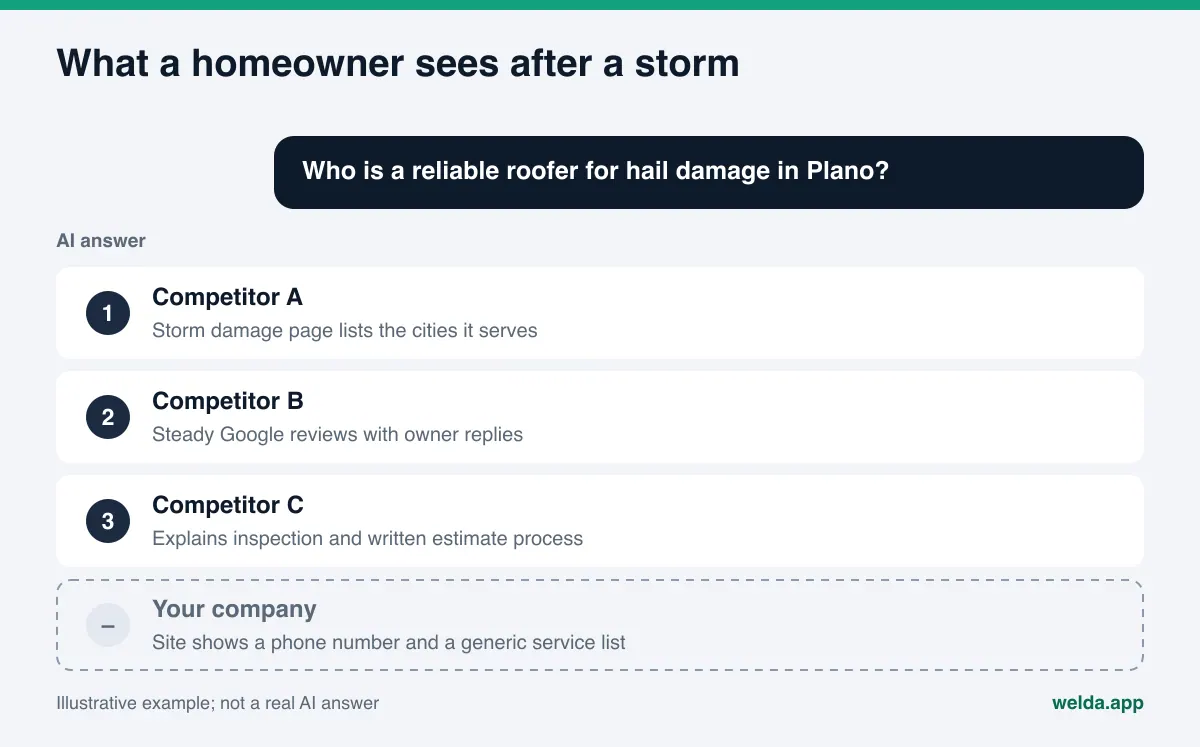
What homeowners ask AI about roofing
Roofing questions fall into a few predictable groups. Writing them down is the first real step of roofing AEO, because every page you write afterwards should answer at least one of them. The examples below are typical patterns written for this article, not measured data:
- Urgent: "roof leaking during rain who can come today", "emergency tarp service near me", "tree branch went through my roof what do I do first"
- Storm and insurance: "how do I know if I have hail damage", "should I call my insurance company or a roofer first", "what does a roofer do during an insurance inspection"
- Repair or replace: "repair or replace a 20-year-old shingle roof", "metal roof vs asphalt shingles", "flat roof options for a commercial building"
- Cost: "what affects roof replacement cost", "do roofers charge for inspections"
- Trust: "how to tell if a roofer is legit", "does a roofer need a license in Texas", "questions to ask before signing a roofing contract"
Notice how many of these are "how" and "what should I check" questions rather than "who" questions. When an AI answers "how to tell if a roofer is legit," it often lists checks and may cite a source. A roofer whose site explains its own inspection, estimate and warranty process plainly gives the AI something to quote, and a natural business to name in the same answer.
Why AI search visibility works differently for roofers
Several things set roofing apart from other local services, and each one changes how AI reads you.
You work at the customer's address, not yours. Most roofing companies do not receive customers at an office. Google treats them as service-area businesses: its guidelines for service-area businesses say to remove the address from your Business Profile if you don't serve customers there, and to define service areas instead. Without a storefront, the only reliable signal of where you work is what you write. A roofer whose site just says "serving the DFW area" gives AI little to work with when someone asks about Frisco or McKinney specifically.
Storm chasing has made homeowners cautious. After major storms, out-of-town crews knock on doors. The FTC's advice for homeowners after weather emergencies is blunt: get estimates from more than one contractor, confirm license and insurance, walk away from demands for cash up front and get a written contract. AI assistants tend to fold this caution into their answers. When they do name companies, they lean toward businesses with a consistent local presence, steady reviews and a clearly described process. That is not a guarantee of anything, but it tells you which information does the work.
The job is expensive and rare. A homeowner replaces a roof maybe once or twice in the time they own a house. They rarely know a roofer already, so they research. As AI becomes the first stop in that research, a company that is missing from the first answer often never makes the list of three estimates.
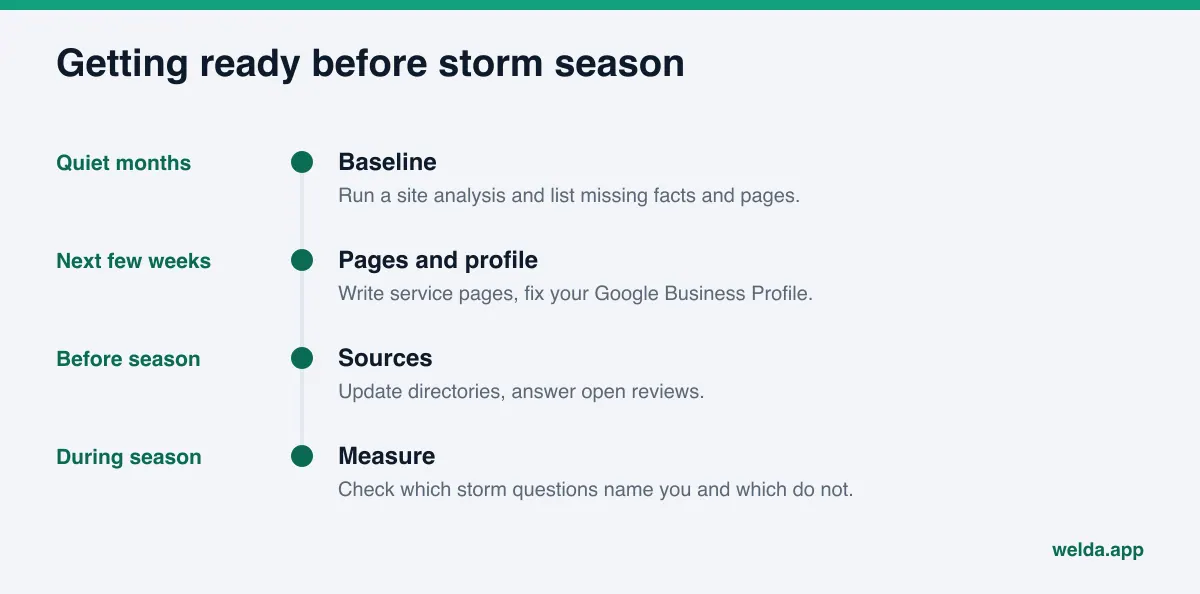
Demand is seasonal and sudden. Hail and hurricane seasons concentrate demand into a few weeks. New content usually takes weeks to show up in AI answers, so starting after the storm is starting late.
What AI looks at before naming a roofing company
AI assistants do not "know" your company. When a question comes in, they search the web, read what they find and assemble an answer. For your name to appear, three things have to be true at once.
Findable. Your site is open to AI crawlers. Small contractor sites sometimes block them in robots.txt without anyone noticing. Your Google Business Profile is verified and complete. Your name appears on the sites homeowners check for contractors: Yelp, Angi, the BBB, Nextdoor and local directories.
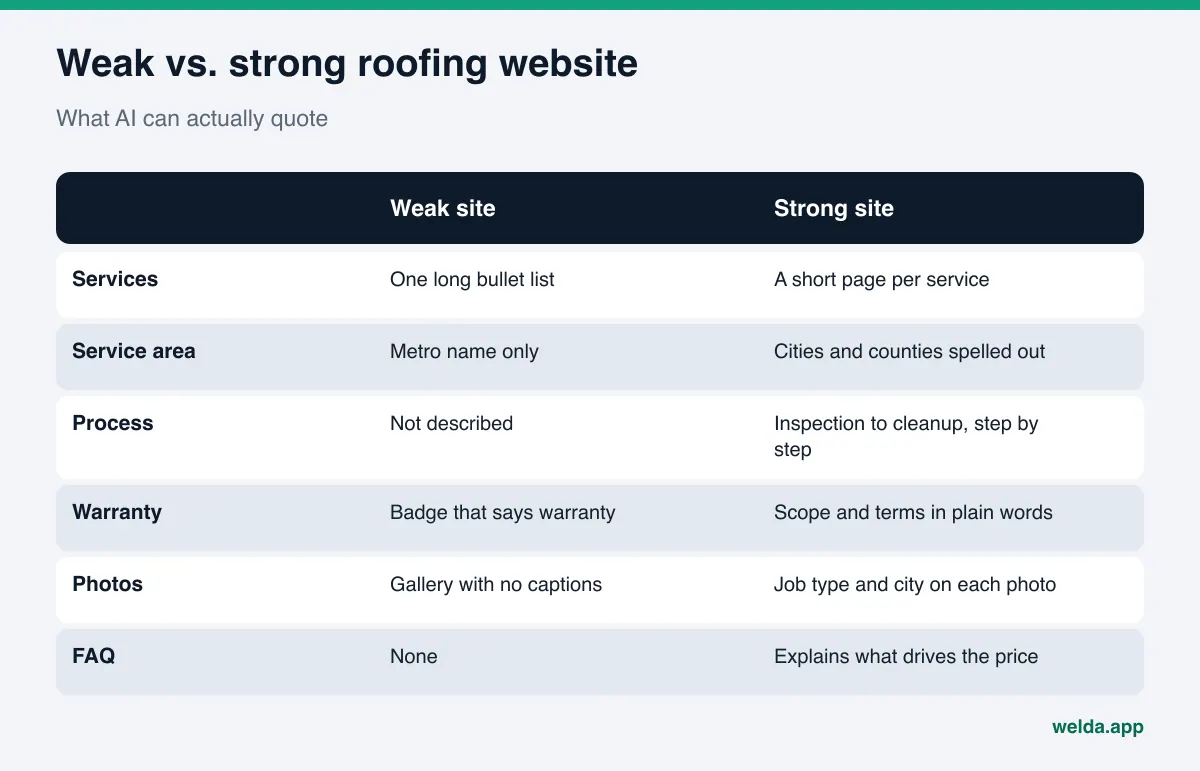
Understandable. AI handles plain sentences far better than images or slogans. "We replace and repair asphalt shingle, metal and flat roofs in Plano, Frisco, Allen and McKinney" can be quoted directly. A "Serving all of North Texas" banner image cannot. Separate service pages, an FAQ that answers real questions and structured business data (schema) all belong here.
Trustworthy. AI names a business more comfortably when the name, phone number and address match everywhere and the reviews show a real track record. Mismatched listings weaken that signal; NAP consistency for AI search covers the details.
Step by step: making your roofing company citable in AI answers
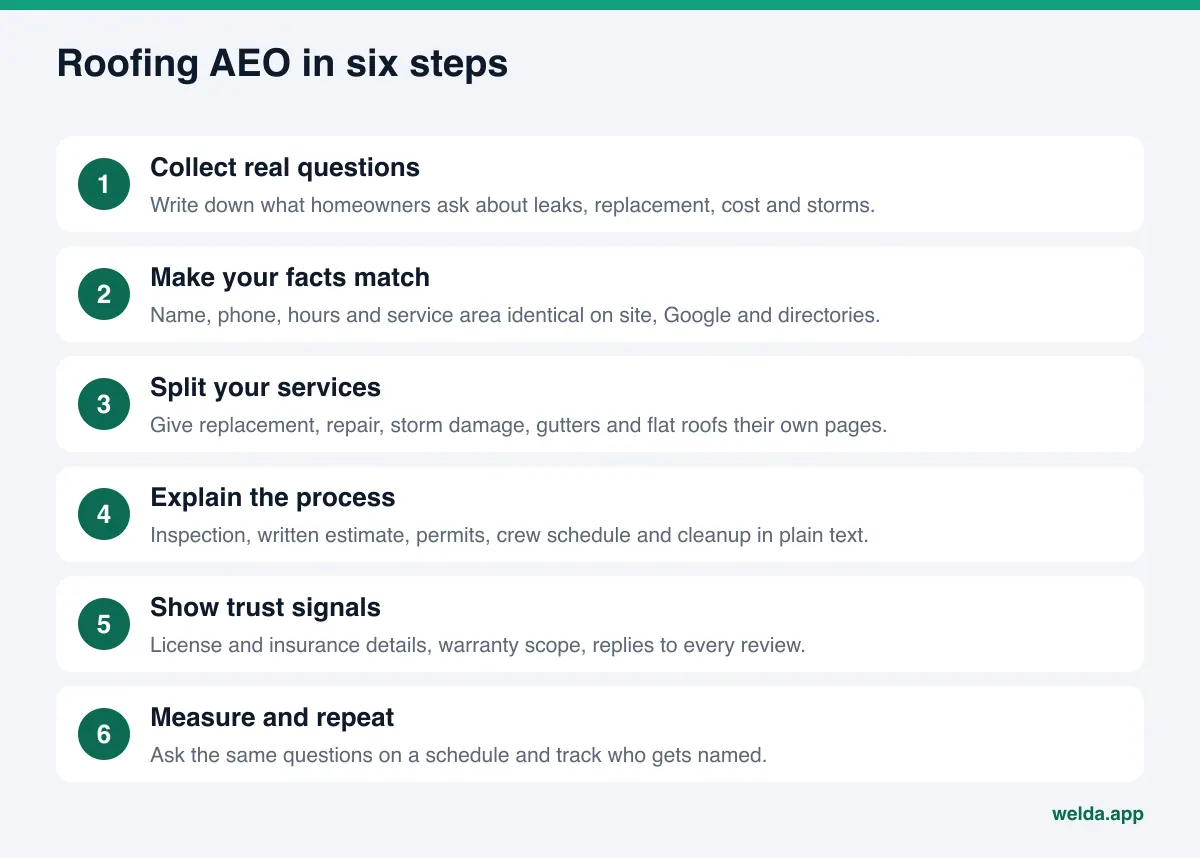
The order below is designed so a small roofing company can work through it in a month or two. Order matters: writing content on top of inconsistent listings is like laying shingles on a rotten deck.
- Collect real questions. Write down the fifteen questions you hear most on the phone and at inspections, in the homeowner's own words.
- Make your basic facts match. Company name, phone, hours and service area identical on your site, your Google Business Profile, Yelp, Angi, the BBB and any other listing. Old numbers on forgotten profiles are common.
- Split your services. Roof replacement, roof repair, storm and hail damage, emergency tarping, gutters, flat and low-slope roofs, commercial roofing if you do it. Give each one its own page or a substantial section.
- Write out your service area. List cities and counties by name. "DFW" or "Greater Houston" alone is too vague for questions that name a suburb.
- Explain your process. How an inspection works, how you write an estimate, who pulls permits, how long a typical job takes, how you protect landscaping and clean up.
- Show trust signals in text. License and insurance details where your state requires them, what your workmanship warranty covers and for how long, and a reply to every review.
- Measure. Ask the same questions on a schedule and record whether you are named, in what position and who is named instead.
Which roofing service pages should you write?
When AI looks for an answer to "flat roof options for a small commercial building," it tends to use a page that explains the subject, not a line in a list of twelve services. The table below shows what each page should cover. Leave out work you don't actually do; being named for a service you don't offer only creates bad calls.
| Service | Homeowner's question | What the page should say |
|---|---|---|
| Roof replacement | Repair or replace? | When repair is enough, what the inspection checks, the steps of a tear-off |
| Storm and hail damage | Do I have damage? | What you look for, how you document it, what you do and don't do with insurers |
| Emergency repair | Can someone come today? | What a temporary fix covers, which cities you reach, after-hours policy |
| Flat and low-slope roofs | Which system fits my building? | Systems you install, where each fits, weather limits on installation |
| Gutters | Clean or replace? | How you decide, materials offered, how gutters relate to roof leaks |
| Metal roofing | Is metal worth it? | Honest trade-offs, where you install it, how long installation takes |
Start each page with a direct two-sentence answer, then go into detail. AI often lifts those opening sentences. If you have a project gallery, caption every photo with the job type and city: "Allen, full tear-off and architectural shingles after hail." An uncaptioned gallery carries no information to an AI, however good the work looks.
On storm pages, be careful with insurance language. Describe what you actually do, for example documenting damage with photos or meeting the adjuster if the homeowner asks, and do not promise that a claim will be paid or that a roof will be "free." That kind of promise is exactly what consumer warnings tell homeowners to watch for.
Writing about price, warranty and trust without a price list
Roofing prices depend on the inspection, but cost is one of the most common questions. AI tends to cite companies that explain what drives the price, and you don't need to publish numbers to do that. Explain roof size and pitch, number of layers to tear off, decking repairs found during the job, material choice, access and permit requirements. Say whether inspections are free and that estimates are written.
Warranty language needs the same care. "Lifetime guarantee," "never leaks again" and "best roofer in Dallas" invite trouble with customers and with advertising rules. State instead what the workmanship warranty covers, for how long and under what conditions, and separate it clearly from the manufacturer's material warranty. Why superlatives cause problems is covered in best claims and advertising rules in AI content. This is not legal advice; have your warranty wording reviewed by a lawyer.
Reviews are the third leg. Roofers tend to get fewer but longer reviews, because the job is big and customers describe it in detail. A calm, specific, signed reply to a negative review can change how AI summarizes your company. Negative reviews in AI answers goes deeper.
Outside sources: where AI reads about roofers
AI does not build its answer from your website alone. For home services, it commonly draws on Google Business Profile and Maps reviews, Yelp, Angi, the BBB, Nextdoor discussions, local news coverage after storms and trade or manufacturer directories. The work on these sources comes in three kinds: create the listing if it doesn't exist, align it with your site if it does, and answer reviews and complaints.
Which directories are worth the time is discussed in business directories for AI visibility. Honesty matters here: opening directory accounts, handling complaints and press work remain your job. Software can show you where you are missing and draft what to write, but it does not log into those accounts for you.
How Welda handles AEO for a roofing company
Welda is software that measures where a business appears in AI answers and prepares the missing pieces on its behalf. Here is the honest status first. The Welda dashboard is in early access and is opening first in Turkey. Regular tracking across four AI engines is being added during early access, and the sample dashboard screens use illustrative data. What anyone in the US can use today is the free site analysis, which runs in English. The question language in the dashboard can be set to English or Turkish. Pricing is not published; it is discussed in the early access conversation. With that said, here are the three parts that matter most to a roofer.
Question-by-question tracking and the competitor view. Take an example roofing company: a small crew covering five suburbs, doing replacements, storm repairs and flat roofs. Welda builds the questions a homeowner would ask ("hail damage roofer in Frisco", "what affects roof replacement cost") and asks each one three times on ChatGPT, Gemini, Perplexity and Google AI. The repeats matter because AI answers vary from one run to the next. For each question, the roofer sees whether the company was named and in what position. The competitor view goes further: it shows on which group of questions a competitor wins and which sources it is being cited from. Seeing that Competitor A gets named on storm questions because of its Angi reviews leads to a specific decision: are you missing from that source, or does your own site never explain storm work at all?
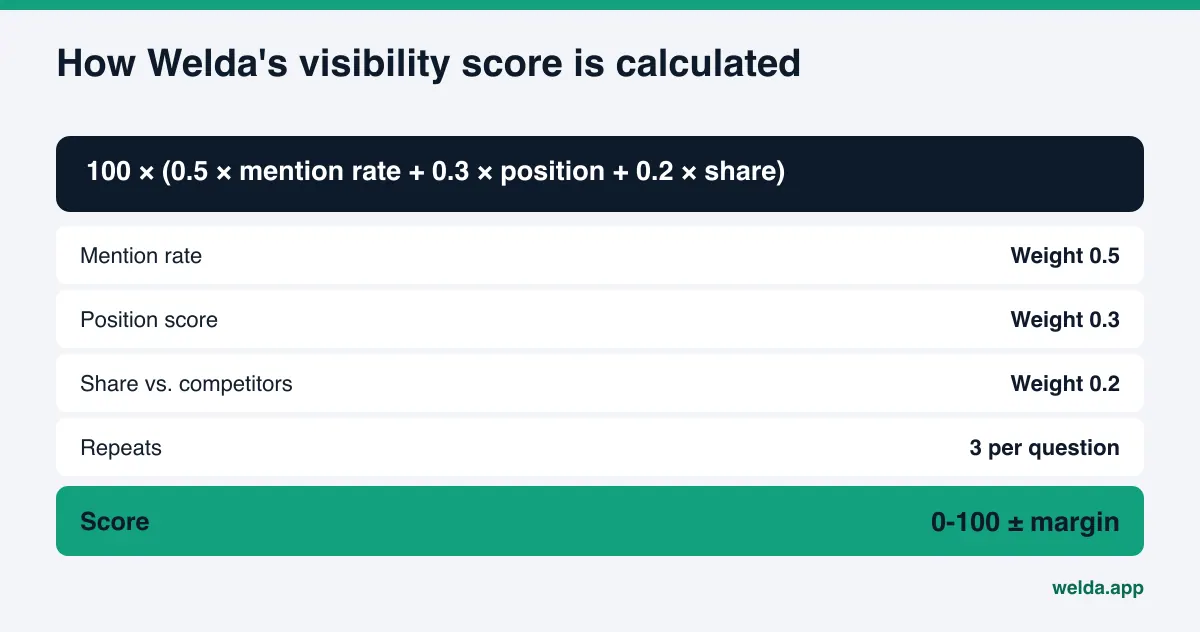
The score formula is published, as shown above. The ± margin comes from the variation across the three repeats, so a normal week-to-week wobble does not look like a real change.
One to-do list, with copy attached. When tracking shows a gap, Welda turns it into an item on a single to-do list. For a roofer, it might read: "No storm damage page; draft attached," "Service areas missing on Google Business Profile; description ready," "Two recent reviews without a reply; reply drafts ready." Welda does not invent facts. If your site doesn't say how long your workmanship warranty runs or which counties you cover, Welda asks you instead of guessing, and leaves the field empty until you answer. In roofing that matters: a wrong warranty term on your site becomes a dispute later.
Approval before anything goes live. If your site runs on WordPress, Welda connects through a separate Editor user and an application password, with no code to install. The storm damage page it drafts opens on your site as a draft; it goes live when you approve it. On other systems Welda hands you a ready package and the change is made by hand. Google Business Profile, Instagram and Facebook can be connected; if they are not, the task stays on the list as manual. Content always lives on your own site; Welda does not host it. Before anything is published, a compliance check flags patterns such as guarantees and superiority claims. It is a flag, not legal advice, and it has not been reviewed by legal counsel.
The dashboard also includes a sources view, a before-and-after comparison and a one-page monthly report.
Limits: what Welda does not do
Knowing what to expect from AI visibility software prevents a bad purchase. Welda does not:
- Promise rankings or placement in ChatGPT. Nobody controls AI answers. Welda measures, shows the gap and drafts the fix; the engines decide.
- Write facts it doesn't know. Warranty terms, licenses, materials and service cities come from you.
- Publish without approval. Sign-off stays with your company.
- Create fake reviews. It drafts replies to reviews; it never writes reviews.
- Do the account work for you. Talking to an unhappy customer, opening directory accounts and press outreach stay with you.
And there is timing. New content usually takes weeks to show up in AI answers. Work started the week after a hailstorm may not help that season.
Choosing AI visibility software for roofing companies: a checklist
Before buying any tool, check your own foundation. If most gaps are on your site and profiles, closing them will do more than tracking.
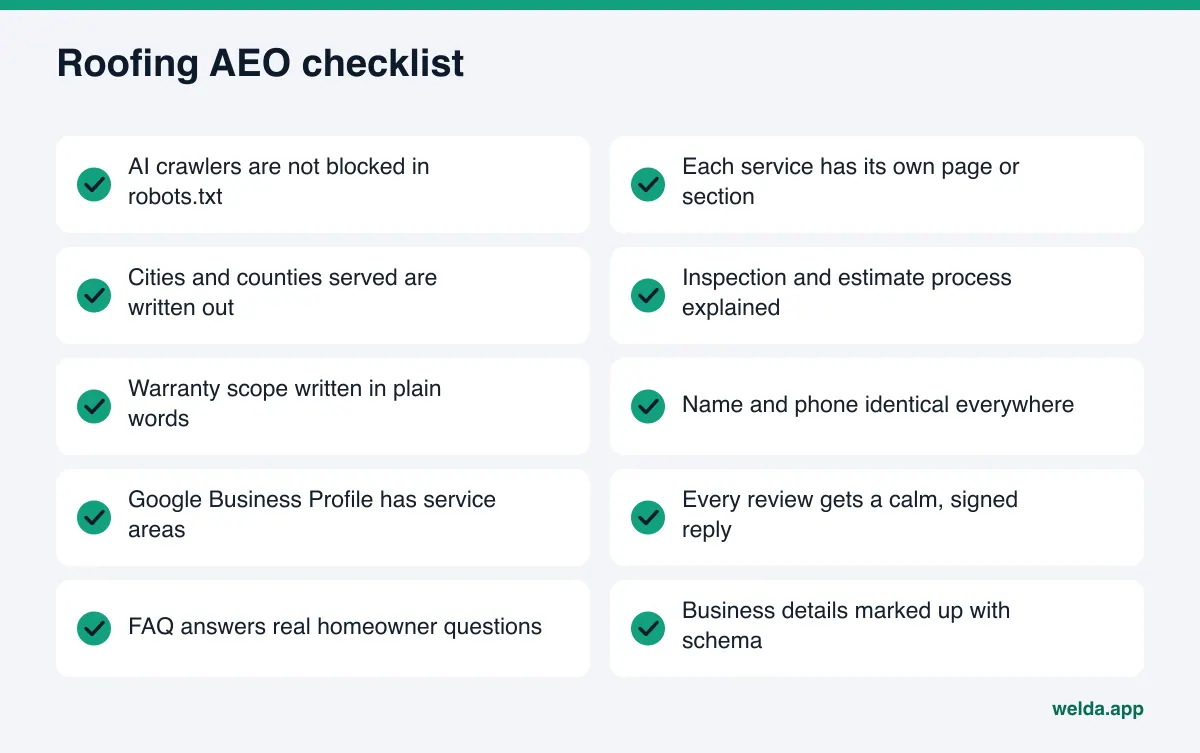
Questions worth asking any vendor:
- Which AI engines are checked, how many times per question, and is the scoring formula published?
- Are questions built around your cities and your services, or generic?
- Does it only report, or does it also draft the fix?
- Who approves publishing, and where does the content live?
- What happens when information is missing: does it ask or guess?
- Does it show which source a competitor is winning from?
If you are weighing whether to check AI answers yourself, manual ChatGPT checks vs tracking tools compares the two approaches. Timing matters too:
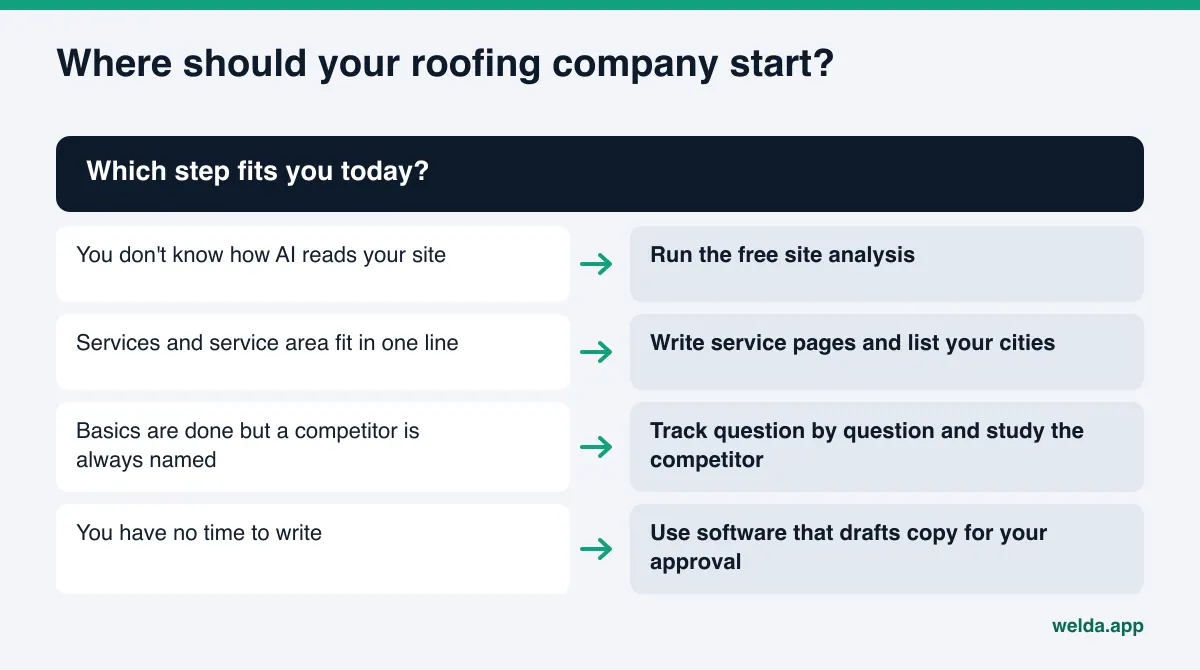
And a quick way to decide where to begin:
Frequently asked questions
Is AEO for roofers different from regular SEO?
Partly. A fast, crawlable, well-written site helps both. The difference is that AI builds a single answer and reads reviews, directories and forums alongside your site. Service area, process and trust information carry more weight.
I don't have an office customers visit. Can I still show up?
Yes. Set up your Google Business Profile as a service-area business with defined service areas, and list the same cities and counties in plain text on your site.
Do I need to publish prices?
No. Explaining what drives the price and how your estimate works is usually enough for AI to use your page on cost questions.
Will Welda get my roofing company to the top of ChatGPT?
No one can promise that. Welda measures where you are named, shows why a competitor is ahead and drafts what is missing. The AI's answer is the engine's decision.
How long until changes show up?
New content usually takes weeks to be reflected in AI answers, which is why the quiet months before storm season are the right time to start.
What does the free analysis show?
It reads your homepage and a few inner pages such as services and contact, and checks AI crawler access, business details and schema, how clearly services are described, FAQ content and page speed. You get a score out of 100, an explanation and fix for each gap and suggested homepage copy. It also asks an AI assistant with web search 5 questions customers might ask and checks whether your name appears. It is a one-time snapshot and does not measure rankings.
See where your roofing website stands today
The first step for any roofing company is knowing how your website reads to AI right now. The free site analysis is free once per site. After you verify your email and phone, the result link arrives by email and stays open for 14 days. The report shows which fixes would move your score the most, suggested homepage copy and a fix package you can add to your site. For ongoing tracking and drafted copy, you can request early access to the Welda dashboard.