What should AI visibility software for orthodontists actually do? It should show whether your practice is named when parents and adults ask ChatGPT, Gemini, Perplexity or Google's AI features for an orthodontist, explain why a competitor is named instead, and help you fix the gaps. Because orthodontics is health care, every piece of content should pass your review before it goes live. No software can guarantee a placement.
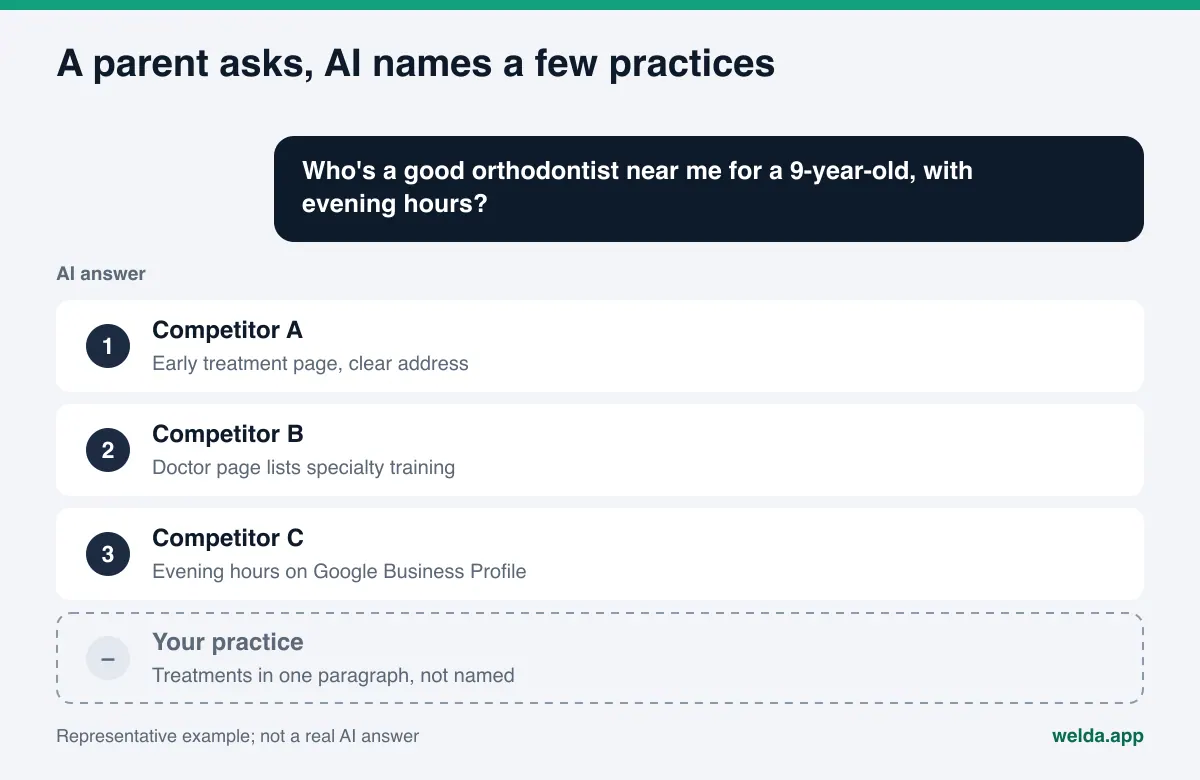
This guide is for orthodontists, practice owners and office managers in the US who are weighing whether they need AI visibility software for orthodontists, and what it should do. The scenario is simple. A parent types "Who's a good orthodontist near me for a 9-year-old? We need early evening appointments." An adult asks "Which orthodontists in Austin offer clear aligners and take my dental plan?" The assistant answers with a short list of practice names. Is yours one of them? Below we cover how answer engine optimization (AEO) works for an orthodontic practice, the steps to take, the advertising rules that shape the work, how Welda handles it and what it does not do. To see where your own site stands today, start with the free AI visibility analysis.
Why orthodontic practices need their own approach to AI search visibility
Orthodontics is a long relationship. A filling is a single visit; braces or aligners mean many months of adjustment appointments. Families research harder, compare more and ask more questions before they commit. A growing share of that comparison now happens inside an AI assistant, where the patient describes the situation and gets named recommendations back in one conversation.
Several things make orthodontic questions different from general dental questions:
- The person asking is often a parent. Questions are practical: when should a child first see an orthodontist, what happens at the first visit, are there after-school appointments.
- Adults ask about discretion and schedule. Clear aligners, ceramic braces, lingual options, early morning or Saturday visits.
- "Orthodontist" is a specialty. Orthodontics and dentofacial orthopedics is one of the dental specialties recognized by the National Commission on Recognition of Dental Specialties and Certifying Boards. Patients often ask specifically for a specialist, and answer engines read your site to tell a specialist practice from a general practice that offers aligners.
- Insurance and financing drive the decision. Families ask which plans you work with, whether there is a payment plan and whether the initial consultation is free. If your site does not say, the assistant answers with someone else.
- Location matters more than usual. A family visiting every few weeks for a year or more weighs drive time, parking and school schedules heavily.
On a classic results page, ranking sixth still earned some clicks. In an AI answer there are usually only a few names, and the patient tends to choose among them. A practice that is not named never enters the comparison. That is why AEO, sometimes also called GEO (generative engine optimization), has moved from a marketing experiment to a new-patient question.
What patients ask AI about orthodontists
Before you change anything, write down the questions your front desk hears every week. They are the same questions patients now type into AI assistants. The examples below are illustrative, written for this guide, not drawn from a measured data set.
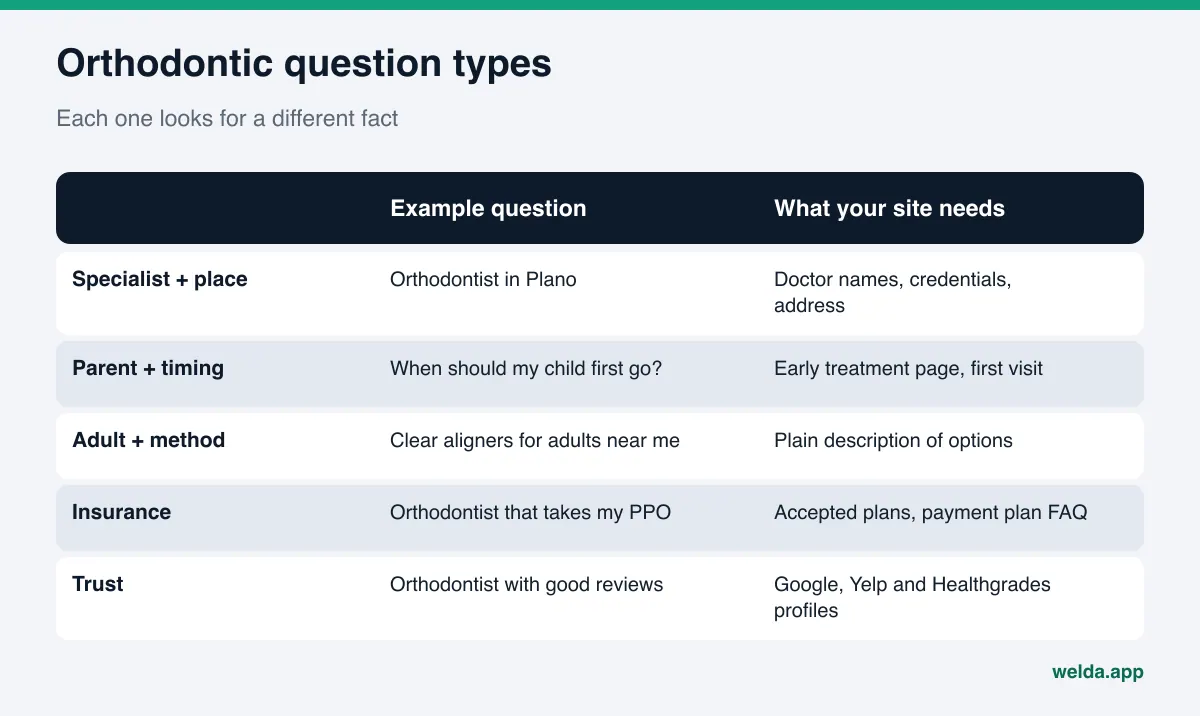
| Question type | Example (illustrative) | What your site needs to answer it |
|---|---|---|
| Specialist and place | "Board-certified orthodontist in Plano?" | Doctor names, credentials, clear address |
| Parent and timing | "When should my 8-year-old see an orthodontist?" | Early treatment page, first-visit description |
| Adult and method | "Orthodontist offering clear aligners for adults near me" | Plain description of the options you offer |
| Schedule | "Orthodontist open Saturdays in Scottsdale" | Current hours, how to book |
| Insurance and payment | "Orthodontist that takes my PPO, with payment plans" | Accepted plans, how financing works |
| Trust | "Orthodontist with good reviews for teens" | Reviews on Google and Yelp, profiles on Healthgrades |
Each row points to a different gap. If you are named for parent questions but never for adult questions, the missing piece is likely an adult treatment page or adult reviews. If you are absent from insurance questions, the missing piece is usually a plain insurance FAQ.
How answer engines decide which orthodontist to recommend
AI assistants do not know your practice from experience. They search the web, read the pages they find, combine what those pages say and name the businesses that best fit the question. For ChatGPT search, the crawler is OAI-SearchBot. OpenAI's crawler documentation says sites that opt out of OAI-SearchBot will not be shown in ChatGPT search answers. On the Google side, the AI features documentation says there are no extra requirements to appear in AI Overviews or AI Mode beyond being indexed and eligible to show a snippet. In other words, the first check is technical: can the bots read your site at all?
Once they can, an answer engine needs to find these facts, consistently, before it can recommend an orthodontic practice:
- Who: practice name, doctor names, degrees and specialty training stated accurately.
- What: the treatments you offer, each described plainly: early (Phase I) treatment, braces, clear aligners, retainers.
- Where: address, neighborhoods served, parking. The same on your site, your Google Business Profile, Yelp and directory listings.
- When: hours, including evening and weekend availability.
- How: what the first consultation includes, how treatment plans are set, how often visits happen.
- Structured data: Schema markup that states business type, address, phone and hours.
Much of this lives off your site. Google Business Profile, Yelp, Healthgrades, insurer directories, local parent forums and Reddit threads all feed AI answers. If your site says "open Saturdays" and your Google profile says "closed Saturday," the assistant cannot tell which one is true and often names a competitor with consistent details.
Advertising rules that shape orthodontic content
Health care marketing has guardrails, and orthodontics is no exception. Three areas matter most for AEO work:
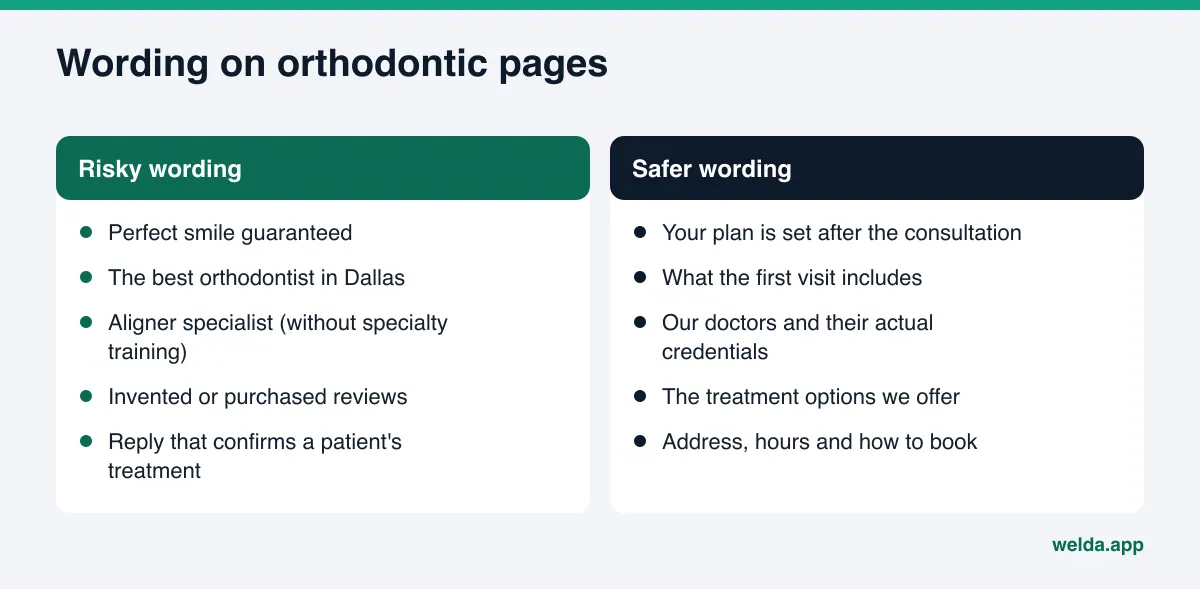
- Reviews and testimonials. The FTC's rule on consumer reviews and testimonials prohibits fake reviews and certain review practices. Buying reviews or writing them in-house is off the table. Ask real patients, answer real reviews.
- Specialty claims. State dental boards regulate how dentists may describe specialty status, and the rules vary by state. Check how your state treats terms like "specialist" and "board certified" before you publish.
- Patient privacy in replies. When responding to reviews, do not confirm that someone is a patient or discuss their treatment. Privacy law applies to public replies too.
Beyond those, avoid outcome promises ("perfect smile guaranteed"), superiority claims ("the best orthodontist in Dallas") and anything that sounds like a diagnosis. The useful part: the information that is safe to publish (who you are, where you are, when you are open, what you offer, how the process works) is exactly what answer engines need to recommend you.
This section is general information, not legal advice. Check current rules with your state dental board or a health care attorney before publishing.
Step by step: AEO for an orthodontic practice
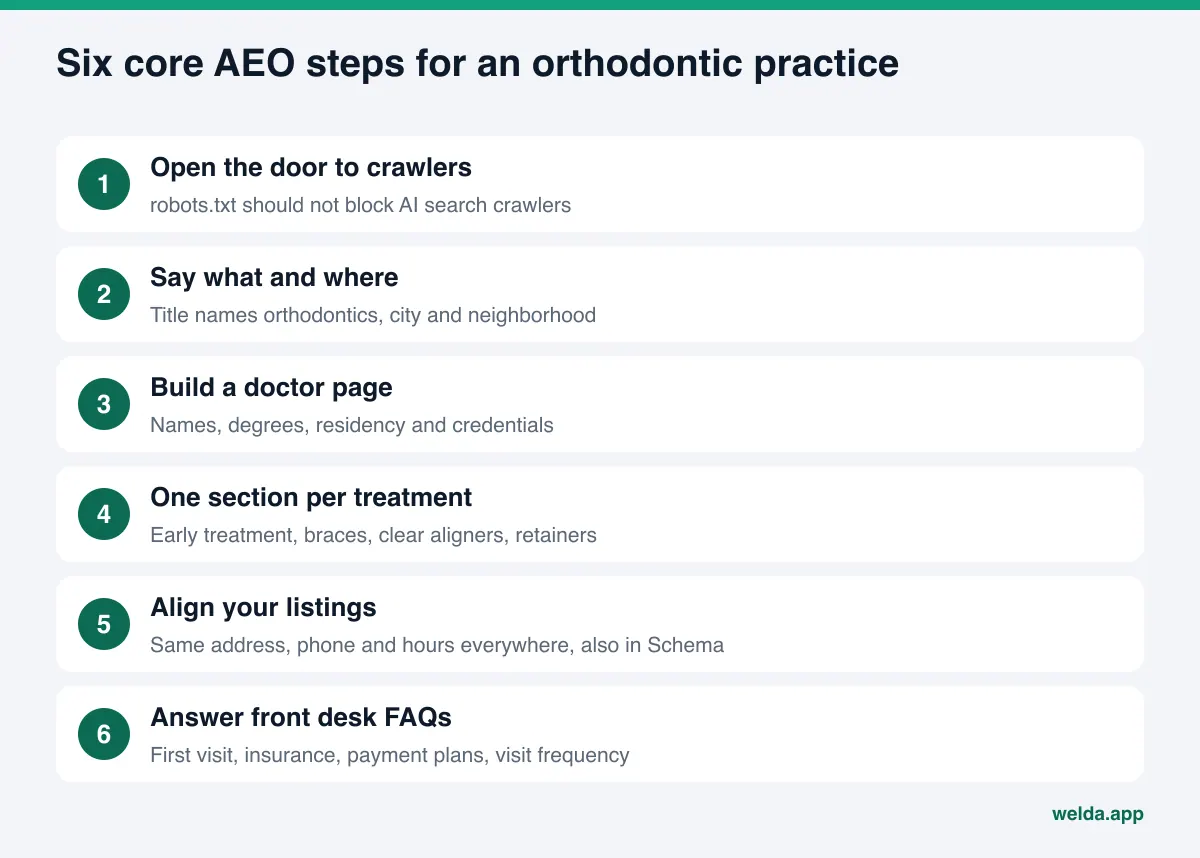
Order matters. If bots cannot read your site, new content does not help. If your basic details conflict across the web, new pages only add to the confusion.
- Open the door. Make sure robots.txt does not block AI search crawlers. The free analysis checks this first.
- Say what and where in one line. Your homepage title, description and main heading should name orthodontics, the city and the neighborhood. "Creating confident smiles" tells an answer engine nothing.
- Build a doctor page. Each orthodontist's name, degree, residency, certifications and interests, stated accurately.
- Give each treatment its own section. Early treatment, braces, clear aligners, retainers, adult orthodontics. Explain what it is, who it may suit and how the process works, without promising results.
- Align your listings. Address, phone and hours written the same way on your site, Google Business Profile, Yelp, Healthgrades and insurer directories. Add the same details in Schema.
- Answer the front desk questions. An FAQ covering the first visit, insurance, payment plans, visit frequency, emergencies with brackets or wires, and after-school hours.
- Respond to reviews, never manufacture them. Calm replies without patient details. A steady flow of genuine reviews matters more than a burst.
If your practice also does cosmetic work, the guide on how cosmetic dentists get recommended by ChatGPT covers that side. For practices focused on children, see AEO for pediatric dentists.
Choosing AI visibility software for orthodontists: what to look for
Look past dashboards and promises. Orthodontics is health care, so a few criteria matter more than they would for a restaurant or a retailer.
| Criterion | Why it matters | Question to ask the vendor |
|---|---|---|
| Engine coverage | Patients use different assistants | Which AI engines do you measure? |
| Repeat runs and margin | The same question gets different answers over time | How many times is each question run, and do you show the spread? |
| Open score formula | A black-box score does not support decisions | What goes into the score, with what weights? |
| Question list | Orthodontic questions depend on location and patient type | Are questions built around my treatments and neighborhoods? |
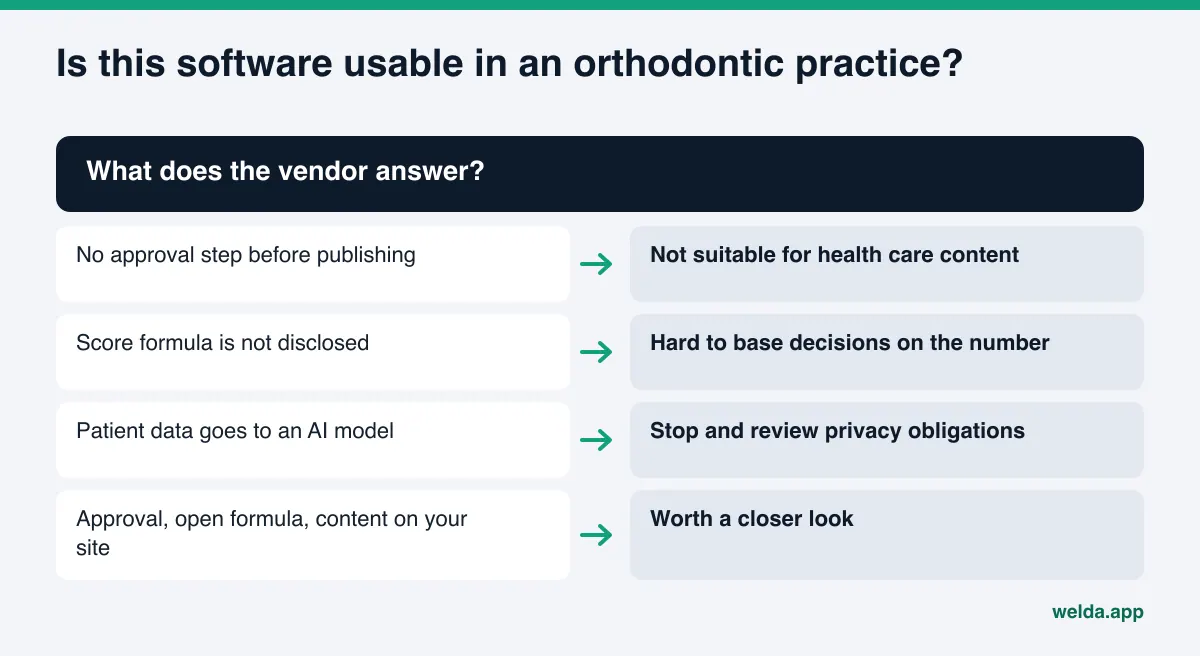
| Approval workflow | Publishing health content without review is risky | Does every piece of content wait for my approval? |
| Compliance flags | Price, guarantee and superiority wording causes trouble | Are risky phrases flagged before publishing? |
| Patient data | Health data is sensitive | Is any patient data sent to an AI model? |
| Content ownership | Content should be your asset | Does content live on my own site? |
The last four rows decide whether a tool is usable in a practice at all. Speed without an approval step is not a feature in health care.
How Welda handles AEO for orthodontic practices
Welda's work for an orthodontic practice comes down to three parts: measuring which questions name you, gathering every gap into one to-do list, and routing every piece of content through your approval before it goes anywhere.
Question tracking: which orthodontic questions name you
In the panel, a question list is built around your treatments and location: early treatment, adult aligners, Saturday hours, insurance. Each question is run three times on ChatGPT, Gemini, Perplexity and Google's AI. The questions screen shows, question by question, which engines name you and in what position. If you appear for teen braces but never for adult aligners, you can see whether the gap is a missing treatment page or a source where competitors are present and you are not. Questions can be run in English or Turkish.
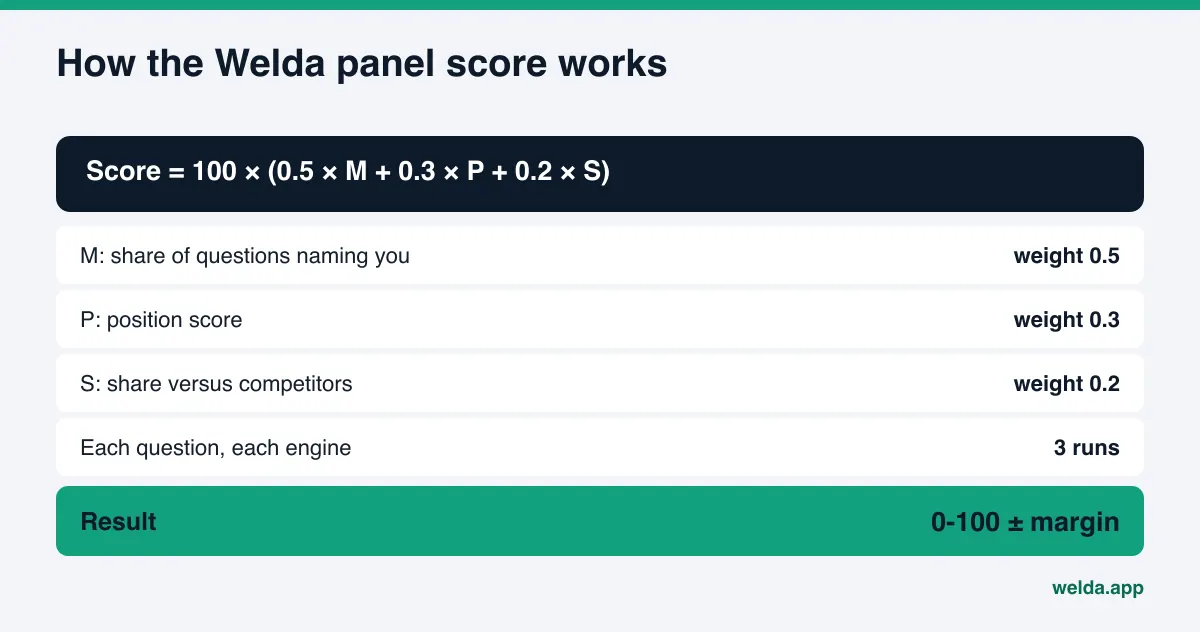
The score formula is public: 100 × (0.5 × share of questions that name you + 0.3 × position score + 0.2 × share versus competitors). The spread across the three runs gives a ± margin, so a single swing is not mistaken for real change. The competitors screen shows which question types a rival wins and which sources help them win. The monthly one-page PDF report is covered in our AI visibility report template guide.
To-do list and approval queue: no auto-publishing in health care
Welda does not invent facts it could not find on your site. If your hours, address or a doctor's credentials are missing, the to-do list asks you for them. Once you enter them, they flow into every draft.
Welda drafts site content, profile text and review replies. In health care nothing is published automatically; every draft lands in an approval queue where you read, edit or approve it. A compliance check flags patterns such as prices, guarantees, superiority claims and diagnostic suggestions before publishing. It is a helper, not legal advice, and it has not been reviewed by legal counsel. Patient data is never sent to an AI model.
Content always lives on your own site. On WordPress, Welda connects through a separate Editor user and an application password, with no code to install; drafts open on your site and go live when you approve them. On other platforms, Welda gives you a ready-to-apply package and the changes are made by hand. Google Business Profile, Instagram and Facebook can be connected; if they are not, the task stays on the list as a manual item. Practices with several offices can read AI search optimization for dental groups for the multi-location side.
Early access, and what you can use today
The Welda panel is in early access and opening first to businesses in Turkey. Regular four-engine measurement is being added during early access, and the sample screens in the panel use representative data. Pricing is discussed in an early access call. What anyone can use today is the free site analysis, which works in English. It reads your homepage and a few inner pages (services, about, contact), scores technical and content readiness out of 100, explains each gap and how to fix it, and runs 5 likely patient questions through an AI assistant with web search to see whether your practice is named. That last part is a one-time check, not ongoing tracking.
Example: where an orthodontic practice might start
The scenario below is an example, not a real practice or a real result. An example practice has two orthodontists and treats both children and adults.
- Day one: the practice runs the free analysis. The report shows a homepage title with only the practice name, no city or specialty, no structured business data and no FAQ section.
- First week: the team adapts the suggested title and description in their own voice, adds Schema, and matches Saturday hours on Google Business Profile and Yelp to the site.
- Following weeks: a doctor page and separate sections for early treatment, braces and adult aligners are written. Each is checked for price, guarantee and specialty wording before it goes live.
- After that: the practice measures which questions name it over time and expects changes to show up over weeks, not days.
Limits: what Welda does not do
- Welda does not guarantee rankings or that you will "show up in ChatGPT." AI answers vary by person, time and question.
- It does not write facts it does not know. Credentials, hours and insurance details come from you.
- It does not publish sensitive content without approval. In health care every draft waits for you.
- It does not write fake reviews or invent patient stories.
- Handling negative reviews, managing directory accounts and press work stay with your practice.
- New content usually takes weeks to be reflected in AI answers.
- The compliance check does not replace legal advice.
The free analysis does not measure rankings either. It shows how your site reads to search engines and AI, and what is missing.
Checklist: is your orthodontic practice ready for AI answers?
Compare your site with the list below. Every "no" is a point where an assistant cannot describe you accurately.
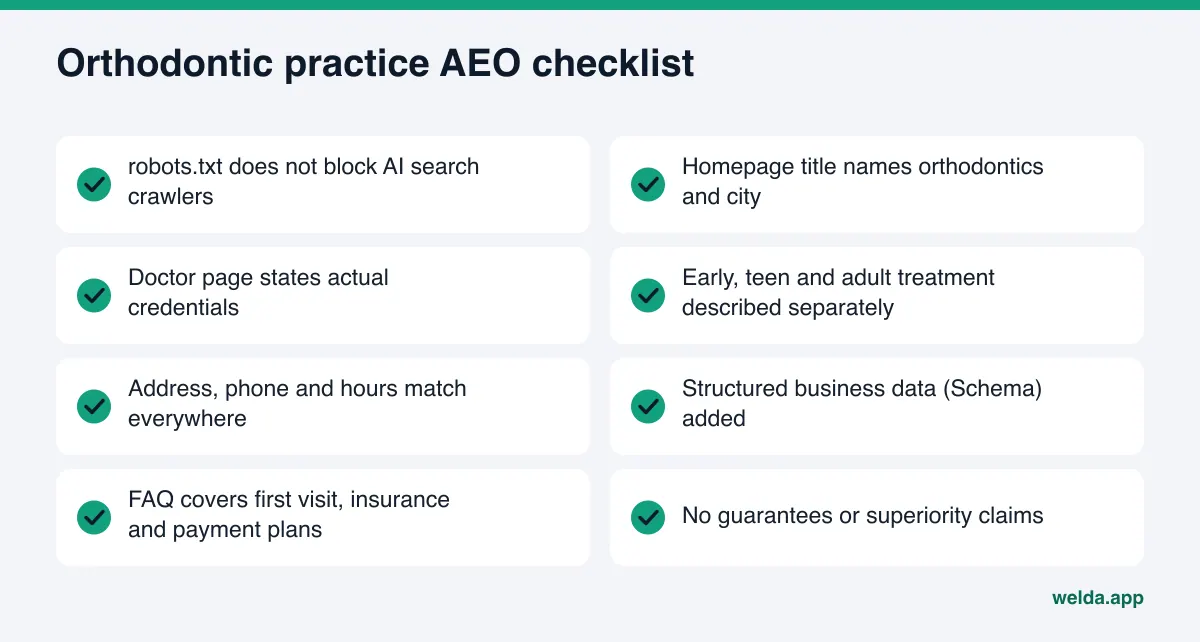
If you find more than three gaps, work in this order: crawler access, consistent address and hours, doctor and treatment pages, then the FAQ. Reviews and reputation are a longer project; see AI search optimization for dental implant clinics for a similar path in another dental field.
Frequently asked questions
Is AI visibility software for orthodontists different from SEO software?
Yes. SEO software tracks your position in search results. AI visibility software tracks whether AI answers name you, in what position, and where competitors lead. They share some technical groundwork, but the questions and the measurement are different.
Should we publish our prices so AI can answer cost questions?
That is your call and depends on your state's rules and your practice. Even without numbers, you can explain how fees are set after the consultation, which insurance you work with and whether payment plans exist. Assistants use that kind of explanation when they answer cost questions.
We are a general dental practice that offers aligners. What should we say?
Describe the service accurately and state your actual credentials. Do not imply specialty status you do not hold; check your state board's rules. Welda's compliance check flags wording like this for your review.
Do before-and-after photos help AI visibility?
AI answers rely mostly on text. If you publish photos, follow consent and accuracy rules. For visibility, clear treatment and process text usually matters more.
How long until we see a change?
Technical fixes can be quick, but new content usually takes weeks to show up in AI answers. That is why repeated measurement and a before-and-after comparison matter.
Does patient information go to Welda or an AI model?
No. In health care, patient data is not sent to an AI model. Welda works with your public information and the marketing content it drafts for your approval.
What does the free analysis cost and include?
It is free once per site. Your email and phone are verified, the results link arrives by email and stays open for 14 days. It includes the score, gaps with fixes, homepage text suggestions, a score simulation, a competitor comparison, a fix package with structured data, and a PDF.
Next step: see how AI reads your practice today
Before you pick AI visibility software for orthodontists, know where you stand. Run the free AI visibility analysis to see what is missing, whether AI crawlers can reach your site and whether your practice is named in 5 patient questions. If you want to talk about the panel, an early access conversation is a good next step once you have your analysis results.