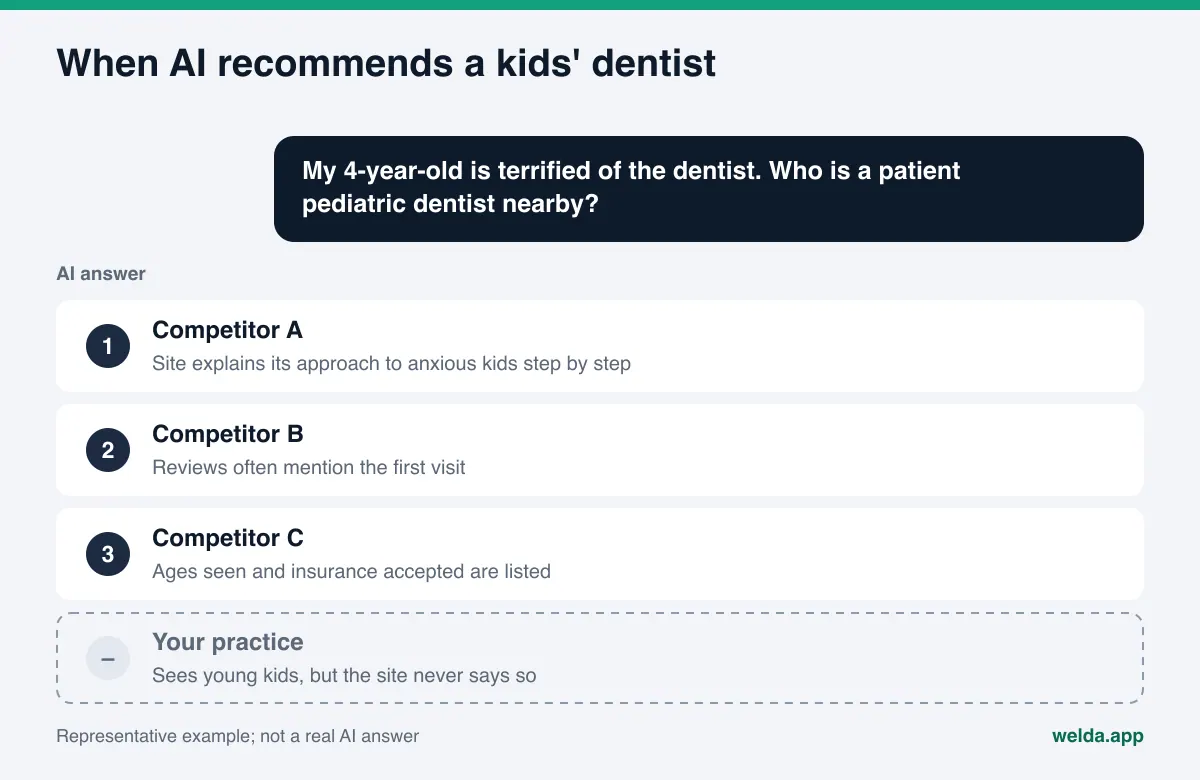
Do parents really ask ChatGPT to find a pediatric dentist, and how does my practice show up in those answers? When a parent types a question like "patient pediatric dentist for a scared 4-year-old" into an AI tool, it reads your website, your Google Business Profile and review sites, then returns a short list. AEO for pediatric dentists means writing out, clearly and consistently, your credentials, the ages you see, how a first visit works, how you handle anxious kids and which insurance you take. This guide walks through the steps and shows which parts Welda handles for you.
What is AEO for pediatric dentists, and why is it its own job?
AEO, short for answer engine optimization, is the work of getting your practice named when people ask AI tools such as ChatGPT, Gemini, Perplexity and Google's AI Overviews or AI Mode for a recommendation. You will also hear it called AI search visibility, and sometimes GEO (generative engine optimization), which means the same thing. In a classic search, a parent sees a page of links and chooses. In an AI answer, they usually see three or four names. If yours is not one of them, they call someone else without ever hearing about you.
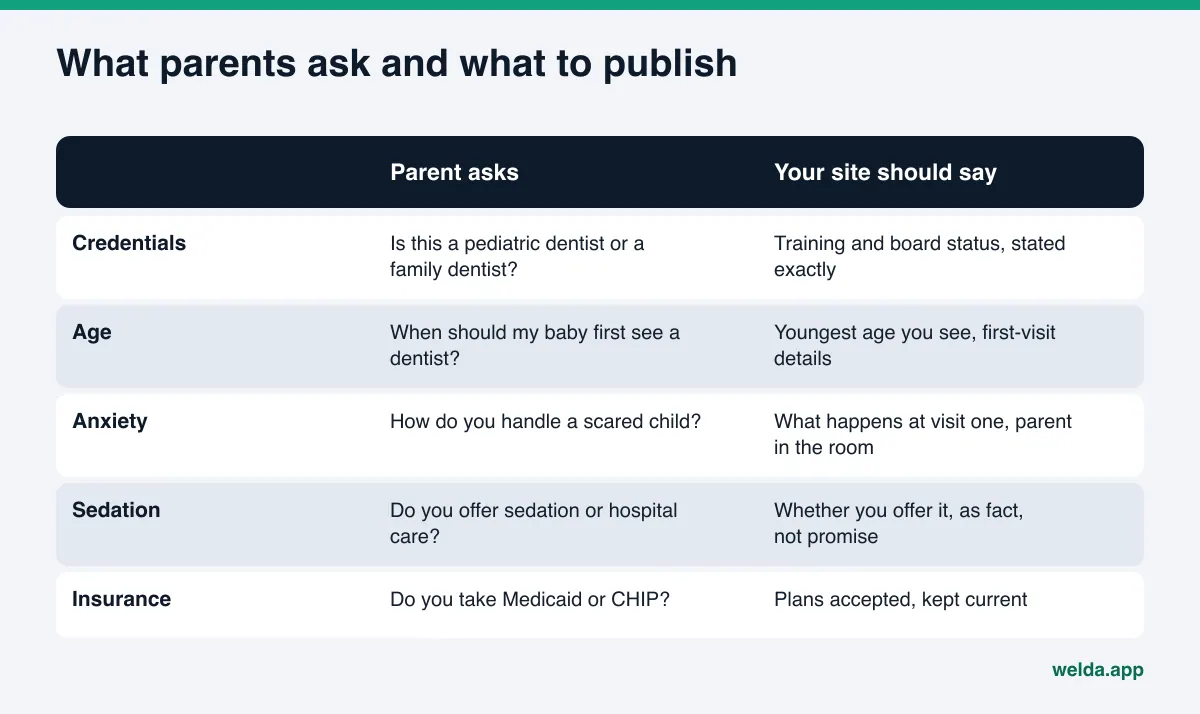
Pediatric dentistry works differently from general dentistry here. An adult patient usually asks about a procedure: an implant, a crown, whitening. A parent asks about a person and a setting. "Where should my baby have a first dental visit," "kids' dentist who does sedation," "pediatric dentist with Saturday hours that takes Medicaid" are questions about approach and logistics more than about treatment. To answer them, an AI tool tries to confirm three things on your site: that you see children, which ages you see, and how you work with a nervous child. If those facts are missing, a practice that wrote them down gets the mention.
The second difference is how much trust weighs. Parents think longer about their child's care than their own, read reviews more closely and ask AI tools for more detail. Answer engines, in turn, tend to name health providers they can describe with consistent, checkable facts. If your credentials read one way on your site and another way on a directory, that mismatch alone can drop you from the list.
The quickest way to find out where you stand is to measure instead of guess. Welda's free site analysis reads your homepage and a few inner pages the way Google and AI tools do and lists each gap separately, with a fix for each one.
What do parents ask AI when they look for a pediatric dentist?
The questions below are our own examples, based on the kinds of questions pediatric front desks hear every day. They are not measured data. Group your own questions the same way, because each group needs a different piece of information on your site.
- Credential questions: "What is the difference between a pediatric dentist and a family dentist," "board certified pediatric dentist in Austin."
- Age questions: "When should my baby see a dentist for the first time," "dentist who sees 18-month-olds near me."
- Anxiety questions: "Gentle dentist for a kid with autism," "pediatric dentist good with anxious children."
- Treatment questions: "Pediatric dentist that offers sedation," "where to get sealants for my 7-year-old," "dentist for baby bottle tooth decay."
- Insurance and logistics questions: "Kids' dentist that accepts Medicaid," "pediatric dentist open Saturdays," "dentist close to my child's school."
Some of these have an authoritative answer AI tools will repeat. The American Academy of Pediatric Dentistry, for example, advises parents that a child should see a pediatric dentist when the first tooth appears, or no later than the first birthday. If your site says you welcome infants for that first visit, the AI can connect that guidance to your practice. If you want to build a full question list for your area, our guide on how to find the questions customers ask AI walks through the method.
What sources does AI use to recommend a pediatric dentist?
Answer engines rarely rely on a single source. They combine your website, your Google Business Profile, reviews on Google Maps, Yelp and health directories such as Healthgrades and Zocdoc, and discussion threads where parents compare notes. For pediatric dentists, local parenting groups and community forums can come up as well.
| Source | What AI reads there | Who controls it |
|---|---|---|
| Your website | Credentials, ages seen, first visit, services, FAQ, insurance, contact | Fully you |
| Google Business Profile | Category, hours, phone, reviews and your replies | Profile yours, reviews by parents |
| Healthgrades, Zocdoc and similar directories | Specialty, credentials, ratings, accepted insurance | Partly you |
| Yelp and community forums | Parent experiences, complaints, your replies | Parents; replies are yours |
The first row matters most, because details elsewhere are usually checked against it. If your site is thin, the AI leans on a two-line directory blurb or an old forum post. If your site is complete, it is also easier to bring the other sources in line with it.
There is also a technical gate. If AI crawlers cannot reach your site, the content does not count. OpenAI lists its crawlers separately in its official documentation, including the one used for search; if your robots.txt blocks it, showing up in ChatGPT search gets harder. Checking this once is enough.
AEO for pediatric dentists: the steps, in order
These steps assume a pediatric practice or a general practice that sees children. The first three are specific to pediatric dentistry and are usually skipped in general dental guides.
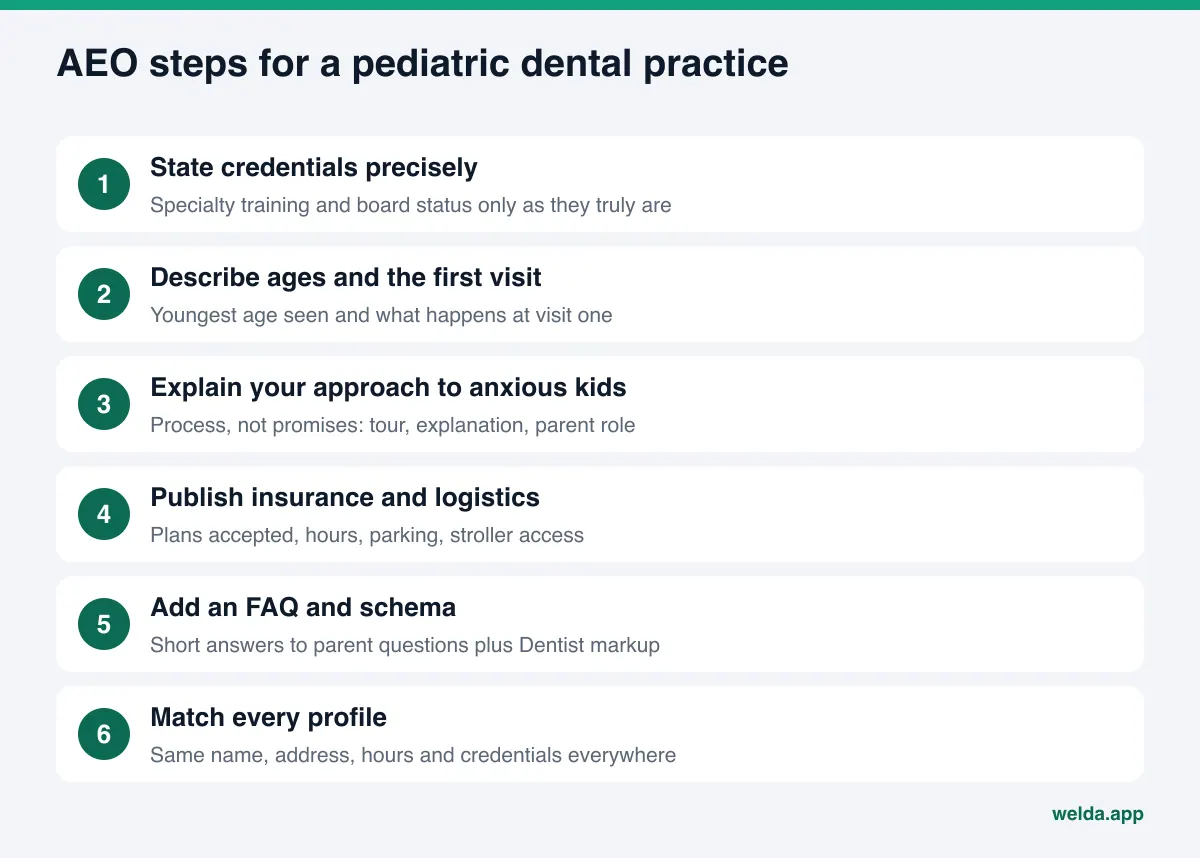
- State your credentials exactly as they are. If you completed a pediatric dentistry residency, say so. If you are a diplomate of the American Board of Pediatric Dentistry, say "board certified" and name the board. If you are a general dentist who sees kids, write "we welcome children" rather than "pediatric specialist." Many state dental boards have rules on how specialties may be advertised, so check yours. Parents ask about this distinction often, and AI tools look for exactly this line.
- Describe the ages you see and the first visit. Say whether you see infants, toddlers, teens or children with special health care needs. Explain in a few sentences what happens at visit one: a tour, getting comfortable in the chair, the exam, the talk with the parent. This section answers "first dental visit" questions directly.
- Explain your approach to anxious kids as a process. Skip "your child will never cry." Describe what you do: whether treatment happens at the first visit, how instruments are introduced, whether parents stay in the room, whether you use tell-show-do or similar techniques. If you offer nitrous oxide, oral sedation or treatment under general anesthesia in a hospital, state it as a service, with where and when it applies. If you do not, say that too.
- Publish insurance and logistics. List the plans you accept, including Medicaid or CHIP if you take them, and keep the list current. Add hours, Saturday availability, the street address, parking, elevator and stroller access, and how to book. Parent questions often end with these details.
- Add an FAQ and structured data. Write short, self-contained answers to the ten questions your front desk hears most. Add LocalBusiness markup to your site; schema.org's Dentist type fits. Name, address, phone and hours in the markup should match what is on the page.
- Match every profile and reply to reviews carefully. Make your name, credentials, address and hours the same on Google, Yelp, Healthgrades and any other directory. When you reply to a review, never confirm that the reviewer is a patient and never mention a child's name, age, treatment or visit date. Our guide to review responses for AI visibility covers the wording in detail.
- Check that AI crawlers can get in. Make sure robots.txt does not block AI search crawlers. This is the only step that touches your site's configuration, and it is usually a one-line change.
Most of these steps are writing, not technical work. The usual problem is that the information lives in the dentist's head and the front desk script, but nowhere on the site.
Example: what a good "first visit" section looks like
To make the steps concrete, here is a section a fictional pediatric practice could publish. The details are invented; the point is to show how much an AI tool can pull from one paragraph.
We see children from the time their first tooth comes in through their teen years, including kids with special health care needs. A first visit usually does not include treatment. Your child tours the office, meets the team and gets comfortable in the chair before a gentle exam. Parents are welcome to stay in the room. If treatment is needed, we explain the options and decide together. We do not offer sedation in the office; when it is needed, we refer to a hospital dental program. We accept most PPO plans and Medicaid. We are open two evenings a week and on Saturday mornings, and the building has an elevator and stroller access.
That paragraph answers several parent questions at once: ages seen, special needs, what the first visit involves, whether parents can stay, sedation, insurance and hours. None of it promises an outcome or claims to be the best. An AI tool reading it can pass along concrete facts, such as "parents can stay in the room and Saturday appointments are available."
Your FAQ can follow the same pattern: "What if my child cries at the first visit?", "Do baby teeth with cavities need to be treated?", "When should my child get sealants?", "How can I prepare my child for the appointment?". Keep answers short, avoid diagnosing, and end with "we will look at this during the exam" where it fits. A dentist should write or approve anything clinical.
What rules apply to pediatric dental marketing and reviews?
The same rules that cover your website and social media cover content AI tools read; there is no separate rulebook for AEO. The summary below is for orientation only and is not legal advice.
- Fake reviews. The FTC's final rule on consumer reviews and testimonials, published in August 2024, prohibits fake reviews and certain review practices. Buying reviews or writing them for parents is not a shortcut worth taking.
- Patient privacy. HIPAA applies to how a practice handles patient information, and that includes public replies to reviews. A reply that confirms someone is your patient or mentions their child's treatment can create a privacy problem, even if the parent posted the details first.
- Specialty advertising. State dental boards set rules on advertising and on who may present themselves as a specialist. Check your own board's rules before you write your credentials line.
For pediatric practices, three wording traps come up again and again. Outcome promises like "pain-free" or "your child will never cry" can mislead. Superlatives like "best pediatric dentist in town" are hard to back up. And photos of young patients or parent testimonials need written consent and careful handling.
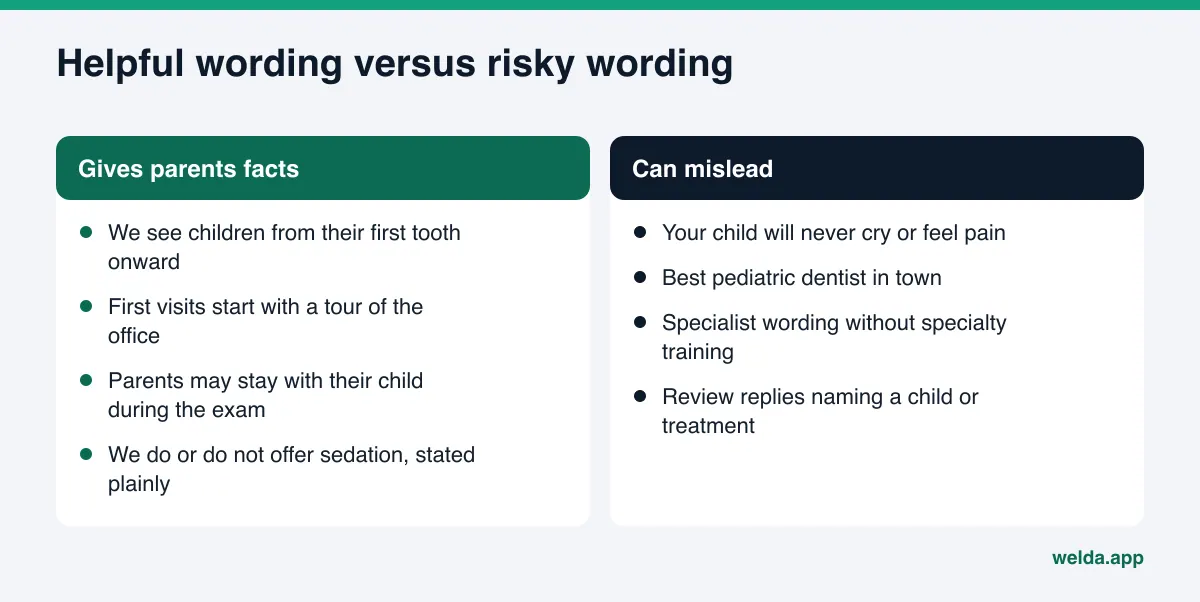
The good news is that compliant content and AI-friendly content mostly overlap. AI tools do not pick up "best"; they pick up the ages you see, how you run a first visit and which services you offer. Factual, measured writing is both safer and more useful in answers.
How Welda handles AEO for a pediatric dental practice
Welda is software that measures where your practice appears in AI answers and fills the gaps on your behalf. Three parts matter most for pediatric dentists.
1. The free site analysis finds what parents and AI cannot see. It reads your homepage and inner pages such as services, about and contact. For a sample pediatric practice, typical findings could include: the page title never says "pediatric" or "children," there is no Dentist schema, the address only appears inside an embedded map, there is no FAQ. Each finding explains what was seen, why it matters and how to fix it. You also get suggested homepage copy (title, description, headline, intro paragraph and FAQ), a simulation showing which fixes would raise the score most, a competitor comparison and a ready-made fix package that includes the schema code. The analysis also asks five sample parent questions to an AI assistant that can search the web and checks whether your practice's name comes up. That is a one-time snapshot, not ongoing tracking. The free analysis runs in English.
2. Missing facts are asked, never invented. In the Welda panel, gaps go onto one to-do list. For a pediatric practice, that list tends to contain exactly the lines discussed above: hours, full address, sedation status, the lead dentist's name and credentials. You fill them in once, and they flow into every draft. Welda does not guess whether you see infants or offer sedation.
3. Every health draft waits for your approval, with a compliance flag. Welda drafts site content, profile text and review replies. In health care nothing publishes automatically; every piece goes into an approval queue. A built-in check flags patterns such as prices, guarantees, superiority claims and diagnostic suggestions before anything goes live, so "pain-free" or "best in town" shows up for review before you approve. That check is not legal advice and has not been reviewed by legal counsel. Patient data is never sent to AI.
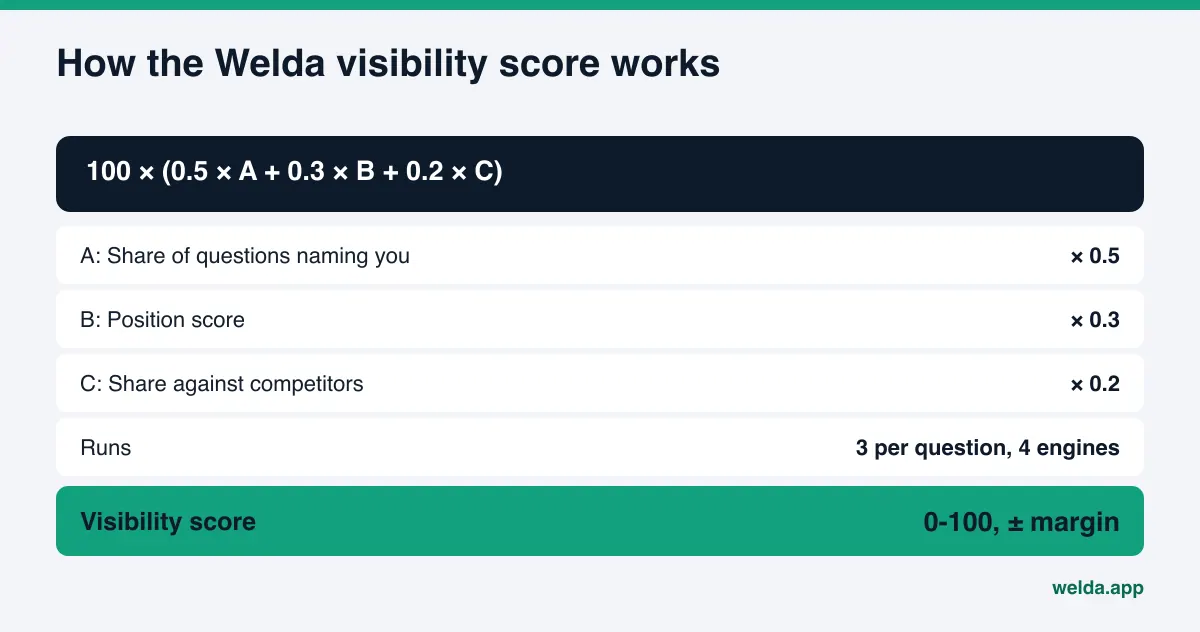
On WordPress sites, Welda connects through a separate Editor user and an application password, without installing code; content opens as a draft and goes live when you approve it. On other platforms you get a ready package to apply yourself. Content always lives on your own site. In the panel, parent questions are asked three times each in ChatGPT, Gemini, Perplexity and Google AI, and the score formula is public.
Here is where things stand today: the Welda panel is in early access. Regular four-engine tracking is being added during early access, and panel screens are shown with representative data. The full panel is opening in Turkey first. The part anyone can use today is the free site analysis, which works in English. Pricing is discussed in an early access call.
Limits: what Welda does not do
- No ranking or "show up in ChatGPT" guarantee. Nobody can guarantee what an answer engine will say. Welda measures, shows the gaps and helps close them.
- No made-up facts. If Welda does not know the ages you see, your sedation policy or your board status, it asks you.
- No health content without approval. Every draft waits in the queue.
- No fake reviews. Welda does not write parent reviews or suggest deceptive ways to collect them.
- Some work stays with you. Handling negative reviews, directory accounts such as Healthgrades or Zocdoc, and press work remain your practice's job. If Google Business Profile is not connected, the task appears as "do by hand."
- It takes time. New content usually takes weeks to show up in AI answers.
Checklist: is your practice ready?
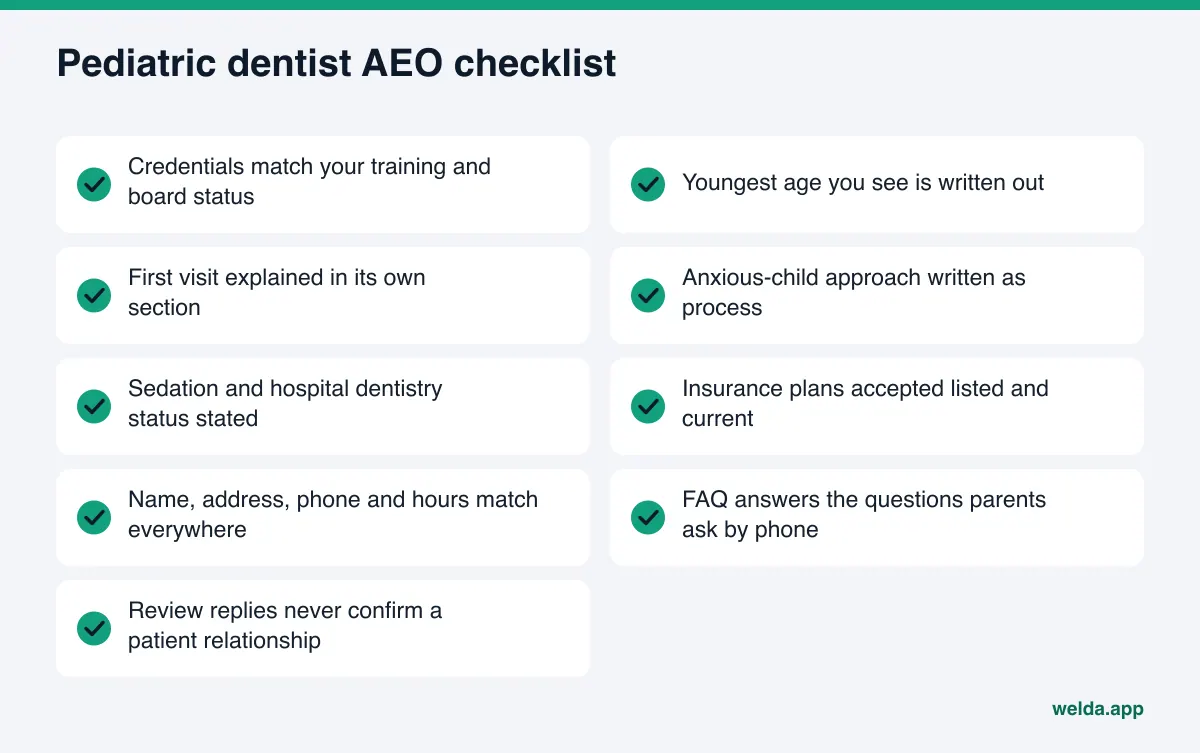
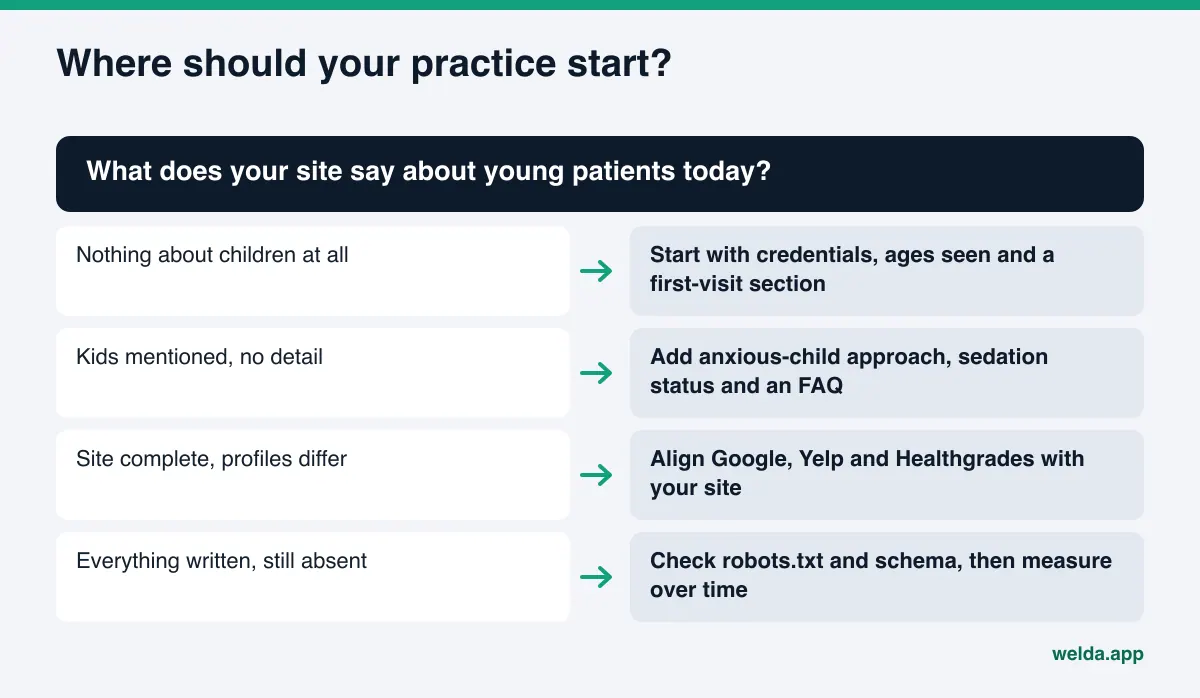
Run through this with your office manager or whoever maintains your website. Every "no" is a task.
Many young patients move on to orthodontic treatment. If your group also offers orthodontics, our guide on AI visibility software for orthodontists explains how to keep the two services distinct on your site. If you run several locations, AI search optimization for dental groups covers location pages.
Frequently asked questions
I am a general dentist who sees a lot of kids. Can I call myself a pediatric dentist?
Write that you welcome children and which ages you see, but avoid specialist wording unless you completed specialty training. Your state dental board's advertising rules decide the details. For AI tools, a clear and consistent statement that you see children matters more than the label.
Should I list sedation or general anesthesia on my site?
Yes, as plain information: whether you offer it, what kind, and where it happens. That answers a common parent question. Avoid turning it into a promise of a pain-free experience. This is not legal advice.
Can I reply to a parent's negative review on Google or Yelp?
You can reply, but keep it general and do not confirm the reviewer is a patient or mention any treatment. A short, calm reply that invites them to call the office is safer and still shows AI tools that you engage.
What does the free analysis tell me about my practice?
It reads your site, gives a score out of 100 split into technical and content, lists each gap with the reason and the fix, suggests homepage copy and checks five sample questions once. It is free once per site; email and phone are verified, and the results link stays open for 14 days. It does not measure rankings.
How long until changes show up in ChatGPT answers?
Usually weeks. Answer engines pick up new content at different speeds, which is why measuring once and stopping is not enough.
Can practices in the US use the Welda panel today?
The panel is in early access and is opening in Turkey first. The free site analysis works in English today, so you can see your gaps right away. Pricing is discussed in an early access call.
Where to start
AEO for pediatric dentists is not a big campaign. It is the work of writing down what parents need to know: credentials, ages, the first visit, your approach to anxious kids, insurance and logistics. Once those facts are on your site, accurate and consistent, an AI tool answering a parent's question can actually read them. If you also offer cosmetic work for adults, our guide on how cosmetic dentists get recommended by ChatGPT covers that side.
Start by seeing where your practice stands today. Run the free site analysis to see how AI reads your site, which gap to close first and whether your name comes up for sample parent questions.