What does AI search optimization for dental groups involve, and how is it different from a single practice? AI search optimization for dental groups means making every office, not just the brand, legible to AI assistants. Patients ask by neighborhood, hours and treatment, and the office that gets named is the one whose address, hours, dentists and services are written clearly and consistently. Nobody can guarantee a position in an AI answer, but when location details are missing or contradictory, the odds that a given office gets mentioned drop sharply.
This guide is written for multi-location dental groups, dental service organizations (DSOs) and the marketing and operations teams who run their websites and listings. The question is simple. When a patient asks ChatGPT, Gemini, Perplexity or Google's AI Overviews and AI Mode for "a dentist near downtown open on Saturday," does your downtown office show up, or does the AI only know your flagship? The discipline is usually called answer engine optimization (AEO); you will also see it called generative engine optimization, or GEO, which means the same thing. Below we cover why the problem is specific to groups, the work to do location by location, how Welda handles that work, and what it does not do. If you want to see where your site stands today, start with the free AI visibility analysis.
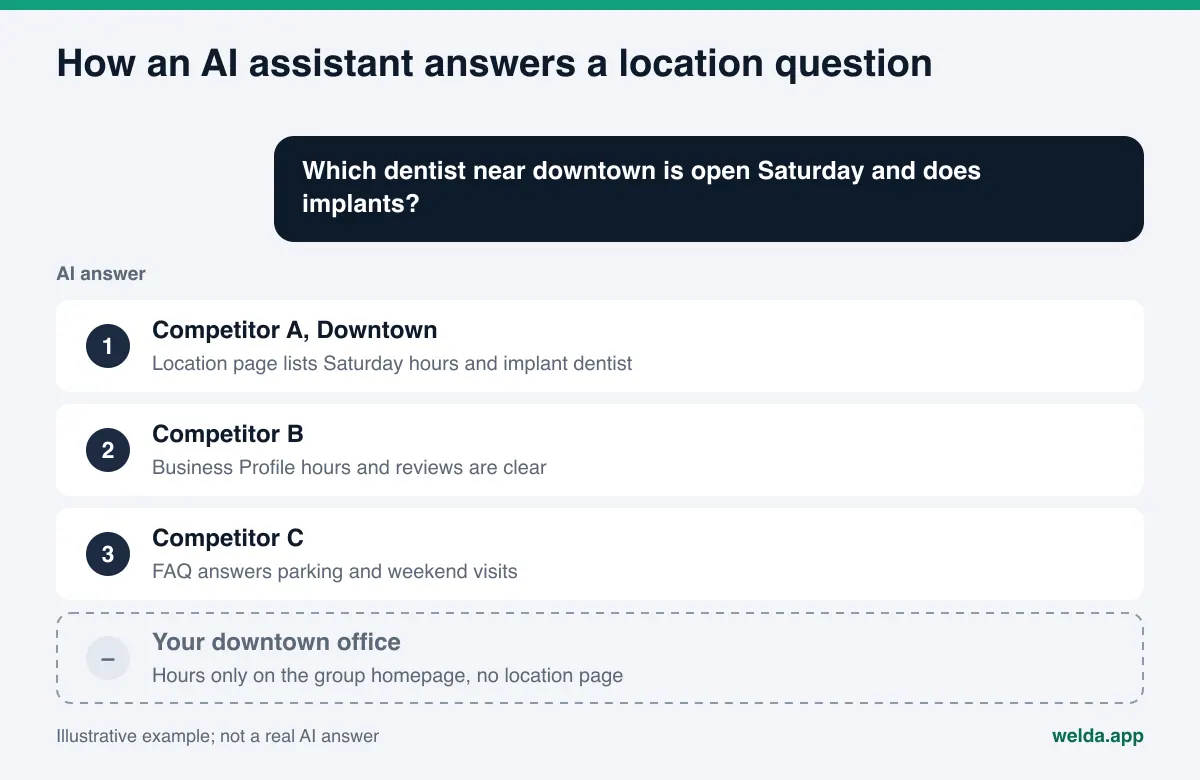
Why AI search optimization for dental groups is its own job
For a single practice, everything an AI system needs to learn lives in one place: one address, one phone number, one set of hours, one team. In a group, that information multiplies with every office and starts to blur. When AI assistants put together an answer, they read your website, your Google Business Profiles, review sites such as Yelp and Healthgrades, booking directories such as Zocdoc, and anything else that mentions you. If those sources do not separate your offices cleanly, three problems show up.
- Locations go invisible. If the site has a single "Our Locations" page with a list of addresses, the AI cannot find hours, dentists or services for a specific office. It has no reason to recommend that office for a neighborhood question.
- Details get crossed. The flagship phone number appears next to a suburban address, or one office's Saturday hours get attached to another. Patients call the wrong office or show up to a locked door. We cover how to correct this in when ChatGPT has wrong information about your business.
- Authority pools in one office. Most reviews, local news mentions and links point to the oldest location. The AI knows the brand but not the new office, so a competitor gets named for neighborhood questions instead.
All three problems grow as the group adds offices or acquires practices. The good news is that most of the fix is under your control. Your website and your Business Profiles are among the sources AI systems lean on most, and you can structure both location by location.
How patients ask AI about dental offices
Dental care usually starts with a complaint or a decision: a cracked tooth, an implant someone has put off for years, a child's first orthodontic consult. When patients describe that to an AI assistant, they almost always add a place and a constraint. Typical questions look like these (written here as examples of the pattern, not as measured data):
- "Is there an emergency dentist open tonight near me?"
- "Which dentist in the north side takes my PPO plan and offers clear aligners?"
- "Good pediatric dentist near the elementary school, with weekend hours?"
- "Dentist near the office downtown that does same-day crowns?"
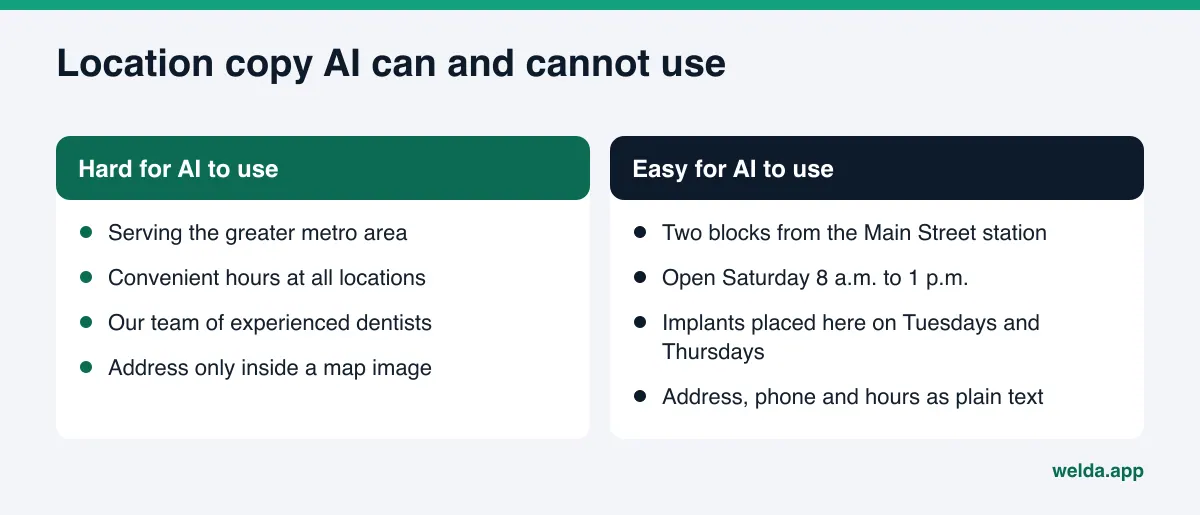
To answer any of these, the AI needs facts that belong to a specific office: neighborhood, hours, weekend availability, insurance accepted, emergency visits, which dentist does which procedure. If those facts live only on a group-wide page, or only inside an image, the AI cannot use them with confidence. How AI systems interpret proximity is covered in more depth in how near me searches work in AI.
The table below maps each question type to what the location page needs to say.
| Patient question type | What the location page needs | Where it must match |
|---|---|---|
| Proximity ("near downtown," "by the station") | Full street address, neighborhood name, nearby landmarks and transit | Website, Google Business Profile, Yelp, directories |
| Hours ("open now," "Saturday") | Day-by-day hours, holiday hours, emergency policy | Site and Business Profile must show the same hours |
| Treatment ("does implants," "pediatric") | Services offered at this office and the dentists who provide them | Location page and dentist bio pages |
| Coverage ("takes my plan") | Insurance networks accepted at this office, financing options | Location page and booking profiles |
| Trust ("good dentist," "gentle with anxious patients") | Dentist credentials, office reviews and responses | Business Profile, Healthgrades, Yelp, bios |
| Practical ("parking," "wheelchair access") | Parking, transit, accessibility, languages spoken | The location page FAQ |
Treatment-specific questions follow their own patterns. See AI search optimization for dental implant clinics and AI visibility software for orthodontists. In a group, offices often differ in what they offer, so those recommendations apply office by office.
AI search optimization for dental groups, step by step
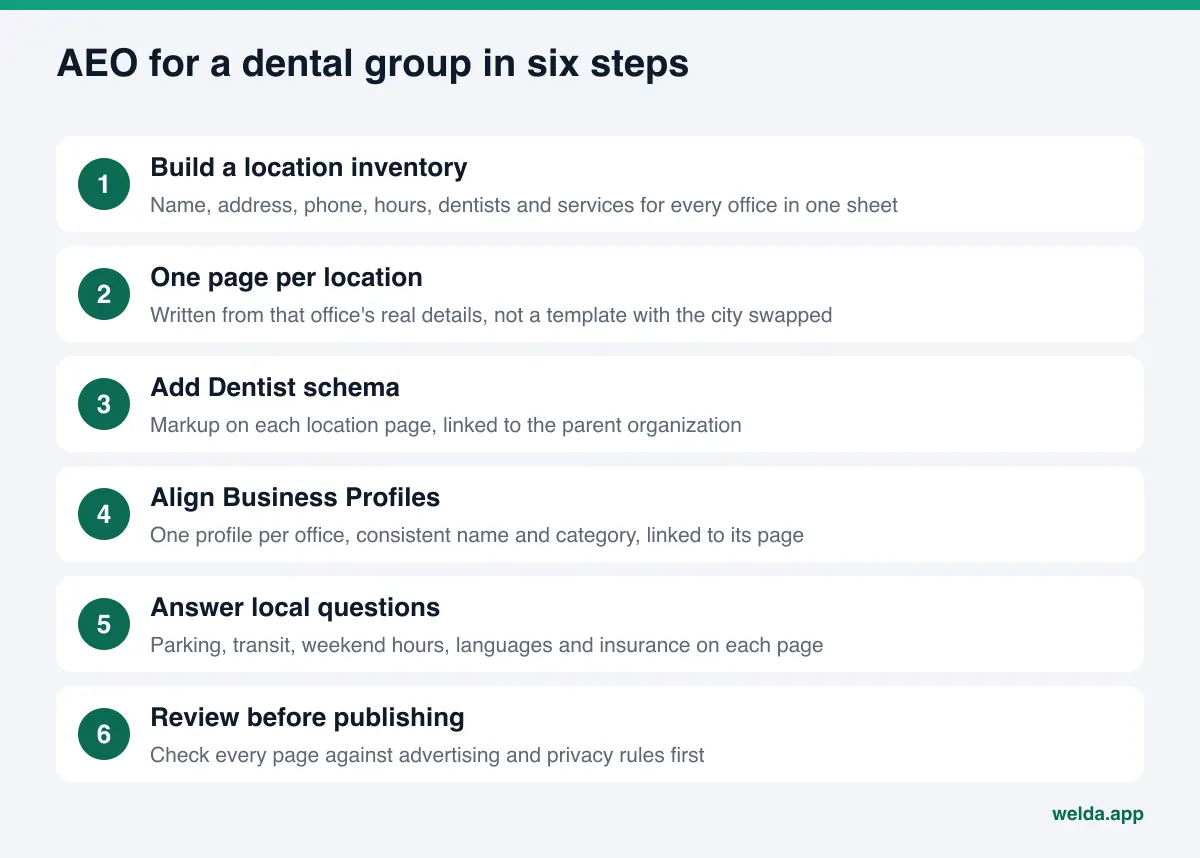
These steps run in the same order no matter how many offices you have. For a five-office group it is a few weeks of work; for a forty-office DSO it takes longer, but the sequence does not change.
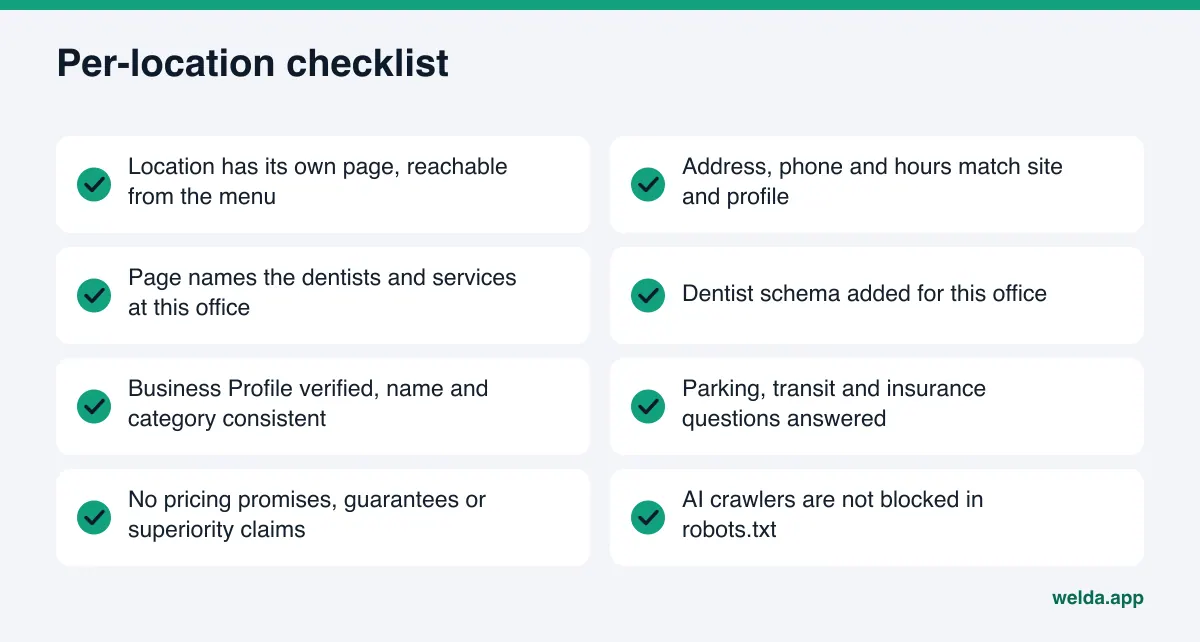
- Build a location inventory. One row per office: legal name, the name on the sign, full address, phone, day-by-day hours, holiday hours, the dentists who practice there and on which days, services offered, insurance accepted, parking and transit. This sheet becomes the single source of truth for everything that follows.
- Give each office its own page. The URL should describe the location, and the page should be reachable from the main navigation. The copy should not be cloned from a template with the city name swapped.
- Add structured data per location. Each location page carries markup with that office's address, phone, hours and coordinates.
- Align your Business Profiles. One Google Business Profile per office, with a compliant and consistent name and category, and a website link that points to the location page rather than the homepage.
- Answer local questions on each page. Parking, transit, weekend hours, emergency visits, languages spoken, insurance and how to book, in short and direct answers.
- Review before publishing. Advertising and privacy rules apply to every location page. Strip out pricing promises, guarantees and superiority claims before anything goes live.
How to write a location page that AI can use
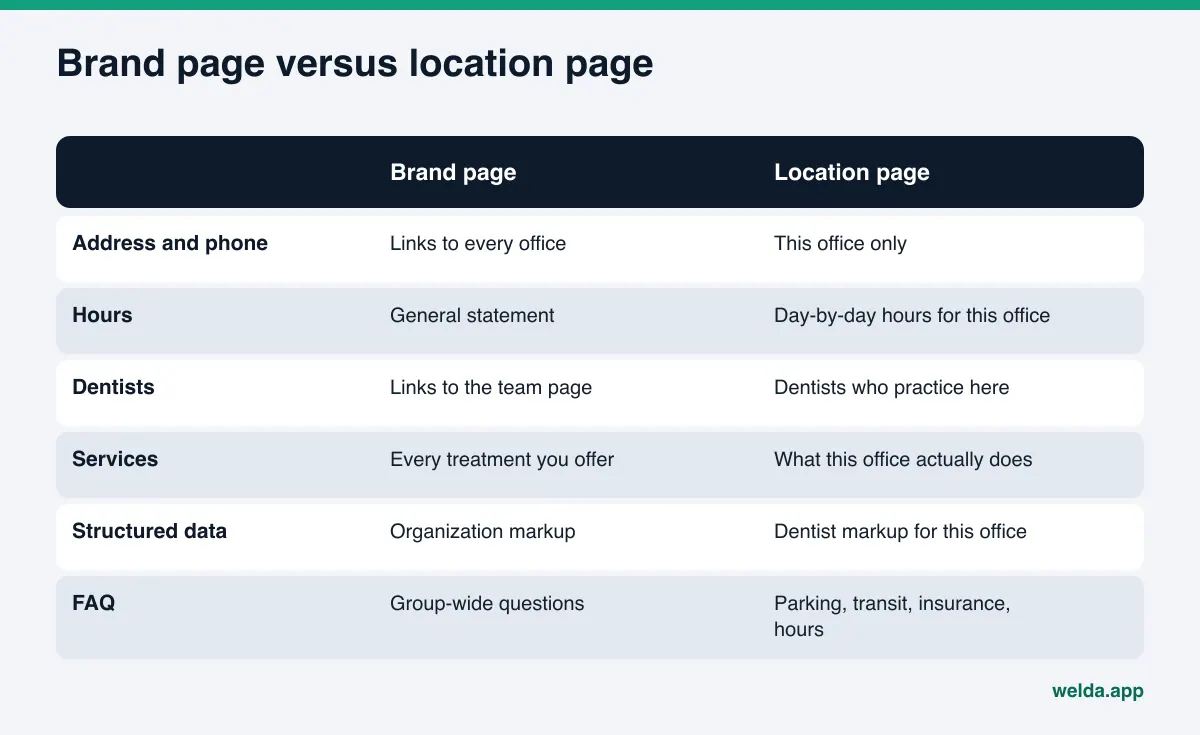
The most common mistake in dental groups is cloning one location page and changing only the city. To an AI system those pages are indistinguishable, and none of them gives a reason to recommend that specific office. A strong location page includes the full address with a nearby reference point, day-by-day hours, the names and credentials of the dentists who practice there, the treatments offered there and the ones referred to another office, parking and transit details, insurance networks, how to book, and a short FAQ for that office. If only one office offers sedation or has a dedicated pediatric area, say so on that office's page. For pediatric questions in particular, AEO for pediatric dentists has detailed examples.
How to spread structured data across locations
Google's local business structured data documentation recommends defining each business location as its own LocalBusiness item and using the most specific subtype available. Schema.org has a Dentist type for exactly this. In practice, the downtown location page carries a Dentist item with the downtown address, phone, hours and coordinates; the north side page carries its own. Each item can reference the group's organization, so an AI system reads both the office and the brand it belongs to. Cramming every office into a single item on one page removes the very distinction you are trying to create.
How to manage Google Business Profiles across a group
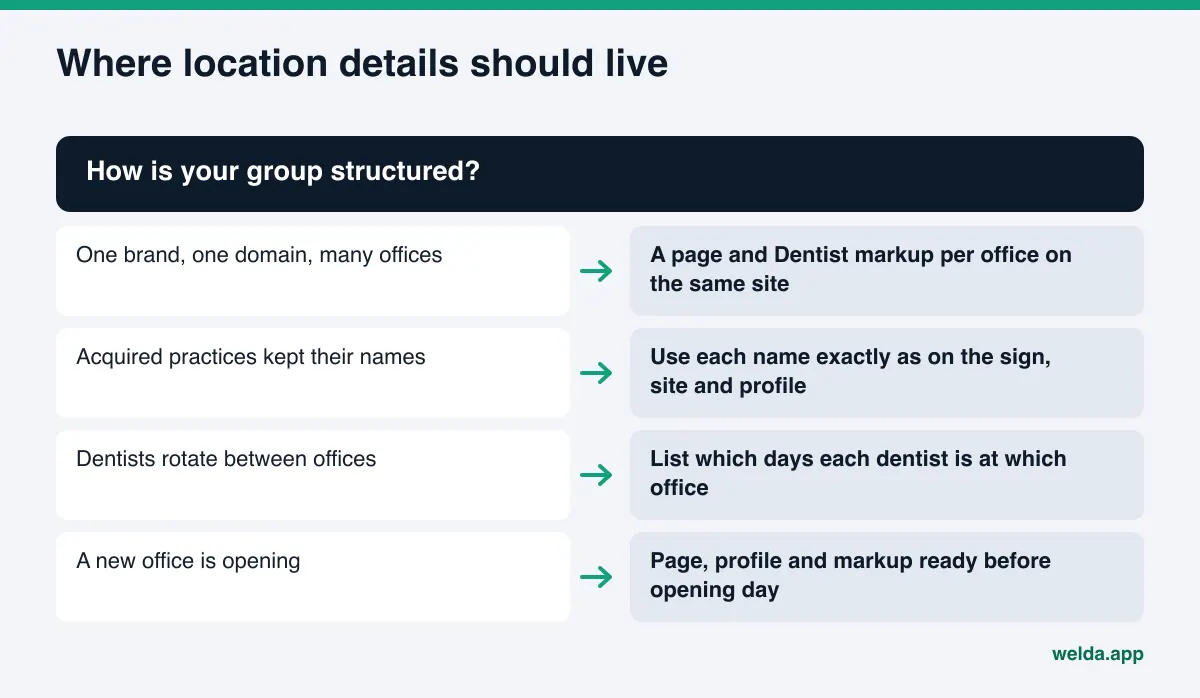
Google's Business Profile guidelines set clear rules for chains: all locations in the same country should use the same name, locations that provide the same service should share a category, and you should not create more than one profile per physical location. Adding descriptors such as "near the mall" or "open late" to the business name is against the guidelines; address and hours belong in their own fields. The guidelines also cover practitioners: dentists who are directly reachable by patients can have their own profiles, and where several practitioners share a location, the organization also gets a profile for that location. Following these rules keeps offices from blurring together in Maps and in AI answers that draw on Maps data. Groups built through acquisitions should pay special attention here: if acquired practices kept their original names, those names need to be used consistently on the sign, the site and the profile.
How reviews connect to each office
Reviews accumulate on each office's profile and on sites like Yelp and Healthgrades. If one office has hundreds of reviews and another has a handful, AI answers reflect that imbalance. Newer offices need a steady, honest way to ask patients for reviews. The FTC's final rule on fake reviews and testimonials prohibits fake reviews and incentives tied to a positive or negative review, so reviews are never bought, written for patients or traded for a discount. When responding, do not confirm that the reviewer is a patient or mention treatment details; patient privacy rules apply to review responses too. This is not legal advice; check with your compliance counsel and your state dental board's advertising rules.
How Welda handles AEO for a dental group
Welda is software that measures where a business shows up in AI answers and fills the gaps on the business's behalf. For a dental group, three parts of that work matter most: seeing how the site presents its locations today, collecting the missing location details without guessing, and preparing every piece of copy for approval before it goes live.
The free analysis: how your site presents its offices
The free analysis reads your homepage and a few inner pages (services, about, contact, pricing) the way Google and AI systems do. For a group, it quickly shows whether your locations sit in a single list on the contact page, whether addresses and phone numbers are readable as text, whether structured data exists and which office it actually describes, whether your Business Profiles and social profiles are linked from the site, whether there is an FAQ, and whether AI crawlers are allowed in through robots.txt. For each gap it explains what it found, why it matters and how to fix it, and a simulation shows how much each fix would move the score. The analysis also puts five questions a patient might ask to an AI assistant that can search the web and checks whether your name appears in the answers. That is a one-time measurement.
Know its limits. The analysis is free once per site and reads the homepage plus a few inner pages, so it does not audit forty location pages one by one. Its value for a group is showing how location information is structured across the site and which gaps repeat everywhere. The fix package it produces, including business markup, is a starting point you can adapt to each location page. The free analysis runs in English and German.
The Welda panel: what it measures and how it handles missing facts
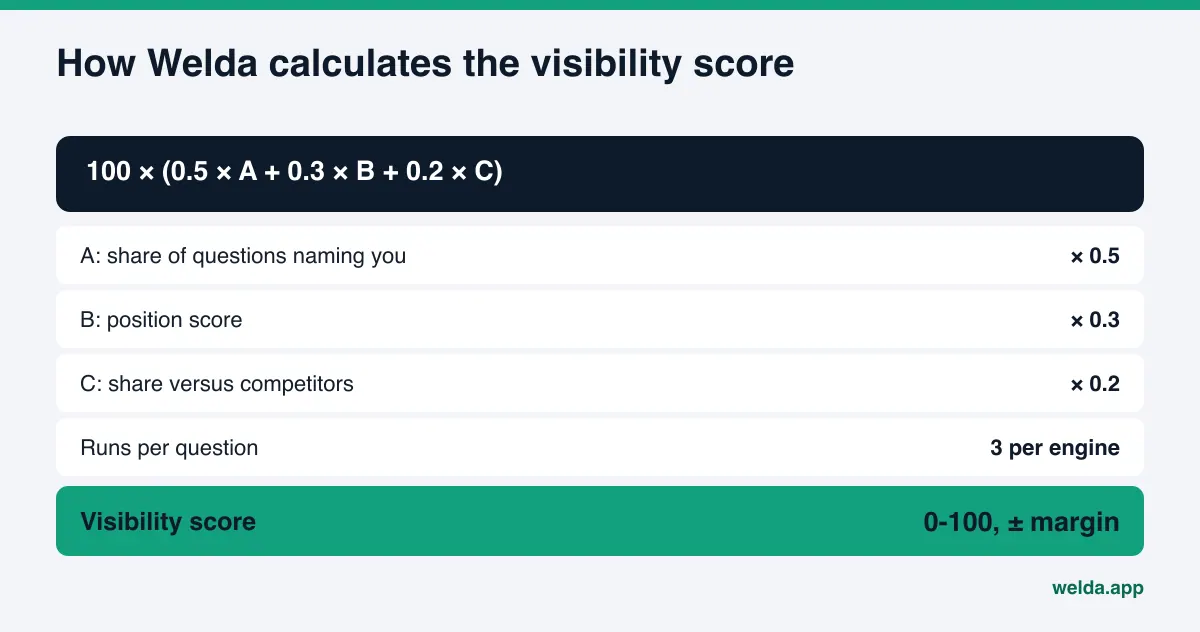
The Welda panel asks the questions patients are likely to ask to ChatGPT, Gemini, Perplexity and Google AI, three times each, and shows which questions name you, in what position, and where competitors are ahead. For a group, that means questions built around your offices' neighborhoods, so you see not only whether the brand is mentioned but which office is missing from which local question. The score formula is public (see the figure below), and the spread between the three runs produces a margin of error.
When Welda cannot read a fact from your site, such as one office's Saturday hours or whether sedation is offered there, it leaves the field blank and asks you rather than guessing. In a group, that list of open questions effectively shows the empty cells in your location inventory. Every piece of content Welda drafts, from location page copy to FAQ answers and profile descriptions, waits in an approval queue. In healthcare there is no automatic publishing; everything comes to you for sign-off, and a compliance check flags pricing, guarantee, superiority and diagnosis-style claims before publication. That check is not legal advice and has not been reviewed by counsel. Patient data is never sent to AI.
On WordPress sites, Welda connects through a separate Editor user and application password that you create, with no code to install; pages open as drafts on your own site and go live once you approve them. On other platforms, Welda provides a ready-made package and your team applies it. Content always lives on your own website.
An honest note on availability. The full panel is in early access and is opening first in Turkey. Regular four-engine measurement is being added during early access, and sample panel screens use representative data. What anyone can use today, in English, is the free analysis. Pricing is discussed in the early access conversation.
Limits: what Welda does not do for dental groups
In a multi-location group, setting expectations correctly matters as much as the work itself. Welda does not do the following:
- No ranking guarantees. Welda does not promise that any office will appear in ChatGPT or any other AI answer. New content usually takes weeks to show up in AI answers.
- No invented facts. If it cannot find an office's hours, dentists or services, it asks you.
- No unapproved publishing. In healthcare, every piece of content comes to you first, and you decide when each office's page goes live.
- No fake reviews. It can help you draft responses to reviews; it does not write reviews.
- Some work stays with your team. Handling negative reviews, directory accounts such as Yelp or Zocdoc, and PR stay with you. If a Business Profile is not connected, profile work is listed as a manual task.
- No legal sign-off. The compliance check flags risky patterns; it does not certify that copy meets HIPAA, FTC or state board rules.
These limits are not gaps in the product; they are what responsible AI visibility in healthcare requires. One office appearing in AI answers with wrong hours or a non-compliant claim affects trust in the whole group.
Decision guide: where should your group start?
Rather than starting every task in every office at once, most groups do better working in this order.
| Situation | Do first | Do next |
|---|---|---|
| No location pages, just an address list | Location inventory and one page per office | Dentist markup and local FAQs |
| Location pages exist but are clones | Add each office's dentists, services and hours | Office-specific questions and transit details |
| Site and Business Profile hours disagree | Fix both from the single inventory sheet | A rule to update both together |
| Flagship is strong, other offices weak | Close page and profile gaps at weak offices | An honest review request process there |
| Recently acquired practices | Decide on naming and apply it everywhere | Merge or redirect old practice pages carefully |
| A new office is opening | Page, profile and markup ready before opening | Verify hours and dentists in the first weeks |
One more question to settle: who keeps location information up to date? In groups, a change in hours, a new associate or a dropped service is known at the office but often never reaches the person managing the website. Tying the location inventory to a single owner is the simplest way to keep what AI systems read accurate.
Example scenario: a three-office group's first month
The following is an example, not a real practice. Picture a dental group with three offices: the flagship has been at the same address for years, the second opened two years ago, and the third a few months ago. The website has one contact page with three addresses stacked together. The free analysis shows that the structured data on the contact page describes only the flagship, there is no FAQ, and the Business Profiles are not linked from the site. Of the five patient questions put to the AI assistant, the group is named once, for a question about the flagship's neighborhood.
In the first month the group builds its inventory and discovers that the newest office's Saturday hours are wrong on its Business Profile. It creates three location pages, each with that office's dentists, services, insurance networks and parking details, adds a Dentist item to each page, and points each Business Profile's website link to the matching page. All copy is reviewed for risky claims before it goes live. It will take weeks for any of this to show up in AI answers, and the outcome cannot be known in advance, but AI systems now have a clear, consistent source for every office.
Frequently asked questions
Should each office have its own website?
Usually not. One domain with a complete page for each office keeps the brand's authority together and is easier to manage. If acquired offices kept their own names, consistent use of each name across sign, site and profile matters more than separate domains.
Is a templated location page enough?
A shared structure works; shared copy does not. Headings and sections can match, but each page needs that office's real dentists, services, hours and directions. Pages that differ only by city name tell an AI system nothing new.
What if a dentist works at several offices?
State on the dentist's bio which days they are at which office, and list them on each relevant location page. When the information matches in both directions, AI systems can connect the dentist to the right office.
Does the free analysis audit every location?
No. It runs once per site and reads the homepage plus a few inner pages. It shows how location information is structured and which gaps repeat; ongoing per-question measurement is the job of the Welda panel, which is in early access.
Will Welda publish location pages on its own?
No. In healthcare there is no automatic publishing. Welda drafts, the compliance check flags risky patterns, and approval stays with your team.
How long until results show up?
New content usually takes weeks to appear in AI answers, and timing varies by engine. Welda does not guarantee outcomes; it measures what changes and shows you.
See how your group looks to AI today
AI search optimization for dental groups is not a campaign. It is the discipline of keeping location information clear, consistent and current. The first step is seeing how your site describes your offices to AI systems right now. Run the free AI visibility analysis to get your score, a list of gaps with fixes, suggested homepage copy and a fix package you can add to your site. The results link arrives by email and stays open for 14 days.