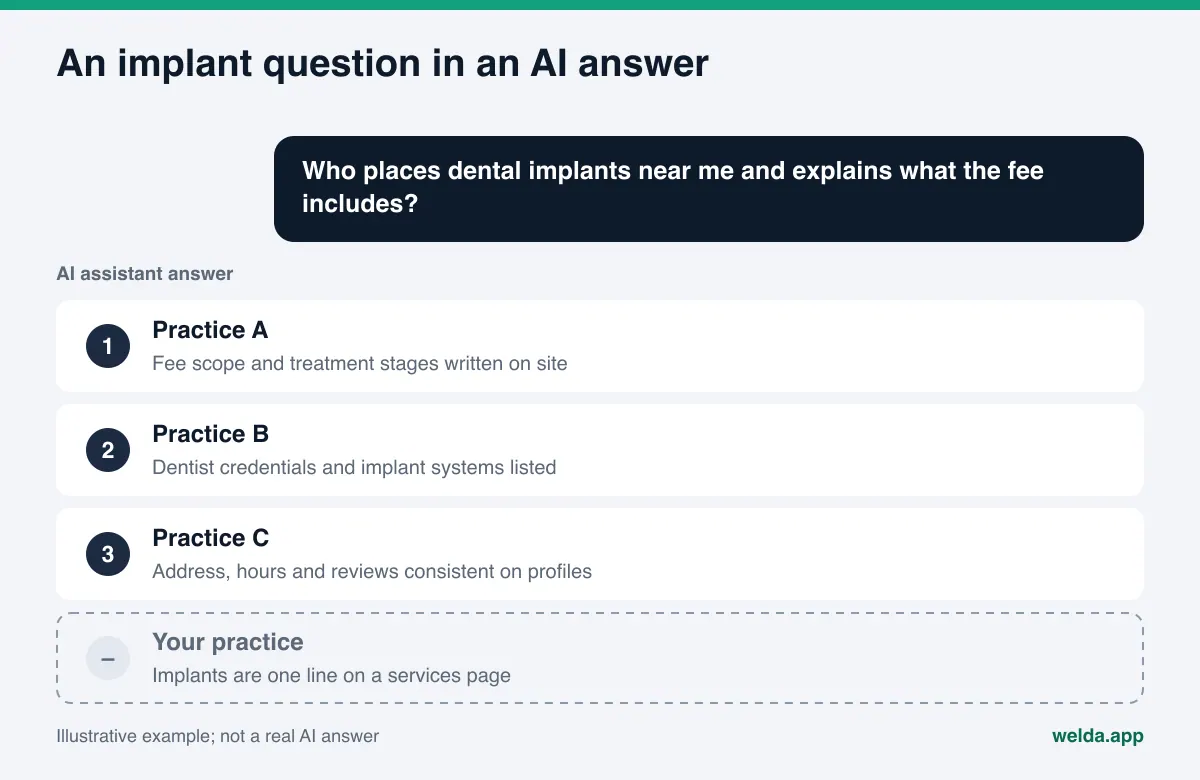
What does AI search optimization for dental implant clinics actually involve? Patients weighing implants now ask ChatGPT, Gemini, Perplexity and Google's AI Mode questions like "what does an implant quote usually include" or "who places implants near me and explains the full cost." AI search optimization for dental implant clinics is the work of making sure your practice is named in those answers with accurate information: a site AI can read, treatment details written out plainly, and claims that stay within advertising rules.
Why AI search optimization for dental implant clinics is its own discipline
In the US the most common name for this work is AEO, answer engine optimization. You will also see "AI search visibility" or simply "AI visibility." Some vendors call it GEO (generative engine optimization); it is the same idea under a different label. Whatever you call it, the question is simple: when a prospective patient asks an AI assistant about implants, does your practice come up, and is what the assistant says about you correct?
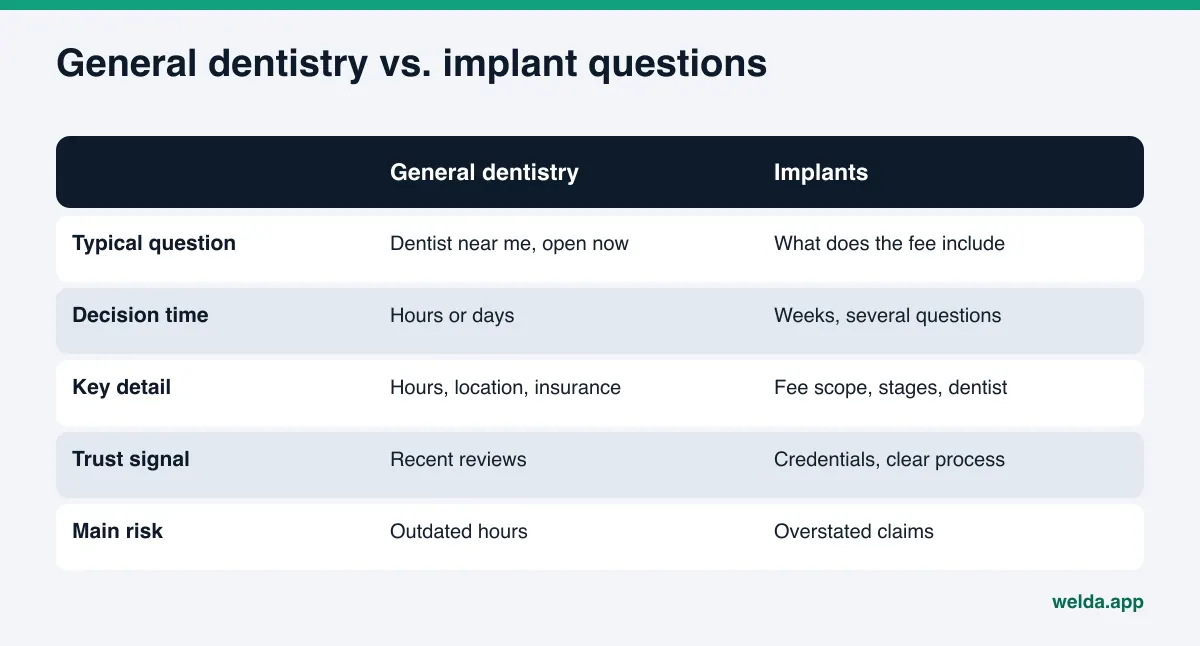
For a general dental office, AEO mostly means answering "dentist near me" and "emergency dentist open now." Implant practices face a different pattern, for three reasons.
First, implants are a considered purchase. A patient rarely asks one question. They start with what an implant is, move to what a quote covers, compare implant systems, ask about financing and timelines, and only then ask which practice to visit. An answer engine looks for a source at every step. If your site does not cover those steps, the assistant builds its answer from other sites and leaves you out.
Second, cost and trust questions dominate. Many patients have seen a low headline price for a full-arch procedure, received two very different treatment plans, and do not know which one to believe. When they ask an AI assistant to help them decide, the assistant leans on sources that spell out what a fee includes, describe the treatment in stages, and show who the dentist is.
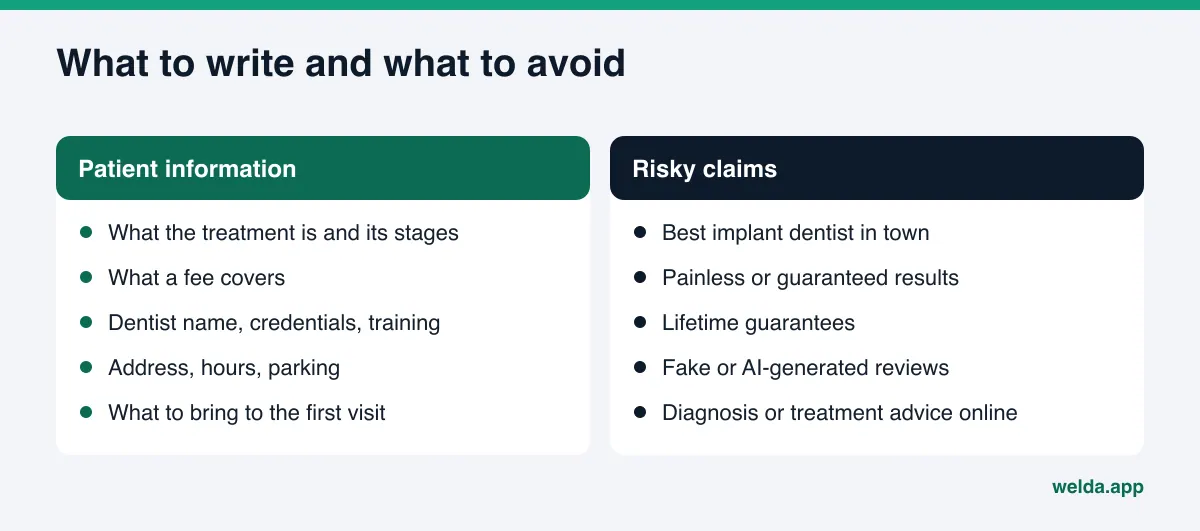
Third, health care advertising is regulated. State dental boards set their own rules on advertising and on how specialties may be described, and federal consumer protection law applies to reviews and testimonials. Lines such as "the best implant dentist in town," "painless treatment, results you can count on" or "lifetime guarantee" create risk, and they are not the kind of factual statement an AI assistant can reuse anyway. Good AEO for an implant practice means clearer, more measured information, not louder copy. This article is general information, not legal advice.
To see where your site stands today, run it through Welda's free site analysis. It reads your homepage and a few inner pages, such as services, pricing, about and contact, the way search engines and AI systems do, and lists what is missing.
What implant patients ask AI assistants
Implant questions fall into a handful of recurring types. Each type needs a specific piece of information before an answer engine can confidently name your practice.
| Patient question type | What the answer needs | Where it belongs on your site |
|---|---|---|
| What does an implant fee include? | Scope: exam, imaging, implant, abutment, crown, follow-up visits | Implant page and a cost or financing section |
| Which implant systems do you use? | Systems offered and how the choice is made | Implant page, FAQ |
| How long does treatment take? | Stages and typical ranges, with a note that timelines vary | Treatment process section |
| Who places implants near me? | Street address, neighborhood, parking, hours | Contact page, business schema, Google Business Profile |
| Who is the dentist? | Name, credentials, training, focus areas | Doctor bio page |
| Do you take insurance or offer financing? | Accepted plans and payment options in plain words | Insurance and financing page |
Most of this information already exists inside the practice. Your front desk explains it on the phone every day. The problem is that it is not written on the website. An AI assistant does not call your office; it only uses what it can read. We cover how to structure a cost page for this purpose in pricing pages for AI answers.
The sources matter too. Alongside your site, answer engines draw on your Google Business Profile, review platforms such as Yelp, physician and dentist directories such as Healthgrades, and local news or community forums. If your site says one thing and a directory says another (an old address, outdated hours, a closed location), the assistant has no reason to trust either version. Consistency across these sources is part of the job.
Step by step: AEO for an implant practice
The steps below are an order any implant practice can follow on its own. Each one builds on the previous step; skipping ahead usually wastes effort.
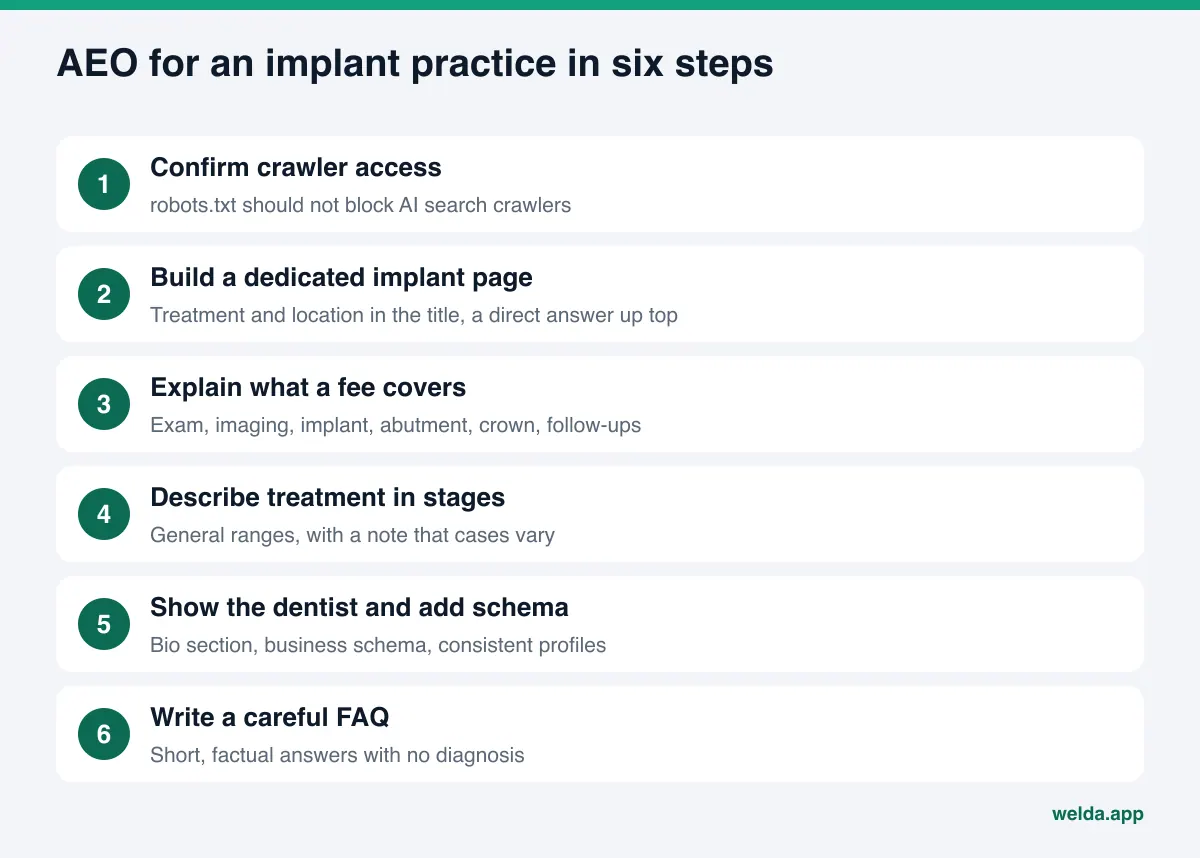
- Confirm AI crawlers can reach your site. If robots.txt blocks search crawlers, nothing else matters. OpenAI states in its crawler documentation that ChatGPT's search features use a bot called OAI-SearchBot, and that sites blocking it will not be shown in ChatGPT search answers. Web agencies sometimes block bots wholesale for security reasons, so it is worth one check.
- Build a dedicated implant page. A single line on a "Services" page is not enough. The page title and main heading should name the treatment and your city or neighborhood, and the opening paragraph should answer the most common patient question in two or three sentences.
- Explain what a fee covers. Whether to publish dollar figures is your decision and should be checked against your state's rules. Even without numbers, you can state what a treatment fee includes: consultation, CBCT or other imaging, the implant, abutment, crown and follow-up visits. That is the question patients actually ask.
- Describe treatment in stages. Consultation and imaging, planning, surgery, healing, restoration and maintenance visits. Give general ranges and say clearly that timelines depend on the individual case.
- Make the dentist visible. Name, credentials, training and focus areas belong in their own section. AI assistants look here when someone asks who performs the procedure.
- Add business schema. Practice name, address, phone, hours and location should be in structured data on the page, with your Google Business Profile and social profiles linked to it. For the linking part, see how to link social profiles with sameAs.
- Write an FAQ section. Answer five to seven real patient questions briefly and carefully. Avoid diagnosing; "we confirm this after an exam" is an honest answer.
Once these steps are done, it usually takes weeks for new content to show up in AI answers. Record a baseline before you change anything and ask the same questions again at regular intervals.
What belongs on a dental implant page
Your implant page is where you show an answer engine that you are a reliable source on the topic. The checklist below is the minimum. Every item is something the practice already knows; none of it requires a new claim.
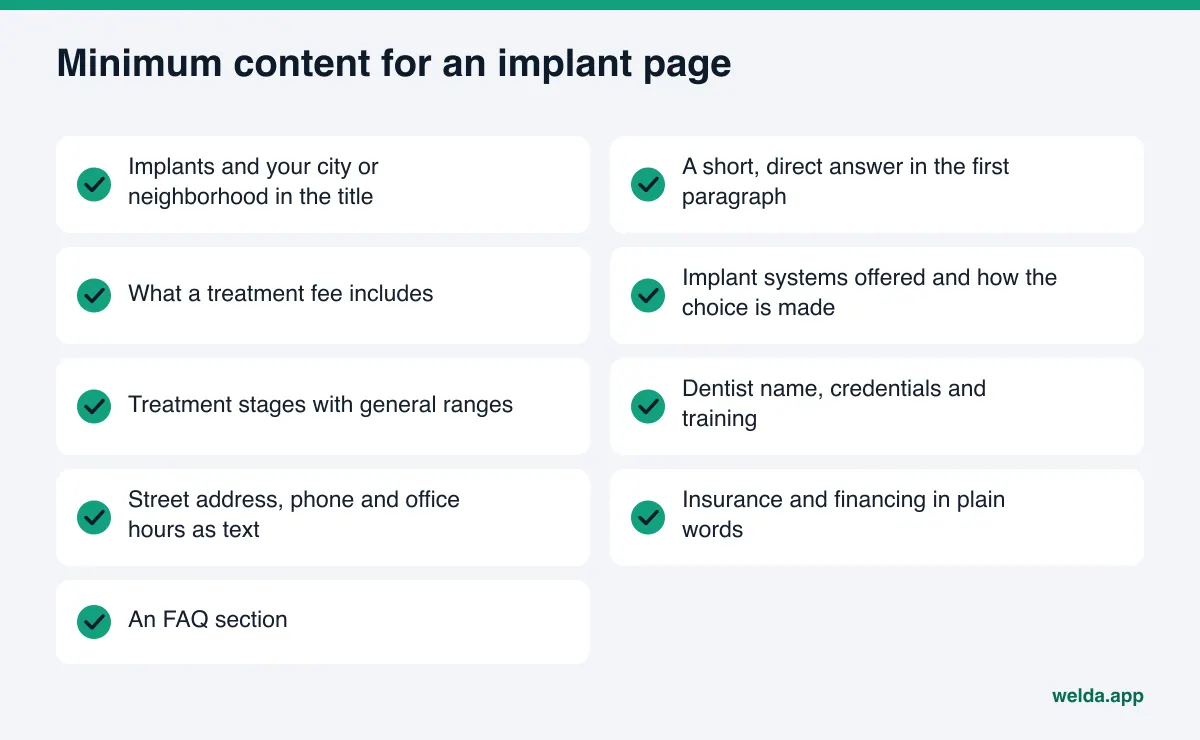
Avoid two common traps. The first is putting everything on one page: a single missing tooth, multiple missing teeth, full-arch restoration, bone grafting and sinus procedures all in one paragraph. Neither patients nor AI systems can tell which information applies to which case. Separate subheadings or separate pages read better. The second trap is promotional language. "Limited time," "don't miss out" or "everyone qualifies" can cause trouble with advertising rules, and it turns an information page into an ad in the eyes of an answer engine.
Practices with strong cosmetic demand face a similar challenge, covered in how cosmetic dentists get recommended by ChatGPT. Multi-location practices need separate information for each office, which we discuss in AI search optimization for dental groups.
How advertising and review rules shape implant AEO
The question implant practices ask most often is whether AI visibility is even possible under strict advertising rules. It is, because answer engines are looking for information, not advertising. The area the rules restrict and the area AI assistants need overlap far less than people expect.
Reviews are the clearest example. The Federal Trade Commission's rule on consumer reviews and testimonials, published in the Federal Register in August 2024, prohibits creating or buying fake reviews, including AI-generated reviews and reviews from people with no real experience of the business, and prohibits undisclosed reviews written by the business's own officers or managers. For an implant practice this settles a common temptation: the path to a stronger review profile is asking real patients, not manufacturing feedback.
Patient photos, before-and-after images and testimonials raise additional questions around patient authorization and your state board's rules. Check those with your counsel before using them. Claims of superiority, outcome promises and guarantees fall in the same risk zone.
On the other side sits plain information: what the treatment is, its stages, who performs it, where the office is, when it is open, which insurance plans you accept and what a patient should bring to the first visit. That is exactly what an answer engine needs to build a reliable answer. For final boundaries, consult your state dental board's guidance and your own attorney.
Example scenario: a single missing tooth question
To make this concrete, consider a fictional example. An example implant practice operates in a suburban area with two dentists. Its site has a homepage, a "Services" page and a contact page. Implants appear on the services page as one sentence. The address sits only inside an embedded map, office hours are missing from the site, and the Google Business Profile still lists last year's hours.
A patient asks an AI assistant: "I'm missing one tooth. Is there a practice near me that places implants and is upfront about what the fee covers?" The assistant scans local practices for three facts: the practice is nearby, it places implants, and it says something about what the fee includes. The example practice gives half of the first two and none of the third. The answer names Practice A and Practice B, which both have dedicated implant pages with a "what's included" section.
The fix is not large. Write the address and hours as text and add them to business schema; correct the hours on the Google Business Profile; create a dedicated implant page that covers single-tooth, multiple-tooth and full-arch cases under separate headings; write out the fee scope and treatment stages; show the dentists' names and training. None of this requires a new claim. It is information the practice already has.
Understanding why competitors lead also matters. If Practice A's own website is cited as the source, the work is on your site. If Practice B is named through a directory profile, the work is in that directory. Those are different jobs, and knowing which one applies keeps you from writing content in the wrong place. This scenario is illustrative only; it does not describe a real practice or a real measurement.
How Welda handles AI visibility for implant practices
Welda is software that measures where a business appears in AI answers and fills the gaps on the business's behalf. For an implant practice, three parts matter most: a clear picture of your site today, question-by-question tracking of implant queries, and a rule that health content never goes live without your approval.
The free site analysis gives you a starting picture. It works in English and German and is available to anyone today. It reads your homepage and several inner pages and checks whether AI crawlers can get in, your page title and description, your main heading, business schema, whether your address and phone number are written out, whether your profiles are linked, your FAQ section, review and trust signals, how clearly your treatments are described, and page speed. You get a score out of 100, a list of each issue with why it matters and how to fix it, ready-to-use copy suggestions for your homepage, a simulation of which fixes move the score most, a competitor comparison and a fix package you can add to your site. The analysis also asks five patient-style questions to an AI assistant that can search the web and checks whether your practice is named. That is a one-time snapshot, free once per site.
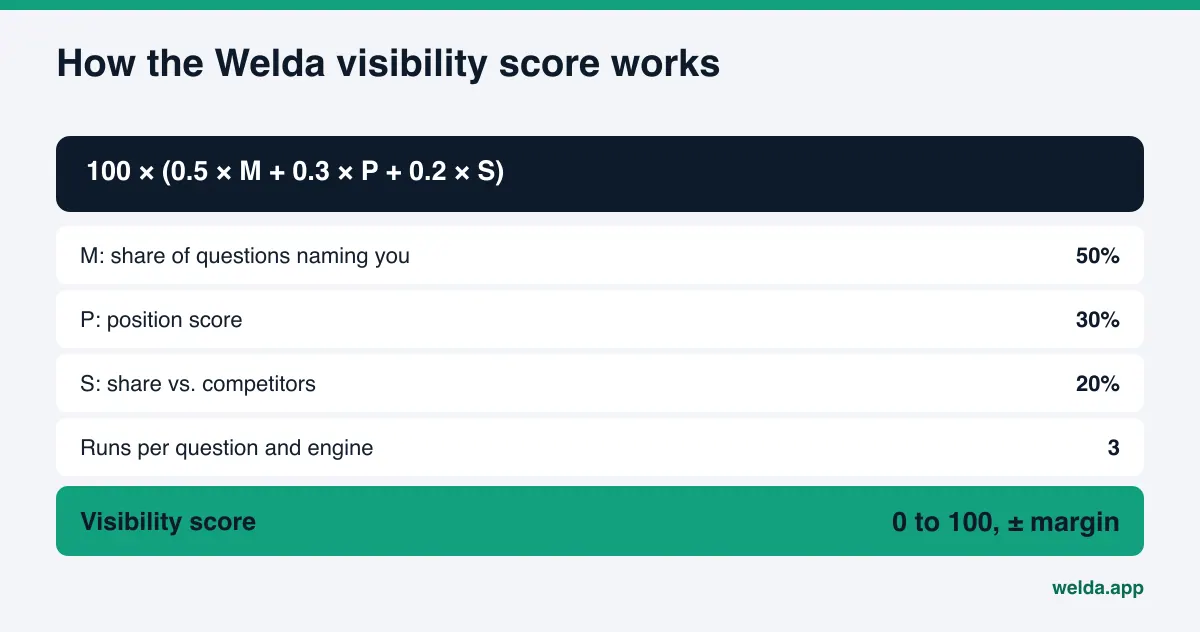
The Welda panel tracks implant questions one by one. The panel is in early access and opening in stages, starting with businesses in Turkey. In the panel, your chosen questions are asked to ChatGPT, Gemini, Perplexity and Google AI three times each. For a question such as "implant dentist near me who explains the full fee," you see which engines mention you, in what position, and which source a competitor wins from. The score formula is open: 50 percent the share of questions where you are named, 30 percent position, 20 percent share against competitors, with a margin of error derived from the spread across the three runs. Regular four-engine tracking is being added during early access, and sample screens use representative data.
In health care, every piece of content waits for approval. When Welda finds a gap, it drafts implant page copy, FAQ answers, profile text and review replies. There is no automatic publishing for health care businesses; every draft goes to your approval queue. Before anything is published, the compliance check flags patterns such as prices, guarantees, superiority claims and diagnostic suggestions. It is a helper, not legal advice, and it has not been reviewed by a legal advisor. Patient data is never sent to AI.
Welda does not invent facts. If your implant systems, office hours or sedation options are not on your site, those fields stay empty and you are asked to fill them in once. Content always lives on your own site: on WordPress, Welda connects through a separate Editor user and an application password without installing code, opens the page as a draft and publishes it only after you approve. On other platforms Welda hands you a ready-made package to apply yourself.
Limits: what Welda does not do
With a high-value treatment like implants, setting the right expectations matters. Here is what Welda does not do:
- It does not guarantee rankings or placement in ChatGPT or any other assistant. Nobody controls how answer engines decide; you can measure and fix the information.
- It does not write facts it does not know. Your implant systems, your dentists' training and your fee scope are things you are asked for.
- It does not publish health content without your approval.
- It does not create fake reviews or write reviews on behalf of patients.
- Handling negative reviews, managing directory accounts such as Healthgrades or Yelp, and press work stay with your practice. Welda can draft a review reply, but you send it.
- It is not legal advice. The compliance check flags risky patterns; your state rules and your counsel have the final word.
Timing matters too. New implant content usually takes weeks to show up in AI answers, so a flat score in the first weeks is normal. How often to re-check is covered in how often to measure AI visibility.
Checklist: is your implant practice ready?
Use this table as a quick self-assessment. Every "no" is a task.
| Check | How to tell |
|---|---|
| AI crawlers can access the site | robots.txt does not block search crawlers |
| A dedicated implant page exists | The page title names implants and your location |
| Fee scope is written out | A patient can find "what's included" on the page |
| Treatment stages are explained | Stages and general ranges in their own section |
| The dentist is visible | Name, credentials and training in a bio section |
| Business schema is present | Address, phone and hours match in code and on the page |
| Profiles are consistent | Google Business Profile and directories show the same details |
| No risky claims | Guarantees, "best" and "painless" have been removed |
Frequently asked questions
How is AEO for an implant practice different from traditional SEO?
The foundation is shared: a readable site and clearly written information. The difference is the measure. AEO does not ask "what position am I in" but "does the AI answer name my practice, and with accurate details."
Do I have to publish implant prices?
No. Publishing dollar figures is your decision and should be checked against your state's rules. Explaining what a fee covers answers the most common patient question and helps answer engines either way.
Can AI-generated reviews help my profile?
No. The FTC rule on reviews and testimonials prohibits fake reviews, including AI-generated ones. Asking real patients for honest feedback is the only sound route.
Will Welda publish my implant page automatically?
No. There is no automatic publishing for health care businesses. Welda drafts the content, the compliance check flags risky patterns, and approval stays with you.
How long until I see results?
New content usually takes weeks to appear in AI answers. Nobody can promise a timeline or outcome; regular measurement is how you see change.
Can I use the Welda panel in the US today?
The panel is in early access and opening first in Turkey. The free site analysis works in English today, and pricing is discussed in an early access conversation.
First step: see your site the way AI does
AI search optimization for dental implant clinics is not a big campaign. It is steady, careful information work: crawlers can reach your site, a dedicated implant page exists, fee scope is spelled out, and your dentist and location details are consistent everywhere. To see which of these is missing, start the free site analysis. Your results arrive by email and stay open for 14 days, with a list of issues, copy suggestions and a fix package that shows you what to do first.