How do cosmetic dentists get recommended by ChatGPT? ChatGPT, Gemini, and Perplexity recommend a cosmetic dentist based on what they can read and cross-check: which treatments the practice offers, who performs them, where the office is, and whether the website, Google Business Profile, and review sites tell the same story. Practices that explain veneers, whitening, and bonding in plain, accurate language are easier to cite. Nobody can guarantee a mention, but a practice with thin treatment pages is rarely picked.
How cosmetic dentists get recommended by ChatGPT: what the answer engines read
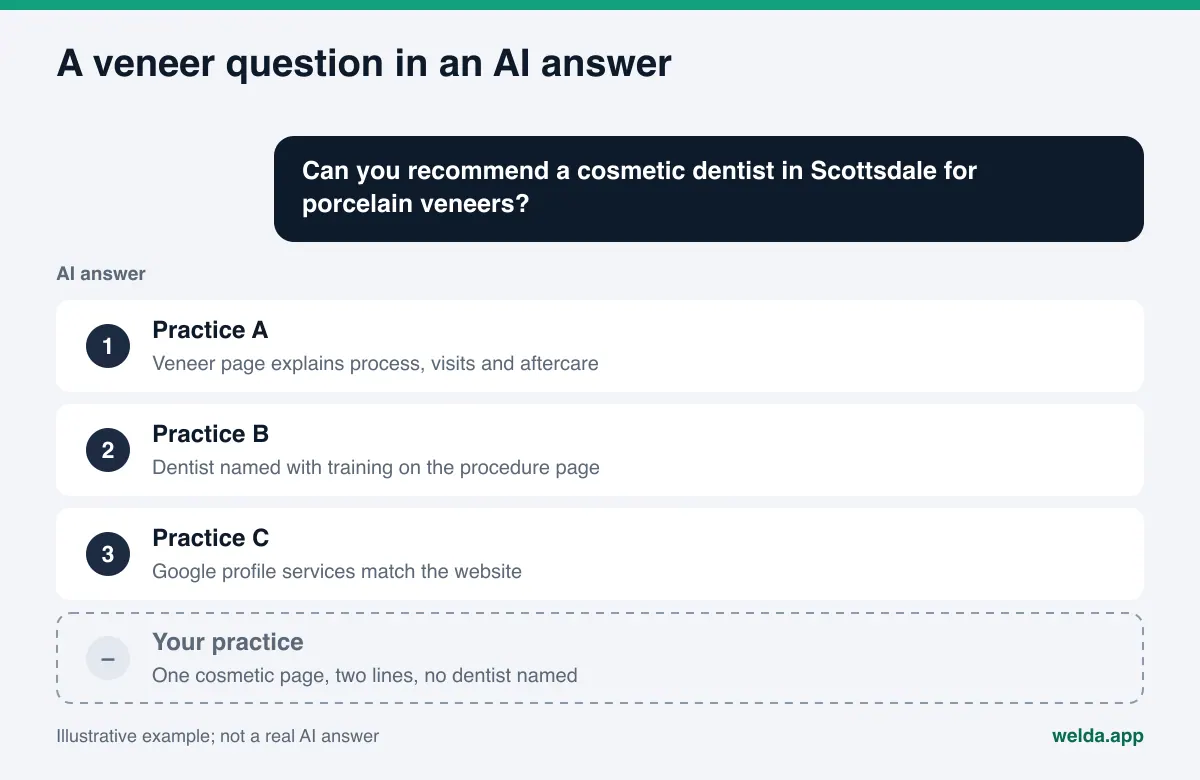
When a patient asks ChatGPT "who does good porcelain veneers near me" or "is Invisalign or bonding better for a small gap," the model usually runs a web search, reads a handful of pages, and writes an answer that names a few practices. The work of making your practice one of those names is called AEO, short for answer engine optimization. You will also see it called AI search visibility, AI visibility, or GEO (generative engine optimization); in the US, AEO is the term most people search for.
The sources an answer engine reads for a cosmetic dentistry question are fairly predictable: practice websites, Google Business Profile listings, Yelp, Healthgrades, local news or "best of" roundups, and forum threads where patients compare their experience. The engine then favors practices whose information is specific and consistent across those sources.
The signals that matter most:
- Access. Crawlers have to be allowed in. According to OpenAI's crawler documentation, sites that block OAI-SearchBot will not be shown in ChatGPT search answers; GPTBot, which is used for model training, is controlled separately.
- Treatment detail. A page for each procedure that explains what it is, who it suits, how many visits it takes, and what aftercare looks like.
- Dentist detail. The name, degree, and accurate credentials of the dentist who performs the work.
- Location and contact. Address, neighborhood, phone, and hours, written the same way on the site and every profile.
- Third-party agreement. What Google reviews, Yelp, and Healthgrades say about the practice and the services it lists.
To see where your own site stands on these signals, run it through Welda's free site analysis. It reads your home page and key inner pages (services, about, contact) the way Google and AI assistants do, then lists each gap with a fix.
Why cosmetic dentistry needs its own AEO approach
Emergency dentistry is a proximity search: a patient in pain wants the closest open office. Cosmetic dentistry is a research purchase. A patient considering veneers may spend weeks reading, comparing practices, and asking follow-up questions. More of that research now happens inside a single AI conversation. The patient asks "what are the downsides of veneers," then "how long does composite bonding last," then "which dentists in Austin do minimal-prep veneers." The first two questions decide which sources the engine trusts. The third decides who gets named.
That chain matters. If your site answers the first two questions well, it can become a cited source, and the engine is more likely to treat you as a candidate when the patient asks for a recommendation. If your site only has a "Cosmetic Dentistry" page with a stock photo and a "Book Now" button, the engine has nothing to quote.
Cosmetic dentistry also carries a credentials question. Phrases like "cosmetic dentistry specialist" are common on practice websites. The National Commission on Recognition of Dental Specialties and Certifying Boards lists 12 recognized dental specialties, and cosmetic or esthetic dentistry is not one of them. State dental boards set their own rules on how specialty and credential claims may be advertised. If your site uses a title the engine then repeats, you have spread an inaccurate claim further. Describing accurate credentials is both the safer and the more citable choice.
What patients ask AI about cosmetic dental work
Cosmetic dentistry questions tend to fall into a few groups. The examples below are illustrative, written to show the pattern, not taken from a measured dataset:
| Question type | Example | What the engine looks for |
|---|---|---|
| Comparison | "Veneers or bonding for chipped front teeth?" | Neutral pages that explain both options |
| Risk and longevity | "Does whitening damage enamel?" | Clear explanations, aftercare, who should avoid it |
| Process | "How many visits for a smile makeover?" | Step-by-step process pages |
| Cost drivers | "Why do veneer prices vary so much?" | Pages that explain what drives cost |
| Local recommendation | "Cosmetic dentist in Scottsdale for veneers?" | Location, services, dentist, consistent profiles |
| Trust | "How do I check a cosmetic dentist's credentials?" | Named dentists with verifiable training |
Notice that only one row asks for a name directly. The others are informational, but they shape which practices the engine considers credible when the recommendation question comes.
Step by step: how cosmetic dentists get recommended by ChatGPT
These are steps a practice can take with its own team or web vendor. Order matters: make sure AI crawlers can reach the site, then improve what they read.
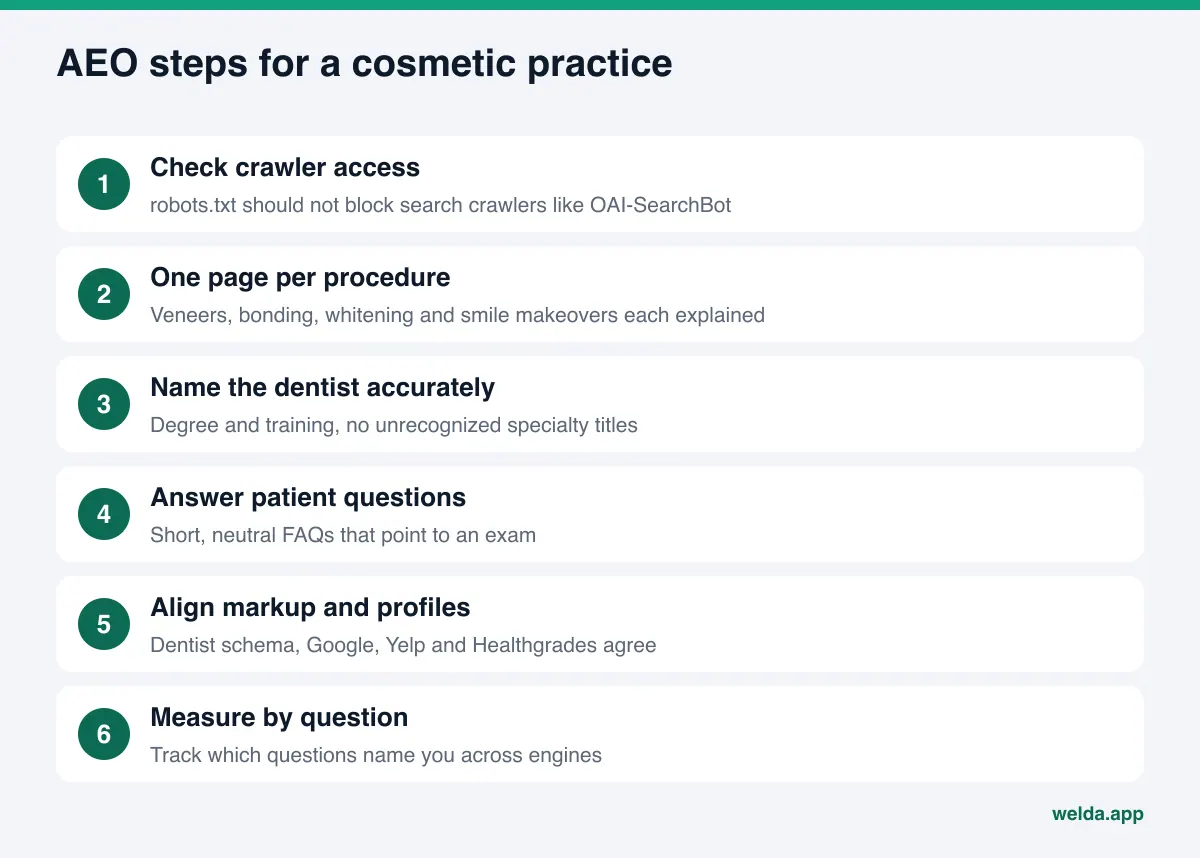
- Check crawler access. Open your robots.txt file and confirm that OAI-SearchBot, Googlebot, and other search crawlers are not blocked. Some security plugins and site builders block unfamiliar bots by default.
- Give each procedure its own page. Porcelain veneers, composite bonding, professional whitening, gum contouring, and smile makeovers each deserve a page. Explain what the procedure is, who typically considers it, who may not be a candidate, the usual sequence of visits, and aftercare.
- Name the dentist. On each treatment page, state who performs the work, with degree and accurate credentials. List continuing education as education, not as a specialty title.
- Answer the real questions. Add a short FAQ to each page: "Do veneers require removing enamel?", "How long does whitening last?", "Can bonding be repaired?" Answer neutrally and point to an exam for individual decisions.
- Add structured data. Mark up the practice with the schema.org Dentist type: name, address, phone, hours, and the services you offer. Our guide to schema markup for AI search walks through the fields.
- Align your profiles. Make sure Google Business Profile categories and services, Yelp, and Healthgrades match the procedures on your site and list the same dentists.
- Respond to reviews carefully. Reply to reviews without confirming that the reviewer is a patient or mentioning any treatment details; HIPAA privacy rules still apply when you reply in public. Never buy or write reviews. The FTC's final rule on fake reviews and testimonials prohibits fake reviews and certain review practices.
- Measure by question. Track a fixed set of patient questions across engines and note where you are named and where a competitor is named instead.
How to write a cosmetic procedure page that AI can cite
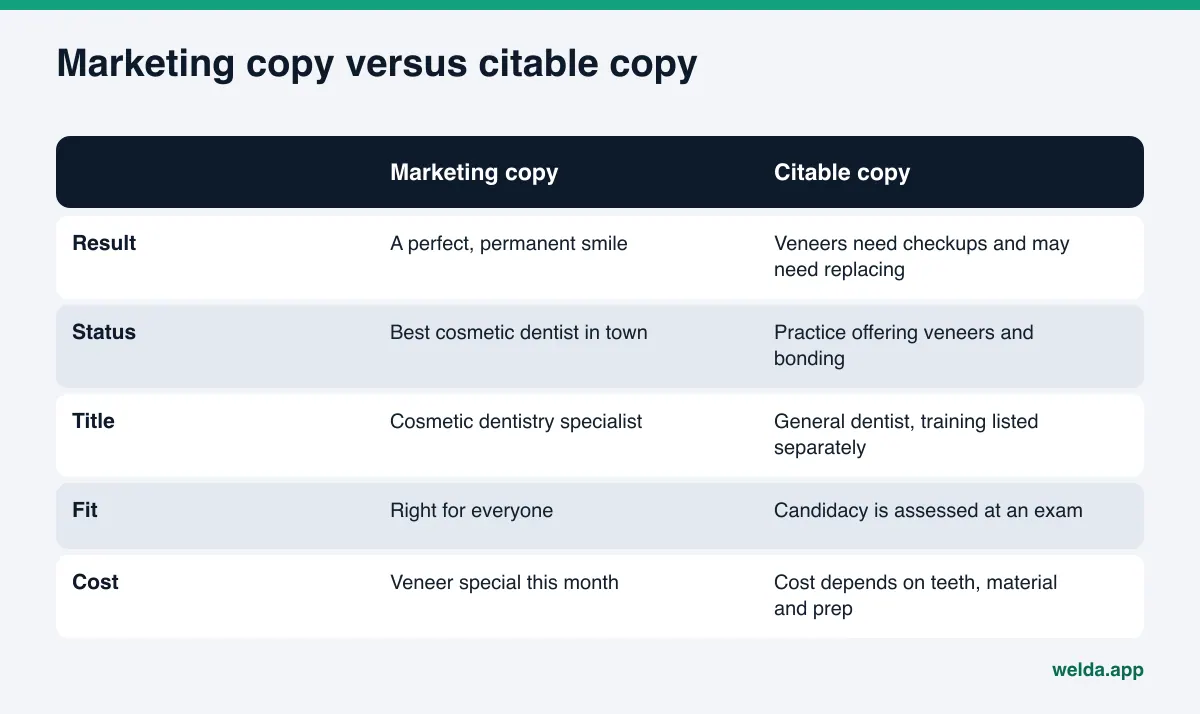
A good procedure page reads like a calm consultation, not an ad. Answer engines prefer pages that resolve a question completely, because they can quote a sentence or two and move on. The comparison below shows the difference between marketing copy and citable copy.
A practical page structure, using porcelain veneers as the example:
| Section | What to write | Watch out for |
|---|---|---|
| Short definition | What veneers are, in two or three sentences | Define the clinical term once |
| Who considers it | Color, shape, spacing, chips | Avoid "right for everyone" |
| Who may not be a candidate | Situations assessed at the exam | Do not diagnose on the page |
| Process | Consult, records, trial smile, placement, follow-up | Give visit counts as typical ranges |
| Aftercare | Hygiene, night guard, checkups | No promises of permanence |
| Your dentist | Name, degree, training | No unrecognized specialty titles |
| Cost factors | Number of teeth, material, prep work | Explain drivers, not promotions |
| FAQ | Three to five short answers | Keep answers general |
Before and after photos are common in cosmetic dentistry. Answer engines mostly work with text, so the description around a photo matters more than the photo itself. If you use them, make sure they follow your state board's rules and that the surrounding text does not promise a result.
Many cosmetic practices also place implants or offer clear aligner therapy, and each has its own question set. See AI search optimization for dental implant clinics and AI visibility software for orthodontists for those.
Profiles and third-party sources: where cosmetic practices lose consistency
Once the website is in order, the next question is how the practice looks elsewhere. Before recommending a practice, an answer engine often checks what the site says against one or two outside sources. If your site explains veneers and bonding but your Google Business Profile lists only "Dentist" with an empty services section, the two sources do not support each other.
The places worth checking for a cosmetic practice:
- Google Business Profile: primary and secondary categories, the services list, and the description. List cosmetic procedures under the same names your site uses, and keep promotions and superlatives out of the description.
- Google and Yelp reviews: the procedures patients mention in reviews influence which questions an engine connects you with. You cannot script reviews, but you can reply calmly and without patient details.
- Healthgrades and similar directories: the dentist's name, credentials, and practice address should match the site exactly. Old addresses and former associates are common leftovers.
- Local roundups and forums: know what is being said about the practice in local "best of" lists and community threads, even if you cannot change it.
Inconsistency usually comes from small things: a practice name spelled two ways, outdated hours, or a procedure listed on a profile that the site no longer offers. Each is easy to fix one at a time, but left alone, they weaken the engine's confidence that it is describing the same practice.
How Welda does this work
Welda is software that measures where a business appears in AI answers and prepares the missing pieces on the business's behalf. For a cosmetic dental practice, three parts do most of the work: the free site analysis, question-level measurement, and the approval queue for healthcare content.
The free site analysis. Anyone can use it today, in English. It reads your home page and inner pages the way an AI assistant would and checks crawler access, page titles and descriptions, the main heading, business markup, address and phone, links to your profiles, FAQ content, reviews and trust signals, how clearly your services are described, and page speed. You get a score out of 100, split into technical and content, plus what was found for each gap, why it matters, and how to fix it. It also suggests rewritten home page text, simulates how much each fix would raise the score, compares you with competitors, and gives you a ready-to-install fix pack that includes business markup. Separately, it asks five patient-style questions to an AI assistant that can search the web and checks whether your practice is named. That is a one-time check, not ongoing tracking. The analysis is free once per site; your email and phone are verified, and the results link stays open for 14 days. It does not measure rankings or promise any.
Question-level measurement. In the Welda panel, the questions patients ask ("veneers or bonding," "cosmetic dentist near downtown," "how long does whitening last") are each asked three times in ChatGPT, Gemini, Perplexity, and Google AI. For each question you see whether the practice is named, in what position, and which competitor is named instead and from which source. A typical pattern for a cosmetic practice: informational questions cite other websites, and local recommendation questions name competitors with stronger procedure pages. That tells you which page to write first.
Approval queue for healthcare. Welda never auto-publishes healthcare content. Every procedure page, profile description, and review reply it drafts lands in an approval queue for the practice to read, edit, or approve. Before publishing, a compliance check flags patterns such as pricing, guarantees, superiority claims, and anything that reads like a diagnosis, so a line like "a perfect, permanent smile" gets flagged with a reason. This check is not legal advice and has not been reviewed by legal counsel. When Welda does not know a fact, such as how many visits your veneer process takes, it asks you instead of guessing. No patient data is sent to AI.
Content always lives on the practice's own website. On WordPress, Welda connects through a separate Editor user and an application password, with no code to install; drafts open in WordPress and go live only after approval. On other platforms, Welda provides a ready package and your team applies it.
Early access. The Welda panel is in early access and opening in stages, starting with businesses in Turkey. Regular four-engine measurement is being added during early access, and sample screens in the panel use representative data. The free site analysis works in English and German today. Pricing is discussed in the early access conversation.
Limits: what Welda does not do
Cosmetic dentistry is sensitive for patients and for regulators, so it helps to be clear about what Welda does not do.
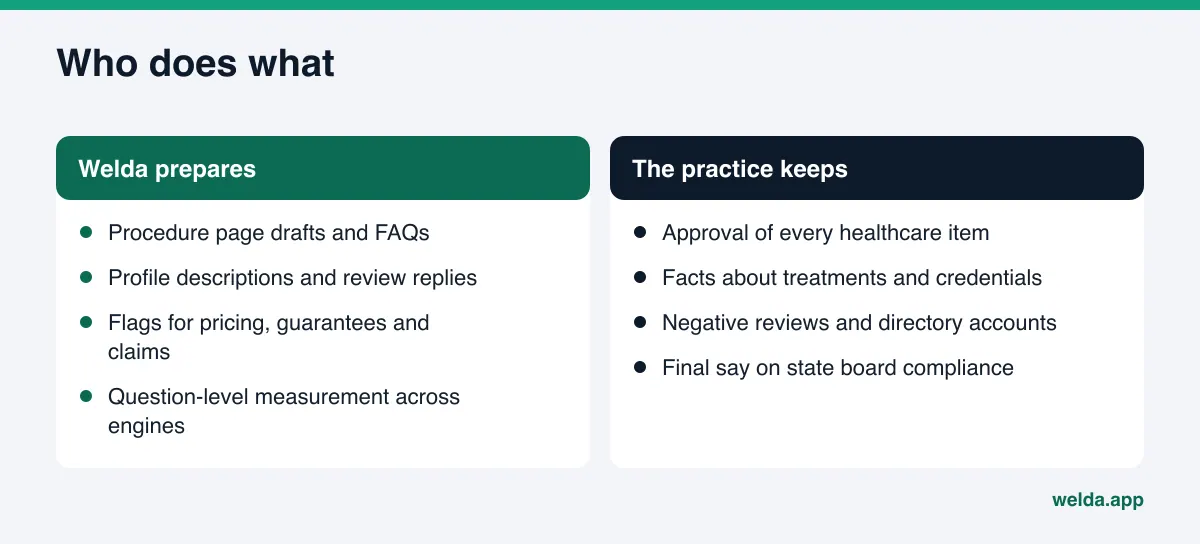
- No guarantees. Welda does not guarantee that your practice will appear in ChatGPT or any other engine, or in any position. No one can.
- No invented facts. Treatment details, materials, and credentials come from the practice.
- No publishing without approval. Every healthcare item goes through the queue.
- No fake reviews. Welda does not write or solicit reviews on anyone's behalf. Handling negative reviews stays with the practice.
- No legal opinions. The compliance check flags risky patterns; your state board rules and your attorney have the final word.
- No directory or PR work. Directory accounts, listings management, and press outreach stay with the practice.
Timing is the other limit. New content usually takes weeks to show up in AI answers. Plan a baseline measurement before you change anything and a second one later; before and after AEO measurement explains how.
Decision guide and checklist for cosmetic practices
Every practice starts from a different place. The decision guide below covers the most common starting points.
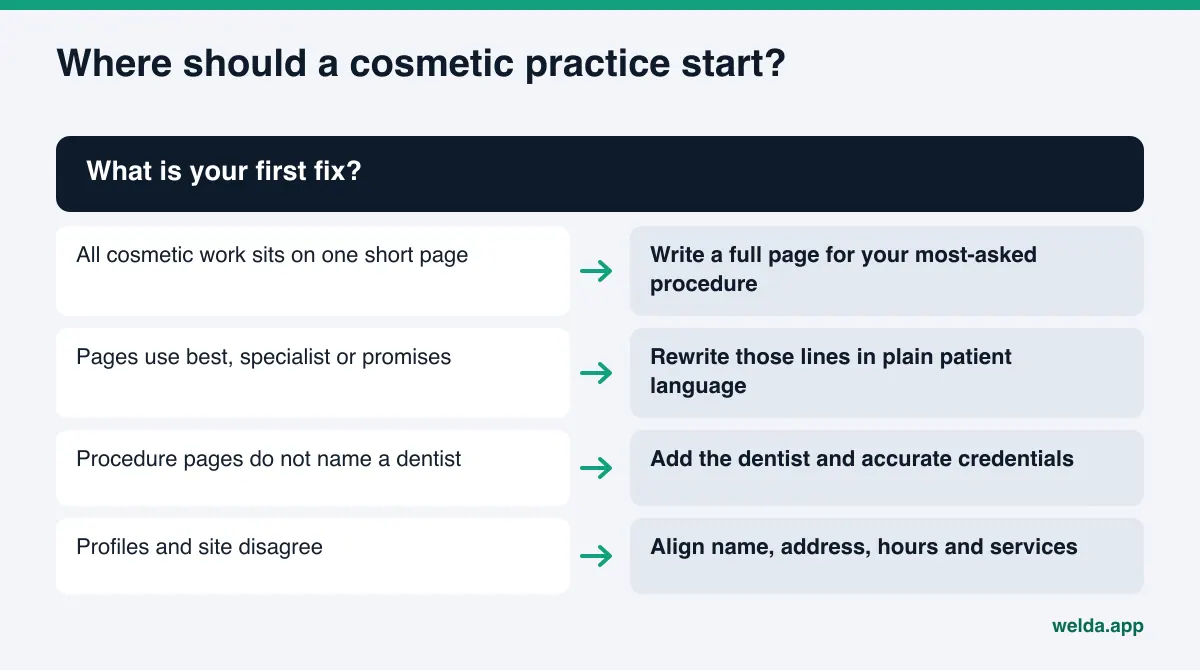
Once you know where to start, use this checklist for every procedure page. After the first page is complete, the rest follow the same template.
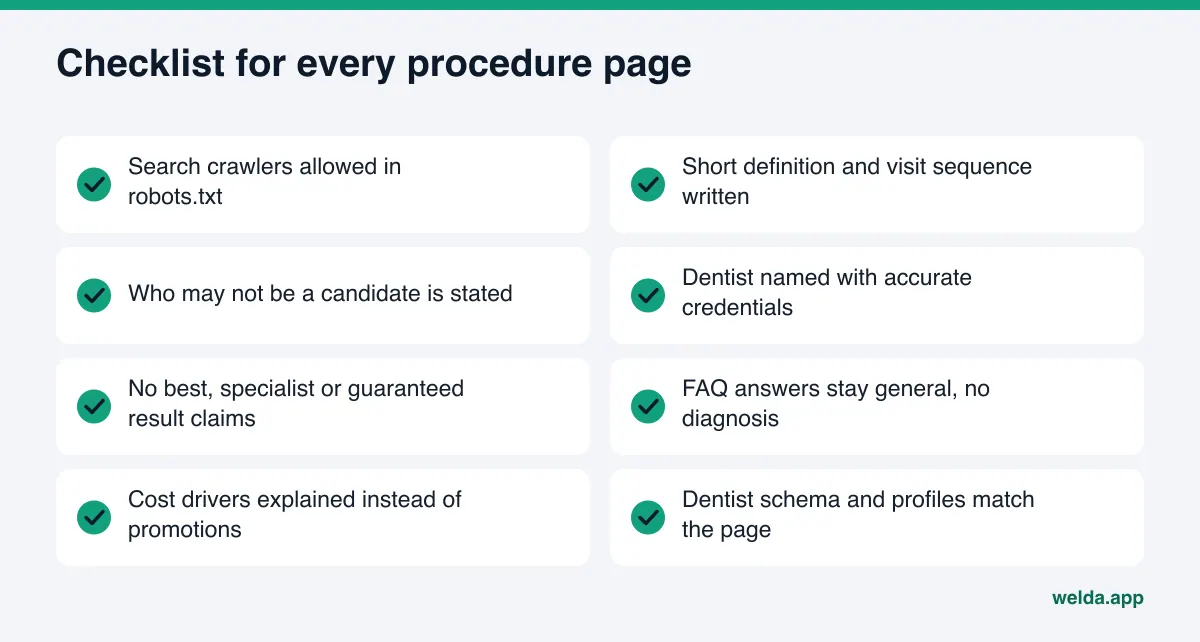
A few more questions to ask your team:
- Does any page still say "best," "specialist," or promise a result?
- Does every procedure page name the dentist who performs it?
- Do Google Business Profile services match the procedures on the site?
- Do Yelp and Healthgrades list the same dentists and address?
- When did we last check which patient questions name us?
Frequently asked questions
Does ChatGPT favor practices that advertise?
AI answers are not an ad placement. The engine builds its answer from the pages and third-party sources it can read. Clear, consistent information on your site and profiles matters more than ad spend.
Can I call myself a cosmetic dentistry specialist?
Cosmetic dentistry is not among the 12 specialties recognized by the National Commission, and state boards regulate specialty claims. Describe your degree and training accurately and check your state board's advertising rules. This is not legal advice.
Should I list veneer prices on my site?
That is a business decision within your state's rules. For AI visibility, a page that explains what drives cost (number of teeth, material, preparatory work) answers the patient's question even without a number.
Do before and after photos help AEO?
Answer engines mainly read text, so the explanation around a photo carries more weight than the photo. If you use them, follow your board's rules and avoid implying a guaranteed result.
Will Welda publish procedure pages automatically?
No. For healthcare, every item goes to the approval queue. On WordPress, approved items are published from drafts; elsewhere, your team applies the package.
How long until changes show up in AI answers?
Usually weeks. Measure before you change anything and again a few weeks later, using the same questions, so the comparison is fair.
Is the Welda panel available for US practices?
The panel is in early access and opening first in Turkey. The free site analysis works in English today for any practice website.
Start with your own website
For a cosmetic dental practice, AEO starts with replacing marketing language with patient information: one clear page per procedure, accurate credentials, consistent profiles, and careful review replies. To see where your site stands, run it through Welda's free site analysis. It is free once per site, and you get a score out of 100, each gap with its fix, suggested home page copy, and a fix pack you can install.